
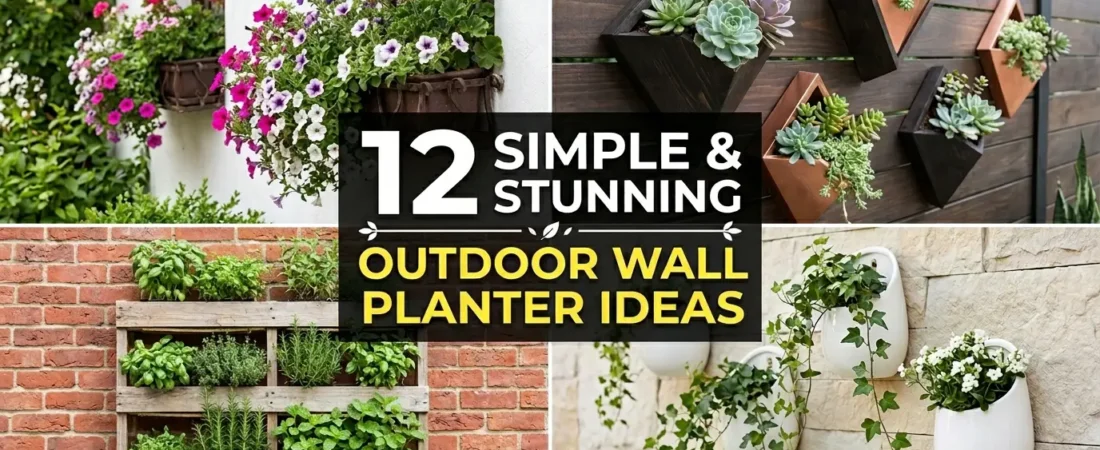
Outdoor wall planter ideas address the one dimension of outdoor space that floor-based gardening ignores entirely: vertical surface area. Every fence panel, every rendered wall, and every brick surface in an outdoor space is potential garden — growing space that adds no pressure on limited floor area and creates visual interest at the exact height where people look rather than downward at the ground.
These 12 ideas cover the full range of outdoor wall planter approaches from a single rustic pot hung on a bracket to a complete modular growing system with integrated irrigation. Each addresses a different wall type, a different installation requirement, and a different design outcome.
Table of Contents
1. A Vertical Herb Wall Turns a Dead Fence Into a Productive Kitchen Garden
✦ Vertical Herb Wall Setup
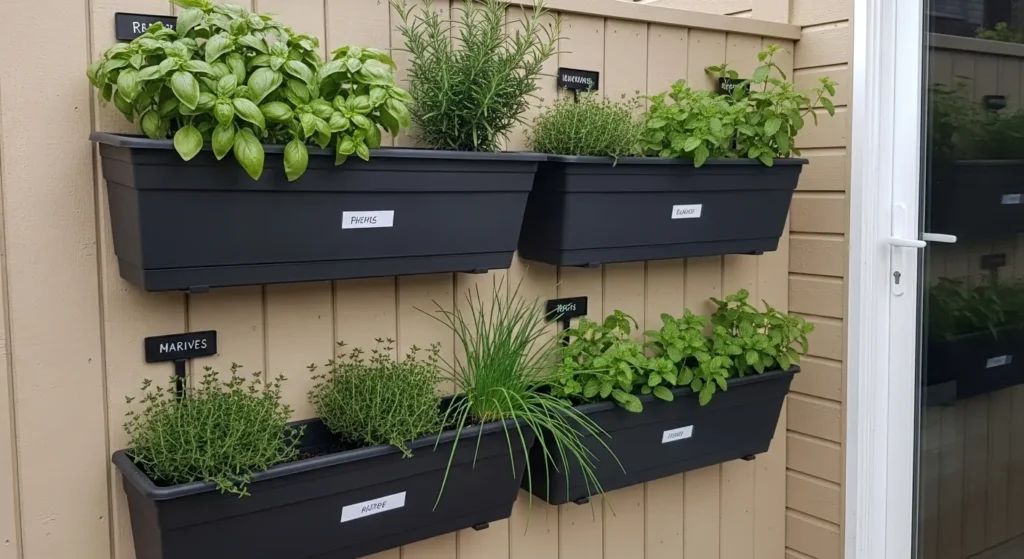
A vertical herb wall mounted on a fence or rendered wall beside the kitchen door is the most functionally justified wall planter investment available. It produces something used rather than simply admired — fresh herbs for cooking accessed within ten seconds of the kitchen without tools, preparation, or significant effort.
The installation approach that maximizes both productivity and longevity: wall-mounted trough planters at three heights rather than individual pot brackets. Troughs hold more compost volume per fixing point than individual pots, support more plants per watering session, and create a cleaner visual line across the fence face. Three troughs at heights of 18 inches, 36 inches, and 54 inches above ground level create a vertical herb garden visible and accessible from standing height with the lowest trough accessible to children.
Assign herb varieties to troughs based on water requirement rather than alphabetical or aesthetic logic. Mediterranean herbs — rosemary, thyme, oregano, sage — share the top trough where drainage is fastest and drying is most rapid between waterings. Moderate-water herbs — parsley, chives, basil — occupy the middle trough. Mint occupies the bottom trough alone in its own container within the trough system — its invasive roots must not contact other herbs.
PRO TIP: Paint fence-mounted herb trough brackets and any visible wall fixings in the same color as the fence before installation. Visible hardware in contrasting colors draws attention to the installation mechanism rather than the planting. Hardware that disappears into the fence surface makes the herb wall appear to float from the fence face.
2. A Wooden Slat Frame Creates a Display Structure That Ages Beautifully
✦ Wooden Slat Planter Display
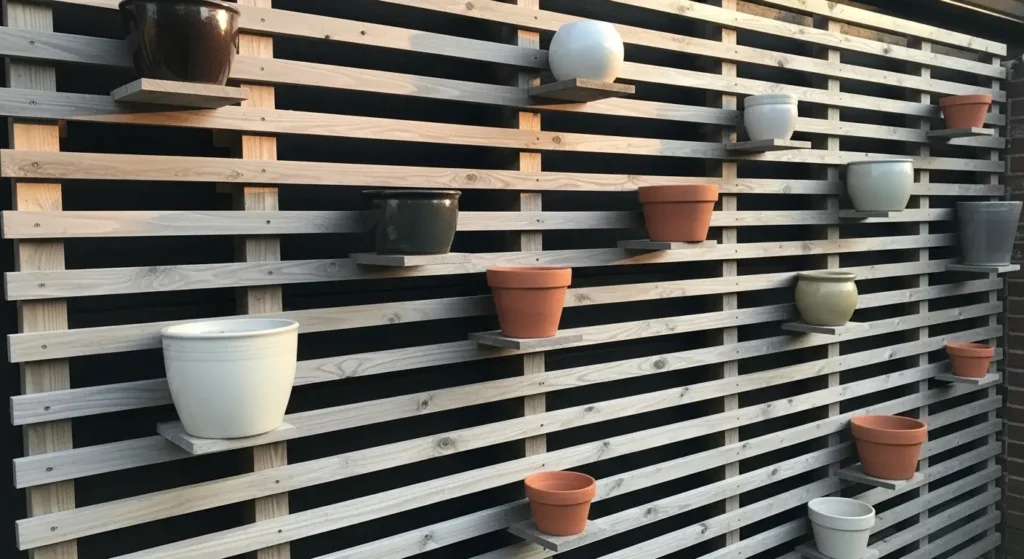
A wooden slat frame provides a display structure rather than individual hanging points — a unified surface onto which pot brackets, hooks, and planting elements are mounted at freely chosen positions. The frame is the permanent installation. Individual planting elements can be repositioned, replaced, and updated without modifying the wall.
The construction of a wall-mounted wooden slat display frame: horizontal timber slats of 2 by 2 or 2 by 3 inch section fixed to the fence or wall at 8-inch vertical intervals using countersunk exterior screws. The slat spacing is the module that determines where brackets can be positioned — any bracket that spans two slats can be mounted at any horizontal position along those slats. This modularity makes the frame infinitely repositionable without drilling new wall holes.
Cedar and hardwood slats weather to a beautiful silver-grey without treatment — the natural weathering adds visual quality over time rather than deteriorating the appearance. If warm timber tone is preferred apply a single coat of teak oil annually to maintain the honey color of fresh timber.
3. Fabric Pocket Planters: Thirty Plants From One Square Meter of Wall
✦ Hanging Pocket Planters
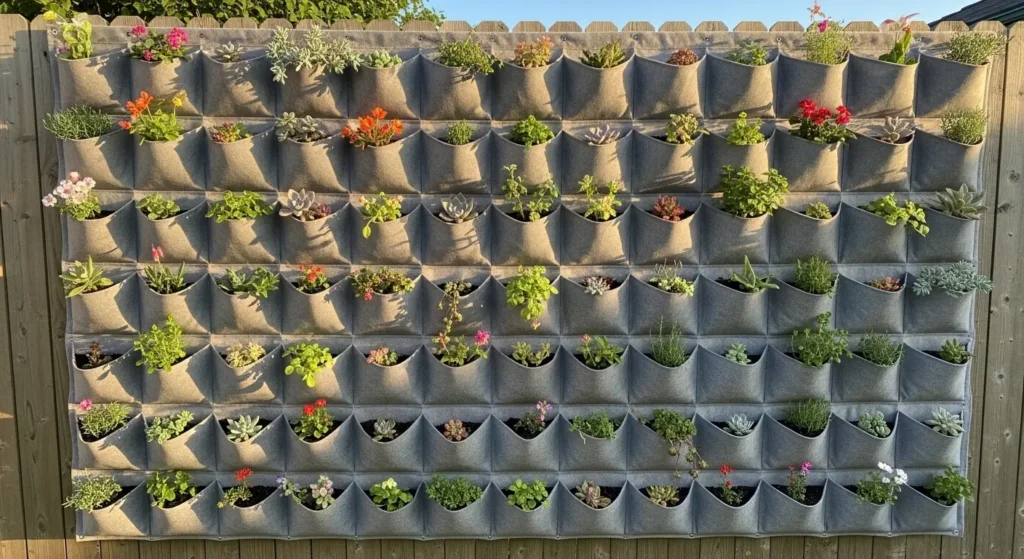
Fabric pocket planters achieve the highest plant density per wall area of any vertical planting system. A standard 39-pocket felt vertical garden panel measuring 24 by 56 inches holds thirty-nine individual plants in one square meter of wall space — more planting than most ground-level borders cover in four times that area.
The plant selection for pocket planters must account for the limited root volume each pocket provides. Each pocket holds approximately 0.3 liters of growing medium — sufficient for compact plants but inadequate for vigorous perennials or anything with extensive root systems. The varieties that perform best in pocket planters: succulents and sedums which tolerate restricted root volume, small herbs like thyme and oregano, alpine plants that naturally grow in shallow rocky conditions, and compact annuals like lobularia and nemesia.
Watering pocket planters is the primary management challenge because each pocket must receive adequate moisture without excess water from upper pockets waterlogging lower ones. Top-filling the upper pockets and allowing water to percolate downward works in theory but creates significant moisture variation between top and bottom pockets. Drip irrigation lines fed to individual pockets — one drip emitter per pocket — solve this completely and transform a high-maintenance system into a nearly self-managing one.
PRO TIP: Install fabric pocket planters on a south or west facing fence where morning sun reaches the pockets before afternoon heat peaks. Full afternoon sun on fabric pocket planters with limited compost volume causes rapid drying that requires twice-daily watering in summer. Morning sun with afternoon shade produces the most manageable moisture conditions.
4. Powder-Coated Metal Wall Planters: Industrial Precision That Suits Modern Outdoor Spaces
✦ Modern Metal Frame Planters
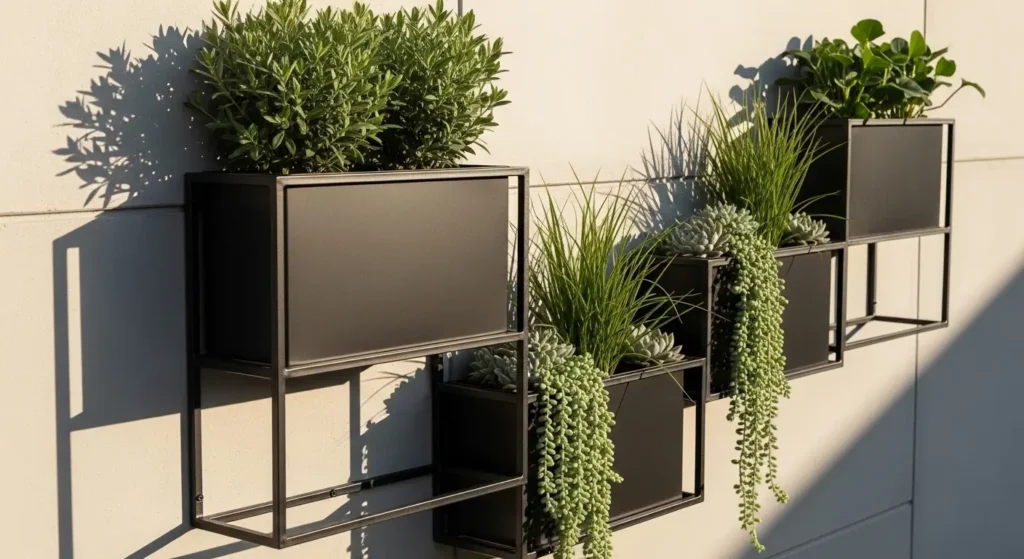
Powder-coated metal wall planters create a design precision that timber, ceramic, and fabric alternatives cannot achieve. The clean geometric forms, the uniform finish quality, and the sharp shadows that metal containers cast against a wall all communicate design intent rather than improvised display.
The powder coating specification matters significantly for outdoor longevity. Standard indoor powder coating degrades in UV within one to two seasons. Outdoor-rated polyester powder coating with UV stabilizers maintains color quality for five to seven years in full sun exposure. When purchasing metal wall planters for outdoor use confirm the coating specification — the visual quality of the product on installation day tells you nothing about its UV stability.
Matte black is the finish that works in the widest range of outdoor contexts because it reads as architectural rather than decorative. Matte black metal planters on a white rendered wall, a grey fence, or a brick surface all create the same high-contrast visual statement. Colored metal planters require more deliberate matching to surrounding surfaces and are less versatile when fence or wall surfaces change.
PRO TIP: Line metal wall planters with coco coir or landscape fabric before filling with compost. Unlined metal containers, particularly those in dark colors, absorb heat in direct sun and raise root-zone temperatures significantly above ambient air temperature. Elevated root temperatures stress most plants and can be lethal to cool-season crops. The liner provides thermal insulation as well as compost retention.
5. The Pallet Wall Garden: How to Build One That Performs Rather Than Just Photographs Well
✦ Repurposed Pallet Garden Wall
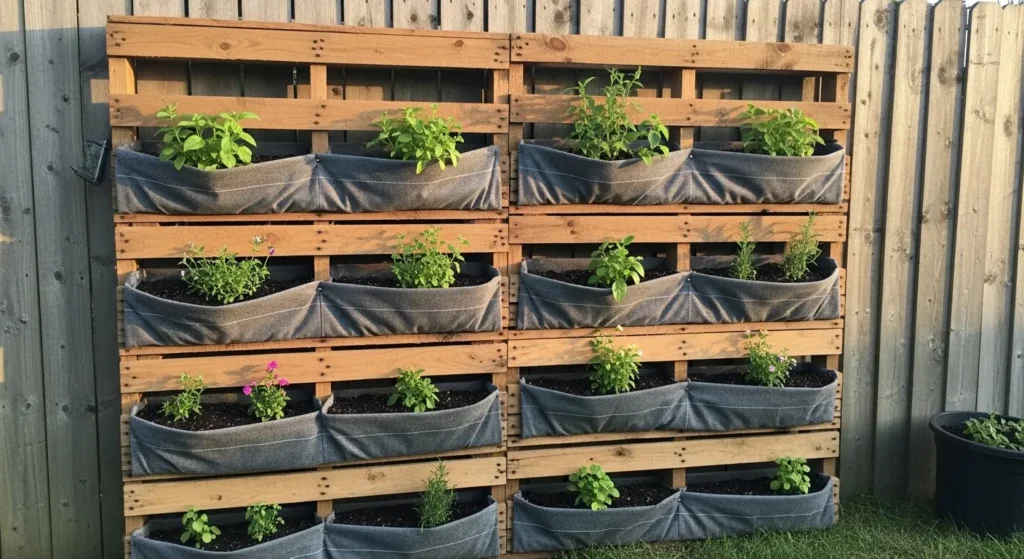
Pallet wall gardens are the most photographed and most abandoned vertical planting project in home gardening. They look spectacular in installation photographs and disappointing three months later because most builds omit the structural details that make them function as growing systems rather than display structures.
The four details that separate a pallet wall garden that performs from one that fails. First: use only HT-marked pallets — heat-treated timber rather than chemically treated. The HT stamp is on the pallet block. MB-marked pallets use methyl bromide treatment that leaches into food crops. Second: line every planting cavity between the slats with landscape fabric stapled to the pallet frame before adding compost. Without lining compost falls through within days. Third: use coconut coir mixed with compost at 1:1 ratio rather than pure compost — coir retains moisture significantly better than compost in the exposed drying conditions of a vertical surface. Fourth: install the pallet at a 5-degree backward tilt from vertical. A perfectly vertical pallet causes water to run off the face rather than soaking in. The slight backward tilt directs water into the planting cavities rather than down the face.
PRO TIP: Plant pallet wall gardens while the pallet is lying flat on the ground rather than after installation. Plants installed in horizontal pockets establish root contact with compost immediately and are held in place by gravity during the critical first two to three weeks. Plants installed into vertical pockets immediately after erection fall out before roots establish. Lay flat, plant, wait two weeks for roots to establish, then erect.
6. A Succulent Wall Frame Is the Outdoor Display That Requires Almost No Water
✦ Succulent Wall Arrangement
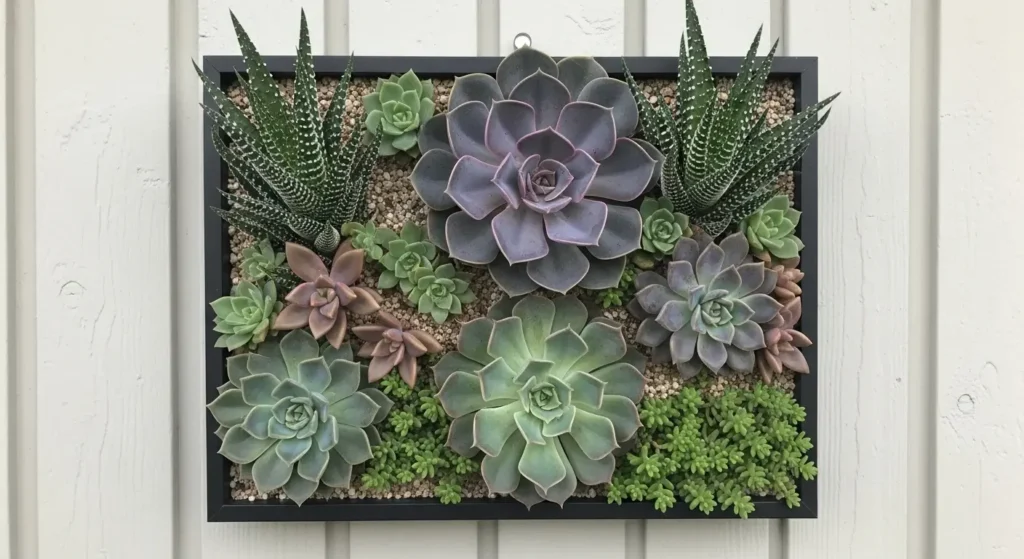
A wall-mounted succulent frame creates the one vertical garden display that genuinely requires minimal maintenance. Succulents store water in their tissue and tolerate the drying between waterings that fabric pocket planters and coir-lined systems demand frequent attention to prevent. A well-planted succulent wall frame in a sheltered position can go two to three weeks between waterings in moderate weather.
The construction of a succulent wall frame uses a shallow shadow box structure — a frame 3 to 4 inches deep — filled with a gritty growing medium of one part compost to two parts horticultural grit. The gritty medium drains immediately after watering rather than retaining moisture and prevents the crown rot that kills succulents in water-retentive composts.
Plant selection for a wall-mounted succulent frame requires varieties with compact rosette forms that do not outgrow their allocated space within one season. Echeveria species and hybrids in varied colors create the palette quality that makes succulent arrangements visually compelling. Sedum varieties provide ground-cover infill between rosettes. Haworthia and Gasteria provide upright accent forms. Avoid Aeonium species in outdoor wall frames — their winter dormancy and summer growth requirements make them difficult to maintain in mixed outdoor succulent plantings.
PRO TIP: Allow a newly planted succulent wall frame to root for four to six weeks in a horizontal position before mounting vertically. Succulent root systems establish slowly and plants placed in a vertical frame immediately after planting fall out as the growing medium dries and contracts. Horizontal establishment means the root systems grip the growing medium before the frame is mounted.
7. A Flowering Vertical Wall Creates the Most Photographed Feature in Any Garden
✦ Flowering Vertical Feature
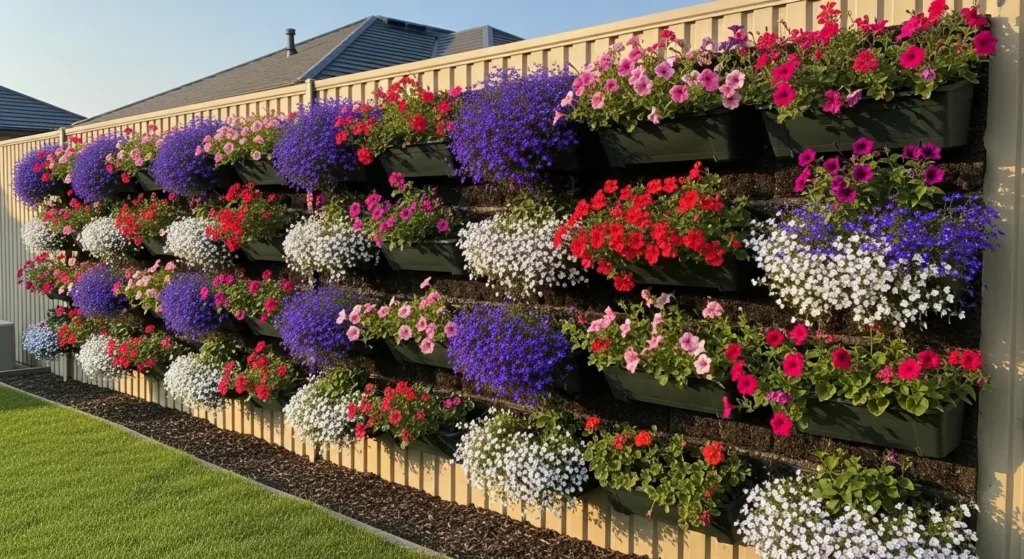
A flowering vertical wall is the most visually dramatic outdoor wall planter outcome — multiple rows of containers each overflowing with summer annuals creating a continuous surface of color across an entire fence face. The effect at peak summer reads as a living tapestry that photographs and performs at a scale no individual planter achieves.
The engineering requirement of a flowering vertical wall is irrigation. Multiple rows of flowering annuals in individual containers require daily watering in summer — the cumulative time investment of a hand-watered twelve-pot vertical wall is fifteen to twenty minutes daily, making it one of the most time-intensive planting formats in any garden. A drip irrigation system fed from a garden tap timer eliminates this commitment entirely and delivers more consistent moisture than hand watering.
The planting strategy for maximum flowering wall impact uses one variety per row rather than mixed varieties within each row. A row of pure white petunias above a row of deep purple petunia above a row of trailing red geranium creates banding contrast that reads dramatically from distance. Mixed varieties within each row creates a confetti effect that loses definition at the viewing distances where the wall feature is typically seen.
PRO TIP: Install drip irrigation before mounting containers on the wall rather than retrofitting afterward. Running drip lines through mounted containers on a finished wall installation is significantly more difficult than routing the lines through empty container brackets before any planting is in place. Ten minutes of pre-planning the irrigation routing saves an hour of retrofitting.
8. The Renter-Friendly Balcony Wall Garden: No Drilling, Full Coverage
✦ Balcony Wall Garden
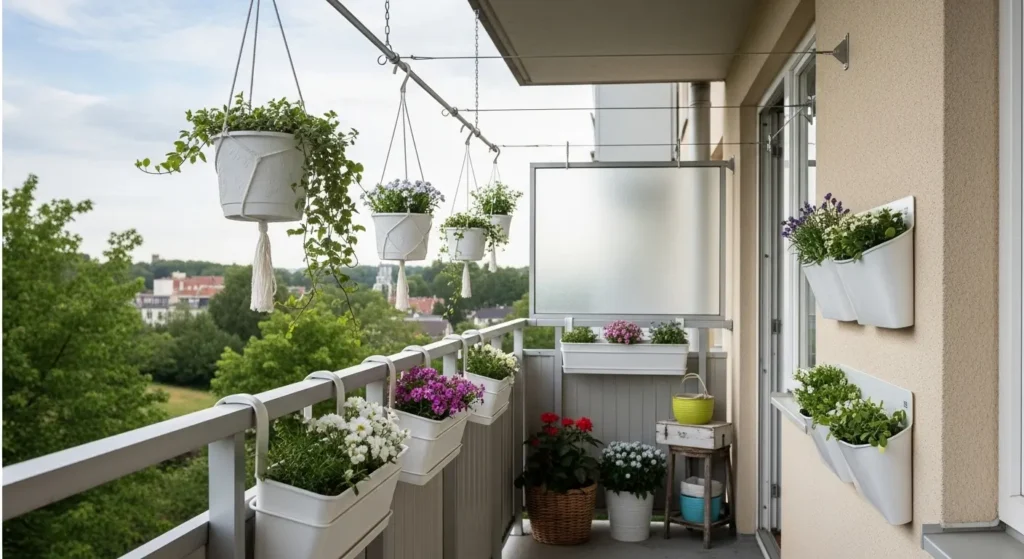
A balcony wall garden for renters requires achieving full vertical plant coverage without drilling, permanent fixing, or modifications that affect the return of a security deposit. Three non-permanent installation methods combined create a complete balcony wall garden that uses all available vertical surfaces.
Method one: tension rods installed horizontally between the two side walls of a covered balcony. Tension rods rated for 15 to 20 pounds support S-hook hanging planters and trailing plants along their length. Method two: over-rail planter brackets that grip the top of balcony railings through compression. These support plants on the outer and inner railing faces without any wall contact. Method three: adhesive-backed removable hooks rated for outdoor use on smooth rendered or tiled balcony walls. Weight limit 5 pounds maximum — suitable for lightweight fabric pocket planters with small succulents or herbs.
The three methods combined cover the ceiling zone, the railing zone, and the wall zone of a balcony simultaneously. A complete plant coverage that dismantles without trace when the tenancy ends.
9. A Green Wall Screen Provides Privacy and Planting From the Same Structure
✦ Privacy Green Wall Screen
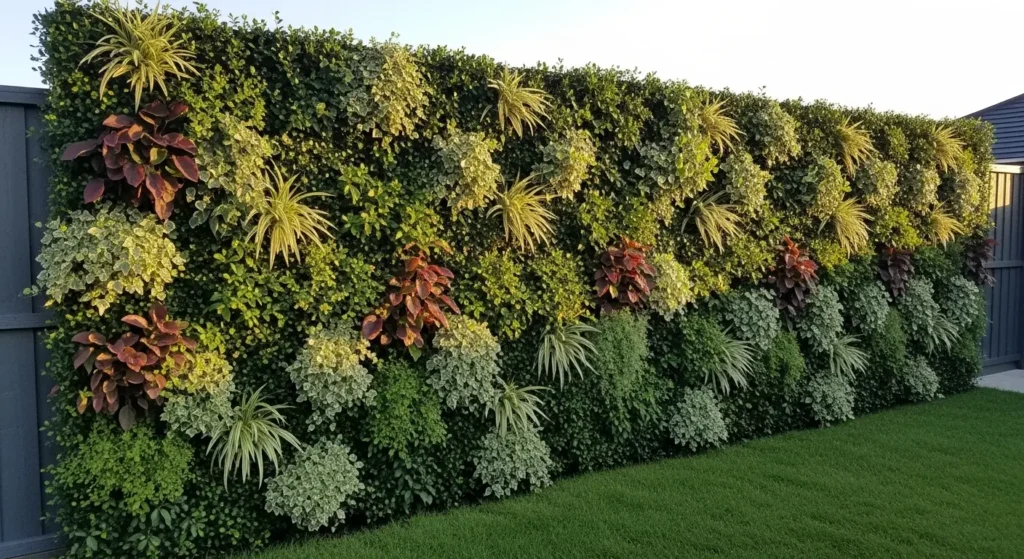
A living wall screen addresses the privacy requirement and the garden requirement simultaneously from one structure. Where a solid timber or composite privacy screen blocks sightlines but creates an austere boundary, a planted living screen blocks the same sightlines while adding biodiversity, seasonal interest, fragrance, and the genuine warmth of living material.
The plant selection for a privacy green wall screen must prioritize coverage speed, density, and year-round opacity. Annual climbers — sweet peas, morning glory, nasturtium — cover quickly in summer but provide no winter privacy. Evergreen ivy is the most reliable year-round privacy plant for wall systems because its dense overlapping leaf coverage provides complete visual screening in every season and its growth improves the coverage each successive year.
For a trellis-supported living privacy screen the combination that works fastest and most completely: evergreen ivy as the permanent base coverage that establishes year-round opacity. Climbing roses or jasmine as the aesthetic overlay that adds seasonal flower color and fragrance to the evergreen base. The ivy covers the screen structure completely within two to three growing seasons while the climbing plants add the sensory dimension that pure ivy coverage lacks.
PRO TIP: Install a drip irrigation tube along the base of any living wall privacy screen at the time of installation rather than after planting is established. A base-level drip line can be positioned accurately when the planting bed is empty. Retrofitting irrigation through established dense climbing plant growth requires significantly more effort and often damages established plants.
10. A Geometric Planter Grid Creates an Outdoor Installation That Reads as Art
✦ Geometric Wall Planter Grid
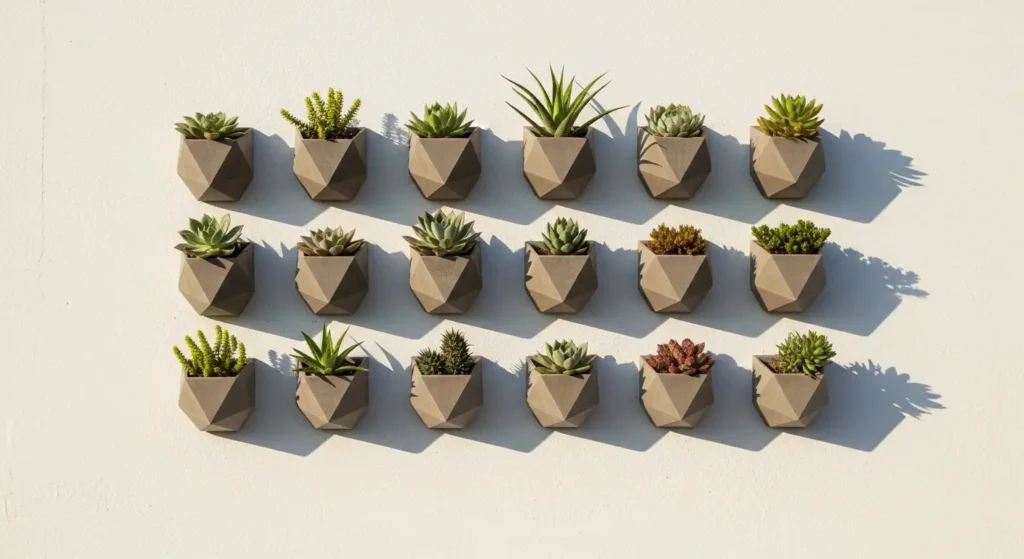
A geometric planter grid uses repetition and precision to create a wall installation that reads as intentional art rather than accumulated decoration. Identical containers mounted at identical spacings in a perfect grid, each containing an identical plant, create the visual effect of a designed installation where the discipline of the arrangement is the aesthetic statement.
The grid approach requires precision in both mounting and plant selection. All brackets must be mounted at identical spacings — use a laser level rather than a tape measure for perfect horizontal alignment, and a plumb line for vertical alignment. Any irregularity in spacing reads as error rather than intention in a grid format.
The plant selection for a geometric grid should be a single variety throughout rather than varied plants in each pot. Identical echeveria rosettes in every pot. Identical small cacti. Identical trailing sedums that cascade at the same length from every container. The uniformity is the point — a geometric grid with varied planting loses its precision quality and becomes simply a collection of small pots.
PRO TIP: Mount geometric wall planter grids on a painted panel of painted MDF or exterior plywood cut to the exact grid dimensions before mounting on the wall. The panel provides a clean uniform background that makes the grid read as a complete installation rather than individual pots mounted on an irregular wall surface. The panel mounts on four wall fixings rather than one fixing per planter.
11. Modular Stackable Wall Planters: The System That Grows With Your Space
✦ Modular Stackable Planters
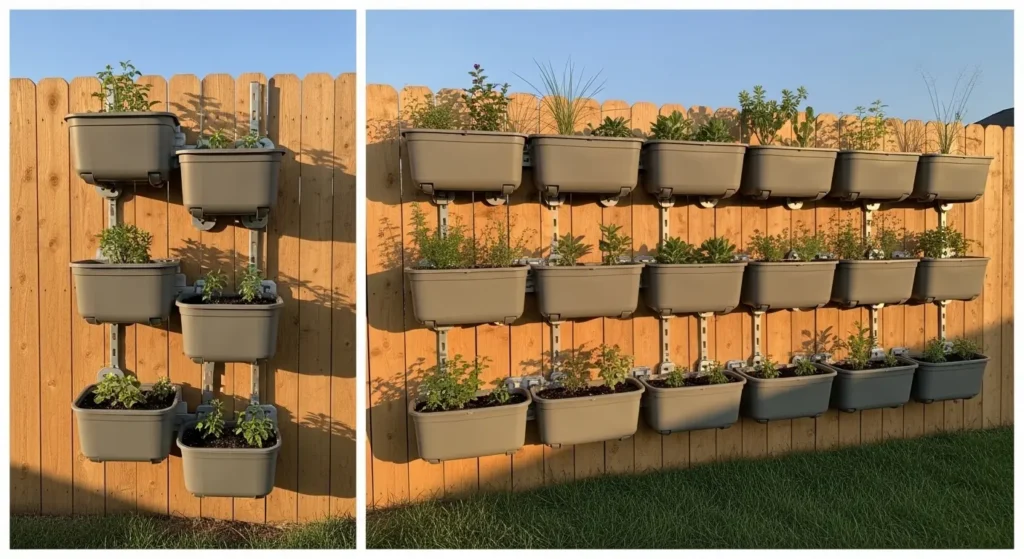
Modular stackable wall planter systems are the wall garden format with the most practical scalability. Start with four modules in one corner of the fence. Add four more when budget allows. Extend across the full fence face over multiple seasons. The modular connection system means each addition integrates visually with the existing installation rather than looking like a separate element added later.
The connection quality is the critical variable between modular wall planter systems. Systems with positive-locking connections between modules — where each unit physically grips the adjacent unit rather than simply resting against it — maintain alignment as plants grow and as thermal expansion and contraction affects the materials through seasons. Systems with loose-fitting connections gradually misalign and require manual realignment after every season.
Water management in modular stacked systems requires deliberate design. Modules at the top of the stack must drain without waterlogging the modules immediately below. Look for systems with designed overflow channels that direct excess water to the sides of the stack rather than through the drainage holes of lower modules. Unmanaged overflow creates waterlogging in lower modules while upper modules dry out.
12. Rustic Individual Pot Hooks: The Simplest Outdoor Wall Planter System and Often the Best
✦ Rustic Hanging Pot Wall
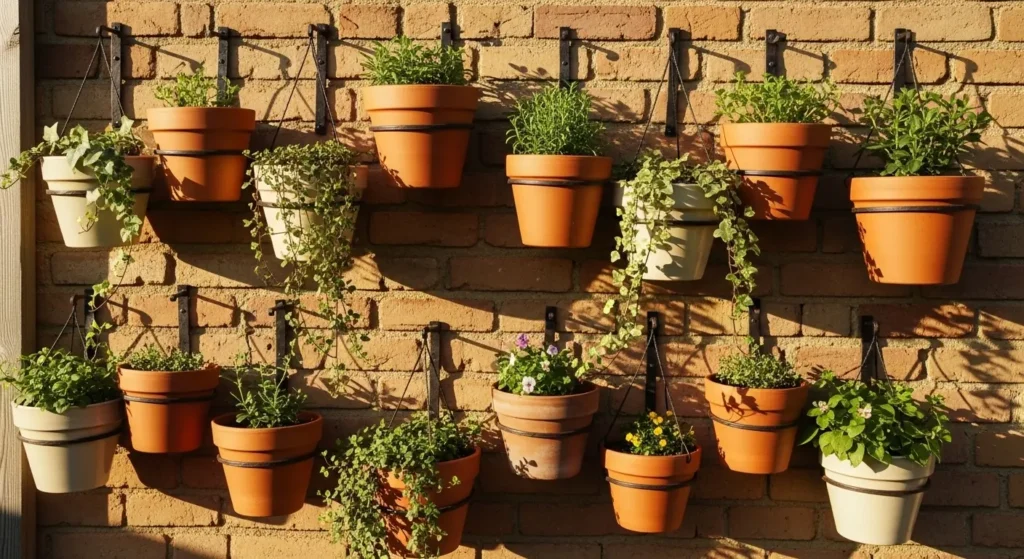
Individual pot brackets on a wall are the oldest, simplest, and in many contexts the most effective outdoor wall planting approach. The charm of a brick or stone wall hung with varied terracotta pots at different heights and positions comes from precisely the quality that modular systems and geometric grids lack — the organic informality of objects gathered and placed without a systematic framework.
The installation requirement for individual pot wall brackets is straightforward: a wall plug and screw rated for the combined weight of bracket, pot, compost, and plant at full saturation. A loaded 6-inch terracotta pot weighs approximately 5 to 8 pounds. A bracket rated for 15 pounds provides adequate safety margin. Into brick or stone use masonry wall plugs and 2-inch screws. Into timber use exterior screws directly without plugs.
The arrangement principle for individual wall pots: install at varied heights within a defined vertical zone rather than in a perfectly horizontal line. A collection of pots all at the same height looks like a shelf. The same collection at heights varied by 4 to 8 inches between adjacent pots looks curated. Group in odd numbers — three, five, or seven pots in a cluster — for the most organic visual quality.
PRO TIP: Replace the compost in individual wall-hung terracotta pots each spring rather than topping up. The limited compost volume of small wall pots depletes fully within one season and becomes compacted and nutrient-exhausted. Fresh compost each season costs under $2 per pot and produces plant performance that topping up tired compost never achieves.
Choosing the Right Wall Planter System for Your Surface
The wall surface determines which installation approaches are available and which produce the best long-term results:
Brick and stone walls:
All systems work. Masonry fixings are the most reliable anchor for heavy systems. The wall surface adds aesthetic quality to simple individual pot bracket displays — exposed brick as a backdrop makes terracotta pots look significantly more beautiful.
Timber fence panels:
Best suited to pallet gardens, wooden slat display frames, and systems that distribute load across multiple fence fixing points. Avoid very heavy systems on standard 1-inch fence boards — the board thickness limits the screw depth available.
Rendered and painted walls:
Geometric grid systems and modern metal frames work best as the clean wall surface becomes part of the display. Use rawlbolt fixings into the masonry beneath the render for heavy systems — never rely on adhesive or render-only fixings for loaded planting systems.
Balcony walls with no drilling permitted:
Tension rod systems, over-rail brackets, and lightweight fabric pocket planters with removable adhesive hooks. All three methods leave no permanent mark on the surface.
📌 More garden planting ideas → 16 Garden Planter Ideas That Transform Outdoor Spaces
Frequently Asked Questions
What is the best plant for an outdoor wall planter?
The best plant for an outdoor wall planter depends on the available light and the watering commitment available. For low-maintenance walls in any light: succulents and sedums require the least water and tolerate the drying between waterings that elevated wall positions accelerate. For shade positions: ferns, ivy, and impatiens all perform well in low-light wall planting. For maximum colour impact in sun: trailing petunias, calibrachoa, and geraniums produce the most flower density in wall-mounted positions. According to the RHS plants with naturally compact root systems and drought tolerance are consistently the most successful choices for any wall-mounted planting system.
How do I water outdoor wall planters?
Outdoor wall planters dry out faster than ground-level containers because elevated position, air movement on all sides, and reduced container volume all accelerate evaporation. Hand watering works for individual pot bracket displays of up to six containers. For larger systems a drip irrigation line connected to a garden tap timer is the most practical solution — it delivers consistent moisture at set intervals without daily manual intervention and can be programmed to compensate for hot weather periods. Self-watering wall planters with integrated reservoirs are the highest-convenience option for individual wall positions.
Can I put wall planters on a rental property fence?
Wall planters on rental property require installation methods that leave no permanent damage to the surface. Tension rod systems, over-rail railing brackets, removable adhesive hooks rated for outdoor use, and lightweight fabric pocket planters with temporary fixings all provide full wall garden coverage without permanent modification. Drilling into brick, stone, or timber on rental property should be discussed with the landlord before installation as it constitutes alteration of the property even when the holes are later filled.
Your Walls Are Your Most Underused Garden Space
Every outdoor wall planter idea in this guide starts from the same premise: the vertical surfaces in your outdoor space are growing space that currently produces nothing. A fence that takes up 40 linear feet of your garden boundary is 40 linear feet of potential garden that is currently invisible, unused, and contributing nothing to the space it occupies.
Choose the wall planter approach that suits your wall type, your maintenance commitment, and your design intent. Install it properly. Plant it generously. The wall that was a boundary becomes the most interesting surface in the garden.
All the products mentioned in this article are linked on Amazon. Every recommendation is something we genuinely believe in.
More Garden and Outdoor Planting Ideas
→ 12 Genius Garden Planter Box Ideas
→8 Easy Hanging Plant Ideas For Patios & Balconies
→ 20 Creative Garden Rock Art Ideas
→ 12 Boho Garden Ideas You’ll Love
Choose the wall planter approach that suits your wall type, your maintenance commitment, and your design intent. Install it properly. Plant it generously. The wall that was a boundary becomes the most interesting surface in the garden.

Sheikh Hassaan is a digital architect for small businesses and the founder of The Glow Up System. He writes about home decor, garden design, and outdoor living for real American homes – practical ideas that work in actual spaces without oversized budgets.