
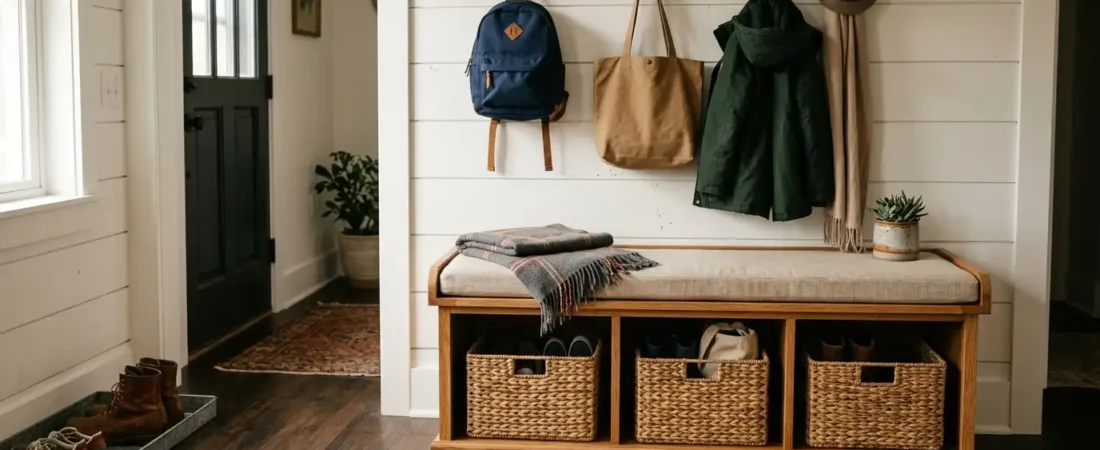
The entryway is the first thing you see when you walk in and the last thing you see when you leave. Yet it is one of the most overlooked spaces in most homes. Shoes pile up. Bags drop on the floor. Jackets hang from doorknobs. It is chaos before you even get inside. But it does not have to be that way. A well-designed mudroom bench solves all of that in one simple piece of furniture.
That is what makes mudroom bench ideas so valuable, turning a cluttered entry into a functional, beautiful space that works for your family every single day.
This article covers seven practical mudroom bench ideas that work for real homes, not sprawling foyers or magazine-perfect mudrooms. Every suggestion includes specific dimensions, actual paint colors, and real product references you can use. No vague advice. No impossible layouts. Just smart, stylish benches that make your entryway work as hard as you do.
Why a Mudroom Bench Changes Everything About Your Entryway
The entryway is where the outside world meets your home. It is the transition zone between dirty shoes and clean floors, between coats and comfortable clothes. A mudroom bench is the anchor of that transition. It gives you a place to sit, a place to store, and a place to organize all the stuff that accumulates at the door.
Most people underestimate how much a bench changes the way an entry functions. Without a bench, you are bending over to take off shoes, dropping bags on the floor, and piling coats on top of each other. With a bench, you sit down, take your time, and everything has a place. It is not just about organization. It is about making your daily routine easier.
The best mudroom bench ideas also add significant value to your home. Buyers notice a well-designed entryway. It signals that the home is cared for and thoughtfully laid out. A bench with storage is one of the most cost-effective upgrades you can make to your entry space.
The key is to design the bench for how you actually live. How many pairs of shoes come in and out every day? How many coats and bags need hanging? How much space do you really have? The best benches are built around real needs, not generic ideas.
Table of Contents
1. The Classic Wooden Bench With Storage Baskets
✦ Best for: Families who need hidden storage for shoes, gloves, and everyday items
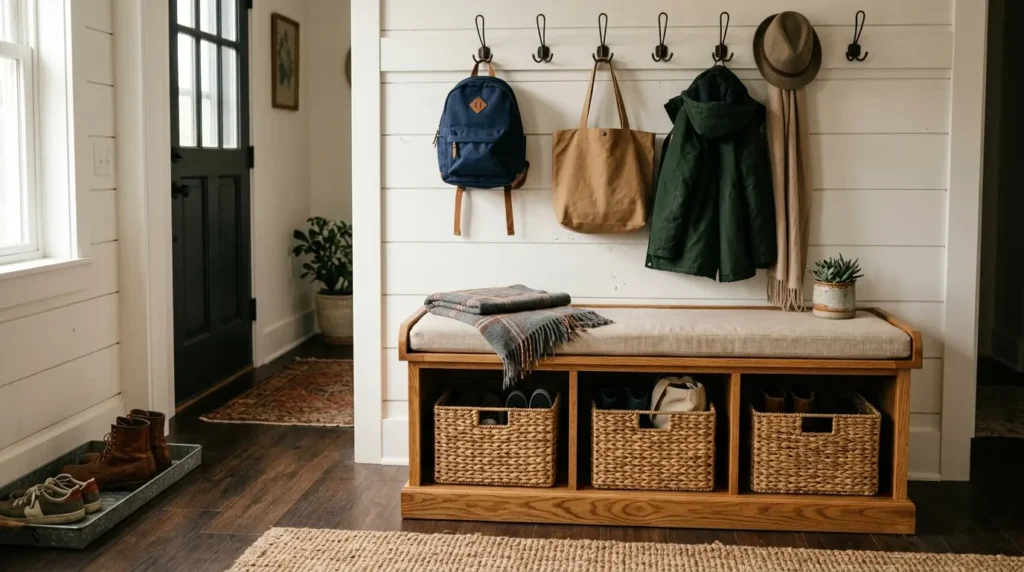
A wooden bench with storage baskets is the foundation of most mudroom bench ideas. It is simple, functional, and works in almost any space. The bench provides seating. The baskets provide hidden storage. Together, they solve the two biggest entryway problems.
For dimensions, a bench should be at least 36 inches wide to seat two people comfortably. For a family of four, aim for 48 inches or more. The depth should be 14 to 16 inches. That is deep enough for comfortable seating but shallow enough to fit in most entryways. The height should be 18 to 20 inches. That is the same height as a standard dining chair.
Choose a wood finish that works with your home. Unfinished pine or oak reads as rustic and warm. White paint reads as modern and clean. Dark walnut reads as traditional and rich. The finish should complement your existing trim and flooring.
For baskets, measure the space under the bench. Baskets should slide in and out easily with a 1-inch clearance on each side. Woven baskets in natural materials like seagrass or water hyacinth add texture and warmth. Metal bins add industrial contrast. Fabric bins add softness. Choose what fits your style.
The design principle here is hidden organization. The bench looks clean and simple, but the baskets below hold everything you need to keep out of sight. That is the secret to a beautiful mudroom that actually works.
2. The Built-In Bench With Floor-to-Ceiling Storage
✦ Best for: Custom mudrooms where you want maximum storage and a seamless look
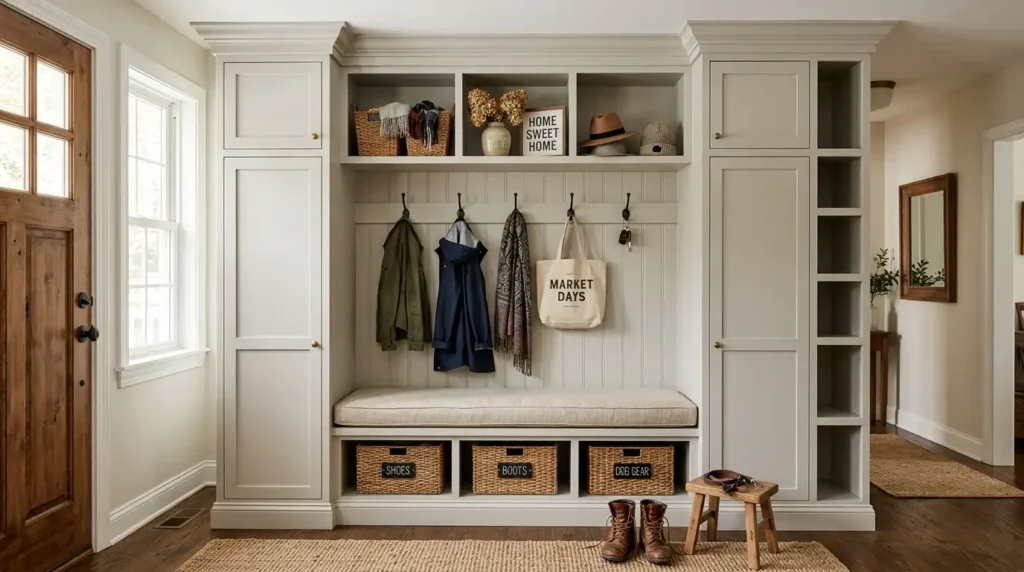
A built-in bench with floor-to-ceiling storage is the ultimate mudroom bench idea. It transforms an entire wall into an organized entry system that looks custom and works perfectly. Every inch of space is used. Nothing is wasted.
The basic layout is simple. A bench in the center with tall cabinets or shelving on both sides. The bench provides seating and storage underneath. The cabinets provide hanging space for coats and closed storage for seasonal items. The shelving above the bench provides display space or extra storage for hats and accessories.
For dimensions, the bench should be the same depth as the cabinets, typically 18 to 20 inches. The cabinets should be at least 60 inches tall. That gives you enough hanging space for full-length coats. Use adjustable shelving inside the cabinets for maximum flexibility.
Paint the entire unit the same color as the wall. This makes the built-in recede visually and keeps the space from feeling cramped. Benjamin Moore Pale Oak or Sherwin-Williams Agreeable Gray are excellent choices. They are warm neutrals that work with most color palettes.
Add hardware in brass or matte black for contrast. The hardware is the jewelry of the built-in. It adds personality and polish without overwhelming the space.
The design principle is integration. The built-in should look like it was always there, not like an afterthought. That integration is what makes this one of the most successful mudroom bench ideas for custom homes.
3. The Bench With Shoe Storage and Cubbies
✦ Best for: Homes where shoes are the biggest entryway problem
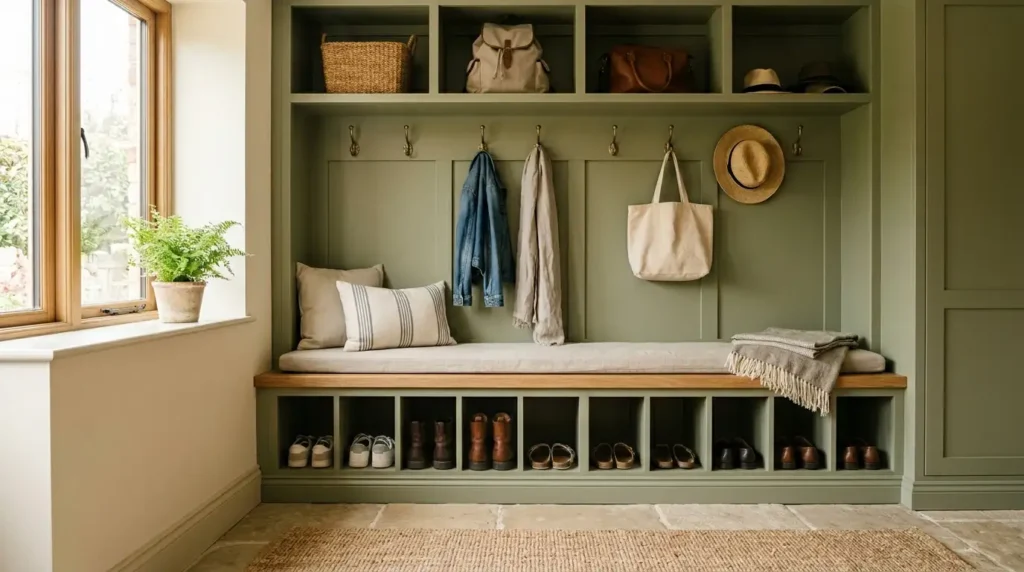
Shoes are the biggest challenge in most mudrooms. They accumulate quickly, take up floor space, and create visual chaos. A bench with dedicated shoe storage solves that problem by giving each pair a designated spot.
The most effective shoe storage is vertical. Cubby-style cubbies or slanted shelves hold shoes at an angle, making them easy to access and easy to see. Each cubby should be at least 6 inches wide, 12 inches deep, and 6 inches tall. That fits most adult shoes, including boots.
For families, add a shelf above the bench for backpacks and bags. Each family member gets a designated cubby or hook. This removes the argument about whose stuff is whose. Personalization adds order.
Paint the bench a color that adds personality. Sage green, navy blue, or charcoal gray all work well. The bench can be the accent piece in your mudroom, especially if the walls are neutral. Farrow and Ball Pigeon or Sherwin-Williams Naval are excellent choices for a bold but livable color.
Add a cushion in a durable, stain-resistant fabric. Sunbrella or indoor-outdoor fabrics are ideal for mudrooms. They hold up to daily use and clean up easily.
The design principle is organization by category. Shoes have a place. Bags have a place. Coats have a place. When every category has a designated spot, clutter disappears. That is the power of thoughtful mudroom bench ideas.
4. The Floating Bench That Saves Floor Space
✦ Best for: Narrow entryways where floor space is limited
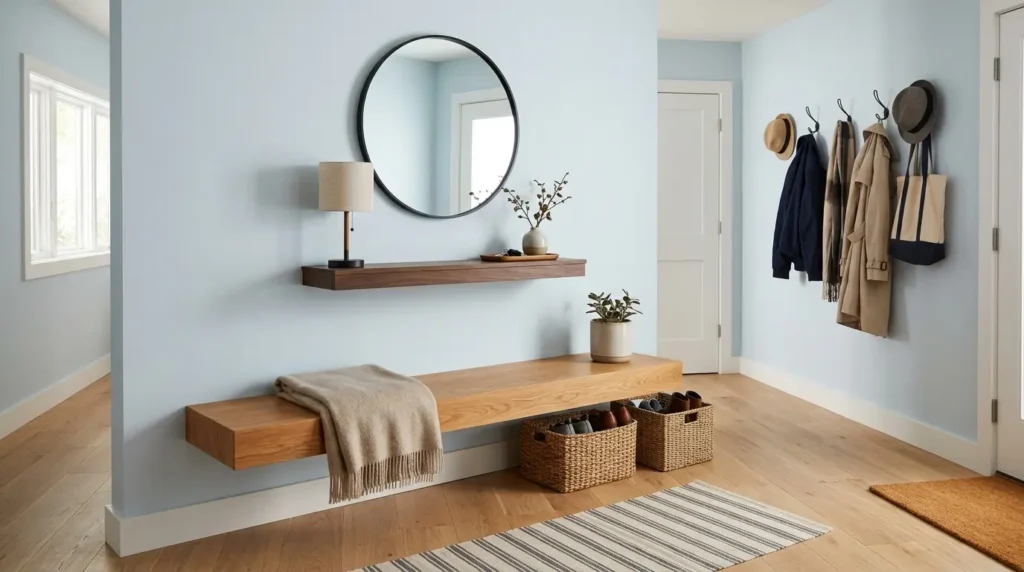
A floating bench is one of the most clever mudroom bench ideas for tight spaces. It mounts directly to the wall, eliminating legs and creating the illusion of more floor space. The open floor beneath the bench makes the room feel larger.
For installation, use heavy-duty wall anchors or attach directly to wall studs. The bench should support at least 250 pounds. That is the minimum for adult seating. If possible, find studs for installation. They provide the strongest support.
The depth should be 14 to 16 inches, the same as a standard bench. The height should be 18 to 20 inches. These dimensions are comfortable for sitting and work with most entryways.
Add hooks above the bench for coats and bags. A shelf above the hooks adds additional storage for hats and small items. A mirror on the wall adds light and depth.
The design principle is visual spaciousness. By removing the legs, the bench takes up less visual space. That makes the entry feel more open and airy. In a narrow mudroom, that visual openness is worth more than the extra storage under the bench.
5. The Bench With Drawers for Hidden Storage
✦ Best for: Homes where you want to keep shoes and accessories completely out of sight
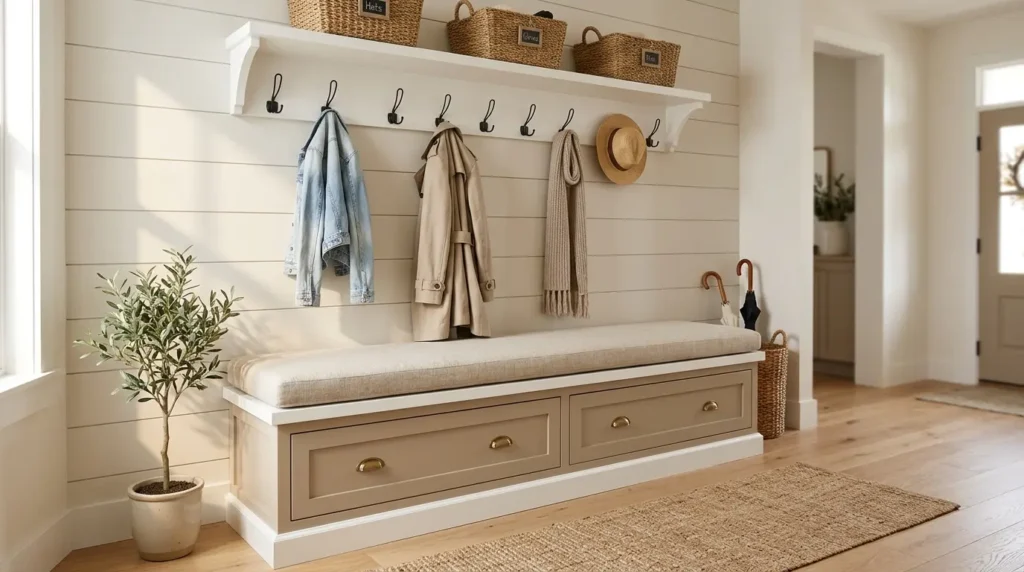
Drawers provide the most hidden storage of any mudroom bench idea. They keep everything out of sight and out of mind until you need it. Shoes, gloves, scarves, and even pet supplies can live in drawers and never create visual clutter.
For dimensions, drawers should be at least 6 inches deep and 18 inches wide. That gives you enough space for shoes and accessories. Use full-extension drawer slides so you can access the entire drawer. Standard slides only open halfway, which makes it hard to reach items in the back.
The bench should be 18 to 20 inches high, the same as a standard chair. The depth should be 14 to 16 inches. Add a cushioned seat for comfort. The cushion should be at least 2 inches thick and upholstered in a durable fabric.
Add a shelf above the bench for decorative baskets or small plants. This adds warmth to the space without competing with the storage below. The shelf should be at least 12 inches above the bench to allow for comfortable access.
The design principle is concealment. Drawers hide the clutter while providing easy access. That is the beauty of mudroom bench ideas with drawers. Everything is organized, but nothing is visible.
6. The Corner Bench That Uses Awkward Space
✦ Best for: Mudrooms with an awkward corner that would otherwise go unused
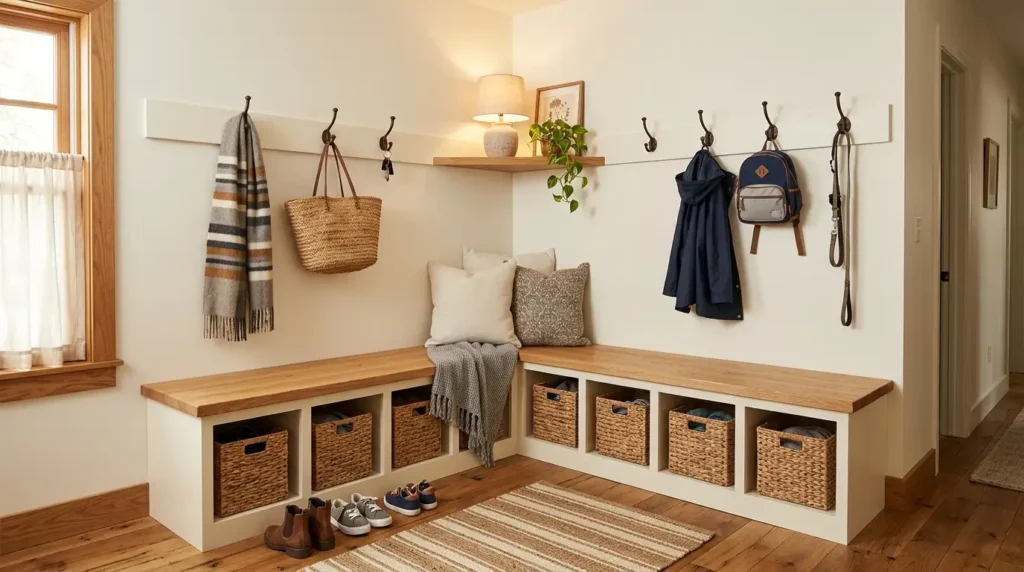
A corner bench makes use of space that most people ignore. It turns an awkward corner into a functional seating and storage area. It also creates a cozy nook that adds character to the entryway.
The layout is simple. Two benches meet at a 90-degree angle. Each bench is 14 to 16 inches deep. The length depends on the wall space available. Add storage baskets under both benches for maximum functionality.
Install hooks above the bench on both walls. This gives you more hanging space than a straight bench. Use double hooks for even more capacity. A corner shelf above the bench provides additional storage or display space.
For the seat, use a corner cushion or two separate cushions. Corner cushions can be custom-made or you can use two rectangular cushions that meet at the corner. The cushion should be at least 2 inches thick for comfort.
The design principle is maximizing unused space. A corner bench transforms a dead zone into a functional zone. That is the magic of mudroom bench ideas designed for corners.
7. The Bench With Open Shelving for Easy Access
✦ Best for: Families with kids who need quick access to shoes and gear
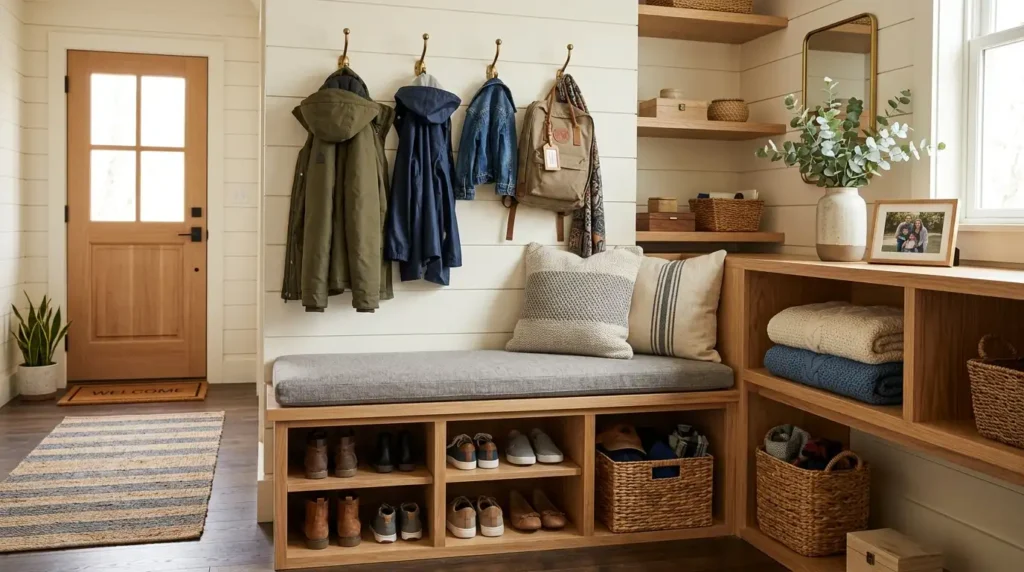
Open shelving is the most accessible mudroom bench idea. It makes everything visible and easy to grab. That is especially useful for families with kids who need to get ready quickly and independently.
For dimensions, the bench should be at least 36 inches wide. The shelves above should be 8 to 10 inches deep. That is deep enough for shoes, baskets, and small items. The spacing between shelves depends on what you are storing. For shoes, 6 inches is enough. For baskets, measure the baskets and add an inch.
Use woven baskets or fabric bins on the shelves. They add texture and color while keeping small items organized. Each family member can have their own basket for hats, gloves, and accessories.
Add hooks at a height accessible to kids. Lower hooks for children’s coats and backpacks. Higher hooks for adult items. This teaches kids independence and reduces the chaos of the morning routine.
The design principle is accessibility. Open shelving puts everything within reach. In a busy family mudroom, that accessibility is worth more than the hidden storage of closed cabinets.
Frequently Asked Questions About Mudroom Bench Ideas
What is the best height for a mudroom bench?
The best height for a mudroom bench is 18 to 20 inches. That is the same height as a standard dining chair. It is comfortable for adults to sit on while removing shoes. For families with children, consider adding a lower step stool or a second lower bench. That makes the bench accessible for everyone.
How much depth does a mudroom bench need?
A mudroom bench should be 14 to 16 inches deep. That is enough for comfortable seating without taking up too much floor space. If you are adding storage underneath, measure your storage containers and add an inch of clearance. For baskets, allow at least 1 inch on each side for easy access.
What material is best for a mudroom bench?
Wood is the most popular and versatile material for mudroom benches. Oak, maple, and birch are durable and hold up well to daily use. Pine is more affordable but dents more easily. For a painted bench, MDF or poplar is a good choice. They take paint well and are less expensive than solid wood. For added durability, choose a hardwood and finish it with a clear protective coat.
How do I style a mudroom bench for maximum functionality?
According to Better Homes & Gardens, the most functional mudroom benches include three key elements: seating, storage, and hanging space. Add a cushioned seat for comfort, baskets or drawers underneath for storage, and hooks above for coats and bags. Keep the top clear of clutter except for a small decorative item or two. Function should always come first in a mudroom.
Related Articles
Home Decorating Ideas for Small Houses
Rustic Wedding Decor Ideas That Feel Warm and Genuine
Farmhouse Kitchen Island Features Worth Adding
Small Apartment Ideas That Make Every Square Foot Count
A good mudroom bench does more than provide seating. It gives every item a home so your entryway stays organized, welcoming, and ready for whatever comes through the door.

Sheikh Hassaan is a digital architect for small businesses and the founder of The Glow Up System. He writes about home decor, garden design, and outdoor living for real American homes – practical ideas that work in actual spaces without oversized budgets.