
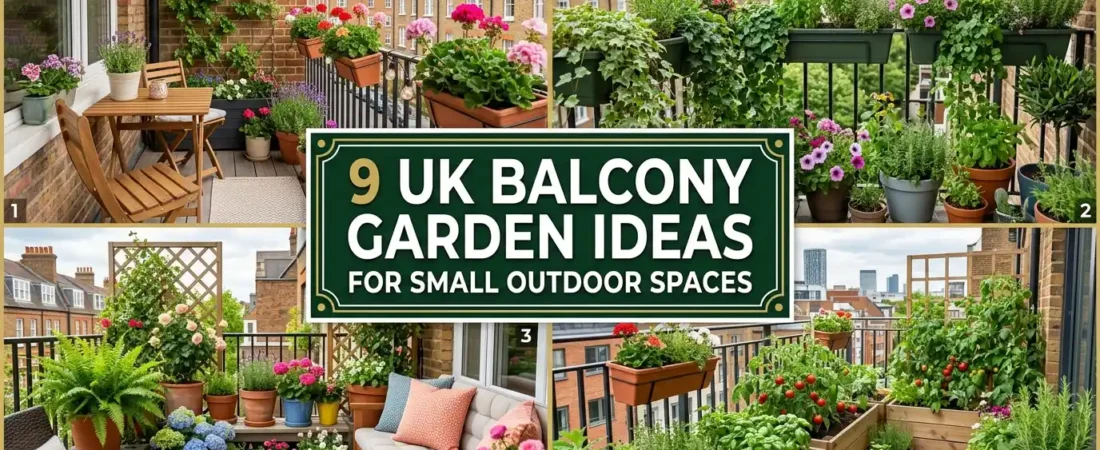
UK balcony garden ideas have to solve a different set of problems from balcony gardening anywhere else. The weather is unpredictable from April through October, most balconies face north or east, the growing season is shorter, and the average British flat balcony is narrower than almost anywhere else in the world.
I find that frustrating when I read balcony garden advice that assumes six months of reliable sunshine and a south-facing aspect. Most UK balcony gardeners do not have either. These ideas are written specifically for British conditions — the rain, the wind, the limited light, and the narrow concrete ledges that most of us are actually working with.
Table of Contents
What UK Balcony Garden Ideas Need to Handle That Others Do Not
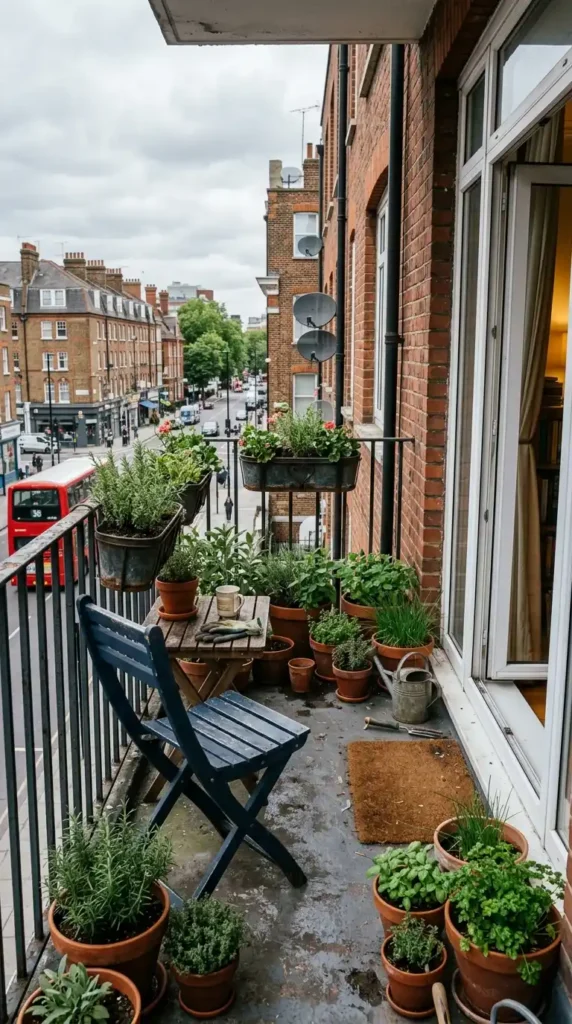
Wind is the biggest killer of UK balcony plants that most guides ignore. A balcony above the third floor in any British city creates a wind tunnel effect that snaps stems, desiccates leaves, and knocks over containers. I always assess wind exposure before recommending any plant for a UK balcony because the same plant that thrives in a sheltered London courtyard fails completely on an exposed Manchester high-rise balcony.
UK building regulations and most leasehold agreements restrict what can be placed on balconies, particularly regarding weight and anything that could fall. Check your lease and your building’s structural load rating before filling a balcony with heavy containers. Plastic and fibreglass containers weigh significantly less than terracotta and ceramic at the same volume.
The UK growing season for outdoor containers runs from mid-April to mid-October in most parts of England and Wales, shorter in Scotland. That six-month window shapes every planting decision. Plants that need a long warm season to produce — most tomato varieties, peppers, aubergines — struggle on UK balconies unless you have a genuinely sunny south-facing aspect.
1. Railing Planters With Wind-Tolerant Herbs for the UK Climate
✦ Best for: adding growing space to any UK balcony railing without using floor space or drilling into walls
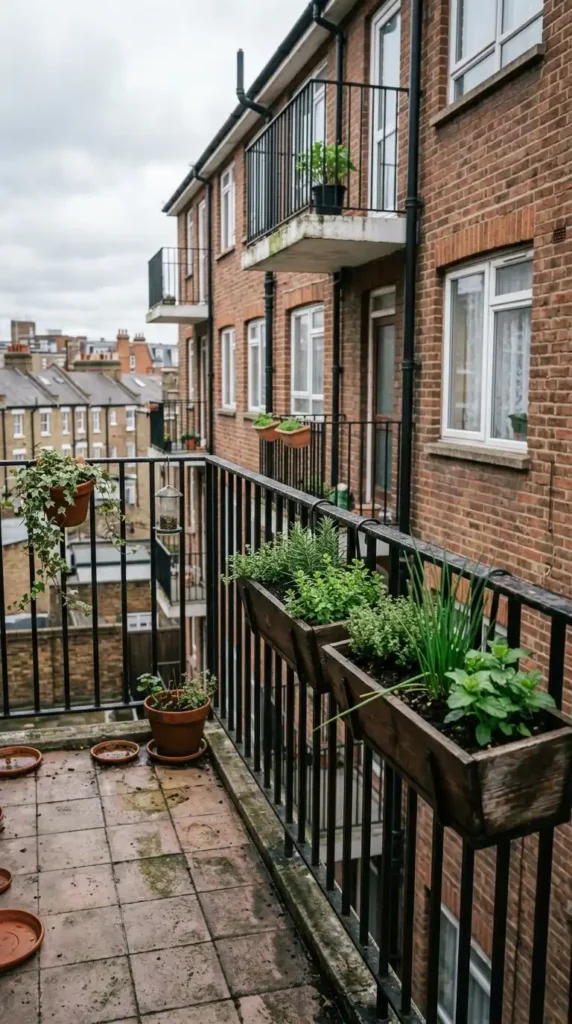
I recommend railing planters as the starting point for every UK balcony garden because they use the one surface that is otherwise completely wasted — the top and inside face of the balcony railing — without taking any floor space or requiring permanent fixings that most UK leases prohibit.
The herb selection for UK balcony railing planters needs to account for wind tolerance. Rosemary, thyme, and chives handle wind exposure well because their small leaves and woody or hollow stems resist wind damage. Basil is the UK balcony herb I am most cautious about recommending — it needs warmth and dislikes wind and is the herb most likely to disappoint in a British summer.
Self-watering railing planters are worth the additional cost on a UK balcony specifically because of the unpredictable rain pattern. A UK summer alternates between weeks of drought and weeks of rain that makes consistent watering difficult. A self-watering reservoir buffers both extremes — the plant draws water as needed rather than relying on a consistent watering schedule that UK weather makes difficult to maintain.
2. Shade-Tolerant Containers for North and East-Facing UK Balconies
✦ Best for: the majority of UK flat balconies that face north or east and receive limited direct sunlight
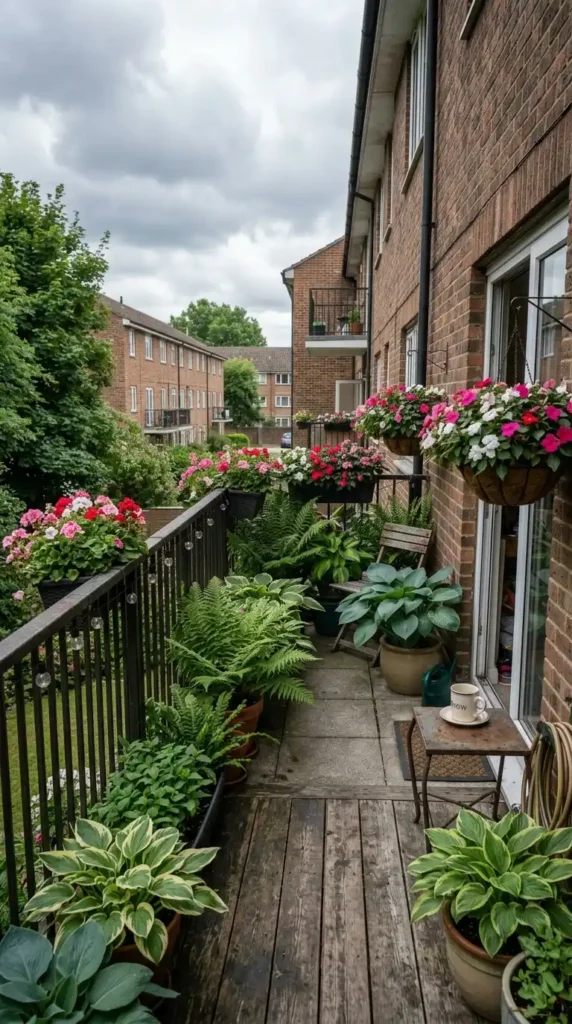
I think the north-facing UK balcony is the most misunderstood gardening situation in Britain. People assume nothing will grow and either leave the balcony bare or try sun-loving plants that predictably fail. The plants that actually suit a north-facing UK balcony are beautiful and genuinely well-matched to British conditions.
Ferns are the best structural plant for a shaded UK balcony — they are native to British woodland conditions and thrive in the cool moist air that a north-facing urban balcony provides. Hostas perform equally well and their large architectural leaves create genuine visual impact in a shaded space. Impatiens and begonias provide continuous flower color from May through October in full shade.
For food growing on a shaded UK balcony: lettuce, spinach, rocket, and kale all prefer cool partial shade and produce reliably through the British summer without bolting in the way they do in direct sun. A north-facing UK balcony in July is often a better environment for salad leaves than a south-facing one where heat stress causes premature bolting.
3. Salad Leaves Container Garden for a UK Balcony That Feeds You
✦ Best for: any UK balcony that receives at least 3 hours of light daily and wants to produce food through the British growing season
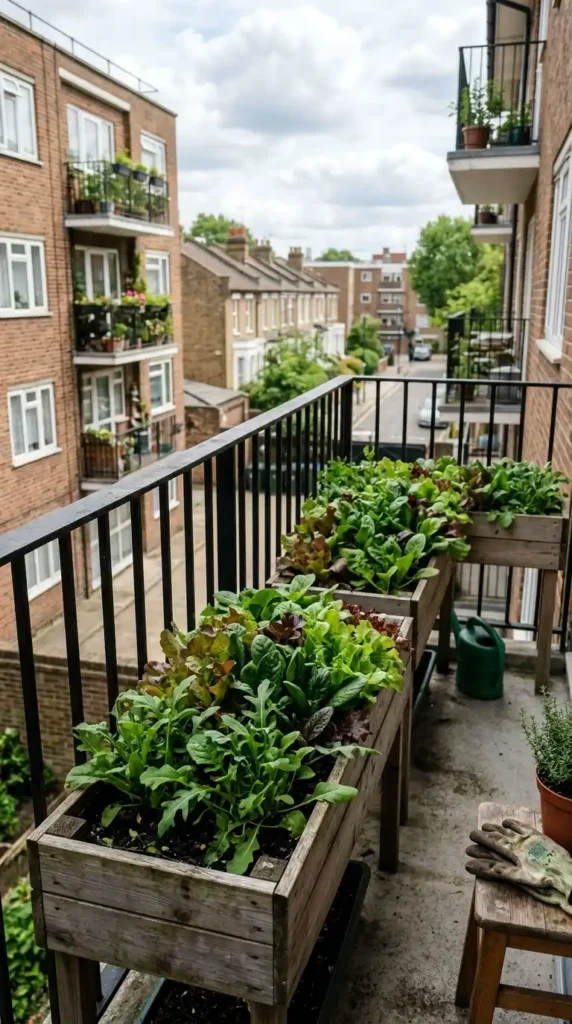
Salad leaves are the food crop I recommend most confidently for UK balcony gardens because they are genuinely well-suited to British conditions. They grow quickly, tolerate partial shade, prefer the cool temperatures of April through June and September through October, and can be cut and come again repeatedly through the season.
A window box or rectangular planter of 60 centimetres produces enough mixed leaves for a household of two to eat salad two or three times a week from May through October. Sow seeds directly into the container in April, cut leaves when they reach 10 centimetres, and the plant regrows from the base for multiple harvests.
The cut-and-come-again varieties that perform best on UK balconies: mixed loose leaf lettuce, rocket, spinach, and baby kale. Avoid hearting varieties like iceberg that need a full season to mature. The loose leaf types provide the fastest harvests and the longest productive period within the British growing window. For more on container food growing our balcony garden ideas for small spaces guide covers the container and soil setup in detail.
4. Wind-Resistant Planting for Exposed High-Rise UK Balconies
✦ Best for: balconies above the fourth floor or in exposed positions where wind regularly damages standard balcony plants
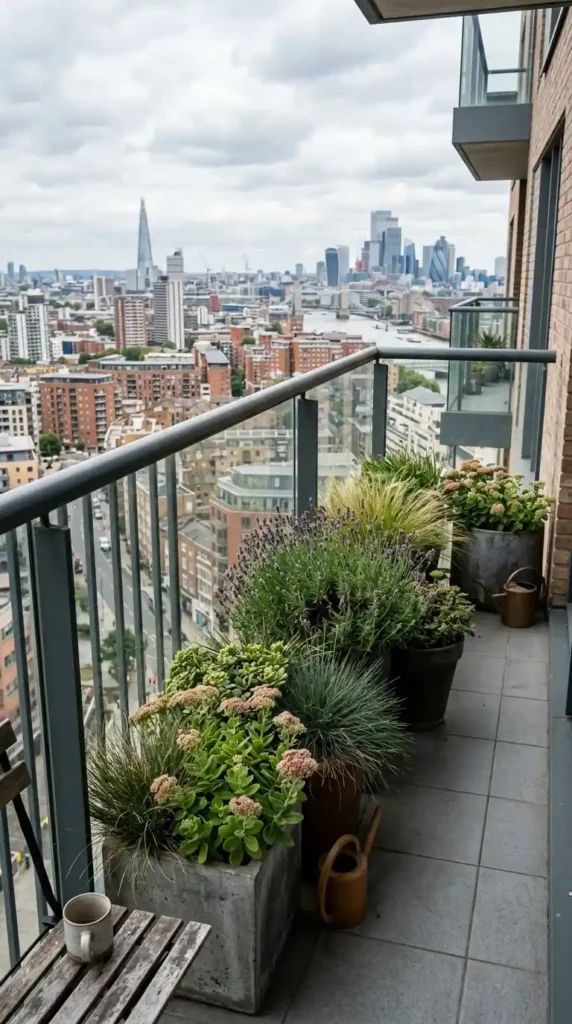
I have seen more UK balcony gardens fail from wind than from any other cause. Above the fourth floor in any British city the wind load on plants is significant and consistent. Tall plants snap. Large-leaved plants desiccate. Light containers blow over. The only reliable approach is to select specifically for wind tolerance from the start.
The plants that consistently survive UK high-rise balcony conditions: lavender with its flexible stems and small aromatic leaves. Ornamental grasses — Festuca glauca and Carex species — that flex in wind rather than resisting it. Sedums and sempervivums that stay low and compact. Heathers that form dense mats which present minimal wind resistance.
Container weight matters enormously on an exposed UK balcony. Heavier containers do not blow over. Fill the base of containers with gravel or stones before adding compost to lower the centre of gravity. Group containers against the wall rather than placing them near the railing edge where wind exposure is strongest.
5. Year-Round UK Balcony Garden With Seasonal Container Rotation
✦ Best for: UK balcony gardeners who want their outdoor space to look considered and alive through every season of the British year
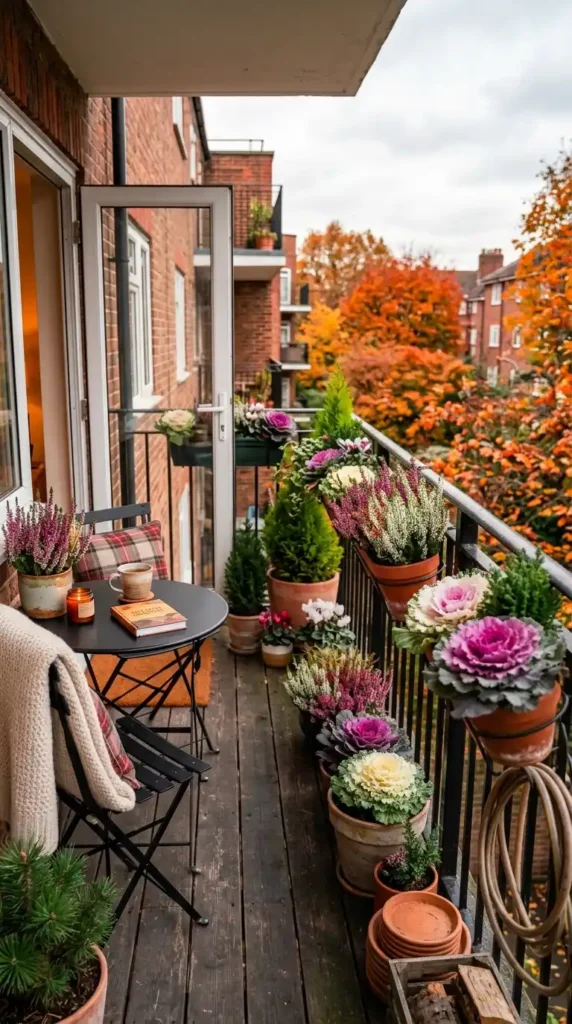
The year-round UK balcony garden is the approach I find most rewarding because it means the space never looks abandoned even in February. The British climate actually supports year-round balcony gardening better than most people realise — the mild winters mean many plants that would die in a continental European winter survive perfectly well outdoors in the UK.
The UK seasonal rotation that works best:
Spring (March to May): tulips and daffodil bulbs planted in autumn that bloom from March. Pansies and violas for early colour. Salad leaves sown in April.
Summer (June to September): herbs at the railing, trailing fuchsias and petunias for colour, salad leaves continuing, one tomato or courgette on a sunny balcony.
Autumn (October to November): ornamental kale for architectural interest, heathers for colour, cyclamen for the most vivid autumn flower available in British conditions.
Winter (December to February): evergreen shrubs in containers including dwarf box, skimmia, and Euonymus stay structural and green. Winter-flowering pansies provide colour on mild days. Hellebores bloom from December through March in sheltered UK conditions.
6. Vertical Growing on a Narrow UK Balcony
✦ Best for: very narrow UK balconies where floor space is so limited that vertical growing is the only practical option
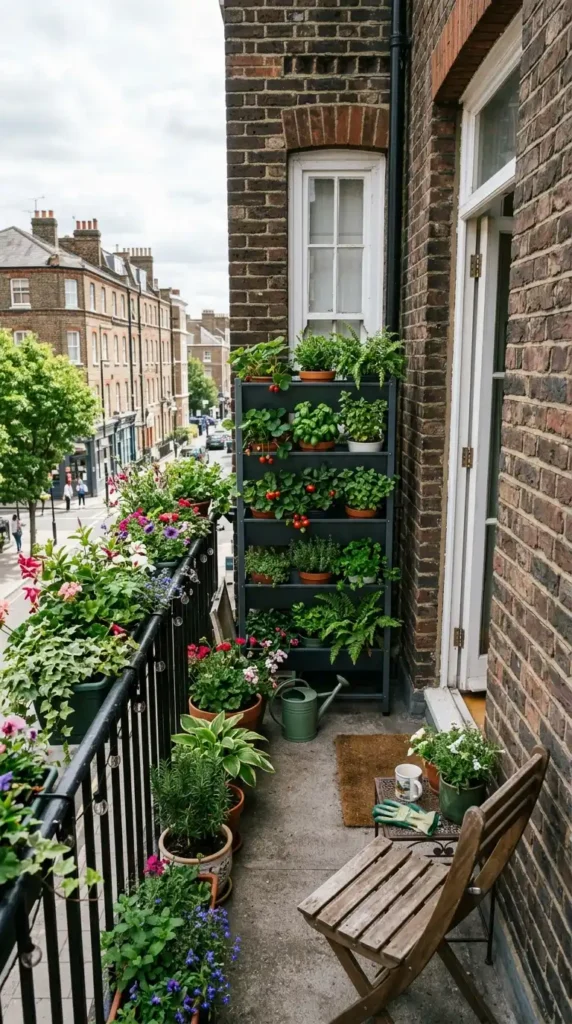
I think freestanding vertical tower planters are the most useful piece of equipment for narrow UK balcony gardening. A tower planter with a 12-inch footprint holds 12 to 20 individual plants in a floor space smaller than a single standard pot.
The freestanding format is important for UK renters specifically — it requires no wall fixings and can be moved inside or taken to a new property when you leave. A freestanding tower beside a railing planter on a 3-foot-deep balcony creates two layers of growing space in what most people would write off as too narrow to garden in.
On a narrow UK balcony every pot placed on the floor reduces the usable passage width. One freestanding tower and two railing planters creates the maximum growing capacity while keeping the floor completely clear for one chair and comfortable movement. That balance is what makes a narrow balcony feel spacious rather than cluttered.
7. Tomatoes on a UK Balcony Done Correctly
✦ Best for: south or southwest-facing UK balconies that receive at least 6 hours of direct sun through June, July, and August
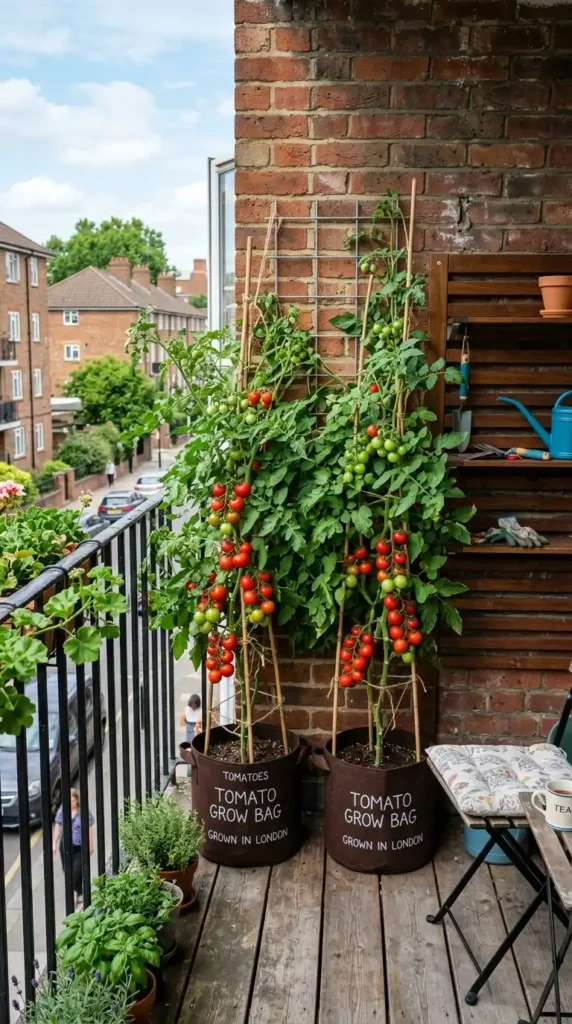
I am cautious about recommending tomatoes for UK balcony gardens because I have seen the disappointment when people plant standard varieties on a partially-shaded British balcony and get minimal fruit by October. The UK growing season is genuinely short and the summers genuinely unpredictable. Variety selection is everything.
The tomato varieties that consistently produce on UK balconies: Tumbling Tom for hanging basket or railing planter use — it trails rather than grows upright and produces cherry tomatoes without staking. Losetto for a compact bush variety that performs in cooler conditions than most. Totem for the most reliably productive container tomato in British weather.
Grow bags against a south-facing wall capture the maximum reflected heat available on a UK balcony. The wall absorbs heat during the day and releases it overnight — creating a slightly warmer microclimate than open air planting that makes a measurable difference to fruit production in the British climate.
8. Low Maintenance UK Balcony Garden for Busy Londoners and City Dwellers
✦ Best for: UK flat residents with demanding schedules who want a balcony that survives periods of neglect without looking abandoned
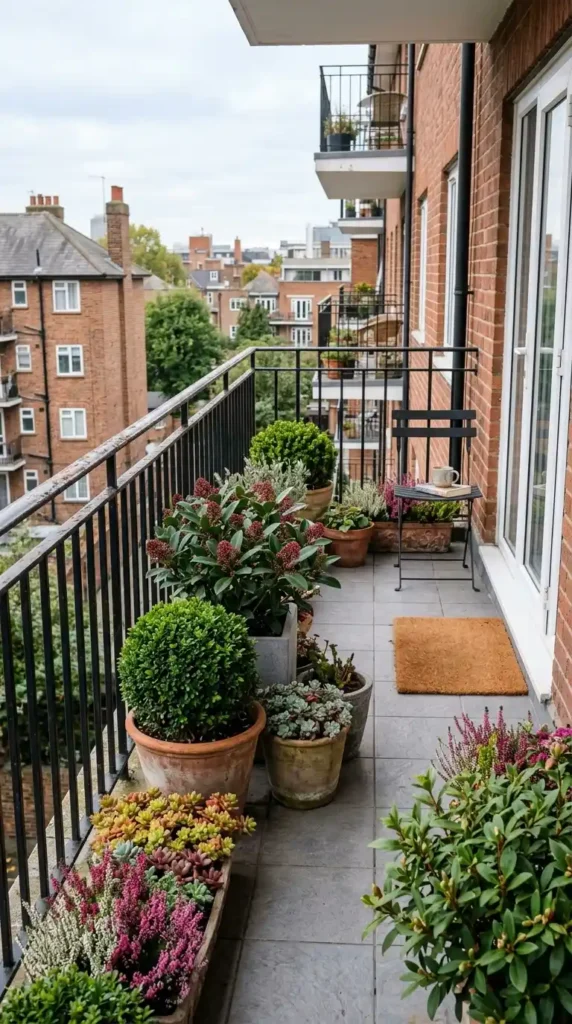
The low maintenance UK balcony garden is the setup I return to most often when advising people in London and other British cities where a demanding work schedule means the balcony genuinely gets ignored for weeks at a time. The UK climate actually helps here — the regular rainfall means many established plants require no supplemental watering for months.
The plants that create the best low maintenance UK balcony: dwarf box (Buxus sempervirens) in a container provides permanent evergreen structure that requires one trim per year and nothing else. Skimmia japonica provides evergreen glossy foliage, red berries in winter, and fragrant spring flowers with almost zero maintenance. Heathers bloom for months and require no deadheading or feeding.
Self-watering containers are the single most useful purchase for a low maintenance UK balcony. They buffer the inconsistent British rainfall — storing water when it rains and releasing it during dry spells — which means established plants in self-watering containers can genuinely go several weeks without any attention during a typical British summer. For drought-tolerant plant options that suit this approach our drought tolerant plants succulents guide covers the best varieties for container growing.
9. Making a Narrow UK Balcony Feel Like an Outdoor Room
✦ Best for: any UK balcony where the goal is to create a genuine outdoor sitting space rather than simply a place where plants happen to be
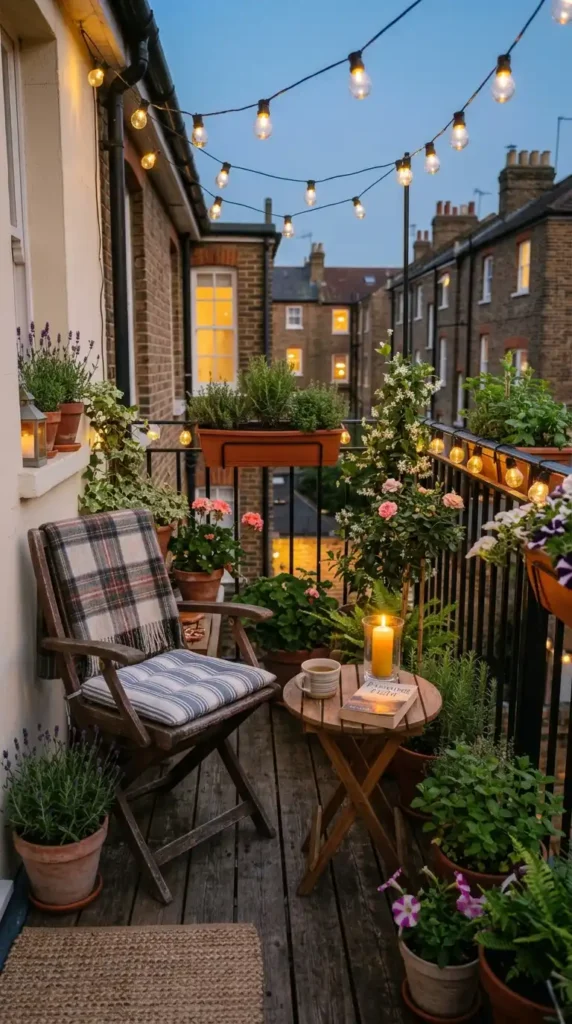
My favourite UK balcony garden transformation I have seen involved no additional plants at all. The person added one folding chair, a set of battery-operated warm white string lights, and a small side table for a coffee. The balcony they had been ignoring for two years became the place they spent every dry evening of the summer.
One good chair fits on even the narrowest UK balcony. A folding canvas director’s chair takes up 20 by 24 inches of floor space when open and folds flat against the wall when not in use — solving the space problem completely. On a 3-foot-deep balcony that leaves enough room to stand, move, and have a pot or two beside the chair.
Warm white string lights only on a UK balcony. Cool white lights make the space feel like a car park rather than somewhere to sit and relax. Battery-operated means no outdoor socket needed — a practical consideration on most British flats where a balcony power outlet is not standard. A strand of warm white battery lights costs under £15 and is genuinely the highest-return purchase available for a UK balcony garden.
Frequently Asked Questions
What grows well on a UK balcony?
Herbs including rosemary, thyme, and chives, salad leaves, ferns, impatiens, heathers, and sempervivums all perform reliably in UK balcony conditions. According to the Royal Horticultural Society, container gardening on balconies and patios is the fastest-growing form of gardening in the UK with salad leaves and herbs consistently ranking as the most popular and most productive crops for limited outdoor spaces.
What plants survive a windy UK balcony?
Lavender, ornamental grasses, sedums, heathers, and dwarf box all handle UK balcony wind exposure well. Avoid large-leaved plants and tall single-stemmed plants on exposed positions above the third floor.
Can I grow tomatoes on a UK balcony?
Yes on a south or southwest-facing balcony that receives at least 6 hours of direct sun in summer. Use UK-appropriate varieties like Tumbling Tom, Losetto, or Totem rather than standard supermarket varieties which need a longer warmer season than most British summers provide.
How do I garden on a balcony without drilling in the UK?
Over-the-rail railing planters, freestanding vertical tower planters, and Command hook-mounted fabric pocket planters all work without drilling and without violating UK leasehold agreements. These three solutions cover railing, wall, and floor space without any permanent modification.
More Balcony and Garden Ideas
→ 9 American Apartment Balcony Garden Ideas That Actually Fit
→ Balcony Garden Ideas for Small Spaces That Actually Work
→ Container Garden Plants for Shade That Thrive in Pots
→ 9 Deer Resistant Drought Tolerant Plants Neighbors Will Ask About
Conclusion
The UK balcony garden that works is not the one with the most plants. It is the one matched to its actual conditions — the wind exposure, the light levels, the building’s structural limits, and the realistic amount of time the gardener has to maintain it.
I always suggest starting with one railing planter of wind-tolerant herbs and one structural evergreen in a heavy container. Those two elements take 30 minutes to set up, cost under £30, and create an immediate sense of an intentional outdoor space.
The string lights come next. Then the chair. Then the salad leaves. A UK balcony garden builds itself naturally once the first element is in place — and that first element is always simpler and cheaper than most people expect.

Sheikh Hassaan is a digital architect for small businesses and the founder of The Glow Up System. He writes about home decor, garden design, and outdoor living for real American homes – practical ideas that work in actual spaces without oversized budgets.