
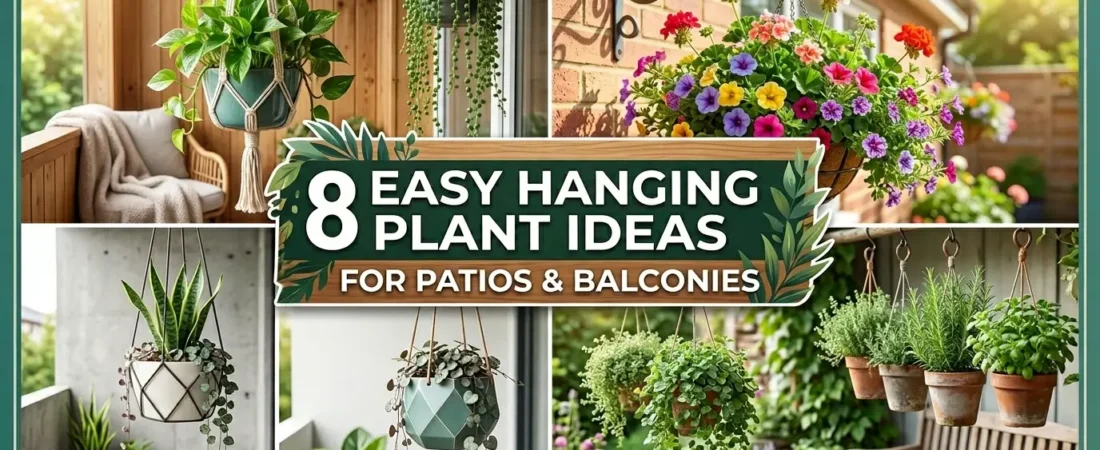
Easy hanging plant ideas for patios and balconies solve a specific spatial problem that floor-level planting cannot: how to add abundant greenery and color to a space without using any of its limited floor area. A hanging plant occupies overhead volume that would otherwise be empty, frames views, softens hard structural surfaces, and creates the layered planting quality that makes outdoor spaces feel genuinely lush rather than simply decorated.
These 8 ideas each address a different hanging plant scenario — from the simplest single basket to a complete balcony hanging garden — with specific guidance on the plant choices, installation details, and care practices that determine whether hanging plants look spectacular or struggle.
Table of Contents
1. Trailing Petunias: The Hanging Plant That Cascades Further Every Week
✦ Trailing Petunia Display
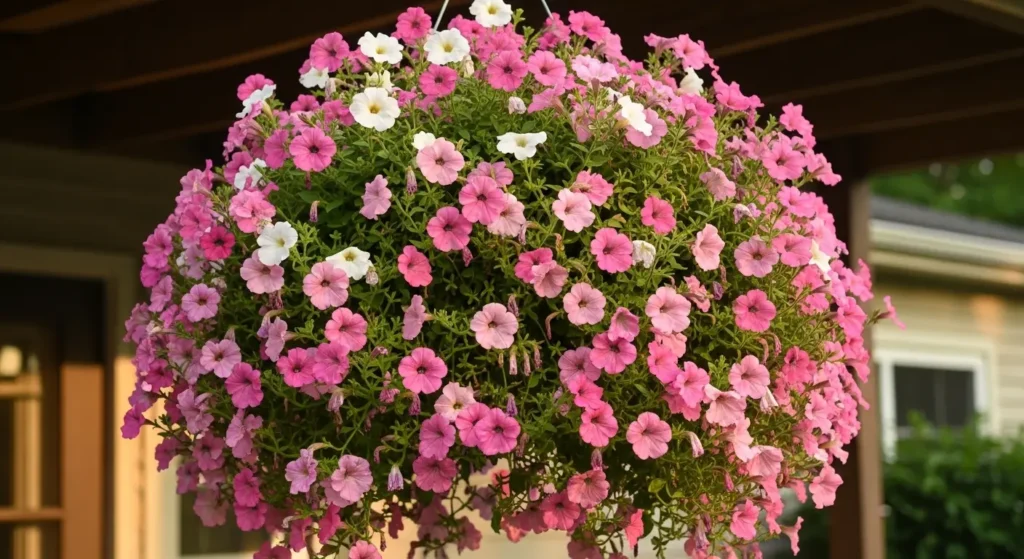
Trailing petunias are the hanging plant that gets better every week rather than peaking and declining. The Wave and Supertunia series produce stems that extend 18 to 24 inches below the basket base by midsummer, creating a cascading flower waterfall that is completely disproportionate in visual impact to the modest basket it originates from.
The critical detail that separates spectacular trailing petunia baskets from mediocre ones: pinching. When new plants are first installed in a basket pinch out the growing tips of every stem to encourage branching. One unpinched stem produces one trailing stem. One pinched stem produces four to six branching stems, each of which becomes a trailing cascade. The ten minutes spent pinching at planting time determines whether the basket has 8 trailing stems or 48 by midsummer.
Feed every week with a high-potassium fertilizer without fail. Petunias in hanging baskets are genuinely hungry plants — the combination of vigorous growth, continuous flowering, and restricted root volume means nutrient depletion occurs faster than in almost any other container situation. Unfed trailing petunias stop flowering within three weeks of nutrient depletion.
PRO TIP: Deadhead trailing petunias every three days rather than weekly. Unlike many annuals petunias respond to every spent flower removed by producing a replacement bud within 48 hours. A three-day deadheading rhythm keeps the basket at maximum flower density throughout the season. A weekly rhythm allows clusters of spent flowers to accumulate which slows new bud production.
2. Macrame Plant Hangers: How to Hang Plants at Three Heights From One Anchor Point
✦ Macrame Plant Hangers
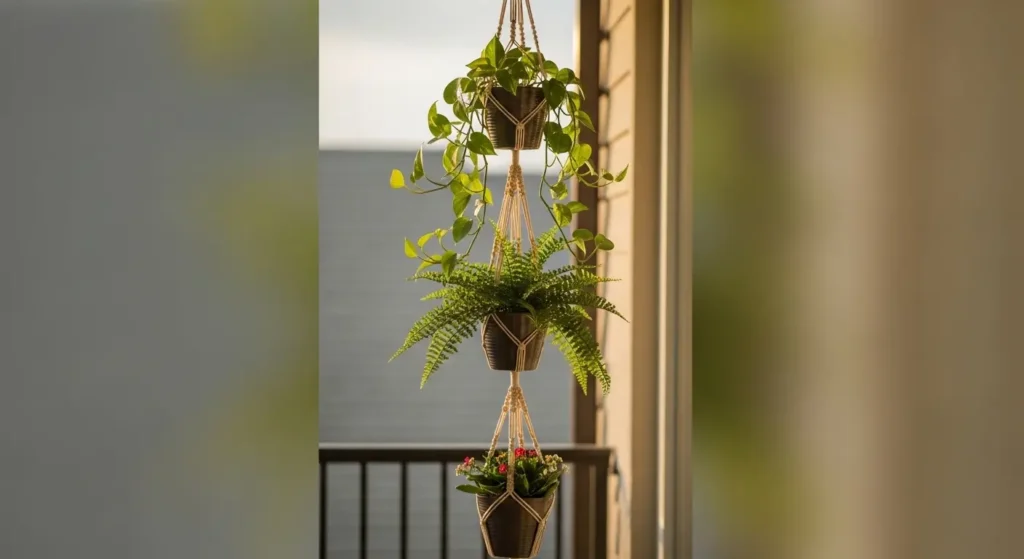
Macrame plant hangers allow height variation that standard basket hooks cannot — the length of the macrame can be adjusted to position each plant at a specific height rather than all hanging at the uniform distance that metal hook brackets provide. A set of three macrame hangers at dramatically different lengths creates a vertical cascade from one anchor point that reads as a designed installation.
The weight capacity of macrame hangers is the installation detail that most often causes failure. Natural cotton macrame cord has a practical load limit of 6 to 8 pounds for a single-strand design and 15 to 20 pounds for multi-strand designs. A standard 10-inch pot with wet compost and a mature plant weighs 8 to 12 pounds. Check the listed weight rating of any macrame hanger before loading — overloaded macrame fails at the knots rather than the cord and drops without warning.
The self-watering hanging planters with macrame rope hangers are specifically designed with load-rated macrame cord appropriate for the planter weight at full saturation. The integrated reservoir also eliminates the most common macrame hanging plant problem — the need to remove plants from the hanger for watering which damages the cord knots over time. Find them linked on Amazon.
3. Ferns in Hanging Baskets: The Shade Solution That Fills With Every Watering
✦ Hanging Basket Ferns
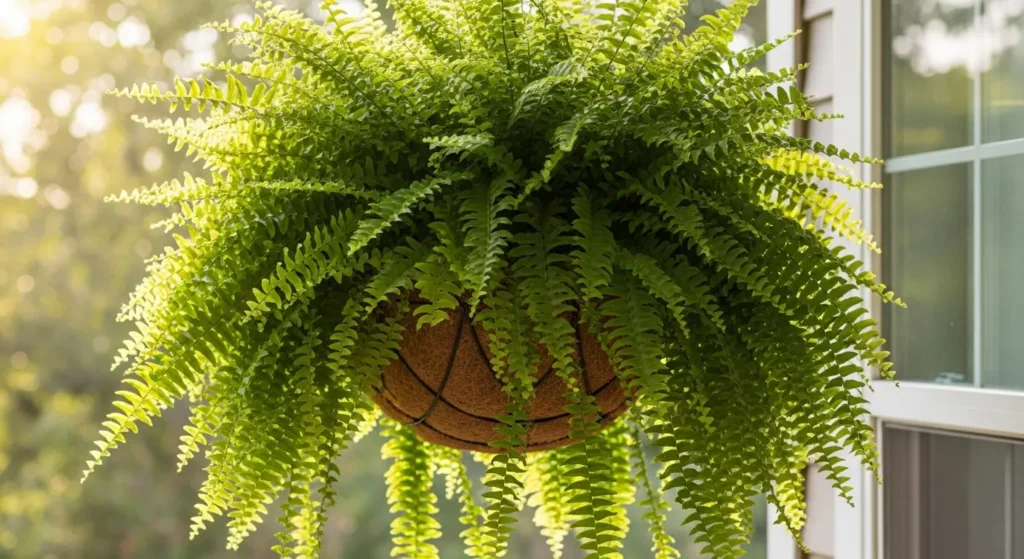
Ferns in hanging baskets solve the problem that defeats most hanging plant choices: shade. North-facing patios, covered porches, and balconies shaded by overhanging structures or adjacent buildings cannot support the sun-loving flowering annuals that populate most hanging basket displays. Boston ferns, sword ferns, and asparagus ferns all produce spectacular hanging baskets in positions that receive no direct sun and minimal indirect light.
The watering requirement for fern hanging baskets is the primary management challenge. Ferns require consistent moisture — they do not tolerate the drying between waterings that petunias and geraniums handle without significant setback. In warm weather a fern basket in a sheltered position needs watering every one to two days. The practical solution is misting the foliage daily in addition to watering the root zone — ferns absorb moisture through their fronds as well as their roots and daily misting in warm dry conditions significantly reduces watering frequency by supplementing root-zone uptake.
Boston ferns (Nephrolepis exaltata) produce the most dramatic hanging basket display of any fern species — the arching pinnate fronds can reach 24 to 36 inches in length in a single season in good conditions. The fronds arch gracefully outward and downward from the basket creating the spherical silhouette that makes fern hanging baskets so visually distinctive.
PRO TIP: Bring fern hanging baskets inside before the first frost and overwinter in a cool bright room with monthly watering. The same fern basket that cost $8 to $12 as a small plant in spring becomes a large established specimen by autumn worth $30 to $40 as a nursery plant. Overwintering and replanting annually saves significant cost while producing better displays each successive year.
4. Ivy in Hanging Baskets: The Year-Round Structure Plant That Improves With Age
✦ Cascading Ivy Baskets
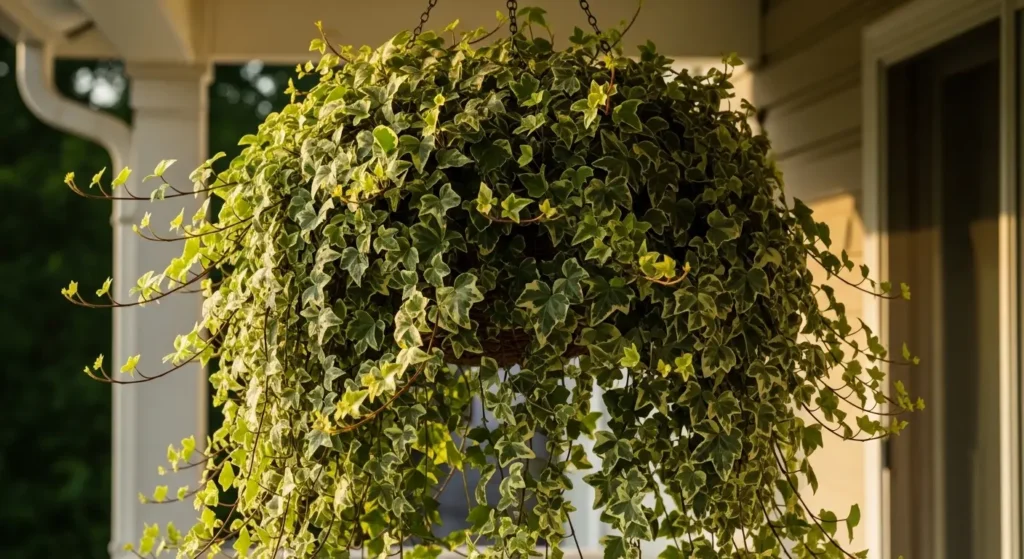
Ivy hanging baskets are the only outdoor hanging plant that looks better in November than in June. While flowering annuals decline and require replacement as autumn approaches ivy continues growing, cascading, and thickening through cooler temperatures that stop most other hanging plants entirely. An established ivy basket by October has cascades two to three times longer than it had in June.
The visual quality of ivy hanging baskets improves annually — unlike flowering annuals that are replaced each spring ivy establishes a progressively larger and more impressive display from the same basket over multiple seasons. A three-year-old ivy basket in a quality large container with well-fed root growth produces cascades that no first-year planting achieves regardless of initial plant quality.
Variegated ivy varieties — Hedera helix ‘Glacier’ with cream-edged leaves, or ‘Goldheart’ with yellow-centered leaves — create more visual interest in hanging baskets than plain green ivy because the variegation catches light differently and maintains visual distinctiveness even from a distance.
PRO TIP: Feed ivy hanging baskets with a balanced nitrogen-rich fertilizer in spring and early summer rather than the high-potassium fertilizer used for flowering plants. Ivy growth is the desired outcome — lush foliage production responds to nitrogen. High potassium fertilizers designed for flowering plants slow the vigorous growth that makes ivy baskets spectacular.
5. Coco Coir Lined Baskets: The Liner That Makes the Basket Beautiful Before a Plant Is Added
✦ Coconut Coir Basket Style
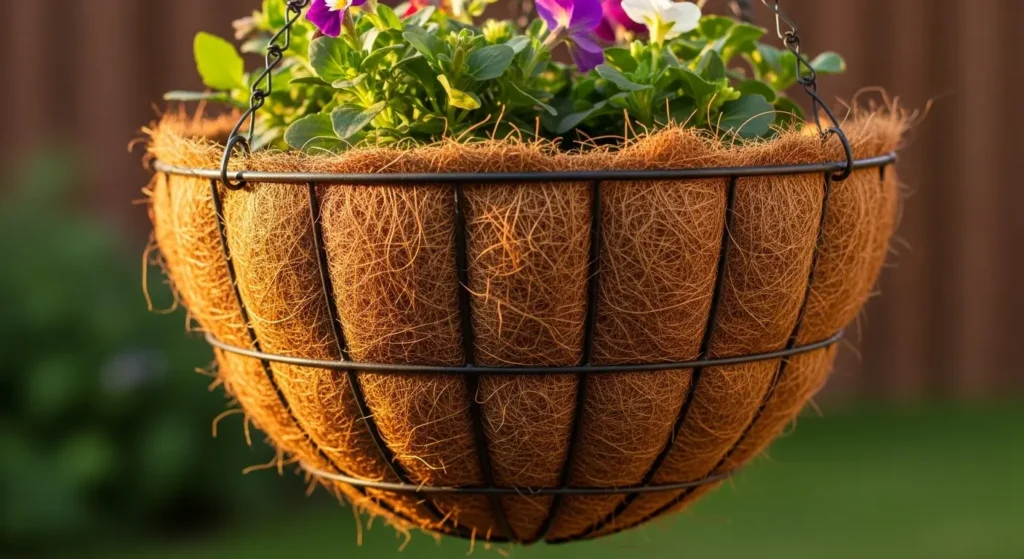
Coconut coir lining transforms an open wire basket from a utilitarian growing structure into an attractive natural display piece before any plant is added. The warm brown fibrous texture of coco coir has genuine visual quality — the natural material creates the rustic organic aesthetic that synthetic plastic liners and foam liners cannot approach.
Coco coir baskets also perform better horticulturally than plastic-lined alternatives because the coir allows planting through the basket sides as well as the top. Pushing plant root balls through small slits cut in the coir liner around the basket circumference creates a ball-shaped display where plants emerge from every surface simultaneously — the traditional hanging basket technique that produces the globe of flowers that makes the best hanging basket displays so impressive.
For side planting through coir liners: use small plug plants rather than mature plants — the root ball must fit through the liner slit without damage. Plant at an angle pointing downward initially so the stem grows outward before turning upward toward light. The angled downward insertion prevents the plant from slipping out of the basket side before roots establish within two to three weeks.
PRO TIP: Soak a coco coir liner in water for five minutes before installing it in the basket frame. A pre-soaked liner holds its shape during planting and does not wick moisture away from newly installed root balls during the critical establishment period. Dry coir installed around moist root balls can actually draw moisture out of the compost rather than retaining it.
6. Porch Ceiling Hanging Plants: Installation Details That Prevent the Most Common Failure
✦ Porch Ceiling Planters
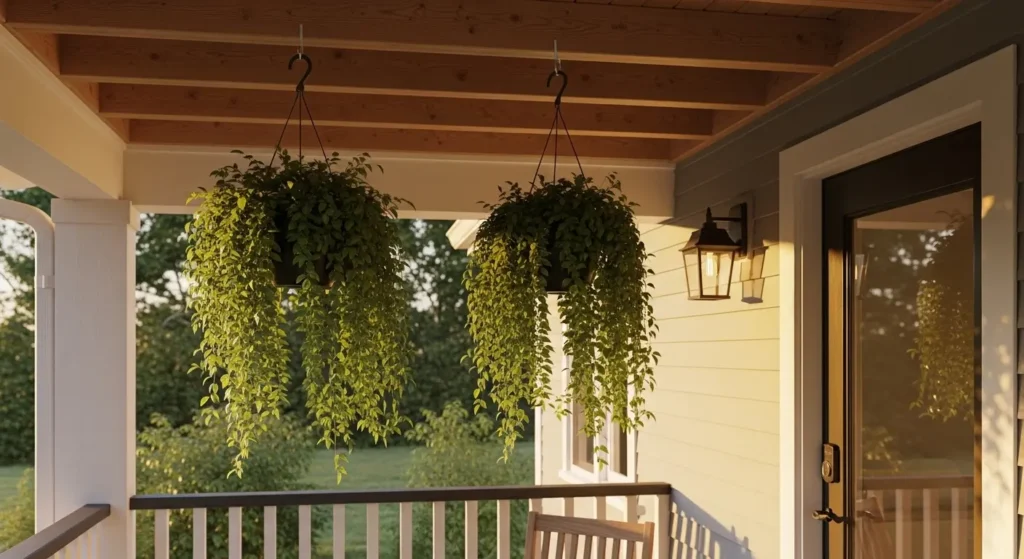
Porch ceiling hanging plants fail most often not because of plant care but because of inadequate installation. A standard porch ceiling plaster or drywall cannot support a loaded hanging basket — the weight must be transferred to the ceiling joists through properly installed hook hardware rated for dynamic loads.
The installation specification for a single hanging basket: a heavy-duty swivel hook with a minimum 50-pound static rating screwed directly into a ceiling joist. Use a stud finder to locate joists before drilling. A 3-inch structural screw into the joist center provides the load distribution that shorter screws into plaster cannot. The swivel feature allows the basket to rotate for even light exposure without the hook unscrewing over time.
For porch positions without exposed joist access — smooth ceilings where joist locations are difficult to determine — use a beam clamp on an exposed porch beam or a tension rod system between porch columns. Never use adhesive hooks for hanging plant weights above 2 pounds regardless of the rated load on the packaging — adhesive hooks rated for static loads fail under the dynamic loading that occurs when a hanging basket moves in wind.
PRO TIP: Install two hooks per basket position spaced 6 inches apart with a short length of chain connecting them as the hanging point. The two-hook installation distributes the basket load across two joist fixings rather than one, doubles the safety margin, and provides a convenient mechanism for adjusting the hanging height by choosing which chain link to hang from.
7. Railing Planter Hooks: How to Add Hanging Plants to Balconies Without Ceiling Fixings
✦ Railing Hanging Pots
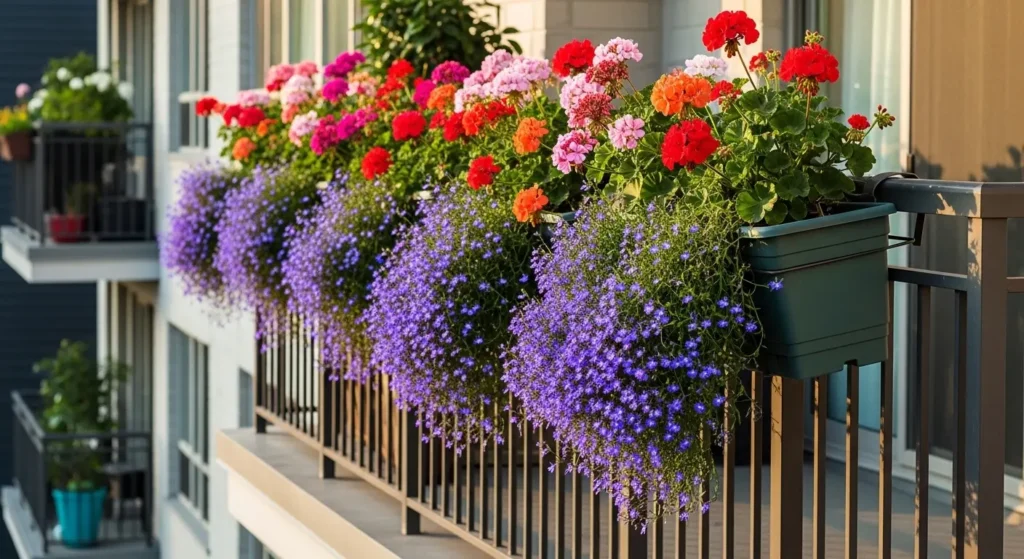
Balcony renters who cannot install ceiling hooks and balconies without overhead structure can achieve hanging plant displays through over-rail planter hooks that grip the balcony railing without any drilling or permanent fixing. Over-rail hooks grip the top of standard railing profiles and support hanging planter weight through compression rather than penetration.
The railing mounting approach has one design consideration that ceiling hanging does not: wind exposure. Balcony railings are typically the most wind-exposed position on any apartment exterior. Plant selections for railing-mounted hanging pots must be wind-tolerant — plants with brittle stems, large soft leaves, or top-heavy growth habits suffer significant damage in wind that ceiling-hung plants in sheltered porch positions never experience.
Wind-tolerant hanging plant varieties for railing positions: trailing geraniums (Pelargonium) which handle wind, salt air, and irregular watering with more resilience than almost any other hanging plant. Trailing verbena which is naturally tolerant of exposed conditions. Succulents and trailing sedums which handle full wind exposure and benefit from the drying effect of air movement. Avoid fuchsias, impatiens, and large-leaved begonias in exposed railing positions — all three suffer leaf damage in wind that significantly reduces their display quality.
PRO TIP: Weight the base of over-rail railing planters with a layer of stones or gravel in the bottom 2 inches before adding compost. The added base weight lowers the center of gravity of the planter and significantly reduces the rocking and tipping that wind causes in lightweight empty-base railing planters. The weight addition costs nothing and prevents the most common railing planter failure mode.
8. Hanging Herb Gardens: The Display That Earns Its Place With Every Meal You Cook
✦ Herb Hanging Planters
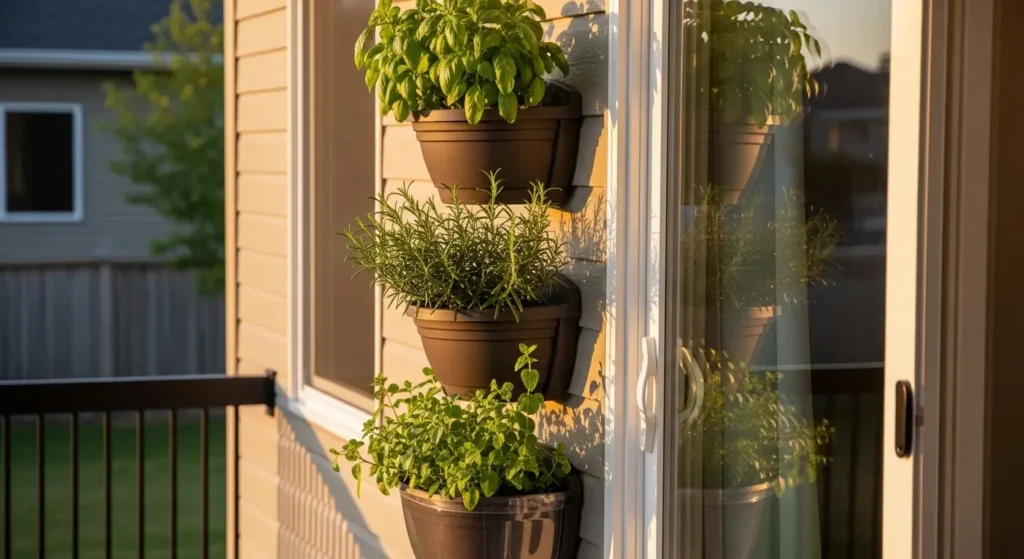
A hanging herb garden positioned beside the kitchen door combines the functionality of a kitchen herb supply with the visual quality of a designed plant display — and unlike floor-level herb planters it uses no patio floor space at all. The vertical hanging format also places herbs at harvest height where they are picked from standing position without bending.
The herb selection that works best in hanging planters focuses on varieties that tolerate the drying between waterings that hanging position accelerates. Mediterranean herbs — rosemary, thyme, oregano, and sage — are ideally suited to hanging planters because their natural habitat is dry rocky terrain that replicates the fast-drying conditions of an elevated hanging position. Basil and mint, which need consistent moisture, require hanging positions with shade from afternoon sun and more frequent watering than the Mediterranean herbs.
Mint must always have its own separate hanging planter — never shared with other herbs. Mint root systems are aggressive enough to escape through the drainage holes of one planter, grow along any surface, and establish in adjacent planters within a single season. One mint plant in its own hanging container is controllable. Mint in a shared planter eliminates everything else within six to eight weeks. The 5-Pack Heirloom Herb Seeds covers the full culinary selection for filling multiple hanging herb planters from seed at a fraction of the cost of purchasing individual established plants. Find them linked on Amazon.
PRO TIP: Harvest hanging herb plants from the top of each stem rather than picking individual leaves. Top harvesting removes the growing tip which triggers branching below the cut. Each top harvest creates two to four new growing stems that replace the harvested one within two weeks. Leaf-picking does not trigger this branching response and produces a progressively bare-stemmed plant rather than the bushy growth that regular top harvesting maintains.
The Hanging Plant Care Calendar
Hanging plants have different care requirements from ground-level containers because elevated position accelerates moisture loss and wind exposure stresses growth. This seasonal care sequence applies to all outdoor hanging plants:
At installation:
Pinch growing tips of all flowering annuals. Check hook installation load rating. Pre-soak coir liners. Water thoroughly and allow to drain before hanging.
June and July — peak season:
Check moisture daily — hanging baskets in sun may need twice-daily watering in heat waves. Feed weekly with high-potassium fertilizer. Deadhead flowering varieties every two to three days. Rotate for even light exposure.
August — midseason assessment:
Cut back any leggy petunias by one third to stimulate fresh branching and autumn flowering. Replace any plants that have finished their season. Continue feeding and watering at full frequency.
September and October:
Reduce watering frequency as temperatures drop. Bring tender plants inside before first frost. Overwinter ivy, ferns, and structural plants for reuse next season. Clean and store baskets and hooks.
📌 More hanging plant and garden ideas → 16 Garden Planter Ideas That Transform Outdoor Spaces
Frequently Asked Questions
What plants are best for hanging baskets on a patio?
The best plants for patio hanging baskets depend primarily on light availability. For sunny positions trailing petunias, trailing geraniums, bacopa, calibrachoa, and trailing verbena all produce spectacular displays. For shaded positions Boston ferns, cascading ivy, trailing begonias, and impatiens perform where sun-loving plants cannot. For year-round structure cascading ivy is the most reliable choice in any position. According to the Royal Horticultural Society trailing pelargoniums (geraniums) are among the most reliable and longest-flowering plants for hanging basket use across a wide range of exposure and climate conditions.
How often should I water hanging baskets?
Hanging baskets in full summer sun typically need watering once to twice daily — more frequently than any other container type because elevated position and full air circulation accelerate evaporation from all surfaces simultaneously. The test is to push a finger 2 inches into the compost — if dry at that depth water immediately. Self-watering hanging planters with built-in reservoirs extend the watering interval to every two to three days by supplying moisture from below as the compost dries, making them the most practical choice for busy schedules or holiday periods.
How do I hang plants on a balcony without drilling?
Balcony hanging plants without drilling are achievable through three methods: over-rail planter hooks that grip the railing top through compression without any drilling. Tension rod systems installed horizontally between balcony walls that support hanging plants from the rod. Freestanding plant stand frames with integrated hanging hooks that sit on the balcony floor and support overhead hanging plants at any height. All three methods provide the vertical hanging plant display of installed hooks without any permanent modification to the balcony structure — important for renters and for buildings that restrict drilling.
Hanging Plants Earn Their Position Every Day They Flower
A well-maintained hanging plant is one of the most constantly rewarding garden investments available. It uses no floor space. It adds color and greenery at the height where people actually look. It creates the layered planting quality that makes outdoor spaces feel genuinely abundant. And when it is performing well it is the element that guests photograph and ask about most.
Choose the hanging plant idea from this guide that suits your patio or balcony conditions. Install the hook correctly. Plant generously. Feed weekly and water consistently. The effort is modest and the result lasts an entire season.
All the products mentioned in this article are linked on Amazon. Every recommendation is something we genuinely believe in.
More Garden and Planting Ideas
→ 12 Cute Mini Garden Ideas For Small Spaces
→ 12 Front Porch Ideas That Instantly Wow
→ 12 Genius Garden Planter Box Ideas
→ 12 Boho Garden Ideas You’ll Love
Choose the hanging plant idea that suits your conditions. Install the hook correctly. Plant generously. Feed weekly and water consistently. The effort is modest and the result lasts an entire season.

Sheikh Hassaan is a digital architect for small businesses and the founder of The Glow Up System. He writes about home decor, garden design, and outdoor living for real American homes – practical ideas that work in actual spaces without oversized budgets.