
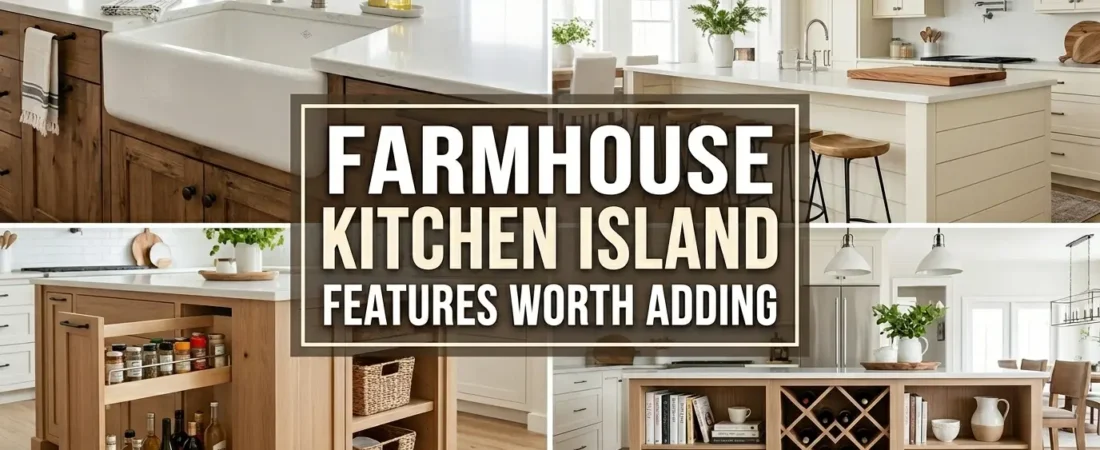
A farmhouse kitchen island is the hardest-working surface in the kitchen and the one with the most potential for both functional upgrade and visual character. The features worth adding to a farmhouse island are not the ones that look best in photographs — they are the ones that change how the kitchen actually works on a Tuesday morning. This guide covers the features that experienced farmhouse kitchen designers specify first and the aesthetic details that make each one look unmistakably farmhouse rather than simply functional.
Whether you are building a new island, upgrading an existing one, or planning a kitchen renovation around the island as the focal point, these features address every dimension of farmhouse island design — storage, surface, seating, lighting, and the finishing details that define the style.
Table of Contents
1. A Butcher Block Countertop: The Most Authentically Farmhouse Island Surface Available
✦ Butcher Block Countertop
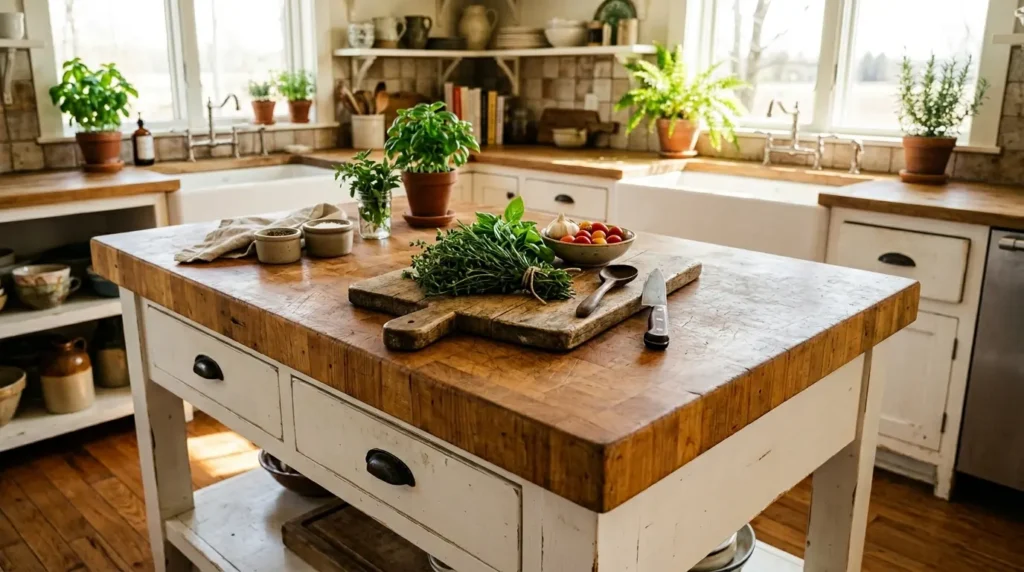
Butcher block is the countertop material most authentic to the farmhouse kitchen because it was the working surface of genuine farm kitchens — used for chopping, rolling pastry, preparing vegetables, and every other food preparation task that made the farm kitchen functional. A modern farmhouse island with a butcher block top references this history while providing a genuinely superior cutting and preparation surface.
End-grain butcher block — where the wood fibers run vertically and the end of each board faces upward — is the most durable and most self-healing option. Knife cuts in end-grain butcher block close over time as the wood fibers swell with moisture. Edge-grain butcher block is the more affordable alternative with a striped linear grain pattern that suits contemporary farmhouse aesthetics.
Maintenance is the primary consideration for butcher block in a kitchen environment. Monthly application of food-safe mineral oil keeps the wood hydrated and prevents cracking, staining, and moisture damage. An island with a sink requires particular attention to the wood around the sink cutout where moisture exposure is highest — a beeswax finish over the mineral oil creates a more moisture-resistant barrier in this zone.
PRO TIP: Apply mineral oil to new butcher block countertops daily for the first two weeks before regular use. The initial oil saturation period fills the wood pores completely and creates the protective baseline that monthly maintenance oil applications maintain. Skipping the initial saturation period leaves the wood vulnerable to staining and moisture damage from the first day of kitchen use.
2. Open Lower Shelving on the Island: Storage That Also Displays
✦ Open Lower Shelving
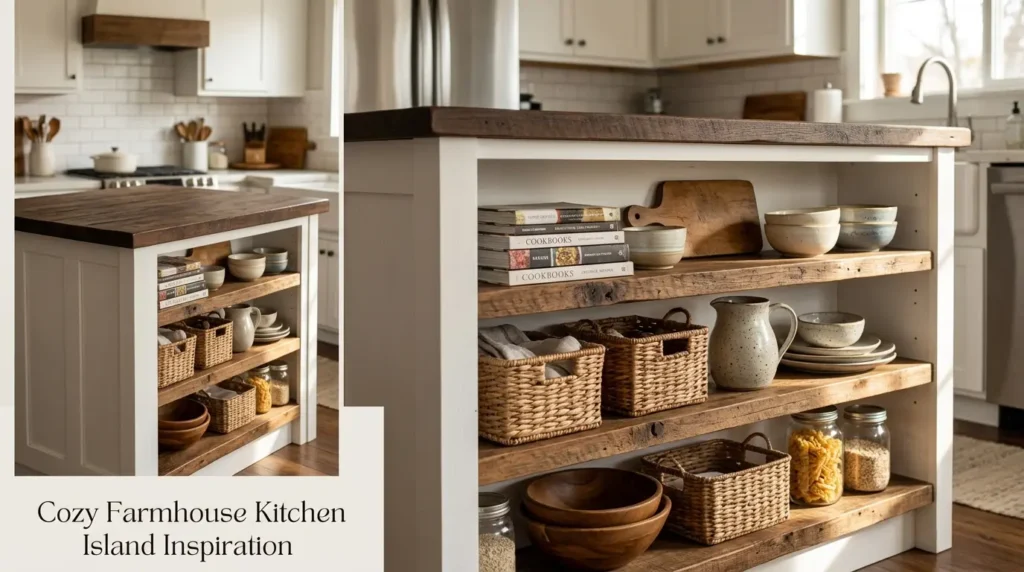
Open lower shelving on a farmhouse kitchen island serves two purposes simultaneously — providing accessible everyday storage and creating the visual display surface that gives the island its character beyond the countertop. A solid-sided island with closed cabinets is functional. An island with open shelving on one or both sides is a visual feature as well as a storage solution.
The items best suited to open island shelving: cookbooks standing upright create height variation and personal character. Wooden bowls in graduated sizes create the organic visual warmth that ceramic or metal cannot. Wicker and rattan baskets holding everyday items maintain the natural material palette while keeping less visually appealing items contained. A collection of matching ceramic serving pieces creates the consistent visual rhythm that makes open shelving look curated rather than accumulated.
The shelf depth for island open shelving should match the depth of the items it will hold — 10 to 12 inches suits cookbooks and standard bowls. Deeper shelves create shadows at the back that make the display look cluttered. Shallower shelves suit decorative items but not practical kitchen storage.
3. A Painted Base With a Contrasting Countertop: The Two-Tone Feature That Defines Modern Farmhouse
✦ Painted Base With Contrasting Top
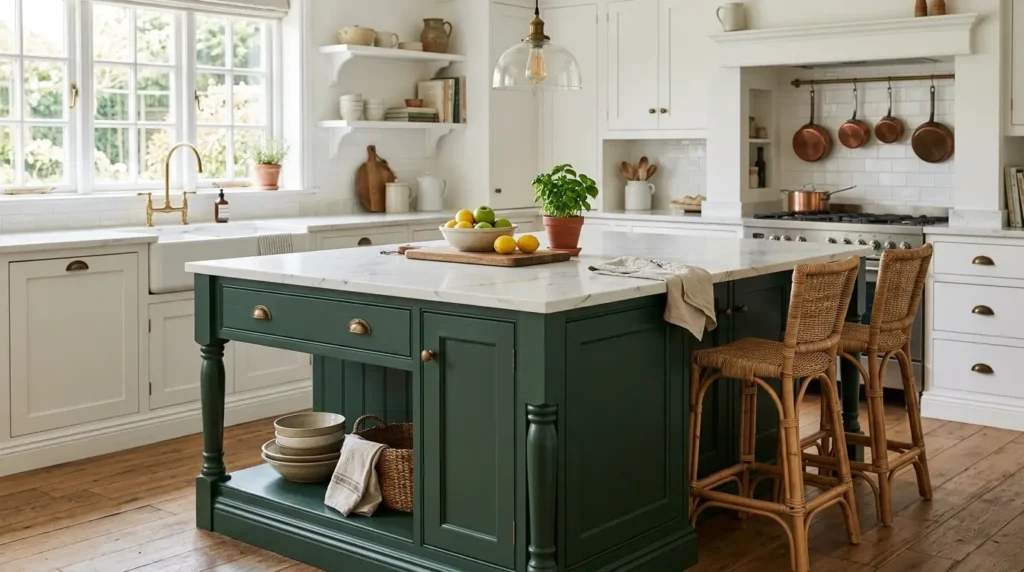
A painted island base in a contrasting color to the perimeter kitchen cabinets is the most impactful single design decision in a farmhouse kitchen because it transforms the island from a functional surface into the room’s focal point. A white kitchen with a dark navy, deep forest green, or classic black island creates the visual anchor that organizes the whole room composition around it.
The color choices that work best for a farmhouse island base: deep navy for a formal yet warm contrast with white cabinetry. Forest green for the color most directly referencing the farmhouse outdoor connection. Classic black for the strongest contrast and the most graphic impact. Warm charcoal for a softer version of the dark island that suits warmer kitchen palettes.
The paint finish matters as much as the color. Furniture-grade alkyd paint in an eggshell or satin finish creates the durable wipeable surface that a kitchen island requires. Standard wall paint in any finish deteriorates rapidly on a surface that is touched, leaned against, and occasionally bumped daily. The correct paint specification is the practical foundation that makes the aesthetic decision lasting.
PRO TIP: Paint only the visible exterior cabinet faces of the island in the contrasting color — keep the interior of island cabinets in white primer for maximum light reflection and cleanliness. The contrasting color on the exterior creates the design statement. White interiors make the storage spaces feel larger and easier to maintain.
4. Pendant Lights Above the Island: The Lighting Feature That Completes the Farmhouse Kitchen
✦ Pendant Lighting Above
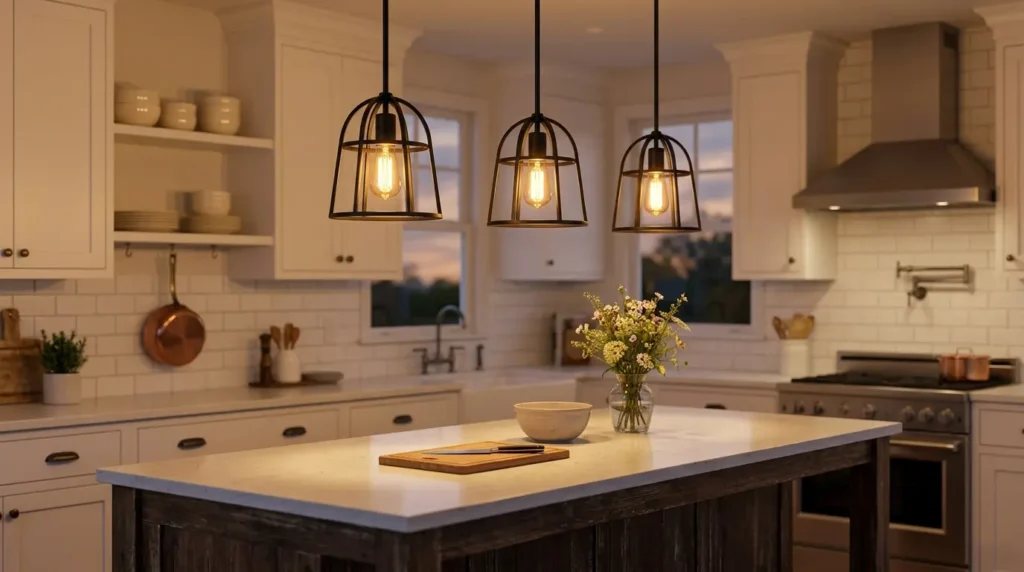
Pendant lights above the kitchen island are the feature that most transforms the visual quality of the space because they operate on two levels simultaneously — as task lighting that improves the practical function of the work surface and as decorative objects that contribute significantly to the farmhouse aesthetic of the kitchen.
The pendant style most suited to a farmhouse kitchen island: black iron cage pendants with Edison bulbs for the industrial-farmhouse aesthetic. Rattan or woven natural fiber dome pendants for the warmer more organic farmhouse look. Enamel dome pendants in white or cream for the classic farmhouse diner aesthetic. Galvanized metal dome pendants for the utilitarian farmhouse character that references genuine working farm lighting.
The hanging height is the installation detail that most determines whether island pendant lights look correct. The bottom of the pendant should hang 30 to 36 inches above the countertop surface — low enough for effective task illumination and visible enough from the dining or living areas to read as a feature, but high enough for seated people at the island to see each other across it without the pendants obstructing the sightline.
PRO TIP: Install pendant lights on a dimmer switch rather than a standard on-off circuit. Full brightness pendants provide excellent task lighting during food preparation. The same pendants at 30% brightness during breakfast or evening drinks create the warm intimate atmosphere that makes the island a genuinely social surface rather than purely a work surface.
5. Shiplap Cladding on the Island Sides: The Detail That Makes a Plain Island Look Custom-Built
✦ Shiplap Island Sides
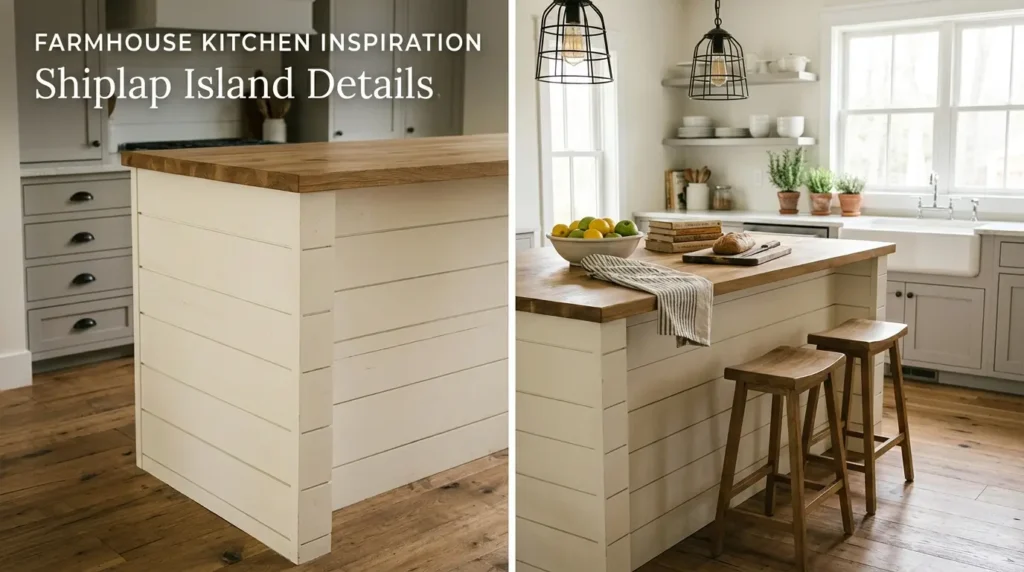
Shiplap cladding applied to the visible sides of a kitchen island transforms a standard flat-sided cabinet unit into a feature that looks custom-built and specifically farmhouse in character. The horizontal board lines add the architectural detail that makes the island read as a piece of furniture rather than a box of cabinets.
The installation: shiplap-effect MDF boards nailed directly to the existing flat cabinet sides. Paint in the same color as the island base for a unified treatment or in a slightly different tone for subtle variation. The board joints should be level and the board ends should be covered with a simple timber edge trim for the clean finished quality that exposed board ends undermine.
Shiplap island sides work equally well on a white island and on a painted contrasting island. On a white island the shiplap adds texture within a monochromatic palette. On a dark navy or forest green island the shiplap creates the horizontal line pattern that adds visual complexity to the solid color.
6. A Generous Seating Overhang: The Feature That Makes the Island a Social Space
✦ Seating Overhang
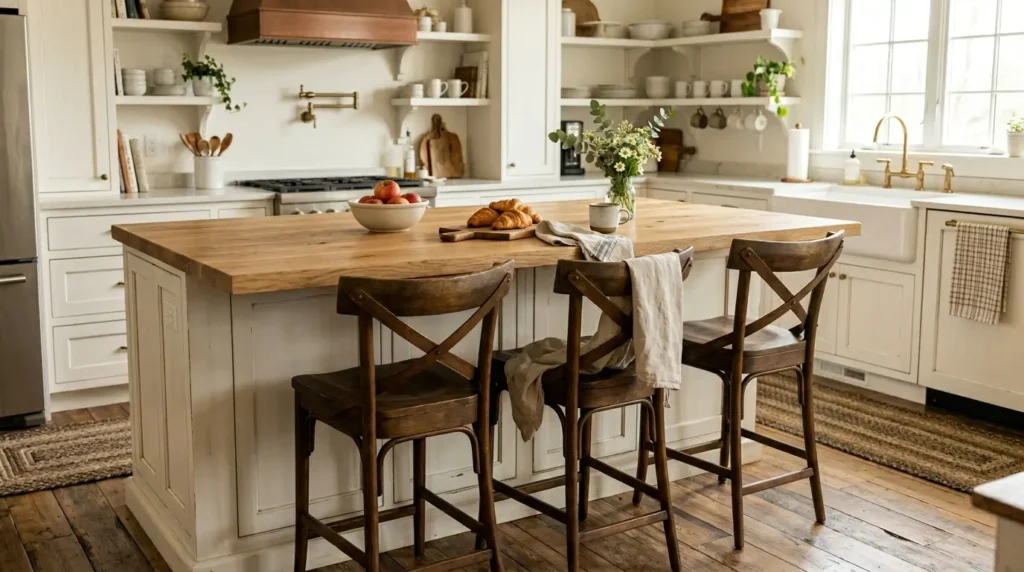
A generous seating overhang on one side of the kitchen island transforms it from a preparation surface into the social center of the kitchen — the place where children do homework while dinner is being made, where guests gather with a drink while the host cooks, and where the family gathers for informal meals. This functional transformation is the most significant upgrade any island feature can provide.
The overhang specification: a minimum of 12 inches of countertop overhang provides knee clearance for seated guests but feels slightly tight. A 15 to 18-inch overhang creates the comfortable seating depth that allows guests to sit with relaxed posture rather than perching. An 18-inch overhang requires countertop support through either thick solid surface material (butcher block or solid stone of 3-inch thickness handles this span unsupported) or corbel brackets underneath.
Farmhouse bar stool selection for the island seating: cross-back wooden stools in natural or painted finish are the most consistent with the farmhouse aesthetic. Windsor-style turned leg stools reference American farmhouse tradition. Rattan seat stools with timber legs bridge the farmhouse and natural aesthetics. All three work at both standard counter height (36 inches — use 24-inch seat height stools) and bar height (42 inches — use 30-inch seat height stools).
PRO TIP: Leave 26 to 28 inches of space between each bar stool center point on the seating overhang. This spacing provides comfortable elbow room between seated guests without wasting available seating positions. An island of 6 feet in length accommodates three stools at 26-inch spacing — a comfortable social gathering number for an informal kitchen seating area.
7. Built-In Spice and Herb Storage: The Practical Feature That Farmhouse Kitchens Do Best
✦ Built-In Spice Storage
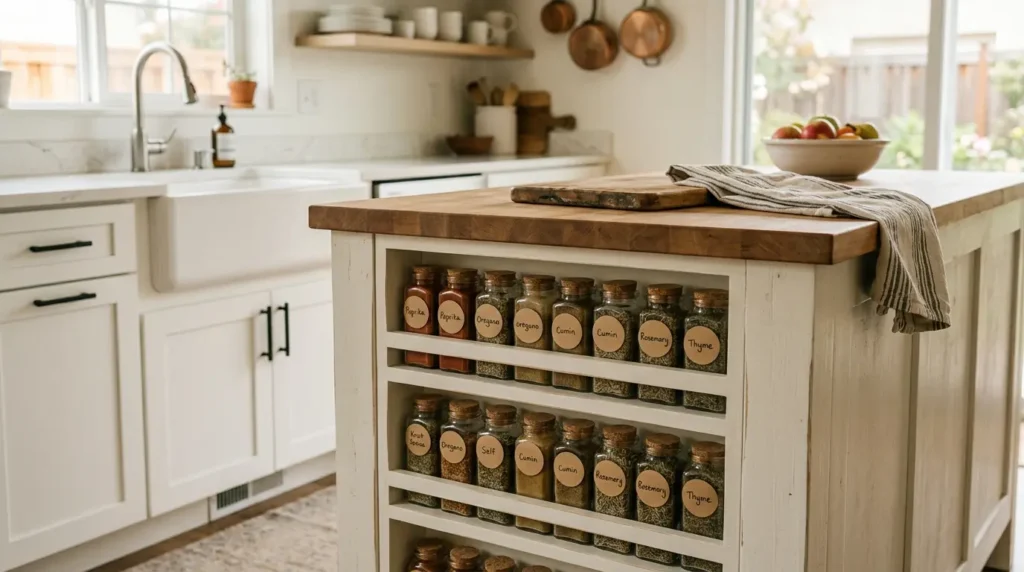
Built-in spice storage on a kitchen island end panel or within a shallow pull-out drawer brings the most-used cooking ingredients to the most-used cooking surface — the island preparation area. The proximity of herbs and spices to the primary prep surface reduces the constant back-and-forth to wall-mounted spice racks or cabinet-stored spice collections that interrupts cooking flow.
The farmhouse spice storage approach: a shallow end-panel rack of 3 to 4-inch depth on the kitchen-facing end of the island holds 20 to 30 small jars at arm’s reach from the butcher block preparation surface. Decant all spices into matching small glass jars with hand-lettered labels — the decanted jar approach is both more practical (uniform jars use the shallow rack more efficiently than varied commercial packaging) and more visually consistent with the farmhouse open-storage aesthetic.
A pull-out spice drawer installed in one of the island’s upper cabinet positions provides the concealed version of the same spice access — a tiered drawer insert holds jars flat with labels facing upward, readable from above when the drawer is pulled open. This approach suits kitchens where open rack storage feels too exposed but the proximity benefit of island spice storage is still wanted.
PRO TIP: Label all spice jars on the lid rather than or in addition to the side label. Spices stored in a tiered drawer are read from above — a side label is invisible when the jar is in the drawer. A lid label in clear handwriting makes identification immediate without removing jars from the rack or drawer.
8. An Island Farmhouse Sink: The Feature That Makes the Island the Kitchen’s Primary Work Center
✦ Farmhouse Sink Integration
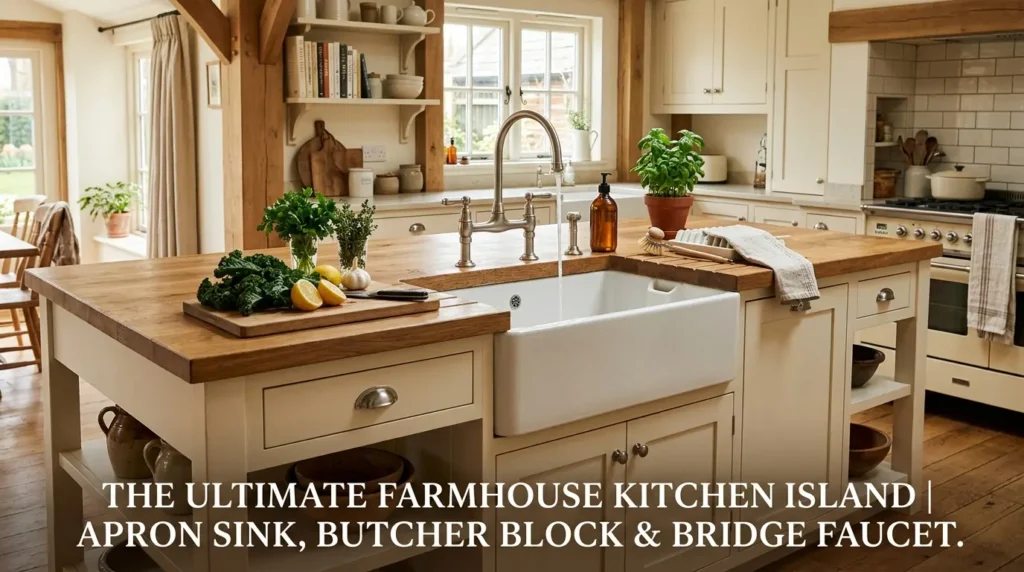
An apron-front farmhouse sink integrated into the island countertop creates the most functional and most visually distinctive island configuration available. The island sink serves as both the primary prep wash station and the visual centerpiece of the island — the deep white ceramic front panel of a farmhouse sink is the single most recognizable farmhouse kitchen element and its placement in the island rather than at the perimeter makes it the room’s undisputed focal point.
The practical consideration for an island sink is plumbing routing — supply and drain lines must run through the floor to an island position rather than through a wall as in standard perimeter sink installations. This is a straightforward plumbing task in a renovation but requires planning in advance rather than being added after the island is installed.
The island sink configuration that produces the most functional kitchen layout: the farmhouse sink centered in the island countertop with butcher block preparation surface on both sides. The two-sided prep surface flanking the sink creates the complete prep-wash-prep workflow that professional kitchen designers specify in serious cooking kitchens.
9. Corbel Details: The Architectural Accent That Makes an Island Look Built-In and Custom
✦ Decorative Corbel Details
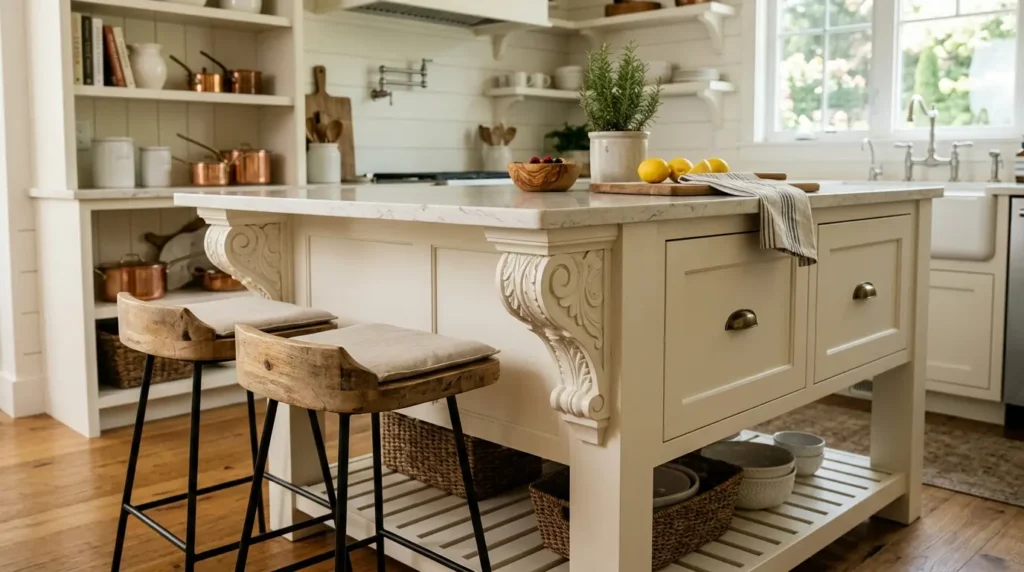
Decorative corbels at the countertop overhang corners of a farmhouse kitchen island add the architectural detail that makes a standard cabinet island read as custom-built furniture. Corbels reference the bracket details of Victorian and farmhouse architecture — their presence on a kitchen island communicates craft quality and intentional design that flat-sided cabinet islands lack.
Corbels for kitchen islands are available in timber or MDF in a range of profiles from simple curved brackets to ornately carved traditional designs. The profile should suit the overall farmhouse aesthetic — simple curves suit the cleaner modern farmhouse look, more carved details suit the more traditional or rustic farmhouse style.
Installation: corbels attach to the island side panel at the point where the countertop overhang begins. They are decorative rather than structural in most applications — the overhang support comes from the countertop material or additional internal framing. Paint corbels in the same color as the island base for a unified treatment. Leaving corbels in natural wood while the island base is painted creates a two-tone detail that suits the rustic farmhouse aesthetic.
PRO TIP: Size corbels proportionally to the island — a large 9 by 6 foot island requires corbels of at least 8 inches height to read at the correct scale. Small corbels on a large island look incidental rather than architectural. The scale of the corbel relative to the island determines whether it reads as a designed detail or an afterthought.
10. Built-In Wine and Bottle Storage: The Feature That Makes the Island a Complete Entertaining Hub
✦ Wine and Bottle Storage
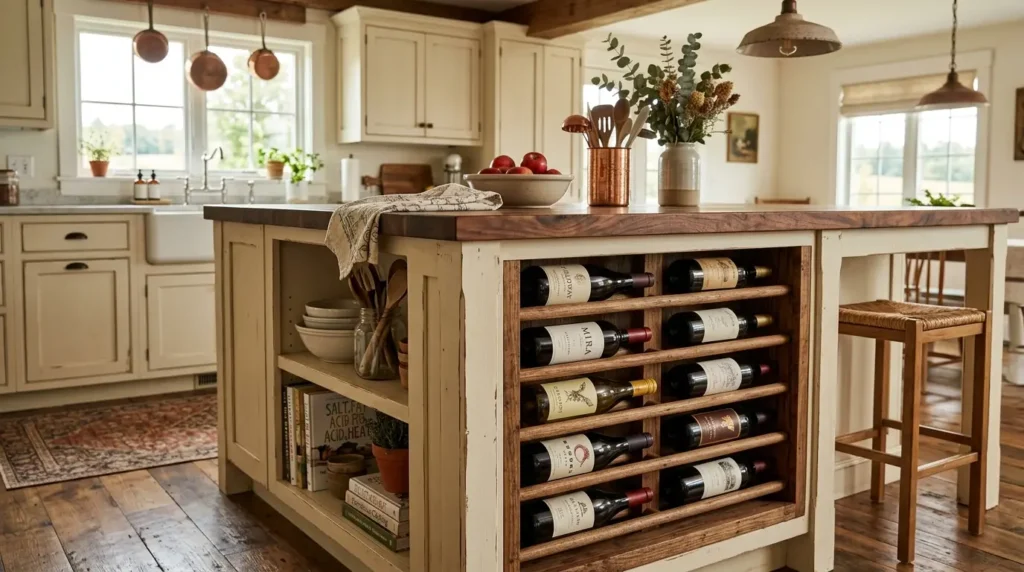
Built-in wine and bottle storage integrated into the kitchen island end panel or lower cabinet section creates the complete entertaining hub that makes the island the natural gathering point for guests. Wine stored at counter level accessible from the island preparation surface eliminates the trip to a separate wine rack or cellar that interrupts both cooking and hosting.
The farmhouse wine rack design: horizontal timber dowel racks holding 8 to 12 bottles in the island end panel create the visual warmth and craft quality that wire or metal wine racks cannot provide. The exposed bottle ends visible from the kitchen side add to the farmhouse open-storage aesthetic — bottles, like jars and baskets, are worth displaying rather than concealing.
For non-wine drinkers the same built-in space accommodates tall bottle storage of olive oil, vinegar, and specialty cooking ingredients — the farmhouse kitchen equivalent of the wine rack that suits the cooking-focused island equally well. The built-in bottle storage section keeps the island countertop clear of the tall bottles that accumulate on preparation surfaces and reduce usable workspace.
PRO TIP: Install a small chalkboard panel on the inside face of the wine rack section door or on the island side panel beside the rack. The chalkboard provides a surface for noting which bottles are in the rack, what is needed from the shop, or simple kitchen notes — a functional detail that adds the hand-written character entirely consistent with the farmhouse aesthetic.
How to Prioritize Island Features by Budget
Not every feature belongs in every budget. This is the sequence that delivers the most farmhouse impact per dollar spent:
Under $200:
Paint the island base in a contrasting color, add shiplap cladding to the sides, and install pendant lights above. These three changes transform the appearance of any existing island for under $200 in materials.
Under $500:
Add a butcher block countertop section, open lower shelving on one side, and corbel details at the overhang. The butcher block section can replace just the island top rather than the full kitchen countertop to keep costs manageable.
Full renovation:
Integrate the farmhouse sink, create the seating overhang with cross-back stools, build in the spice rack and wine storage, and install the full pendant lighting scheme. The complete feature set creates the farmhouse kitchen island that becomes the defining room of the house.
📌 More home decor and kitchen ideas: How To Decorate a Farmhouse Laundry Room
Frequently Asked Questions
What is the most popular farmhouse kitchen island style?
The most consistently popular farmhouse kitchen island combines a painted base in a contrasting color — most commonly deep navy, forest green, or classic black — with a butcher block or white marble countertop, open lower shelving on the kitchen-facing side, and two to three pendant lights above. According to Houzz the dark-painted island with natural countertop is the single most saved kitchen island configuration in the farmhouse style category, appearing in over 60% of farmhouse kitchen renovation projects documented on the platform.
What size should a farmhouse kitchen island be?
A farmhouse kitchen island requires a minimum of 42 inches of clearance on all sides for comfortable circulation — 48 inches is preferred. For a kitchen of 12 by 15 feet or larger a 4 by 6 foot island accommodates a seating overhang on one side, a sink, and open shelving storage. For smaller kitchens a 3 by 4 foot island provides the preparation surface benefit without compromising the circulation clearance that makes island kitchens function rather than obstruct. Standard island counter height is 36 inches — bar height seating islands at 42 inches suit smaller spaces where the island also needs to function as a breakfast bar without a separate dining table.
What countertop looks best on a farmhouse kitchen island?
Butcher block is the countertop most authentic to the farmhouse aesthetic and the most practical for a food preparation island — the surface improves with use rather than showing wear as a flaw. White marble or marble-effect quartz is the premium alternative that suits the more polished modern farmhouse aesthetic and provides a heat-resistant surface that butcher block cannot offer. For a dark-painted island base a white countertop in either material creates the high-contrast two-tone combination that defines the modern farmhouse kitchen island style.
The Farmhouse Island Is Worth Building Around
A fully featured farmhouse kitchen island becomes the room that the whole house gravitates toward — the preparation surface, the gathering point, the homework desk, the breakfast bar, and the visual focal point of the kitchen simultaneously. No other single kitchen feature delivers this combination of practical function and social value.
Start with the features that change the function first — the butcher block top, the seating overhang, the pendant lights. Add the character details — shiplap sides, corbels, contrasting paint — in the second phase. The island improves with every feature added and every one of them is worth the investment.
All the products mentioned in this article are linked on Amazon. Every recommendation is something we genuinely believe in.
More Home Decor and Kitchen Ideas
→ 10 Cozy Christmas Living Room Ideas
→ 12 Front Porch Ideas That Instantly Wow
→ How To Make Fake Christmas Porch Candle Decorations
The island improves with every feature added and every one of them is worth the investment.

Sheikh Hassaan is a digital architect for small businesses and the founder of The Glow Up System. He writes about home decor, garden design, and outdoor living for real American homes – practical ideas that work in actual spaces without oversized budgets.