
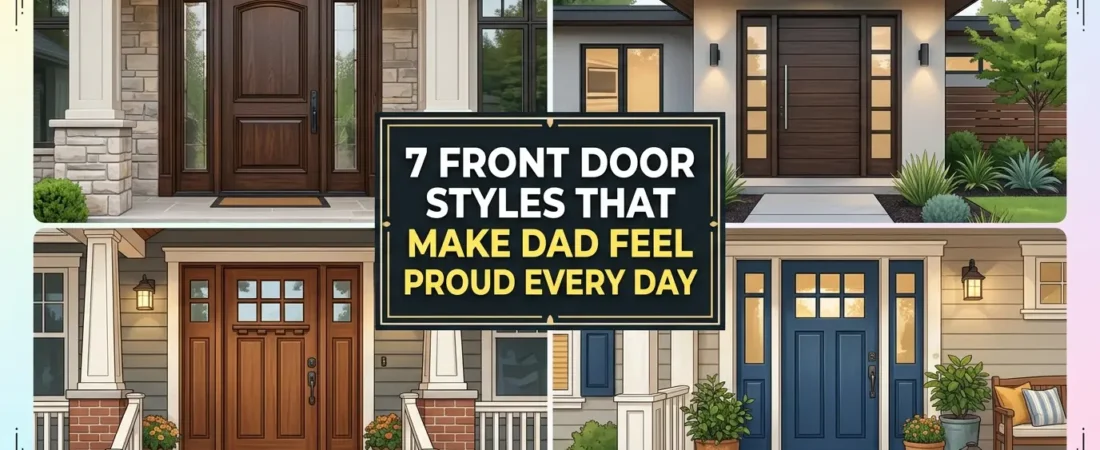
There is a particular kind of satisfaction that comes from pulling into the driveway and actually liking what you see — most homeowners can point to the exact moment their front door stopped feeling like an afterthought and started feeling like a statement. Front door decor ideas that genuinely improve curb appeal are rarely about following a trend; they are about choosing a style, material, and color that suit the house’s architecture and that the person walking through it every day will still be proud of in ten years.
This guide walks through seven distinct front door styles, what makes each one work, the kind of house it suits best, and the practical details — wood species, hardware finish, paint sheen — that separate a door that looks expensive from one that looks merely new. Whether the goal is a full door replacement or simply repainting and re-accessorizing an existing one, every idea here is built to last well beyond a single season of enthusiasm.
Table of Contents
1. The Solid Walnut Slab Door
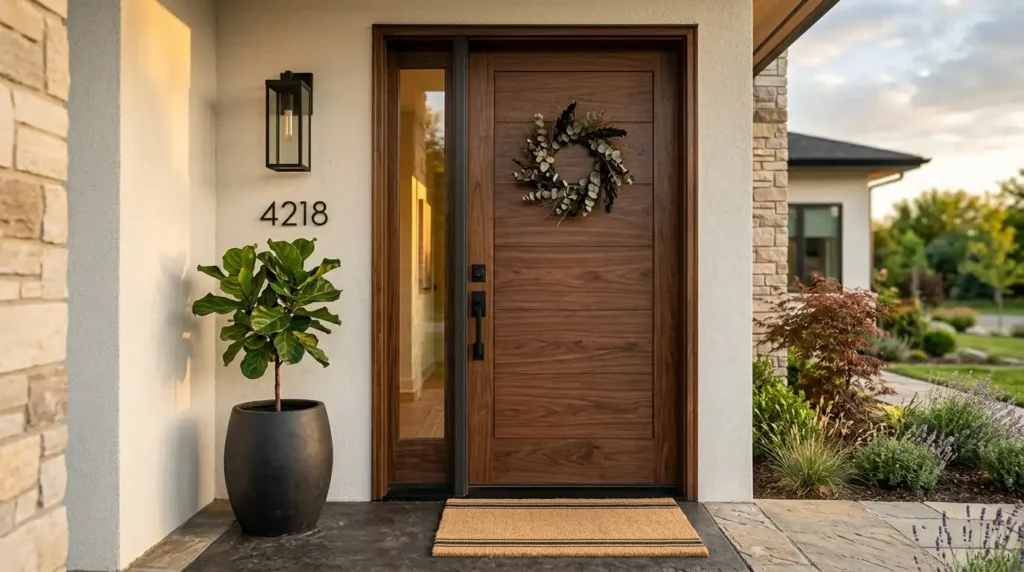
Walk up to almost any architecture magazine’s idea of a high-end modern home and there is a strong chance the front door is a single uninterrupted slab of dark wood. There is nothing fussy about it. No raised panels, no decorative glass, often not even a visible seam — just a wide plane of walnut or a walnut-look composite, usually finished in a satin sheen that lets the grain do all the talking.
This style suits contemporary, mid-century, and transitional homes particularly well, where clean lines elsewhere on the facade would clash with a heavily ornamented door. The contrast that makes it work is between the warmth of the wood and the coolness of whatever material surrounds it — stucco, board-and-batten siding, or stone veneer all read as more sophisticated once a deep wood tone is sitting in the middle of them.
Real walnut is expensive and genuinely requires a covered entry to protect it from direct rain and sun exposure, both of which accelerate fading and checking over time. A fiberglass door with a walnut wood-grain finish achieves nearly the same visual effect at a third of the cost and with essentially no UV maintenance concerns, which is why it has become the more common choice even among buyers who specifically wanted the walnut look.
Hardware matters enormously here. Matte black or aged bronze pull handles in a long vertical bar style read as far more substantial than a small round knob, and they continue the minimal, uninterrupted aesthetic that makes a slab door feel intentional rather than incomplete.
2. Classic Black With Brass Hardware
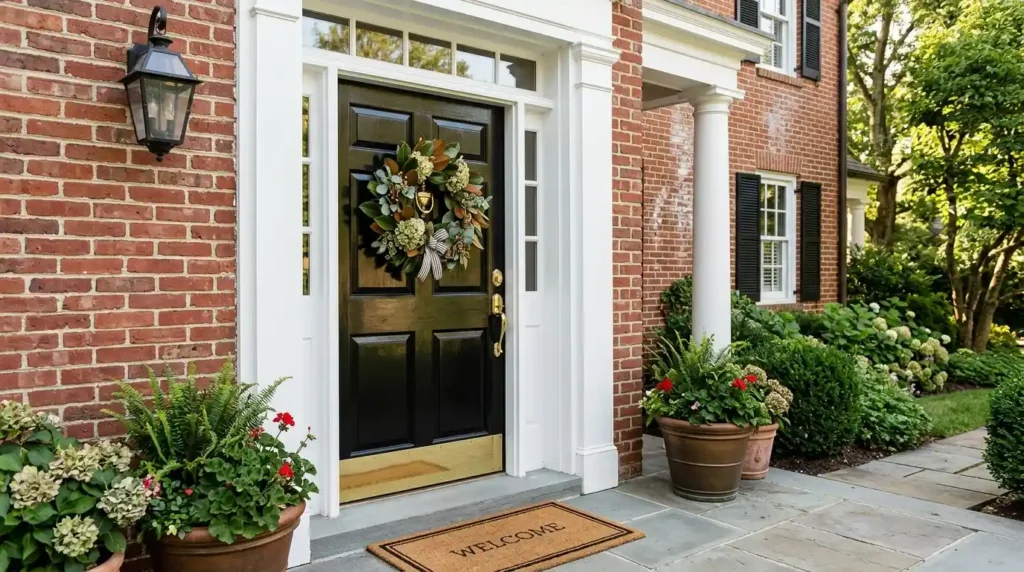
Some combinations never go out of style because they were never really a trend to begin with. Black paired with brass on a six-panel door is one of them — it has appeared on colonial homes, Georgian townhouses, and craftsman bungalows for well over a century, and it still photographs as immediately handsome on a real estate listing today.
Three things make this combination work consistently. First, the contrast level: black is dark enough to look deliberate against almost any siding or brick color, from white to deep red to tan. Second, brass has enough warmth to soften the severity of solid black, preventing the entry from reading as cold or austere. Third, the hardware does real visual work — a substantial brass kick plate, a classic knocker, and a lever handle with a keyed deadbolt cover all add detail without adding clutter.
Use a high-gloss or semi-gloss exterior paint rather than satin or matte for the black door itself. Gloss reflects light in a way that makes the door look freshly painted for years longer than a flatter sheen, and it is also considerably easier to wipe clean of everyday dirt and pollen.
If the brass hardware on hand has gone dull or patchy rather than developing an even, attractive patina, it is almost always cheaper and faster to replace it than to attempt to restore it — a full hardware set including handle, deadbolt, kick plate, and knocker typically runs $80 to $200 depending on quality.
3. Dutch Door With a Half-Glass Top
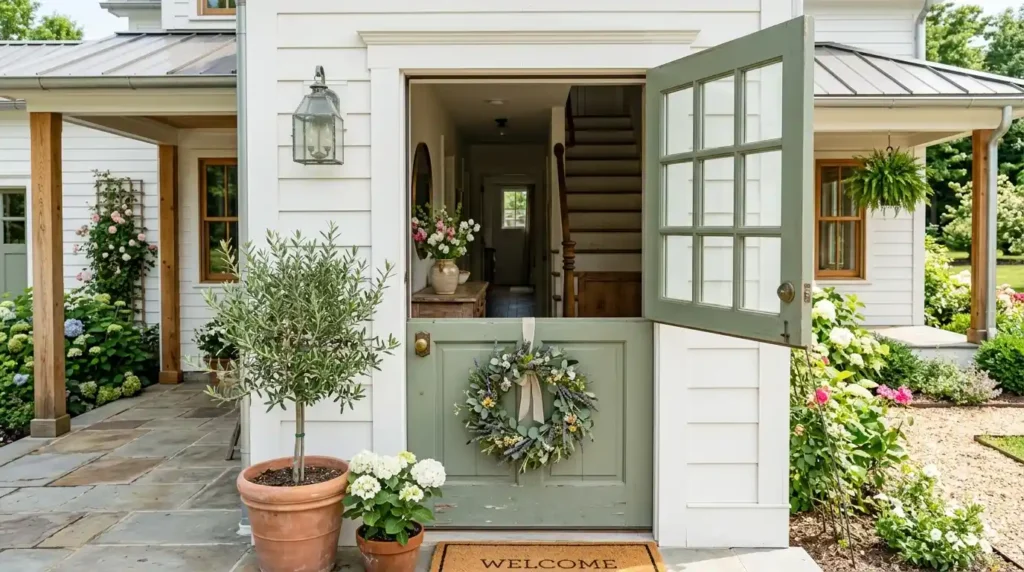
One homeowner who switched from a standard single-panel door to a Dutch door described the change as turning their front entry into the most-used feature of the entire house — not because it looks unusual, although it does, but because the top half opens independently, letting in air and light and allowing a quick conversation with a visitor or a child playing in the yard without fully opening the house to the outside.
The style originated on Dutch farmhouses centuries ago for exactly this practical reason, and it has found a strong second life on American farmhouse and cottage-style homes over the past decade. A divided-light glass panel in the top half is the detail that elevates it from purely functional to genuinely charming, letting daylight spill into an entryway that would otherwise rely entirely on a side window or transom.
This style asks more of its surroundings than a standard door does. Because the horizontal split line is so visually prominent, the door tends to work best on homes with some amount of existing horizontal detail to echo it — board-and-batten siding, a porch railing, or a low garden wall all help the split feel intentional rather than gimmicky.
Sage green, soft denim blue, and warm cream are the three most common paint choices for a Dutch door, all of which lean into the cottage and farmhouse association rather than fighting it. A separate top and bottom latching mechanism is required by design, so budget slightly more for hardware than a standard single-panel door would need.
4. Mahogany With a Deep Red Stain
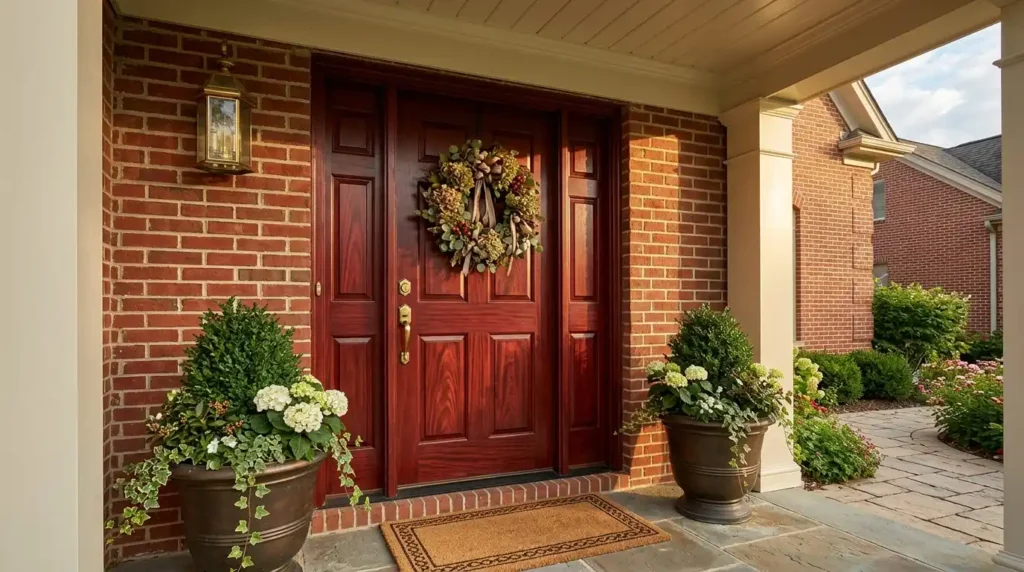
Mahogany has been the wood of choice for serious front doors for generations, and a deep red stain — rather than paint — is what allows it to earn that reputation rather than just borrow it. Stain lets the wood’s natural grain pattern remain visible beneath the color, so every door looks subtly different depending on the specific plank, while paint would flatten that variation into a single uniform surface.
Three stain shades dominate this category: a true mahogany red-brown, a darker oxblood that reads almost burgundy in shade, and a lighter cherry tone that leans more orange. Of the three, the true mahogany red-brown is the most versatile against different brick and siding colors, while oxblood pairs particularly well with gray or white exteriors for a more dramatic contrast.
Maintenance is the genuine tradeoff for choosing stain over paint. A stained wood door needs a fresh coat of exterior-grade polyurethane or spar varnish every two to three years to protect against UV fading and moisture, considerably more frequent than the five-to-seven-year repaint cycle of a painted door. A covered porch or deep overhang significantly extends the interval between refinishing, since direct sun and rain exposure are what break down the finish fastest.
Solid mahogany doors run considerably higher in price than most alternatives on this list, frequently $1,500 to $4,000 installed depending on size and glass detail, which makes this the style most often chosen specifically as a long-term investment piece rather than a quick refresh.
5. Bold Color With a Neutral House
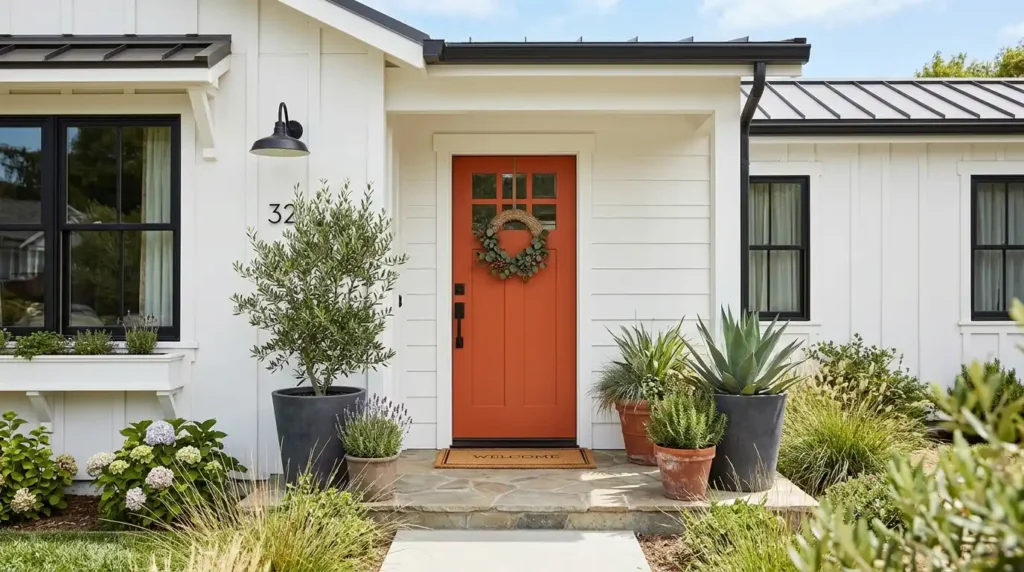
Plenty of homeowners spend years circling the idea of a bold front door color and never quite commit to it, usually out of fear it will look like a mistake rather than a choice. The trick that consistently makes it work is restraint everywhere else — a vividly colored door reads as confident and intentional specifically because the rest of the house’s palette stays quiet and neutral around it.
Terracotta, deep mustard yellow, forest green, and a true cobalt blue are the four bold colors that show up most often in professionally designed exteriors, largely because each one has enough depth and complexity to avoid looking cartoonish or overly saturated against white, gray, or tan siding.
A small test that prevents most regret: paint a sample board in the chosen color and prop it against the actual door location at three different times of day, since direct morning sun, harsh midday light, and shaded late afternoon light can each make the same color read noticeably different. A color that looks perfect at 10 a.m. can look murky or oddly pink by 5 p.m.
Keep hardware finish simple and singular when the door color itself is doing the dramatic work — one consistent black or brushed nickel finish across the handle, hinges, and any house numbers nearby prevents the entry from feeling visually busy or competing with itself.
6. Craftsman Style With Sidelight Windows
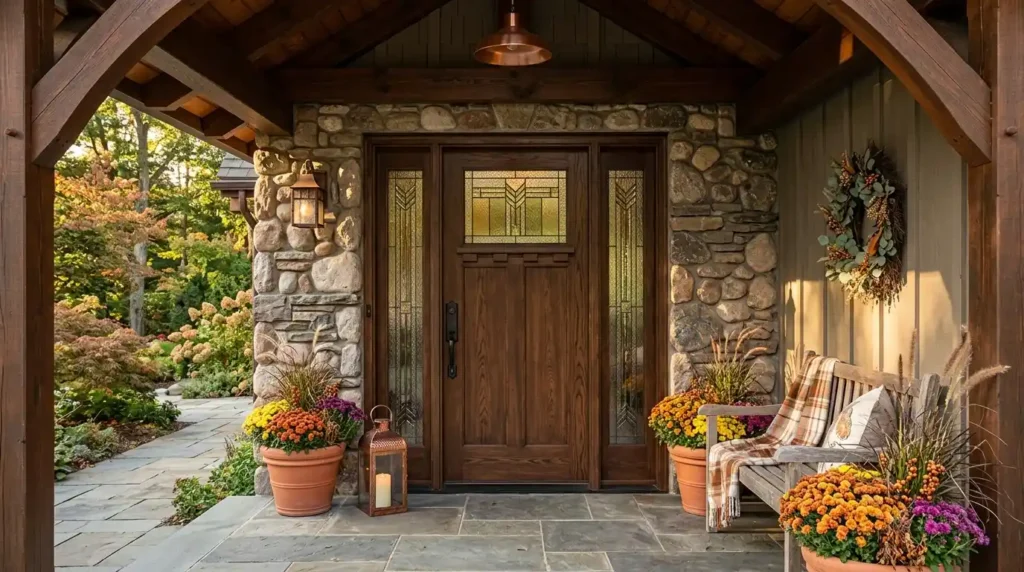
Getting a genuine craftsman-style entry right comes down to four specific elements working together rather than any single dramatic gesture. Skip one and the whole effect tends to read as generic rather than authentically craftsman.
A wide top panel of textured or seedy glass, rather than a small round or oval window, matches the horizontal proportions craftsman architecture favors throughout. Matching narrow sidelight windows on one or both sides of the door extend that glass detail and flood the entryway with diffused natural light. Substantial stone, brick, or tapered wood columns framing the opening echo the load-bearing, handcrafted feel that defines the style. Iron or oil-rubbed bronze hardware, ideally with a hand-hammered or visibly forged texture rather than a smooth machined finish, completes the look.
Dark stains in walnut, espresso, or a deep mahogany-brown are the most common finish choices, since craftsman architecture as a whole tends toward earthy, grounded tones rather than bright or pastel colors.
This style suits homes that already have at least some craftsman or bungalow architectural bones — exposed porch beams, tapered columns, a low-pitched gable roof — far better than it suits a colonial or contemporary home with no existing reference points to support it.
7. Double French Doors With Iron Detailing
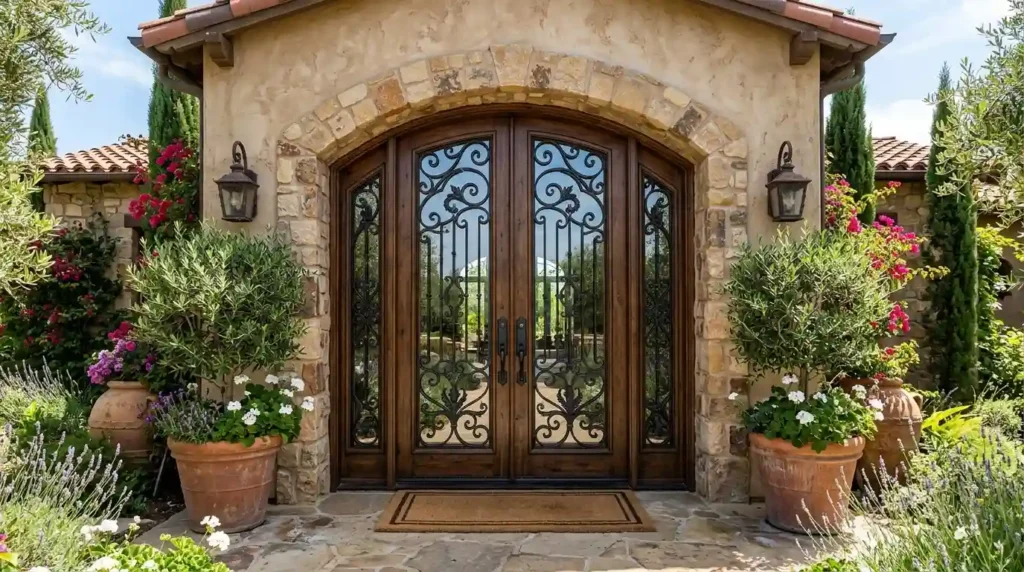
For homes with the architectural scale to support it, a pair of double doors immediately raises the perceived value of the entire entry, and adding iron detailing within the glass panels pushes that effect further still. This is the style most consistently associated with larger Mediterranean, Spanish colonial, and French country homes, where a single standard-width door would look visually undersized against tall ceilings and wide entryways.
The iron scrollwork itself can be a fully decorative insert behind clear or lightly frosted glass, or a functional security grille that still allows light through — both achieve a similar visual richness, but the security grille version offers a genuine practical benefit alongside its looks.
Because this style depends so heavily on scale, it is one of the few on this list that can backfire on a smaller or more modest home. A pair of substantial double doors on a compact ranch or cottage-style house tends to look oversized and slightly absurd rather than impressive, so this is a style best matched carefully to an entry that already has genuine width and height to work with.
Real estate appraisers and agents frequently cite a well-executed double-door entry as one of the more memorable details that helps a listing stand out in buyers’ minds after a day of touring multiple similar homes, even when it is difficult to assign that memorability a precise dollar value on its own.
Symmetrical Entryway Aesthetics That Increase Your Property Value
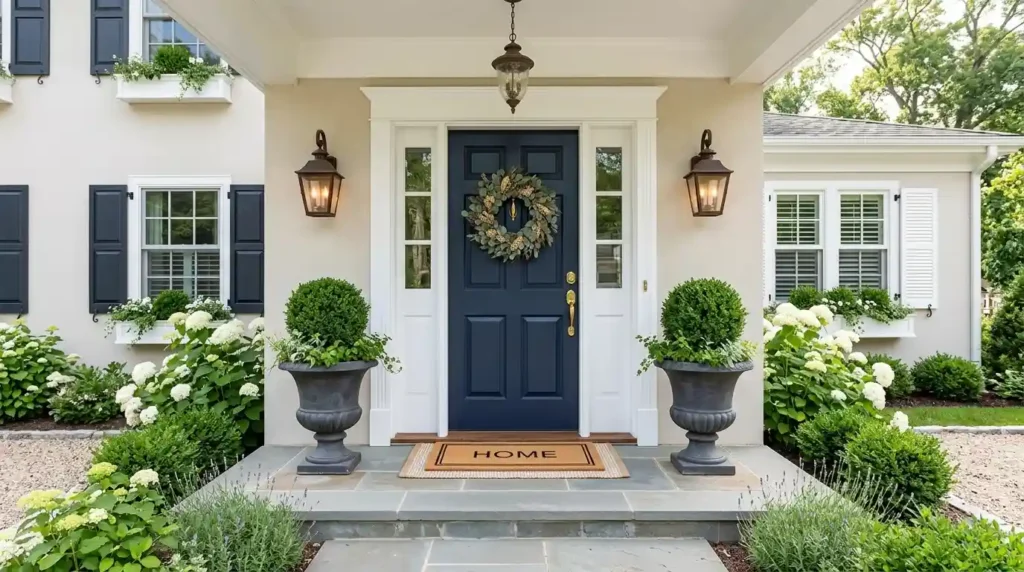
Independent of which door style is chosen, symmetry around the entry is one of the most consistently cited factors in how buyers and appraisers describe curb appeal, and it is also one of the cheapest improvements available since it rarely requires touching the door itself at all.
A matched pair of planters, sconces, or even simple potted topiaries placed at equal distance on either side of the door creates an immediate sense of intentional design, even on a house where the door itself is fairly modest. Mismatched or single-sided versions of these same elements, by contrast, tend to register subconsciously as unfinished or neglected, regardless of how nice each individual piece is.
Wall-mounted sconces flanking the door at matching height are particularly effective after dark, since they frame the entry with light precisely where a visitor’s eye naturally lands first. Solar-powered options have become reliable enough in recent years to make this upgrade accessible even on homes without existing exterior wiring near the entry.
House numbers, a doormat centered precisely beneath the door rather than off to one side, and a single consistent hardware finish throughout all combine with this symmetry principle to produce an entry that reads as cared for at a glance, which several real estate studies have linked to measurably faster sale times and modestly higher offers compared to similar homes with a cluttered or asymmetrical entry.
📌 More home decor ideas: Reading Nook Ideas Around Dad’s Favorite Chair
Frequently Asked Questions
What front door color adds the most value to a home?
Black, deep navy, and certain shades of red consistently rank among the highest-value front door colors in real estate research, largely because they photograph well, suit a wide range of siding and brick colors, and read as classic rather than trend-driven. According to Zillow’s research on home listing language, homes with black front doors have historically sold for several thousand dollars more on average than comparable homes with other door colors, though the exact figure varies by market and year.
Should a front door match the trim or contrast with it?
Most designers recommend contrast between the front door and its surrounding trim, since a strong contrast is what makes the entry the visual focal point of the facade rather than blending into it. A common approach pairs a bold or dark door color with crisp white trim, though the reverse — a light door with darker trim — can also work well on more contemporary homes.
How often should a front door be repainted or refinished?
A painted front door typically needs repainting every five to seven years under normal exposure, while a stained wood door generally requires a fresh protective coat every two to three years due to greater vulnerability to UV fading. A door protected by a deep covered porch or overhang can often go significantly longer between refinishing than one fully exposed to direct sun and rain.
What is the standard size for a front door?
The standard residential front door size in the United States is 36 inches wide by 80 inches tall, though 32-inch and 34-inch widths are also common on older homes. Double-door entries typically use two 36-inch panels for a combined opening of 72 inches, which is why double doors generally require a more generously scaled entry to avoid looking disproportionate.
More Home Decor Ideas
→ How To Build a Cozy Dad’s Retreat Patio Corner
→ 10 Father’s Day Gifts for Gardeners He Will Actually Love
→ Best Ergonomic Gardening Tools for Older Dads
Pick the style that matches the house first, then the color, then the hardware — in that order, almost every front door upgrade turns out right.

Sheikh Hassaan is a digital architect for small businesses and the founder of The Glow Up System. He writes about home decor, garden design, and outdoor living for real American homes – practical ideas that work in actual spaces without oversized budgets.