

Most reading corners fail for one simple reason, they were designed around a vacant chair rather than around the specific way someone actually sits, reads, and unwinds in it. Reading nook ideas built around an existing favorite chair work far better than starting from scratch, because the chair already tells you everything about lighting angle, side table height, and the general mood the space needs to support.
This guide covers how to build a genuinely well-used reading nook around a favorite chair — from positioning and lighting through the side table, storage, and finishing layers that turn a chair in a corner into the spot someone heads to automatically at the end of every day.
Table of Contents
Positioning the Chair Correctly

The single biggest improvement available to most existing reading chairs costs nothing — simply moving the chair into a corner position at a slight angle rather than leaving it facing squarely into the middle of the room. A corner position provides a sense of enclosure on two sides, which makes sitting and reading feel more deliberate and contained rather than exposed in the middle of an open space.
Where possible, position the chair so natural light falls over the shoulder rather than directly ahead — light from behind or to the side illuminates the page without creating glare or forcing the reader to squint toward a bright window. A position near a window but angled slightly away from facing it directly usually achieves this balance correctly.
Balancing Comfort and Aesthetics Around an Oversized Accent Chair
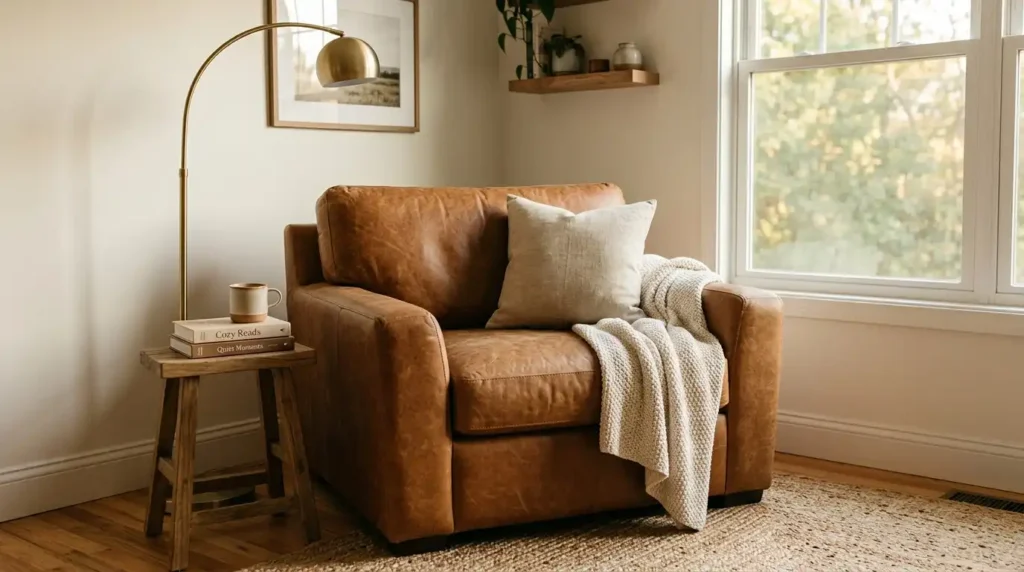
An oversized or well-worn favourite chair often does not match the rest of a room’s decor scheme, and the instinct is sometimes to disguise or minimise it. The better approach is to let the chair remain the visual anchor of the nook and build everything else around it in a simpler, more neutral palette, so the chair’s character reads as a deliberate feature rather than a mismatch.
Keep additional cushions and throws to one or two pieces in a complementary neutral tone rather than competing patterns — an oversized chair already provides enough visual weight on its own, and overdressing it with decoration tends to reduce rather than enhance its comfort and presence.
If the chair’s upholstery is worn but structurally sound, consider this patina an asset rather than a flaw to correct — a chair that looks lived-in signals genuine use and comfort far more convincingly than a pristine, newly upholstered piece sitting unused in the corner of a showroom-styled room.
Lighting the Reading Nook Properly

A single overhead room light is almost never sufficient for comfortable reading — the light level needed directly on a page is significantly higher than what general room lighting provides, and overhead light alone tends to cast the reader’s own shadow across the book. A dedicated reading lamp positioned beside or just behind the chair solves this directly.
An adjustable floor lamp with the light source positioned roughly level with or slightly above the reader’s shoulder when seated provides even illumination across the page without glare. Lamps with a swing arm or fully adjustable head allow this position to be fine-tuned to the specific chair and seated height.
Choose a warm light temperature around 2700K to 3000K rather than a cooler daylight bulb — warm light is considerably more comfortable for extended reading sessions and contributes to the relaxed, wind-down atmosphere the nook is meant to support, particularly in the evening.
The Side Table and Nearby Storage
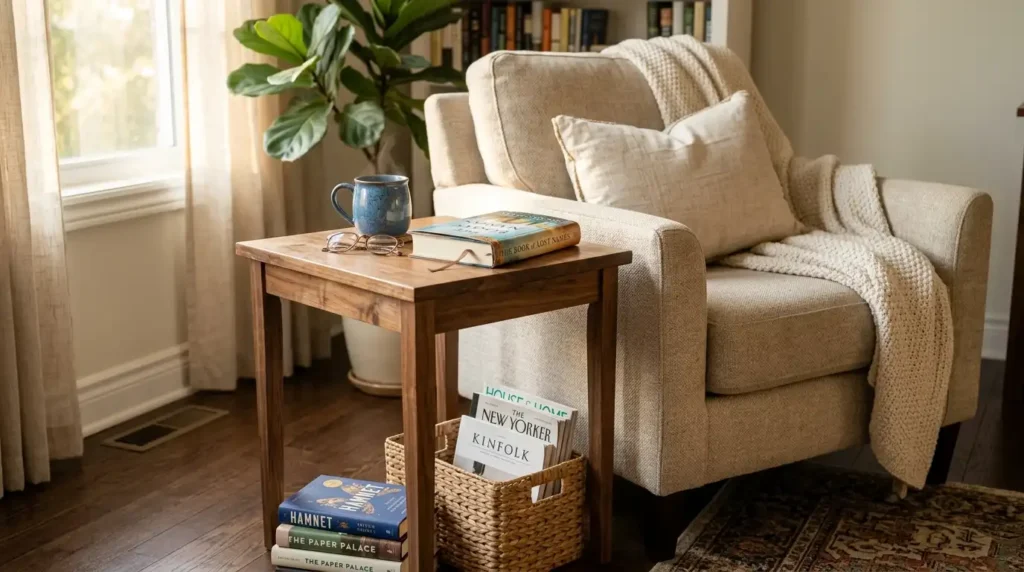
A side table positioned at or just below the height of the chair arm allows a drink, glasses, or a phone to sit within easy reach without needing to lean or get up. A table that is too low or positioned too far from the chair gets used far less than one placed at exactly the right working height and distance.
Nearby storage for books in progress — a small stack on the table, a low shelf, or a simple basket on the floor beside the chair — keeps whatever is currently being read close at hand rather than requiring a trip to another room each time. This small convenience is often what determines whether the chair gets used daily or only occasionally.
Finishing Touches That Make the Nook Feel Complete
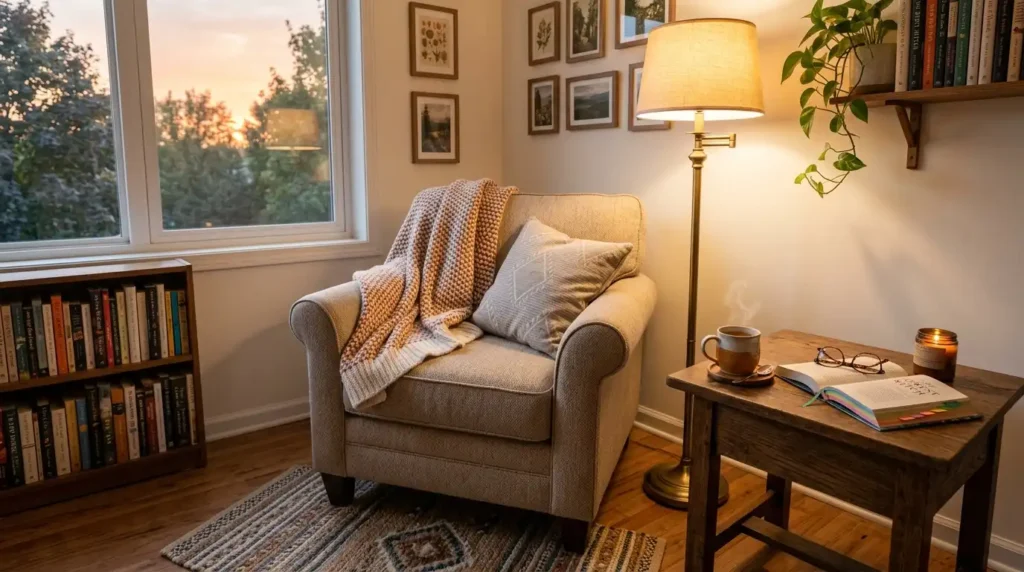
A rug beneath the chair:
A rug positioned beneath and slightly extending past the chair visually defines the nook as its own distinct zone within a larger room, even without any walls or furniture forming a literal boundary.
A throw within reach:
A throw draped over the chair arm or back rather than folded and stored away signals that the chair is in regular use and adds an immediate layer of comfort for anyone settling in for an extended sit.
The goal across every element is the same: remove every small friction that might otherwise discourage someone from settling into the chair for twenty minutes rather than ten. Good light, a table within reach, and a throw close at hand are simple changes, but together they are usually the difference between a chair that gets used daily and one that sits empty most of the time.
📌 More home decor ideas: How To Build a Cozy Dad’s Retreat Patio Corner
Frequently Asked Questions
How do you style a reading nook?
Styling a reading nook starts with positioning the chair in a corner at a slight angle to create a sense of enclosure, ideally with natural light falling over the shoulder rather than directly ahead. Add a dedicated reading lamp positioned beside or behind the chair, a side table at arm height for drinks and books, a rug beneath the chair to define the space, and a throw within easy reach. According to the American Society of Interior Designers, defining smaller functional zones within a larger room through positioning, rugs, and lighting is one of the most effective ways to create a sense of purpose and comfort without structural changes.
What kind of lamp is best for a reading nook?
An adjustable floor lamp with a swing arm or movable head is generally the best choice for a reading nook, as it allows the light position to be fine-tuned to the specific chair height. Position the light source roughly level with or slightly above the reader’s shoulder when seated, and choose a warm light temperature around 2700K to 3000K for comfortable extended reading.
Should I replace a worn but comfortable reading chair?
Not necessarily — a structurally sound chair with worn upholstery often signals genuine, regular use, and many interior designers treat this patina as a feature rather than a flaw. Building the rest of the nook in a simple, neutral palette around the existing chair, rather than disguising or replacing it, usually produces a more authentic and more comfortable result than starting over with new furniture.
How much space do you need for a reading nook?
A reading nook can be created in a space as small as a corner roughly 1.5 by 1.5 meters — enough for a single armchair, a small side table, and a compact rug. The key factor is not overall room size but proper positioning relative to a light source and enough clearance for the chair to be entered and exited comfortably.
More Home Decor Ideas
→ 10 Father’s Day Gifts for Gardeners He Will Actually Love
→ 6 Low Maintenance Houseplants to Gift a Dad This Father’s Day
→ Best Ergonomic Gardening Tools for Older Dads
Fix the light and the side table first. Everything else is decoration — those two are the reason the chair actually gets sat in.

Sheikh Hassaan is a digital architect for small businesses and the founder of The Glow Up System. He writes about home decor, garden design, and outdoor living for real American homes – practical ideas that work in actual spaces without oversized budgets.