

There is a version of a dark, moody, candlelit bedroom that looks genuinely atmospheric and a version that looks like a Halloween display left up too long — and the distance between the two comes down entirely to the quality and intentionality of the choices made. Witchy bedroom decor at its best draws on a specific visual language of natural materials, dark tones, celestial references, and layered candlelight that creates a genuinely beautiful and enveloping sleeping environment rather than a themed room.
This guide covers the witchy bedroom decor ideas that look genuinely magical — organized by category, with specific product and styling guidance that keeps each element reading as design rather than costume and builds toward a complete room aesthetic that works year-round rather than only in October.
Table of Contents
What Separates Genuinely Witchy Decor From Halloween Themed
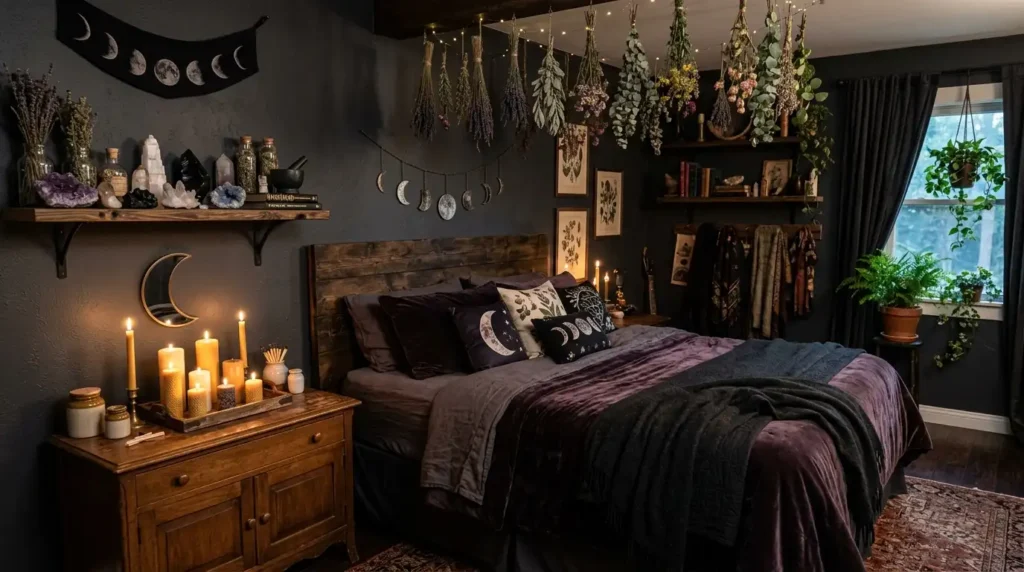
The witchy aesthetic is rooted in a specific relationship with natural materials, cycles, and atmosphere that has nothing inherently to do with Halloween. The visual language it draws on — dark botanicals, candlelight, crystal, aged timber, celestial symbolism, deep jewel tones — belongs to a longer tradition of European cottage and apothecary interiors that predate the commercialized holiday version by centuries. A bedroom designed with this as the reference point looks rich and atmospheric. A bedroom designed with plastic cauldrons and orange accents looks seasonal.
The specific elements that keep witchy bedroom decor on the right side of this line: natural and aged materials rather than manufactured props, a consistent dark color palette that creates atmosphere rather than signaling a theme, real botanical elements rather than artificial ones, and lighting that relies on actual flame or convincing warm-toned LED rather than string lights with plastic covers. Each of these decisions shifts the room from themed to genuinely atmospheric.
The color palette that consistently produces the most genuinely witchy bedroom atmosphere without reading as Halloween: deep charcoal and soft black for walls and bedding, deep plum or midnight burgundy as the jewel tone accent, aged gold and antique brass rather than bright gold for hardware and accessories, and natural wood in dark walnut or ebony stains for furniture and display surfaces. This palette creates depth and mystery without any single element that reads as overtly costumed.
1. Dark Wall Color as the Foundation of the Entire Aesthetic
✦ Best for: a bedroom where the entire aesthetic is being built from scratch or repainted
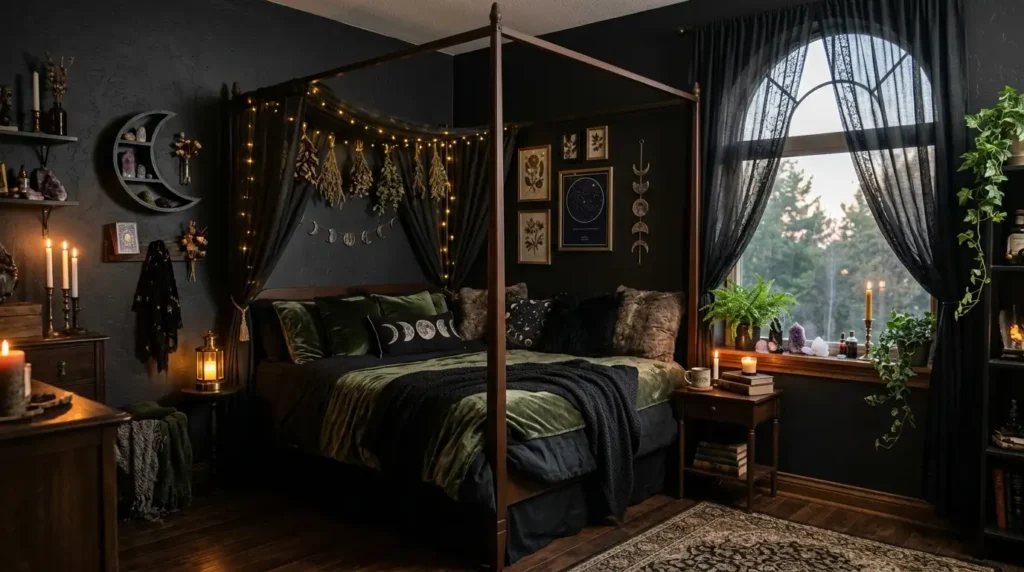
Dark wall color is the single most impactful decision in creating a genuinely witchy bedroom because it transforms the fundamental atmosphere of the space — from a room that feels exposed and conventional to one that feels enclosed, intimate, and genuinely nocturnal. A charcoal, deep forest green, or midnight navy bedroom creates the specific quality of darkness that makes candlelight look genuinely magical rather than merely decorative.
Specific paint colors that produce the best witchy bedroom atmosphere: Farrow and Ball’s Off-Black for the most sophisticated near-black. Benjamin Moore’s Witching Hour (a deep dark plum) for the most explicitly on-theme choice that still reads as designed. Sherwin-Williams’ Inkwell for a warm charcoal that suits bedrooms with limited natural light better than a cooler black. All three are dark enough to create genuine atmosphere without the flat quality of a pure black that absorbs all light uniformly.
The concern most people have about painting a bedroom dark — that it will feel small and oppressive rather than atmospheric — is based on a misunderstanding of what makes dark rooms feel claustrophobic. It is not the dark color itself but the absence of light variation within the dark space. A dark bedroom with multiple warm light sources creating pools of amber light, reflective surfaces like mirrors and metallic accessories catching and redistributing that light, and at least one window with sheer curtains that allow diffuse daylight — this dark bedroom feels atmospheric and enveloping rather than oppressive.
For renters who cannot paint: deep charcoal or forest green peel-and-stick wallpaper applied to the headboard wall only creates a dark feature wall behind the bed that shifts the room’s entire atmosphere without touching the remaining walls. This single wall change has 80 percent of the impact of painting the entire room for a fraction of the commitment.
2. Layered Candles and Warm Lighting That Makes the Room Feel Alive
✦ Best for: transforming any bedroom’s atmosphere after dark without changing any permanent elements
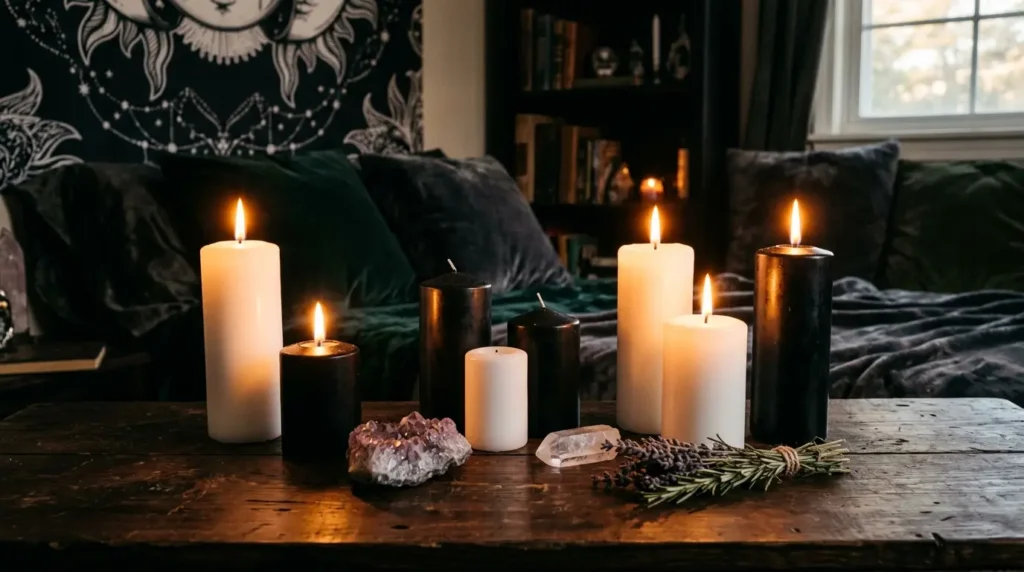
Candles are the most transformative single element in a witchy bedroom because they change the quality of light in the room rather than simply adding illumination. A bedroom with five lit pillar candles on a wooden surface looks and feels categorically different from the same bedroom with overhead lights on — the flickering, directional, warm amber quality of candlelight creates shadows and depth that electric lighting at any temperature cannot replicate.
The arrangement approach that works best for a genuinely atmospheric candle display: a cluster of pillar candles at three different heights on a single wooden surface, combined with two or three taper candles in black iron or antique brass holders at slightly different heights. The variation in height creates a layered effect that reads as an altar or apothecary surface rather than a simple candle arrangement. Group the candles at one end of a dresser or on a dedicated wooden tray rather than scattering them individually around the room.
Scent matters as much as appearance in a witchy bedroom candle arrangement. Frankincense, black amber, patchouli, and dark woods are the fragrance families most associated with the witchy aesthetic — they create an olfactory atmosphere that works with the visual design rather than contradicting it. A white floral or citrus candle in a black holder undermines the room’s atmosphere in the same way that a cheerful blue throw would — the sensory mismatch registers even when it cannot be immediately identified.
3. Crystal Collections and Natural Objects as Display Art
✦ Best for: adding genuine natural material and texture to shelves and surfaces without manufactured decor
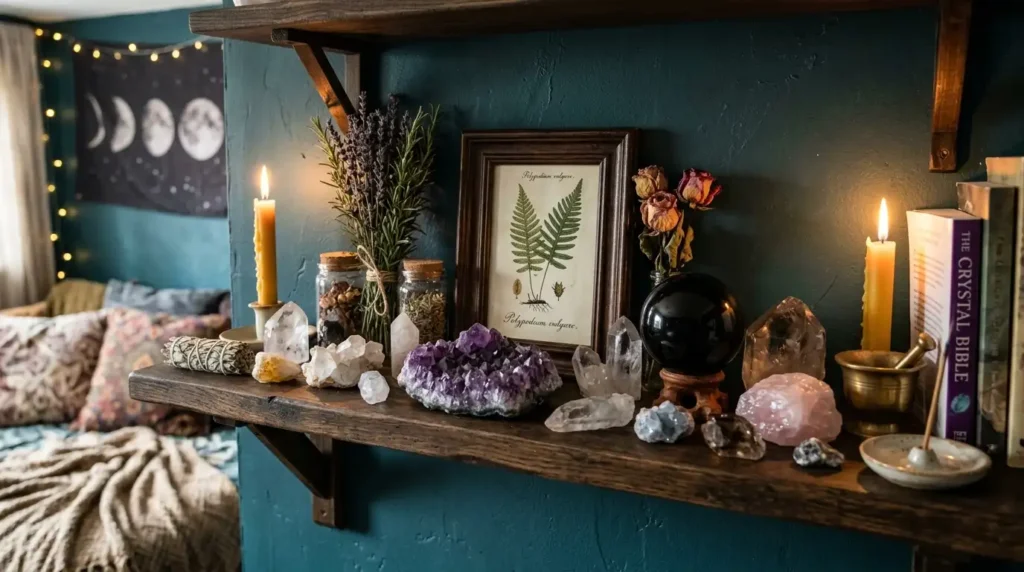
Crystal specimens are among the few decor categories where the real object consistently looks better than any manufactured alternative — a raw amethyst cluster has visual complexity and material authenticity that no resin replica achieves, and the variety of forms within a crystal collection creates the kind of interesting, irregular display that manufactured objects rarely approach. Building a crystal collection over time rather than purchasing a complete set at once also gives the display the accumulated quality that makes it feel genuine rather than assembled.
The crystal varieties that photograph best and create the strongest visual impact in a witchy bedroom display: raw amethyst clusters for the deep purple that suits the color palette. Clear quartz points for the light-catching quality that creates sparkle within the dark room. Black tourmaline and obsidian for the completely light-absorbing matte black that creates contrast with the more reflective crystals. Labradorite for the iridescent flash that appears as the light angle changes — one of the most genuinely magical-looking natural materials available.
Display the crystal collection on a dark-stained wooden shelf or tray rather than directly on a light surface — the dark background makes the crystal colors and forms more visible and creates the apothecary-shelf quality that suits the witchy aesthetic. Mix crystal specimens with one or two other natural objects: a small bundle of dried lavender, a smooth piece of driftwood, a moth specimen in a small glass dome. The mix of natural categories creates a more interesting display than crystals alone.
4. Dried Botanicals and Hanging Herbs for a Living Witchy Ceiling
✦ Best for: adding organic ceiling and wall interest that photographs beautifully and fills the room with subtle fragrance
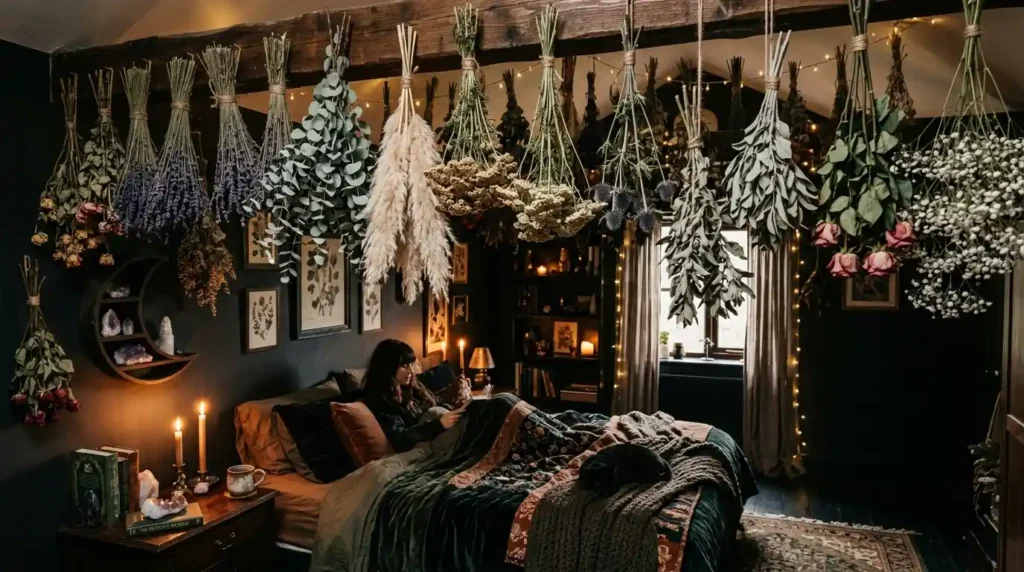
Hanging dried botanicals from the ceiling is one of the defining visual moves of the witchy bedroom aesthetic — it fills the upper plane of the room with organic texture and creates the specific impression of an apothecary or herb room that no wall-level decor can replicate. The ceiling in most bedrooms is completely empty and therefore completely wasted as a design opportunity. Three or four bundles of dried herbs and botanicals hanging from a ceiling hook, curtain rod, or exposed beam immediately transform how the entire room reads.
The botanicals that work best for ceiling hanging in a witchy bedroom: dried lavender bundles for fragrance and the silvery purple color that suits the palette. Eucalyptus stems for the grey-green color and the light clean fragrance that balances heavier candle scents. Dark pampas grass for feathery texture and the slightly haunting quality of its movement in any air current. Dried thistle and seed pods for the gothic botanical quality of their forms.
Tie each bundle with black twine or dark ribbon rather than raffia or natural-colored string — the dark binding material keeps the arrangement consistent with the room’s color palette rather than introducing a light warm tone that reads as incongruous. Hang the bundles at varying heights using different lengths of twine to create a layered effect rather than a flat row at uniform ceiling height.
5. Dark Velvet Bedding and Layered Textiles for Maximum Atmosphere
✦ Best for: creating the rich, enveloping quality that makes a witchy bedroom feel genuinely luxurious to sleep in
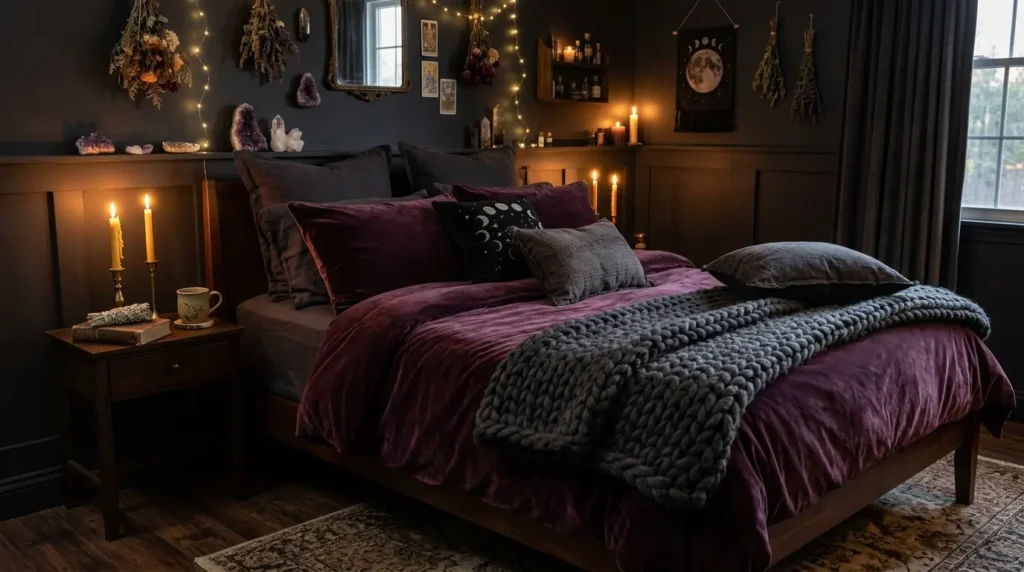
The bed in a witchy bedroom should feel like somewhere genuinely worth retreating to — the combination of dark color and sensory richness that makes the entire aesthetic compelling rather than merely stylistic. Velvet is the fabric that most directly delivers this quality because it changes appearance with the angle of both the light and the viewer’s position, creating the specific depth and sheen that dark cotton or linen cannot achieve.
Deep plum, midnight black, and forest green velvet duvet covers are the three color choices that suit the witchy bedroom palette most directly. Midnight black velvet reads as the most dramatic and the most cohesive with a charcoal or black-walled bedroom. Deep plum adds color depth and suits bedroom walls that are charcoal or dark green rather than black. Forest green velvet creates the most nature-connected version of the aesthetic and pairs beautifully with crystal and botanical elements in the rest of the room.
Layer the velvet duvet with a chunky knit or cable-knit throw in charcoal or deep gray draped across the foot of the bed, and two or three dark linen pillow covers in near-black or dark slate alongside the sleeping pillows. The texture contrast between the velvet surface, the rough knit throw, and the more matte linen creates the material richness that makes the bed feel genuinely luxurious rather than simply dark-colored.
6. Celestial Wall Art and Moon Phase Displays as the Room’s Focal Point
✦ Best for: a feature wall or above-bed position where the primary visual element needs to anchor the entire room’s theme
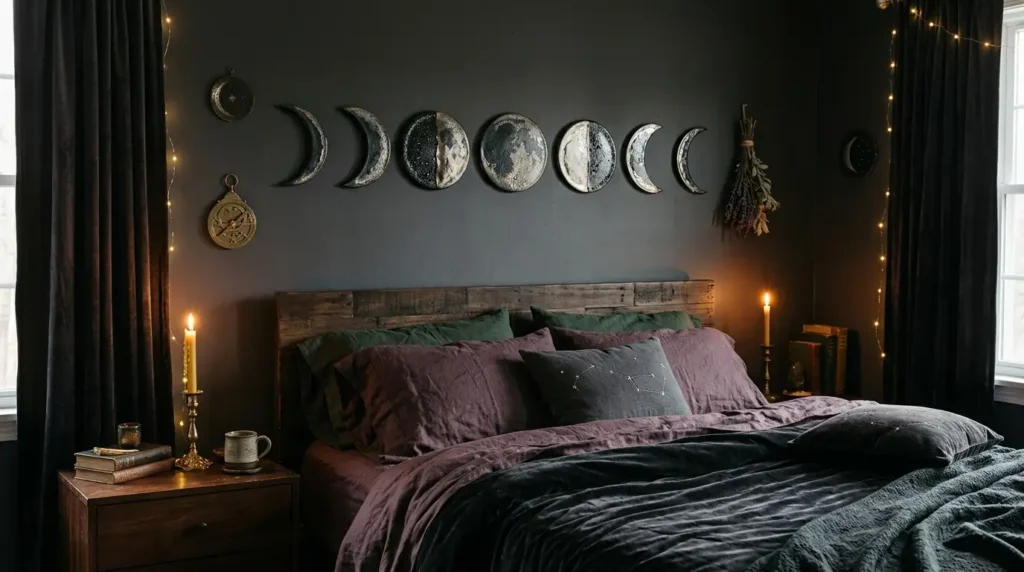
Celestial imagery — moon phases, star charts, astrological wheels — is the most thematically coherent visual element for a witchy bedroom because it references the actual system of beliefs and practices that the witchy aesthetic draws from, rather than the theatrical symbolism of Halloween. A moon phase display above the bed occupies the same visual position as a headboard feature wall and creates a focal point that is simultaneously decorative and meaningful.
The formats that work best: a series of eight ceramic moon phase discs arranged in chronological sequence across the wall above the bed — new moon through full moon and back — creates an elegant horizontal installation that reads as genuine art rather than a decorative print. A single large-format dark-background star chart print in an oversized black frame creates the same impact as a piece of fine art. A hand-drawn or vintage astronomical print in an antique gilded frame introduces the aged-knowledge quality that suits the apothecary dimension of the witchy aesthetic.
The mistake to avoid with celestial decor in a witchy bedroom: too many different celestial elements competing for attention. One strong focal point — moon phase series or single large print — works far better than a wall covered in multiple celestial prints, crescent moon hooks, star-shaped lights, and constellation stickers simultaneously. Restraint with the celestial elements makes each one more significant.
How To Pull the Complete Witchy Bedroom Together
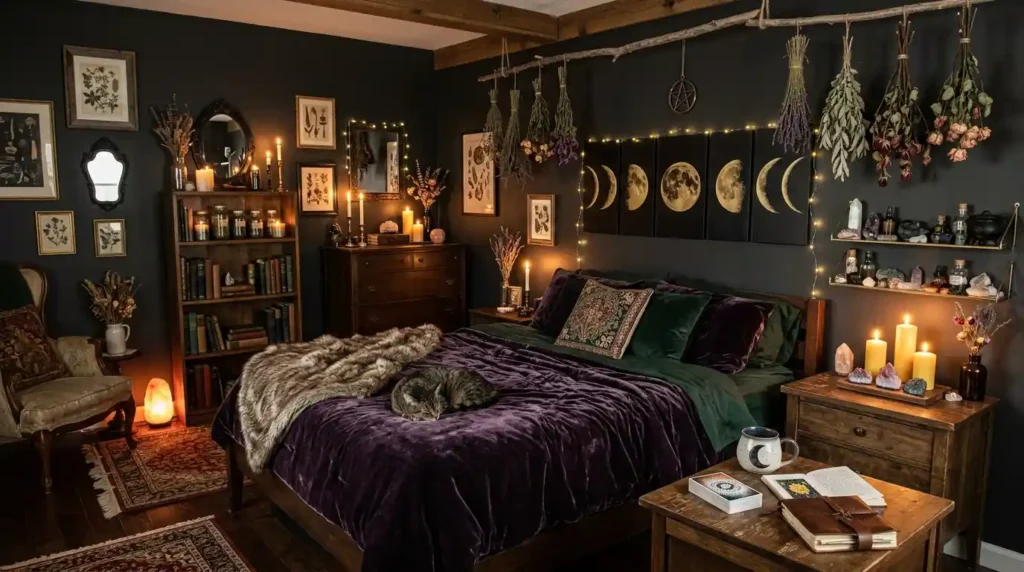
A witchy bedroom that looks genuinely designed rather than assembled has a consistent palette running through every element — the dark wall color, the dark velvet bedding, the black-stained wood of the shelves and candle holders, and the deep jewel tones of the crystal collection all speak the same color language. Introducing an element in a color or material that sits outside this language — a bright color, a light wood, a chrome finish — breaks the atmosphere more than any single witchy prop could create it.
Start with the wall color and the bedding as the two largest surfaces in the room — once these are right everything else becomes easier to choose because the palette is established. Add the candle arrangement as the primary atmospheric element. Build the crystal and botanical shelf display as the room’s interactive feature — a display that rewards close inspection rather than reading only from a distance. Add the celestial focal point above the bed. Hang the dried botanicals last, since their position relative to the rest of the room’s elements determines whether they feel integrated or randomly placed.
The room should function as a genuinely comfortable, practical bedroom first and a witchy aesthetic space second. A bedroom that is atmospherically beautiful but too dark to dress in, too dramatically lit to read in, or too heavily scented to sleep comfortably in has prioritized aesthetics at the expense of the room’s actual function — and a room that cannot be lived in comfortably is ultimately not a well-designed room regardless of how it photographs.
📌 More bedroom and home decor ideas: Bedroom Wall Decor Stickers That Actually Look Good
Frequently Asked Questions
What is witchy bedroom decor?
Witchy bedroom decor is a design aesthetic that draws on the visual language of natural magic, apothecary tradition, and celestial symbolism to create a dark, atmospheric, and deeply textured bedroom environment. It is characterized by dark wall colors in charcoal, deep green, or midnight navy, jewel-tone bedding in velvet or rich cotton, layered candle arrangements, crystal and dried botanical displays, celestial art and moon phase imagery, and natural materials throughout. At its best it creates a bedroom that feels genuinely enveloping and magical. According to Architectural Digest the dark moody bedroom aesthetic, of which witchy decor is a prominent variant, has become one of the most consistently searched bedroom design directions of the past three years.
How do I make my bedroom look witchy on a budget?
The highest-impact witchy bedroom changes on a low budget: paint one wall — specifically the headboard wall — in a deep charcoal or dark green, which costs under forty dollars and transforms the room’s atmosphere more than any other single change. Add a cluster of pillar candles at different heights on a wooden tray, which costs twenty to thirty dollars and creates the most atmospheric evening lighting available. Hang three bundles of dried lavender or eucalyptus from the ceiling above the bed, which costs under fifteen dollars and creates the hanging botanical ceiling effect. These three changes together for under $90 produce a room that genuinely reads as witchy rather than merely decorated.
What crystals should I put in a witchy bedroom?
The crystals most consistently used in witchy bedroom displays: amethyst for the deep purple color and its traditional association with intuition and dreams, making it particularly appropriate for a sleeping space. Clear quartz for its light-catching clarity and its role as a versatile specimen that suits any crystal arrangement. Black tourmaline and obsidian for the completely matte black surface that creates visual contrast within a mixed crystal display. Labradorite for the iridescent flash that provides movement and magic within the arrangement as light angles change. Selenite for the white luminous quality that provides lightness within an otherwise dark color scheme.
What colors are used in witchy bedroom decor?
The witchy bedroom palette centers on dark neutrals with jewel tone accents: deep charcoal, soft black, and midnight navy as the primary wall and textile colors. Deep plum and burgundy as the jewel tone accent present in velvet bedding, candles, or one accent element. Forest green as an alternative dark ground color that creates a more nature-connected version of the aesthetic. Aged gold and antique brass rather than bright gold for hardware and metallic accessories. Natural wood in dark walnut or ebony stains for furniture and display surfaces. Avoid bright colors, pastels, and cool-toned grays — all of which work against the warm, enveloping quality the witchy palette creates.
More Bedroom and Home Decor Ideas
→ Family Photo Wall Ideas That Never Look Tacky
→ Minimalist Men’s Bedroom Ideas for a No-Fuss Dad
→ How To Create a Living Memorial Garden for a Father
Start with the wall and the bedding. Get the palette right on the two largest surfaces and everything else finds its place naturally.

Sheikh Hassaan is a digital architect for small businesses and the founder of The Glow Up System. He writes about home decor, garden design, and outdoor living for real American homes – practical ideas that work in actual spaces without oversized budgets.