
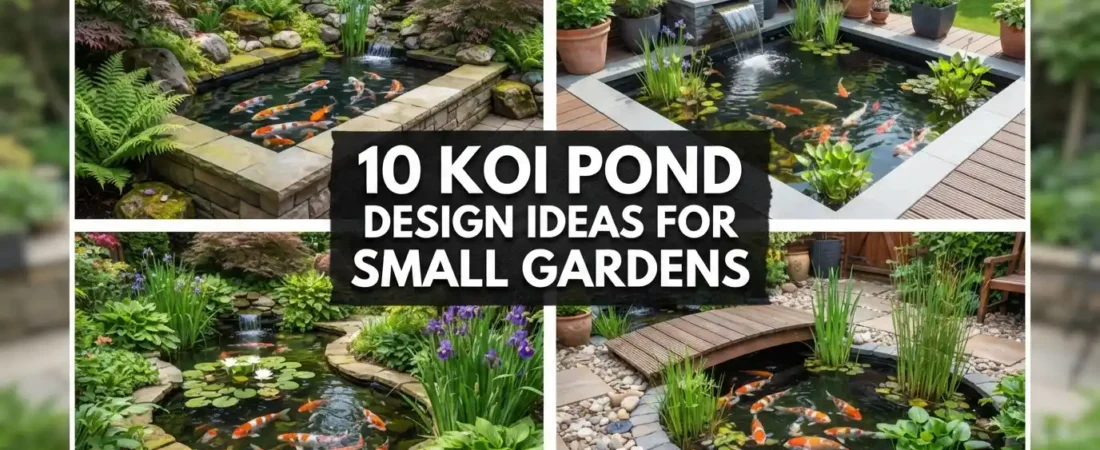
A small garden is not a barrier to keeping koi. It is a design constraint that, handled correctly, produces a more focused and more beautiful water feature than a large pond with unlimited space. The key is choosing a design that maximizes every inch while maintaining the depth and water quality that koi need to thrive. From corner ponds to raised whiskey barrels, there is a solution for every tiny yard.
This guide covers 10 practical koi pond design ideas for small gardens that fit tight spaces while keeping your fish healthy and happy.
Table of Contents
What Makes a Small Garden Koi Pond Successful?
Before diving into specific designs, it helps to understand the non-negotiable requirements for any koi pond, regardless of size. The absolute minimum for keeping koi successfully is 1,000 gallons of water, which corresponds to a pond approximately 6 feet long by 4 feet wide by 3 feet deep. This minimum accommodates two to three small koi at a maximum and requires a high-quality filtration system running continuously to maintain water quality.
The depth requirement is the dimension most frequently underestimated in small garden koi pond design: koi need a minimum depth of 3 feet, and preferably 4 feet in climates with cold winters. Koi cannot regulate their body temperature and must have access to deeper water where temperatures are more stable when surface temperatures fluctuate seasonally.
The practical footprint of a 1,000-gallon pond at 3 feet deep is approximately 6 by 4 feet at the surface. This footprint fits into a remarkably small garden space when positioned correctly. A 6 by 4 foot pond along one boundary wall or in a corner position leaves substantial garden space remaining even in a garden of 10 by 12 feet total. The key is treating the pond’s position and design as the primary garden design decision rather than fitting it around existing features.
Stock density in a small koi pond: the standard guideline is 250 gallons of water per koi, with koi measured at their adult size of 12 to 24 inches rather than at purchase size. A 1,000-gallon pond supports four koi at this guideline. Understocking a small koi pond, keeping two or three koi in a 1,000-gallon pond, produces better water quality, healthier fish, and a more beautiful visual result than pushing the stock density to the maximum the filtration can support.
1. The Corner L-Shaped Koi Pond
✦ Best for: Corner positions where an L-shaped design uses otherwise dead space efficiently
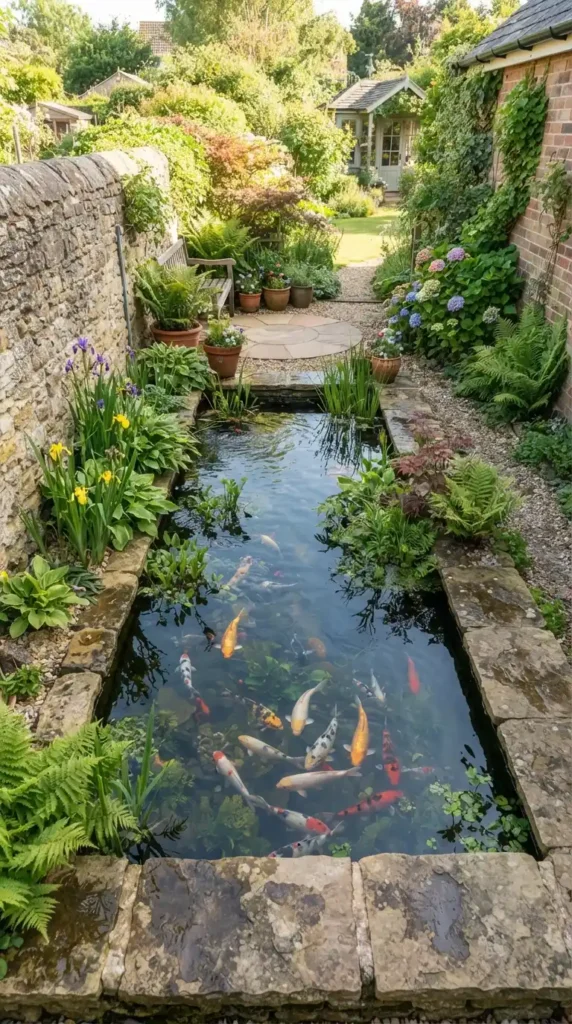
An L-shaped koi pond positioned in a garden corner is one of the most space-efficient small garden pond designs available. It uses the corner area that is often the most difficult garden space to fill with planting or furniture, while leaving the central garden area free for seating, lawn, or planting. The L-shape also creates a larger water surface area and volume than a rectangular pond of the same total linear measurement, because it extends along two walls rather than one.
The proportions that work best for an L-shaped corner koi pond in a small garden: each arm of the L should be at least 4 feet wide to provide adequate swimming space for koi. A narrower arm creates a channel that koi will use as a turn rather than a habitat. The corner section should be the deepest part of the pond at 3 to 4 feet depth, with the arms slightly shallower at 2.5 to 3 feet. This depth variation creates the warmer shallow areas that koi use in cooler weather alongside the deeper stable-temperature zone they need in winter.
An L-shaped pond liner requires careful planning at the internal corner. The fold in the liner at the 90-degree internal corner is the most vulnerable point in the entire installation and must be executed as a single continuous fold without cuts or joins. Most professional pond installers use a specific corner fold technique that creates a pleat at the internal corner. Watching a detailed video tutorial of this specific fold before attempting a DIY liner installation on an L-shaped pond is strongly recommended.
2. The Raised Block Koi Pond
✦ Best for: Small patios and courtyard gardens where digging is limited or where the pond needs to double as seating
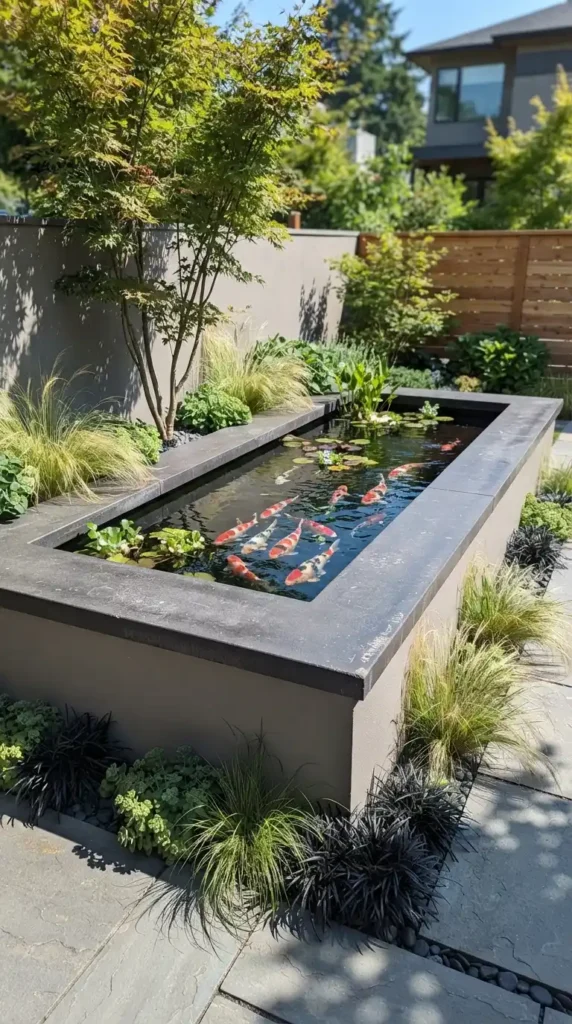
A raised koi pond, built above ground level with masonry, timber, or rendered block walls, is the most practical small garden koi pond design for three specific reasons. It eliminates the excavation required for an in-ground pond, which makes it feasible in gardens with hard or rocky soil or in gardens built on concrete or paving. It places the water surface at a comfortable viewing height, typically 24 to 30 inches above ground, so koi can be observed easily without bending. And it provides straightforward access to the pond base for cleaning and maintenance.
The wall material for a raised koi pond determines both its aesthetic character and its thermal performance. Rendered concrete block walls painted in a neutral color suit contemporary and courtyard garden styles and provide good thermal mass that moderates water temperature fluctuations. Natural stone block walls suit cottage and traditional garden styles and create a more organic appearance. Timber sleeper walls suit informal garden styles but have a shorter lifespan in ground contact, typically 10 to 15 years before replacement is needed.
The raised pond wall can be built to a width of 12 to 18 inches at the top to create a coping surface that functions as informal seating alongside the pond. This is one of the most useful design features in a small garden where every surface needs to serve multiple purposes. A coping width of 12 inches is comfortable for sitting; 18 inches allows drinks and plates to be set on the surface alongside a person sitting on it.
3. The Naturalistic In-Ground Pond With Rock Surrounds
✦ Best for: Cottage and naturalistic garden styles where a formal raised pond would look out of place

A naturalistic in-ground koi pond with irregular edges, rock surrounds, and pond-side planting creates the most organic and most visually established pond appearance available. When designed well it reads as a natural pool that has always been in the garden rather than a constructed feature. This approach suits cottage, woodland, and informal garden styles where the geometric precision of a raised or formal pond would look incongruous.
The irregular edge that defines a naturalistic koi pond requires careful design to avoid looking like an accidental shape rather than a deliberate organic one. The most successful naturalistic pond edges use smooth flowing curves without tight corners or straight sections. Any straight section or sharp corner in a naturalistic pond immediately reads as constructed rather than natural. The edge should look like it was carved by water over time rather than dug by a spade following a string line.
Rock placement around a naturalistic koi pond follows the same principles as rock placement in a rock garden: rocks should be buried to at least one-third of their depth to look like they belong in the landscape rather than being placed on top of it. Two or three larger rocks read as a natural outcropping. Avoid uniform sized rocks placed in an even ring around the entire pond edge, as this reads as a manufactured rock border rather than a naturalistic setting.
4. The Formal Geometric Pond
✦ Best for: Contemporary and Japanese-influenced garden styles where geometric precision suits the design language
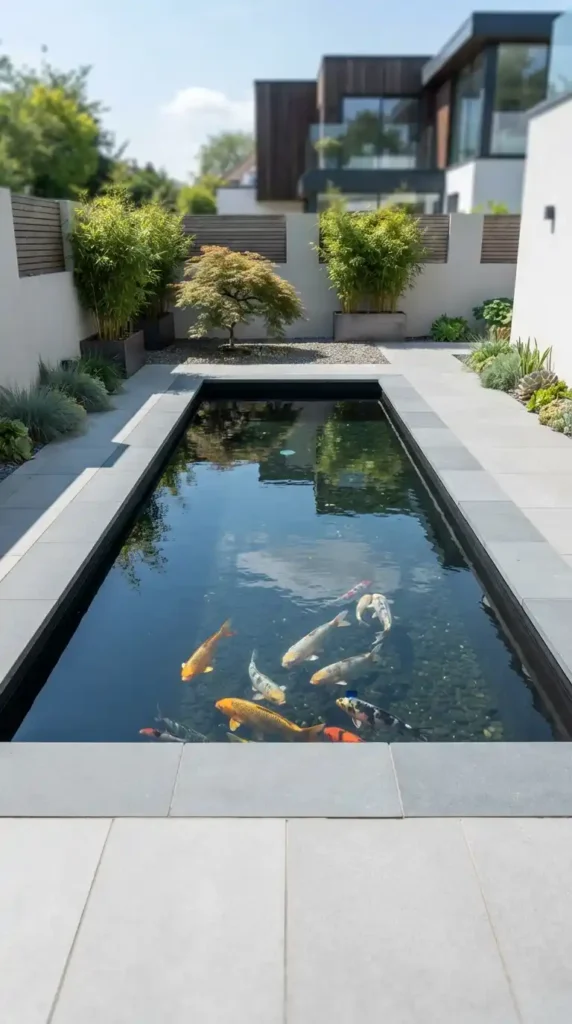
A formal geometric koi pond, precisely rectangular or square with clean-cut stone or concrete coping flush with the surrounding paved surface, creates the most contemporary and most architecturally resolved small garden water feature available. The geometric precision signals that the pond was designed as part of the garden’s overall composition rather than added after the fact, and the flush coping detail that sits level with the surrounding paving creates the seamless quality associated with high-end garden design.
The most effective dimensions for a formal rectangular koi pond in a small contemporary garden: a 2:1 or 3:1 length-to-width ratio creates the most visually dynamic result. A pond that is 8 feet long by 4 feet wide reads as a significant water feature at 1,000 gallons. A square pond of the same volume feels less dynamic because the equal dimensions create a static, symmetrical form rather than the directional quality of a rectangle.
Coping material selection for a formal geometric koi pond should match or complement the surrounding hard landscaping material. The same stone or porcelain used in the garden paving used as the pond coping creates the most integrated result. A contrasting coping material creates a deliberate frame around the water surface that can work well but requires confident material selection to avoid looking like mismatched components rather than a designed contrast.
5. The Waterfall Pond With Cascading Feature
✦ Best for: Any koi pond design where water movement, sound, and additional oxygenation are wanted
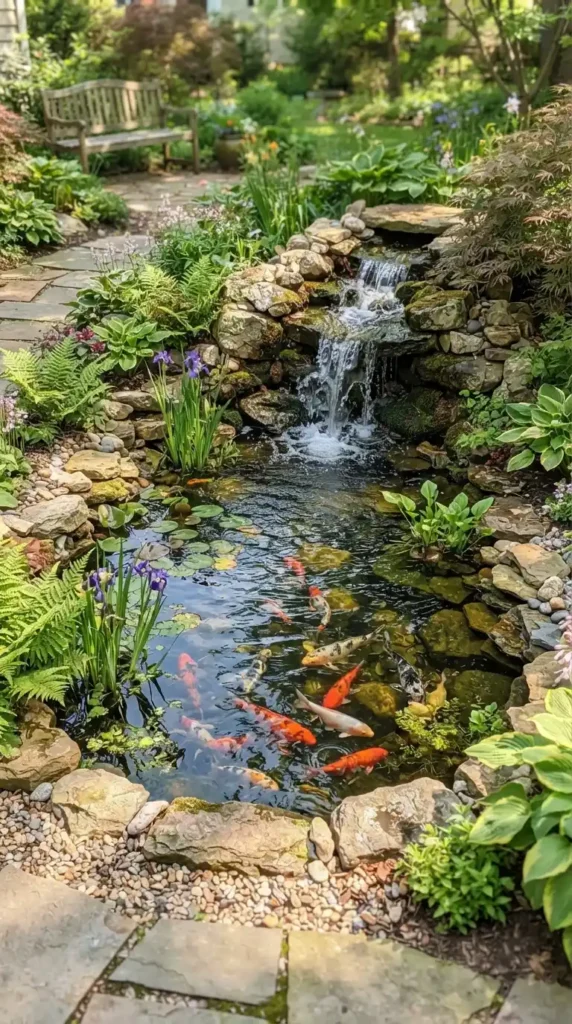
A waterfall integrated into a small koi pond design serves three functions simultaneously. It oxygenates the water as it falls, creating the surface agitation that allows oxygen exchange at the water surface. It creates the specific sound of moving water that makes a garden feel genuinely peaceful and masks ambient noise from neighboring properties. And it provides a design focal point at one end of the pond that draws the eye and gives the water feature a clear sense of direction and hierarchy.
A waterfall for a small koi pond does not need to be large to be effective. A fall height of 12 to 18 inches over a width of 18 to 24 inches creates enough water movement to oxygenate a 1,000 to 2,000 gallon pond adequately when the pump is sized correctly. The pump circulating water to the waterfall should turn the pond volume over at least once per hour. A 1,000-gallon pond needs a pump rated at a minimum of 1,000 gallons per hour at the head height of the waterfall.
Rock waterfall construction for a naturalistic pond: stack flat stones in overlapping layers above the pond edge, with each layer slightly set back from the one below it to create the stepped cascade effect. The most important construction detail is sealing all gaps between stones with waterfall foam sealant. Any gap that allows water to flow through the rockwork rather than over the face of the stones causes the waterfall to lose flow and eventually fail as the water takes the path of least resistance through the rock rather than over it.
6. The Patio Pond With Glass Viewing Panel
✦ Best for: Patios and paved areas where an in-ground pond is not possible

A small koi pond built into a patio with one glass or acrylic side brings an aquarium-like experience to a compact space. The clear panel allows you to watch the koi at eye level, creating an immersive viewing experience that surface viewing cannot match. This design works beautifully on small patios where a traditional in-ground pond would not fit.
The glass panel must be made from toughened laminated glass to withstand water pressure and maintain clarity. The panel should be at least 12 inches high and 24 inches wide for effective viewing. A UV-resistant sealant is essential to prevent leaks around the glass. The koi will initially be wary of the glass but will quickly become accustomed to it and swim freely past.
This patio pond design is one of the most space-efficient koi pond design ideas for small gardens because it uses vertical space for viewing rather than requiring a larger surface area. The pond itself can be relatively compact while the viewing panel makes it feel larger and more engaging.
7. The Japanese-Inspired Pond With Bamboo Feature
✦ Best for: Gardens influenced by Japanese garden design where the koi pond is the centerpiece
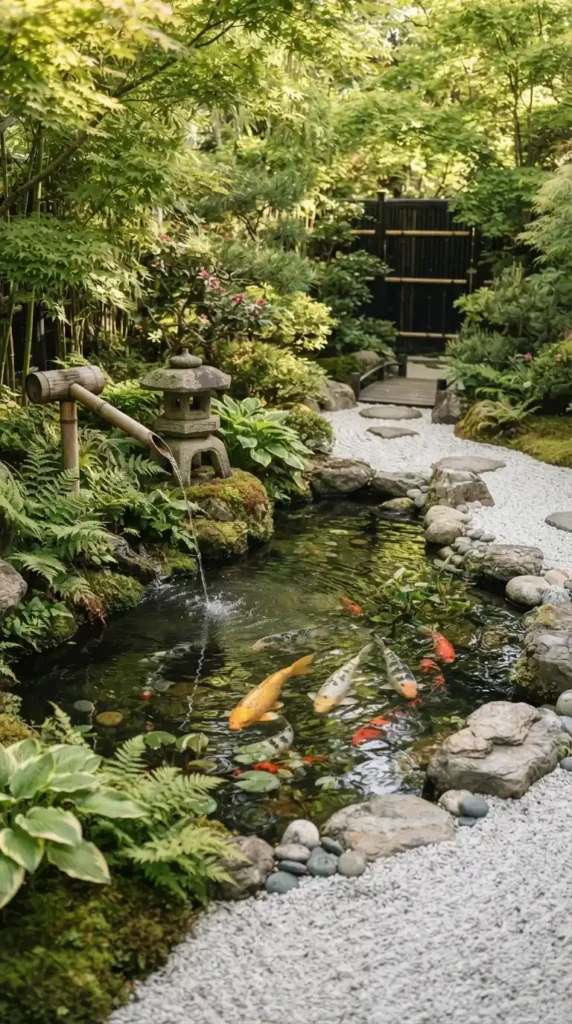
Koi originate from Japanese ornamental fish breeding culture, making a Japanese garden aesthetic the most historically appropriate and most visually coherent setting for a koi pond. A small Japanese garden centered on a koi pond can be achieved in a remarkably small space. Even a 10 by 12 foot garden can accommodate a koi pond, a gravel raked area, one or two carefully placed stones, and the specific plant species that define the Japanese garden vocabulary.
The Japanese garden elements that create the most authentic small-scale result alongside a koi pond include a shishi-odoshi bamboo water feature. This is the traditional bamboo tube that fills with water and tips to strike a stone, creating the specific rhythmic sound associated with Japanese gardens. A stone lantern positioned at the pond edge illuminates the water at night. Raked gravel or decomposed granite in the area surrounding the pond and clipped azalea or box topiary in simple round or irregular cloud forms complete the aesthetic.
Plant species for a Japanese garden koi pond surround include Japanese maple for the specific leaf form and autumn color associated with Japanese garden aesthetics. Bamboo in a contained root barrier prevents spreading. Ophiopogon planiscapus ‘Nigrescens’ provides ground-level texture. Moss as a ground cover in shaded areas around the pond and Iris ensata at the pond margins complete the planting scheme.
8. The Deck-Integrated Pond
✦ Best for: Gardens with a timber deck where the pond can be built into the structure
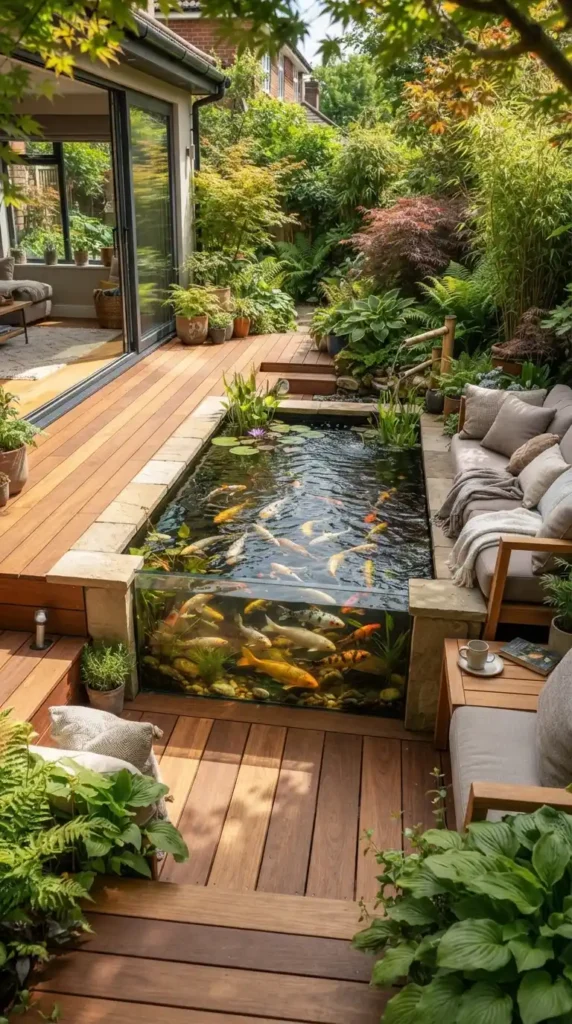
A deck-integrated koi pond creates a seamless connection between the garden structure and the water feature. The pond is built into the deck, with the deck level matching the pond edge. The integration creates a unified design where the pond and the deck feel like a single element. This is one of the most elegant koi pond design ideas for small gardens where space is at a premium.
The most dramatic feature of a deck-integrated koi pond is the glass viewing panel. A panel of toughened glass set into the side of the deck allows underwater viewing of the koi. This transforms the pond from a surface-level feature into an immersive experience. Guests can sit at deck level and watch the koi swim past at eye level, creating a connection to the fish that surface viewing cannot match.
The design is particularly effective in small gardens because it uses the existing deck structure rather than taking up additional ground space. The pond becomes a feature of the deck rather than competing with it for space.
9. The Whiskey Barrel Koi Pond
✦ Best for: Very small patios, balconies, and tiny urban gardens
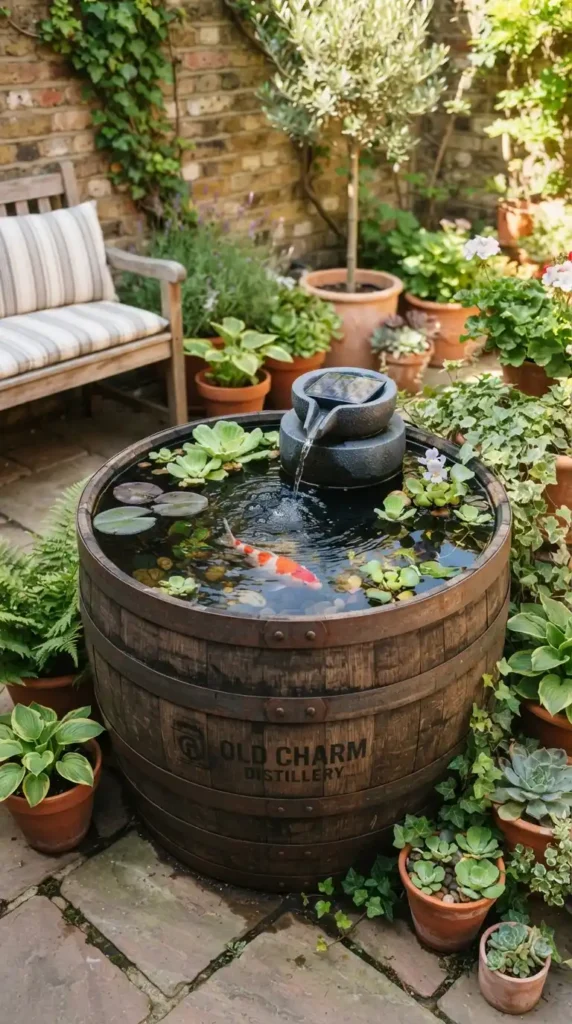
A whiskey barrel koi pond is one of the most charming and compact small garden koi pond design ideas. The deep basin provides just enough room for a few small fish while adding rustic charm to any patio or balcony. A small solar fountain keeps the water moving, and floating plants provide shade and oxygen for the fish.
This design works best for very small spaces where a traditional pond would not fit. The barrel can be positioned on a patio, balcony, or even a small deck. It is also one of the most affordable options, making it accessible to gardeners on a budget.
For the best results, choose a barrel that is at least 30 inches in diameter and 24 inches deep. This provides enough water volume for a small koi or two, though it is important to remember that koi will outgrow a barrel pond and will eventually need a larger home.
10. The Glass-Walled Indoor-Outdoor Pond
✦ Best for: Homes with a sunny room or conservatory that opens to a small outdoor space
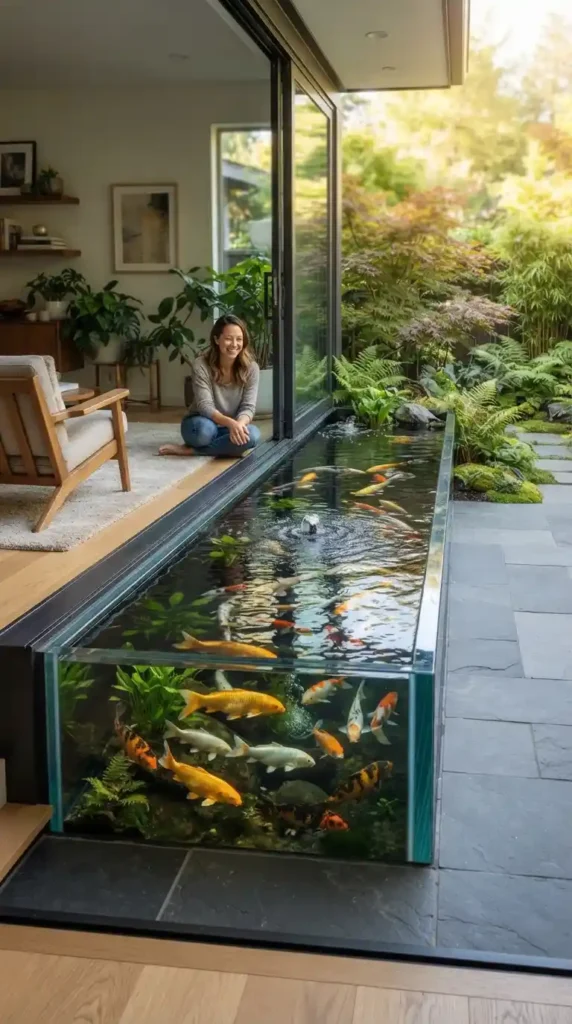
For the ultimate in compact luxury, a glass-walled pond positioned between an indoor room and a small outdoor garden creates a stunning visual connection. This is one of the most innovative koi pond design ideas for small gardens, as it makes the pond feel like it belongs to both spaces simultaneously.
The pond is built into a wall or partition, with clear glass on both sides allowing viewing from the interior and exterior. This creates a seamless connection between inside and outside, making a small garden feel larger and more integrated with the home.
The design requires careful planning for insulation and condensation control on the indoor side, as well as a robust filtration system to maintain water quality in the warmer indoor environment. The result, however, is a unique and stunning feature that makes the most of a limited footprint.
Getting the Filtration Right in a Small Koi Pond
Filtration is the most important element in any small garden koi pond design, more important than the pond shape, the coping material, the surrounding planting, or any other design decision. Koi produce substantially more waste than goldfish or other pond fish, and in a small pond the water volume available to dilute this waste is limited. An undersized or inadequate filtration system produces green water, sick fish, and a pond that looks and smells nothing like the beautiful feature it was designed to be.
The three-stage filtration system for a small koi pond includes mechanical filtration, biological filtration, and UV clarification. Mechanical filtration removes solid waste particles from the water before they break down into ammonia. A bottom drain positioned at the lowest point of the pond connected to a settlement chamber or vortex filter is the most effective mechanical filtration approach. Biological filtration converts harmful ammonia into nitrite and then into the less harmful nitrate through bacterial action in a biological filter media. UV clarification kills the single-celled algae that cause green water, the most common water quality problem in small koi ponds.
The biological filter must be sized to handle the ammonia load of the specific fish stock in the pond. Undersized biological filtration produces ammonia spikes that are fatal to koi. The general rule is that the biological filter should have at least 10 cubic feet of media for a 1,000-gallon pond. The pond volume should be turned over through the filtration system at least once per hour.
Frequently Asked Questions About Koi Pond Design Ideas for Small Gardens
1. What is the minimum size for a koi pond in a small garden?
The absolute minimum is 1,000 gallons, which corresponds to a pond approximately 6 feet long by 4 feet wide by 3 feet deep . This footprint fits into a remarkably small garden space when positioned correctly along a boundary wall or in a corner.
2. How many koi can I keep in a small pond?
The standard guideline is 250 gallons of water per koi, measured at adult size . A 1,000-gallon pond supports four koi at this guideline. However, understocking with two or three koi produces better water quality and healthier fish.
3. How deep does a koi pond need to be?
A koi pond needs a minimum depth of 3 feet and preferably 4 feet in climates with cold winters . This provides thermal stability and protection from predators.
4. What is the best shape for a small garden koi pond?
The best shape maximizes water volume within the available garden footprint . Rectangular ponds with a 2:1 or 3:1 length-to-width ratio provide the most swimming space per square foot. L-shaped ponds are the most space-efficient for corner positions.
5. What filtration do I need for a small koi pond?
You need a three-stage system: mechanical filtration (to remove solids), biological filtration (to convert ammonia to nitrates), and UV clarification (to prevent green water) . The filter must be sized for the fish load, not just the pond volume.
Related Articles
15 Jaw-Dropping Koi Pond Ideas You’ll Love
The Ultimate Koi Pond Guide: Design, Building, Filtration & Maintenance
21 Koi Pond Design Ideas for Small Gardens (Modern + Japanese Styles)
A small garden is not a limitation—it is an opportunity for a more focused, more beautiful pond. With the right design, filtration, and plant choices, even the tiniest yard can become a tranquil koi retreat.

Sheikh Hassaan is a digital architect for small businesses and the founder of The Glow Up System. He writes about home decor, garden design, and outdoor living for real American homes – practical ideas that work in actual spaces without oversized budgets.