
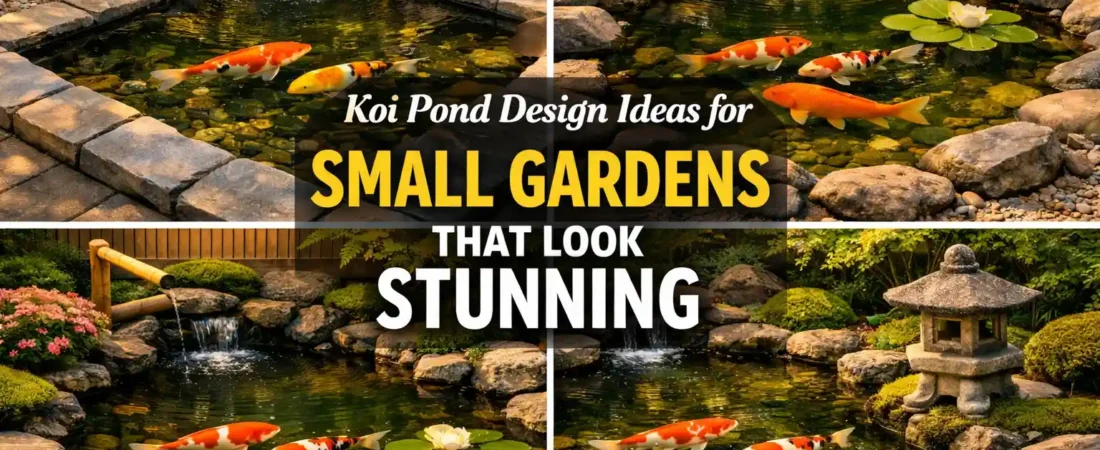
I used to think a koi pond needed a large garden to look good. Then I saw a 6 by 4 foot raised pond in a tiny courtyard that stopped me in my tracks. It was the most striking feature in the entire space.
The truth is small gardens often produce better koi pond designs than large ones. A smaller footprint forces better decisions about depth, filtration, and focal point placement.
These koi pond design ideas for small gardens cover 21 layouts from budget DIY builds to glass-panel luxury ponds, with honest notes on cost, size requirements, and what I would actually choose at each budget level.
Table of Contents
What Is the Minimum Size Koi Pond for a Small Garden?
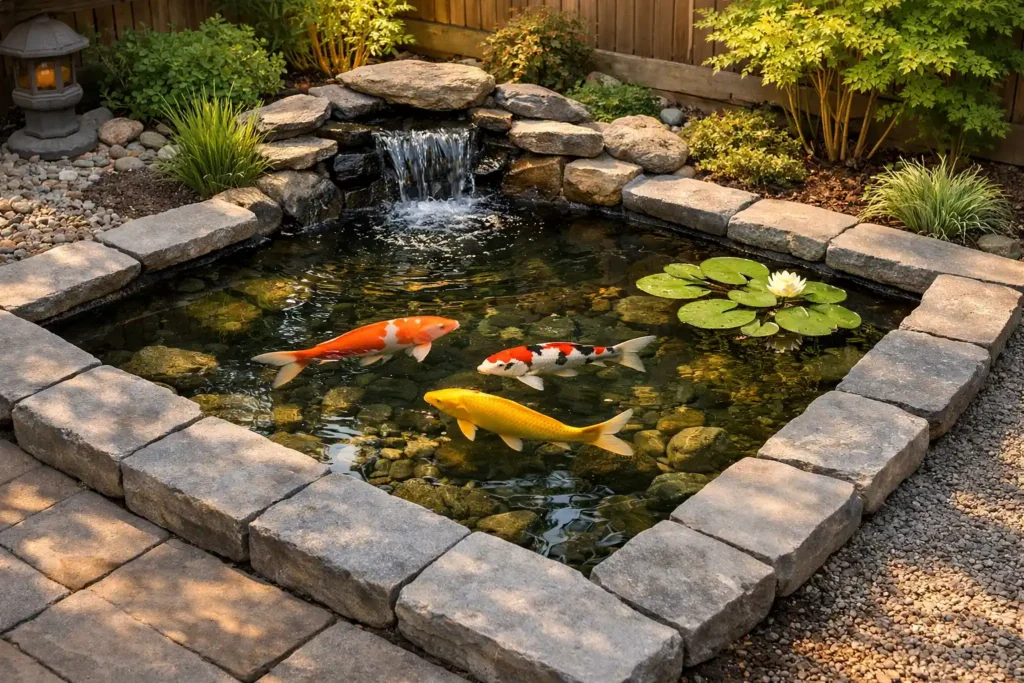
This is the question I get asked most and the answer surprises almost everyone. The minimum viable koi pond is significantly larger than most people expect.
The depth requirement is the dimension most frequently underestimated in small garden koi pond design: koi need a minimum depth of 3 feet, and preferably 4 feet in climates with cold winters. Koi cannot regulate their body temperature and must have access to deeper water where temperatures are more stable when surface temperatures fluctuate seasonally. A pond that is 8 feet across but only 18 inches deep is not a suitable koi pond regardless of its surface area.
The practical footprint of a 1,000-gallon pond at 3 feet deep is approximately 6 by 4 feet at the surface. This footprint fits into a remarkably small garden space when positioned correctly. A 6 by 4 foot pond along one boundary wall or in a corner position leaves substantial garden space remaining even in a garden of 10 by 12 feet total. The key is treating the pond’s position and design as the primary garden design decision rather than fitting it around existing features.
Stock density in a small koi pond: the standard guideline is 250 gallons of water per koi, with koi measured at their adult size of 12 to 24 inches rather than at purchase size. A 1,000-gallon pond supports four koi at this guideline. Understocking a small koi pond, keeping two or three koi in a 1,000-gallon pond, produces better water quality, healthier fish, and a more beautiful visual result than pushing the stock density to the maximum the filtration can support.
1. Raised Koi Pond for Small Gardens (Best All-Round Choice)
✦ Best for: small patios and courtyard gardens where digging is limited or where the pond needs to double as a seating or leaning surface
I recommend raised ponds to most people starting their first small garden koi pond. The viewing angle alone makes it worth it — you actually see the koi properly instead of squinting down at the surface.
Ideal garden size: Small to medium gardens (even 10×10 ft courtyards)
Material options: Concrete block, timber sleepers, stone cladding
Cost range: $800 – $5,000 depending on finish
What it solves: Limited digging space, poor visibility, filtration access issues
Styling tip: Keep edges wide (12–18 inches) so it doubles as seating
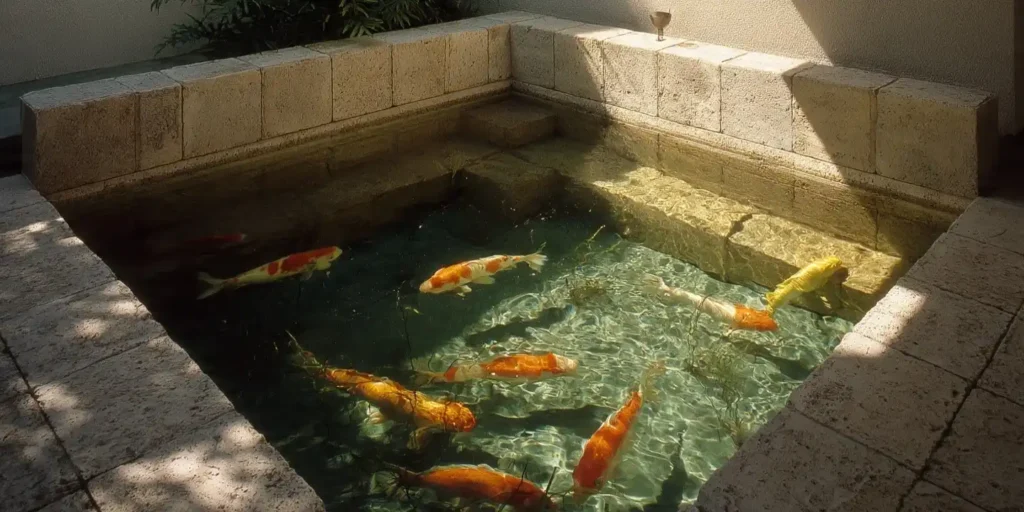
A raised koi pond works especially well in small gardens where digging a deep in-ground pond is difficult or impractical. By lifting the structure above ground, you gain better control over water depth, easier maintenance access, and a clearer viewing angle of the koi.
In compact spaces, raised ponds also create a stronger architectural presence, making the pond feel like an intentional design feature rather than something “added in.”
The wall material for a raised koi pond determines both its aesthetic character and its thermal performance. Rendered concrete block walls painted in a neutral color suit contemporary and courtyard garden styles and provide good thermal mass that moderates water temperature fluctuations. Natural stone block walls suit cottage and traditional garden styles and create a more organic appearance. Timber sleeper walls suit informal garden styles but have a shorter lifespan in ground contact, typically 10 to 15 years before replacement is needed.
The raised pond wall can be built to a width of 12 to 18 inches at the top to create a coping surface that functions as informal seating alongside the pond. This is one of the most useful design features in a small garden where every surface needs to serve multiple purposes. A coping width of 12 inches is comfortable for sitting; 18 inches allows drinks and plates to be set on the surface alongside a person sitting on it.
2. Modern Concrete Koi Pond (Best Minimalist Small Garden Design)
✦ Best for: Contemporary homes with clean architectural lines and minimalist landscaping
I love modern concrete ponds in small courtyards because they look like they were designed by an architect rather than added as an afterthought. The clean lines do a lot of the design work for you.
Ideal garden size: Courtyards, modern small gardens, townhouses
Material options: Poured concrete, rendered block, fiberglass lining
Cost range: $2,000 – $10,000+
What it solves: Visual clutter, design inconsistency, weak focal points
Styling tip: Use dark concrete for dramatic koi contrast
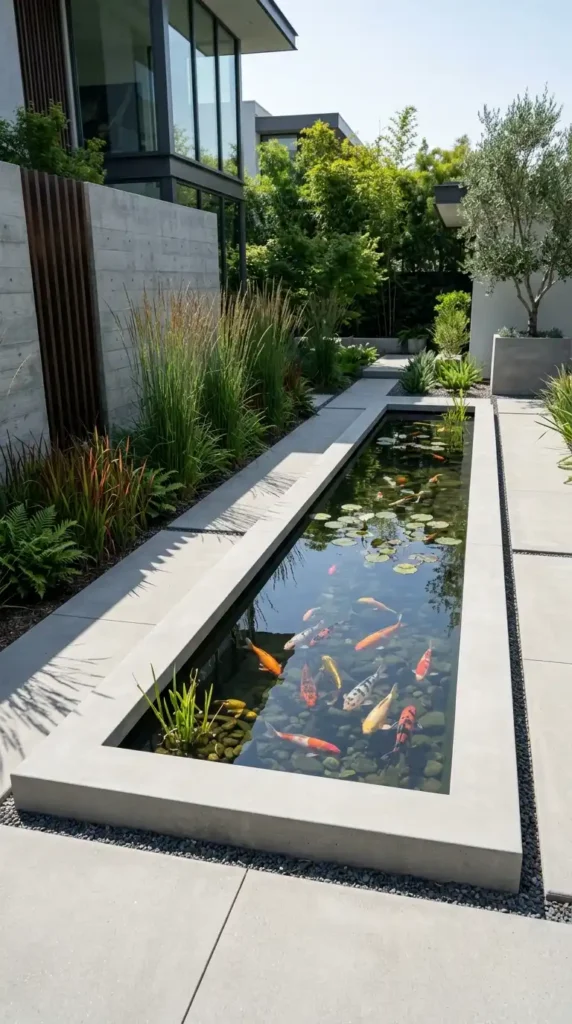
Modern concrete koi ponds are ideal for small gardens that follow a clean architectural style. The strong geometric shape creates a visual anchor, making even compact outdoor spaces feel structured and intentional.
Because of their simplicity, these ponds make koi fish and water movement the central design feature, rather than surrounding decoration.
The color of a modern concrete pond matters. Light gray concrete creates a bright, reflective surface that makes the water appear lighter and the koi colors pop. Dark gray or charcoal concrete creates a dramatic, moody pool where the koi appear to float in darkness. The choice depends on the overall garden aesthetic and the color of the koi being kept.
3. Japanese Garden Koi Pond (Best Natural Zen Design)
✦ Best for: Gardens influenced by Japanese garden design where the koi pond is the centerpiece of a complete Zen aesthetic
Ideal garden size: Small Japanese-style or minimalist gardens
Material options: Stone, gravel, timber, natural planting
Cost range: $1,500 – $8,000
What it solves: Lack of harmony, visual noise, unbalanced layouts
Styling tip: Use asymmetry + moss + stone lanterns for authenticity
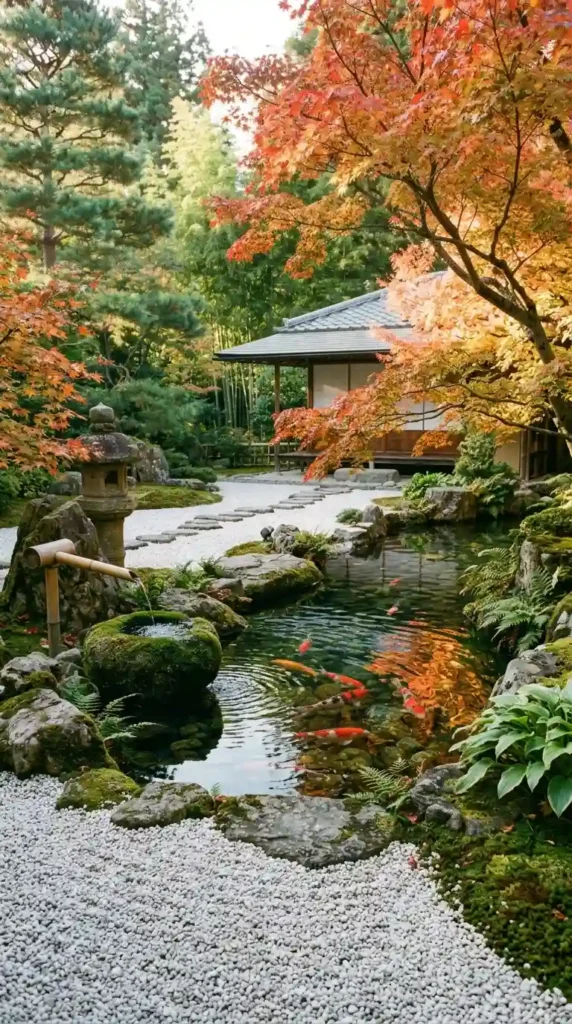
A Japanese-style koi pond focuses on balance, simplicity, and natural flow. In small gardens, this style works extremely well because it avoids overcrowding the space with unnecessary design elements.
The pond becomes part of a wider “garden scene” rather than a standalone object, which helps small spaces feel more intentional and peaceful.
4. Corner L-Shaped Koi Pond for Small Gardens (Best Space-Maximizing Layout)
✦ Best for: Corner positions in small gardens where an L-shaped design uses otherwise dead space efficiently
Ideal garden size: Narrow gardens, corner plots, small urban yards
Material options: Concrete liner, stone edging, reinforced EPDM liner
Cost range: $1,500 – $7,000
What it solves: Wasted corner space, awkward garden layouts, poor flow
Styling tip: Use planting on outer edges to soften the L-shape
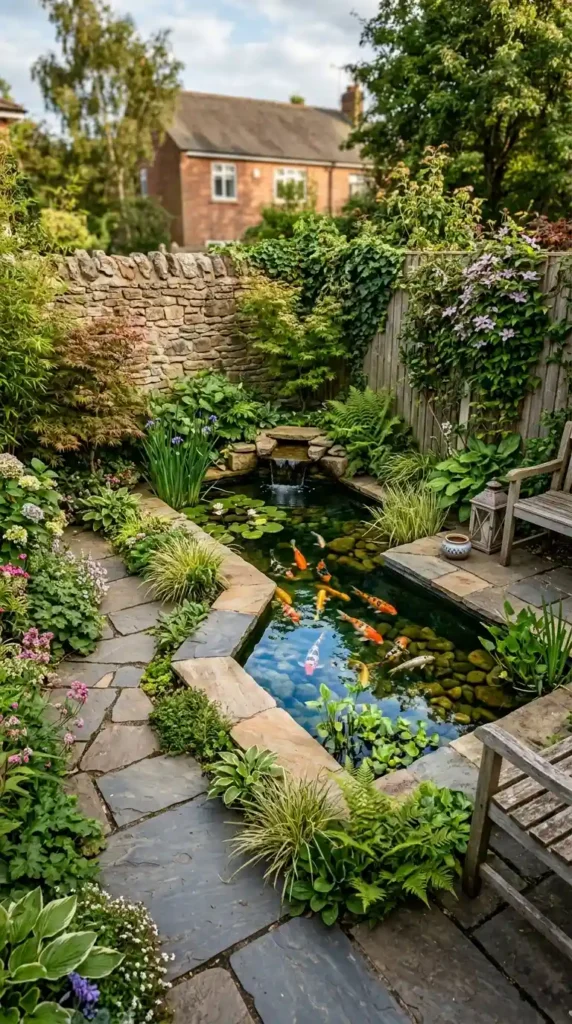
An L-shaped koi pond is one of the most efficient ways to use corner space in a small garden. Instead of forcing a rectangular layout, it wraps around existing boundaries and turns unused corners into a strong design feature.
This layout naturally increases water surface area without dominating the entire garden footprint, making it ideal for compact outdoor spaces.
5. Naturalistic Koi Pond for Small Gardens (Best Organic Landscape Style)
✦ Best for: Cottage and naturalistic garden styles where a formal raised pond would look out of place
Ideal garden size: Cottage gardens, sloped gardens, informal layouts
Material options: Pond liner, natural rock, soil planting edges
Cost range: $1,000 – $6,000
What it solves: Harsh geometry, artificial-looking ponds, lack of softness
Styling tip: Bury stones partially for a natural “formed by nature” look
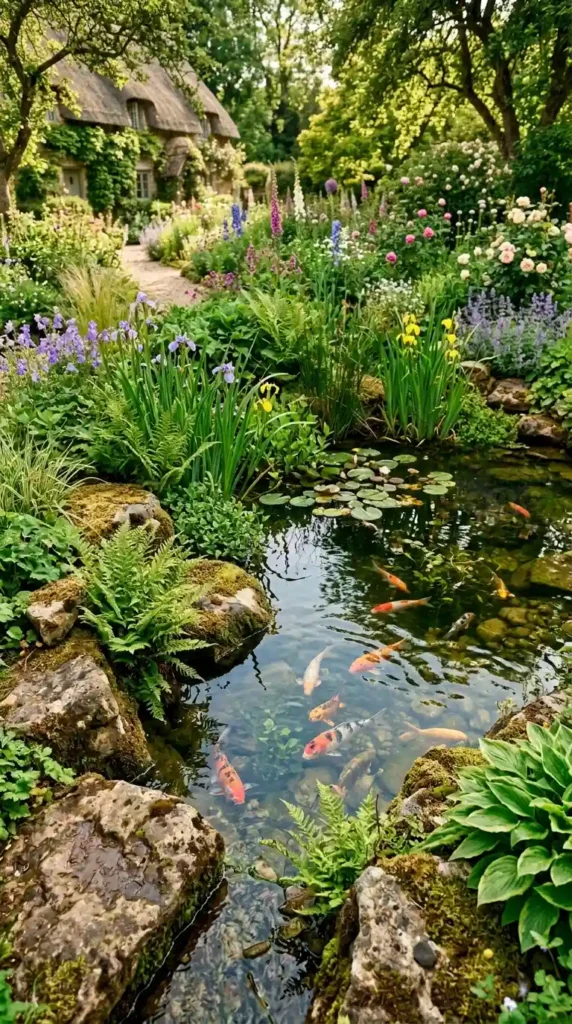
A naturalistic koi pond blends into the garden instead of sitting as a separate feature. In small gardens, this approach makes the space feel larger because the boundaries of the pond are visually softened.
Irregular edges and layered planting help create a more organic water feature that feels like it has always been part of the landscape.
6. Formal Geometric Koi Pond for Small Gardens (Best Architectural Design)
✦ Best for: Contemporary and Japanese-influenced garden styles where geometric precision suits the design language
Ideal garden size: Modern courtyards, structured landscapes
Material options: Concrete, stone slabs, porcelain coping
Cost range: $2,000 – $10,000
What it solves: Lack of structure, visual imbalance, weak focal points
Styling tip: Match pond edges to patio paving for seamless integration
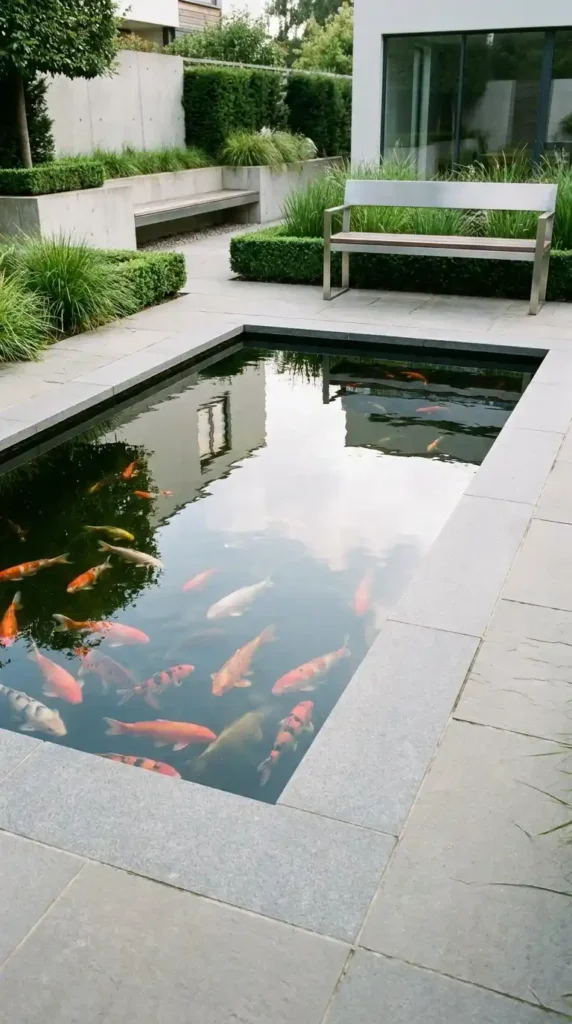
A formal geometric koi pond uses precise shapes like rectangles and squares to create a strong architectural statement. In small gardens, this clarity helps organize the space visually.
Because everything is structured, the pond becomes a deliberate centerpiece rather than a decorative add-on.
7. Small Koi Pond With Waterfall (Best Oxygenation & Sound Feature)
✦ Best for: Any koi pond design where water movement, sound, and additional oxygenation are wanted alongside the filtration system
Ideal garden size: Any small to medium garden
Material options: Rock waterfall, ceramic spillway, hidden pump system
Cost range: $800 – $5,000
What it solves: Stagnant water, low oxygen levels, silent/flat garden feel
Styling tip: Keep waterfall height low (12–18 inches) for natural effect
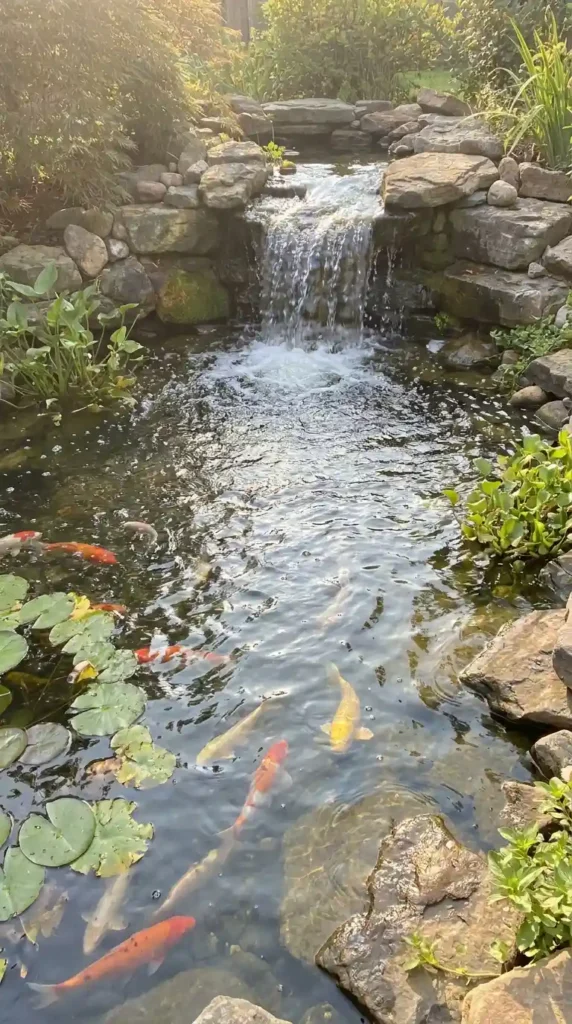
A waterfall adds movement, sound, and oxygenation to a koi pond. In small gardens, even a modest waterfall dramatically increases atmosphere without requiring large space.
It also helps improve water quality, which is especially important in compact koi ponds.
8. Patio Koi Pond for Small Urban Gardens (Best Hardscape Integration)
✦ Best for: Urban gardens and patios where the pond needs to integrate with hard landscaping
Ideal garden size: Patios, rooftops, paved courtyards
Material options: Timber box frame, rendered block, fiberglass shell
Cost range: $1,500 – $8,000
What it solves: No soil access, small footprint, urban limitations
Styling tip: Match pond finish to patio material for cohesion
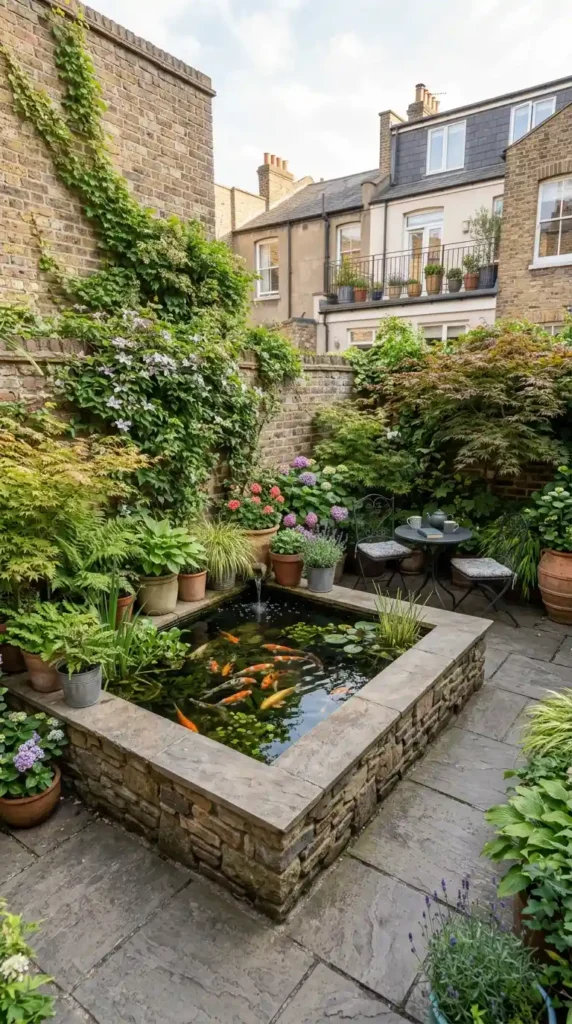
A patio koi pond is designed to sit directly on hard surfaces rather than being dug into the ground. This makes it ideal for urban gardens or paved outdoor spaces.
Because it sits above ground, it becomes a strong architectural feature and often doubles as a visual divider between zones.
9. Deck-Integrated Koi Pond With Glass Viewing Panel (Best Luxury Viewing Feature)
✦ Best for: Gardens with a timber deck where the pond can be built into or alongside the deck structure
Ideal garden size: Deck gardens, modern backyards
Material options: Timber deck, reinforced liner, tempered glass panel
Cost range: $3,000 – $15,000
What it solves: Limited viewing angles, lack of interaction with koi
Styling tip: Use lighting inside pond for night viewing effect
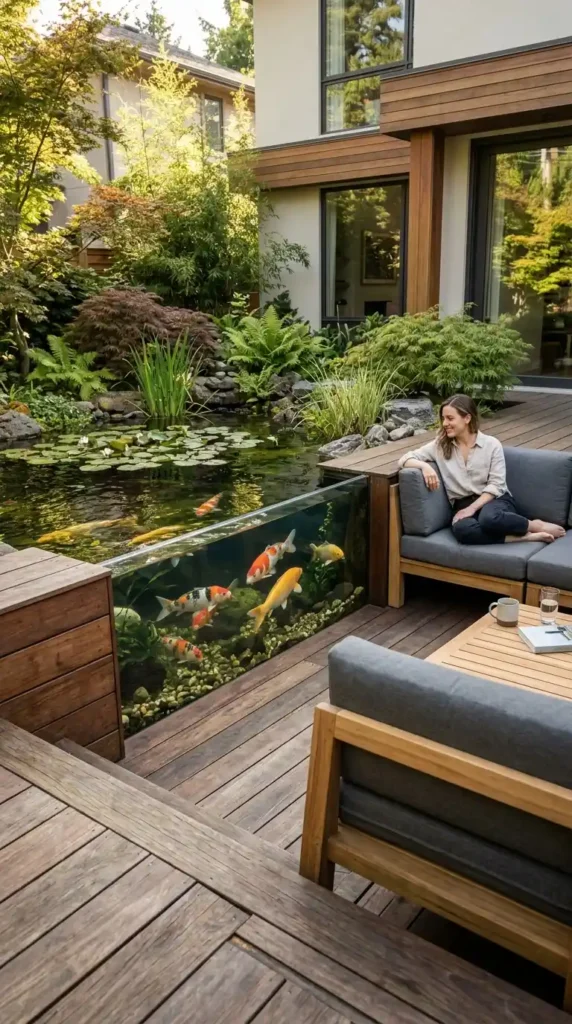
A deck-integrated koi pond with a glass panel allows underwater viewing of koi at eye level. This transforms the pond into an immersive experience rather than a surface feature.
It works especially well in modern garden designs where indoor-outdoor flow is important.
10. Koi Pond With Bridge for Small Gardens (Best Visual Focal Feature)
✦ Best for: Cottage and traditional gardens where a bridge adds charm and creates a focal point
Ideal garden size: Cottage gardens, traditional layouts
Material options: Timber bridge, stone bridge, metal frame bridge
Cost range: $1,000 – $6,000
What it solves: Lack of focal point, simple pond layouts
Styling tip: Keep bridge narrow and slightly arched for elegance
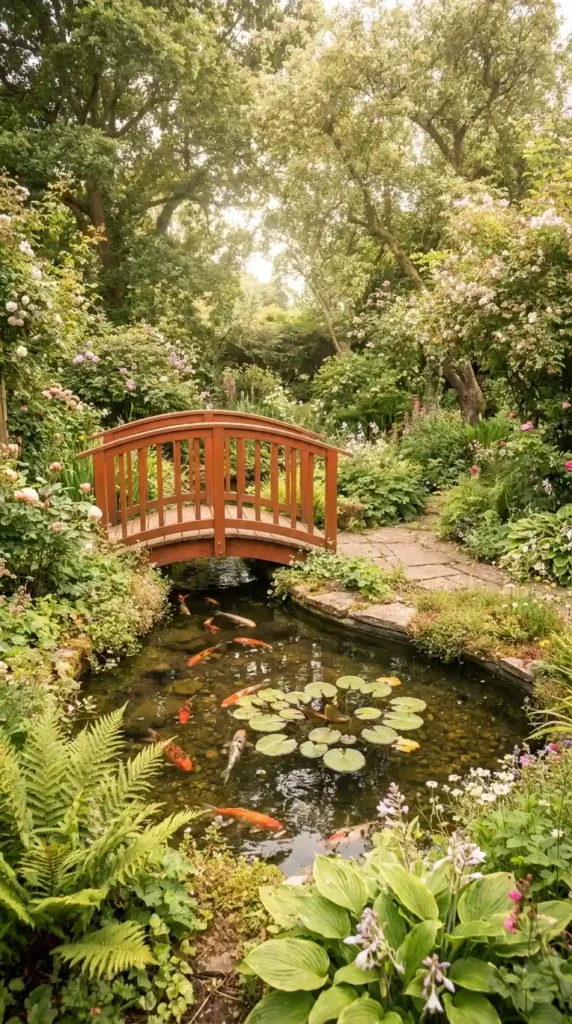
A small bridge over a koi pond creates instant visual interest and adds depth to the garden design. It gives the illusion of a larger garden by introducing layered perspective.
Even a short bridge in a compact garden dramatically increases charm and structure.
11. Koi Pond With Lighting (Best Night-Time Garden Feature)
✦ Best for: Gardens where the pond needs to be visible and beautiful after dark
Ideal garden size: Any garden size
Material options: LED pond lights, uplighting, solar garden lights
Cost range: $200 – $2,000
What it solves: Dead nighttime garden space, lack of visibility after sunset
Styling tip: Use warm white lighting for natural water glow
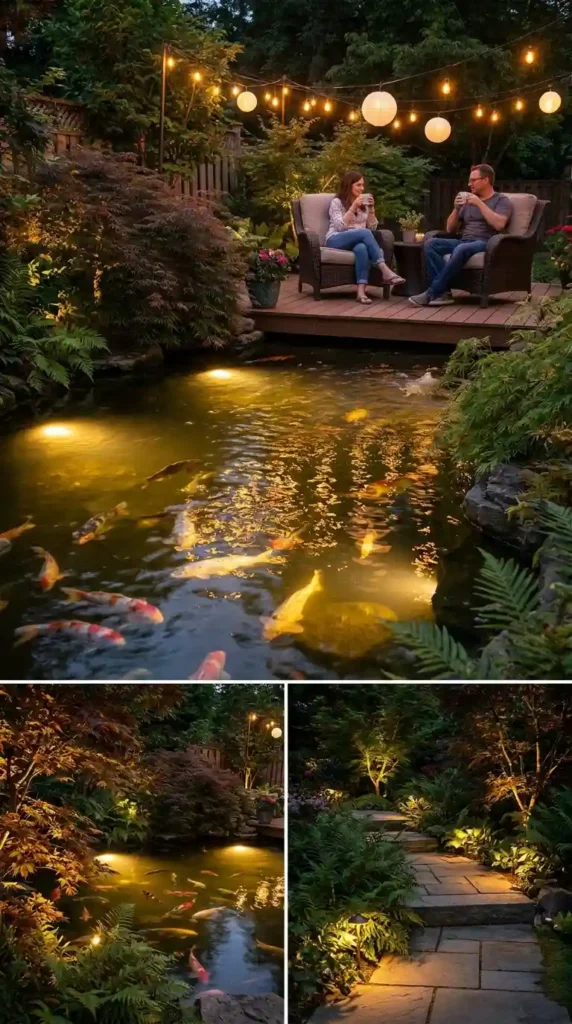
Lighting transforms a koi pond into a night feature. In small gardens, this is especially powerful because it extends usability of the space beyond daylight hours.
Underwater lighting highlights koi movement, while surrounding lights add depth and atmosphere.
12. Budget DIY Koi Pond With Preformed Liner (Best Beginner Option)
✦ Best for: Gardeners on a budget who want to build a koi pond without specialist skills or expensive materials
If I were starting from scratch on a tight budget this is where I would begin. A preformed liner pond teaches you everything about koi keeping without committing thousands of dollars to a permanent structure.
Ideal garden size: Small beginner gardens
Material options: Preformed plastic liner, gravel base, simple pump
Cost range: $300 – $1,500
What it solves: High cost barriers, construction complexity
Styling tip: Hide liner edges with stone and planting
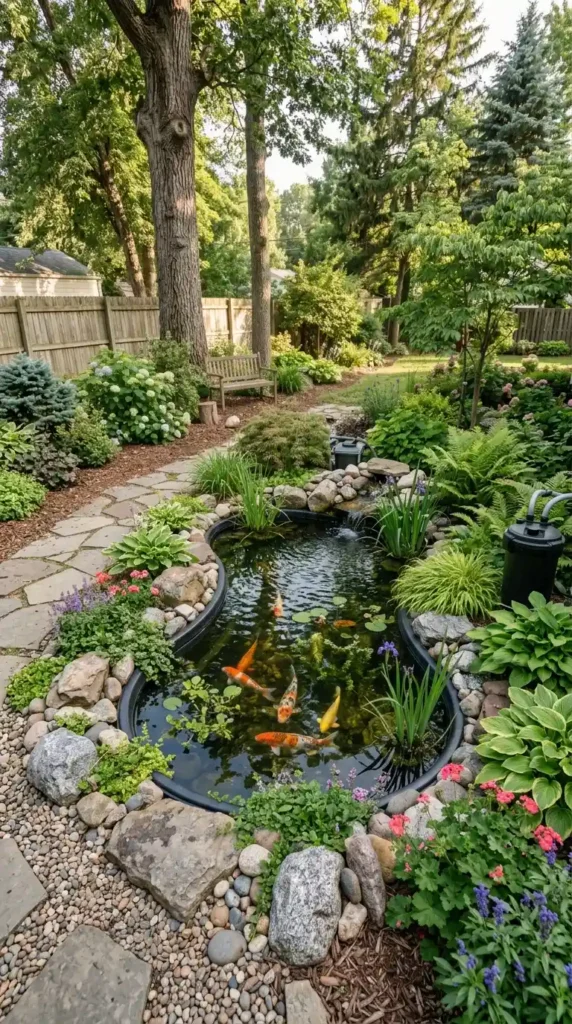
A preformed liner pond is the simplest way to build a koi pond. It requires minimal construction knowledge and can be installed quickly.
While limited in size and shape, it is ideal for first-time pond builders.
13. Koi Pond With Stream (Best Natural Water Flow Design)
✦ Best for: Gardens on a slope where a stream can create natural water movement and sound
Ideal garden size: Sloped gardens or larger small gardens
Material options: Liner stream bed, rock channel, pump system
Cost range: $1,500 – $8,000
What it solves: Flat garden layout, lack of movement
Styling tip: Keep stream shallow and gently curved
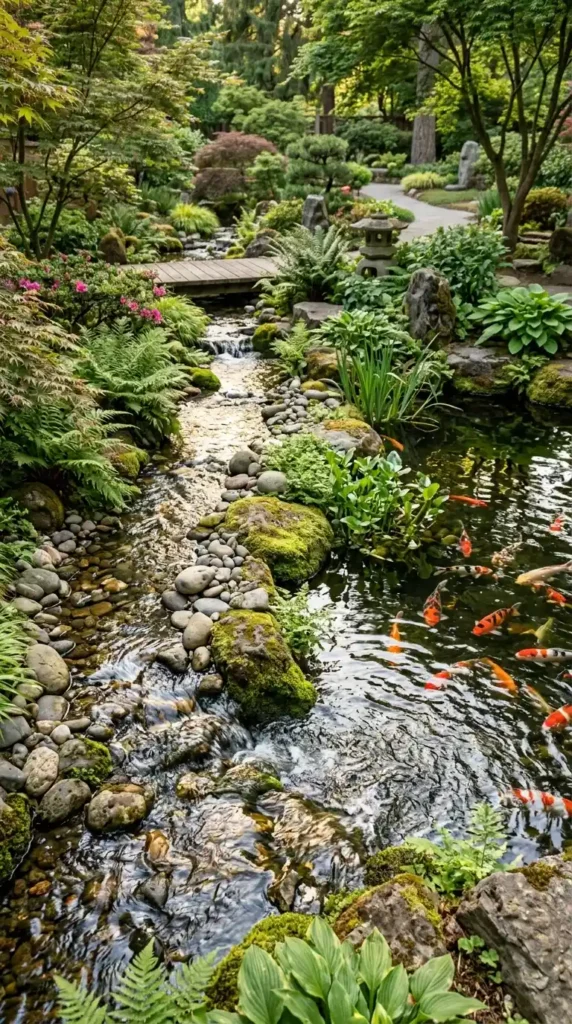
A small stream feeding into a koi pond creates continuous movement and sound. It also improves oxygen levels in the water system.
Even short streams dramatically improve garden atmosphere.
14. Koi Pond With Seating Area (Best Relaxation Layout)
✦ Best for: Gardens where the pond is the centerpiece of a dedicated relaxation area
Ideal garden size: Small gardens with defined zones
Material options: Stone bench, timber seating, built-in wall seating
Cost range: $500 – $4,000
What it solves: Lack of usability, pond-only viewing design
Styling tip: Position seating 3–5 feet from water edge
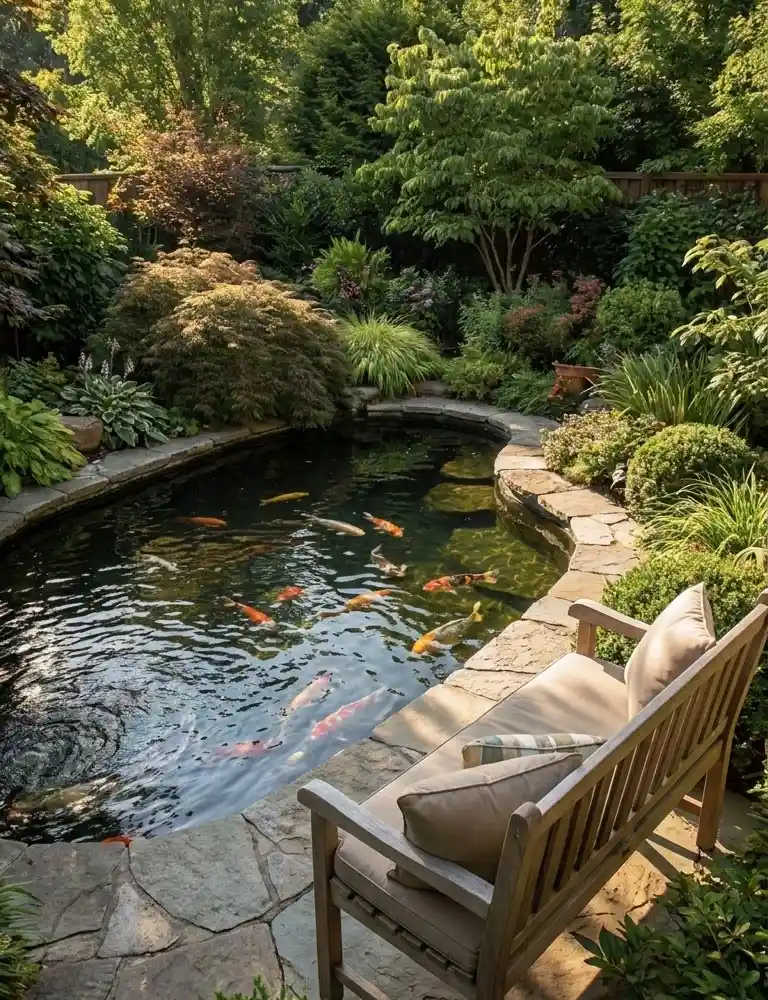
Adding seating turns a koi pond into a lived-in space rather than just a visual feature. In small gardens, this is essential for usability.
It creates a dedicated relaxation zone centered around water movement.
15. Koi Pond With Pergola (Best Shade & Structure Solution)
✦ Best for: Gardens where the pond needs protection from leaf debris and afternoon sun
Ideal garden size: Sunny small gardens
Material options: Timber pergola, metal frame, climbing plant support
Cost range: $1,000 – $6,000
What it solves: Excess sunlight, algae growth, lack of structure
Styling tip: Add climbing plants for filtered shade
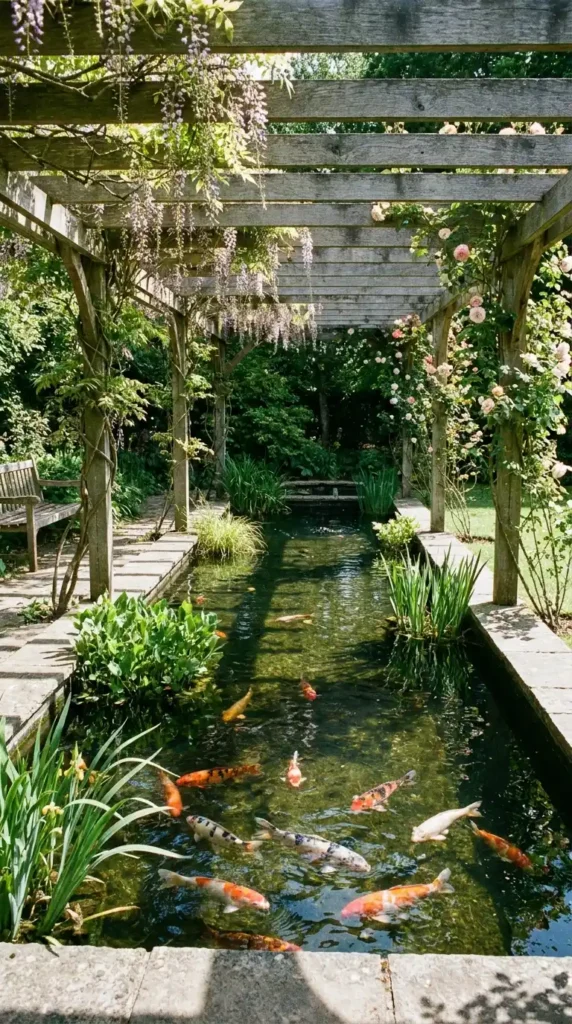
A pergola over a koi pond provides both functional shade and architectural structure. It helps regulate water temperature and reduces algae growth.
In small gardens, it also creates vertical interest without using ground space.
16. Minimalist Koi Pond for Small Gardens (Best Clean Design Style)
✦ Best for: Gardeners who want to create a biodiverse pond that benefits local wildlife
Ideal garden size: Modern homes, small courtyards
Material options: Concrete, black liner, steel edging
Cost range: $1,500 – $9,000
What it solves: Visual clutter, over-designed gardens
Styling tip: Limit planting to one or two sculptural plants
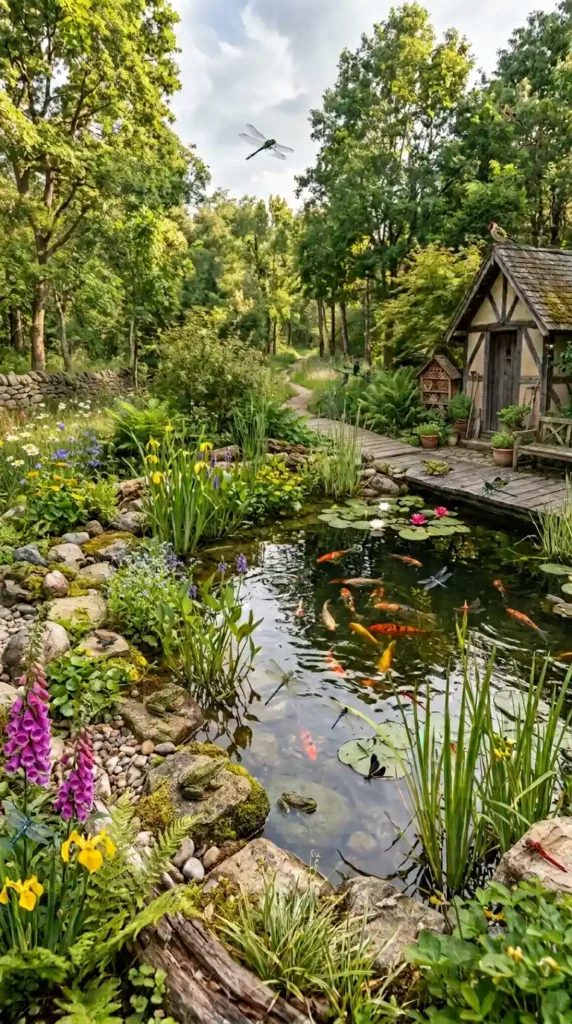
A minimalist koi pond focuses on clean lines and simplicity. It removes unnecessary decoration so the koi and water become the main focus.
This works especially well in modern architecture.
17. Raised Edge Koi Pond With Seating Wall (Best Dual-Purpose Design)
✦ Best for: Naturalistic gardens where a bridge is too formal or structural
Ideal garden size: Compact gardens
Material options: Block wall, stone coping, timber sleeper frame
Cost range: $2,000 – $8,000
What it solves: Lack of seating, unused pond perimeter
Styling tip: Use wide coping stones for comfort
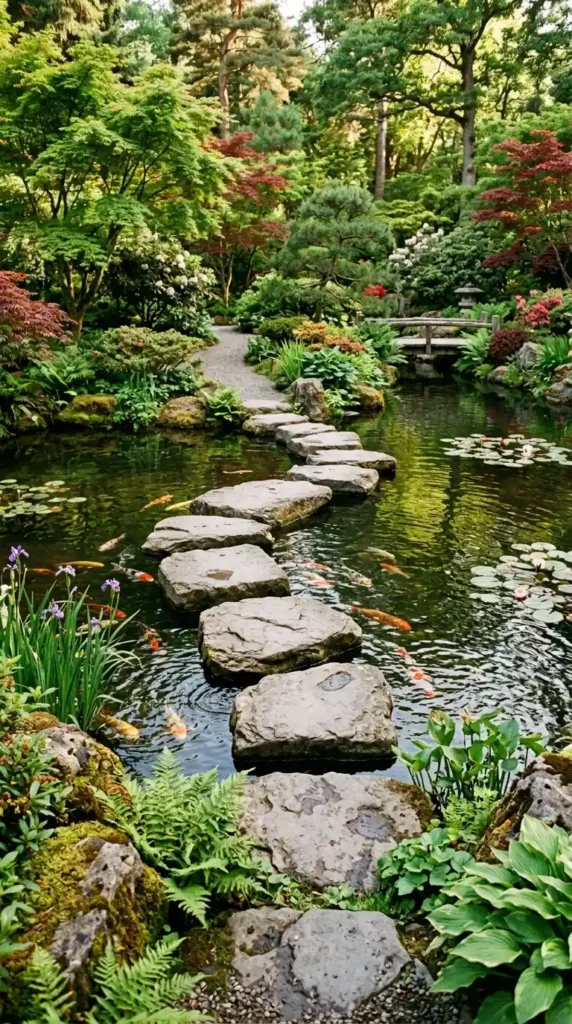
This design combines pond structure with seating functionality. The raised edge doubles as a bench, making it highly efficient for small spaces.
It turns the pond into a social feature, not just a visual one.
18. Wildlife-Integrated Koi Pond (Best Eco-Friendly Design)
✦ Best for: Any koi pond where the aesthetic is enhanced by a mix of water plants
Ideal garden size: Natural gardens, eco landscapes
Material options: Natural liner, planting shelves, rock edges
Cost range: $1,000 – $6,000
What it solves: Lack of biodiversity, sterile pond appearance
Styling tip: Add shallow planting zones for habitat balance
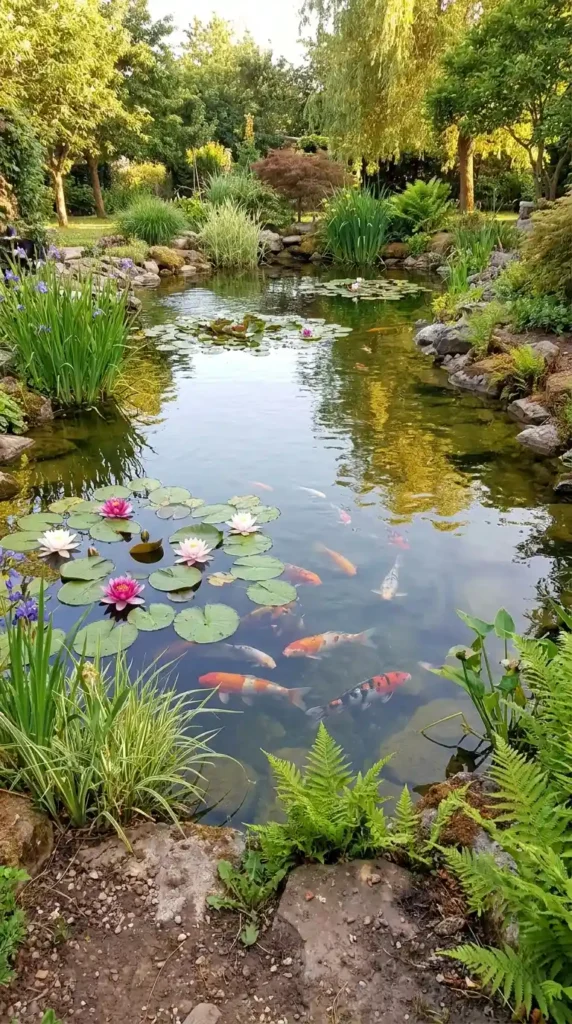
This type of pond supports both koi and surrounding wildlife. Marginal planting zones help create ecological balance while still supporting fish health.
It feels more alive and natural than purely decorative ponds.
19. Small Geometric Corner Pond (Best Compact Modern Layout)
✦ Best for: Modern gardens where simplicity and clean lines are the priority
Ideal garden size: Tight corners, narrow yards
Material options: Concrete, stone slab, fiberglass shell
Cost range: $1,500 – $7,000
What it solves: Inefficient corner use, awkward layouts
Styling tip: Use straight edges aligned with fences or walls
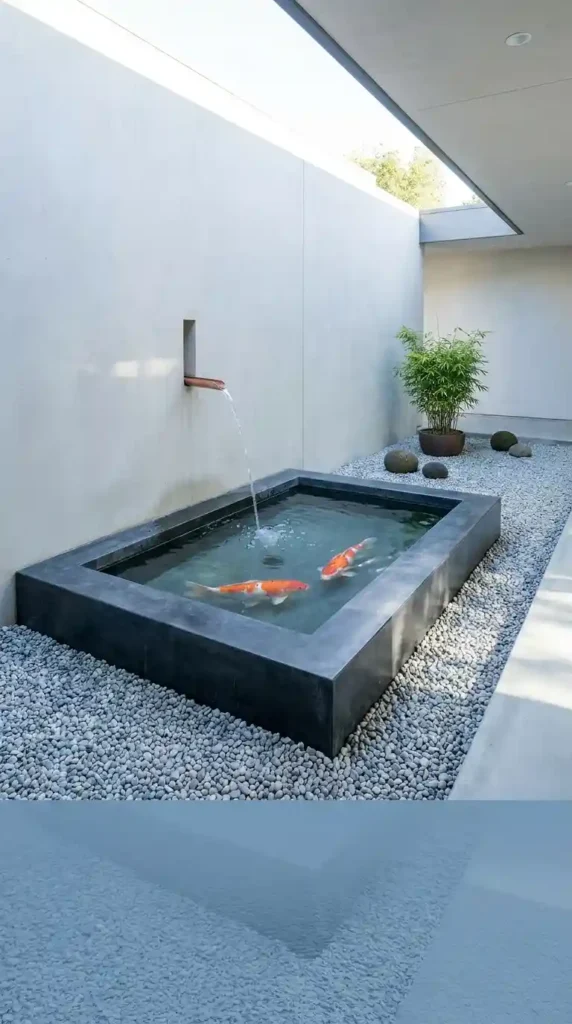
A compact geometric pond fits neatly into corners and maximizes limited space. Its structured shape makes it feel intentional even in very small gardens.
20. Zen Gravel & Koi Pond Combo (Best Japanese Minimal Hybrid)
✦ Best for: Naturalistic gardens where the pond needs to blend seamlessly with the garden
Ideal garden size: Japanese-inspired small gardens
Material options: Gravel, stone, liner pond
Cost range: $1,000 – $5,000
What it solves: Lack of harmony, overly busy layouts
Styling tip: Use raked gravel zones around pond edges
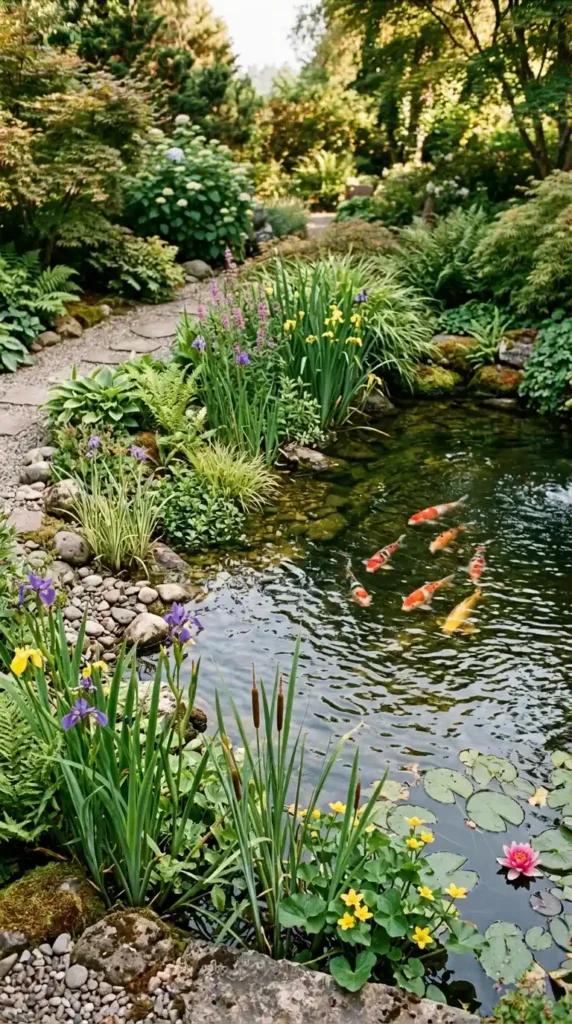
This hybrid design blends gravel landscaping with water features. It creates a calm, meditative environment ideal for compact gardens.
21. Compact Modern Feature Pond (Best Entry-Level Designer Look)
✦ Best for: Understanding the non-negotiable technical requirements that keep koi healthy and water clear in any small pond design
Ideal garden size: Very small gardens or courtyards
Material options: Fiberglass shell, concrete, steel edging
Cost range: $800 – $4,000
What it solves: No focal point in small gardens
Styling tip: Use lighting + clean edges for premium effect
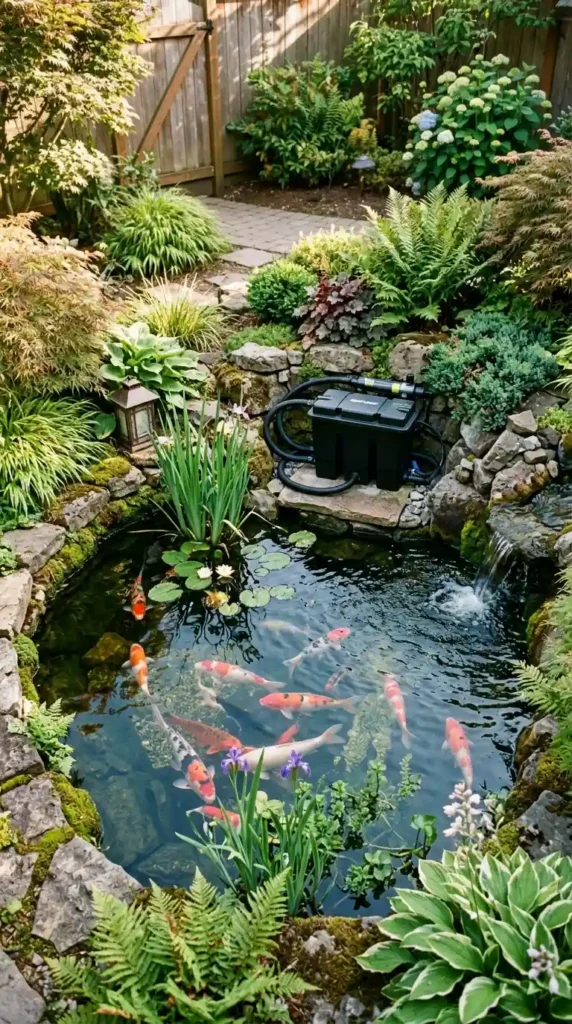
This is a simplified koi pond designed purely for visual impact in tight spaces. It focuses on clean geometry and minimal maintenance.
Even in very small gardens, it creates a strong design anchor.
Best Plants for a Small Koi Pond
Plants in a koi pond perform genuine water quality functions alongside their decorative role. They absorb nitrates from the water, provide surface cover that reduces algae growth by shading the water, and give koi shelter from overhead predators such as herons. The challenge in a koi pond specifically is that koi are enthusiastic plant disturbers. They dig in substrate, uproot plants, and eat soft-leaved aquatic species. Plant selection and protection for a koi pond needs to account for this.
Koi-resistant pond plants include water lilies in large heavy containers with gravel mulch over the soil surface. The container prevents rooting disturbance and the gravel prevents koi from digging out the soil. Hardy water lilies in a small koi pond should cover no more than one-third of the surface area to allow adequate water oxygenation and fish observation. Nymphaea ‘Marliacea Chromatella’ for yellow flowers, Nymphaea ‘James Brydon’ for deep pink flowers, and Nymphaea ‘Gonnere’ for white double flowers are all reliably vigorous in small pond containers.
Marginal plants in protected planting baskets on shallow shelves also work well. Iris, rush, and reed species in mesh baskets with large stones placed on top prevent koi from disturbing the roots. Pontederia cordata (pickerelweed) for blue flowers and vigorous growth. Iris pseudacorus for yellow iris flowers and striking vertical form. Typha minima (dwarf bulrush) for the characteristic cattail seed heads at a manageable scale for small ponds.
Plants to avoid in a koi pond: any soft-leaved submerged oxygenating plant such as hornwort or elodea will be eaten by koi within days of planting. Delicate floating plants such as water hyacinth and water lettuce are similarly short-lived in a koi pond. Stick to the robust marginals and container-grown water lilies for any planting in a pond that contains koi.
Frequently Asked Questions About Koi Pond Design Ideas for Small Gardens
What is the minimum depth for a koi pond in a small garden?
→ 3–4 feet
Can koi live in a small garden pond?
→ yes, if filtration + depth correct
What is the cheapest koi pond design for small gardens?
→ preformed liner or raised timber pond
Do koi ponds increase home value?
→ yes, especially landscaped water features
Is a waterfall necessary for a koi pond?
→ not required, but improves oxygen + aesthetics
How small can a koi pond be?
The minimum practical size is 1,000 gallons, which is roughly 6 feet long by 4 feet wide by 3 feet deep. Anything smaller makes stable water chemistry nearly impossible to maintain.
How many koi can I keep in a small pond?
The standard guideline is 250 gallons per koi at adult size. A 1,000-gallon pond supports four koi at maximum. I always recommend stocking two or three and resisting the urge to add more.
How deep does a koi pond need to be?
Minimum 3 feet, preferably 4 feet in cold climates. Shallow ponds overheat in summer and freeze too deeply in winter. Depth is the dimension most people underestimate.
What is the best shape for a small koi pond?
Rectangular at a 2:1 or 3:1 ratio gives the most swimming space per square foot. L-shapes work best in corners. Avoid tight kidney shapes as they create poor water circulation.
How much does a small koi pond cost?
A basic preformed liner pond runs $500 to $1,000. A custom concrete pond with professional filtration costs $5,000 to $15,000. Glass-panel luxury builds can reach $50,000 or more.
What plants are best for a koi pond?
Water lilies in heavy containers with gravel topping and marginal plants like iris in mesh baskets with stones on top. Avoid soft-leaved plants entirely as koi will eat them within days.
Koi pond design ideas for small gardens are becoming increasingly popular in modern landscaping because they allow homeowners to create high-impact water features even in limited outdoor spaces. With the right structure, filtration system, and layout planning, even a compact garden can support a healthy and visually stunning koi pond.
Related Articles
The Ultimate Koi Pond Guide: Design, Building, Filtration & Maintenance
Garden Plants for Shade That Thrive Without Direct Sunlight
8 Rooftop Garden Ideas Perfect For Summer
If I had to choose one design for most small American backyards it would be a raised concrete pond at 1,000 gallons with a clean rendered finish and a simple waterfall for oxygenation. It fits in almost any space, requires no digging, and looks genuinely impressive from day one.
Get the depth right, get the filtration right, and understock it. Those three decisions determine whether your koi thrive. Everything else, the material, the shape, the planting, is secondary to getting those fundamentals in place.

Sheikh Hassaan is a digital architect for small businesses and the founder of The Glow Up System. He writes about home decor, garden design, and outdoor living for real American homes – practical ideas that work in actual spaces without oversized budgets.