
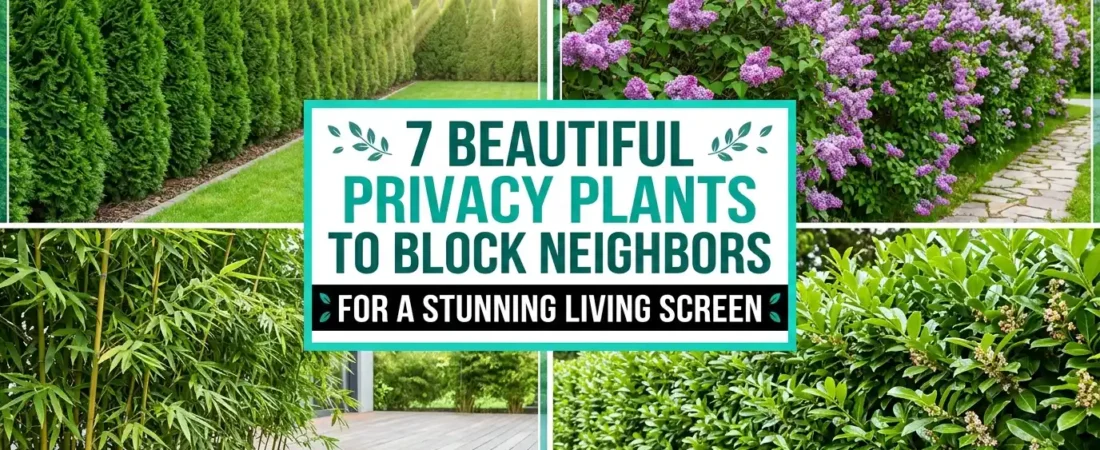
A fence gives you a boundary. Privacy plants give you a living wall that blocks sightlines, reduces noise, creates habitat for birds and pollinators, and looks genuinely beautiful in every season. The right privacy plant does what no fence can — it grows more beautiful over time, filters wind rather than blocking it, and creates the kind of lush green backdrop that makes a backyard feel like a private retreat rather than a fenced-off lot.
These privacy plants cover every garden size, climate zone, and screening need — from fast-growing evergreen hedges that block a neighbor’s second-floor window within two seasons through ornamental grasses, bamboo screens, and flowering shrubs that create privacy without looking like a deliberate barrier.
Table of Contents
How to Choose the Right Privacy Plant for Your Yard
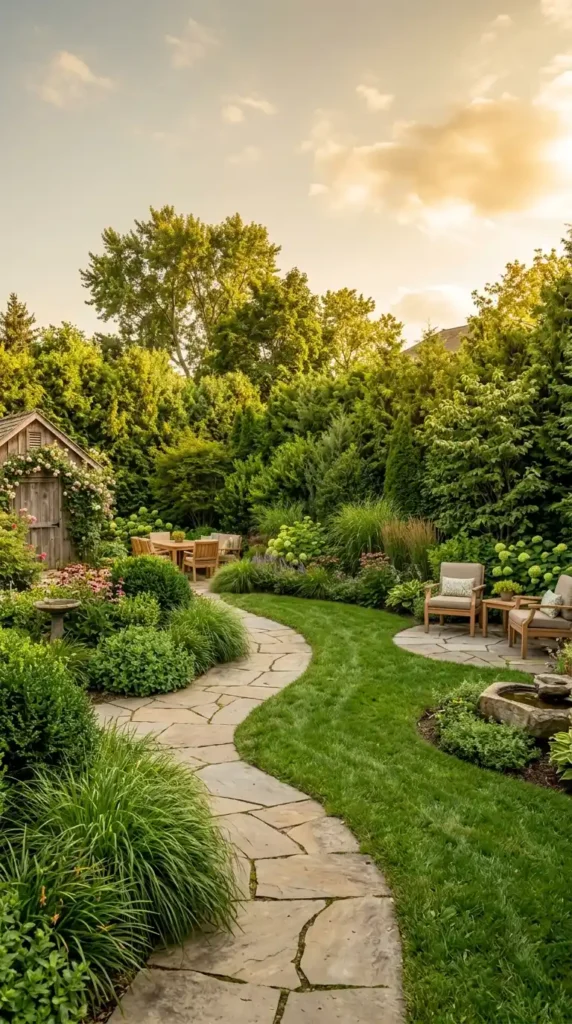
Before choosing a privacy plant the two questions that determine everything else: how tall does the screen need to be and how fast does it need to get there. A neighbor’s ground-floor window requires a screen of 6 feet. A second-floor deck or window requires 10 to 15 feet. A rooftop terrace or elevated view requires 20 feet or more. Each height requirement points to a completely different category of plant — a 6-foot screen is achievable with ornamental grasses or medium shrubs while a 15-foot screen requires a tree or large shrub species.
Growth rate is the second critical factor. The fastest-growing privacy plants — Leyland cypress, green giant arborvitae, and clumping bamboo — reach screening height in two to four years but require significant space and ongoing maintenance. The slowest — boxwood, holly, and yew — take eight to twelve years to reach full screening height but require almost no maintenance once established. Most homeowners want something in between: a plant that reaches adequate screening height in three to five years without becoming a maintenance problem.
The spacing rule that most people get wrong when planting a privacy screen: plant for the mature spread of the plant, not for the screening gap that exists today. Arborvitae planted 3 feet apart to immediately close gaps will require thinning in five years when the plants reach their mature spread of 4 to 6 feet. Plant at the recommended spacing — typically 4 to 6 feet for most privacy shrubs — and fill the gaps in the first two seasons with fast-growing annuals or ornamental grasses while the permanent plants establish.
1. Green Giant Arborvitae — The Most Popular Fast-Growing Privacy Tree
✦ Best for: creating a tall dense evergreen privacy screen quickly in most US climate zones
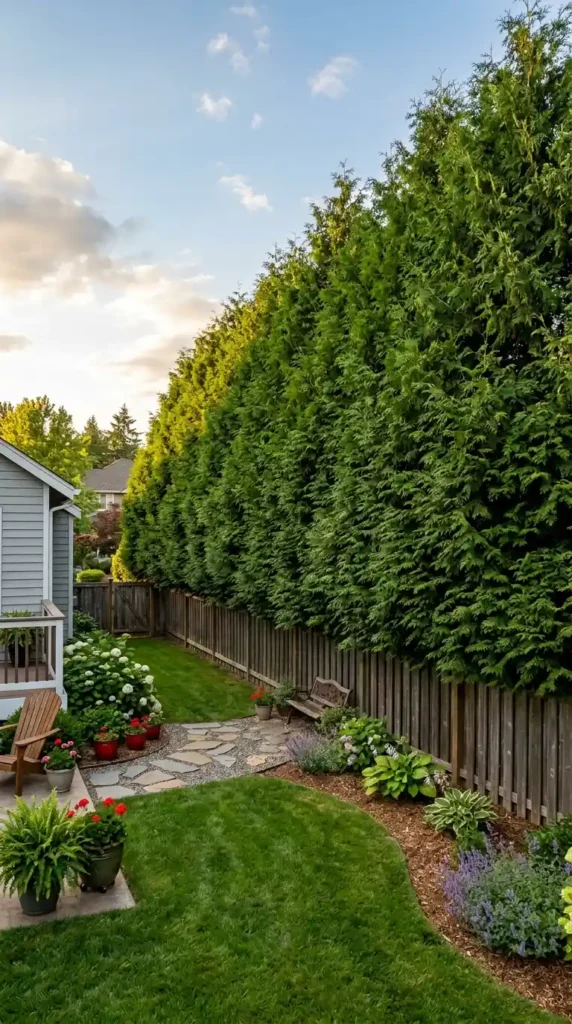
Green giant arborvitae is the most widely planted privacy tree in America for good reason — it combines genuinely fast growth of 3 to 5 feet per year with a naturally pyramidal form that requires no pruning, dense evergreen foliage that provides year-round screening, excellent disease resistance, and adaptability to most US soil types and climate zones from zone 5 through zone 8. A green giant planted today at 6 feet tall will reach 15 to 18 feet within three to four years without any shaping or maintenance.
The planting spacing that creates the most effective green giant privacy screen: 5 to 6 feet on center for a solid wall effect where the trees grow together into a continuous hedge. 8 to 10 feet on center for a looser screen that maintains individual tree form while still providing significant privacy. The 5 to 6 foot spacing creates complete visual screening faster but requires more plants — budget for one tree per 5 to 6 linear feet of boundary when planning the planting.
One thing homeowners often overlook with green giant arborvitae: at maturity these trees reach 40 to 60 feet tall and 12 to 18 feet wide. In a small backyard the eventual size can become overwhelming. If the screening height needed is under 15 feet and space is limited consider Emerald Green arborvitae instead — it reaches only 12 to 14 feet tall and 3 to 4 feet wide, making it significantly more manageable in a typical suburban yard.
2. Clumping Bamboo — Fast Privacy Without the Invasive Spread
✦ Best for: creating a dramatic tall privacy screen in a narrow space without the invasive spreading of running bamboo varieties
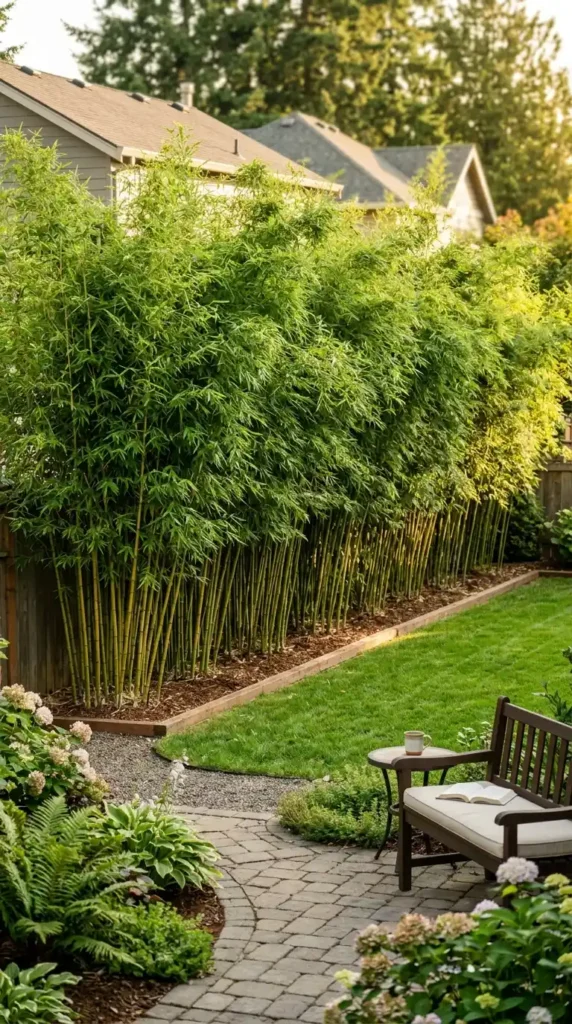
Clumping bamboo — specifically Fargesia and Bambusa species rather than the invasive running Phyllostachys varieties — is the privacy plant that creates the most dramatically beautiful and most unique living screen available in American gardens. Where running bamboo spreads aggressively through underground rhizomes and can become a significant neighborhood problem, clumping bamboo stays contained within its original planting footprint and expands only a few inches per year outward from the original clump.
The clumping bamboo varieties that perform best as privacy screens in the US: Fargesia robusta for zones 5 through 9 — it reaches 12 to 15 feet tall in a tight clump of 4 to 6 feet wide and tolerates both full sun and partial shade. Bambusa multiplex Alphonse Karr for zones 8 through 11 — the golden canes with green stripes create one of the most visually beautiful privacy screens available in warmer climates. Both establish quickly and reach screening height within two to three years from a 5-gallon nursery plant.
A common mistake with bamboo privacy screens is underwatering in the establishment period — bamboo is drought tolerant once established but requires consistent moisture in its first two seasons to develop the root system that supports rapid above-ground growth. A drip irrigation system or weekly deep watering during the first two summers after planting makes the difference between a bamboo screen that reaches screening height in two years and one that takes five.
3. Leyland Cypress — The Fastest Growing Privacy Tree for Large Properties
✦ Best for: large property boundaries where maximum height and maximum growth speed are the primary requirements
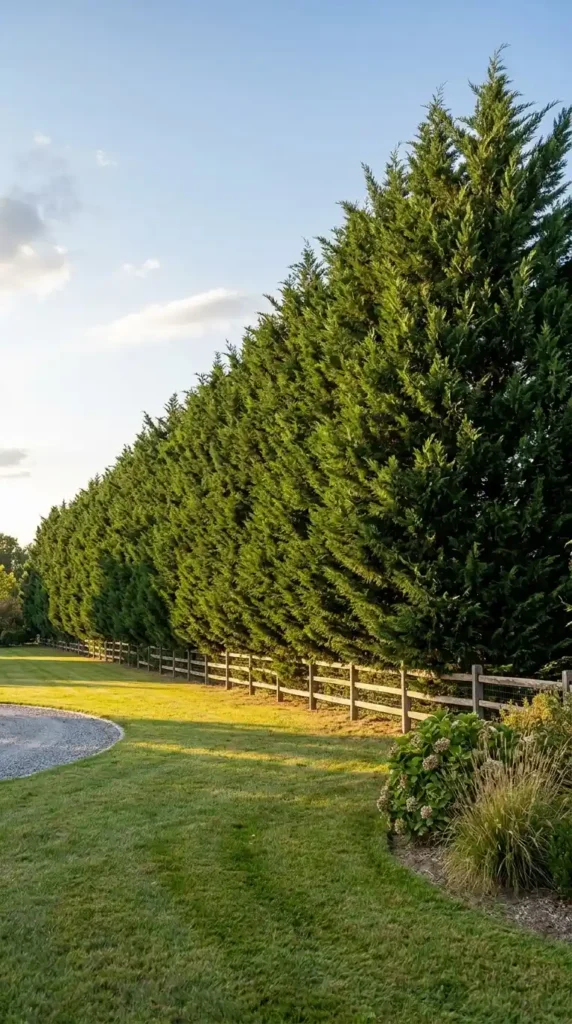
Leyland cypress is the fastest-growing privacy tree available in American gardens — it adds 3 to 4 feet of height per year under good conditions and reaches 40 to 60 feet at maturity. For a large property boundary where a tall dense evergreen screen is needed quickly and space is not a constraint Leyland cypress delivers results faster than any other evergreen tree available. A row of Leyland cypress planted at 8 feet tall will be at 20 feet within three to four years.
The significant caveat with Leyland cypress that every homeowner should understand before planting: it is susceptible to several fungal diseases including Seiridium canker and Botryosphaeria canker that can kill individual trees in a row and are difficult to control once established. In humid southeastern states — Georgia, Alabama, the Carolinas — Leyland cypress disease problems are common enough that many landscapers now recommend green giant arborvitae instead. In drier western and midwestern climates Leyland cypress performs significantly better.
Planting spacing for Leyland cypress privacy screens: 6 to 8 feet on center for a solid hedge effect. At this spacing the trees grow together into a continuous wall within three to four years. Do not plant closer than 6 feet — the dense overlapping growth at tight spacing increases humidity within the hedge and accelerates fungal disease development.
4. Emerald Green Arborvitae — The Best Privacy Plant for Small Yards
✦ Best for: small suburban yards where a manageable-sized evergreen privacy screen is needed without the eventual size problems of larger species
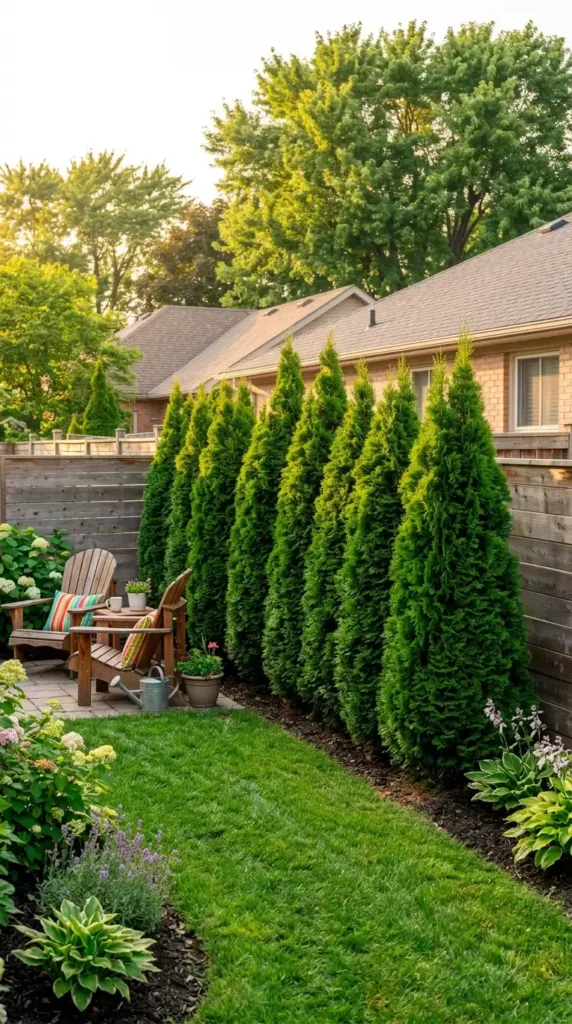
Emerald Green arborvitae is the privacy plant that solves the size problem that makes green giant arborvitae impractical for small yards. At mature height of 12 to 14 feet and mature width of only 3 to 4 feet it provides adequate screening height for most residential privacy needs while fitting in spaces where a 12 to 18 foot wide plant would be impossible. A row of Emerald Green arborvitae planted 3 to 4 feet from a fence line stays within the property without overhanging neighbors.
Emerald Green arborvitae grows more slowly than green giant — adding 6 to 9 inches per year rather than 3 to 5 feet — which means it takes longer to reach screening height but also means it requires no pruning or shaping to maintain its neat naturally columnar form. For a homeowner who wants a privacy screen that stays the same size and shape indefinitely without any maintenance this slower growth is an advantage rather than a limitation.
Plant Emerald Green arborvitae 2 to 3 feet on center for an immediate solid screen effect — the narrow mature width means the plants will not outgrow this spacing even at full maturity. In cold climates zone 4 and 5 wrap newly planted Emerald Greens in burlap for the first two winters to prevent winter burn from drying winds — this is the most common cause of browning in young plantings.
5. Skip Laurel — The Best Privacy Hedge for Shade and Difficult Spots
✦ Best for: shaded areas and difficult spots where most evergreen privacy plants struggle to establish
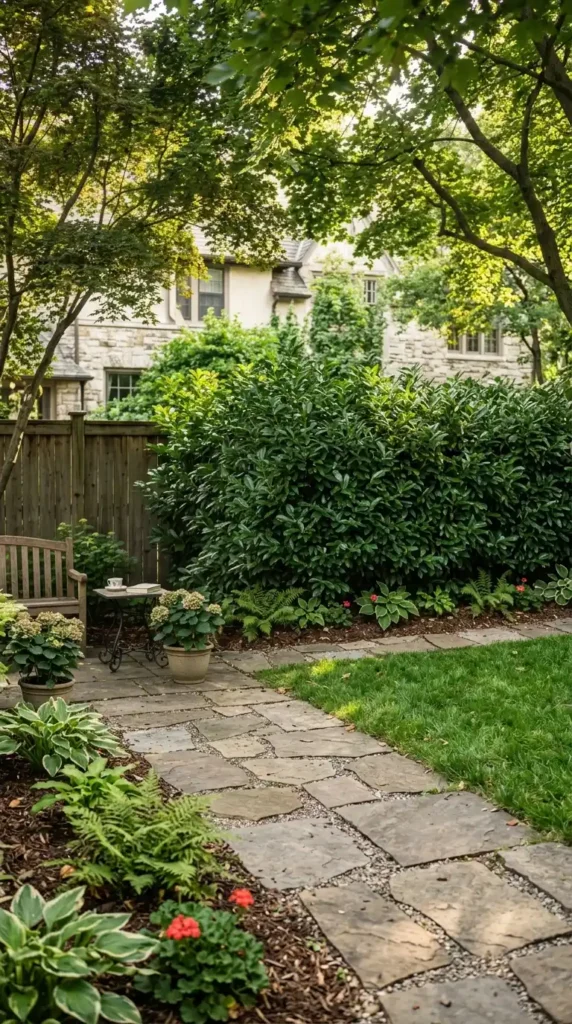
Skip laurel is the evergreen privacy hedge that performs where most others fail — in partial to full shade. Where arborvitae and cypress need at least six hours of direct sun to grow densely, skip laurel thrives in the shaded north-facing sides of houses, under tree canopies, and in the shadow of existing fences where a privacy screen is most needed but light is most limited. The large glossy dark green leaves also create a visual richness that fine-textured conifers cannot match.
Skip laurel reaches 10 to 18 feet tall at maturity in zones 6 through 9 and grows at a moderate rate of 1 to 2 feet per year. It responds well to pruning and can be maintained as a formal hedge at any height from 4 to 15 feet, making it one of the most versatile privacy hedge plants available. In spring it produces fragrant white flower spikes that make it genuinely ornamental as well as functional — something most privacy conifers cannot offer.
Plant skip laurel 4 to 5 feet on center for a hedge that fills in within three to four years. The deer resistance of skip laurel is a significant advantage in suburban areas where deer pressure prevents many ornamental plants from establishing — skip laurel is rarely browsed even in high-deer-pressure areas because the leaves contain compounds deer find unpalatable.
6. Ornamental Grasses — Fast Seasonal Privacy With a Natural Look
✦ Best for: adding natural-looking seasonal privacy to a yard that needs screening from June through October without a permanent year-round structure
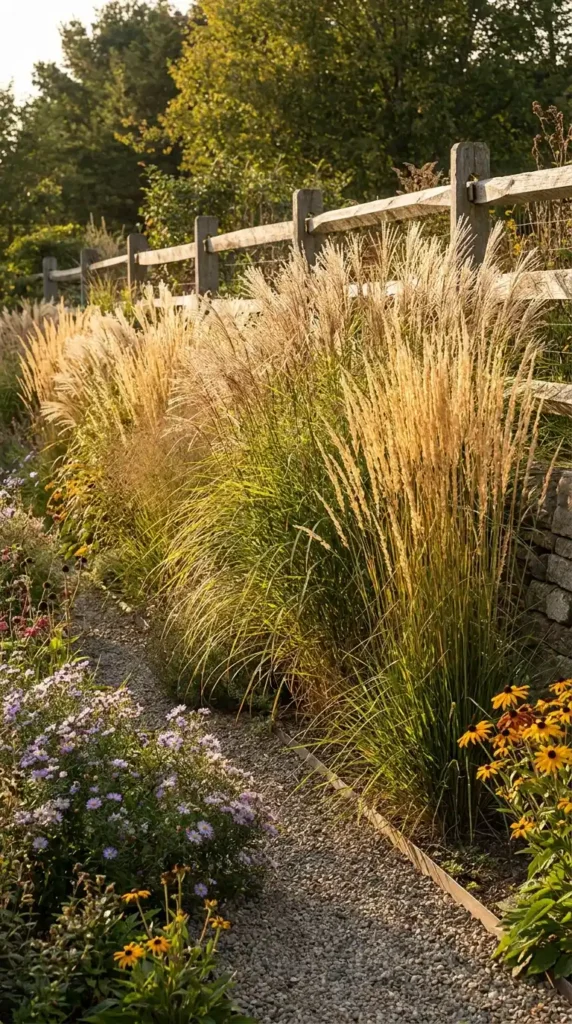
Tall ornamental grasses — particularly Karl Foerster feather reed grass at 5 to 6 feet, Miscanthus sinensis varieties at 6 to 8 feet, and Panicum virgatum switchgrass at 4 to 6 feet — are the fastest seasonal privacy solution available. They emerge from the ground in spring, reach full height by June, and provide dense screening through fall before being cut back in late winter. In their first season from a 1-gallon nursery plant most tall grasses reach 4 to 5 feet of screening height.
The advantage of ornamental grasses as privacy plants over evergreen hedges: they move in the wind which creates a natural dynamic quality that static hedges cannot achieve. They produce seed heads in late summer and fall that are among the most beautiful plant forms available in the American garden. They require minimal maintenance — one hard cut to 6 inches in late winter or early spring is the entire annual maintenance requirement. And they establish quickly enough to provide meaningful screening in their very first growing season.
Combine ornamental grasses with an evergreen backbone for a privacy planting that works year-round. A row of Emerald Green arborvitae at 5 to 6 foot spacing with Karl Foerster grass planted in the gaps creates immediate year-round privacy while the arborvitae establishes — the grasses fill the visual gaps in summer and the arborvitae provides the winter screening that the dormant grasses cannot.
7. Nellie Stevens Holly — A Beautiful Flowering Privacy Hedge
✦ Best for: homeowners who want an evergreen privacy hedge that is also genuinely ornamental with seasonal interest beyond just screening
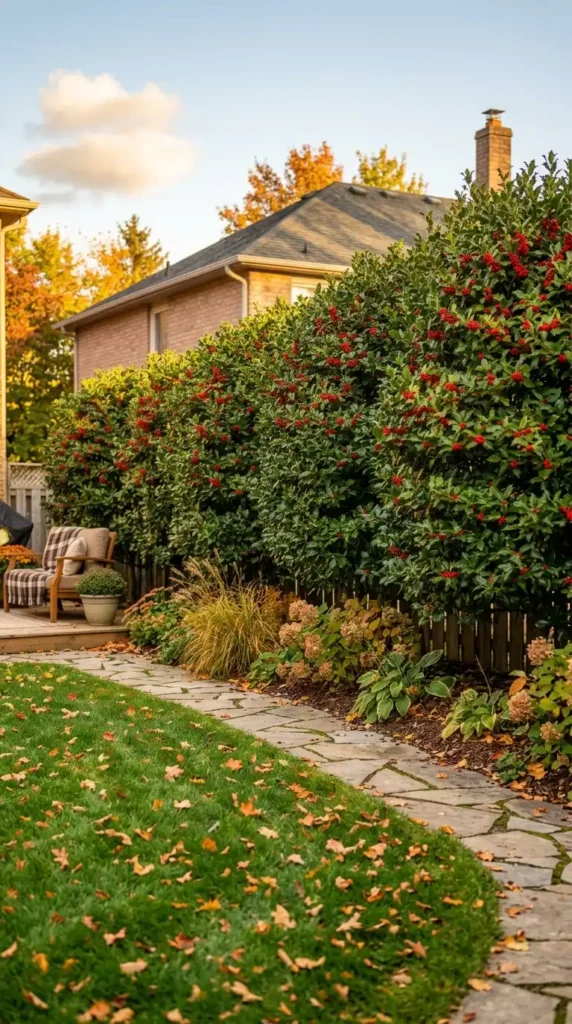
Nellie Stevens holly is the privacy hedge that landscape designers choose when function and ornamental beauty are both required — it provides dense year-round screening with its glossy dark green spiny foliage, produces bright red berries in fall and winter that create genuine seasonal interest and attract birds, grows at a moderate-to-fast rate of 2 to 3 feet per year, and is significantly more disease resistant and deer resistant than most other privacy hedge plants.
Nellie Stevens holly reaches 15 to 25 feet at maturity in zones 6 through 9 and maintains a naturally pyramidal form that requires little pruning to stay tidy. The spiny leaves that deter deer also deter anyone from reaching through or over the hedge which adds a genuine security element beyond visual privacy. A mature Nellie Stevens holly hedge is genuinely impenetrable — it is one of the few privacy hedges that also functions as a physical barrier.
Plant Nellie Stevens holly 5 to 6 feet on center for a hedge that fills in within four to five years. One male holly — any variety — planted within 50 feet of a row of Nellie Stevens ensures consistent berry production since hollies require cross-pollination. Most nurseries sell small male holly plants specifically for this purpose alongside Nellie Stevens rows.
Frequently Asked Questions
What is the fastest growing privacy plant?
The fastest growing privacy plants for American gardens are Leyland cypress at 3 to 4 feet per year, green giant arborvitae at 3 to 5 feet per year, and clumping bamboo at 2 to 4 feet per year. Among these green giant arborvitae is the most widely recommended because it combines fast growth with excellent disease resistance and adaptability across most US climate zones. Leyland cypress grows equally fast but is prone to fungal disease in humid southeastern climates. Bamboo grows fast but requires species selection to avoid invasive running varieties. According to the Arbor Day Foundation, green giant arborvitae is consistently ranked among the top three most recommended fast-growing privacy trees for American residential landscapes because of its combination of growth rate, disease resistance, and low maintenance requirements.
What privacy plants work in full shade?
The privacy plants that perform best in full to partial shade: skip laurel is the top choice for shaded privacy hedging in zones 6 through 9 — it tolerates deep shade and still grows densely enough to provide complete screening. Inkberry holly is a native option that thrives in wet shaded spots where most plants struggle. Mountain laurel provides privacy at 6 to 10 feet in woodland and shaded settings. Yew is one of the few conifers that tolerates full shade and can be maintained as a dense formal privacy hedge. For ornamental grasses in shade Japanese forest grass Hakonechloa provides beautiful screening in partial shade though it reaches only 2 to 3 feet.
How close to the property line can I plant privacy plants?
Property line setback requirements for plantings vary by municipality and are governed by local zoning ordinances rather than federal or state rules. Most US municipalities require trees and large shrubs to be planted at least 2 to 4 feet from the property line. Some HOA communities have additional restrictions on hedge height and species. Before planting any privacy hedge check your local zoning code and HOA rules — planting on or over a property line can create legal disputes with neighbors and may require removal of established plants. The safest approach is to plant so that at mature size the plant’s canopy stays within your property line.
What privacy plants work in containers on a patio or deck?
The privacy plants that perform best in large containers for patio and deck screening: clumping bamboo in a 25 to 30 gallon container reaches 8 to 12 feet and provides dramatic tropical-looking privacy. Sky pencil holly in a 15 to 20 gallon container reaches 8 to 10 feet in a very narrow 2-foot-wide column. Arborvitae in large containers provides evergreen screening but requires significant watering — containers dry out faster than ground plantings. Ornamental grasses in 15-gallon containers provide seasonal screening at 4 to 6 feet. All container privacy plants require more frequent watering and fertilizing than in-ground plants and should be moved to a protected location in climates with hard freezes to prevent root damage.
More Garden Ideas
→ Garden Border Ideas That Make Every Bed Look Designed
→ Garden Path Ideas for a More Beautiful Backyard
→ Container Garden Plants for Shade That Thrive in Pots
→ Garden Edging Ideas That Make Your Yard Look Professionally Done
Plant for the mature size, not the current gap. A screen that is too close together today becomes a maintenance problem in five years. Get the spacing right from the start.

Sheikh Hassaan is a digital architect for small businesses and the founder of The Glow Up System. He writes about home decor, garden design, and outdoor living for real American homes – practical ideas that work in actual spaces without oversized budgets.