
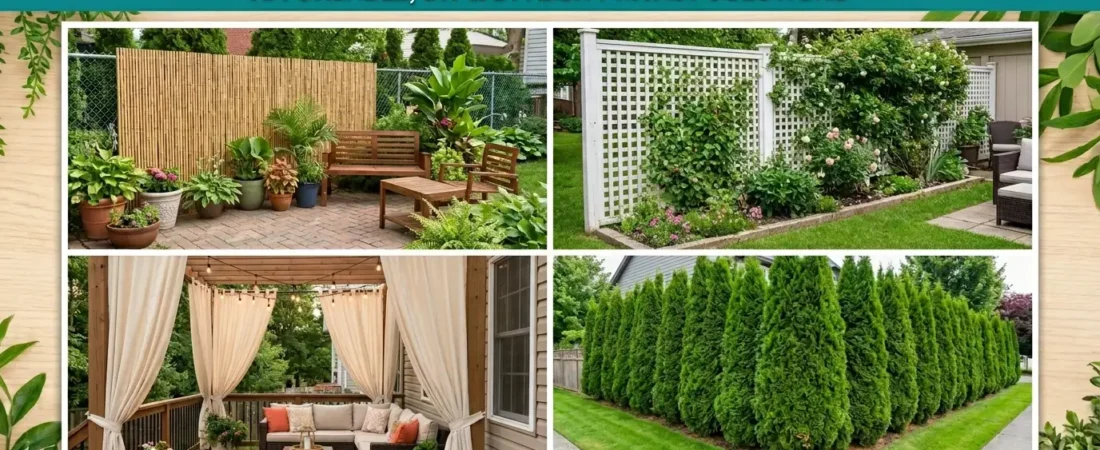
Cheap ways to block neighbors’ view are one of the most searched outdoor privacy topics for good reason — being overlooked in your own backyard changes how you use it. A patio you feel observed on gets used less. A backyard that feels genuinely private becomes the outdoor room you actually live in through the summer. The good news is that effective privacy screening does not require planning permission, expensive construction, or a large budget. These 10 solutions range from a $15 reed fence roll to a living bamboo screen that provides permanent privacy from year two onward.
Every solution here includes an honest cost, an installation time, and how long it takes to provide effective privacy.
Table of Contents
1. Reed Fence Rolls: Instant Privacy for $15 That Looks Natural From Both Sides
✦ Reed Fence Covering
💰 Cost: $15–$30 per roll ⏱ Installation: 30 minutes
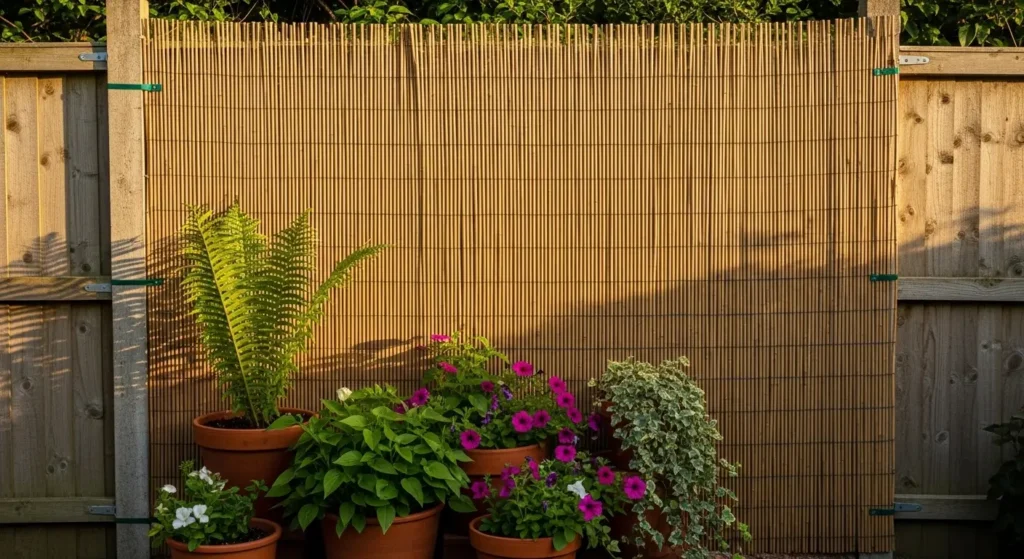
Reed fence rolls are the fastest and cheapest privacy screening solution available. A single roll covers 13 linear feet of fence to a height of 6 feet in 30 minutes with garden wire and basic tools. The natural honey-brown reed material looks attractive from both sides — unlike solid timber or fabric screens that present an unattractive back face to the neighbor.
Attachment method: unroll the reed panel along the existing fence. Attach using galvanized garden wire threaded through the reed weave and around the fence rails at the top, middle, and bottom. No drilling required on timber fences. The wire attachment allows the reed panel to flex in wind without detaching.
The limitation of reed fence rolls is longevity. Natural reed degrades in outdoor conditions over 3 to 5 years as UV and moisture break down the reed fibers. Synthetic reed-effect rolls made from UV-stabilized polyethylene last 10 to 15 years with identical visual results. The synthetic version costs $5 to $10 more per roll and is significantly better value over a 5-year period.
PRO TIP: Attach reed fence rolls to the neighbor-facing side of your fence rather than the garden-facing side. Reed attached to the outside face of the fence adds 2 to 3 inches of height above the fence top — the most valuable privacy zone — while keeping your garden-facing fence face clean for decorating and planting.
2. Bamboo: The Living Privacy Screen That Reaches 15 Feet and Costs $30 to Plant
✦ Fast-Growing Bamboo Screen
💰 Cost: $30–$80 for initial planting ⏱ Installation: 2 hours to plant, 2 years to privacy
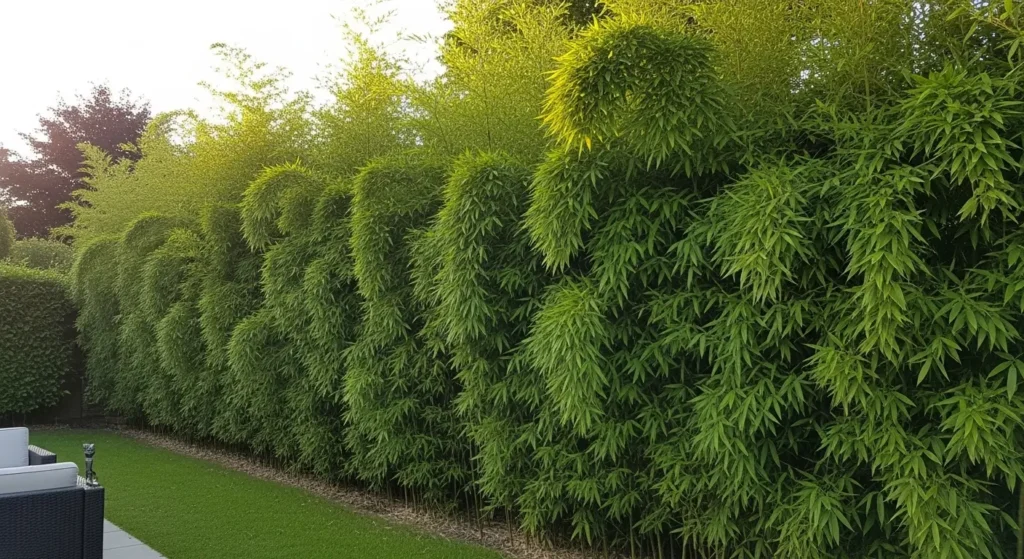
Bamboo is the cheapest long-term privacy screening solution available when measured over a 10-year period. The initial planting cost is $30 to $80 for a 10-foot run of clumping bamboo. By year 3 it provides complete privacy to 12 to 15 feet height. By year 5 it is a mature screen that requires minimal maintenance and costs nothing ongoing.
The critical species choice: always use clumping bamboo (Fargesia species) rather than running bamboo (Phyllostachys species) for garden privacy screens. Running bamboo spreads aggressively via underground rhizomes and will invade your garden, your neighbor’s garden, and eventually your foundations within 5 years. Clumping bamboo stays in a tidy expanding clump that is easily managed and never invasive.
Fargesia murielae and Fargesia robusta are the two most reliable clumping bamboo species for temperate climate privacy screens. Both are fully hardy to -20 degrees Celsius, reach 10 to 15 feet within 4 to 5 years, and produce the dense feathery culm-and-leaf structure that creates the most complete visual privacy of any living screen plant.
PRO TIP: Install a rhizome barrier trench even when using clumping bamboo. Dig a 24-inch deep trench along the planting line and insert 60cm bamboo barrier membrane before planting. Even clumping species produce occasional exploratory rhizomes and the barrier provides complete containment insurance at minimal cost.
3. Outdoor Privacy Curtains: The Removable Privacy Solution That Also Adds Style
✦ Outdoor Privacy Curtains
💰 Cost: $25–$60 ⏱ Installation: 1 hour
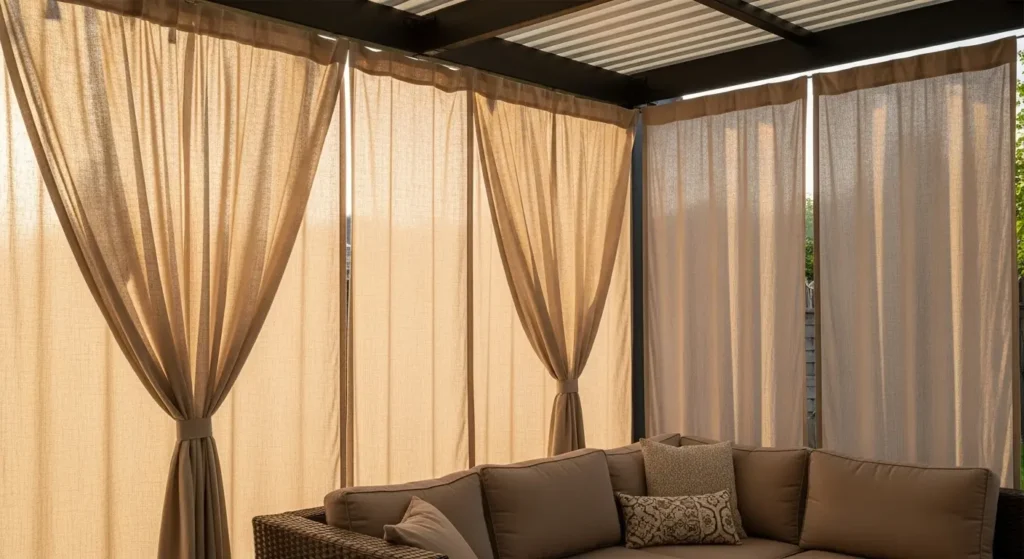
Outdoor privacy curtains are the only privacy solution that is fully reversible — drawn closed for privacy when needed and drawn back when they are not. This flexibility makes them ideal for patio seating areas where you want privacy during relaxed evening use but open sky views during the day.
Installation requires a tension wire or curtain track mounted between two posts, a pergola beam, or a wall and fence combination. Outdoor-rated curtain panels in weather-resistant polyester or solution-dyed acrylic fabric handle outdoor conditions without mold, fading, or deterioration. Standard indoor curtains used outdoors develop mold within weeks in damp conditions.
The privacy quality of outdoor curtains depends entirely on the fabric weight. Lightweight sheer outdoor fabric filters light and creates soft privacy but does not block direct sightlines completely. Medium-weight outdoor canvas or Sunbrella-type fabric creates complete visual privacy at a 6-foot panel width. For full privacy without a solid barrier use double curtain panels on overlapping tracks — the overlap eliminates the gap that a single panel leaves when drawn.
4. Tall Potted Plants: Mobile Privacy That Costs $20 and Moves With You
✦ Tall Potted Plants
💰 Cost: $20–$60 ⏱ Installation: Immediate
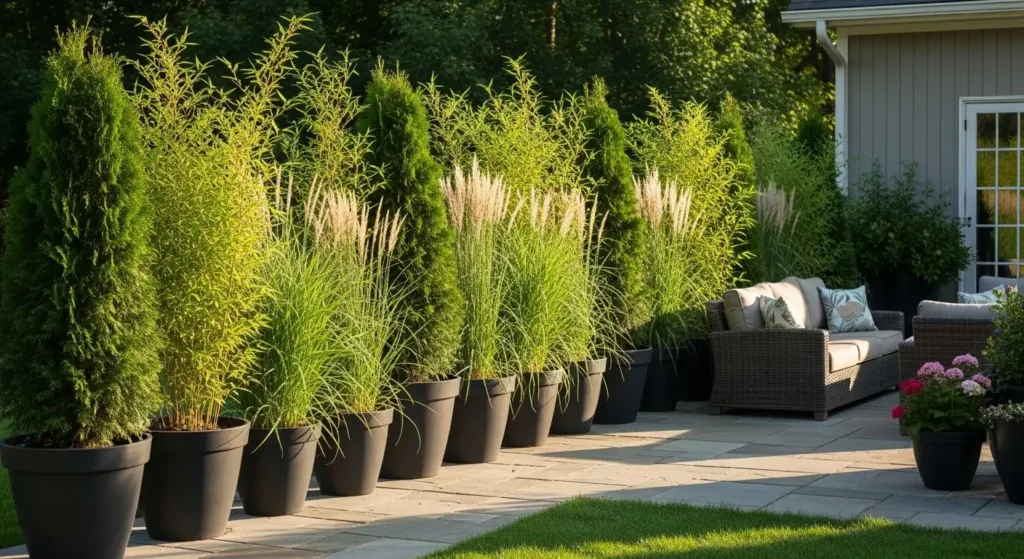
A row of tall potted plants positioned along the overlooked boundary creates instant privacy that requires no installation, no permission, and no permanent modification to the property. This is the privacy solution for renters, for temporary screening needs, and for anyone who wants the flexibility to reposition their privacy screen as sun patterns and usage change through the season.
The plant species that create the most effective potted privacy screens: bamboo in large containers reaches 6 to 8 feet within one growing season and creates dense screening. Tall ornamental grasses — Miscanthus sinensis or Calamagrostis — reach 5 to 6 feet and create a softer more naturalistic screen. Photinia robusta in large containers provides year-round evergreen screening with red-tipped new growth. Griselinia in containers provides dense evergreen coverage in mild climates.
The container size is the critical variable. Privacy-height plants in small containers become top-heavy and fall in wind. Use containers of minimum 18-inch diameter and 16-inch depth for plants reaching 5 feet or taller. The Quarut Large Planter Pots provide the correct scale and weight for privacy-height container plants. Find them linked on Amazon.
PRO TIP: Link tall privacy pots together with a length of jute twine tied loosely around each pot at mid-height when positioning them as a privacy row. The loose connection allows individual pots to be repositioned while preventing the row from becoming disorganized in wind. A row of connected pots also reads as a designed privacy feature rather than a collection of individual plants.
5. Trellis With Climbing Vines: The $40 Privacy Solution That Improves Every Year
✦ Trellis With Climbing Vines
💰 Cost: $30–$60 ⏱ Installation: 2 hours to install, 1 season to privacy
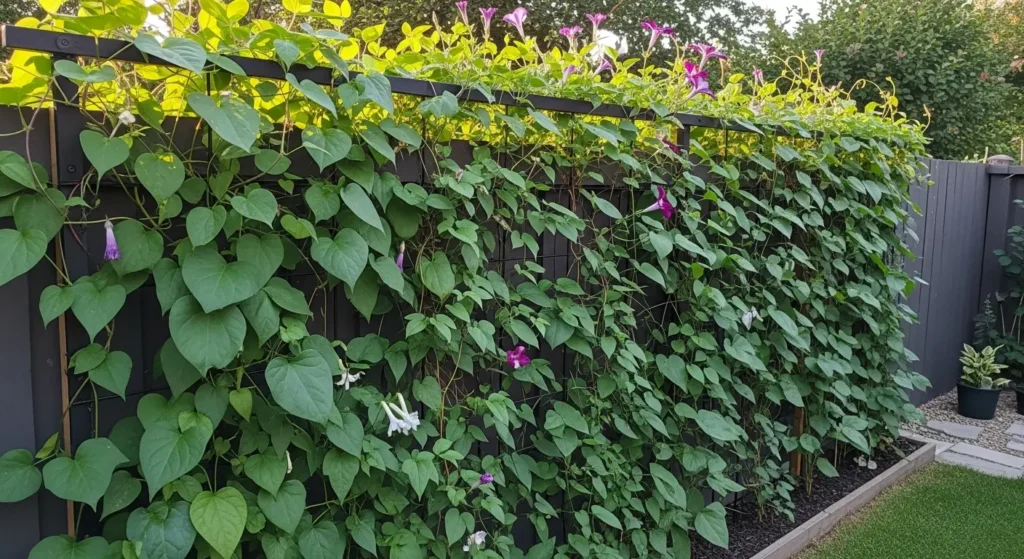
A trellis panel attached above an existing fence and planted with climbing vines extends the effective privacy height by 2 to 4 feet without requiring planning permission in most residential jurisdictions. The trellis adds structural height and the climbing plant fills that height with dense living coverage within one growing season.
The installation: attach a 2-foot tall timber or metal trellis panel to the top of the existing fence using fence post brackets or direct screwing through the trellis base into the fence top rail. Plant climbing plants at the trellis base — one plant per 18 to 24 inches of trellis width. Tie initial shoots to the trellis with soft garden wire. Within 8 to 10 weeks in summer conditions the climbing plants fill the trellis width and create effective privacy screening above the existing fence line.
The fastest-establishing climbing plants for trellis privacy: annual sweet peas fill a trellis completely within 6 weeks from planting but require annual replanting. Clematis montana establishes within one season and returns larger every year. Climbing roses take 2 seasons to provide dense coverage but add fragrance and flower color to the privacy screen. Evergreen clematis (Clematis armandii) provides year-round coverage in mild climates.
PRO TIP: Mount the trellis panel at a 5-degree forward angle from the fence rather than vertical. A slightly forward-angled trellis directs climbing plant growth outward over the garden rather than straight up — creating a wider effective privacy canopy and reducing the bare lower stem zone that vertical trellis training produces.
6. A DIY Pallet Privacy Screen: Free Materials, One Afternoon, Complete Coverage
✦ DIY Pallet Privacy Screen
💰 Cost: $0–$20 ⏱ Installation: 3 to 4 hours
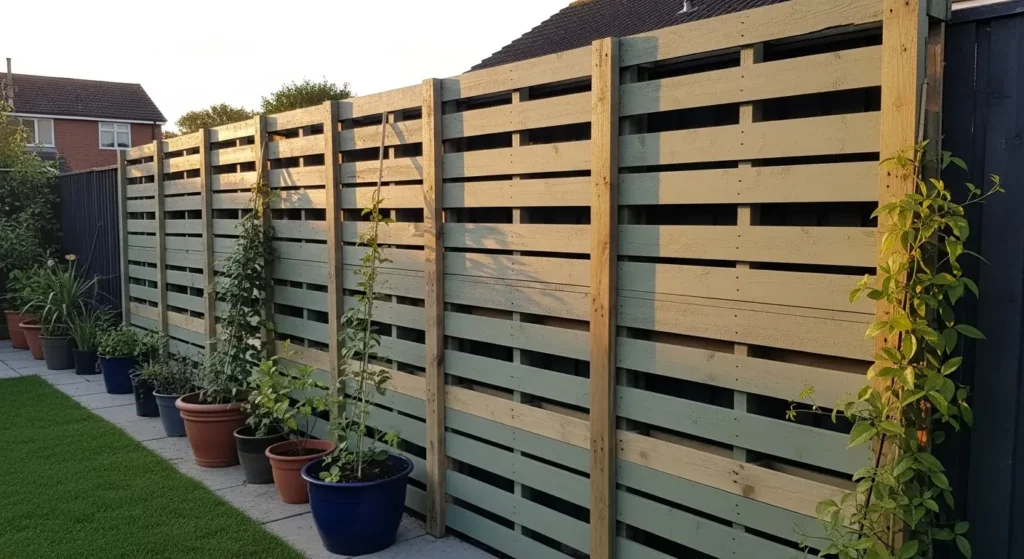
A DIY pallet privacy screen uses free or near-free reclaimed pallets assembled into a solid privacy panel that costs almost nothing in materials. Two standard pallets side by side create a 4-foot wide privacy panel. Four pallets create an 8-foot wide screen. The assembled pallet screen can be painted to match the existing fence for a designed appearance or left natural for a rustic aesthetic.
The construction: source HT-marked pallets from hardware stores, garden centers, or Facebook Marketplace free listings. Connect two pallets side by side using 2 by 2 inch timber battens screwed across the back face at top, middle, and bottom. Add vertical timber posts at each end extending 12 inches below the pallet base and driven into the ground for stability. Paint all surfaces with exterior paint before final installation.
The freestanding pallet screen is the privacy solution that leaves no permanent fixing on walls or fences — making it suitable for rental properties. Two ground-driven posts provide the only fixing point and these leave minimal ground disturbance when removed.
PRO TIP: Paint both faces of a DIY pallet privacy screen before assembly — the neighbor-facing side in a neutral natural tone that suits the shared boundary, the garden-facing side in your chosen garden color. A privacy screen that presents a finished face to the neighbor rather than raw timber back generates significantly less friction in shared boundary situations.
7. A Painted Lattice Panel Creates Privacy With Light and Air Rather Than a Solid Wall
✦ Lattice Privacy Wall
💰 Cost: $20–$50 ⏱ Installation: 2 hours
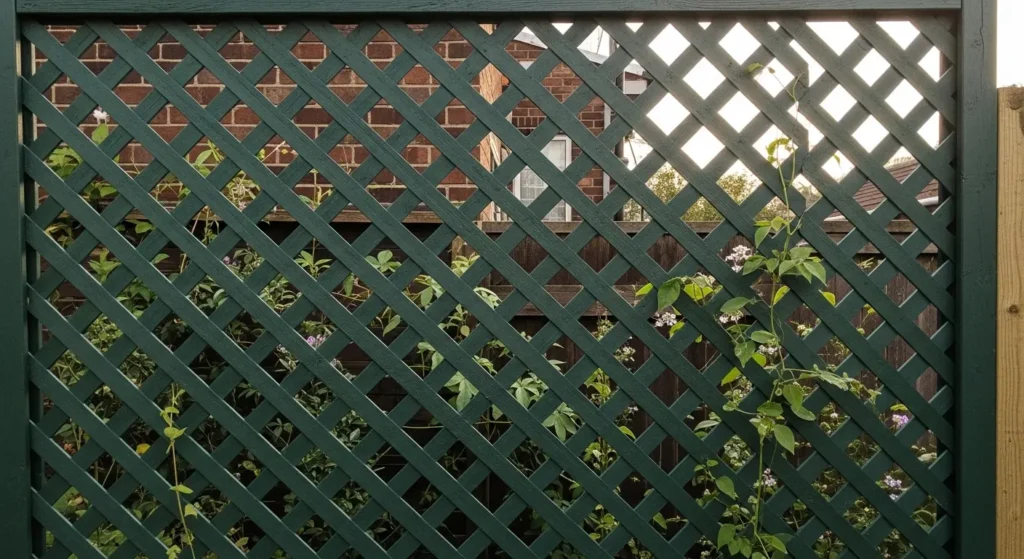
A lattice privacy screen provides the psychological privacy of a solid barrier without the visual heaviness. The diagonal or square grid pattern creates a defined boundary that blocks direct sightlines while allowing air circulation and partial light transmission — making lattice the most garden-friendly privacy solution for spaces where a solid screen would create shade and wind problems.
The privacy quality of lattice depends on the opening size. Standard 2-inch diamond lattice provides privacy at distance but not at close range — a neighbor standing 10 feet away cannot see through it clearly but standing directly against it can. Smaller 1-inch lattice provides more complete privacy at all distances. For maximum privacy use lattice with offset backing — two layers of lattice at 45-degree offset to each other create complete visual blockage with no direct line of sight through the grid.
Painted lattice in a deep garden color — charcoal, forest green, or slate blue — reads as an architectural garden feature rather than a privacy afterthought. The paint color choice transforms inexpensive lattice panels into a designed garden element and climbing plants trained through the lattice complete the living wall effect.
8. An Angled Shade Sail Creates Overhead Privacy From Elevated Neighbors or Overlooking Windows
✦ Shade Sail Barrier
💰 Cost: $25–$60 ⏱ Installation: 1 to 2 hours
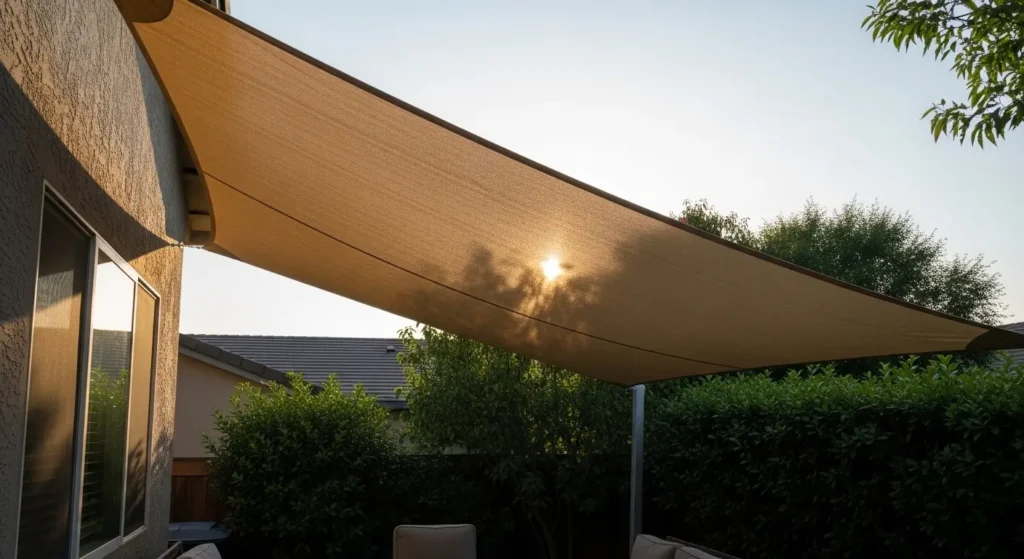
A shade sail is the only cheap privacy solution that addresses overhead sightlines — the overlooking problem that vertical screens cannot solve. A neighbor with a raised deck, an upper-floor window, or an elevated garden looking down into your patio requires an overhead privacy element rather than a vertical one. An angled shade sail installed at 30 to 45 degrees covers the overhead sightline while maintaining open sky views in other directions.
The installation: identify the specific overhead position from which you feel overlooked. Install the shade sail anchor points so the sail angles to block that specific sightline. The sail does not need to cover the entire overhead zone — it needs to cover the arc between your primary seating position and the overlooking position specifically.
Choose shade sail fabric with a tight enough weave for privacy. Open-weave shade sails that allow 30% light transmission provide insufficient visual privacy — a neighbor can still see through them at close angles. Tightly woven high-density polyethylene shade sail fabric with less than 5% light transmission provides complete privacy screening while maintaining adequate light levels in the space below.
PRO TIP: Install shade sail anchor points at different heights rather than all at the same level. A sail hung from three points at different heights creates the angular tilt that directs both shade and privacy screening where needed. Three attachment points at the same height create a flat horizontal sail that provides shade but minimal privacy from angled overhead sightlines.
9. A Hanging Planter Divider Creates a Living Privacy Curtain Between Spaces
✦ Hanging Planter Divider
💰 Cost: $30–$60 ⏱ Installation: 1 hour
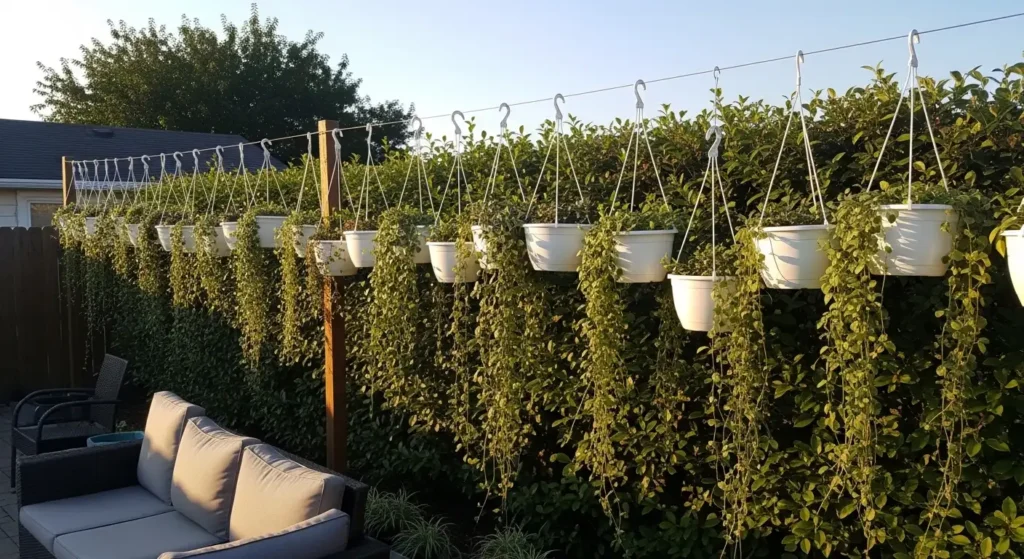
A hanging planter divider uses a horizontal tension wire or beam from which multiple planters are suspended at varying heights to create a living curtain of trailing plants. The curtain of cascading foliage creates soft privacy that blocks sightlines without the hard boundary quality of a fence or screen.
The installation: stretch a 10 to 12 gauge tension wire between two existing posts, a pergola beam and a wall, or two fence posts. Suspend six to eight planters at varying heights — 12 inches, 18 inches, and 24 inches below the wire — using S-hooks. Choose trailing plants that cascade downward creating the curtain density: trailing Tradescantia, ivy, trailing sweet potato vine, and cascading petunias all create effective screening within 4 to 6 weeks of planting.
The self-watering hanging planters with macrame rope hangers are ideal for this application — the built-in reservoir extends the watering interval on a privacy divider where daily watering of multiple suspended planters would be impractical. Find them linked on Amazon.
PRO TIP: Space hanging planters at 18-inch intervals along the tension wire rather than at even wider spacing. At 18-inch spacing the trailing plant growth from adjacent planters overlaps within 4 to 6 weeks creating a continuous dense curtain. At 24-inch spacing gaps remain visible between plants throughout the season.
10. A Budget Hedge Row: The Permanent Privacy Solution That Pays Back for Decades
✦ Budget-Friendly Hedge Row
💰 Cost: $30–$80 for a 10-foot run ⏱ Installation: 2 hours to plant, 3 years to privacy
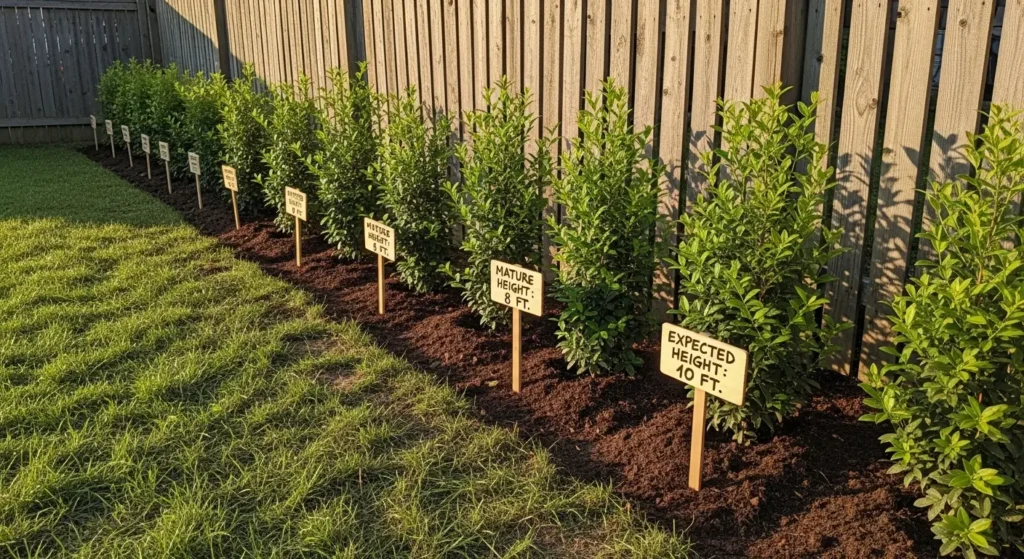
A budget hedge row is the cheapest privacy solution measured over 10 years because after the initial planting cost the hedge costs nothing to maintain beyond an annual clip and grows more effective every season. A hedge planted today is the most complete privacy solution you will have in 5 years regardless of what temporary screens you install in the meantime.
The cheapest effective hedging species by establishment rate: Griselinia littoralis at $3 to $5 per plant grows 18 to 24 inches per year, provides year-round evergreen privacy, and handles coastal and exposed conditions that other hedging species cannot tolerate. Plant at 18-inch spacing for a 10-foot run requiring 7 plants — total cost $21 to $35. Photinia robusta at $4 to $6 per plant grows at a similar rate with the bonus of vivid red new growth in spring. Leylandii grows the fastest of all hedging species at 3 feet per year but requires twice-yearly clipping to prevent it becoming a legal dispute with neighbors.
For the fastest establishment clip the new hedge plants by one third at planting time. Counter-intuitively cutting the plants back at planting stimulates lateral branching from the base — creating a dense bushy hedge from the ground up rather than a sparse gappy hedge that develops from the top down.
PRO TIP: Plant hedging in autumn rather than spring when budget hedging bare-root plants are available at 30 to 50% less than the price of container-grown plants available in spring. Bare-root plants establish faster than container plants because they have no root-bound compaction to overcome and their natural dormancy at planting time reduces transplant shock. A 10-foot hedge run in bare-root plants costs $10 to $20 in autumn versus $30 to $50 for the same plants in spring.
Choosing the Right Privacy Solution for Your Situation
The right privacy solution depends on three specific factors about your situation:
How quickly do you need privacy?
Immediate — reed rolls, outdoor curtains, shade sail, tall potted plants. All provide same-day screening. Within one season — trellis with climbing vines, hanging planter divider, pallet screen. Permanent and improving — bamboo, hedge row, trellis with perennial climbers.
Is the sightline horizontal or overhead?
Horizontal sightlines from a neighboring garden — any vertical screen works. Overhead sightlines from elevated positions — shade sail is the only cheap solution that addresses this angle.
Are you renting or do you own?
Renters — tall potted plants, freestanding pallet screen, outdoor curtains on tension wire, hanging planter divider. All leave no permanent marks on the property. Owners — all solutions including trellis, bamboo, and hedge row which require permanent installation.
📌 More backyard and privacy ideas → 7 Rental-Friendly Backyard Ideas on a Budget
Frequently Asked Questions
What is the cheapest way to get privacy in your backyard?
The cheapest immediate backyard privacy solutions are reed fence rolls at $15 to $30 per roll covering 13 feet of fence, DIY pallet screens built from free reclaimed pallets at zero material cost, and tall potted plants using ornamental grasses or bamboo in containers at $20 to $40. For the cheapest long-term solution a bare-root hedge planted in autumn costs $10 to $20 for a 10-foot run and provides permanent privacy within 3 to 4 years. According to the American Society of Landscape Architects living privacy screens including hedges and bamboo consistently add more measurable property value than equivalent non-living screening solutions of the same height.
How do I block my neighbor’s view without a fence?
The most effective ways to block a neighbor’s view without installing a fence are: tall potted plants positioned along the boundary line which provide immediate privacy without any ground fixing. A row of bamboo in large containers which reaches 6 to 8 feet within one season. Outdoor privacy curtains hung from a tension wire between existing posts which provide adjustable privacy that draws back when not needed. A shade sail angled to block the specific sightline from above for overhead privacy from elevated neighboring positions.
What grows fast for privacy screening?
The fastest-growing plants for garden privacy screening are: clumping bamboo (Fargesia species) which grows 2 to 3 feet per year and reaches effective privacy height within 2 to 3 years. Griselinia littoralis which grows 18 to 24 inches per year as a privacy hedge. Photinia robusta which grows 18 inches per year with year-round evergreen coverage. For annual climbing plant coverage sweet peas and climbing nasturtium fill a trellis completely within 6 weeks of planting in summer conditions — the fastest of all privacy plant options for immediate seasonal screening.
Privacy Is the Difference Between a Backyard You Use and One You Avoid
Every backyard privacy solution in this guide costs under $80 and most can be installed in an afternoon. The most expensive solution here — a bamboo planting or hedge row — costs less than a single outdoor chair and provides decades of increasing value. The cheapest — a reed roll or pallet screen — provides immediate relief from the overlooked feeling that makes a backyard uncomfortable to use.
Choose the solution that matches your timeline, your tenancy status, and the specific angle of the sightline you want to block. Install it this weekend. A private backyard is a different space entirely from an overlooked one.
All the products mentioned in this article are linked on Amazon. Every recommendation is something we genuinely believe in.
More Backyard and Outdoor Ideas
→ 25 Genius Back Patio Ideas on a Budget
→ 12 Dog-Friendly Backyard Ideas For Active Pets
→ 7 Sloped Backyard Ideas That Look Amazing
→ 10 Budget-Friendly Summer Landscaping Ideas
A private backyard is a different space entirely from an overlooked one.

Sheikh Hassaan is a digital architect for small businesses and the founder of The Glow Up System. He writes about home decor, garden design, and outdoor living for real American homes – practical ideas that work in actual spaces without oversized budgets.