
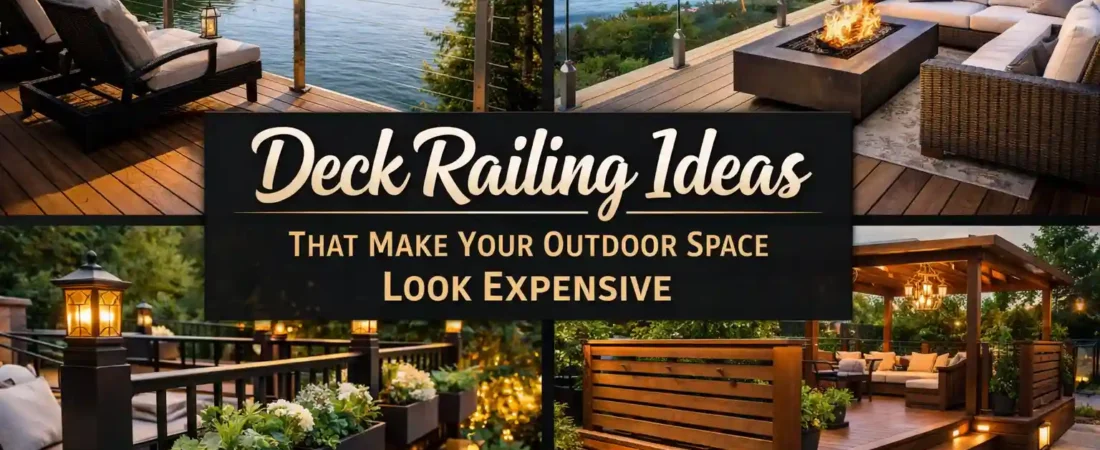
The railing is the one element of a deck that most homeowners treat as a safety requirement and nothing more — and that is exactly why so many decks look unfinished despite everything else about them being well designed. Deck railing ideas that genuinely elevate an outdoor space treat the railing as a design feature rather than a code compliance item, using material, color, and detail to frame the view and define the space rather than simply enclosing it.
This guide covers the deck railing ideas that make the biggest visual difference — from cable and glass systems that preserve the view through classic wood and composite options to the specific finishing details that separate a railing that looks custom-built from one that looks like it came from a box.
Table of Contents
Why Your Deck Railing Matters More Than You Think
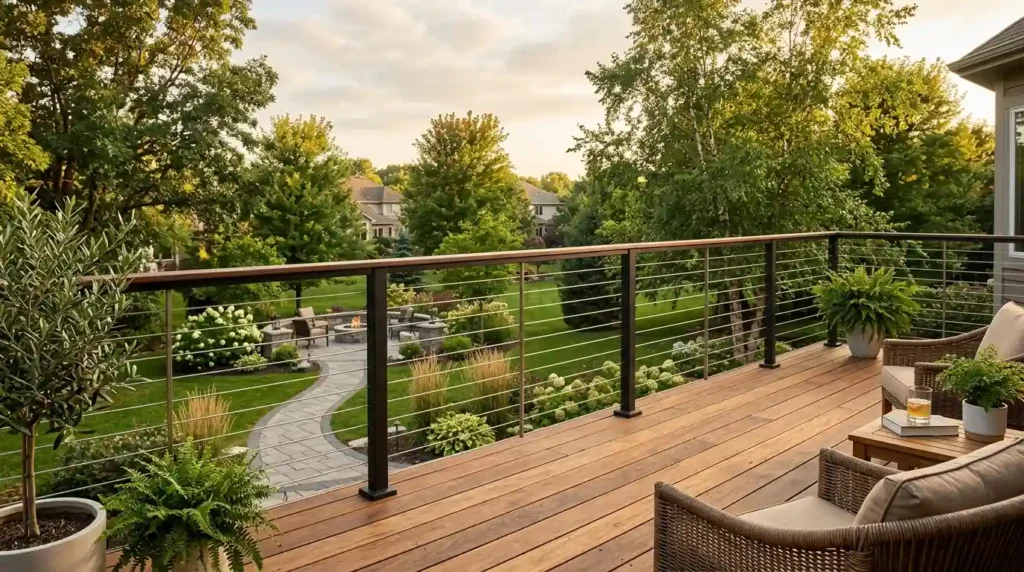
The railing system accounts for roughly 30 to 50 percent of what you see when you look at a deck from the yard or from inside the house. A beautiful deck surface in premium hardwood or composite with a dated aluminum baluster railing on top reads as unfinished — the railing undermines the deck investment rather than completing it. Conversely a modest pressure-treated deck with a well-chosen railing system reads as considerably more designed than the underlying material warrants.
Deck railing decisions also directly affect how the outdoor space feels from inside it. A solid or heavily balustraded railing encloses the deck and creates a room-like quality. An open cable or glass railing preserves the sightline to the yard or view beyond the deck and creates the expansive quality associated with high-end outdoor living spaces. The railing choice determines whether the deck feels like an outdoor room or an outdoor platform.
Before choosing any railing system check local building codes for your specific situation — most residential deck railings in the US require a minimum height of 36 inches for decks less than 30 inches above grade and 42 inches for higher decks, with baluster spacing no greater than 4 inches to prevent a 4-inch sphere from passing through. Every railing idea in this guide is available in code-compliant configurations.
1. Horizontal Cable Railing for an Unobstructed View
✦ Best for: elevated decks with a yard, water, or landscape view worth preserving
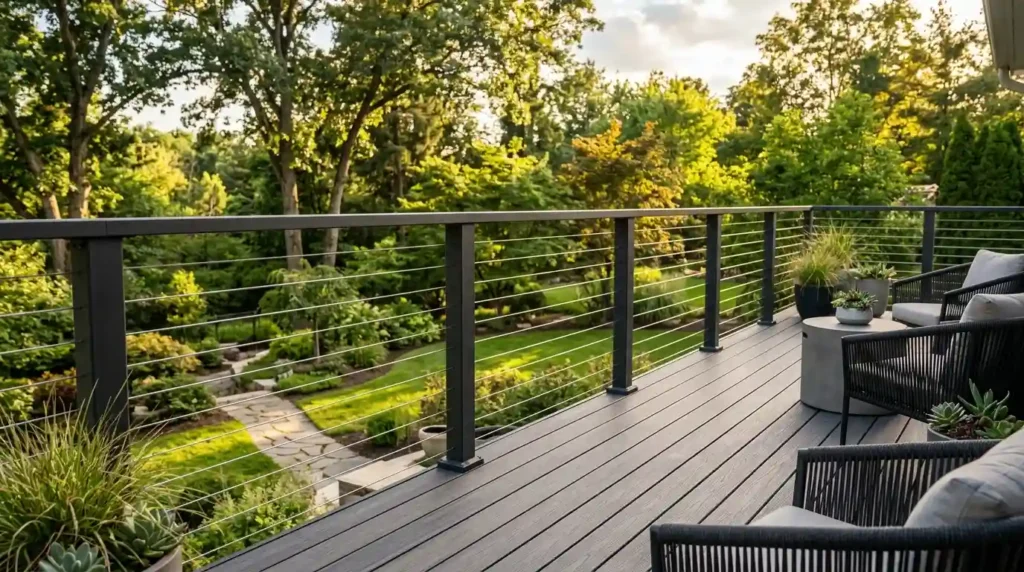
Cable railing is the railing system most frequently associated with high-end contemporary outdoor spaces because it achieves something no other railing system does as effectively — it defines the edge of the deck without meaningfully interrupting the view through it. Horizontal stainless steel cables tensioned between posts at 3-inch intervals meet code requirements while maintaining approximately 70 to 80 percent visual openness through the railing plane.
The post material and finish is where most of the design work in a cable railing system happens, since the cables themselves are consistent across all installations. Dark powder-coated steel posts create the most contemporary result and suit modern and transitional home styles. Natural timber posts in ipe, cedar, or a timber composite create a warmer version of the same open aesthetic and suit craftsman and farmhouse home styles. Stainless steel posts throughout create the most marine-grade and most minimalist version, particularly suited to coastal properties.
Cable railing has a higher upfront installation cost than wood or composite baluster systems — typically $150 to $250 per linear foot installed versus $60 to $120 for standard composite systems. The investment is justified by longevity, since stainless steel cable does not rot, warp, or require painting, and by the view preservation that genuinely increases how a deck is used and perceived.
One practical consideration specific to cable railing: corner posts experience significantly higher tension loads than intermediate posts because the cables change direction at corners. Corner posts need to be substantially larger and more securely anchored than intermediate posts — a detail that DIY cable railing installations frequently undersize, leading to posts that lean inward over time as cable tension pulls them.
2. Glass Panel Railing for the Most Luxurious Open Feeling
✦ Best for: decks where maximum visual openness and a premium appearance are the primary goals
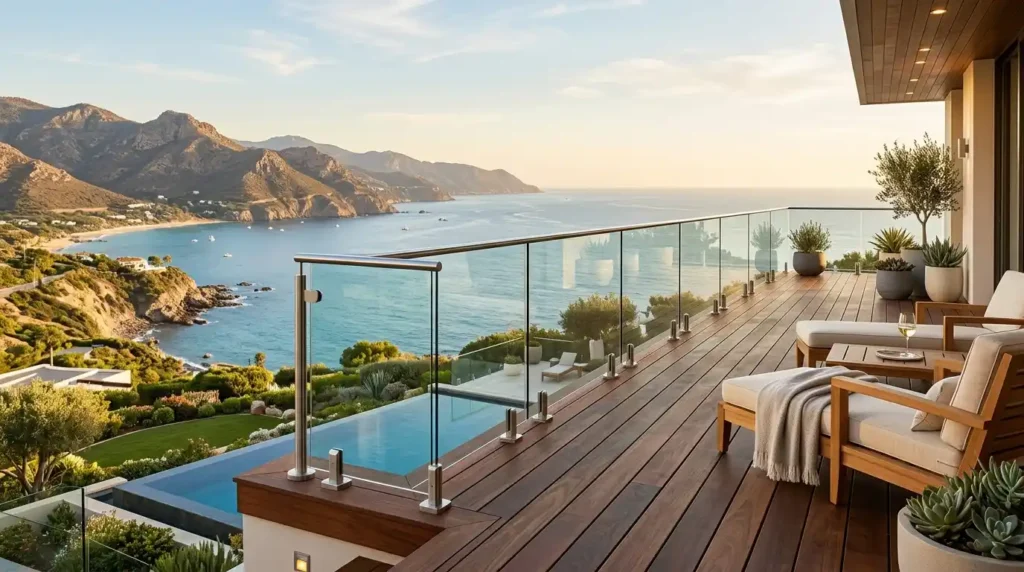
Frameless or semi-frameless glass panel railing is the highest-end option in residential deck railing and the one that most consistently photographs as resort or custom-home quality. A full panel of tempered or laminated safety glass from post to post provides complete wind protection — a practical benefit on exposed decks that cable railing does not offer — while maintaining the full view through the railing plane without the horizontal lines that cable systems introduce.
Two installation approaches: a frameless system uses base-mounted aluminum channels or point-fixed hardware to hold the glass panels without any visible top rail, creating the most minimalist and most expensive result. A semi-frameless system uses a slim aluminum or stainless top rail connecting the posts above the glass panels, which adds structural rigidity, reduces cost, and still reads as significantly more open than a traditional baluster system.
Glass railing maintenance is the primary practical consideration — glass shows water spots, fingerprints, and pollen accumulation more visibly than any other railing material. A deck in a wet climate or near trees requires regular glass cleaning to maintain the premium appearance that justifies the higher installation cost. In a dry climate with minimal tree cover glass railing maintenance is genuinely minimal.
3. Black Powder-Coated Aluminum for a Modern Farmhouse Look
✦ Best for: farmhouse, transitional, and modern home styles where black metal creates a strong graphic contrast
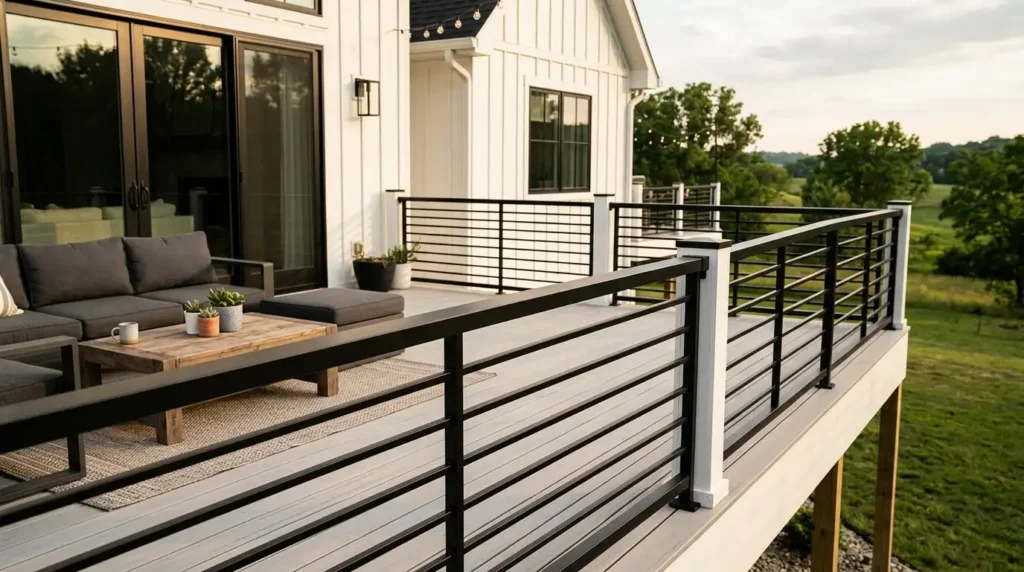
Black powder-coated aluminum railing has become one of the most popular deck railing choices over the past five years because it combines the clean graphic quality of wrought iron with the low maintenance and corrosion resistance of aluminum at a cost significantly lower than either cable or glass systems. The matte black finish reads as intentional and contemporary on a wide range of home styles — it suits the modern farmhouse aesthetic particularly well but also translates to transitional, coastal, and contemporary homes.
The baluster profile within a black aluminum system makes more design difference than most people account for when specifying. Flat bar balusters in a horizontal or diagonal pattern read as more contemporary than round balusters. Square tube balusters at 1-inch width read as more architectural than thinner round balusters. Deck railing systems that use flat bar balusters in a horizontal pattern alongside a slim flat top rail create the closest approximation of a cable railing aesthetic at a significantly lower cost.
Powder-coated aluminum does not rust, does not require painting, and does not warp or rot — it is genuinely maintenance-free beyond occasional washing. The powder coat finish on quality aluminum railing systems carries a 20 to 25 year warranty from most major manufacturers, making it one of the most durable and most cost-effective railing choices available for residential applications.
4. Composite Railing That Matches the Deck Surface
✦ Best for: composite deck surfaces where a matched material system creates a fully cohesive outdoor space
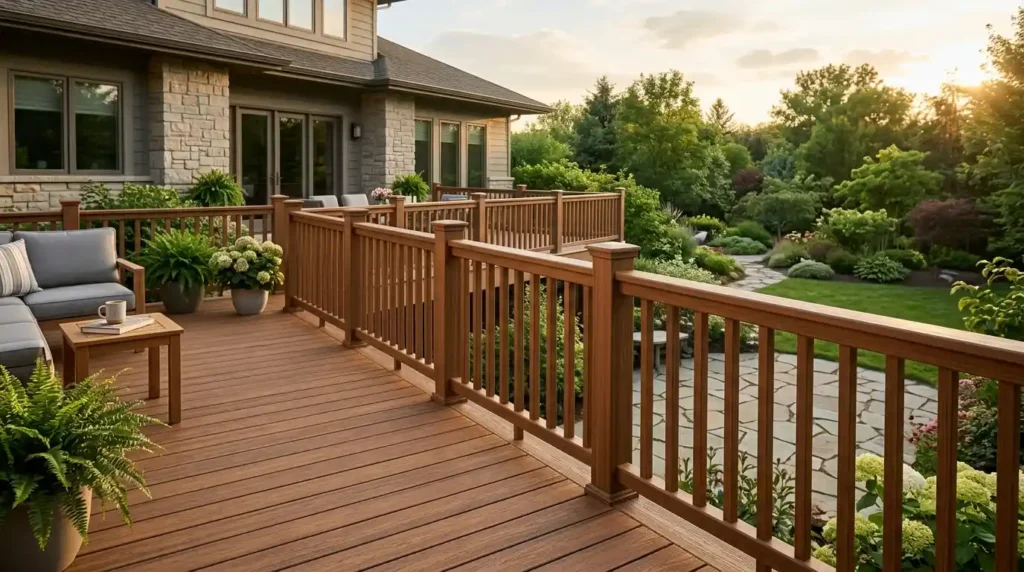
The most visually cohesive deck result available is a composite decking surface with a composite railing system in a coordinated or matching color from the same manufacturer. Trex, Fiberon, TimberTech, and Azek all produce complete deck and railing systems where the post wraps, top rails, and bottom rails use the same material and color family as the deck board surface, creating a fully integrated appearance that no mix-and-match combination of materials achieves.
Composite railing systems typically use aluminum balusters within the composite frame rather than composite balusters — composite material does not have sufficient structural strength in a baluster profile without an internal metal core, which adds cost and weight. The top rail, post wraps, and bottom rail are composite; the balusters are powder-coated aluminum in a coordinated color.
The strongest design argument for a matched composite system: it removes the decision about what material the railing should be by making the deck and railing a single product family. The strongest argument against it: the aesthetic is specific to the composite material look — if the composite decking ages in a way that differs from the railing composite over time, the mismatch becomes increasingly visible.
5. Wood Posts With Cable Infill for a Warm Contemporary Hybrid
✦ Best for: decks where the warmth of natural timber is wanted alongside the openness of a cable system
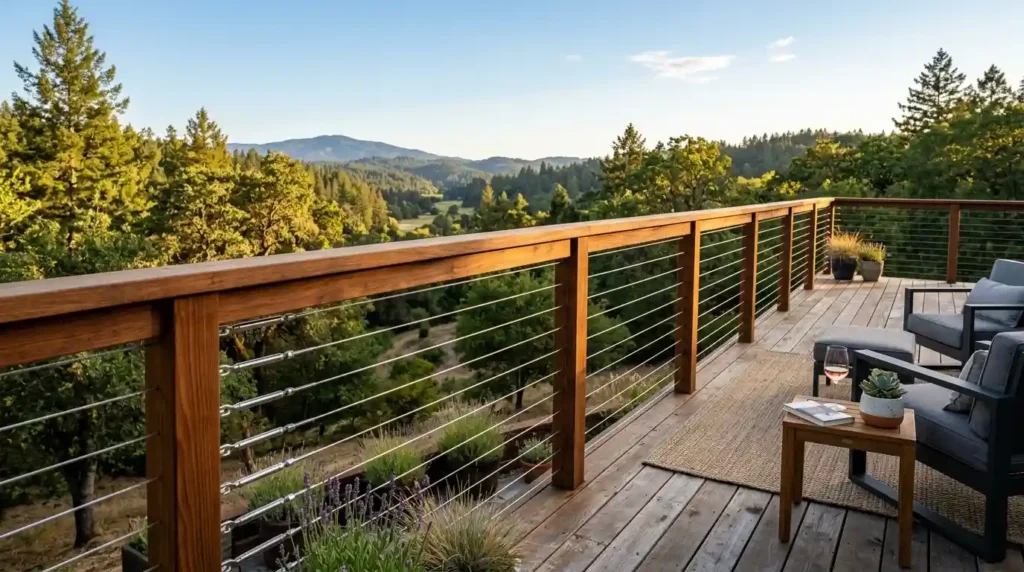
The combination of natural timber posts and stainless cable infill creates a hybrid aesthetic that sits precisely between the warm traditional quality of an all-wood railing and the open contemporary quality of an all-metal cable system. The timber introduces warmth and organic character that steel posts cannot provide, while the cable preserves the view openness that timber balusters would eliminate.
Cedar, ipe, and cumaru are the timber species most commonly used for posts in this hybrid system — all three have sufficient hardness and natural rot resistance for outdoor post applications. Cedar is the most affordable and most widely available. Ipe is the hardest and most durable but also the most expensive and most difficult to work with. Cumaru is a practical middle ground between the two in both cost and durability.
The maintenance consideration in a wood-and-cable hybrid: the timber posts require periodic oiling or staining to maintain their color and resist weathering, while the stainless cable requires essentially no maintenance. This means the railing system has two different maintenance schedules — the cables look the same in ten years as on installation day, while the posts will need attention every two to three years to maintain their appearance.
6. Horizontal Wood Boards as a Privacy and Design Statement
✦ Best for: ground-level or low decks where privacy from neighbors is wanted alongside a strong design statement
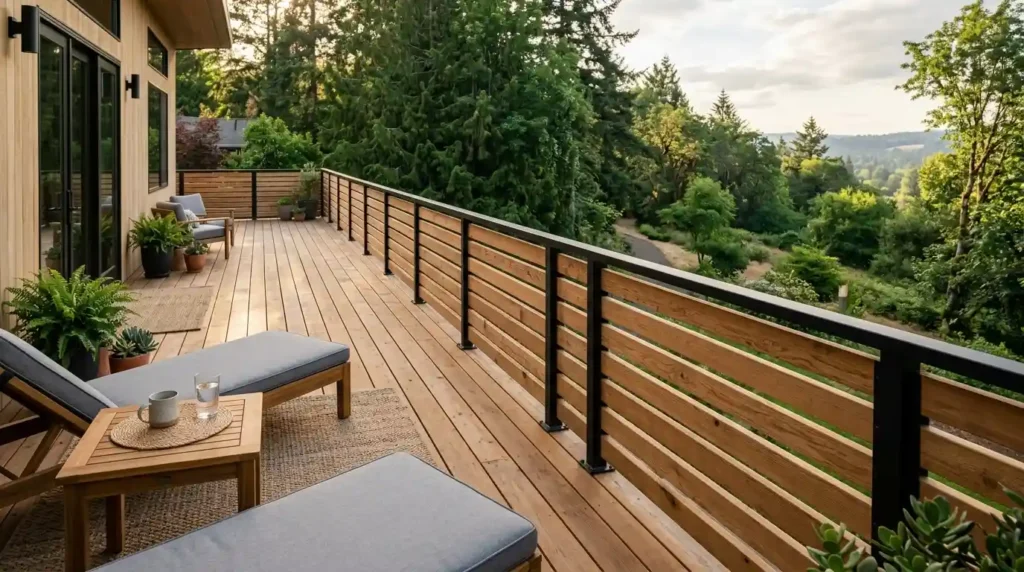
Horizontal board railing is the railing style that most directly creates privacy alongside its design statement — the boards run parallel to the deck surface with narrow gaps between them, allowing air movement and filtered light while blocking direct sightlines from adjacent properties. On a ground-level deck or a deck with close neighbors this is often the most practical railing choice in addition to being a strong design one.
The specific detail that makes horizontal board railing look designed rather than fence-like: the gap between boards. A consistent gap of 1 to 1.5 inches between each horizontal board creates the privacy effect while maintaining visual lightness. Boards butted tightly together create a solid fence. Boards with gaps wider than 2 inches lose the privacy benefit. The 1 to 1.5 inch gap is the specification that balances all three qualities — privacy, air movement, and visual lightness.
Horizontal board railing must be verified for code compliance in the specific application — the 4-inch sphere rule that governs baluster spacing also applies to horizontal boards, meaning that the gap between boards cannot exceed 4 inches and the boards themselves must be oriented to prevent climbing. Most code authorities require that horizontal railings include a specific anti-climbing feature or spacing that prevents the boards from functioning as a ladder — check local requirements before installation.
7. Mixed Material Railing That Combines Metal Posts With Wood Top Rail
✦ Best for: decks where industrial metal and warm timber need to coexist in a single railing system
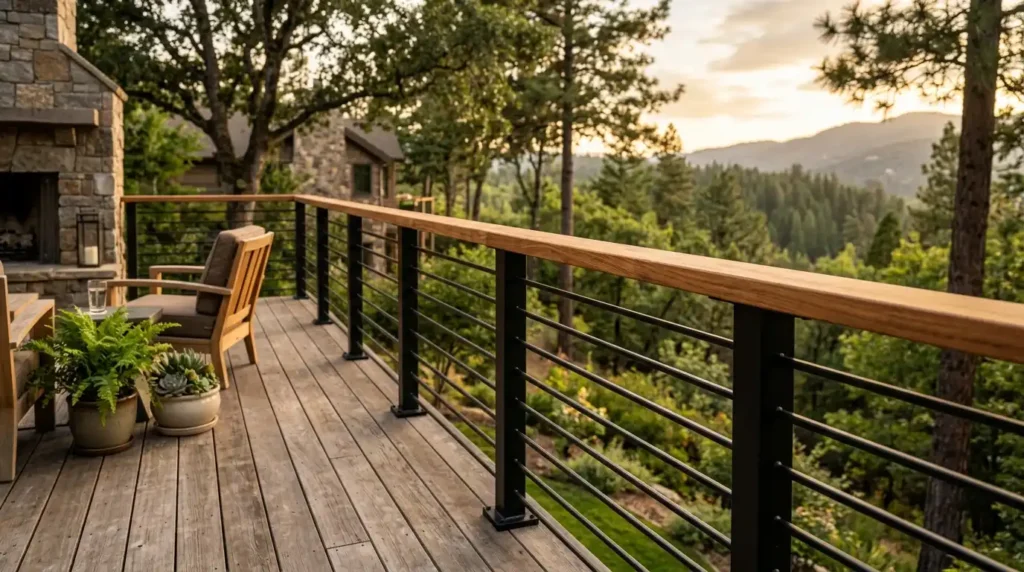
A mixed material railing that uses black powder-coated metal posts and balusters with a natural timber cap rail is one of the most popular contemporary deck railing approaches because it delivers the best qualities of both materials simultaneously — the precision and low maintenance of metal for the structural components and the warmth and tactile quality of timber for the single component that is actually touched and used most frequently.
The cap rail is the most ergonomically important element in any railing system — it is the surface that hands rest on when leaning against the railing, the surface that a drink gets set on, and the surface that catches the eye at the top of the railing composition. A timber cap rail at 5 to 6 inches wide in ipe, cedar, or a hardwood composite provides genuine comfort and warmth that an aluminum top rail does not, regardless of how well the aluminum is finished.
The timber cap rail in a mixed material system does require maintenance — typically an annual oiling or biannual staining to prevent graying and checking — but the maintenance is limited to a single linear element rather than an entire railing system, making it considerably more manageable than maintaining an all-timber railing throughout.
How To Choose the Right Deck Railing for Your Home Style
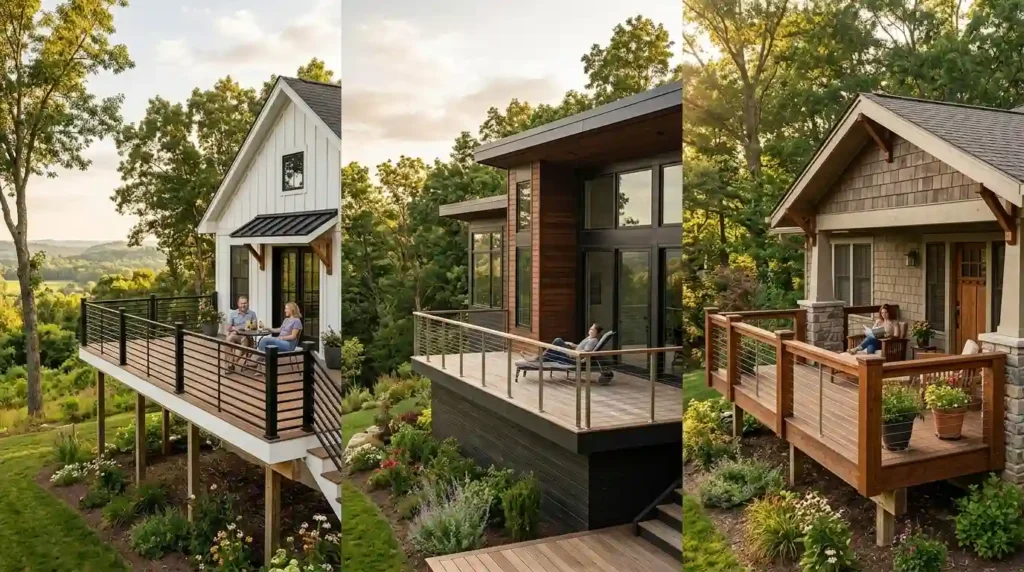
The railing system that looks best on any specific deck is the one that reads as an extension of the home’s architectural language rather than a separate product category applied to the outside of the house. A craftsman bungalow with cable railing looks incongruous. A contemporary home with ornate wrought iron railing looks equally mismatched. The home’s existing material palette and architectural detail set the parameters within which the railing choice should operate.
Contemporary and modern homes:
Cable railing or frameless glass panel. Clean horizontal lines, minimal post visibility, maximum view openness. Dark powder-coated steel posts suit a home with dark window frames and trim. Stainless posts suit a home with silver or light gray metal elements.
Farmhouse and transitional homes:
Black powder-coated aluminum with square balusters or horizontal flat bar infill. The black metal reads as the same material language as the black window frames and door hardware common to farmhouse and transitional architecture.
Craftsman and traditional homes:
Wood posts with cable infill or composite railing in a warm wood-tone color. The natural material quality of timber suits the handcrafted architectural character of craftsman homes better than the industrial precision of all-metal systems.
Coastal and beach homes: cable or glass railing for maximum view and wind resistance. If timber is preferred choose a naturally salt-resistant species such as ipe or teak rather than cedar, which weathers poorly in high-humidity coastal environments.
📌 More outdoor and patio ideas: How To Build a Cozy Dad’s Retreat Patio Corner
Frequently Asked Questions
What is the most popular deck railing right now?
Cable railing and black powder-coated aluminum are the two most popular deck railing styles in current residential design, with cable railing leading in higher-end new construction and remodeling projects and black aluminum leading in mid-range projects due to its lower cost and wider material availability. Glass panel railing has grown significantly in popularity for elevated decks with views. According to the North American Deck and Railing Association, low-maintenance metal and cable systems have consistently grown market share over traditional wood railing systems over the past decade as homeowners prioritize durability and reduced maintenance.
How much does deck railing cost to install?
Deck railing installation costs vary significantly by material and system type. Standard pressure-treated wood railing: $30 to $60 per linear foot installed. Composite railing: $60 to $120 per linear foot installed. Black powder-coated aluminum: $60 to $100 per linear foot installed. Cable railing: $150 to $250 per linear foot installed. Glass panel railing: $200 to $400 per linear foot installed. Material costs typically represent 50 to 60 percent of the total installed cost with labor making up the remainder.
What is the cheapest deck railing option?
Pressure-treated pine railing with standard wood balusters is the least expensive deck railing option at $20 to $40 per linear foot for materials, with DIY installation bringing total cost to approximately $30 to $60 per linear foot. Pressure-treated wood requires regular maintenance — painting or staining every 2 to 3 years — and has a shorter lifespan than composite or metal alternatives. For a maintenance-free budget option, basic powder-coated aluminum baluster systems from manufacturers like Fortress or Deckorators represent the best value at $50 to $80 per linear foot installed.
Does deck railing need to meet building codes?
Yes — deck railing in the United States must meet local building codes which are typically based on the International Residential Code. Standard requirements: railing required on decks 30 inches or more above grade, minimum height of 36 inches for decks less than 30 inches above grade and 42 inches for higher decks, baluster or infill spacing no greater than 4 inches (preventing a 4-inch sphere from passing through), and structural requirements for the railing to withstand a 200-pound load applied at the top rail. Always verify local code requirements with your building department before beginning a railing installation or replacement project.
More Outdoor and Patio Ideas
→ How To Design the Ultimate Grilling Garden for Dad
→7 Front Door Decor Ideas That Make Dad Feel Proud
→ How To Build a DIY Garden Bench Dad Will Actually Use
Match the railing to the house first. Every other decision — material, color, infill style — follows naturally from that one starting point.

Sheikh Hassaan is a digital architect for small businesses and the founder of The Glow Up System. He writes about home decor, garden design, and outdoor living for real American homes – practical ideas that work in actual spaces without oversized budgets.