
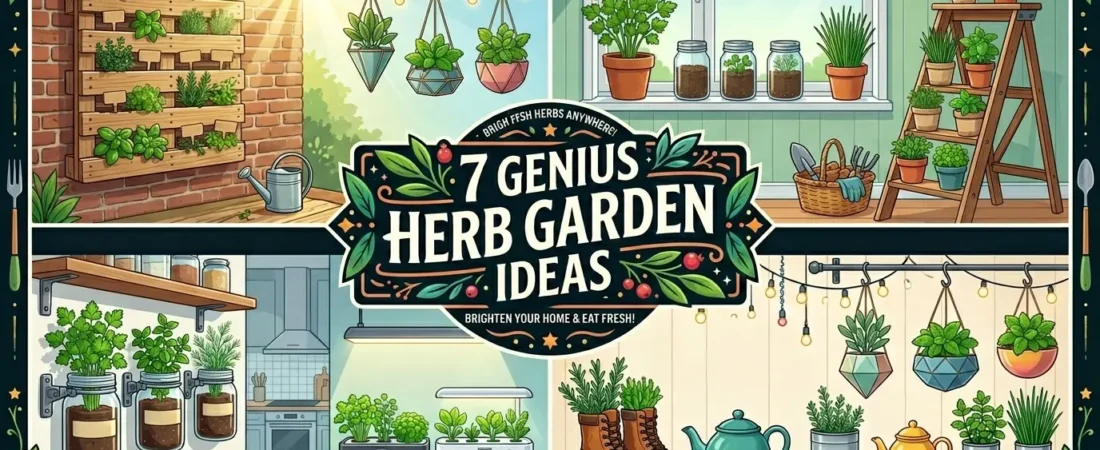
Herb garden ideas work best when they are designed around how you actually cook rather than how herbs are supposed to be grown. A herb garden that requires going outside in the rain, bending down, searching through unlabelled pots, and returning muddy is a herb garden that stops being used by February. The ideas in this guide are designed around proximity, accessibility, and the specific growing requirements that keep herbs productive rather than decorative.
These 7 herb garden setups each solve a different version of the herb growing problem — from a complete spiral garden that creates its own microclimate to a rolling cart that follows the sun. Every one produces genuinely harvestable herbs through the growing season.
Table of Contents
1. The Herb Spiral: One Structure That Creates Six Different Growing Microclimates
✦ Spiral Herb Garden Design
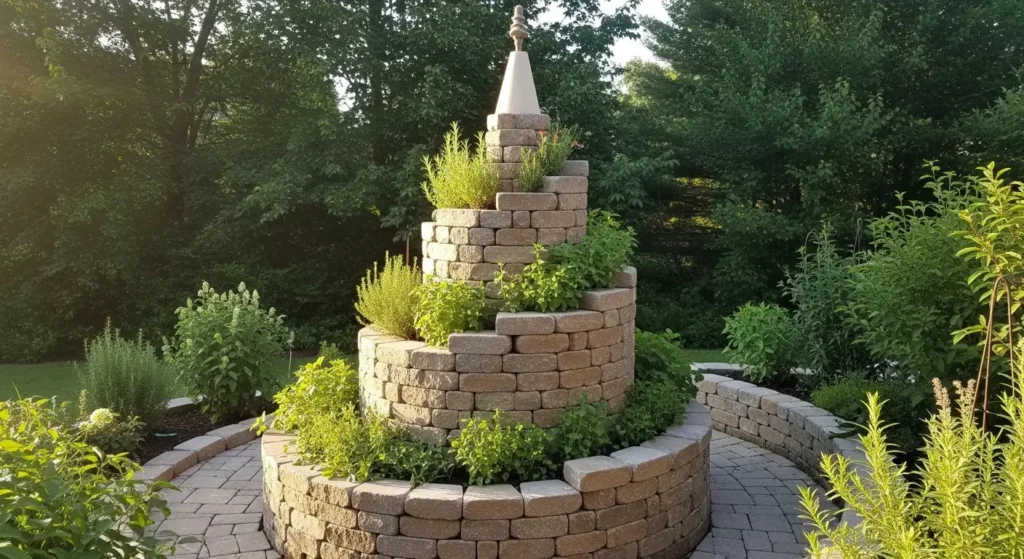
A herb spiral is the most space-efficient and ecologically sophisticated herb garden design available. One spiral structure 5 feet in diameter creates six distinct growing microclimates from a single footprint — hot and dry at the sunny apex, progressively cooler and moister toward the shaded base — allowing herbs with completely different requirements to thrive in the same garden feature simultaneously.
The microclimate gradient from apex to base: the top of the spiral in full sun with fast-draining rocky soil suits Mediterranean herbs — rosemary, thyme, oregano, and sage — that originate in dry rocky terrain and perform best in conditions that most garden soil cannot provide. The middle spiral levels suit moderate herbs — chives, marjoram, and tarragon. The shaded moist base suits moisture-loving herbs — mint, lemon balm, and Vietnamese coriander — that bolt and become bitter in the hot dry conditions at the top.
Build the spiral from reclaimed brick, dry-stacked stone, or gabion wire filled with rubble. The spiral wall retains the growing medium at each level and creates the height differential that generates the microclimate gradient. Fill each level with growing medium appropriate to the herbs planted there — gritty sandy compost at the top, standard compost in the middle, moisture-retentive compost at the base.
PRO TIP: Orientate the herb spiral with the apex at the south or southwest side so Mediterranean herbs at the top receive maximum direct sun. The north-facing lower spiral sections naturally receive less sun and retain more moisture — exactly the conditions that shade-tolerant moisture-loving herbs require. The spiral orientation aligns the microclimate gradient with the solar gradient without any additional planning.
2. The Kitchen Door Herb Station: Designed Around the 10-Second Harvest Rule
✦ Kitchen Door Herb Station
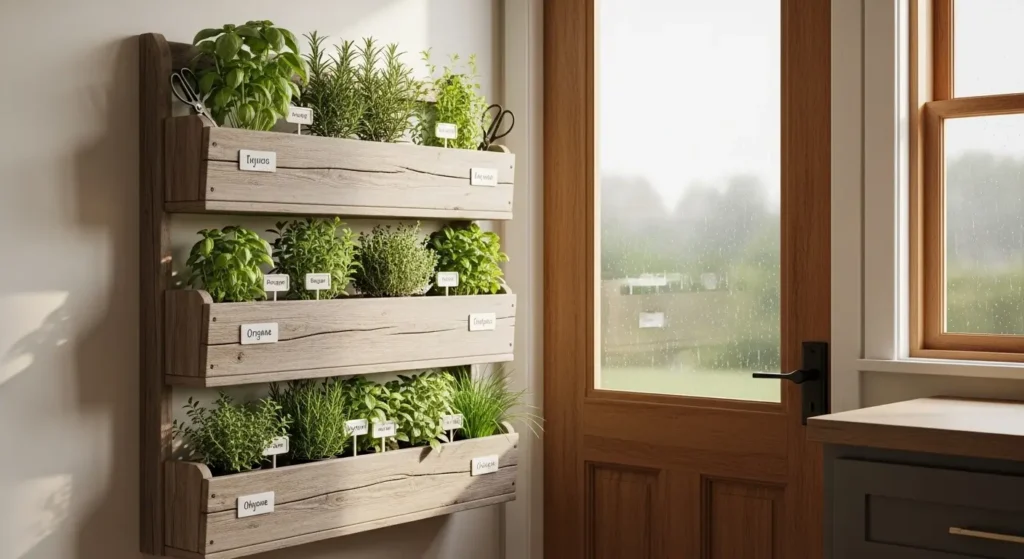
The 10-second harvest rule is the design principle that determines whether a herb garden gets used daily or occasionally: if harvesting a herb takes more than 10 seconds from the moment you decide you want it the herb garden will be used for special occasions rather than everyday cooking.
A kitchen door herb station is designed specifically to meet the 10-second rule. Wall-mounted trough planters at counter height beside the back door. Each trough labelled with the herb name. The door opens, the herb is cut, the door closes. Ten seconds. No shoes required, no searching, no bending.
The 5-Pack Heirloom Herb Seeds covers the five most-used culinary herbs — basil, chives, parsley, dill, and cilantro — for planting directly into the kitchen door station troughs. Sow seeds directly into the troughs in spring and the station is producing harvestable herbs within 4 to 6 weeks. Find them linked on Amazon.
The one maintenance practice that keeps a kitchen door herb station productive rather than ornamental: harvest every trough weekly whether you need the herbs or not. Regular harvesting of the growing tips prevents woody growth, encourages branching, and keeps plants in the productive leafy stage throughout the season.
PRO TIP: Install a small hook beside the kitchen door herb station specifically for a pair of small scissors or herb snips. The most common reason herb gardens stop being used is the friction of finding scissors before harvesting. Scissors on a permanent hook at the herb station eliminate this friction completely — the tools are always where they are needed.
3. A Rolling Herb Cart Follows the Sun and Solves the Shade Problem Permanently
✦ Rolling Herb Cart Garden
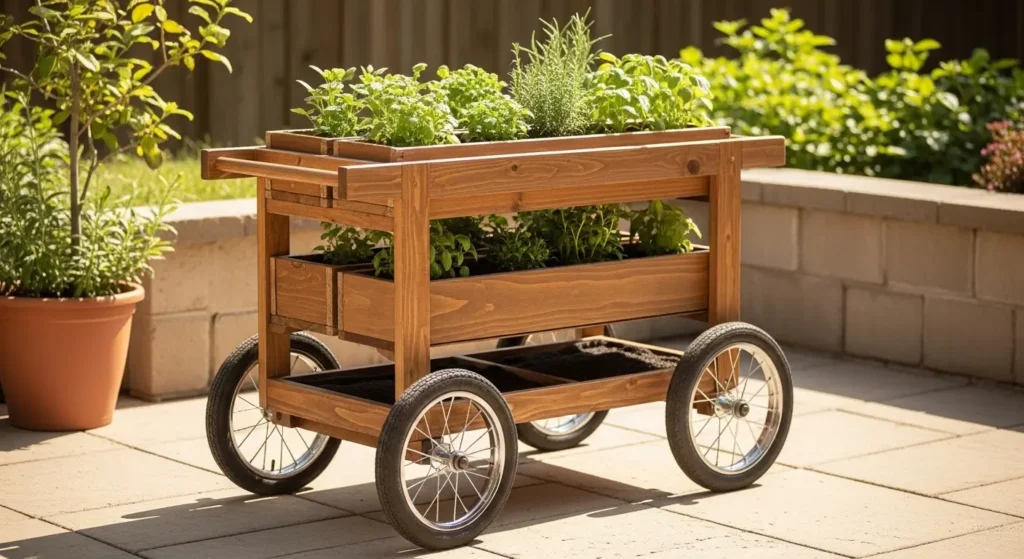
A rolling herb cart solves the problem that fixed herb gardens cannot: sun patterns change. A herb bed that receives 8 hours of sun in June receives 4 hours in September as the sun angle drops. Mediterranean herbs require 6 hours minimum for productive growth — a fixed herb bed in a compromised sun position produces struggling herbs regardless of soil quality or watering. A rolling cart follows the optimal sun position throughout the season.
The rolling cart format also allows the herb garden to move with daily routine — beside the kitchen door in the morning when cooking happens, on the patio in the afternoon to maximize sun exposure, moved inside a porch or lean-to during frost. No other herb garden format provides this flexibility.
The Leteuke Grill Cart provides an excellent base for a rolling herb garden — the multiple shelf levels create tiered growing surfaces, the wheels are heavy-duty rated for loaded weight, and the open structure provides the air circulation that Mediterranean herbs require. Line the shelf surfaces with waterproof trays, fill with gritty herb compost, and the cart becomes a complete rolling kitchen garden. Find it linked on Amazon.
PRO TIP: Weight the lower shelves of a rolling herb cart more heavily than the upper ones — heaviest pots on the lowest shelf, lightest on the top. A rolling cart with top-heavy loading becomes unstable on uneven patio surfaces and tips when wheeled across thresholds. Bottom-weighted loading keeps the center of gravity low and makes the cart safe to move fully planted.
4. A Dedicated Raised Bed Herb Garden Produces More Than Any Other Format
✦ Raised Bed Herb Garden
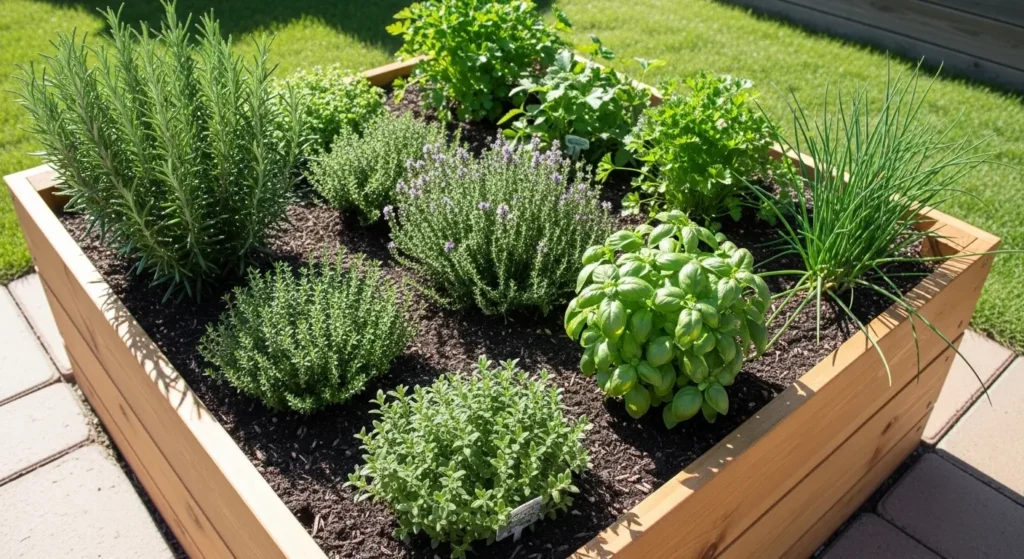
A dedicated raised bed herb garden produces more harvestable herb material than any other format because of root volume, drainage quality, and the thermal advantage of raised growing medium that warms faster in spring and stays productive longer into autumn.
The layout principle for a raised bed herb garden: group herbs by water requirement rather than by culinary category. Mediterranean drought-tolerant herbs — rosemary, thyme, sage, oregano, marjoram — in one section with extra grit added to the compost. Moderate-water herbs — chives, parsley, tarragon, chervil — in the center section. Moisture-loving herbs — basil, coriander, mint in its own contained section — in the shadier end of the bed.
The access rule that determines raised bed productivity: build no wider than 24 inches if accessible from one side, 48 inches if accessible from both sides. A raised herb bed that requires stepping on the growing medium compacts the soil and creates the drainage and root problems that raised beds are specifically designed to eliminate. Every herb in the bed must be reachable from the path without stepping on the growing surface.
5. A Mason Jar Herb Display Brings the Herb Garden Indoors Without Sacrificing Yield
✦ Mason Jar Herb Display
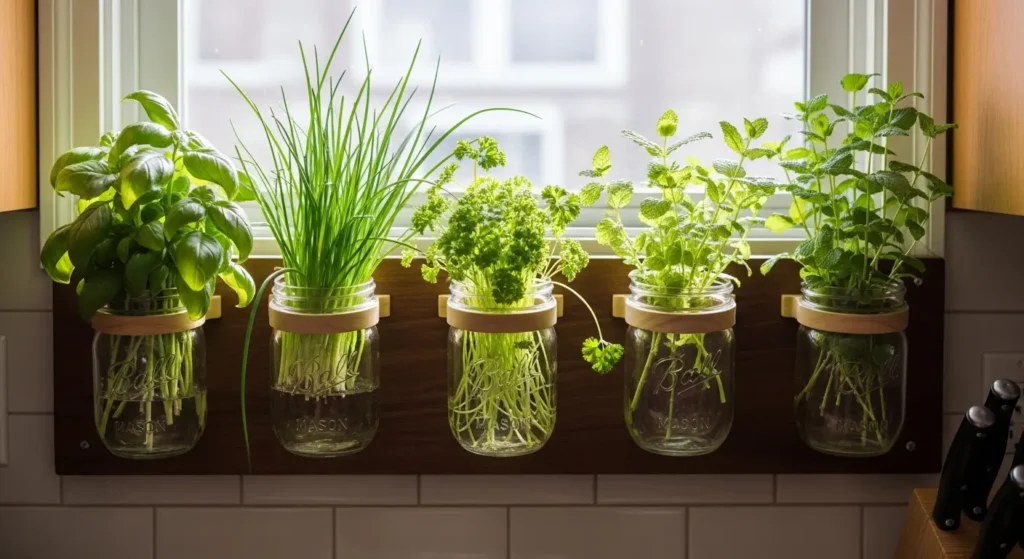
A mason jar herb display mounted on a kitchen wall brings the herb garden indoors and makes it kitchen decor simultaneously. The glass jars catch window light beautifully, the herb labels create a graphic display element, and the proximity to the cooking surface means herbs are used in every meal rather than occasionally retrieved from the garden.
The construction: attach metal hose clamps or purpose-made jar mounting clips to a timber board. The board mounts on the kitchen wall with two screws. Mason jars of uniform size clip into the clamps and can be removed for watering and refilling. The whole installation takes 90 minutes and costs under $25 in materials.
The indoor herb jar growing reality: indoor herbs require more light than most kitchen positions provide. Position the board within 18 inches of a south or west-facing window. Rotate jars toward the light weekly to prevent one-sided growth. Replace basil completely every 6 to 8 weeks as it deteriorates in indoor conditions faster than outdoor-grown herbs — one fresh basil plant every 6 weeks costs $3 and maintains continuous indoor supply through the year.
PRO TIP: Drill a single 8mm drainage hole in the base of each mason jar before planting. Without drainage herbs in sealed glass jars develop root rot within weeks as water pools in the base. A single drainage hole with a small piece of mesh held in place by a pebble prevents waterlogging while keeping compost contained. Place a small tray beneath each jar to catch drainage water.
6. A Balcony Herb Garden Produces Full Kitchen Supply From Zero Garden
✦ Balcony Herb Garden
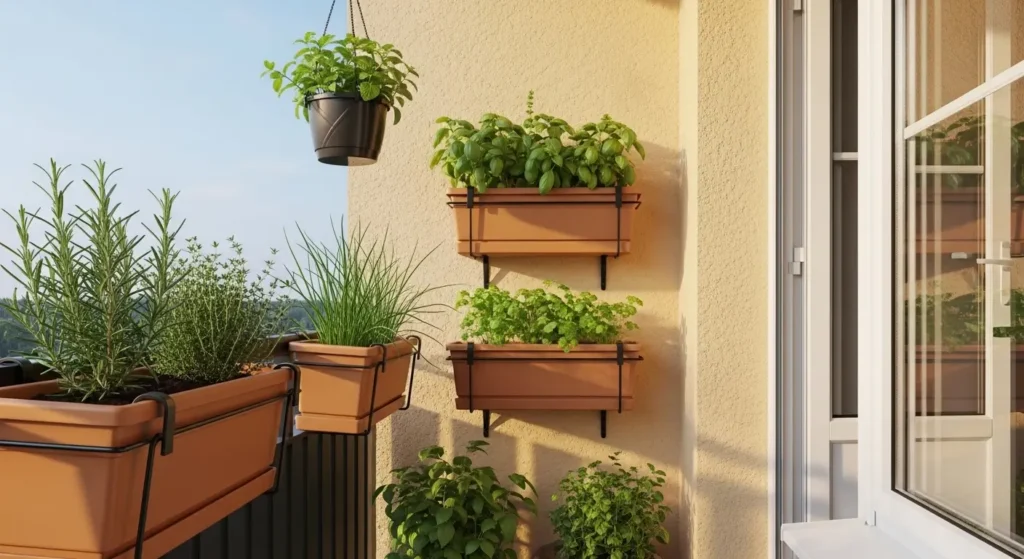
A balcony herb garden produces a complete kitchen herb supply from a space with no garden soil whatsoever. The specific challenge of balcony herb growing is wind exposure — balconies are typically the most wind-exposed position on any apartment building and Mediterranean herbs that thrive in wind-sheltered patio positions can desiccate rapidly in exposed balcony conditions.
The wind-tolerant herb selection for balcony growing: rosemary and thyme are the most wind-tolerant culinary herbs and produce reliably on exposed balconies where other herbs struggle. Chives handle wind better than most soft-stemmed herbs. Mint in a contained balcony planter produces well and actually benefits from the air circulation that prevents the fungal problems mint develops in stagnant humid conditions.
The space utilization formula for a complete balcony herb supply: over-rail planter boxes on the balcony railing exterior for the sun-maximum position. Wall-mounted troughs on the balcony wall for mid-height growing. One hanging planter for the trailing herb element. The three-position approach uses the railing, wall, and ceiling zones of the balcony simultaneously — producing a complete herb garden from surfaces rather than floor space.
PRO TIP: Install a windbreak of clear polycarbonate sheeting on the most exposed balcony face before establishing a balcony herb garden. A single clear polycarbonate panel attached to the balcony railing reduces wind speed at plant level by 60 to 70% while maintaining light transmission. The wind reduction dramatically improves herb performance on exposed balconies and makes the difference between a productive herb garden and a struggling one.
7. A Compact Patio Herb Corner Fits a Complete Herb Selection Into Two Square Feet
✦ Compact Patio Herb Corner
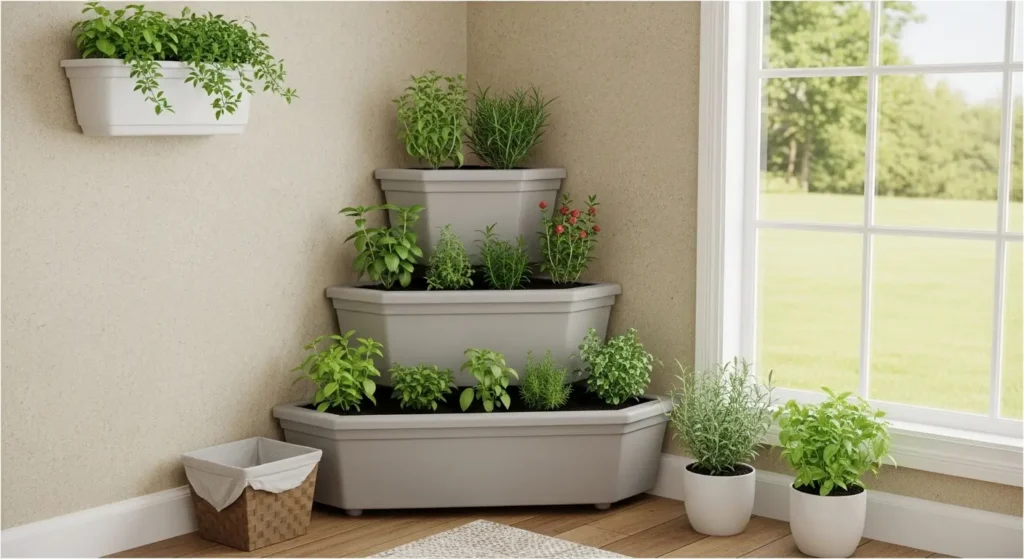
A compact patio herb corner uses a tiered corner unit to stack a complete herb selection into a 2 square foot floor footprint. The corner position provides the additional sun-trap benefit of reflected heat from two fence or wall surfaces simultaneously — Mediterranean herbs in a south-facing patio corner receive more effective heat units per day than the same herbs in an open garden position.
The tiered corner unit construction: three shelves of decreasing depth from bottom to top, each shelf containing one long trough planter. The bottom shelf at ground level holds the largest volume herbs — rosemary, sage, and lavender that grow tall. The middle shelf holds the medium-height herbs — thyme, oregano, and marjoram. The top shelf holds the compact herbs — chives, basil, and compact parsley varieties that suit shallow troughs.
The complete herb selection that fits a compact three-tier patio corner: Tier 1 bottom — rosemary, sage, one compact lavender. Tier 2 middle — thyme, oregano, marjoram, tarragon. Tier 3 top — chives, compact basil, flat-leaf parsley. Twelve herb varieties in two square feet. Every herb a different harvest interval, a different culinary application, and a different visual character — creating a complete kitchen herb supply and a visually interesting patio corner simultaneously.
PRO TIP: Repot the compact patio herb corner completely every two years rather than topping up the existing compost. Herb roots deplete compost nutrients completely within two seasons and the accumulated root mass in a compact trough also reduces drainage and water penetration. Fresh compost every two years restores the productive quality of each tier and is the single maintenance practice with the highest return on a compact herb setup.
The Herb Growing Calendar: What to Plant When
Herb growing success depends as much on timing as on setup. Plant the right herbs at the right time for continuous supply through the season:
March to April — start indoors:
Basil, parsley, chives, and coriander from seed on a warm windowsill. Basil especially needs warmth above 15 degrees Celsius to germinate reliably.
May — plant outdoors after last frost:
Move indoor-started herbs outside. Plant rosemary, thyme, sage, and oregano purchased as young plants. These Mediterranean perennials establish through summer and return larger every following year.
June to July — succession sow:
Sow a second batch of basil, coriander, and dill directly outdoors. Succession sowing ensures continuous fresh supply as early plants begin to bolt.
September — bring tender herbs inside:
Pot up basil plants for indoor windowsill growing before first frost. Rosemary, thyme, sage, and chives are fully hardy and stay outdoors year-round in most temperate climates.
📌 More garden and planting ideas- → 12 Genius Garden Planter Box Ideas
Frequently Asked Questions
What herbs are easiest to grow at home?
The easiest herbs to grow at home for culinary use are chives, mint, thyme, and rosemary. Chives grow in almost any conditions including partial shade and require minimal attention. Mint is vigorous to the point of invasiveness and produces abundantly in any moist position. Thyme and rosemary are Mediterranean perennials that prefer neglect over attention — they produce best in poor dry soil with minimal watering. According to the RHS these four herbs are the most reliably successful for beginner herb gardeners across the widest range of growing conditions.
How much sun do herb gardens need?
Most culinary herbs require a minimum of 6 hours of direct sun per day for productive growth. Mediterranean herbs — rosemary, thyme, oregano, sage, and basil — require the full 6 hours and perform significantly better with 8 hours. Shade-tolerant herbs — mint, chives, parsley, and chervil — grow in 3 to 4 hours of direct sun but produce less vigorously than in full sun. No culinary herb produces well in full shade. A minimum of 4 hours direct sun is the threshold below which most herb growing is not worthwhile.
What is the best herb garden for a small space?
The herb spiral is the most space-efficient outdoor herb garden for a small space — it produces six distinct growing microclimates from a 5-foot diameter footprint and accommodates 15 to 20 herb varieties simultaneously. For the smallest spaces including balconies and indoor growing the mason jar wall display or the compact patio corner tiered unit provide complete herb supply from 2 square feet or less. The kitchen door herb station is the best option when proximity to cooking is the primary requirement.
The Herb Garden That Gets Used Is the One Built for How You Cook
The most beautifully designed herb garden that requires effort to access will be used less than a simple trough of herbs beside the kitchen door. Design your herb garden around your cooking habits first and your aesthetic preferences second. The herb garden that changes your cooking is the one that produces at arm’s reach, in the first 10 seconds you want it, with the herbs you actually use.
Choose the herb garden idea from this guide that puts herbs closest to where you cook. Build it this weekend. The difference in your cooking by next month will be immediately noticeable.
All the products mentioned in this article are linked on Amazon. Every recommendation is something we genuinely believe in.
More Garden and Planting Ideas
→ 16 Garden Planter Ideas That Transform Outdoor Spaces
→ 12 Genius Garden Planter Box Ideas
→ 7 Full Sun Planter Ideas For Hot Summer
→ 12 Boho Garden Ideas You’ll Love
Choose the herb garden idea that puts herbs closest to where you cook. Build it this weekend. The difference in your cooking by next month will be immediately noticeable.

Sheikh Hassaan is a digital architect for small businesses and the founder of The Glow Up System. He writes about home decor, garden design, and outdoor living for real American homes – practical ideas that work in actual spaces without oversized budgets.