
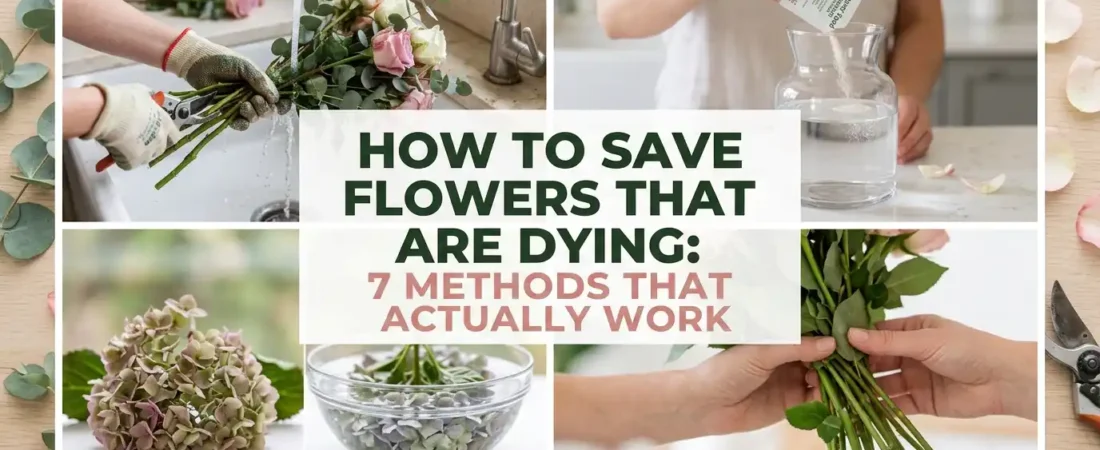
Few things are more disappointing than watching a beautiful bouquet droop and wilt within days. You spent good money on those flowers, and now they’re hanging their heads like they’ve given up on life. But here is the good news: the flowers might not actually be dying. In many cases, they are suffering from dehydration, bacterial buildup, or air locks in their stems, all of which can be fixed .
That is what makes knowing how to save flowers that are dying so valuable, letting you extend the life of your bouquets by days or even weeks. This guide covers seven methods that actually work, from simple tricks to florist secrets.
Table of Contents
Why Do Cut Flowers Wilt and Die?
Before you can save your flowers, it helps to understand why they are dying in the first place. There are three main reasons cut flowers fail :
Bacteria buildup is the most common culprit. When bacteria grow in vase water, they clog the stems and prevent water uptake. Stems may become slimy and discolored . The water can turn murky and even start to smell foul .
Air locks occur when air enters the stem and blocks the flow of water. This is especially common in tulips and roses. Without water reaching the flower head, the blooms dehydrate and droop .
Natural aging is inevitable. All cut flowers have a limited vase life, typically 5 to 10 days depending on the variety. While you cannot stop aging entirely, you can significantly delay it.
1. The Sugar and Vinegar Method: The All-Rounder
✦ Best for: Most cut flowers that are starting to droop and wilt
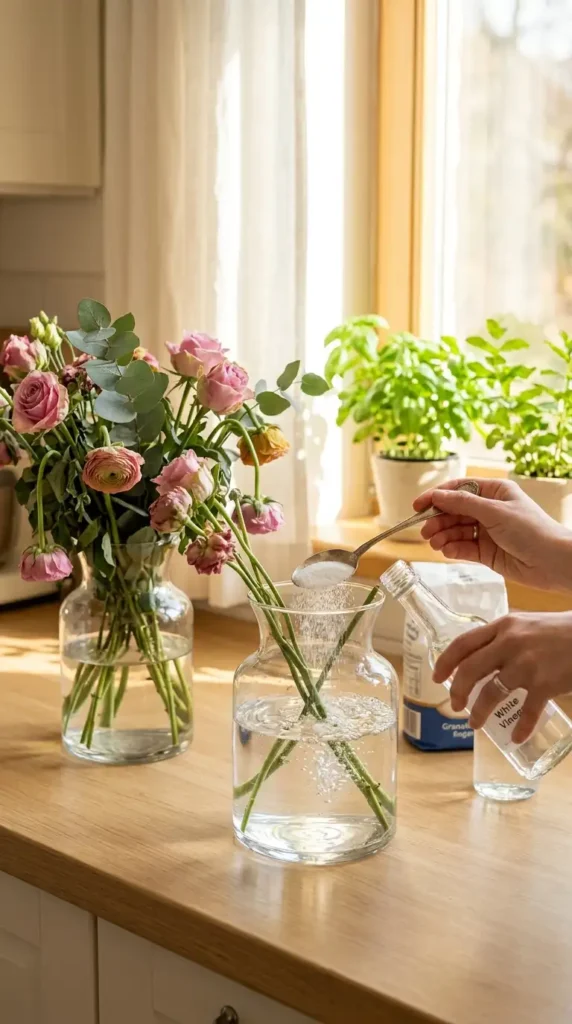
One of the most popular and effective ways to revive wilted flowers is a simple homemade solution. TikTok florist April Dobrowski shared a quick and easy method using common household ingredients .
Start by removing all withered petals and discarding any completely dead flowers. This step helps clean up the bouquet and prevent rot from spreading. Next, add two tablespoons of vinegar to a vase of water. The vinegar kills bacteria that accumulate in the water, which is often the cause of premature wilting .
Then add one tablespoon of sugar. The sugar provides nutrients that help flowers regain their vibrancy and energy . The Royal Horticultural Society also recommends this ratio: one tablespoon of vinegar and one teaspoon of sugar per liter of water . Finally, add some ice to the vase. The cold water helps the flowers perk up more quickly .
2. The Boiling Water Trick: For Stubborn, Woody Stems
✦ Best for: Roses, hydrangeas, snapdragons, and other flowers with tough, woody stems
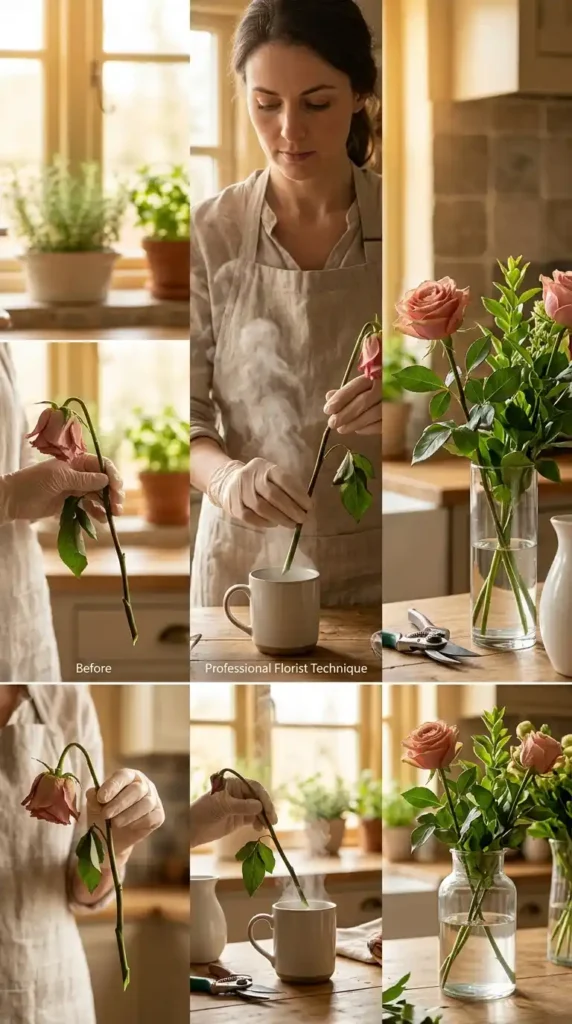
This technique is a professional florist secret. It works by using heat to force air bubbles out of the stem, allowing water to flow freely again . When cut flowers begin to droop, air often enters the stems and blocks water uptake .
Millie Durbak, brand manager at Prestige Flowers, explains: “It’s a lesser-known trick that works wonders. Immersing the ends of droopy cut flowers in just-boiled water for a brief period can revive them” .
The process is simple. Boil water and pour it into a heatproof container. Recut the stems at a 45-degree angle. Dip the bottom 1 to 2 inches of the stems into the boiling water for exactly 30 seconds. Then immediately place the stems into a vase of cool, fresh water .
Important warning: This technique is not for every flower variety. It works best on tough, woody stems like roses, hydrangeas, and snapdragons. More delicate flowers like peonies, freesias, and tulips may be damaged by the heat . For hydrangeas, you can also revive drooping blooms by submerging the entire flower head in room-temperature water for 30 minutes, as they absorb water through their petals .
3. The Full Submersion Method: A Total Rehydration
✦ Best for: Roses, hydrangeas, and flowers that are severely dehydrated
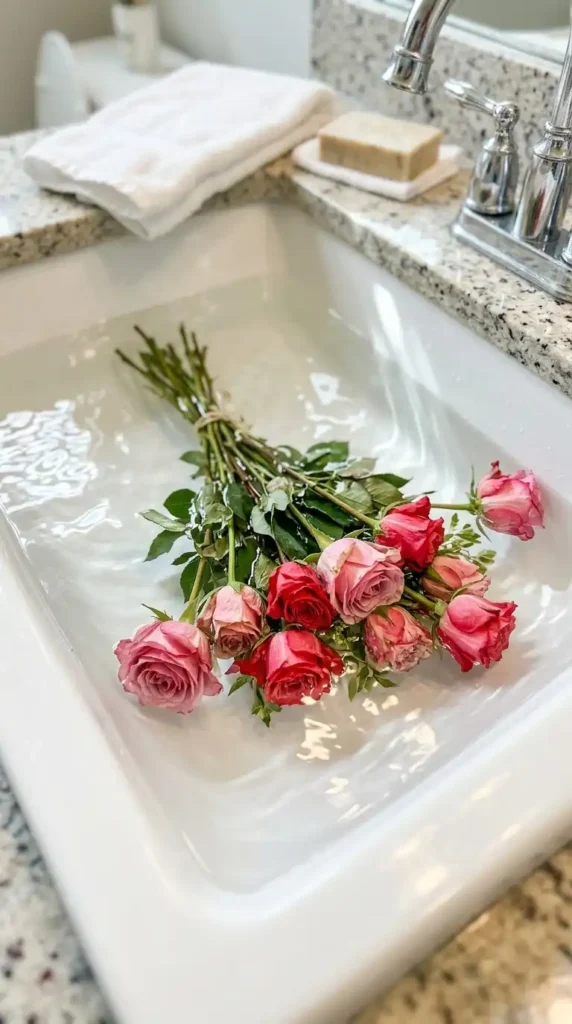
For severely wilted flowers, especially roses, a full submersion can work wonders. Gardening expert Melinda Myers recommends this technique: remove the roses from their vase, recut the stems, and submerge the whole rose—stem, leaves, flowers, and all—in a sink or tub of warm water .
Leave the roses submerged for 30 minutes. Use that time to clean and refill the vase with fresh water and a bit of floral preservative. After 30 minutes, recut the stems on a slant and place them back in the vase. “You will have perky fresh roses to enjoy for a week or more,” Myers says .
This method works because it allows the flowers to rehydrate from every surface, not just through the cut stem. It is particularly effective for roses, which are prone to neck droop when dehydrated.
4. The Pin Prick Method: For Tulips With Air Locks
✦ Best for: Tulips that are drooping due to air locks in their stems
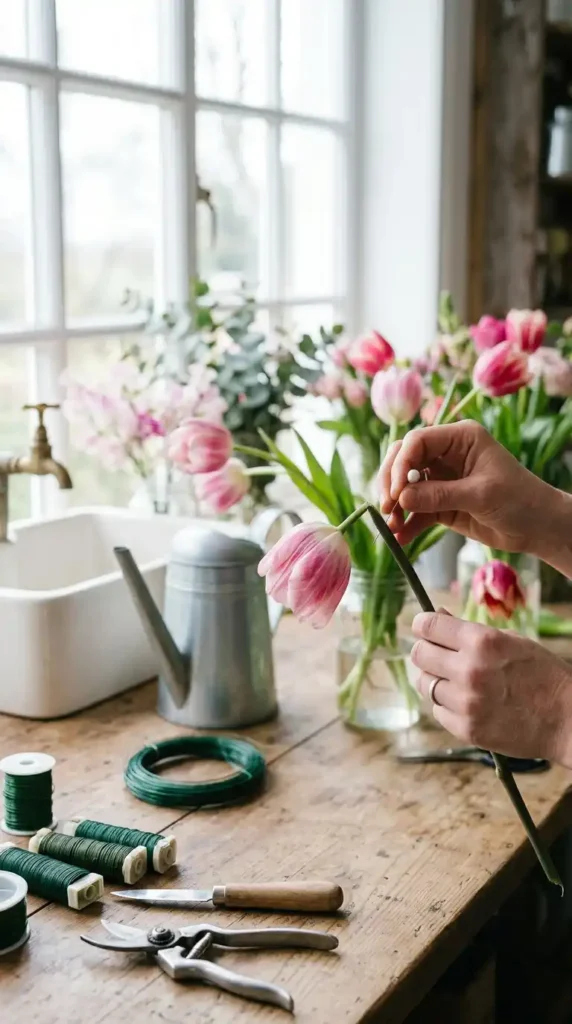
Tulips are notorious for drooping, often within days of being cut. The culprit is often an “air lock” in the stem that prevents water from reaching the flower head . But there is a surprisingly simple fix.
Experts from Floristry Market recommend using a pin to pierce a hole through the top of the tulip stem, just below where the bloom begins . The expert florist explains: “When you see tulips drooping over, it means they have an air lock in their stem, which means that there’s no water getting to the head, so they’ll naturally start to dehydrate and fall over. If you place it through the top of the tulip stem, that will release any air lock in the stem and your tulips will [lift up]. Then it can drink and it will get hydrated right to the top” .
For even better results, wrap the tulip stems in newspaper and let them soak in water for several hours before returning them to the vase. This strengthens the tulips’ structure and keeps them erect .
5. The Daily Recut and Water Change: Preventing Decline
✦ Best for: All flowers, as a preventive measure and for mild wilting
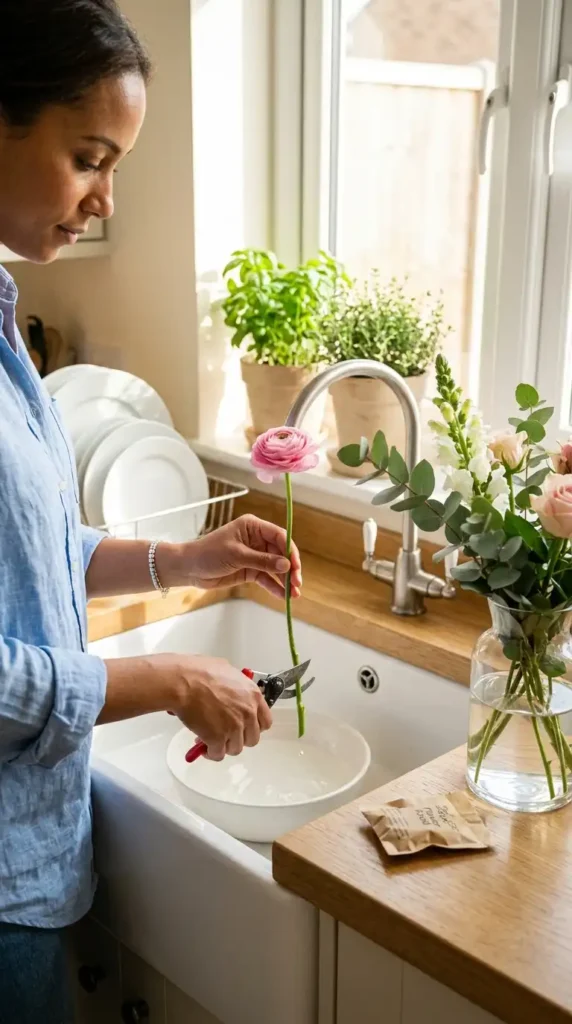
The simplest and most effective way to save dying flowers is to cut the stems and change the water daily. A florist advises: “Think of it like giving your flowers a clean bed to sleep in each night. Fresh water = fresh flowers” .
The cut-off flower stem naturally begins to seal itself to protect against infection. This sealing also blocks water absorption, leading to premature demise. Cutting the stems reopens the water pathways .
Here is the daily routine:
- Remove flowers from the vase and discard any dead blooms
- Wash the vase thoroughly with soap and water to remove bacteria
- Cut about one inch off the bottom of each stem at a 45-degree angle
- Remove any leaves that would sit below the water line
- Fill the vase with fresh, lukewarm water and add flower food if you have it
- Return the flowers to the vase
Repeat this process every 1 to 2 days for the longest vase life .
6. The Flower Food Solution: Commercial and Homemade
✦ Best for: All flowers, as a daily care routine
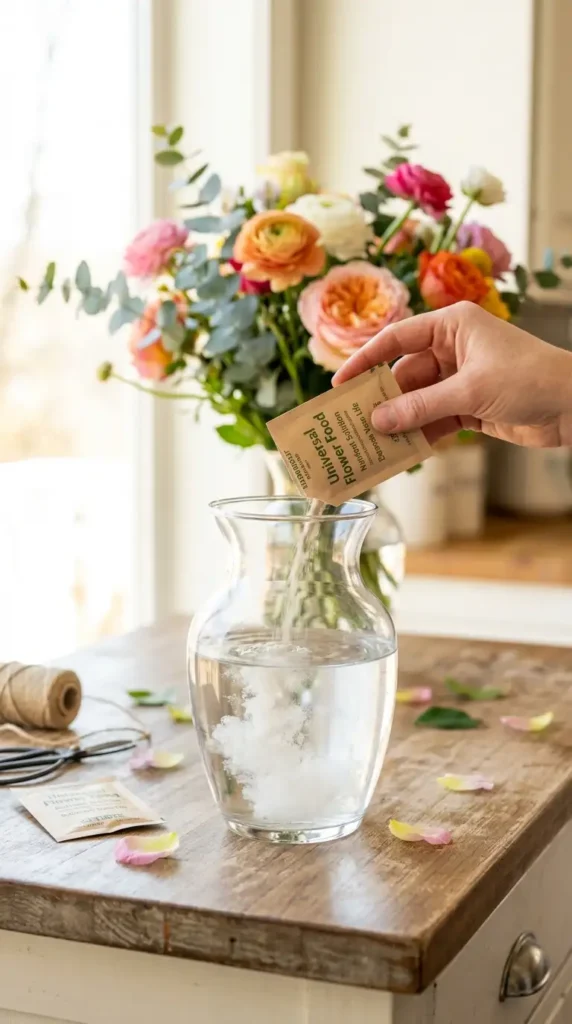
If your bouquet came with a packet of flower food, it is important to use it. These packets contain a balanced mix of nutrients and antibacterial agents designed to prolong the life of your flowers . The commercial mixtures work best at controlling microbial populations and hydrating stems .
If you do not have commercial flower food, the sugar and vinegar mixture works as a homemade alternative . Here is the recipe from the Royal Horticultural Society:
A florist suggests: “No flower food? A teaspoon of sugar or a few drops of bleach can help too (just don’t mix them unless you want a chemistry lesson)” .
7. Keep Flowers Cool and Away from Fruit
✦ Best for: All flowers, as a preventive measure to extend life
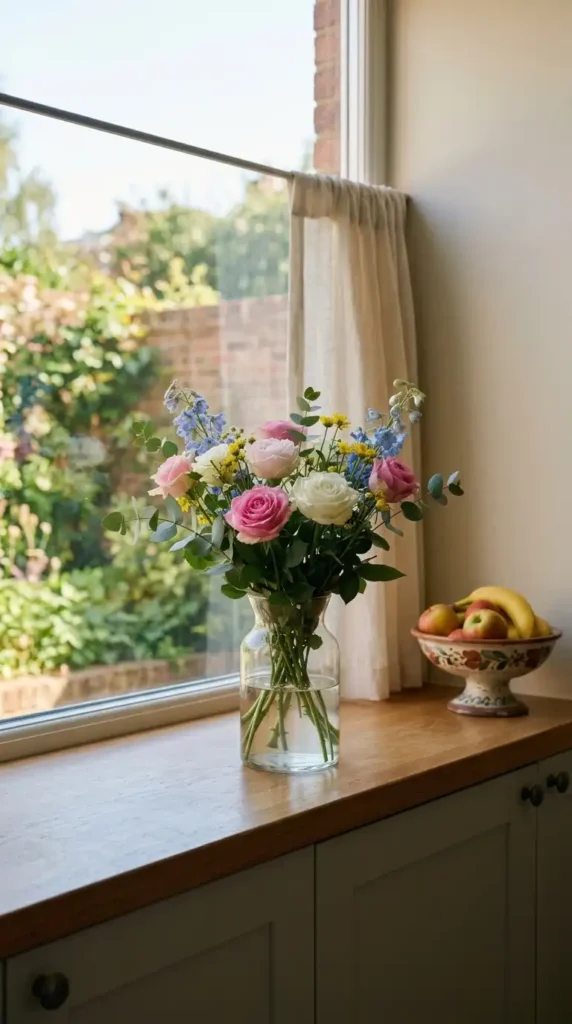
Where you place your flowers matters almost as much as how you care for them. Heat accelerates wilting, while cool temperatures slow it down .
Avoid direct sunlight, heat sources like radiators, and drafts . A cooler spot in the room is ideal .
Equally important: keep your flowers away from ripening fruit. Bananas, apples, and other fruits give off ethylene gas as part of the ripening process. This chemical accelerates flower aging and can cause them to droop and wilt faster .
What to Do When All Else Fails
Sometimes, despite your best efforts, flowers cannot be saved. If the stems are black and mushy, the petals are browning and falling off, or the water smells foul, the flowers are past revival . It is time to let them go and start fresh.
However, you can still enjoy dying flowers by drying them. Hang them upside down in a cool, dark place for a week or two. They will keep their shape and can be used in dried arrangements . You can also press the petals between heavy books to preserve them for crafts .
Frequently Asked Questions About How to Save Flowers That Are Dying
Can you bring dead flowers back to life?
Unfortunately, it is not possible to bring completely dead flowers back to life . However, many flowers that appear dead are actually just severely dehydrated or suffering from air locks or bacteria. These can often be revived with the methods above .
What should I do with dying flowers?
You have several options. You can snip off the dying parts and rearrange the remaining living blooms. You can dry them by hanging them upside down in a dark place. You can press the petals between heavy books to preserve them. Or you can compost them to return nutrients to your garden soil .
Do pennies really keep flowers fresh?
Some sources suggest placing a copper penny in the vase works as an antibacterial agent. However, experts say homemade flower food solutions are not as effective as commercial mixtures . The best approach is to use a clean vase, fresh water, and recut the stems regularly .
How can I make flowers last longer?
Use a clean vase with fresh lukewarm water and flower food. Cut stems at an angle every 1 to 2 days. Remove leaves below the water line. Keep flowers cool and away from fruit and direct sunlight. Remove dead blooms as they appear .
What is the best homemade flower food?
A simple homemade solution is one tablespoon of vinegar and one teaspoon of sugar per liter of water . The vinegar kills bacteria, and the sugar provides nutrients. While this works, commercial flower food is more effective at extending vase life .
Related Articles
Backyard Deck Ideas on a Budget That Look Expensive
Storage Ideas for Small Spaces That Unlock Hidden Square Footage
Couches for Small Spaces That Look Surprisingly Luxurious
Furniture for Small Spaces That Maximizes Every Square Foot
A little knowledge and a few simple tricks can save your flowers and bring them back to life. The next time a bouquet starts to droop, try one of these methods before you toss it.

Sheikh Hassaan is a digital architect for small businesses and the founder of The Glow Up System. He writes about home decor, garden design, and outdoor living for real American homes – practical ideas that work in actual spaces without oversized budgets.