
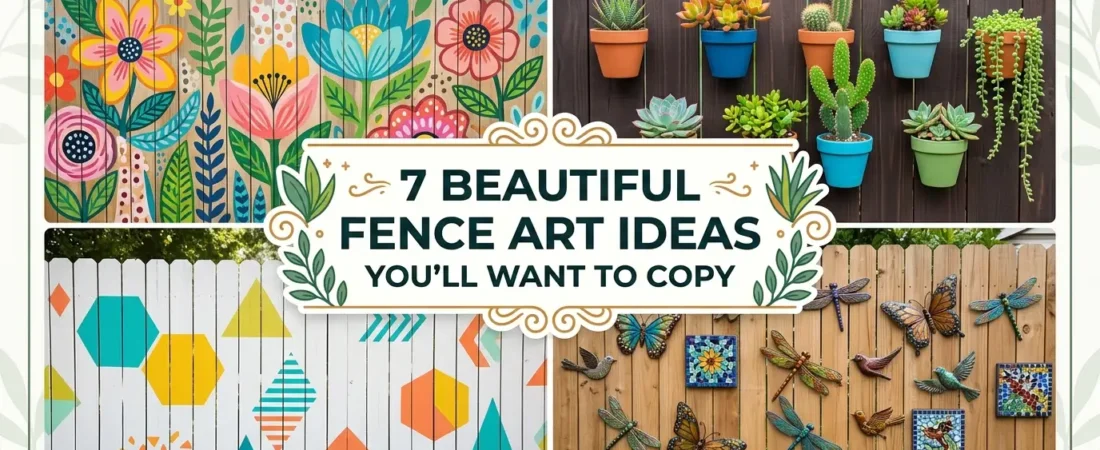
Fence art ideas address the largest blank surface in most gardens — a surface that takes up more square footage than any patio, path, or border combined, and is almost always left bare. A plain timber fence contributes nothing to a garden. A fence treated as a display surface, a gallery wall, or a decorating opportunity contributes more visual character per square foot than anything else in the outdoor space.
These 7 fence art ideas each treat the fence as a canvas for a specific design concept — from a single statement mirror that transforms perceived garden depth to a complete fence gallery wall that makes a boundary the most interesting surface in the space.
Table of Contents
1. A Fence Mirror Transforms the Boundary Into the Garden’s Most Valuable Visual Asset
✦ Decorative Garden Mirror
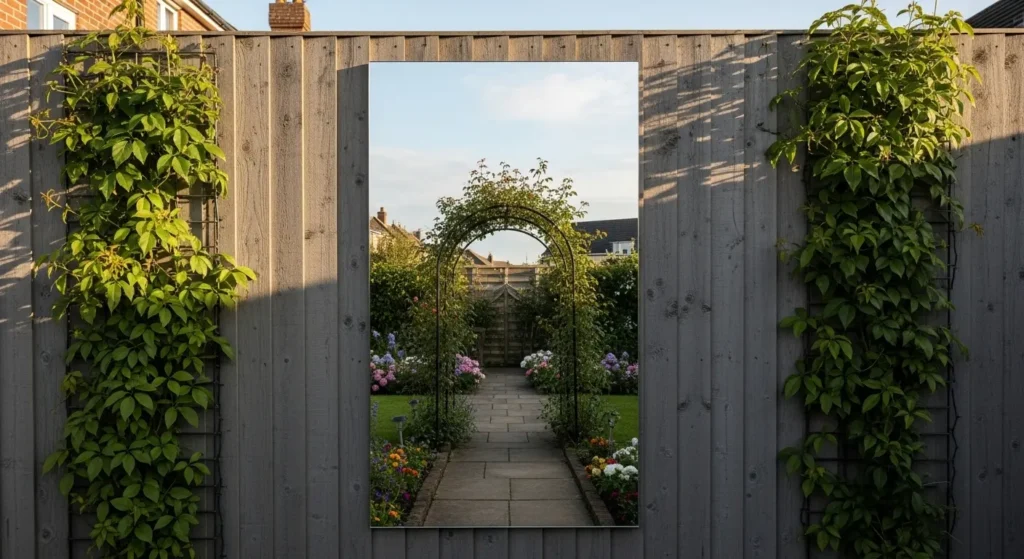
A fence-mounted garden mirror is the single fence art investment with the highest visual return because it changes not just the appearance of the fence but the apparent size of the entire garden. A mirror on the darkest, most visually dead fence section creates a portal effect — the reflection reads as additional garden space beyond the boundary rather than a reflected view of the existing garden.
The framing technique determines how convincingly the mirror reads as an opening rather than a mirror. Train climbing plants — ivy, roses, or jasmine — from the border at each side of the mirror to grow up the fence and curl around the mirror edges. The living frame visually integrates the mirror into the garden plane and blurs the boundary between real and reflected garden. A mirror with visible mounting hardware and no framing reads immediately as a decorative object. A mirror framed by living plants reads as an architectural feature.
Safety specification: always use acrylic outdoor mirrors rather than household glass mirrors on garden fences. Glass mirrors in exposed positions create focused sun reflection capable of igniting dry plant material at certain sun angles. Acrylic mirrors eliminate this risk while producing identical visual results and handling garden conditions without the silvering degradation that glass mirror backing develops in outdoor moisture exposure.
PRO TIP: Position a fence mirror at a slight inward angle — 5 degrees tilted away from the vertical at the top — rather than perfectly upright. A vertically hung mirror reflects the viewer directly back at themselves when they look at it straight on, which breaks the garden depth illusion. A slightly tilted mirror reflects the garden floor and planting at an angle that creates a more convincing sense of looking through rather than looking at.
2. A Fence Lantern Gallery Creates Evening Atmosphere Across the Entire Fence Length
✦ Hanging Lantern Arrangement
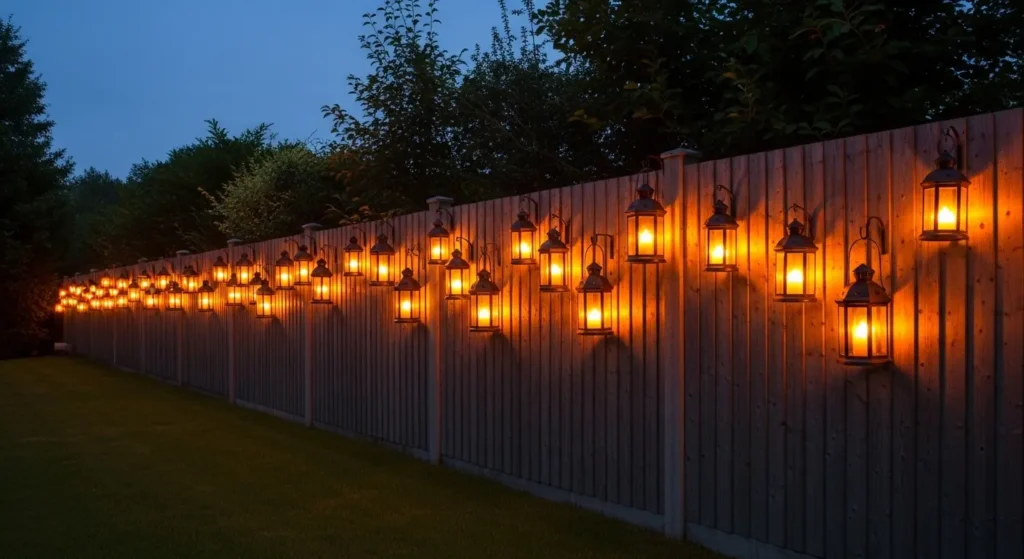
A fence lantern gallery uses multiple lanterns distributed across the fence width as a coordinated lighting installation rather than scattered individual lights. The distinction between a coordinated fence lantern gallery and random fence lanterns is the same as the distinction between a gallery wall and pictures randomly hung — the installation logic determines whether it reads as designed or accumulated.
The installation logic for a fence lantern gallery: consistent hanging heights within defined bands rather than random heights. A lower band of lanterns at 18 to 24 inches from the fence top and an upper band at 6 to 8 inches from the fence top creates two visual lines that read as a designed arrangement. All lanterns within each band at the same height. Spacing between lanterns regular or intentionally irregular — but one or the other, not a mix of both.
The GIGALUMI Mason Jar Solar Lanterns provide the ideal fence gallery lantern format — glass lanterns with warm amber solar lighting that charge during the day and activate automatically at dusk. Six per pack provides enough for a complete fence gallery across a standard 6-foot fence section. Find them linked on Amazon.
PRO TIP: Vary lantern sizes within the fence gallery rather than using identical units. A gallery of all-identical lanterns reads as a product display. A gallery mixing large, medium, and small lanterns of the same style reads as a curated collection. Three sizes — one large lantern flanked by two medium lanterns flanked by two small lanterns — creates a visual rhythm that looks intentionally composed.
3. A Painted Fence Mural Makes the Boundary Disappear Into the Garden It Creates
✦ Painted Fence Mural
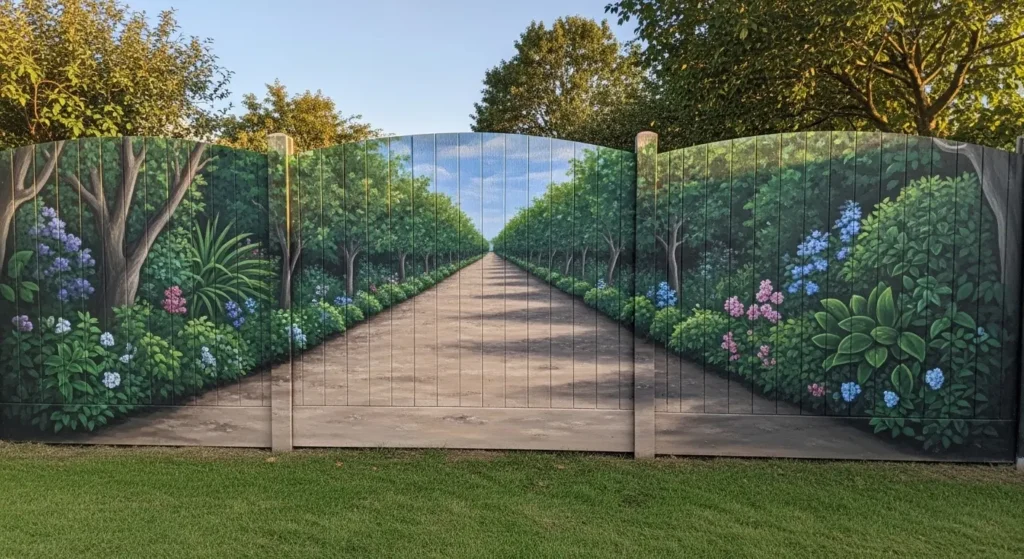
A painted fence mural is the most ambitious of all fence art ideas and the one with the most transformative potential. Where a mirror creates the illusion of depth through reflection a trompe l’oeil mural creates it through painted perspective — a garden path disappearing into painted woodland, a gate opening onto a painted meadow, or a continuation of the actual garden planting in painted form beyond the fence line.
The trompe l’oeil approach that works best for fence murals: paint the view that would exist if the fence were not there. Study the view from the main seating position toward the fence and paint a convincing continuation of that view beyond the boundary. The painted scene should use the same colors as the real garden, the same light quality as the ambient light, and a perspective that matches the eye level from the main viewing position.
For non-artists the stencil mural approach achieves fence art impact without demanding freehand painting skill. Large botanical stencils, geometric repeat patterns, or silhouetted tree and bird designs applied in exterior masonry or timber paint create fence murals with strong visual impact that requires precise stencil application rather than artistic drawing ability. Exterior masonry paint applied to primed timber fence boards lasts 3 to 5 years before needing refresh.
PRO TIP: Prime a timber fence with exterior wood primer before painting any fence mural. Unprimed timber absorbs paint unevenly and causes visible grain bleed-through that undermines detailed work. Two coats of exterior primer creates the smooth uniform surface that mural painting requires. The priming investment is one hour of work that determines the quality of everything painted above it.
4. A Recycled Window Frame on the Fence Creates the Illusion of a Room Beyond the Garden
✦ Recycled Window Frame Art
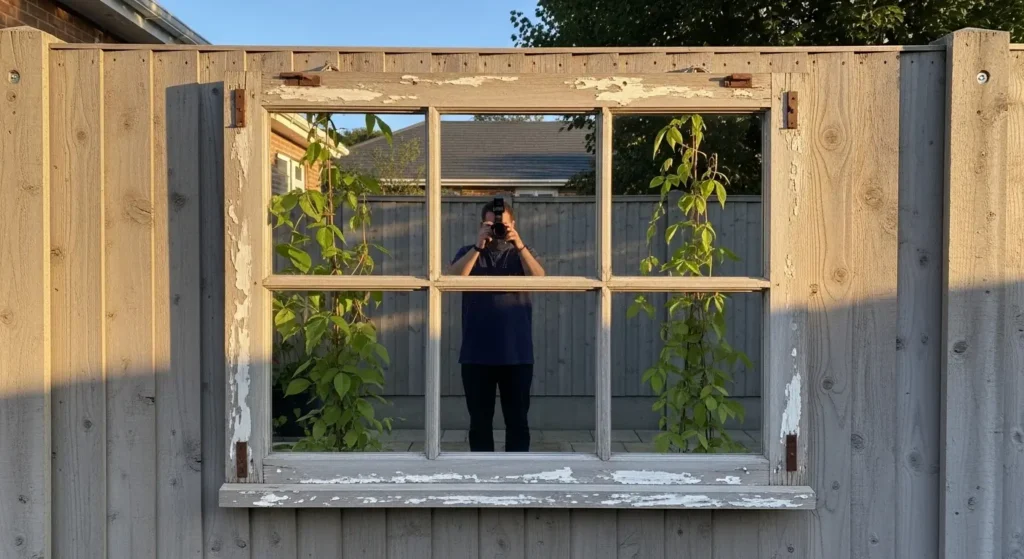
A recycled window frame mounted on a garden fence creates the most architectural of all fence art effects — the suggestion of a window looking through the boundary into a space beyond. The window frame is the recognized symbol of a room’s connection to the outside world. Reversed — mounted on the garden fence looking inward — it creates the same connection from the garden to an implied interior.
The two approaches that work best. First: a mirror panel fitted behind the window frame so the reflection appears through the window openings as a view into a reflected garden space. The window frame contains the mirror and gives it an architectural reading rather than a purely decorative one. Second: train a climbing plant through the window frame openings so the living plant growth appears to come through the window — creating the impression of an inhabited space beyond the fence where plants are growing at a window.
Source recycled window frames from architectural salvage yards, demolition sites with permission, estate sales, and Facebook Marketplace where old double-glazed replacement projects generate large quantities of original timber window frames at no cost. The original paint layers, weathering, and hardware create the character that new timber frames cannot replicate.
5. A Vintage Garden Tool Display Turns Agricultural Heritage Into Fence Art
✦ Vintage Garden Tool Display
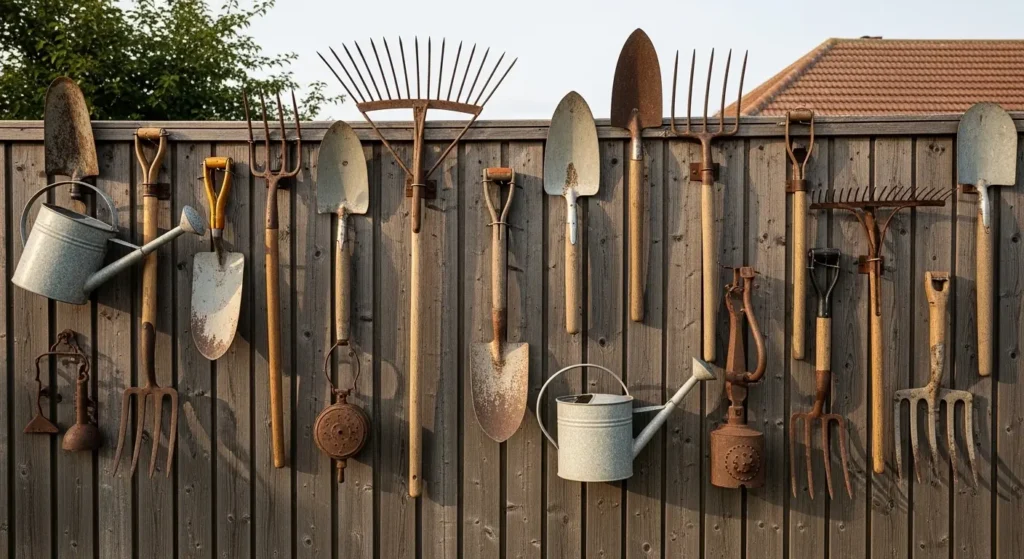
A curated vintage garden tool display turns the objects most associated with gardens — trowels, forks, watering cans, shears — into fence art by mounting them as a composed collection rather than storing them as functional objects. The display is simultaneously decorative, personally resonant for any gardener who owns it, and completely unique because vintage tools are individual objects rather than manufactured uniformity.
The curation principle that separates a vintage tool display from a collection of old things hung on a fence: compositional logic. Group tools by material — all metal tools in one cluster, all timber-handled tools in another. Or by scale — largest tool at the center, diminishing size toward the edges. Or by type — digging tools together, watering tools together, cutting tools together. The grouping logic creates a display that reads as considered rather than accumulated.
Source vintage garden tools from estate sales, boot fairs, antique markets, and charity shops. Tools with original timber handles in good condition are increasingly rare and correspondingly more valuable visually — the contrast between aged metal and worn timber creates more visual interest than all-metal tools. Clean tools of loose rust with a wire brush before mounting but retain the patina — heavy rust removal destroys the character that makes vintage tools worth displaying.
PRO TIP: Mount vintage tools at varying depths from the fence surface rather than all flush against it. A trowel resting on a hook at 3-inch depth creates shadow play on the fence behind it. A watering can on a bracket at 8-inch depth creates a larger shadow mass. The depth variation across a tool display creates dimensional interest that flat-mounted collections lack.
6. A Large Outdoor Macrame Piece Adds Textile Quality to the Hardest Garden Surface
✦ Macrame Outdoor Wall Hanging
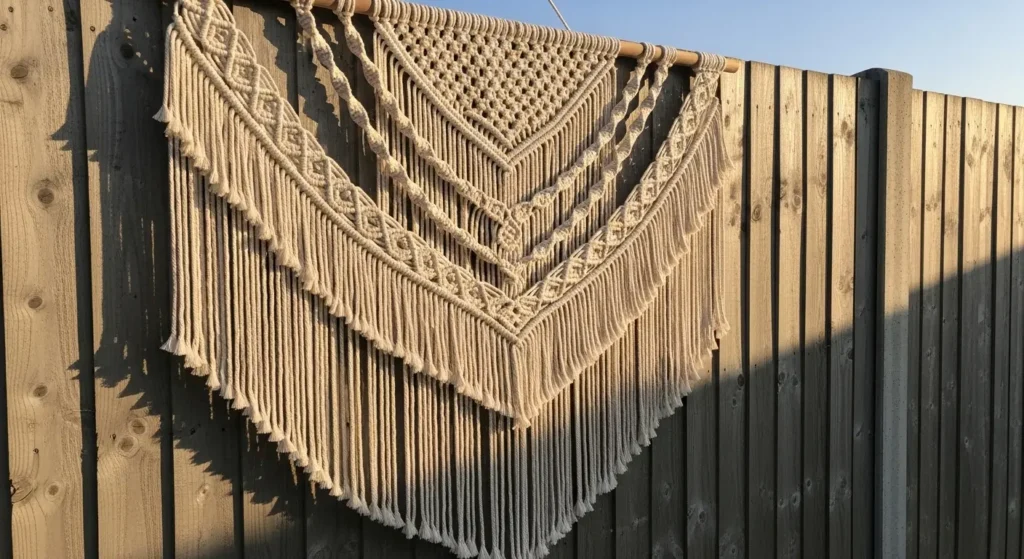
A large outdoor macrame wall hanging brings the one material quality that no other fence art form provides: soft textile warmth on a hard timber surface. Metal, mirror, ceramic, and timber art pieces all share the hard material quality of the fence itself. Macrame breaks this material monotony with fiber, texture, and the hand-knotted quality that communicates human craft time invested in the garden.
The scale consideration for fence macrame: a piece sized to cover a full fence panel — typically 6 feet wide and 4 to 6 feet tall — creates a textile feature that commands the fence section. A smaller piece on a large fence panel looks like decoration. A full-panel piece looks like an art installation. The scale difference requires more cord and more making time but produces disproportionately more visual impact.
Outdoor durability is the specific challenge for fence macrame. Cotton cord absorbs moisture and requires weeks to fully dry after heavy rain, during which time mold risk increases significantly. For permanent outdoor fence installation use polyester or UV-stabilized synthetic macrame cord which handles moisture without absorption and UV without degrading. The visual quality is identical to cotton at any viewing distance over 3 feet.
PRO TIP: Treat an outdoor macrame piece with a light coat of outdoor fabric waterproofing spray before installation. The spray does not change the cord appearance but significantly reduces moisture absorption and increases the drying speed after rain. A treated macrame piece that gets wet in a shower dries in 4 to 6 hours rather than the 2 to 3 days that untreated cotton cord requires.
7. A Fence Gallery Wall Treats the Outdoor Boundary Like an Interior Feature Wall
✦ Colorful Fence Gallery Wall
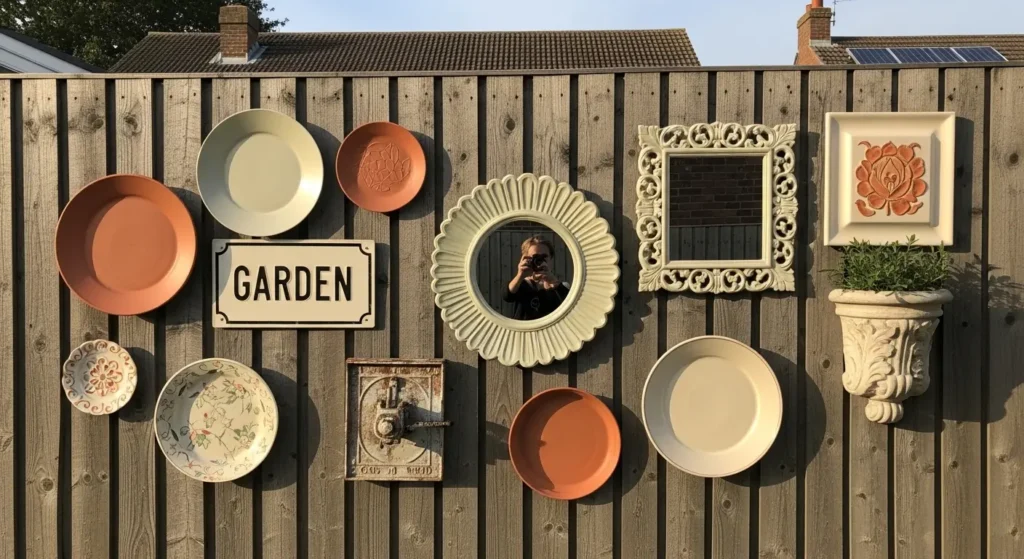
A fence gallery wall applies the interior design gallery wall concept to the garden boundary — a curated collection of different objects in different sizes and materials arranged as a composed installation across a fence section. The gallery wall concept works in gardens for the same reason it works in interiors: the visual energy of a thoughtfully arranged collection of objects exceeds the sum of its individual parts.
The gallery wall curation principle: choose a unifying color palette and apply it to every element in the collection. An outdoor gallery wall where every piece contains some terracotta, cream, or sage reads as composed. A gallery wall where every piece is a different color reads as random regardless of the quality of individual objects. The color palette is the invisible structure that makes the collection read as designed.
The mix of object types that creates the most visually interesting fence gallery wall: one reflective surface (a small mirror or metallic plate) for light. One natural material element (a wood slice, a stone piece, or a terracotta object) for warmth. One plant element (a small wall-mounted planter or a dried botanical) for life. One text or graphic element (a garden sign or printed tile) for personality. Four object types in one unified color palette creates a complete gallery wall from the minimum number of pieces.
PRO TIP: Lay out the fence gallery wall arrangement on the ground before making a single hole in the fence. Place all objects on the grass or patio in their intended arrangement and live with the layout for a day before committing. Gallery walls that are planned on the fence itself — hanging and rehooking as the arrangement develops — result in unnecessary holes and never achieve the considered quality of a pre-planned arrangement installed once.
The One Rule That Makes Every Fence Art Idea Work
Every fence art idea in this guide works when one condition is met: the fence surface behind the art is prepared. A beautiful mirror on a dirty weathered fence looks worse than no mirror. A curated lantern gallery on a grey rotting fence draws attention to the fence rather than away from it.
Before any fence art installation: clean the fence with a pressure washer or stiff brush. Sand any rough or splintering sections. Apply a coat of exterior fence paint or wood stain in a color that suits the garden palette. A freshly painted fence in a deliberate color — dark charcoal, deep forest green, or warm slate blue — reads as a designed background that elevates every art piece mounted against it. The same fence art on an unpainted weathered fence reads as decoration on a neglected surface.
Dark fence colors — particularly dark charcoal and deep green — make plants, mirrors, lanterns, and decorative objects all read more distinctly and more beautifully than light fence surfaces. The dark background creates the contrast that makes every art piece visible and every plant in front of it luminous. Painting the fence is the first fence art decision and the one that makes every subsequent decision more effective.
📌 More garden art and outdoor ideas: 10 Garden Art Ideas That Instantly Upgrade Your Yard
Frequently Asked Questions
What can I put on a garden fence for decoration?
Garden fence decoration options range from functional to purely artistic: outdoor mirrors that create depth illusions, lantern collections for evening atmosphere, macrame wall hangings for textile warmth, painted murals for trompe l’oeil effects, gallery walls of curated objects, vintage tool displays, recycled window frames, and wall-mounted planters. The most effective fence decorations treat the fence as a designed surface with a clear aesthetic intention rather than as a place to hang individual objects. According to the RHS the most consistently successful fence decoration coordinates fence surface color with the objects mounted against it — a deliberately painted fence background elevates every decorative element placed on it.
How do I attach art to a garden fence without damaging it?
For fence art mounting without permanent damage: over-panel hooks that grip the fence top through compression require no screws. Adhesive outdoor hooks rated for the object weight attach to smooth painted fence surfaces and remove cleanly. Tension wire systems strung between fence posts support hanging objects across multiple fence bays without drilling individual fence boards. For rental properties and situations where fence ownership is shared with neighbors the over-panel hook and tension wire methods provide complete fence art installation without any permanent modification.
What color should I paint a fence before adding art?
Dark fence colors create the most effective backgrounds for garden art and garden planting simultaneously. Dark charcoal, deep forest green, slate blue, and deep navy all make plants glow in front of them and art objects stand out against them with maximum contrast. Pale fence colors — cream, white, and light grey — are harder to keep clean, show every mark and weather stain, and create less visual contrast for art objects and plants mounted against them. The single fence painting decision that improves every subsequent garden art and planting choice is to go darker rather than lighter.
The Fence Is the Largest Canvas in Your Garden
Most gardens spend significant effort and investment on borders, pots, paving, and furniture while leaving the largest surface area — the fence — completely bare. The fence art ideas in this guide treat that surface as the design opportunity it actually is.
Choose one fence art idea that suits your garden aesthetic. Paint the fence first in a color that suits the concept. Then install the art against the prepared surface. The transformation from bare boundary to designed garden feature takes one weekend.
All the products mentioned in this article are linked on Amazon. Every recommendation is something we genuinely believe in.
More Garden Art and Outdoor Ideas
→ 12 Simple & Stunning Outdoor Wall Planter Ideas
→ How To Turn Old Junk Into Garden Decor
→ 12 Rustic Planter Ideas That Look Beautiful Naturally
→ 25 Simple But Stunning Garden Lighting Ideas
Paint the fence first in a color that suits the concept. Then install the art against the prepared surface. The transformation from bare boundary to designed garden feature takes one weekend.

Sheikh Hassaan is a digital architect for small businesses and the founder of The Glow Up System. He writes about home decor, garden design, and outdoor living for real American homes – practical ideas that work in actual spaces without oversized budgets.