
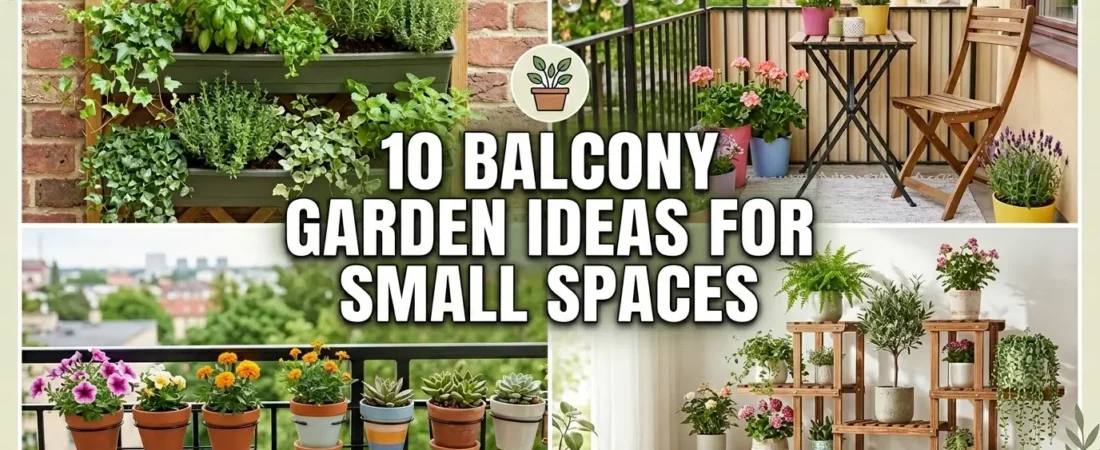
Balcony garden ideas for small spaces require a completely different approach from ground-level gardening. A balcony has three constraints that ground gardens do not: structural weight limits that restrict how much soil and container weight can be placed on the surface, wind exposure that damages plants and dries containers faster than any ground-level position, and the absence of ground soil that makes every plant 100% dependent on what you provide in containers. Get these three constraints right and a small balcony becomes one of the most satisfying and most productive gardening spaces available.
These 10 balcony garden ideas each address the specific constraints of balcony growing with the plant choices, container specifications, and installation approaches that actually work rather than looking good in photographs and failing by midsummer.
Table of Contents
1. Railing Planters: The Balcony Garden That Uses Zero Floor Space
✦ Railing Planter Display
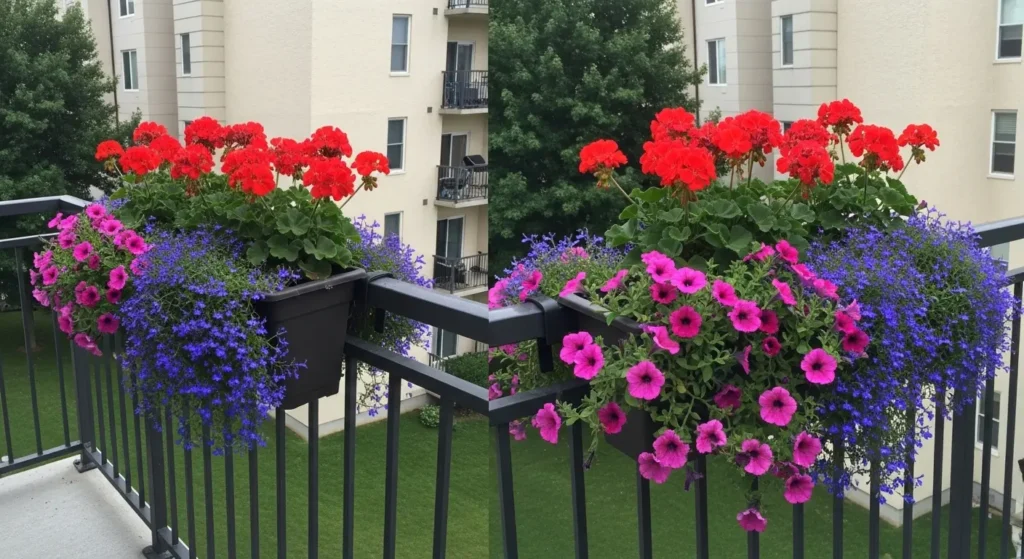
Railing planters occupy the one dimension of a balcony that is otherwise completely unused — the railing itself. Over-rail planter brackets grip the top of standard railing profiles through compression and support planting on both the exterior and interior railing faces simultaneously, doubling the growing surface from a single fixing point.
The weight consideration is critical for railing planters. Most residential balcony railings are rated for a distributed load of 50 to 200 pounds per linear foot. A standard 24-inch over-rail planter fully loaded with wet compost weighs 15 to 25 pounds. Three planters on a 6-foot railing run add 45 to 75 pounds — well within rating for most railings but worth confirming with your building management if you are uncertain.
Plant selection for railing planters must prioritize wind tolerance above all other qualities. The railing position is the most exposed growing position on any balcony. Trailing Pelargonium (ivy geranium) is the most wind-tolerant flowering balcony plant available and produces continuous color from May to October in exposed positions that defeat most other flowering annuals. Trailing Verbena and Calibrachoa also handle railing exposure reliably.
PRO TIP: Install railing planters on the interior railing face rather than or in addition to the exterior face on very exposed high-rise balconies. The interior face is protected from the worst wind by the railing itself and produces significantly better plant performance than the exterior face at height. Interior railing planters are also visible from inside the apartment — adding the garden view that makes the indoor-outdoor connection most valuable in winter months.
2. A Vertical Wall Garden Converts the Balcony Back Wall Into Growing Space
✦ Vertical Wall Garden
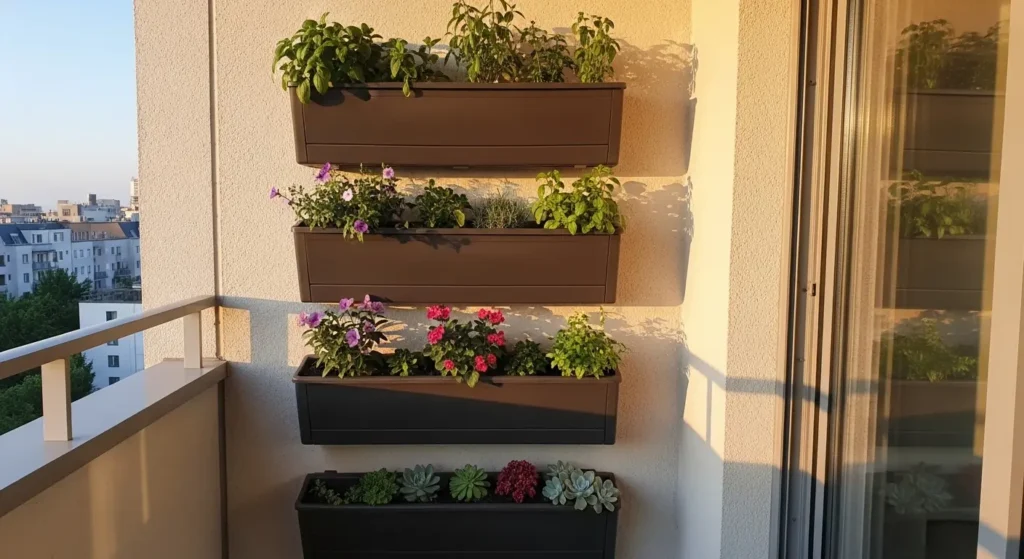
The back wall of a balcony is its most sheltered surface — protected from the prevailing wind by the building structure behind it and receiving reflected warmth from the building facade. This makes the back wall the best growing position on most balconies and the most underused.
A wall-mounted planter system on the balcony back wall creates growing space from a surface that currently contributes nothing to the garden. Three rows of wall-mounted trough planters at 18-inch vertical intervals create three distinct growing zones at the most protected position on the balcony.
The weight distribution advantage of wall mounting versus floor placement is significant on balconies with weight restrictions. A wall-mounted planter transfers its load to the building structure through the wall fixings rather than to the balcony floor slab. Check with your building management whether wall fixings on the balcony back wall are permitted — most buildings allow lightweight wall-mounted planters that do not compromise the building envelope.
PRO TIP: Use lightweight growing medium in wall-mounted balcony planters rather than standard garden compost. Perlite-heavy mixes — one part perlite to two parts coir — weigh 40 to 60% less than standard compost while providing adequate growing medium for most balcony plants. The weight reduction is significant when wall-mounted loads are considered and the free-draining quality of lightweight mixes suits the faster-drying conditions of elevated wall positions.
3. A Balcony Herb Corner Produces Kitchen Herbs From the Most Accessible Outdoor Space You Have
✦ Herb Garden Corner
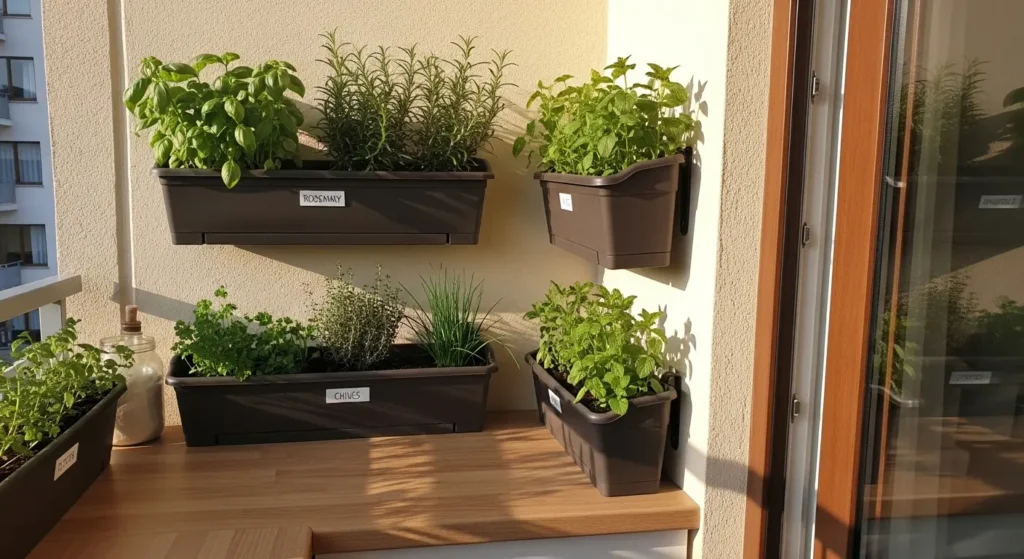
A balcony is often the closest outdoor surface to the kitchen in an apartment — making a balcony herb garden the most practically useful version of the herb garden idea available to apartment dwellers. Herbs within arm’s reach of the kitchen door get used in every meal. Herbs that require going down to a communal garden get used occasionally.
The balcony herb corner works best in the corner nearest the kitchen door — the position that minimizes the distance between herb and cooker. Wall-mounted trough planters at counter height create a kitchen-adjacent herb supply that is accessible without bending, searching, or tools.
The herb selection that performs best on balconies: Mediterranean herbs — rosemary, thyme, and oregano — are the most wind-tolerant culinary herbs and perform well in the exposed conditions that softer herbs find challenging. Mint in its own separate container handles balcony exposure better than most soft-stemmed herbs. Basil is the most challenging balcony herb — it requires a sheltered corner protected from wind and consistent warmth above 15 degrees Celsius. The 5-Pack Heirloom Herb Seeds covers the full culinary selection for a balcony herb corner. Find them linked on Amazon.
4. Hanging Baskets on a Balcony: Overhead Color That Leaves Every Inch of Floor Clear
✦ Hanging Basket Garden
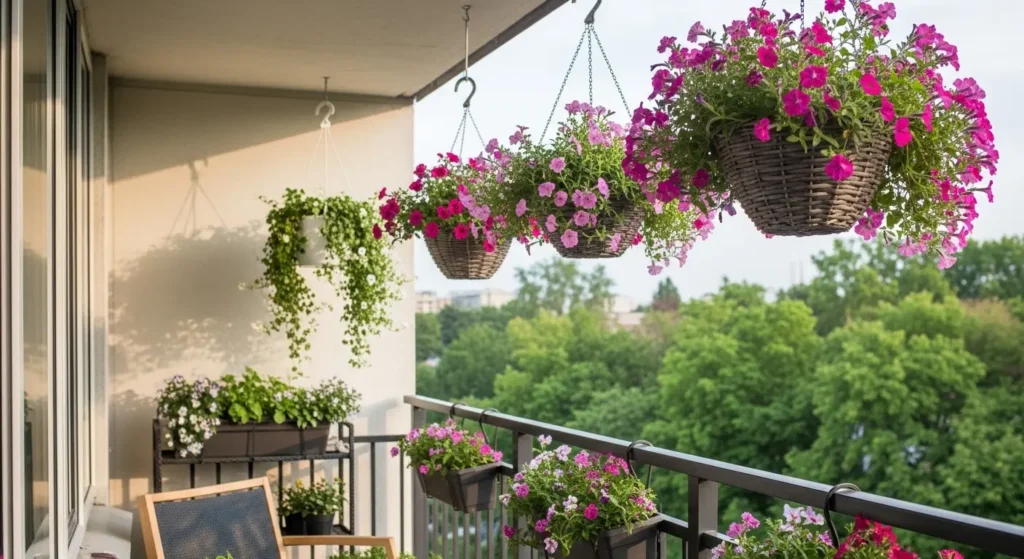
Hanging baskets on a balcony ceiling create color and plant presence in the one zone that floor constraints cannot compromise — overhead. A balcony with three hanging baskets at the ceiling level has abundant flowering plant display while the entire floor area remains available for furniture, movement, and other uses.
The ceiling fixing is the critical installation requirement. Most apartment balcony ceilings are concrete slab — solid and capable of supporting significant loads when fixed correctly. A masonry anchor bolt rated for 50 pounds in concrete provides a safe fixing for a loaded hanging basket. Never use adhesive ceiling hooks for hanging baskets — adhesive fixings fail under dynamic loads and a falling hanging basket causes significant damage and potential injury.
The self-watering hanging planters with macrame rope hangers solve the primary maintenance challenge of balcony ceiling baskets — the watering frequency. A basket suspended at ceiling height requires a ladder or step to water conventionally. The built-in reservoir extends the watering interval to 2 to 3 days and is refillable from below using a long-spouted watering can without any climbing. Find them linked on Amazon.
PRO TIP: Hang balcony ceiling baskets on adjustable chains rather than fixed-length hangers. Adjustable chains allow the basket height to be varied through the season — lower in spring when plants are small and the overhead position is needed for warmth and light, raised in summer when trailing growth needs clearance above head height.
5. A Succulent Collection: The Balcony Garden That Thrives on Neglect and Survives Holidays
✦ Succulent Collection Display
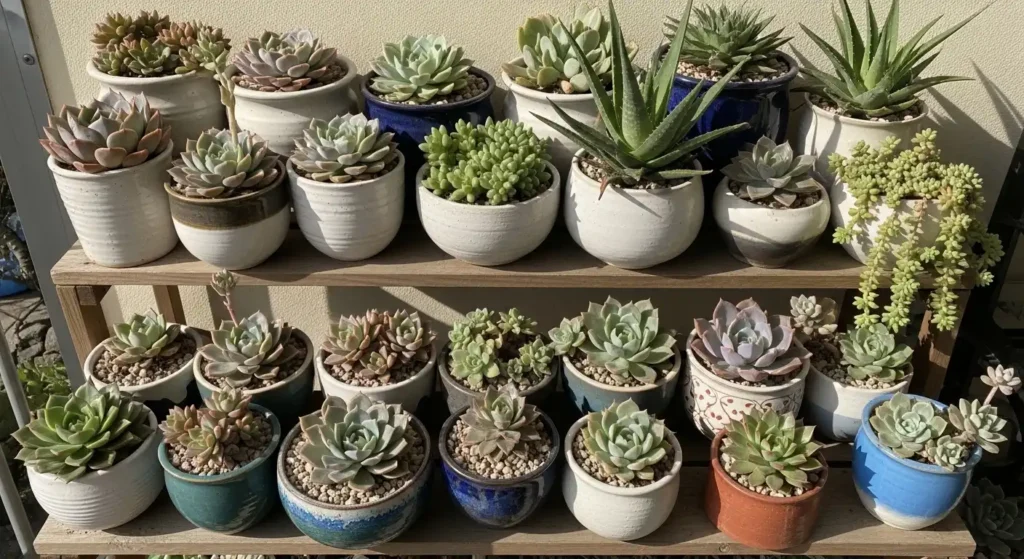
A succulent collection is the ideal balcony garden for anyone who travels, forgets to water, or simply wants a garden that looks after itself. Succulents store water in their tissue and tolerate 2 to 4 weeks between waterings in moderate conditions — the longest watering interval of any flowering or ornamental plant available for balcony growing.
The succulent selection that creates the most visually interesting balcony collection: Echeveria species in varied colors — grey-green, purple, pink-tipped, and blue-grey — create the rosette palette that makes succulent collections so photogenic. Haworthia provides upright vertical accents within the rosette-dominated collection. Sedum burrito and Sedum morganianum provide the trailing element that softens container edges. Aloe vera adds both sculptural presence and practical utility.
Container choice matters as much as plant choice for a succulent collection. Terracotta pots are the correct horticultural choice — their porous walls allow moisture to evaporate from all surfaces, preventing the root rot that glazed ceramic and plastic containers cause in succulents. Handmade terracotta in varied sizes and shapes creates the curated quality that makes a succulent collection look like a personal gallery rather than a nursery purchase.
PRO TIP: Group succulent pots on a single tray of coarse horticultural grit rather than placing them directly on the balcony floor or shelf surface. The grit tray creates a unified display base that reads as a designed arrangement, improves drainage beneath all pots simultaneously, and reflects heat upward around the plants — replicating the warm rocky terrain that succulents naturally inhabit.
6. A Tiered Plant Stand Multiplies Growing Surfaces Without Multiplying Floor Footprint
✦ Tiered Plant Stand Setup
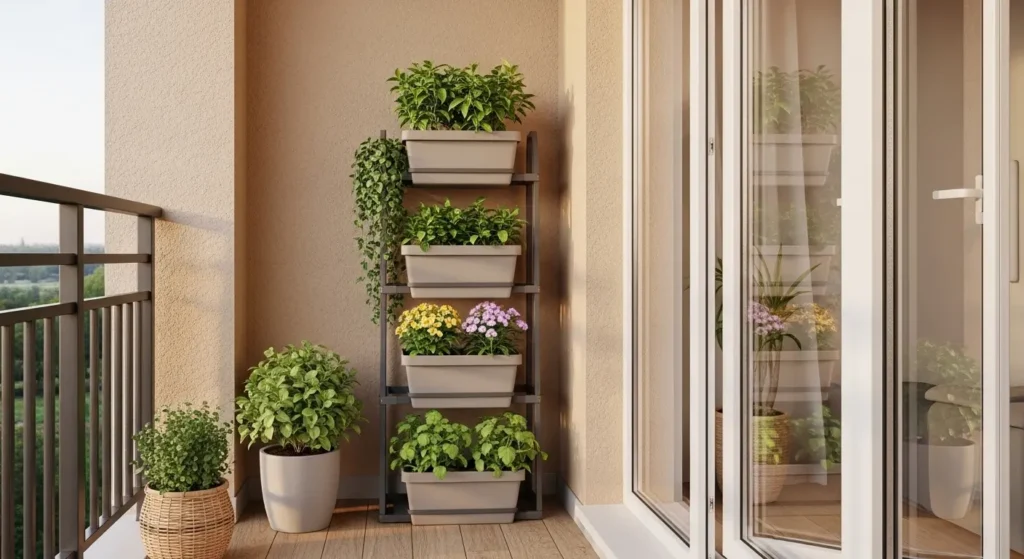
A tiered plant stand creates three to five growing surfaces from a single 18-inch square floor footprint — the most space-efficient use of balcony floor area for plant display available. The vertical stacking means a complete garden presence occupies the same floor space as a single large pot.
The stability requirement of tiered plant stands on balconies is more critical than at ground level. A stand that tips in wind on a ground-level patio falls into the garden. A stand that tips on a balcony becomes a projectile falling to lower levels or the street. Choose stands with wide base dimensions relative to their height — a stand 18 inches wide and 60 inches tall requires a base width of at least 16 inches and positive interlocking between tiers to be safe in wind.
The plant assignment by tier that produces the best visual result and the most practical management: top tier for the smallest lightest pots with the most sun-demanding plants — compact herbs and small succulents. Middle tiers for the primary display plants — flowering annuals and medium perennials. Bottom tier for the largest and heaviest pots — lowering the center of gravity and providing the most stable base layer.
PRO TIP: Secure a tiered balcony plant stand to the back wall using a single adjustable furniture strap or bungee cord attached to a wall hook at the stand’s mid-point. The attachment prevents toppling in unexpected strong wind without permanently fixing the stand. A stand attached at one point can still be moved easily for cleaning and repositioning.
7. Integrating Plants and Seating: The Balcony That Functions as Both Garden and Outdoor Room
✦ Cozy Seating With Greenery
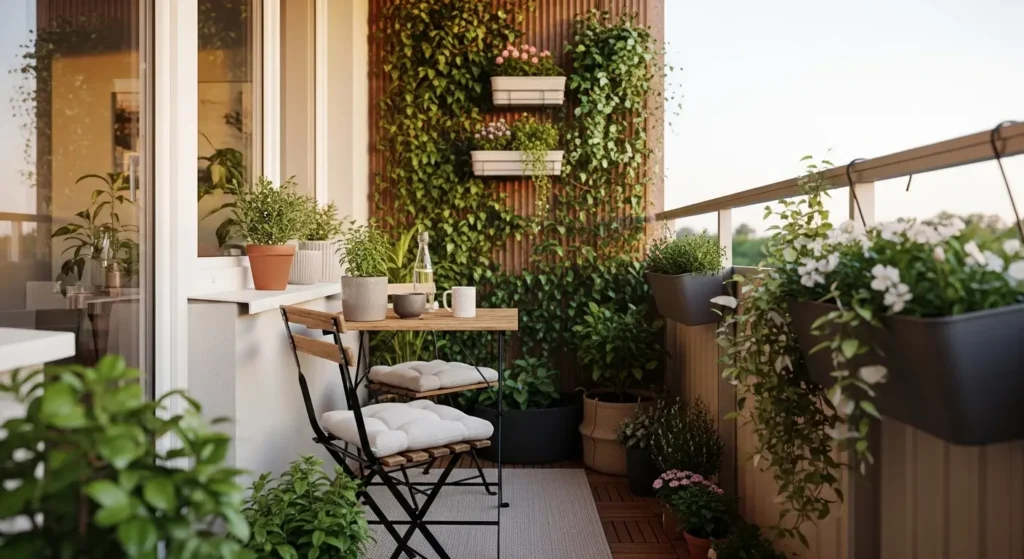
The balcony that functions as both garden and outdoor room requires a spatial discipline that separates the gardening zone from the seating zone without sacrificing either. The principle: keep all planting at the walls, railings, and ceiling while keeping the central floor zone entirely clear for furniture and human movement.
The floor zone required for two-person balcony seating: a compact bistro table and two folding chairs require a minimum clear floor area of 4 by 4 feet. On a standard 6 by 8 foot balcony this leaves a 2-foot perimeter zone for floor-level plants at the walls — sufficient for two to three floor pots if chosen carefully. All other planting goes vertical — railing planters, wall-mounted troughs, and ceiling baskets.
The plant choices for the wall and railing zone around seating should include at least one fragrant variety — jasmine on the back wall, lavender in railing planters, or scented pelargonium at nose height. Sitting surrounded by fragrant plants rather than simply visually surrounded by them creates the genuinely garden quality that a seating-only balcony cannot achieve.
8. A Tropical Balcony Creates Holiday Atmosphere From a City Apartment
✦ Tropical Balcony Retreat
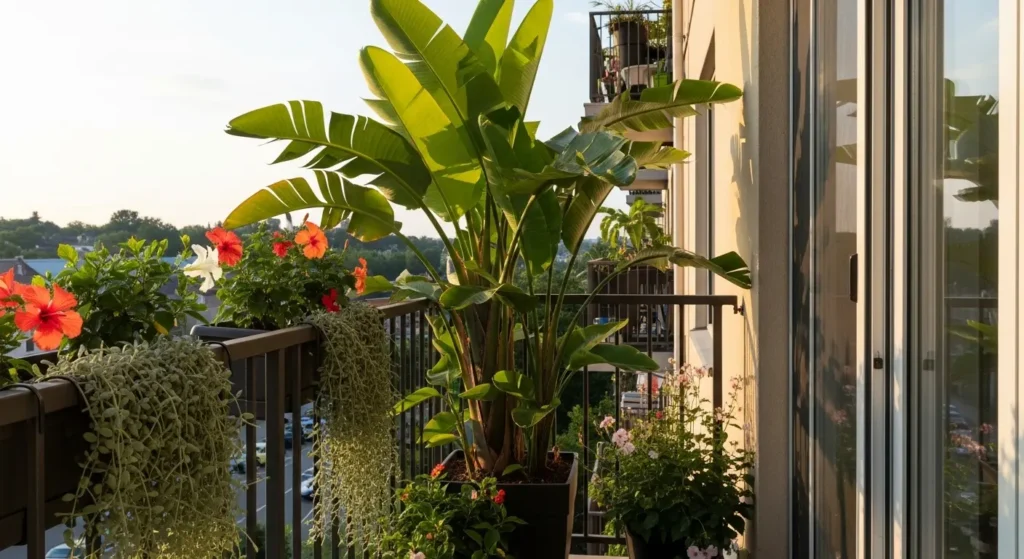
A tropical balcony requires three specific plant types working together: one large architectural tropical as the canopy and statement piece, colorful tropical flowering plants for continuous color, and trailing tropical foliage to soften the railing and container edges.
The large architectural tropical for a balcony position must be chosen with wind tolerance in mind. Bird of paradise (Strelitzia reginae) is the most wind-tolerant large tropical — its paddle leaves flex rather than shred in wind and the plant maintains its architectural quality in exposed positions that destroy banana plants and large-leaved Colocasia. For a sheltered south or southwest-facing balcony Musa basjoo in a large container creates the most dramatic tropical canopy but requires a protected position.
The colorful element: tropical hibiscus in railing planters or containers provides the vivid flower color that creates the holiday feeling. Hibiscus flowers are individually short-lived but continuous — a well-fed hibiscus in a sunny position produces new flowers daily through summer. The Quarut Large Planter Pots provide the container depth that tropical specimens need for the root volume to support their above-ground scale. Find them linked on Amazon.
PRO TIP: Bring tropical balcony plants inside before the first frost rather than leaving them outdoors hoping for a mild winter. Tropical plants that experience even one night below 5 degrees Celsius suffer cold damage that takes weeks to recover from and significantly reduces the following season’s performance. A bird of paradise or hibiscus overwintered inside a warm bright room returns to the balcony in spring in full vigorous health — the same plant left outdoors through a cold winter returns damaged and depleted.
9. A Balcony Plant Privacy Screen That Blocks the View and Looks Beautiful Doing It
✦ Privacy Plant Screen
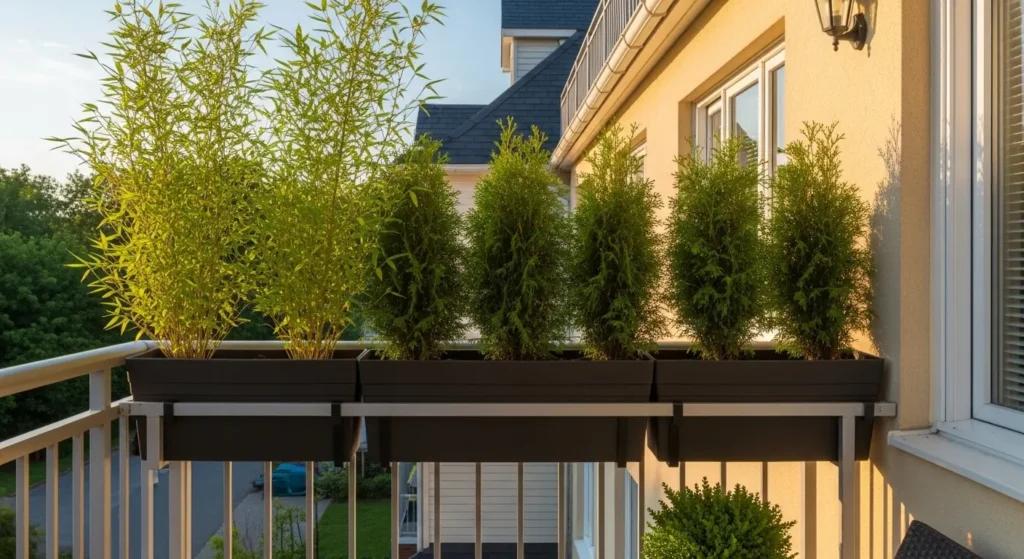
A balcony privacy plant screen addresses the most common complaint about balcony living — being directly overlooked by a neighboring balcony at the same height. Vertical fence screens on balconies are often restricted by building rules. Living plant screens in containers avoid this restriction while providing effective visual privacy.
The plants that create the most effective balcony privacy screens in containers: clumping bamboo in large containers reaches 6 to 8 feet within one growing season and creates dense screening that moves beautifully in wind rather than resisting it. Tall ornamental grasses — Miscanthus sinensis in large containers — reach 5 to 6 feet and create a softer more naturalistic screen. For year-round evergreen privacy phormium and griselinia in large containers provide permanent dense coverage.
The container weight consideration for privacy screens is important on balconies. A large container with bamboo fully loaded with wet soil weighs 80 to 120 pounds. Check the load rating of the balcony floor slab before positioning multiple large containers along the same railing run. Distribute the weight along the full railing length rather than clustering heavy containers in one section.
PRO TIP: Use lightweight growing medium — perlite and coir mix — in privacy screen containers to reduce weight by 40 to 50% compared to standard garden compost. Privacy screening plants establish and perform well in lightweight media when watered and fed consistently. The weight reduction on a loaded balcony floor makes the difference between a safe installation and one that exceeds the floor’s rated load capacity.
10. The Balcony Jungle: Maximum Plant Density in Minimum Floor Space
✦ Small Space Jungle Look
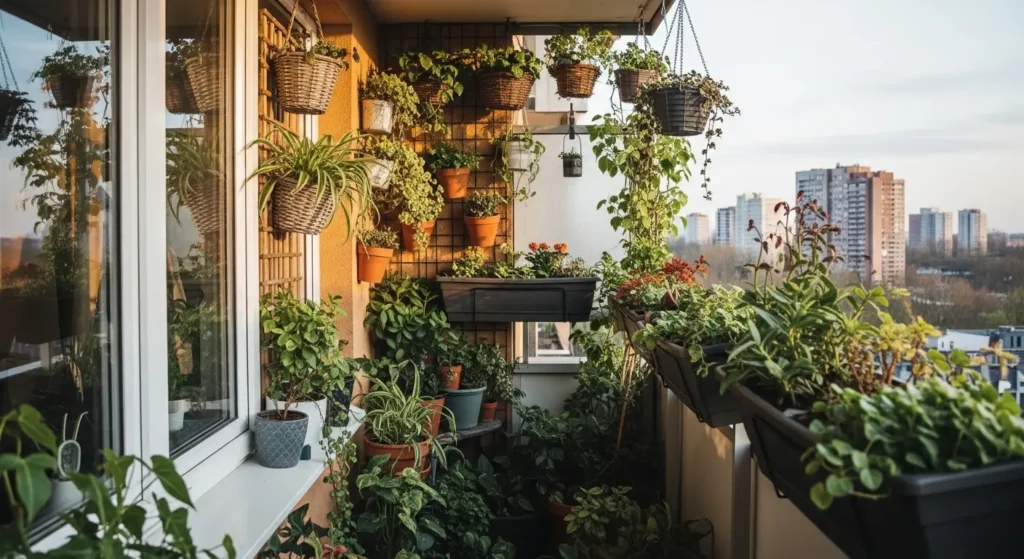
The balcony jungle maximizes plant density by using all five growing zones of a balcony simultaneously: floor level, railing interior and exterior, back wall, ceiling, and the air between these surfaces filled with hanging plants at varied heights. The result is an immersive planted environment where the balcony disappears behind plant life and the experience of being on it is closer to sitting in a garden than on an apartment terrace.
The five-zone balcony jungle planting plan: ceiling — two to three hanging baskets with trailing flowering plants. Back wall — modular wall planters with herbs and compact ornamentals. Railing interior — over-rail troughs with flowers visible from the seating area. Railing exterior — over-rail troughs with wind-tolerant trailing plants visible from street level. Floor corners — two large statement plants in quality containers that anchor the composition.
The jungle effect requires plant coordination across all five zones to avoid the chaotic feeling that too many unrelated plants in too many containers creates. Use a consistent color palette — all green and white, or all warm tones of orange coral and burgundy, or all blue-purple and silver — across every zone. The unified color palette creates cohesion across the density that makes the balcony jungle feel designed rather than accumulated.
PRO TIP: Automate the watering of a balcony jungle using a drip irrigation timer connected to the outside tap or a gravity-fed reservoir. A balcony with plants in five growing zones requires 15 to 20 minutes of daily watering in summer without automation. A drip system with a timer reduces this to 30 seconds of checking per week. The watering automation is what makes the balcony jungle sustainable rather than a beautiful idea that becomes overwhelming by August.
The Three Balcony Garden Rules That Everything Else Depends On
Every successful balcony garden follows three rules that ground gardens do not require:
Check the weight limit before buying anything.
Most residential balconies are rated for 40 to 60 pounds per square foot. A single large container with wet soil can weigh 100 pounds. Ask your building management for the balcony load rating before positioning multiple heavy containers.
Choose wind-tolerant plants for exposed positions.
Wind speed increases with height. A balcony on the 8th floor experiences significantly more wind than a ground-level garden in the same building. Trailing pelargoniums, lavender, rosemary, ornamental grasses, and sedum all handle wind that defeats most flowering annuals.
Water more frequently than ground gardens require.
Balcony containers dry faster than ground-level containers because wind removes surface moisture continuously and the container has no ground moisture to draw from. Check soil moisture daily in summer. Self-watering containers and drip irrigation are not luxuries on a balcony — they are the management systems that make balcony gardening sustainable.
📌 More small space and container garden ideas → 12 Big Style Patio Ideas For Small Outdoor Spaces
Frequently Asked Questions
What plants grow well on a small balcony?
The plants that perform best on small balconies are those tolerant of the wind exposure and faster soil drying that elevated positions create. Trailing Pelargonium (ivy geranium) is the most reliable flowering balcony plant across all exposure levels. Mediterranean herbs — rosemary, thyme, and lavender — handle wind better than most plants and produce harvestable yields alongside ornamental value. Ornamental grasses move beautifully in wind rather than being damaged by it. Succulents and sedums tolerate the faster drying that wind creates. According to the RHS trailing pelargoniums are the single most recommended balcony plant for reliability, flowering duration, and wind tolerance across all climate zones.
How do I garden on a small apartment balcony?
Successful apartment balcony gardening uses all five growing zones rather than only the floor: ceiling hanging baskets, railing over-rail planters on both faces, back wall-mounted troughs, floor corner statement pots, and the air space between these surfaces filled with additional hanging plants. This five-zone approach creates a complete garden from a space that floor-only planting would make feel sparse. Check building rules for what fixings are permitted before installing wall or ceiling mounts and always confirm the balcony floor load rating before positioning heavy containers.
How heavy is too heavy for a balcony garden?
Most residential balconies are rated for 40 to 60 pounds per square foot of floor area. A 6 by 8 foot balcony has a total load capacity of approximately 1,920 to 2,880 pounds including furniture, people, and plants. A single large 20-inch container fully loaded with wet soil weighs 80 to 120 pounds. Lightweight growing medium — perlite and coir mixes — reduces container weight by 40 to 50% compared to standard compost and is recommended for all balcony containers. If uncertain about load capacity contact your building management or a structural engineer before installing multiple heavy containers.
A Balcony Garden Is Proof That Space Is Never the Limiting Factor
Every balcony garden idea in this guide works within the constraints that balcony growing imposes — weight limits, wind exposure, no ground soil. These constraints force better decisions about every plant and every container than the unlimited space of a ground garden ever requires. The most productive and the most beautiful balcony gardens are frequently smaller than 50 square feet.
Choose the balcony garden idea that matches your exposure level and your maintenance commitment. Use all five growing zones. Water consistently. The balcony that currently feels like an underused concrete slab becomes the most used space in the apartment.
All the products mentioned in this article are linked on Amazon. Every recommendation is something we genuinely believe in.
More Small Space and Container Garden Ideas
→ 8 Easy Hanging Plant Ideas For Patios & Balconies
→ 16 Garden Planter Ideas That Transform Outdoor Spaces
→ 10 Cheap Ways To Block Neighbors’ View
→ 7 Rental-Friendly Backyard Ideas on a Budget
The balcony that currently feels like an underused concrete slab becomes the most used space in the apartment.

Sheikh Hassaan is a digital architect for small businesses and the founder of The Glow Up System. He writes about home decor, garden design, and outdoor living for real American homes – practical ideas that work in actual spaces without oversized budgets.