
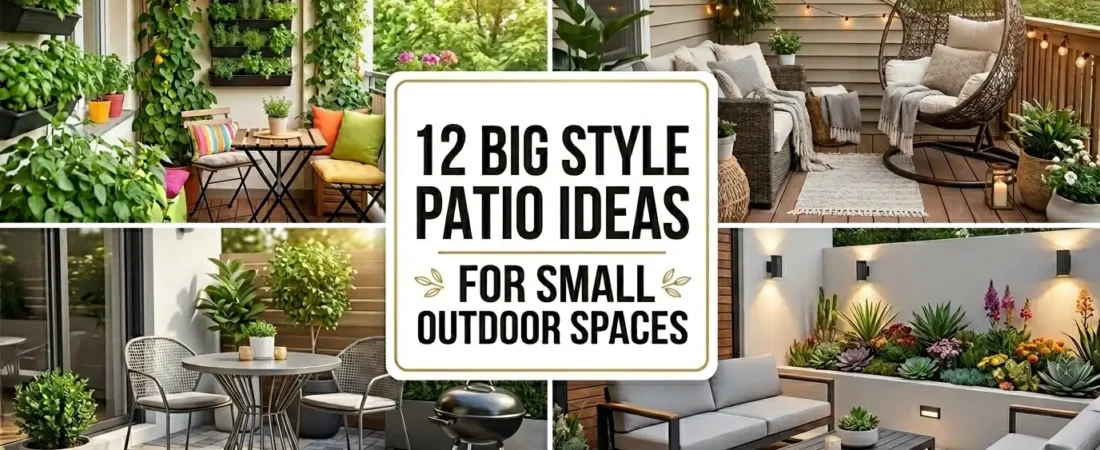
The small patio I find myself thinking about most is 8 by 10 feet. Concrete surface. One corner with a L-shaped modular sofa backed into the fence. One dense plant cluster diagonally opposite. String lights in a zigzag overhead. A fold-down dining table on the third wall that disappears when not needed.
Nothing is wasted. Nothing is accidental. Every element earns its floor space specifically because the floor space is so limited.
Small patio ideas work differently from large patio ideas because the constraint removes the option of adding more. The discipline that constraint forces produces better outdoor spaces than abundance ever would. These 12 approaches show exactly how.
Table of Contents
1. Choose a Round Bistro Table Over Any Rectangular Alternative
✦ Space-Saving Bistro Set
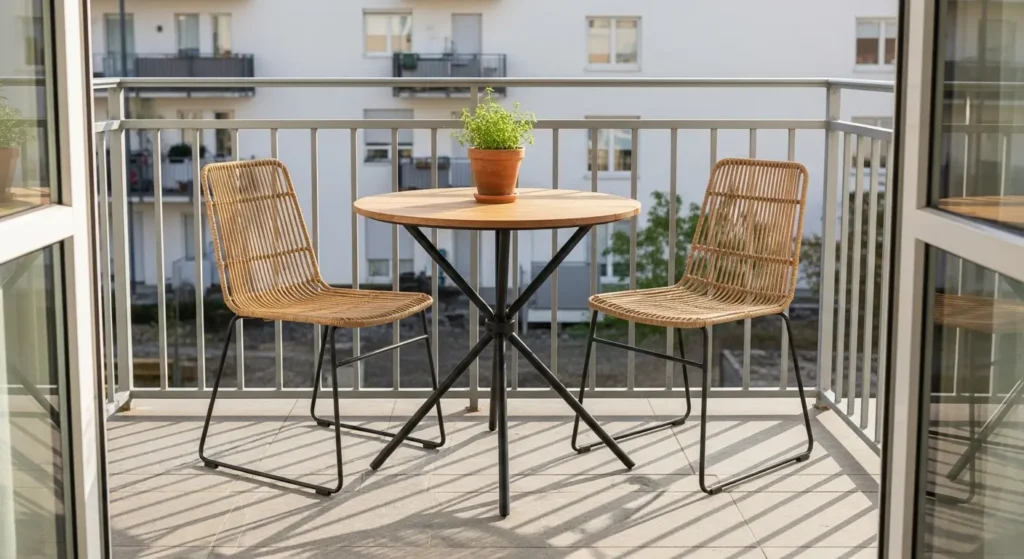
The shape of an outdoor table determines how much usable floor space remains around it. Rectangular tables have four corners that protrude into circulation space simultaneously. Round tables have no corners — the curve allows movement around any point of the perimeter and the same diameter round table occupies less perceived space than a rectangular table of similar seating capacity.
A 28-inch diameter round bistro table seats two comfortably and seats three at a push. It leaves circulation space on all sides even on a patio as narrow as 5 feet wide. The equivalent rectangular table — a 24 by 36 inch two-seater — occupies more corner-to-corner space and creates dead zones at each corner that serve no function.
The most overlooked detail of small patio bistro sets: matching chair profiles matter more than on large patios. Chairs that stack when not in use free the patio for other uses between meals. A round table with two stacking chairs is a small patio dining solution that doubles as a work surface, a coffee station, and a reading spot — three functions from one compact footprint.
PRO TIP: When choosing bistro chairs for a small patio, select chairs with open backs rather than solid back panels. Open-back chairs read as visually lighter because you can see through them to the space behind. Solid-backed chairs visually block the space and make the patio appear smaller from every angle.
2. Treat the Fence as Prime Real Estate, Not Just a Boundary
✦ Vertical Garden Wall
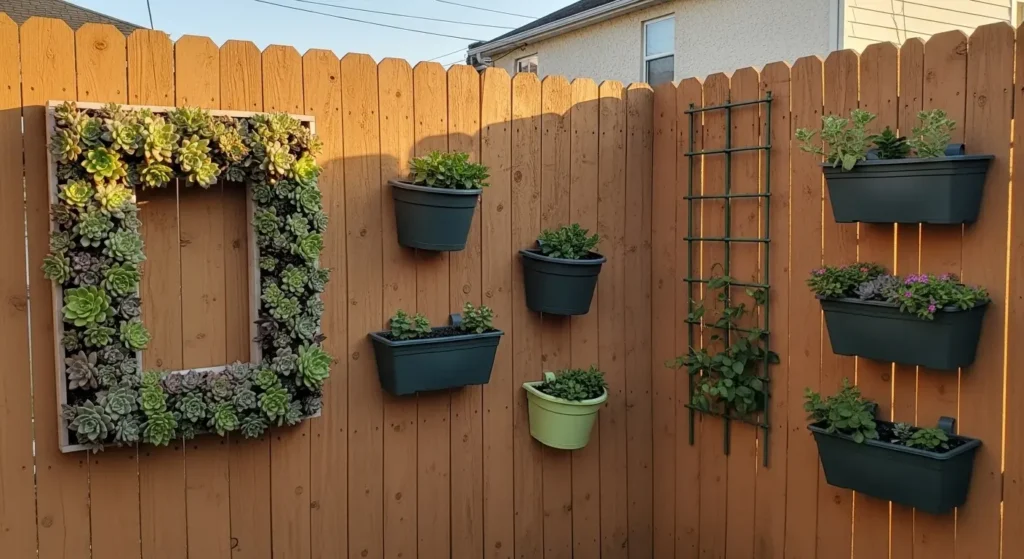
Most small patio owners treat their fence as a neutral backdrop. The most successful small patio designs treat the fence as usable square footage — the largest decoratable surface area in the space, available for vertical growing, decorative display, and lighting at heights that floor space cannot provide.
The vertical fence approach uses three types of mounted elements at three different heights. Low on the fence — 12 to 24 inches from the ground — small mounted planters with compact plants that do not compete with sightlines from seating. Mid-height — 36 to 54 inches — the primary display zone with wall-mounted succulent frames, bracket-mounted ceramic pots, or a short section of trellis with a climbing plant. High — above 60 inches — trailing plants whose foliage cascades downward or solar-powered string lights that define the fence top line at dusk.
The three-height fence treatment creates a layered vertical garden that adds significant visual depth to a small patio without occupying any floor space. The floor remains clear. The fence becomes the garden.
3. Place Seating in a Corner to Create Enclosure That Small Patios Lack
✦ Cozy Corner Lounge
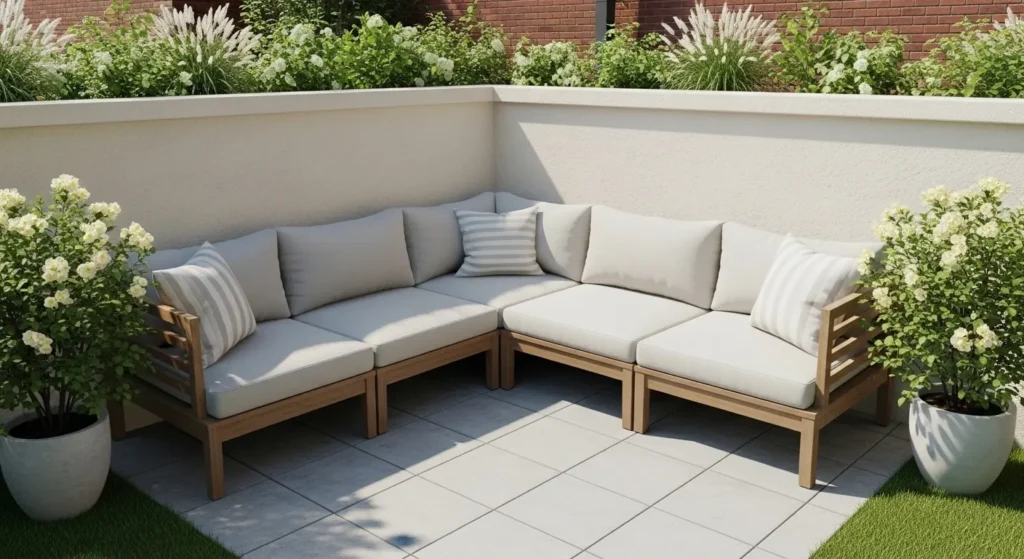
Small patios feel exposed because they lack the three-sided enclosure that creates the comfortable quality of a room. Pushing seating into a corner solves this immediately. Two fence or wall surfaces behind the seating provide the enclosure that the patio itself cannot achieve through scale alone.
A compact L-shaped modular sofa or a two-piece corner set positioned in a patio corner uses the two existing walls as the back and side of an outdoor room. The result is seating that feels genuinely sheltered rather than placed in open space. Add one tall pot plant on each of the two open sides to complete the enclosure with living boundaries.
The psychological effect of corner seating versus open seating is significant and measurable. People sit in corner seats for longer, engage in longer conversations, and feel more relaxed than people seated in the middle of an open space. Interior designers have applied this principle for decades. It works equally well outdoors.
PRO TIP: Position a mirror on the fence wall directly behind corner seating rather than on the side walls. A mirror behind the seating reflects the garden view outward and creates the illusion that the seating is positioned in a much larger garden. The reflection of plants, sky, and open space behind the viewer creates visual depth that doubles the perceived size of the patio.
4. Every Piece of Furniture on a Small Patio Must Do at Least Two Things
✦ Multi-Functional Furniture
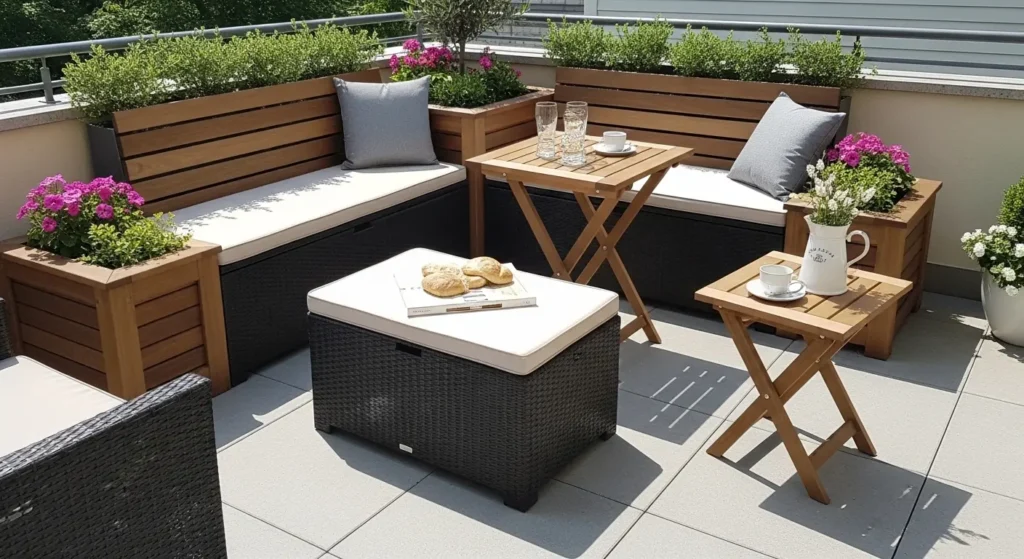
The multi-function furniture rule is the small patio idea I find most changes how people think about every potential purchase for a small outdoor space.
Before anything goes onto a small patio it should be able to answer two questions: what does it do when someone is sitting in it, and what does it do when no one is? If the second answer is “occupies floor space” the piece does not earn its place. A storage ottoman that is also a coffee table and also holds cushions answers both questions. A decorative side table answers only the first.
5. Build In Seating Along One Wall to Maximize Every Centimeter
✦ Built-In Bench Seating

Built-in bench seating along one wall of a small patio solves three problems simultaneously. It provides seating without the leg clearance and circulation space that freestanding furniture requires. It creates storage in the bench cavity below the seat. And it establishes a permanent design element that reads as architectural rather than decorative — a quality that elevates the appearance of any small outdoor space.
A simple built-in bench is one of the most achievable DIY outdoor projects available. Four lengths of pressure-treated timber form the frame. Decking boards create the seat surface. An access panel in the front face opens to storage below. Painted to match the fence in a single color it becomes part of the architecture rather than furniture placed against it.
The built-in bench principle is borrowed from interior design where window seats, banquette dining benches, and alcove seating all use the same logic — pushing seating against a fixed boundary creates more usable open floor space than any freestanding arrangement of the same seating capacity.
PRO TIP: Paint the built-in bench the same color as the fence it backs onto. When bench and fence are the same color they read as a single integrated element and the patio appears significantly wider. A bench that contrasts with the fence reads as furniture placed against a wall. A bench that matches the fence reads as architecture.
6. Create a Dedicated Dining Nook That Serves Its Purpose and Nothing Else
✦ Compact Dining Nook
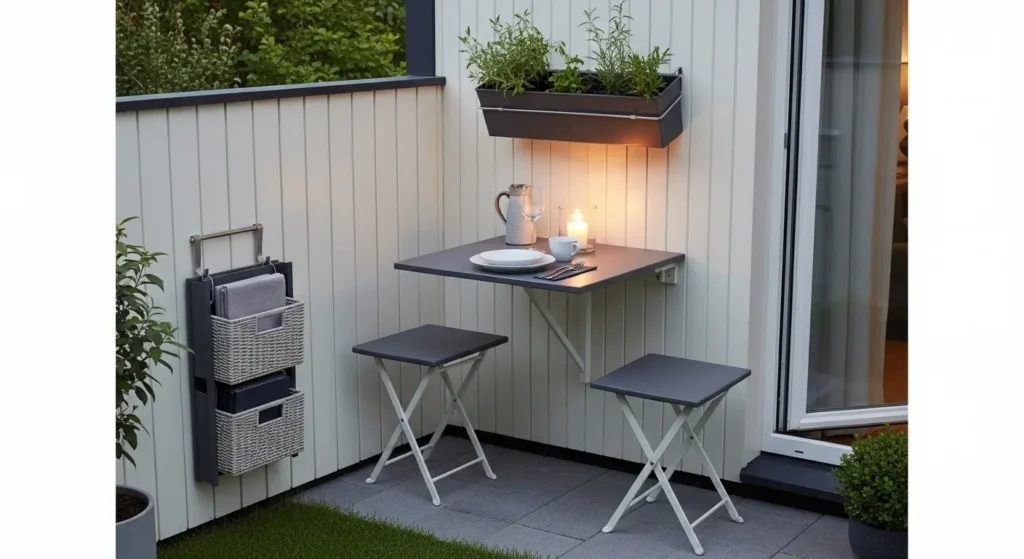
A fold-down wall-mounted table is the most space-efficient outdoor dining solution for the smallest patios. Mounted directly on the fence and hinged to fold flat when not in use it occupies zero floor space between meals. Unfolded it creates a proper dining surface large enough for two. Paired with two folding stools that hang on the fence beside it when not needed the complete dining nook disappears into the fence when not in use.
This approach is borrowed from the galley kitchen principle — naval architects and small apartment designers have applied fold-down and wall-mounted furniture for generations because the principles work. A surface that exists only when needed doubles the usable floor space of a small patio by returning that floor to open circulation when dining is not occurring.
For how the fold-down dining nook works alongside a compact cooking setup see our outdoor kitchen ideas guide which covers the compact outdoor kitchen configurations that suit small patio dimensions.
PRO TIP: Mount a wall-mounted herb planter directly above a fold-down outdoor dining table. The herbs are harvested at hand height during meal preparation, they fragrance the air at the table during eating, and they visually anchor the fold-down table as a defined dining zone even when the table is folded away.
7. Use Ceiling Height to Add Plants That the Floor Cannot Accommodate
✦ Hanging Planter Display
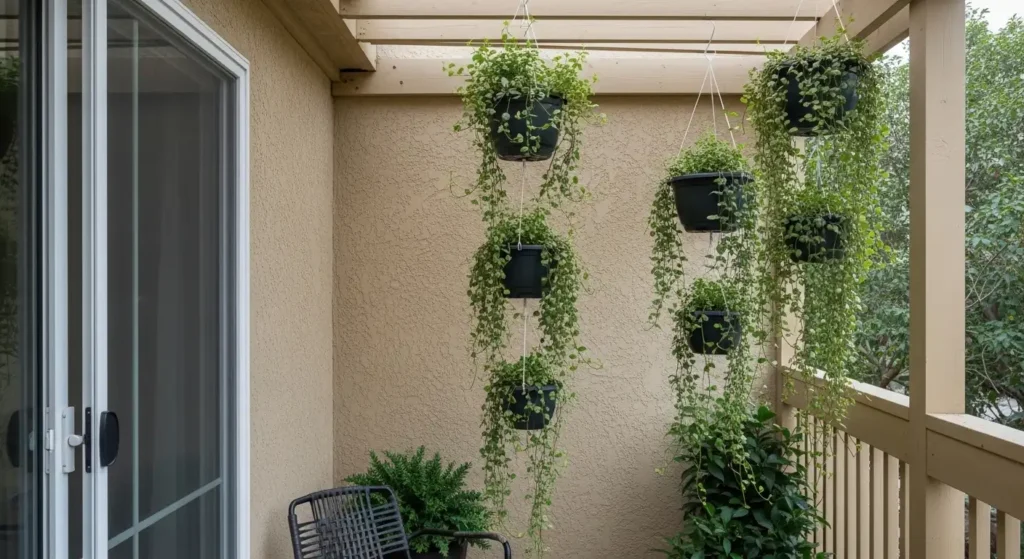
Overhead space is the most consistently wasted dimension of small patios. The volume above head height is available for plants, lighting, and display elements that add richness to the space without affecting circulation or floor area at all. Exploiting this overhead dimension is one of the defining characteristics of sophisticated small patio design.
Three hanging planters at significantly different heights create a vertical plant cascade that fills the overhead volume from ceiling to approximately waist level without occupying any of the floor. The trail of plants connecting each level — pothos, string of hearts, tradescantia — creates continuous green movement through the air that gives the small patio a sense of abundance disproportionate to its floor area.
The height differential between the planters is the critical detail. Three planters at similar heights create a row. Three planters at heights of 7 feet, 5 feet, and 3.5 feet create a cascade. The cascade reads as designed. The row reads as placed. The self-watering hanging planters with macrame rope hangers allow height adjustment through the rope length and their built-in reservoir means the overhead plants — the hardest to water consistently — are managed with minimal effort. Find them linked on Amazon.
PRO TIP: Install a simple tension wire between two walls or fence posts rather than drilling individual hooks for each hanging planter. The wire creates a permanent overhead rail from which planters can be positioned and repositioned at any point along its length. Adjusting a small patio plant display becomes a five-minute task rather than a half-day drilling project.
8. Use the Rug to Tell the Patio Where Its Edges Are
✦ Outdoor Rug Styling
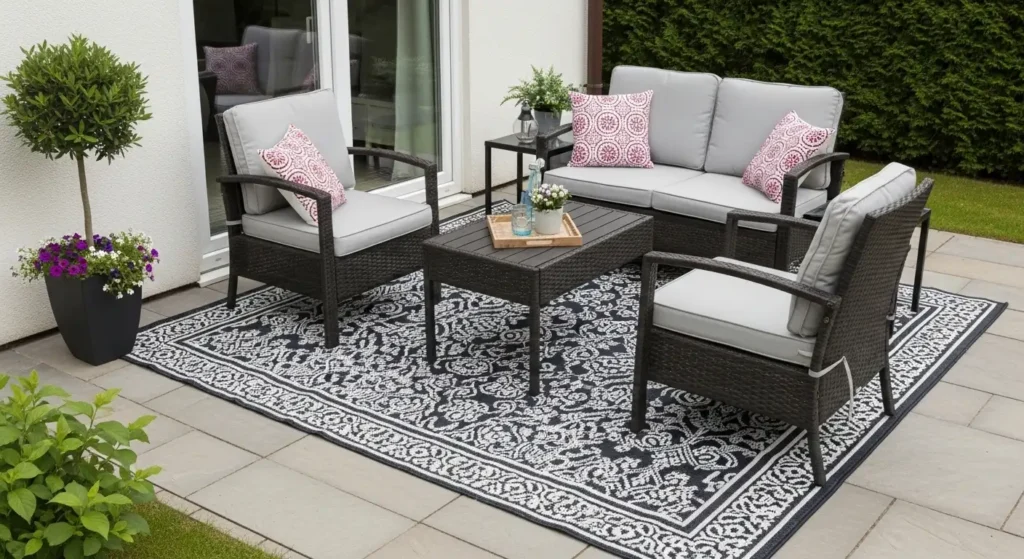
An outdoor rug on a small patio has a different function from an outdoor rug on a large one. On a large patio the rug adds warmth and defines a zone within abundant space. On a small patio the rug is a spatial instruction — it tells every piece of furniture exactly where to be and every person exactly where the outdoor room is.
The sizing rule for small patio rugs is the inverse of what most people expect. Rather than choosing a rug that fits the available space choose a rug sized to the furniture arrangement and let it be smaller than the overall patio. The contrast between the defined rug area and the surrounding unrugged patio surface creates visual layering that makes the space appear larger than a single rug covering most of the patio would.
The pattern choice matters more on a small patio than a large one. Geometric patterns with strong directional lines draw the eye along the longest axis of the patio and create the impression of length or width beyond what exists. Circular patterns emphasize the center of the rug and create a self-contained room feeling that suits corner lounge setups particularly well.
9. Apply the 60-30-10 Rule to Color for an Instantly Polished Small Patio
✦ Minimal Modern Layout
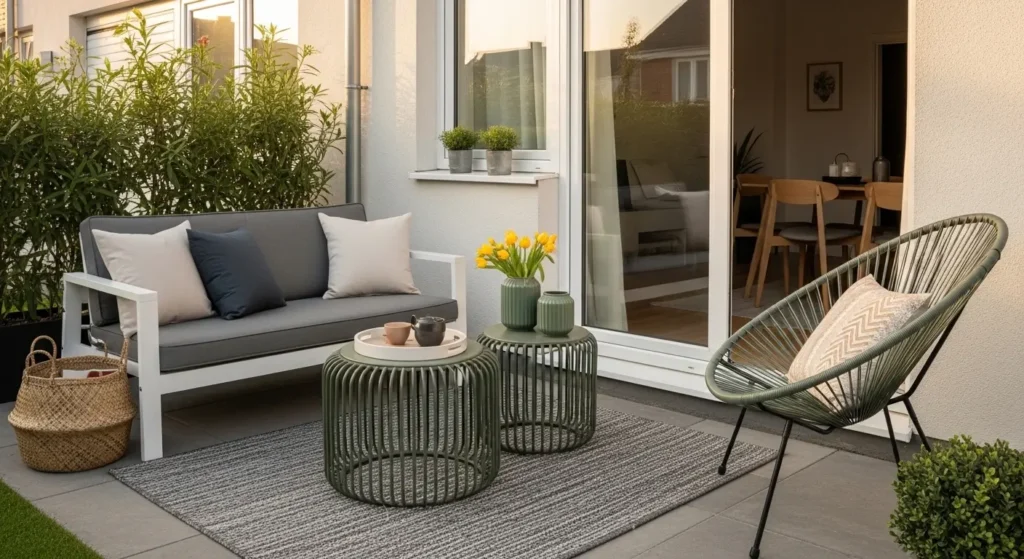
The 60-30-10 rule is the most reliable interior design color formula and it applies equally well to outdoor spaces. It works because it creates visual hierarchy — a dominant tone that establishes the mood, a secondary tone that adds depth, and a small accent that creates interest. Applied to a small patio it creates a polished coherent aesthetic without requiring expensive furniture or complex styling.
60 percent dominant tone: this covers the largest surfaces — the floor material or rug, the largest furniture piece, and the fence or wall color. For small patios warm neutral tones work best — warm grey, natural cream, pale stone, or warm white. These tones recede visually and make the patio feel more spacious than mid-tones or dark tones.
30 percent secondary tone: cushions, smaller furniture pieces, planter colors, and secondary rug if layering. This tone adds personality and warmth to the neutral dominant tone. Sage green, warm charcoal, natural rattan tone, or dusty blue all work with neutral dominant backgrounds.
10 percent accent: one or two objects only — a single terracotta pot, one deep navy throw, one coral cushion. The 10 percent accent is what makes the small patio feel personal and considered rather than simply neutral.
PRO TIP: Apply the 60-30-10 rule to your plant choices as well as your furniture and accessories. 60 percent of your patio plants in one foliage type — all green, all tropical, or all silver-grey. 30 percent in a complementary variety. 10 percent in one flowering accent. The rule works on any design element that involves color choice.
10. The One Purchase That Makes Any Small Patio Look Expensive
✦ Small Patio Luxury Look
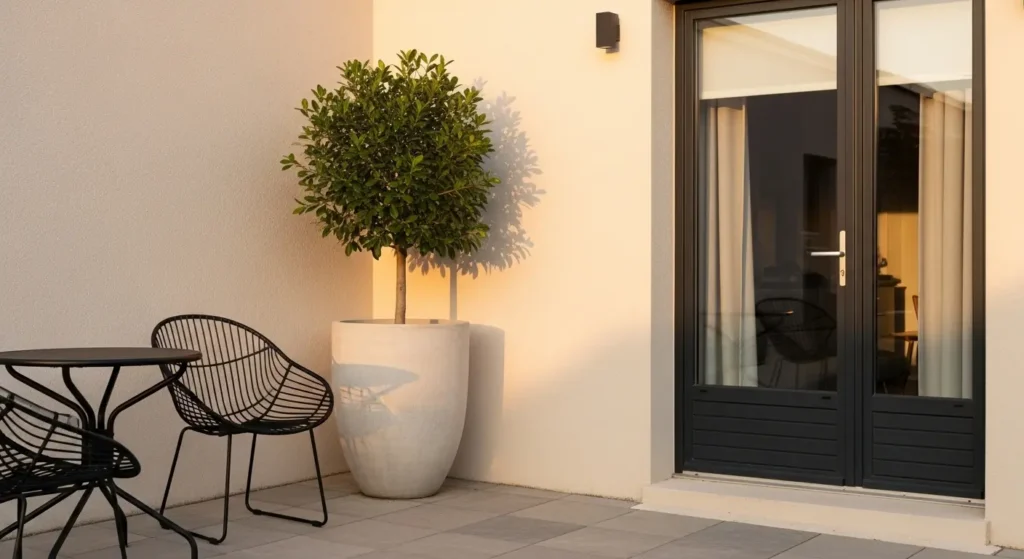
The small patio idea I find most counterintuitive is the one that consistently produces the best result — spending more on one thing rather than less on many things.
Five medium-quality pots distributed around a small patio read as accumulated over time without intention. One large architectural planter with a specimen plant in a quality container in one prominent corner makes the entire patio read as considered. The same budget spent differently creates a completely different impression.
PRO TIP: Position your single luxury statement piece where it is visible from the inside of the house through the back door or window. A beautiful garden feature that you see every time you look out from inside rewards you far more than one that is only visible when you are already outside.
11. Design the Patio Around What It Looks Like Empty, Not What It Looks Like Full
✦ Foldable Furniture Solution
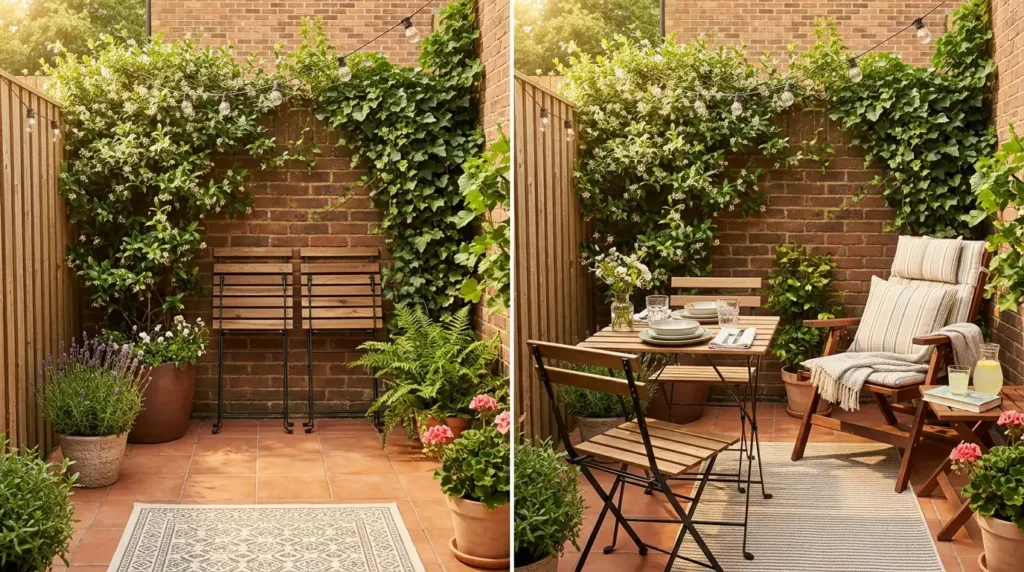
Most small patio designs are optimized for the fully furnished state — what the patio looks like with all furniture out and in use. The better design approach optimizes first for the empty state because a small patio that looks open and spacious when unfurnished becomes a proper outdoor room when furniture is deployed, not a cramped space that feels even smaller when people and chairs fill it.
Foldable and storable furniture makes this approach possible. Folding chairs that stack flat against the fence when not in use. A folding dining table that lives folded at the wall between uses. Folding side tables that flatten to 2 inches depth and hang on hooks. Floor cushions that store in an outdoor storage box. With all furniture stowed the small patio is a clear open platform. With everything deployed it is a functioning outdoor room.
The baseline state of a small patio — what it looks like most of the time — should be the design priority. Most patios are unoccupied more hours than they are occupied. A patio designed to look good when empty looks better when full because the discipline of storage-first design forces choices that work at every furniture density.
PRO TIP: Install a simple outdoor storage bench along one fence wall that doubles as seating and holds all foldable furniture when stowed. The bench looks permanent and architectural when the patio is empty. When furniture is needed everything is retrieved from under the seat rather than from inside the house.
12. The Small Patio Audit: Three Changes That Cost Nothing and Work Immediately
✦ Budget-Friendly Refresh
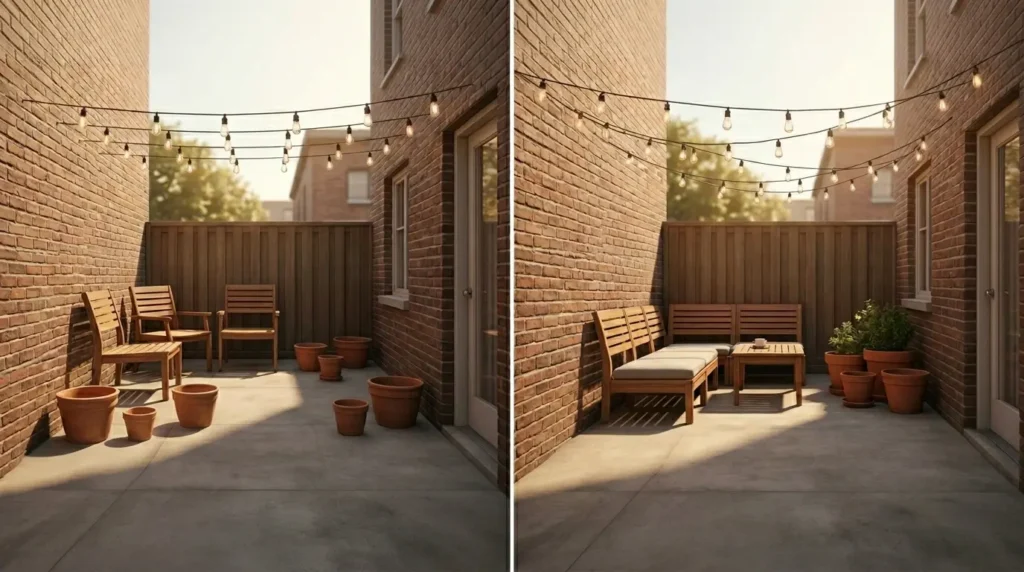
The most effective small patio idea on this list costs nothing. Before any purchase, before any new plant, before any lighting upgrade — three rearrangements that take thirty minutes and work immediately.
I have applied this audit to small patios of every style and every state of neglect. It consistently produces more improvement than anything that could be bought for the same time investment.
Frequently Asked Questions
How do I make a small patio feel bigger?
The design approaches that most reliably make small patios feel larger are: keeping the central floor area completely clear of furniture by pushing everything to the perimeter, using a rug sized to the furniture group rather than the full patio to create defined zones within the space, mounting plants and lighting on walls rather than using floor pots, applying light neutral tones to the dominant surfaces, and installing an outdoor mirror on the darkest fence wall to reflect garden depth. According to the American Institute of Architects the most effective spatial illusions in small spaces come from contrast — a clear central area against defined perimeter elements — rather than from any single decorative choice.
What furniture works best for small patios?
Round tables over rectangular ones to eliminate corner intrusion, chairs with open frames and visible legs rather than solid bases, and folding or stacking pieces that can be stored when not in use. Multi-function pieces like storage ottomans and built-in bench seating along one wall provide maximum function with minimum floor projection.
How do I add privacy to a small patio?
Tall trellis panels with climbing plants or bamboo reed screening attached to existing fence panels create effective visual screening without using floor space. The most space-efficient approach adds height through trellis or screening panels attached to the top of the existing fence — creating privacy above eyeline without any additional footprint.
More Patio and Outdoor Ideas
→ 25 Chic Outdoor Living Patio Ideas You’ll Want To Copy
→ 7 Easy Cement Patio Ideas For Small Spaces
→ 7 Rental-Friendly Backyard Ideas on a Budget
→ 7 Dream Backyard Ideas For Small Spaces
The 8 by 10 foot patio I described at the start, corner sofa, plant cluster, fold-down table, zigzag string lights — was built by someone who had spent two years complaining about how small it was. She did the audit in Section 12 on a Saturday afternoon. Rearranged the seating into the corner. Consolidated the pots. Changed the string light geometry. By Sunday evening it was a different space.
Nothing was purchased. The floor did not expand. Three small patio ideas applied in the right sequence.
Start with the audit. Rearrange before spending anything. The space you have is already the outdoor room you want.

Sheikh Hassaan is a digital architect for small businesses and the founder of The Glow Up System. He writes about home decor, garden design, and outdoor living for real American homes – practical ideas that work in actual spaces without oversized budgets.