

Styling a living room to look genuinely designer-quality requires understanding the specific decisions that separate a professionally styled room from a well-furnished one. A coastal chic living room is one of the most achievable designer aesthetics because its foundations — natural light, restrained palette, quality natural materials — are accessible at every budget level. What makes it look designer is not the price of the individual pieces but the precision with which they are chosen, placed, and combined.
This guide reveals the specific designer techniques applied to coastal chic living rooms — from the spatial decisions and furniture proportions that professional interior designers get right before any decoration begins, through the layering methods, finishing details, and the deliberate imperfections that make a styled room feel genuinely lived-in rather than showroom perfect.
Table of Contents
What Coastal Chic Means and Why It Is Different From Other Coastal Styles
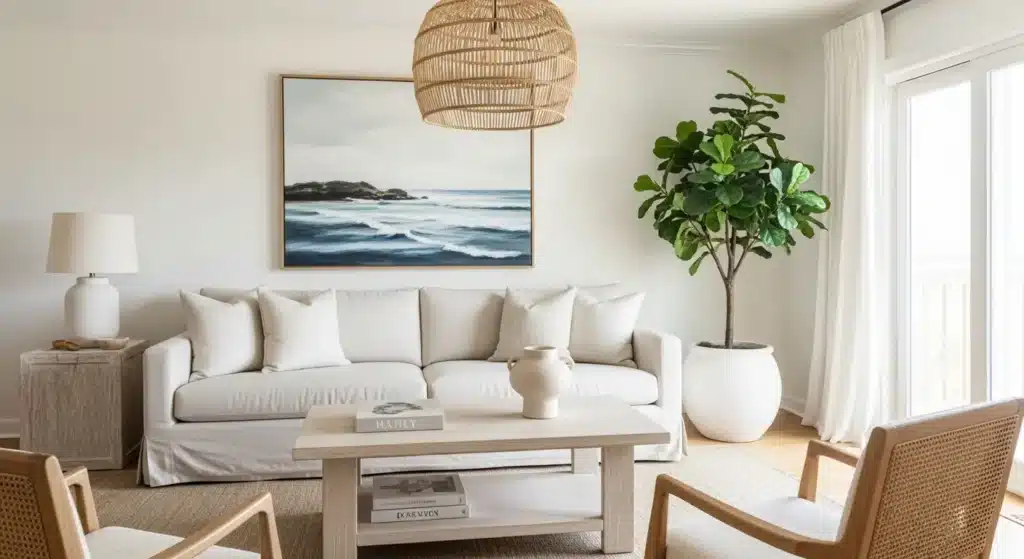
Coastal chic sits at the intersection of coastal design and luxury interior styling. Where modern coastal emphasizes clean lines and contemporary forms, and where cottage coastal emphasizes warmth and informality, coastal chic combines the best of both with a layer of deliberate elegance — better quality materials, more precise styling decisions, and a higher ratio of considered choices to impulse purchases.
The chic element is not about spending more money. It is about applying the specific designer techniques that create the impression of considered luxury — the single oversized artwork instead of a gallery wall, the one statement plant instead of a dozen small ones, the precisely folded throw instead of a casually draped one. These choices cost the same as their alternatives but produce dramatically different results.
The coastal element provides the specific sensory quality that makes coastal chic instantly recognizable — the quality of diffuse natural light, the warmth of natural materials, and the specific palette of warm whites, sandy neutrals, and ocean-reference accent colors that create the impression of living near water regardless of the actual geography.
The Designer Spatial Decisions That Happen Before Any Decoration
Establish the Light Source as the Spatial Anchor
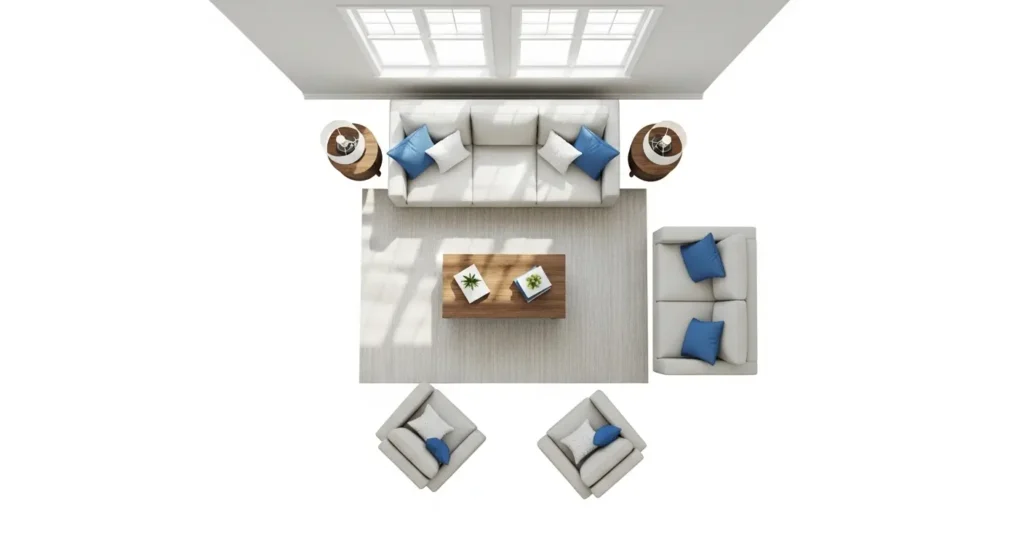
Every designer-styled coastal chic living room is organized around its primary natural light source. The largest window or glazed door is the spatial anchor — every furniture arrangement decision relates to it. The sofa faces toward or across the light source rather than away from it. The seating group orients toward the combination of the light source and the primary focal wall. This light-anchoring decision is made before any furniture enters the room and it is the single decision that most determines whether the room looks designed or simply furnished.
Float the Furniture Group
A designer coastal chic living room has no furniture touching walls. The sofa sits 18 inches from the wall behind it. The accent chairs pull forward into the seating group rather than sitting against side walls. The console table behind the sofa floats 6 inches from the wall rather than being pushed flat against it. This floating arrangement is the most reliable spatial technique for creating the impression of a larger and more luxurious room — it creates visible floor space on all sides of the furniture that communicates generous proportions.
Apply the 18-Inch Coffee Table Rule
Professional interior designers specify the coffee table at exactly 18 inches from the front edge of the sofa. This distance allows comfortable reach to the table surface from a seated position while providing enough clearance to walk between sofa and table without turning sideways. More than 24 inches makes the table feel remote and disconnected from the seating group. Less than 14 inches makes the room feel cramped and difficult to navigate. The 18-inch specification applies to every coastal chic living room regardless of size.
How Designers Apply the Coastal Chic Palette
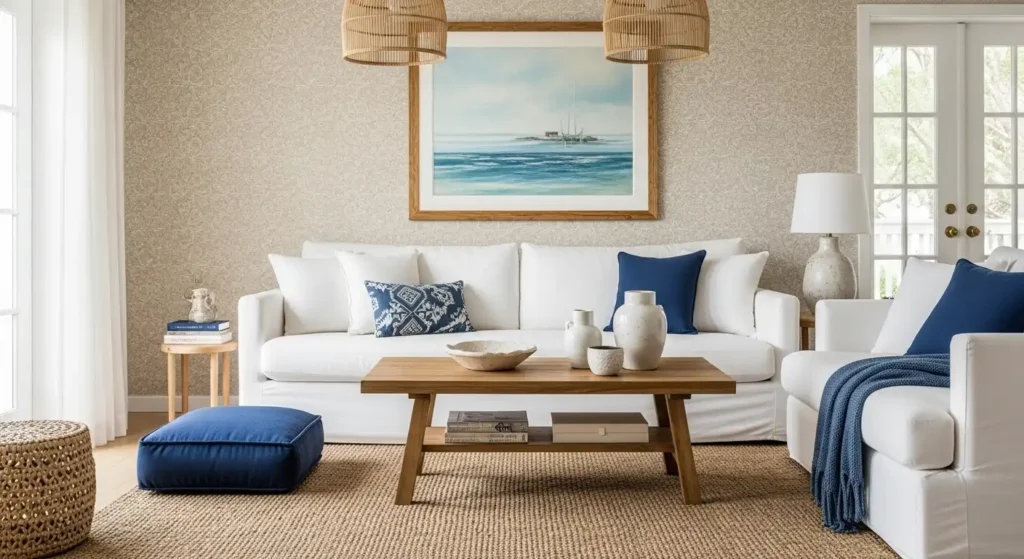
Interior designers apply the coastal chic palette using the 60-30-10 rule — 60% dominant color, 30% secondary color, 10% accent color. Understanding how this rule applies specifically to a coastal chic living room removes all guesswork from color decisions.
60% — Warm white:
Walls, ceiling, large upholstered surfaces, and curtains. This is the dominant color that creates the light-flooded coastal base. Everything else sits against this white foundation. Use the same warm white throughout all surfaces in this 60% category — consistency across surfaces creates the unified quality that designers achieve and that rooms with multiple different whites lack.
30% — Sandy neutrals and natural materials:
The natural fiber rug, timber furniture surfaces, rattan accents, linen textiles in greige and sand tones. This 30% layer creates the warmth and organic quality that prevents the white base from feeling clinical. It comes primarily from material color rather than paint color — the natural tone of jute, oak, and linen rather than any chosen paint shade.
10% — Ocean accent color:
The single coastal accent color — deep slate blue, ocean teal, or soft navy — used in exactly three to four places maximum. Two cushions, one ceramic object, one throw. The precision of 10% is what separates coastal chic from coastal themed — enough accent color to establish the coastal reference, not enough to dominate the palette.
The Designer Layering Technique That Creates Depth
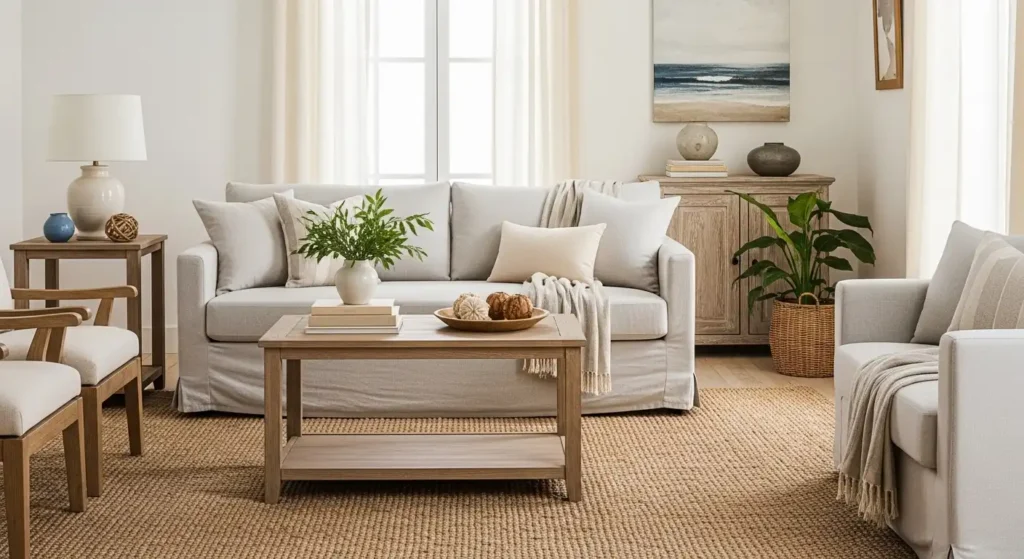
Professional interior designers build rooms in four layers applied in sequence. Understanding the layers and their sequence is the single most useful designer technique available for styling any coastal chic living room.
Layer 1 — The architectural layer
Walls, ceiling, floor, and windows. In a coastal chic living room this means warm white walls in a textured finish, natural or light timber flooring, and windows dressed with sheer white floor-length panels. This layer is established before any furniture enters and it determines the quality of every subsequent layer built upon it.
Layer 2 — The furniture layer
The large furniture pieces — sofa, coffee table, accent chairs, console. In a coastal chic room every furniture piece is chosen for its silhouette as much as its function. Clean visible legs, natural material surfaces, and proportions that suit the specific room dimensions rather than aspirational or generic sizing. This layer creates the room’s structural composition.
Layer 3 — The textile layer
The rug, curtains, cushions, and throws. This layer adds tactile warmth, color depth, and pattern variation to the room structure established in Layer 2. In a coastal chic room the textile layer uses natural fibers exclusively — jute, linen, cotton, silk — and applies the 60-30-10 color rule at the cushion and throw scale.
Layer 4 — The object layer
The decorative objects, artwork, plants, and books that complete the room. This is where most non-designers start and where professionals finish. The object layer works only when the three layers beneath it are correctly established — objects placed in a poorly structured room cannot rescue it. Objects placed in a correctly structured room complete it with minimal effort.
Designer Object Placement Rules for Coastal Chic Rooms
The Odd-Number Grouping Rule
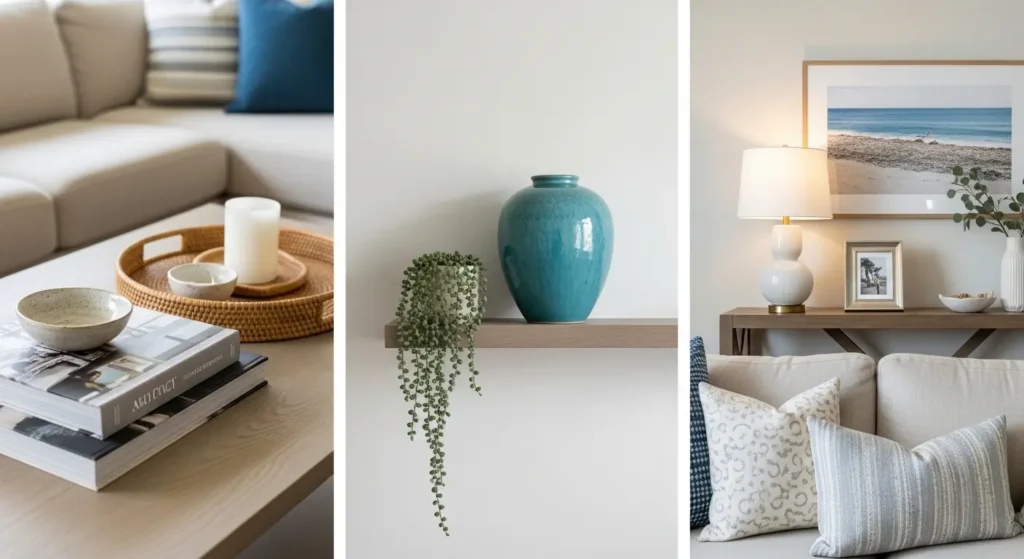
Professional designers always style surfaces with odd-numbered object groupings — three objects, five objects, or seven objects. Odd numbers create the compositional tension that makes arrangements look curated rather than symmetrical. Even-numbered groupings create the matched-pair symmetry that looks purchased rather than styled. On a coffee table: three objects. On a shelf: three or five objects with deliberate negative space between them. On a console: three objects at varied heights.
The Varied Height Principle
Every surface grouping in a designer coastal chic living room has objects at three different heights — tall, medium, and low. A table lamp at 24 inches, a ceramic vessel at 10 inches, and a flat stack of books at 3 inches creates the visual rhythm that a shelf of equal-height objects can never achieve. The height variation draws the eye through the grouping rather than stopping at it.
The One Statement Per Zone Rule
Each zone of a coastal chic living room has one statement element and supporting elements — never two competing statements. The sofa wall has one oversized artwork. The seating group has one statement plant. The coffee table has one statement object on a tray. The shelf has one statement ceramic. When every zone has a single clear focal element the room reads as designed. When multiple zones compete with equal-weight statements the room reads as cluttered regardless of the individual quality of each piece.
The Deliberate Imperfection Technique
The most recognizable quality of designer-styled rooms is what appears to be effortless imperfection — the throw that is casually but precisely folded, the art book that sits at a slight angle, the cushion that is pushed to one side rather than centered. These imperfections are entirely deliberate. They signal that the room is lived in rather than preserved, comfortable rather than precious. In a coastal chic living room the deliberate imperfection communicates the relaxed quality that the coastal aesthetic requires without sacrificing the precision that the chic element demands. The Blissy Silk Pillowcase in soft champagne casually but deliberately draped adds the premium textile element at the sofa. Find it linked on Amazon.
How Designers Use Lighting to Complete the Coastal Chic Room
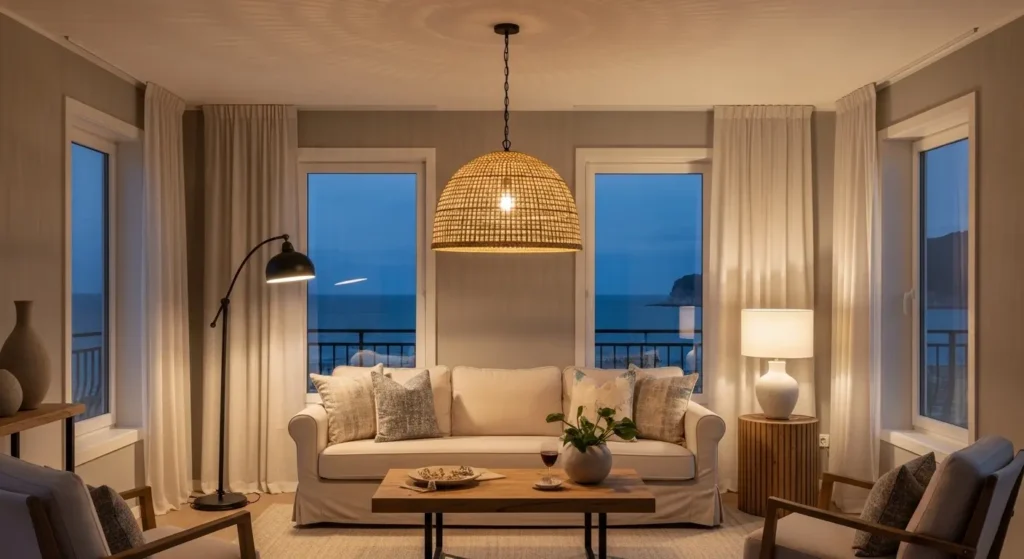
The single most impactful lighting change in any coastal chic living room is switching off the overhead light and using only floor-level and table-level light sources in the evening. This is the designer move that transforms a well-decorated room into a genuinely beautiful one after dark.
Designers specify three light sources at different heights for every living room — a pendant at ceiling level on a dimmer switch for ambient light when needed, a floor lamp beside the seating group for task and reading light, and a table lamp on a console or side table for the intimate low-level light that creates the most beautiful coastal chic evening atmosphere.
All three light sources use warm white bulbs at 2700K — the golden hour temperature that creates the specific warm quality of late afternoon coastal light indoors after dark. Cool white bulbs at 4000K or above destroy the coastal warmth that the entire room design creates during daylight hours.
The Finishing Details That Make a Room Look Designer
Curtains that pool on the floor
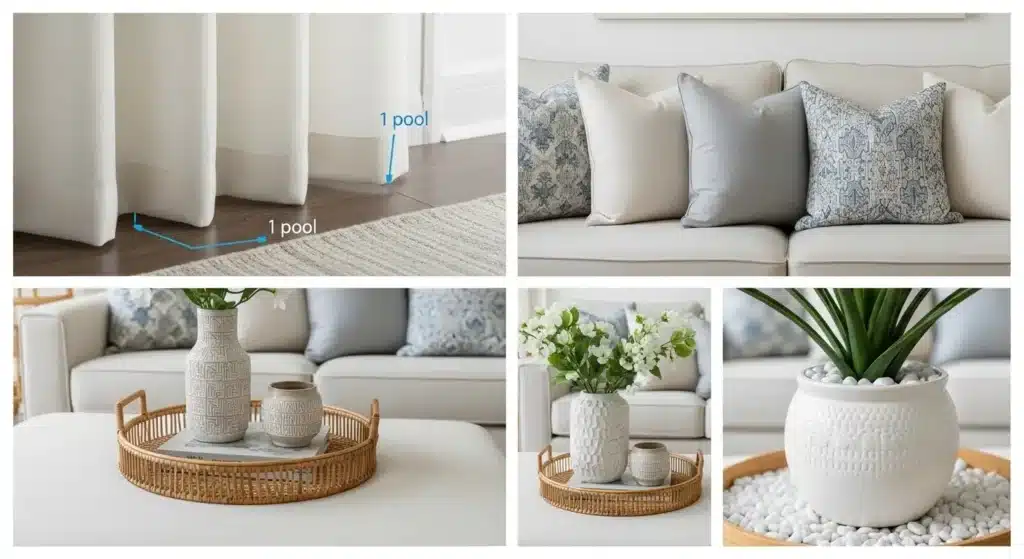
Designer curtains in coastal chic rooms hang from ceiling height and pool 1 to 2 inches on the floor. The slight pool creates the relaxed luxury quality that precise hem-level curtains lack. Hang the curtain rod as close to the ceiling as possible — the maximum height between rod and floor creates the impression of taller ceilings and larger windows regardless of the actual ceiling height.
Plants with dressed soil surfaces
Designer-styled plants in coastal chic rooms have their visible soil surface covered with white stones, moss, or sand rather than exposed potting compost. The dressed soil surface signals that the plant has been styled as a design element rather than simply positioned as a living object. White pebbles or pale sand on the soil surface of a large monstera or fiddle leaf fig in a white ceramic pot completes the plant as a genuinely finished design element.
Art hung at the correct height
The universal designer rule for artwork hanging height: the center of the artwork sits at 57 inches from the floor regardless of ceiling height, wall size, or furniture below it. This measurement corresponds to average seated and standing eye level and produces the comfortable viewing position that artwork hung higher or lower consistently fails to achieve. The most common non-designer mistake is hanging artwork too high — pieces hung at 68 to 72 inches center height look like they are floating above the room rather than part of it.
Books as design objects
Designer coastal chic living rooms use books as deliberate design objects — a stack of three oversized coffee table books in aligned spines on the coffee table or shelf. The books are chosen for their cover colors as much as their content — neutral, natural, and coastal-palette cover tones in a coordinated stack. The spine colors are aligned rather than randomly placed. The stack sits at a slight angle rather than perfectly straight.
📌 More coastal home decor ideas: 10 Modern Coastal Living Room Ideas
Frequently Asked Questions
What is a coastal chic living room?
A coastal chic living room combines the natural light, organic materials, and ocean-reference palette of coastal interior design with the precise styling techniques and design intelligence of luxury interior design. It achieves the relaxed quality of coastal living through deliberate design decisions rather than casual accumulation — fewer objects of higher quality, more precise furniture arrangements, and the specific layering techniques that professional interior designers use to create depth and visual interest. According to Architectural Digest coastal chic is consistently among the most searched living room style terms because it represents the ideal balance of relaxed and refined that most homeowners aspire to.
How do you make a living room look expensive on a budget?
The techniques that make a living room look expensive without spending more are the same designer techniques applied in coastal chic styling — floating furniture away from walls, applying the 60-30-10 color rule with precision, using odd-number object groupings at varied heights, hanging artwork at the correct 57-inch center height, and dressing curtains at ceiling height with a floor pool. None of these techniques cost money — they cost attention and the willingness to rearrange what you already have. The single cheapest change that produces the most dramatic expensive-looking result: switch off the overhead light and use only floor and table lamps in the evening.
What furniture makes a coastal chic living room?
Coastal chic living room furniture has four specific qualities: visible legs in pale timber or matte black rather than skirted or solid bases, natural fabric upholstery in linen or linen-blend in warm white or greige, clean straight arms rather than rolled or casual arm profiles, and proportions sized precisely to the room rather than aspirationally oversized. A clean-lined linen sofa, a bleached oak or rattan coffee table, one rattan accent chair, and a simple pale timber console complete the furniture layer of a coastal chic living room.
What colors go in a coastal chic living room?
Coastal chic living rooms use the 60-30-10 color rule: 60% warm white on walls, ceiling, and large upholstered surfaces, 30% sandy neutrals and natural material tones from the rug, timber furniture, and linen textiles, and 10% ocean accent color in deep slate blue, teal, or soft navy used in three to four places maximum. The warm undertone specification for the white is critical — warm whites with greige or cream undertones create the coastal warmth that cool bright whites destroy. The single most specified warm white for coastal chic living rooms is Benjamin Moore White Dove, which has the exact warm undertone the palette requires.
More Coastal Home Decor Ideas
→ How To Design a Contemporary Coastal Living Room
→ How To Decorate a Coastal Living Room on a Budget
→ How To Design a Small Coastal Kitchen
Start with the spatial decisions — float the furniture, establish the light source as the anchor, place the coffee table at 18 inches. Every styling decision you make after that will look significantly better because the structure beneath it is correct.

Sheikh Hassaan is a digital architect for small businesses and the founder of The Glow Up System. He writes about home decor, garden design, and outdoor living for real American homes – practical ideas that work in actual spaces without oversized budgets.