
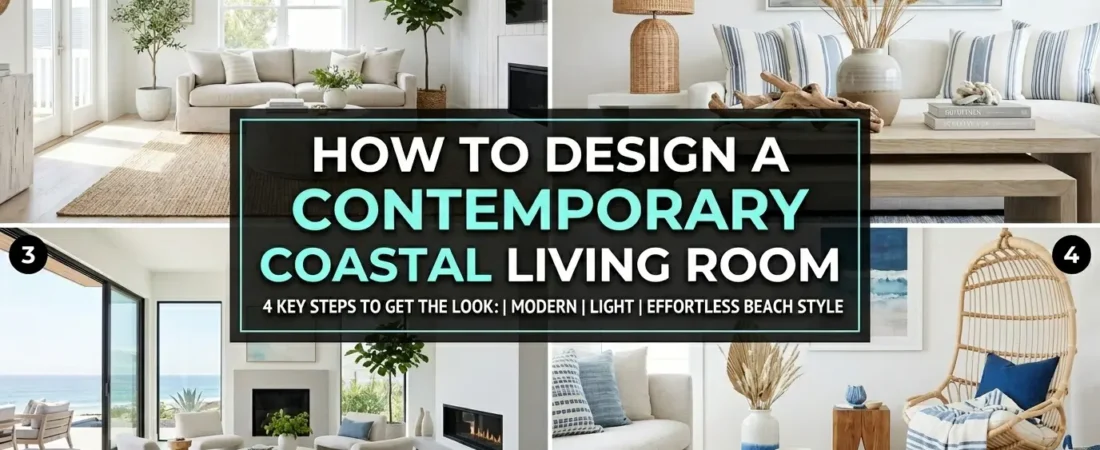
Designing a living room around the coastal aesthetic in its most current form requires a different approach from both traditional nautical styling and the relaxed beach house look. A contemporary coastal living room is more architectural, more edited, and more considered than either of its predecessors — it takes the palette and the natural materials of coastal design and applies a level of design precision that produces something genuinely sophisticated.
This guide covers every design decision in a contemporary coastal living room — from the furniture silhouette and spatial arrangement through wall treatment, lighting, textiles, and the specific finishing details that separate a room that looks coastal from one that genuinely feels it.
Table of Contents
What Separates Contemporary Coastal From Other Coastal Styles
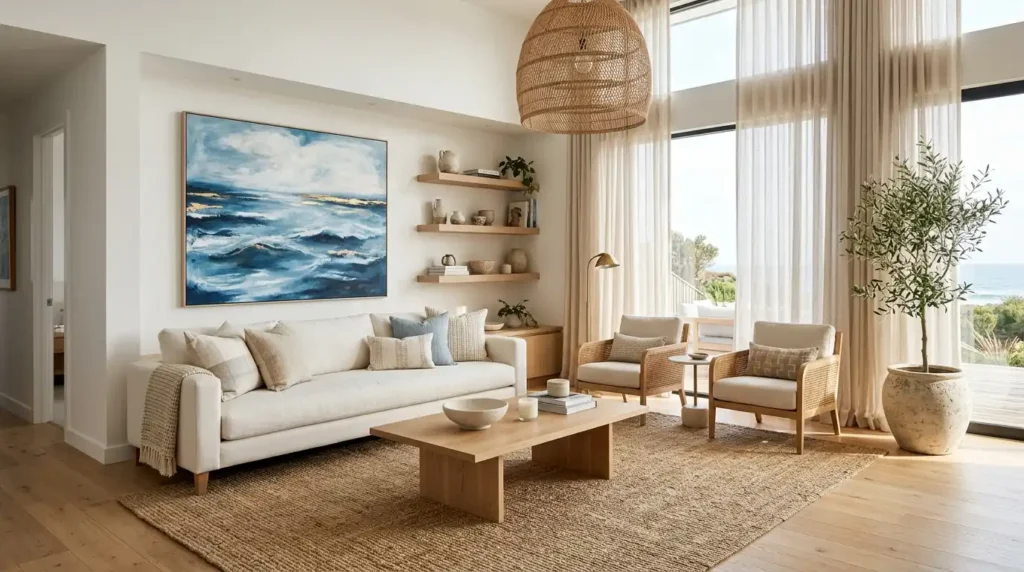
Contemporary coastal is coastal design in its most evolved and most precise form. Where traditional coastal uses anchor motifs and novelty shells, and where relaxed beach house style uses weathered timber and casual abundance, contemporary coastal uses clean architectural lines, a precisely curated palette, and natural materials selected for their design quality rather than their coastal symbolism.
The three distinctions that make a coastal living room specifically contemporary: first, the furniture has clean precise lines rather than the casual rounded forms of beach house style. Second, the color palette is more tightly curated — fewer colors used with more intention rather than a general coastal color scheme. Third, the decorative objects are fewer and of higher individual quality — one excellent piece rather than an abundance of coastal-themed accessories.
Contemporary coastal does not reject the coastal reference — it refines it. The ocean is still present in the palette, the natural materials, and the quality of light that the design creates. But it is referenced through design intelligence rather than decoration.
The Contemporary Coastal Color Palette
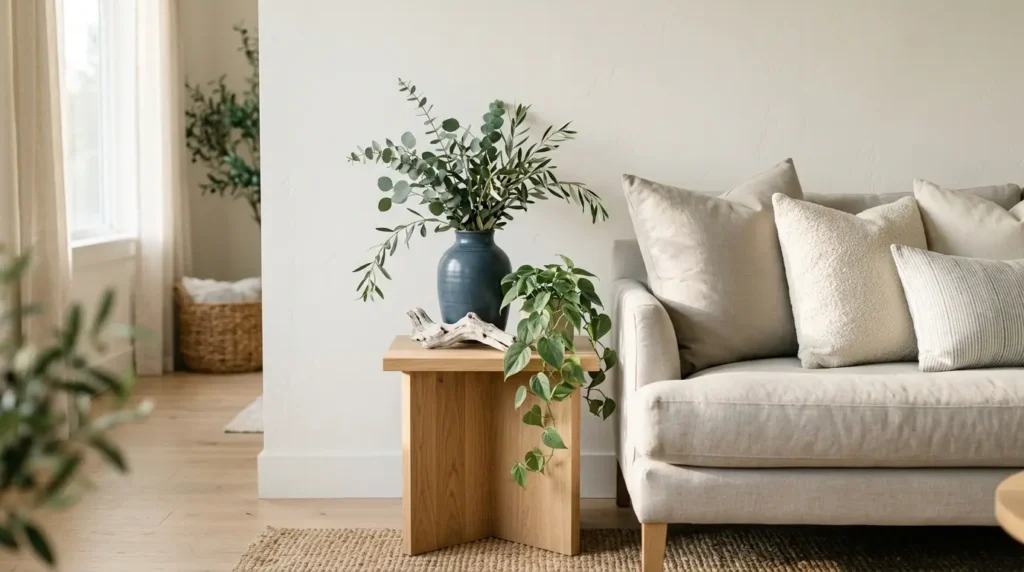
The contemporary coastal palette is more restrained and more sophisticated than the traditional coastal palette. It uses fewer colors at greater depth rather than more colors at equal weight.
Warm white — the dominant base:
Not bright white — warm white with a slight greige undertone. The warmth prevents the clinical quality that pure white creates while maintaining the light-reflective base that the coastal atmosphere requires. Dulux Timeless, Farrow and Ball Pointing, and Benjamin Moore White Dove all have the correct undertone.
Greige and warm sand — the neutral layer:
Greige — the mid-point between grey and beige — is the contemporary coastal neutral that has replaced pure beige. It reads as sophisticated where beige reads as dated. Applied in upholstery, textiles, and secondary surfaces it creates the warm sandy layer that grounds the white base.
Pale oak and driftwood — the natural material tone:
Natural timber in pale oak, ash, or bleached driftwood tones introduces the warmth that the white and greige palette needs without competing with it. This tone comes from furniture and shelving rather than from paint.
Slate blue or deep teal — the single accent:
One carefully chosen coastal accent color used in two to three places maximum — a large ceramic vessel, a throw, one cushion, or a section of cabinetry. Slate blue is more sophisticated than navy for contemporary coastal. Deep teal suits warmer palette directions. Both work — choose one and use it with precision rather than abundance.
Muted sage or eucalyptus green — the living element:
One or two plants and dried botanical arrangements in muted sage or eucalyptus green tones introduce the living color element that completes the palette. This green is muted and grey-toned rather than vivid — it references sea grasses and coastal vegetation rather than tropical foliage.
Furniture Selection and Arrangement
The Sofa
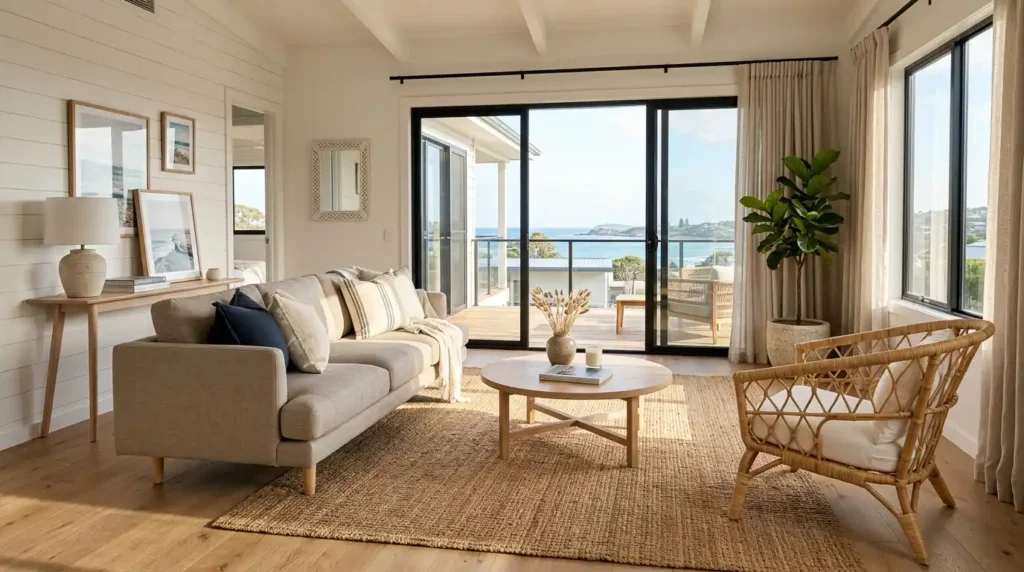
The contemporary coastal sofa has three specific qualities that separate it from both traditional coastal and generic contemporary sofas: a clean straight arm profile rather than a rolled arm, visible legs in pale timber or matte black rather than a skirted base, and upholstery in natural linen or linen-blend fabric in warm white or greige rather than synthetic fabric in any color. The leg visibility is particularly important — furniture that sits directly on the floor creates visual weight that the coastal aesthetic resists. Visible legs create the floating quality that makes rooms feel lighter and more spacious.
Coffee Table and Accent Furniture
A pale oak or rattan coffee table with a lower shelf suits the contemporary coastal living room — the natural material and the lower shelf for displaying one or two considered objects. A round coffee table suits smaller contemporary coastal living rooms better than a rectangular one because it eliminates the hard corners that add visual weight to the seating arrangement.
One rattan accent chair completes the seating group without adding the symmetrical weight of a matching sofa pair. The rattan material introduces the natural coastal texture at the accent furniture scale. Choose a low-profile rattan chair in a contemporary form rather than a traditional peacock or rounded wicker style — the contemporary form is what keeps the room in the current decade.
Furniture Arrangement
Pull all furniture away from the walls. The contemporary coastal living room arrangement floats the furniture group in the room’s center with visible floor space between furniture backs and walls. This counterintuitive approach — particularly in smaller rooms — creates the airy spatial quality that coastal design requires. Furniture pushed against walls makes rooms feel smaller. Furniture floating in space makes rooms feel larger regardless of their actual dimensions.
Wall Treatment and Surfaces
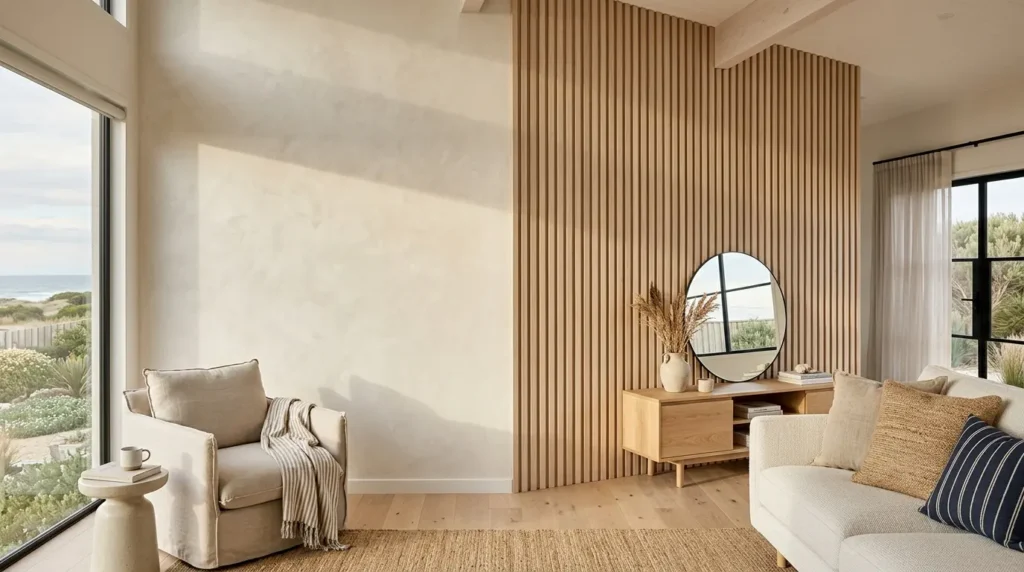
Limewash or Venetian plaster walls:
Flat paint on smooth walls is the least interesting and least coastal wall treatment available. Limewash paint applied in a dry brush technique creates the soft cloudy depth that shifts in appearance through the day as light moves across the surface. This living quality is the wall treatment most consistent with the contemporary coastal aesthetic — it references the texture of whitewashed coastal buildings and the quality of diffuse coastal light simultaneously.
Timber batten feature wall:
Vertical pale oak or white-painted timber battens on the primary feature wall create the architectural texture and warmth that the contemporary coastal room requires without any color contrast. The vertical lines draw the eye upward and increase perceived ceiling height. The timber material adds warmth within the same tone as the wall — texture rather than contrast is the design principle.
Single deep slate blue accent wall:
The wall directly behind the sofa in a deep slate blue or navy creates a strong coastal color anchor for the room. In a contemporary coastal room this accent wall should be the only painted surface in a non-neutral color — all other walls in warm white. The single accent wall principle applies: one bold surface creates a focal point. Multiple bold surfaces create chaos.
Lighting for a Contemporary Coastal Living Room
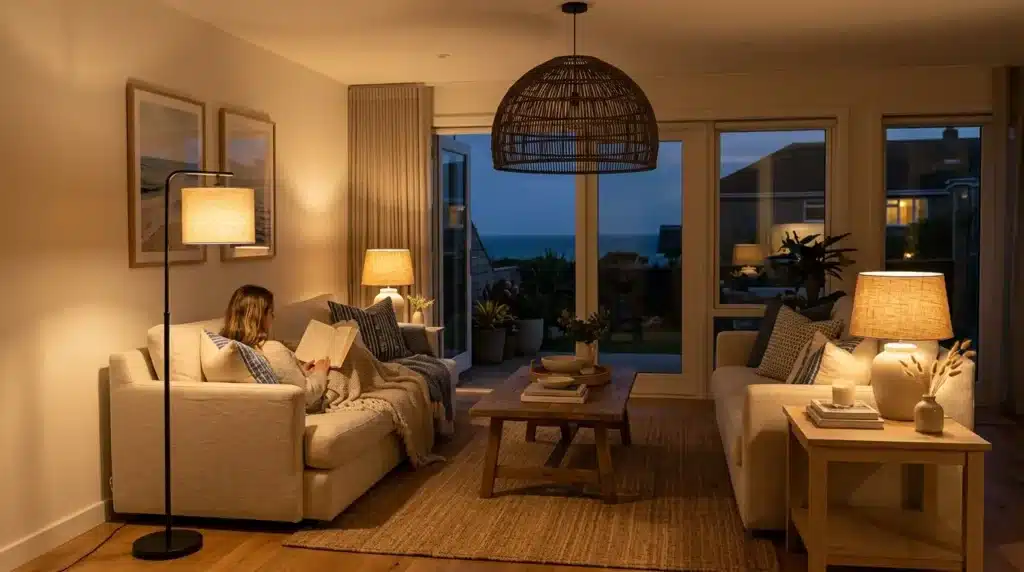
Contemporary coastal living room lighting follows the same layered principle as any well-designed interior but with specific fixture choices that reinforce rather than contradict the coastal material palette.
Statement pendant — the design anchor:
A large rattan dome pendant is the fixture that most immediately establishes the contemporary coastal character of the room. Size it generously — 60 to 80cm diameter for a standard living room — and hang it at the correct height of 200 to 220cm from the floor to the bottom of the shade. A pendant that is too small or hung too high loses its design authority.
Floor lamp — the reading layer:
A slim arc floor lamp in matte black or brushed brass positioned beside the sofa provides task reading light and adds a vertical design element at the room perimeter. The arc lamp silhouette — a long curved arm sweeping over the sofa — suits the contemporary coastal room because of its clean architectural form.
Table lamp — the ambient layer:
One ceramic table lamp in a warm white or sand tone on a side table completes the ambient lighting layer. The ceramic lamp base in a simple organic form suits the contemporary coastal material palette. Use a warm white bulb at 2700K — the warm temperature creates the golden hour quality that makes coastal rooms feel genuinely beautiful in the evening.
Textiles and the Art of Coastal Layering
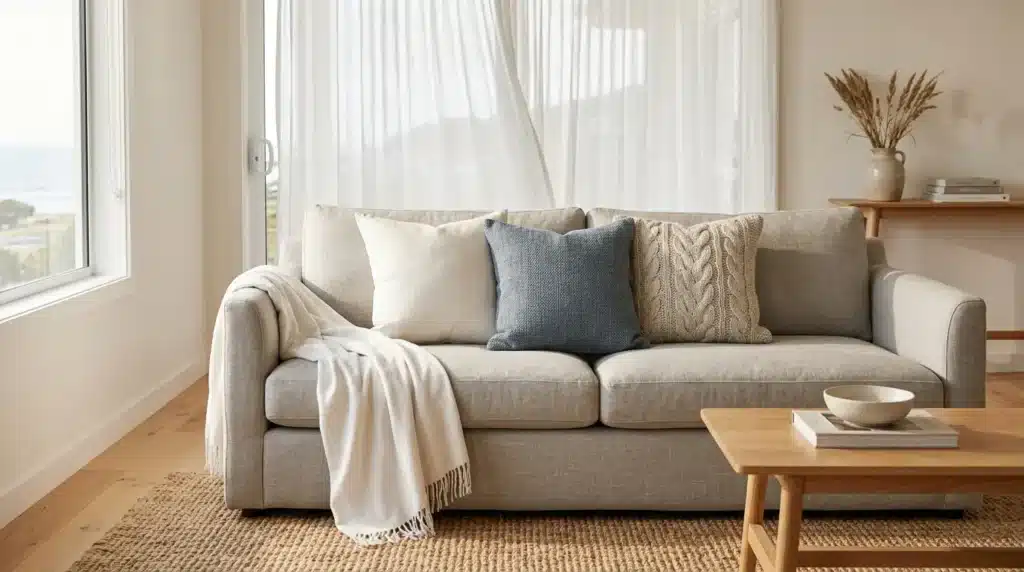
The rug:
A large natural jute or sisal rug sized to the 2/3 rule — covering at least two thirds of the seating area with all sofa front legs on the rug. The natural fiber creates the organic ground-level warmth that synthetic rugs cannot provide. Choose a natural undyed jute for the warmest tone or a bleached white jute for the lightest contemporary coastal effect.
The curtains:
Floor-length sheer white or cream linen panels hung from ceiling height to the floor — as high as possible to create the tall-windowed coastal quality. The sheers allow maximum natural light while providing soft privacy. The slight movement of sheer curtains in a breeze from an open window creates the most distinctly coastal quality in any room — the interior responding to outdoor air movement.
Cushions and throws:
Three cushions on the sofa in the contemporary coastal palette — one warm white linen, one slate blue in a textured weave, one natural oatmeal knit. The three-cushion approach is more considered than the layered abundance of traditional coastal styling. One bleached cotton or linen throw draped over one sofa arm. The Blissy Silk Pillowcase in soft champagne adds the premium textile quality at the bedroom-adjacent cushion position. Find it linked on Amazon.
Accessories and the One-at-a-Time Rule
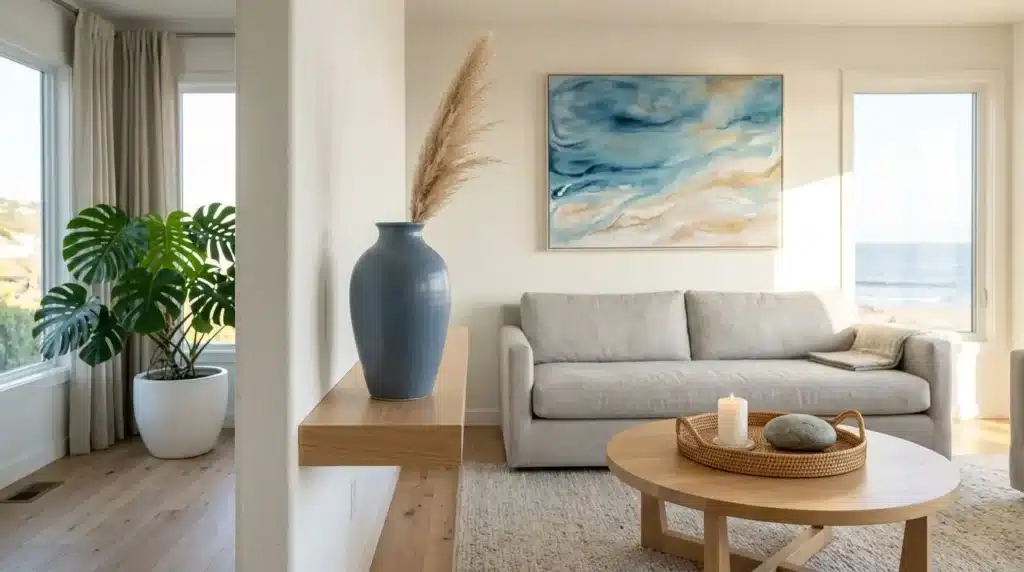
The contemporary coastal approach to accessories is governed by one principle: one excellent piece in each position rather than multiple pieces of lesser quality. Each surface in the room — the shelf, the coffee table, the console, the window ledge — has one considered object rather than a grouping. The restraint is the design statement.
The single statement ceramic:
One large ceramic vessel in the accent color — slate blue, deep teal, or warm sand — on the primary shelf or console. Large enough to be seen from across the room. Simple enough in form that it reads as an object of considered quality rather than a decorative purchase.
The statement plant:
One large plant in a quality ceramic pot in a room corner — a monstera, a fiddle leaf fig, or a large bird of paradise. The plant provides the living element that no other accessory can replicate. One large plant in the correct position creates significantly more presence than three smaller plants distributed around the room.
The artwork:
One large abstract coastal artwork above the sofa — sized at 60 to 75% of the sofa width. Abstract ocean imagery in the palette tones, a large-scale coastal landscape photograph, or a minimal line drawing of waves. The artwork is the room’s primary decorative statement and should be chosen with that responsibility in mind.
📌 More home decor ideas: 10 Modern Coastal Living Room Ideas
Frequently Asked Questions
What is contemporary coastal style?
Contemporary coastal style is the most current and most evolved form of coastal interior design — it applies the coastal palette of warm whites, natural materials, and ocean-reference accent colors with the clean architectural lines and design precision of contemporary interior design. Where traditional coastal uses nautical motifs and beach house coastal uses weathered timber and casual abundance, contemporary coastal uses precise furniture silhouettes, a tightly curated palette, and fewer higher-quality accessories to create a coastal atmosphere that is both relaxed and sophisticated. According to Elle Decor contemporary coastal is one of the defining interior design directions for 2026 precisely because it has shed the themed decorative elements of earlier coastal styles and evolved into a genuinely timeless aesthetic.
What colors work in a contemporary coastal living room?
The contemporary coastal living room uses five colors in a specific hierarchy: warm white as the dominant base covering 50% or more of all surfaces, greige as the neutral layer in upholstery and secondary textiles, pale oak and natural timber tones from furniture and shelving, one accent color in slate blue or deep teal used in two to three places maximum, and muted sage or eucalyptus green from plants and dried botanicals. The hierarchy and the quantities are as important as the color choices — the same colors used in wrong proportions produce a different and less successful result.
How is contemporary coastal different from modern coastal?
Contemporary coastal and modern coastal are closely related but distinct in their design precision. Modern coastal applies contemporary design principles to the coastal aesthetic — clean lines, natural materials, restrained decoration. Contemporary coastal goes further in its editing — it uses fewer pieces, applies the palette with greater precision, and treats each design decision as an architectural choice rather than a decorative one. Contemporary coastal is modern coastal taken to its most refined and most considered form.
What furniture suits a contemporary coastal living room?
Contemporary coastal living room furniture has three specific qualities: clean straight arms rather than rolled or casual arms, visible legs in pale timber or matte black rather than skirted or solid bases, and natural fabric upholstery in linen or linen-blend rather than synthetic materials. A linen sofa in warm white or greige, a pale oak or rattan coffee table, and one rattan accent chair complete the contemporary coastal furniture selection. All pieces should be proportional to the room and arranged in a floating group away from the walls rather than pushed against them.
More Home Decor Ideas
→ How To Decorate a Coastal Living Room on a Budget
→ How To Design a Small Coastal Kitchen
→ 10 Cozy Christmas Living Room Ideas
Start with the palette and the sofa — every other decision in the contemporary coastal living room follows from those two foundational choices. Get the warm white right and the linen sofa right and the rest resolves itself naturally.

Sheikh Hassaan is a digital architect for small businesses and the founder of The Glow Up System. He writes about home decor, garden design, and outdoor living for real American homes – practical ideas that work in actual spaces without oversized budgets.