
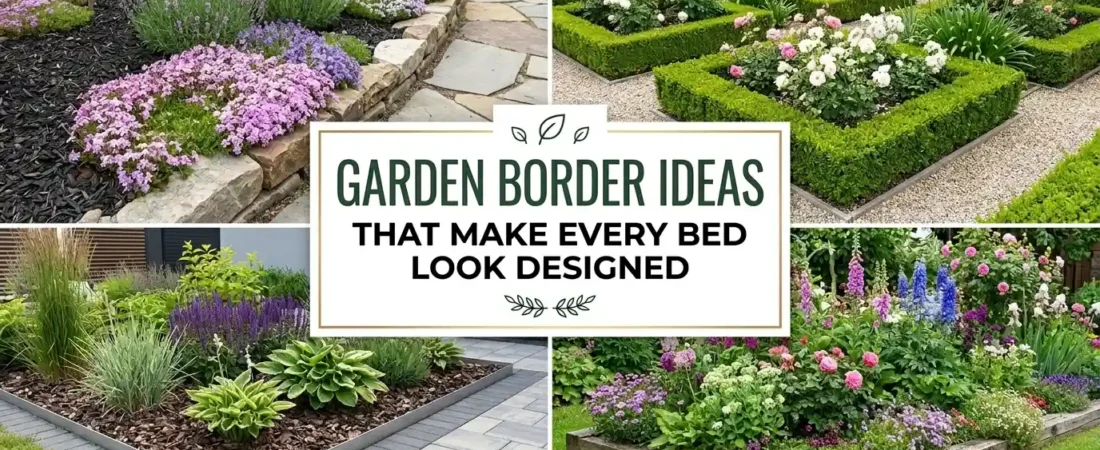
A garden bed without a clearly designed planting border is just a collection of plants sharing the same soil. Garden border ideas that genuinely transform beds treat the border as a complete design — a considered combination of plant heights, colors, textures, and seasonal interest working together rather than a group of individually chosen plants placed wherever there was space. The difference between a designed border and an assembled one is immediately visible and takes the same number of plants to achieve.
This guide covers garden border ideas organized by style and approach — from the classic herbaceous border through mixed, low-maintenance, and contemporary options — with specific plant combinations, design principles, and the practical planting techniques that make each border type look genuinely designed rather than accidentally attractive.
Table of Contents
Why Most Garden Borders Look Unfinished and How to Fix Them
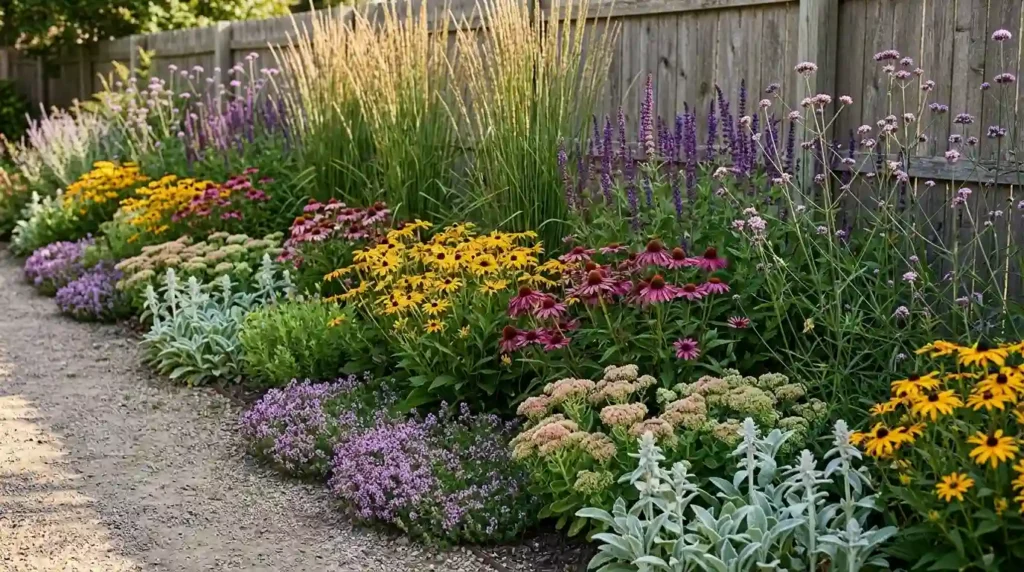
Most garden borders look unfinished for one of three reasons: plants of similar height throughout the border that create a flat, undifferentiated planting mass with no depth or structure. A random color selection that lacks a unifying palette and creates visual noise rather than visual interest. Or a collection of individual plants chosen one at a time rather than in groups that create bold blocks of color and texture visible from the normal viewing distance.
The three-tier height structure that professional gardeners apply to almost every border: tall plants at the back or center of the border, typically 90cm to 150cm or taller, that create the backdrop and the vertical structure. Medium plants in the middle zone, typically 45cm to 90cm, that carry most of the flower color and seasonal interest. Low plants at the front edge, typically under 45cm, that create the foreground layer and the transition between the border and the path, lawn, or edging in front of it.
The group size rule that makes individual plants read as a border rather than a collection: plant in groups of three, five, or seven of the same variety rather than one of each. A single purple salvia disappears in a border. Five purple salvias planted in a group create a bold patch of color visible from 20 feet away. This group planting approach is the single most impactful change available to a gardener with an existing border — removing individual scattered plants and replanting them in concentrated groups transforms a border’s readability instantly.
1. The Classic Herbaceous Border for Continuous Summer Color
✦ Best for: a main garden border along a wall or fence where maximum summer color impact is the goal
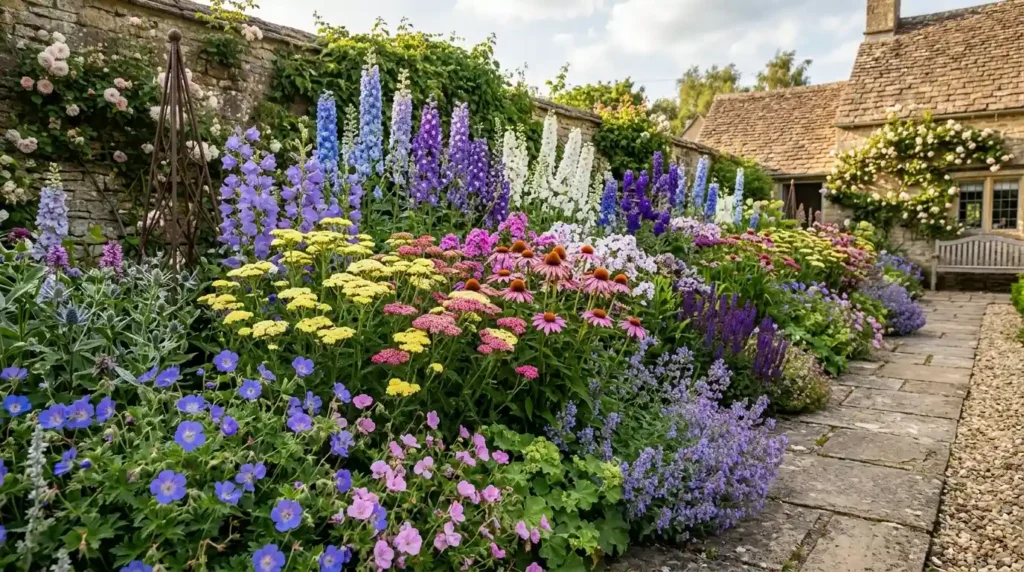
The classic herbaceous border — a continuous planting of perennial flowering plants in the three-tier height structure against a wall, fence, or hedge backdrop — is the most ambitious and most spectacular garden border type available, capable of creating a display from late spring through early autumn that no other border style matches for sheer flower abundance and color richness. It is also the border type that requires the most skill to plant well and the most maintenance to keep looking its best.
A successful classic herbaceous border requires a minimum width of 1.2 meters to accommodate the three-tier structure with comfortable planting distances between each tier. A border of 1.8 to 2.4 meters wide allows more generous group sizes and a more relaxed planting arrangement. Against a wall or fence background that adds height and backdrop without taking planting space, a border of this width creates genuine visual impact from the normal viewing distance of 3 to 5 meters.
A reliable classic herbaceous border plant combination for sustained summer interest: back tier — Verbena bonariensis, Echinops ritro (globe thistle), Rudbeckia fulgida. Middle tier — Echinacea purpurea, Achillea ‘Moonshine’, Salvia nemorosa ‘Caradonna’. Front tier — Geranium ‘Rozanne’, Nepeta ‘Six Hills Giant’, Sedum ‘Autumn Joy’. This combination provides color from June through October in most US climate zones, requires minimal staking, and spreads modestly without becoming invasive.
The herbaceous border’s main limitation is its winter appearance — most herbaceous perennials die back completely to ground level in winter, leaving the border bare or showing only dead stems. Leaving dried seed heads and stems standing through winter provides wildlife value and creates its own frosted winter beauty, and the late-winter cut-back to ground level is one of the most satisfying garden tasks of the year when it reveals the clean soil and the beginning of spring growth beneath.
2. The Mixed Border for Year-Round Interest Without Winter Gaps
✦ Best for: gardens viewed year-round from the house where winter structure and evergreen presence are needed alongside summer flower color
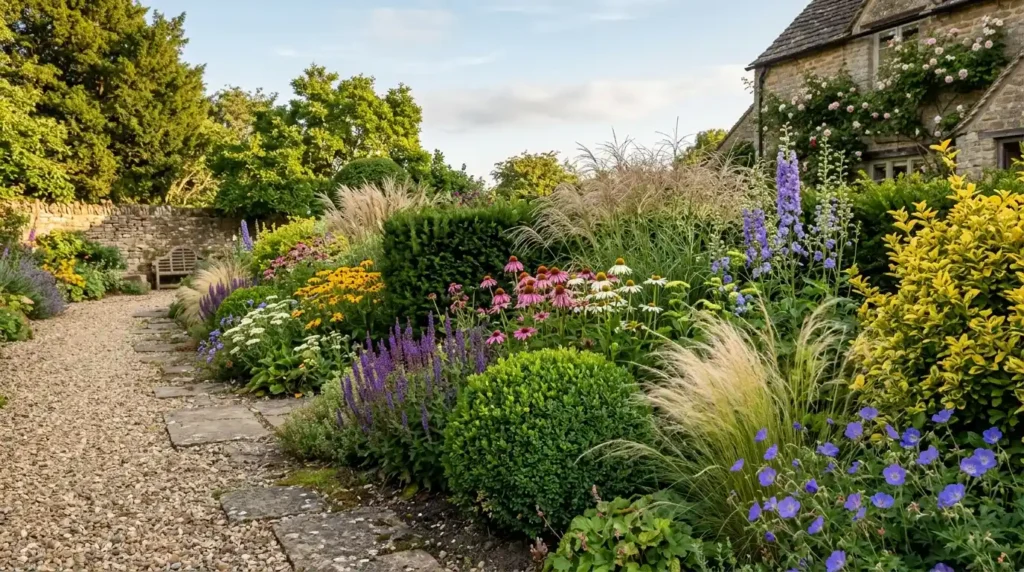
A mixed border combines shrubs, perennials, bulbs, and annuals in a single planting to provide genuine interest across all four seasons rather than concentrating it in summer. The shrubs provide the permanent structural framework that holds the border together visually in winter when the perennials are dormant. The perennials provide the bulk of summer flower color. The bulbs provide spring interest before the perennials are established. The annuals fill gaps in the first year while perennials establish.
Structural shrubs for a mixed border backbone: Pittosporum tenuifolium ‘Silver Queen’ for variegated evergreen foliage. Choisya ternata for fragrant white flowers and glossy evergreen leaves. Sambucus nigra ‘Black Lace’ for dramatic dark cut foliage that reads as a bold structural element throughout the growing season. Hydrangea paniculata ‘Limelight’ for late summer to autumn flower interest after most shrubs have finished.
The ratio that works consistently in a mixed border: approximately one-third shrubs for structure, one-half perennials for flower color and seasonal interest, and one-sixth bulbs and annuals for the gaps and the first-year color while the perennials establish. This ratio prevents the border from becoming either too shrubby and rigid or too flowery and structureless.
3. The Low-Maintenance Border for Beautiful Results With Minimal Effort
✦ Best for: busy gardeners who want a designed border without the weekly maintenance that a classic herbaceous border requires
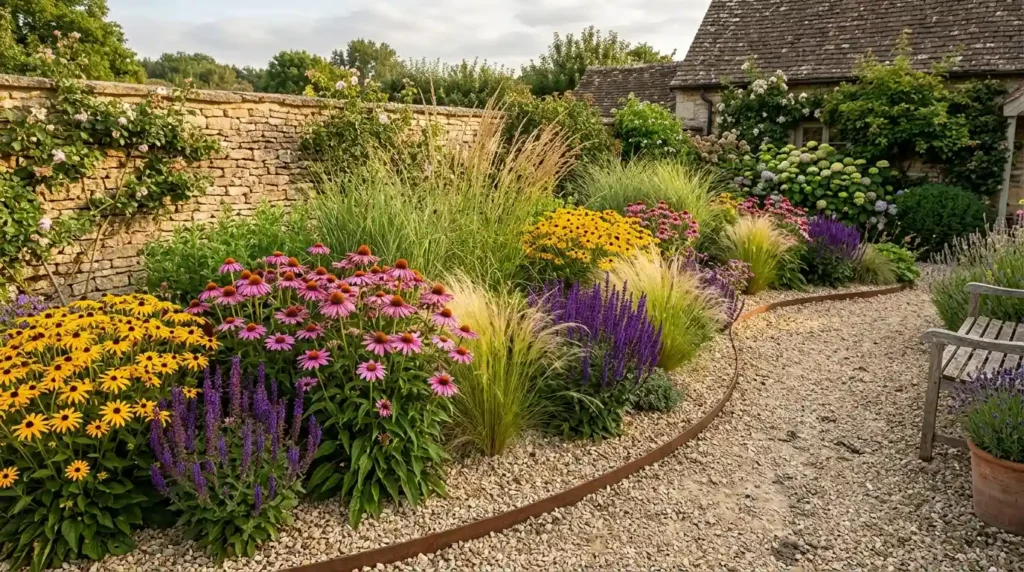
A low-maintenance border is not a compromise — it is a border designed around plants that require minimum intervention to look their best throughout the season. The plants that make a low-maintenance border genuinely low maintenance share specific characteristics: they do not need staking, they do not spread aggressively into neighboring plants, they are not prone to the pest and disease problems that require treatment, and they look good across a long season rather than requiring replacement or cutting back mid-season to prevent collapse.
The plant categories that consistently deliver low-maintenance border performance: ornamental grasses for their structural presence, seasonal color change, and winter interest with a single annual cut-back. Echinacea, rudbeckia, and achillea for long-season flower color, exceptional drought tolerance, and seed heads that provide winter bird interest. Salvia nemorosa and its cultivars for repeat flowering without deadheading. Sedum spectabile for late season interest when most other perennials are fading.
Gravel mulch between plants in a low-maintenance border is more effective than bark mulch for weed suppression and more appropriate for drought-tolerant plant species that prefer the warm, free-draining conditions that gravel creates at soil level. A 5cm depth of fine gravel over landscape fabric between established plants reduces weeding by 80 to 90 percent compared to bare soil and creates the Mediterranean garden aesthetic that suits drought-tolerant plantings naturally.
4. The Cottage Garden Border for Abundant Informal Charm
✦ Best for: a relaxed informal garden where deliberate looseness and self-seeding abundance create the desired character
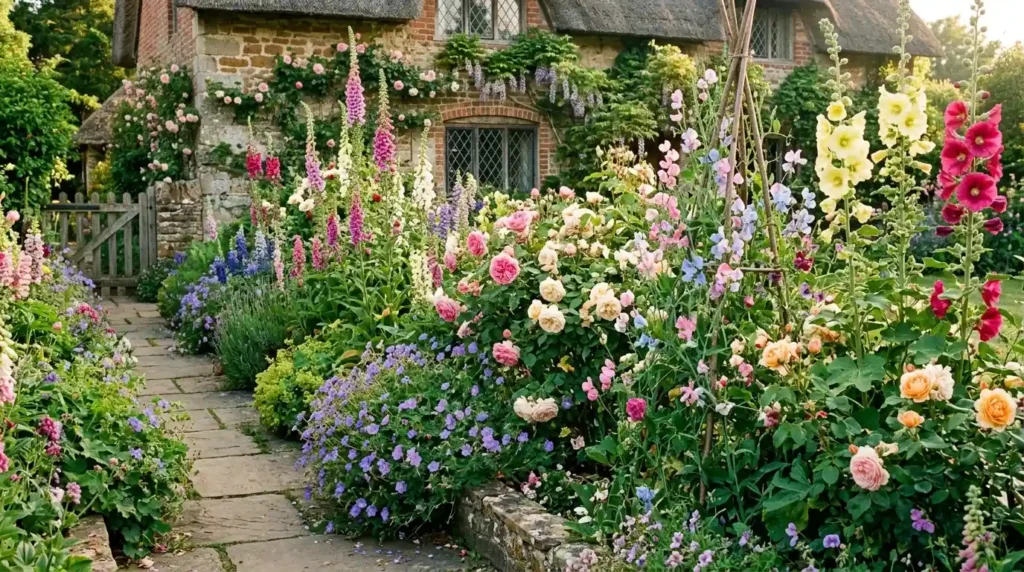
The cottage garden border achieves its characteristic quality of appearing unstudied while being the result of very deliberate plant choices — the appearance of abundance and informality that defines the cottage aesthetic is achieved by choosing plants that self-seed freely, allowing them to spread and intermingle, and editing rather than planting the result. A cottage border is more managed than it appears and less designed than it actually is.
The plants that create authentic cottage garden character most reliably: old roses in pink, white, and soft red for fragrance and the specific flower form associated with the tradition. Foxgloves (Digitalis purpurea) for dramatic vertical spires that self-seed prolifically and appear in unexpected positions. Hollyhocks for old-fashioned vertical summer color. Sweet peas for fragrance and the tradition of growing them on rustic supports. Hardy geraniums for the ground-level sprawl that spills over path edges.
The specific technique that creates genuine cottage garden abundance rather than a tidy border of cottage plants: allow self-seeded plants to grow where they appear rather than removing them and replanting in designed positions. A foxglove that has self-seeded into the middle of the path edge looks more authentically cottage garden than one planted in the back of the border exactly where the design dictated. Managed serendipity — accepting the plant’s choice of position while editing out the least successful seedlings — is the cottage garden’s primary design method.
5. The Contemporary Border Using Grasses and Bold Perennials
✦ Best for: modern and contemporary gardens where a naturalistic but clearly designed planting suits the architectural setting
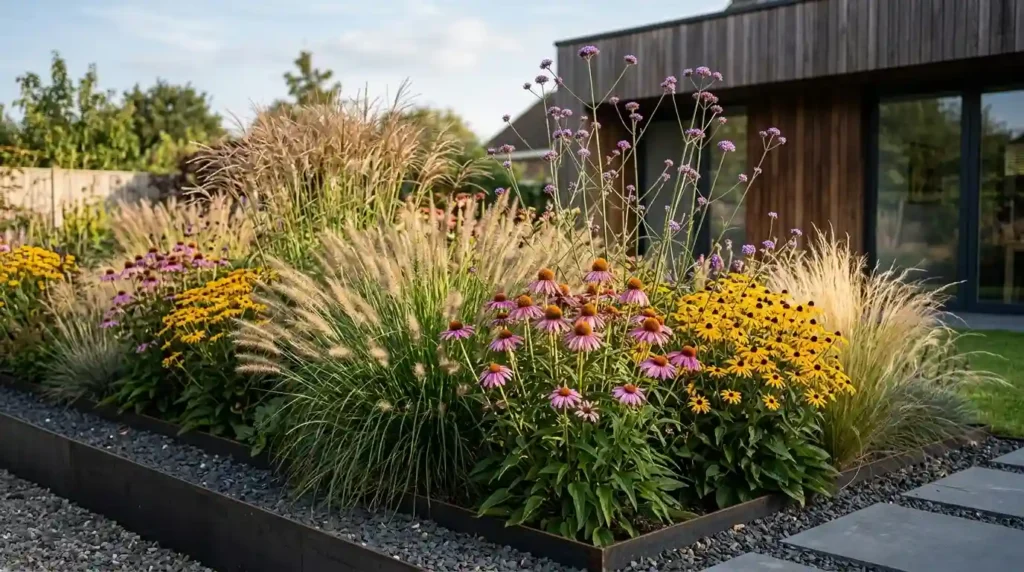
The contemporary garden border draws on the prairie planting movement pioneered by designers Piet Oudolf and Karl Foerster — a style that uses ornamental grasses and robust perennials in naturalistic but clearly designed combinations that look beautiful from high summer through winter and that suit contemporary architectural gardens as well as they suit naturalistic landscapes. The planting is deliberately wilder-looking than a classic herbaceous border while being just as carefully composed.
The plant matrix approach that defines this border style: rather than planting in discrete groups with clear boundaries between them, plants are interwoven so that different species grow into and alongside each other, with grasses threading through perennials and perennials emerging from grass clumps. This interwoven approach creates the naturalistic quality that distinguishes the contemporary prairie border from a traditional perennial border even when using some of the same species.
Key species for a contemporary prairie border: Pennisetum alopecuroides ‘Hameln’ (dwarf fountain grass) for its reliable compact form and attractive seed heads. Miscanthus sinensis ‘Gracillimus’ for tall vertical grass structure. Echinacea purpurea for long-season summer color and winter seed head interest. Rudbeckia fulgida ‘Goldsturm’ for late summer golden color. Verbena bonariensis for its airy purple flowers that weave through and above everything else from midsummer to frost.
6. The Cut Flower Border That Doubles as a Garden Feature
✦ Best for: gardeners who want fresh flowers for the house alongside a productive decorative border
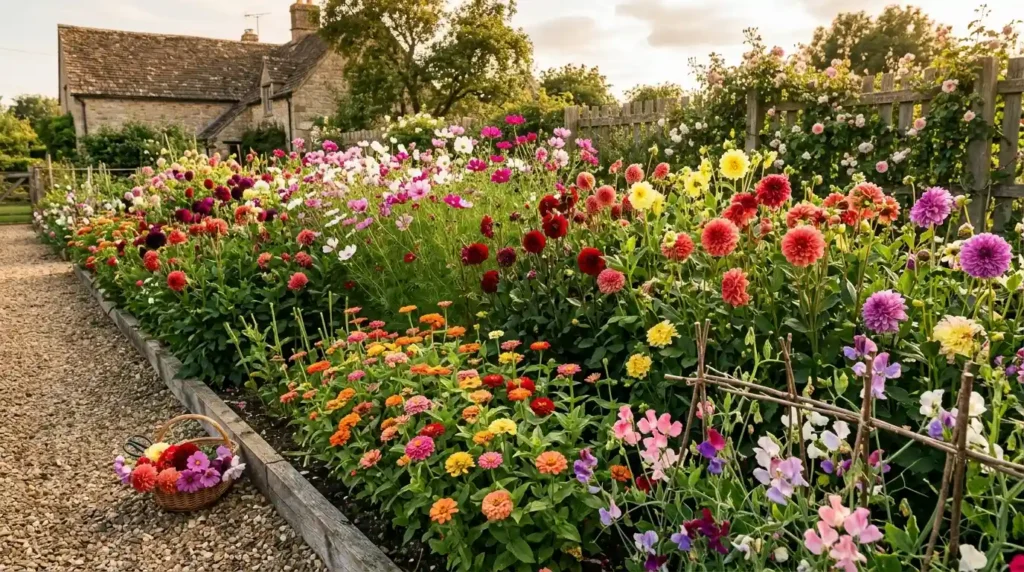
A cut flower border designed to produce both a beautiful garden display and a regular supply of fresh flowers for the house requires a different approach from a purely ornamental border — the plants must be chosen for their vase life and cutting stem length alongside their garden appearance, and the border must be planted densely enough that cutting never depletes the garden display entirely.
The cut flower varieties that perform best in both a garden border and a vase: dahlias in dinner plate and decorative forms for the longest cutting season from midsummer to frost. Zinnias for continuous summer color and excellent vase life. Cosmos bipinnatus for the most generous self-cutting — the more you cut, the more it produces. Sweet peas for fragrance that no other cut flower provides. Lisianthus for an extremely long vase life and a poppy-like flower form that looks expensive.
The cutting technique that makes the border more productive rather than less: cut stems early in the morning when stems are fully hydrated and flower buds are just opening rather than fully open. Place cut stems immediately in a bucket of cool water. Cutting encourages most annuals and many perennials to produce additional flower stems — a zinnia cut to one bud will typically produce three to four replacement stems from the nodes below the cut within two weeks.
7. The Rock and Alpine Border for a Low-Growing Textural Feature
✦ Best for: a sunny well-drained slope or raised position where alpine and rock garden plants create a distinctive low-growing border
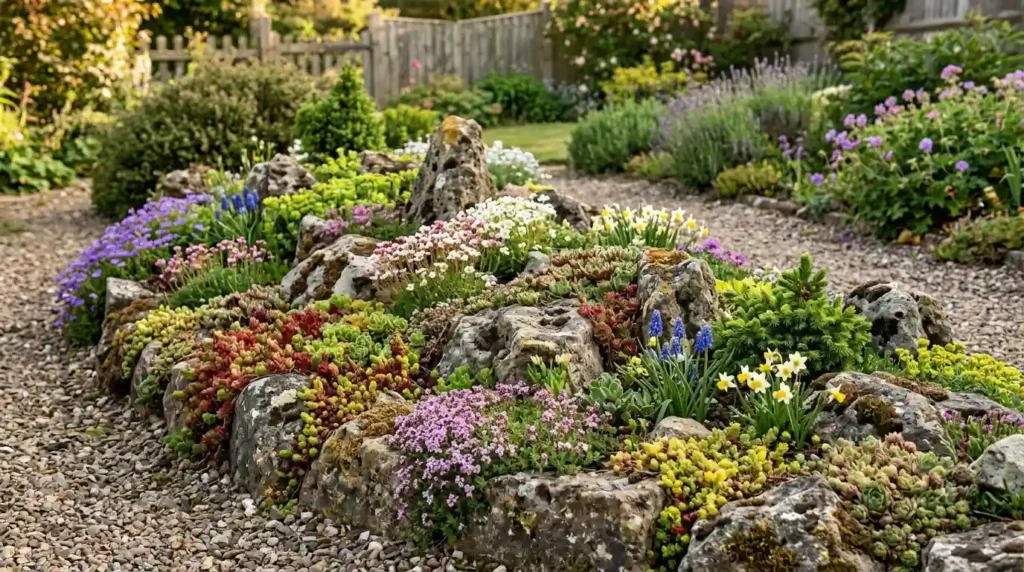
A rock and alpine border occupies a different height range from every other border type on this list — all of its plants grow below 30cm and most grow below 15cm, creating a completely different visual effect from the tiered structure of standard borders. This low-growing quality makes rock borders particularly effective in positions where a full-height border would block a view or where a low uniform texture at ground level suits the garden design better than vertical planting.
The placement of rocks within an alpine border is a design discipline in its own right — rocks should be buried to at least one-third of their depth to look like they belong in the ground rather than being placed on top of it, and should be tilted slightly backward so rainfall runs into rather than away from the planting pockets between them. Two or three larger rocks read as a natural outcropping while a collection of many small rocks of similar size reads as decorative stone rather than genuine rock garden.
Reliable alpine border plants for a first rock garden: Sempervivum (hens and chicks) for rosette form, year-round interest, and completely effortless cultivation — one of the most genuinely no-maintenance plants available. Sedum spathulifolium for silver-purple succulent foliage and yellow summer flowers. Creeping thyme for fragrant ground cover with small pink summer flowers. Armeria maritima (sea thrift) for its distinctive pink pom-pom flowers on fine grassy foliage mounds.
Low Maintenance Garden Border Ideas With Long Seasonal Interest
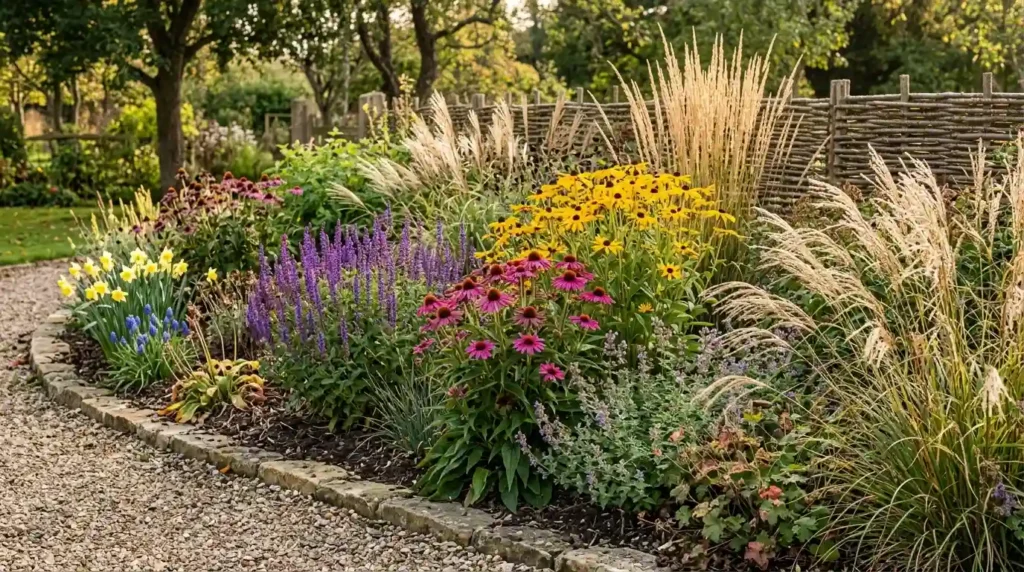
A garden border that provides genuine interest across all four seasons without requiring intensive maintenance achieves this by layering plants with different peak periods in the same planting space. Spring bulbs planted beneath deciduous perennials emerge and flower before the perennials grow tall enough to shade them. Summer perennials carry the color display through the main growing season. Late-season rudbeckia, echinacea seed heads, and ornamental grasses carry the border into autumn and winter.
The spring bulb layer works because most hardy perennials do not emerge from the ground until late April or May — the same soil that appears empty in February and March can be densely planted with tulip, narcissus, and allium bulbs that flower and die back before the perennials above them have grown enough to compete. A border that is all perennials has nothing to offer for three to four months of the year. The same border with a bulb layer underneath is in active display for nine or ten months.
The five plants that provide the longest combined seasonal interest in a low-maintenance border: Allium hollandicum ‘Purple Sensation’ for late spring. Salvia nemorosa ‘Caradonna’ for early to midsummer. Echinacea purpurea for midsummer to early autumn. Rudbeckia fulgida ‘Goldsturm’ for late summer to frost. Pennisetum alopecuroides ‘Hameln’ for autumn seed heads and winter structure after the other plants have been cut back. These five together provide unbroken visual interest from late April through February in most US climate zones.
📌 More garden ideas: Garden Path Ideas for a More Beautiful Backyard
Frequently Asked Questions
What plants are best for a garden border?
The best plants for a garden border depend on the border style and the available light, soil, and maintenance time. For a low-maintenance sunny border: Echinacea, Rudbeckia, Salvia nemorosa, ornamental grasses, and Sedum. For a classic herbaceous border: Delphiniums, Phlox, Achillea, Hardy Geraniums, and Nepeta. For a cottage garden border: Roses, Foxgloves, Hollyhocks, Sweet Peas, and Hardy Geraniums. According to the Royal Horticultural Society, the most consistently successful garden borders combine plants chosen for their different peak flowering periods to create continuous interest across the full growing season rather than a single flush of color.
How wide should a garden border be?
A garden border needs to be at least 90cm wide to accommodate a proper three-tier planting structure with low plants at the front, medium plants in the middle, and tall plants at the back. A border of 90cm allows only the narrowest version of this structure. A border of 1.2 to 1.5 meters is the practical minimum for a generous planting. A border of 1.8 to 2.4 meters allows a fully relaxed three-tier structure with comfortable spacing between plant groups and room for the plants to develop their natural forms without crowding.
How do I make my garden border look fuller?
Three changes make a garden border look fuller immediately: plant in groups of three, five, or seven of the same variety rather than one of each — five identical plants read as a bold color block while five different plants read as a collection. Apply a 5cm mulch layer between plants to suppress weeds and create a clean background that makes the plants read more clearly against it. Add annual plants in any gaps between perennials in the first two to three years while the perennials are establishing — annuals fill space quickly and provide color while the permanent planting matures.
What is the difference between a garden border and a garden bed?
A garden border typically runs along the boundary of another element — a path, a lawn edge, a wall, or a fence — and is viewed primarily from one side. A garden bed is an island planting surrounded by lawn, gravel, or paving and is viewed from all sides simultaneously, which requires a different planting approach with the tallest plants in the center and shorter plants graduating outward in all directions. Border planting uses a front-to-back height structure. Bed planting uses a center-to-edge height structure.
More Garden Ideas
→ Garden Edging Ideas That Make Your Yard Look Professionally Done
→ How To Create a Living Memorial Garden for a Father
→ How To Build a Small Pond With a Waterfall
Plant in groups first. Five of the same plant in one spot will do more for your border than fifteen different plants scattered across the same space.

Sheikh Hassaan is a digital architect for small businesses and the founder of The Glow Up System. He writes about home decor, garden design, and outdoor living for real American homes – practical ideas that work in actual spaces without oversized budgets.