
Living well in a small apartment is not about making peace with limitations — it is about designing so intelligently within them that the limitations stop being visible. Small apartment ideas that genuinely work do not try to make the space look bigger than it is through visual tricks alone. They make it function better, store more efficiently, and feel more personal than the square footage would suggest is possible.
This guide covers small apartment ideas organized by the specific challenges every small apartment presents — from furniture choices that serve multiple functions through storage solutions that use every available inch, lighting approaches that change how the space feels, and the finishing details that make a compact apartment feel like a genuinely considered home.
Table of Contents
The Small Apartment Mindset That Changes Everything
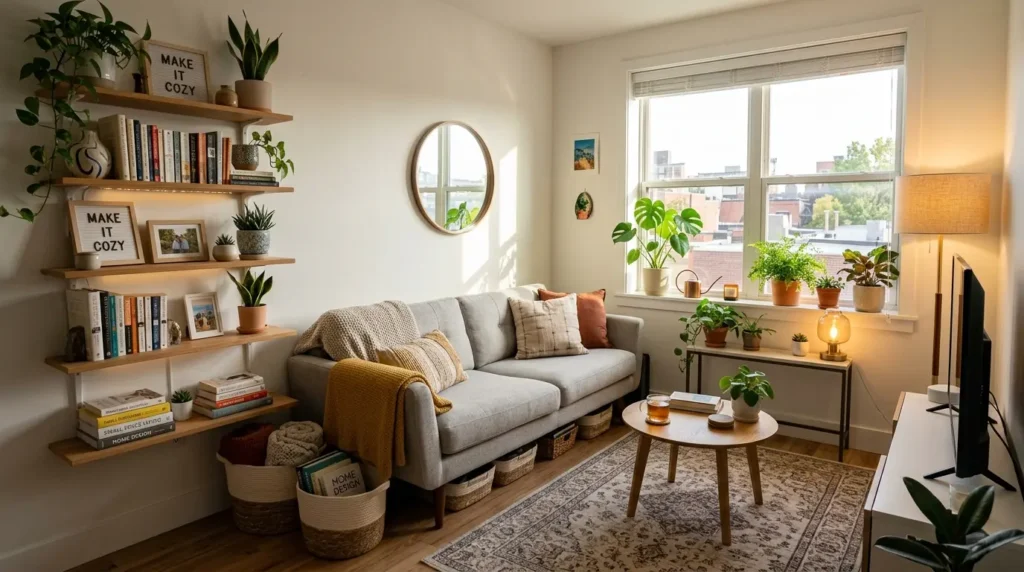
The most important shift in thinking for a small apartment is moving from decorating to designing. Decorating adds things. Designing considers the function and purpose of everything present and removes anything that does not contribute. A small apartment that has been decorated looks busy. A small apartment that has been designed looks intentional and feels significantly more spacious than its dimensions because every element earns its place.
The practical rule that applies to every furniture and storage decision in a small apartment: if an object only does one thing it needs to earn that single function exceptionally well to justify its floor footprint. A coffee table that is only a coffee table in a 400 square foot apartment is a harder sell than a storage ottoman that is simultaneously a coffee table, extra seating, and hidden storage. Every square foot of floor space has a cost — make each piece of furniture pay its rent.
The floor clearance principle that makes small apartments feel larger: the more floor surface that is visible the larger the apartment reads. Furniture with legs rather than furniture that sits directly on the floor reveals the floor beneath it and creates the impression of more space. A sofa on legs, a bed frame with visible clearance beneath, side tables on slim legs — each one reveals floor that contributes to the sense of spaciousness.
1. Floor-to-Ceiling Storage That Uses the Full Height of Every Wall
✦ Best for: any small apartment where floor space is critically limited and wall height is underused
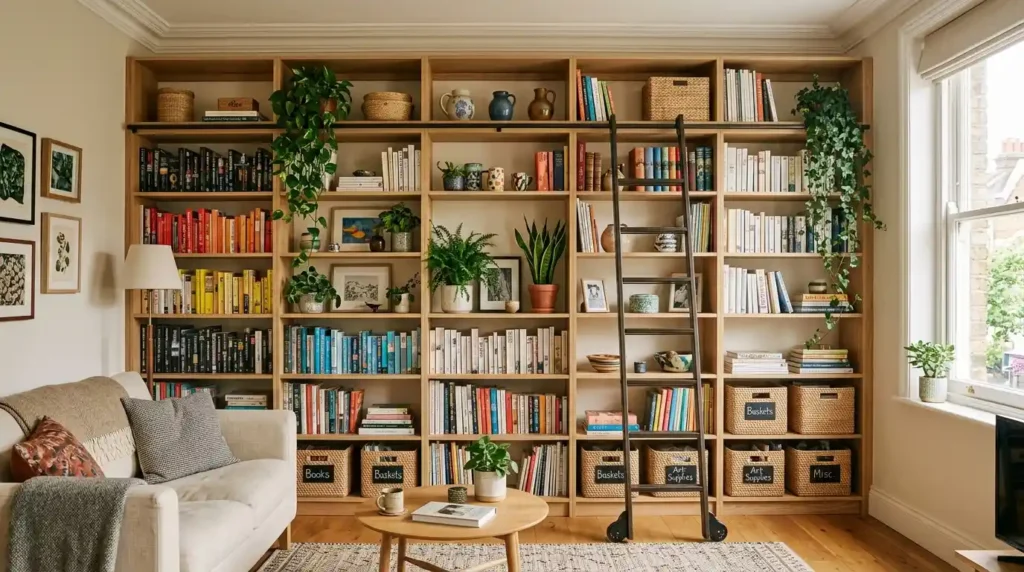
The most underused dimension in any small apartment is height. Standard furniture occupies the first 30 to 36 inches from the floor — leaving everything above that to ceiling height completely empty. In a typical flat with 8-foot ceilings that is more than 4 feet of storage potential per wall that sits unused. Floor-to-ceiling shelving on one full wall converts that unused vertical space into the most abundant storage available without occupying a single additional square foot of floor.
A floor-to-ceiling bookshelf unit on the main living room wall — either a built-in installation or a freestanding unit like the IKEA Billy with extension units — provides storage for books, decorative objects, plants, and concealed storage baskets across its full height. The visual impact of a full wall of shelving makes a small apartment feel more substantial and more considered than bare walls, because a furnished wall communicates deliberate habitation rather than temporary occupancy.
The styling approach that keeps floor-to-ceiling shelving from feeling oppressive in a small apartment: keep the upper shelves lighter and more decorative than the lower shelves. Heavy books and concealed storage boxes at the lower levels. Plants and lighter objects toward the top. This visual weight distribution creates the impression of the shelving being grounded rather than top-heavy.
2. A Sofa That Hides Storage Underneath Without Looking Like It Does
✦ Best for: small apartment living rooms where the sofa footprint is the largest single piece of furniture and its storage potential is currently wasted
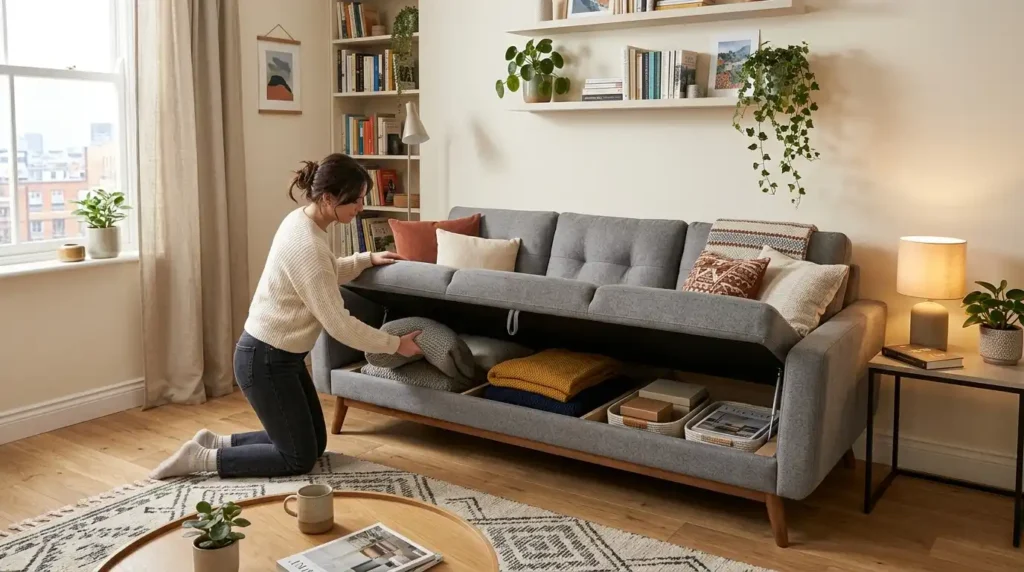
The sofa is typically the largest single piece of furniture in a small apartment living room — it occupies 20 to 25 square feet of floor area that a storage sofa uses simultaneously as seating and hidden storage. A chaise sofa or corner sofa with lift-up storage beneath the seat cushions provides the equivalent of a full ottoman or storage chest without using any additional floor space beyond the sofa’s existing footprint.
Storage sofas suit specific storage categories particularly well: extra bedding and seasonal throws that are used occasionally but need to be accessible. Board games and entertainment items that need to be nearby but not visible. Extra cushion covers and textile accessories that change seasonally. These are all bulky items that traditionally occupy wardrobe or under-bed space — moving them to the sofa storage frees that space for clothing and daily essentials.
The furniture pairing that maximizes the storage sofa’s effectiveness: a storage ottoman as the coffee table in front of a standard sofa, rather than a storage sofa with a standard coffee table. Either combination achieves the same storage outcome — the choice depends on which piece of furniture is the larger investment and which storage category is the priority.
3. Mirrors Positioned to Double the Visual Space of Any Room
✦ Best for: dark or narrow rooms in a small apartment where the visual impression of space needs to be improved without any structural changes
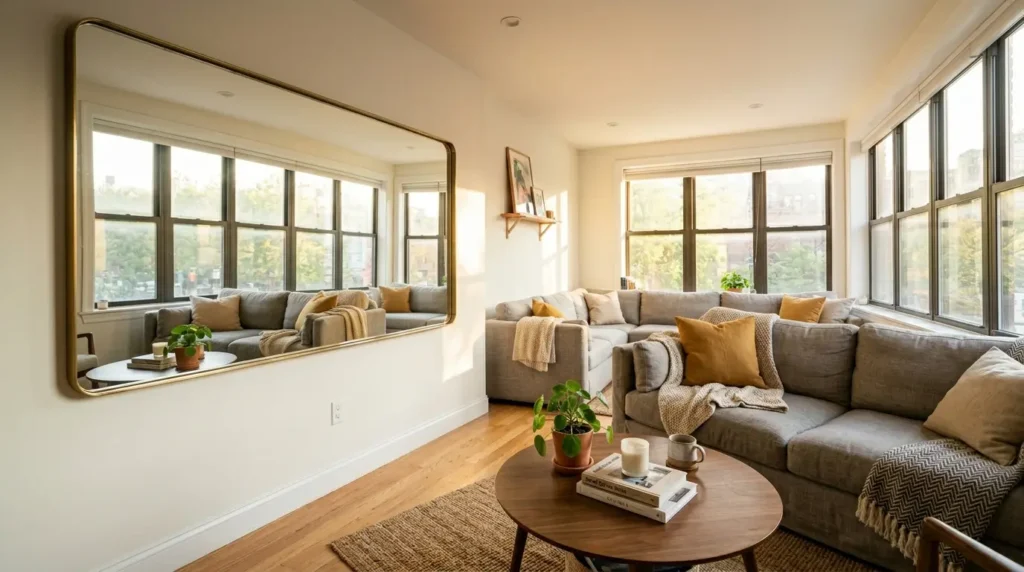
A large mirror positioned correctly in a small apartment creates the single most dramatic visual space improvement available without any construction or permanent change — it literally doubles the apparent depth of the room by creating the impression of an additional space beyond the mirror surface. The key word is positioned correctly — a mirror facing a blank wall reflects the blank wall. A mirror facing a window or a furnished area reflects light and depth.
The most effective mirror positions in a small apartment: opposite a window — the mirror reflects the window and the natural light entering through it back into the room, effectively doubling the light source and making the room feel brighter and larger simultaneously. On the wall at the end of a narrow hallway — a mirror at the end of a corridor visually extends the corridor into apparent infinity, removing the closed-in quality of a short hallway. On the back of a bedroom door — a full-length mirror on the door provides the practical function of a full-length reflection while keeping the floor completely clear.
A large floor-leaning mirror — a full-length mirror leaned against a wall rather than mounted — is the most impactful and most renter-friendly mirror option because it requires no wall fixings, can be repositioned easily, and its large format creates more visual depth than a smaller wall-mounted mirror. A mirror of at least 24 by 60 inches creates genuine spatial impact. Smaller mirrors add visual interest but do not create the space-expanding effect that a large format mirror achieves.
4. Light Colors and Continuous Flooring That Make Rooms Feel Connected
✦ Best for: small apartments where different rooms or zones use different flooring materials creating visual interruptions that make the space feel smaller and more fragmented
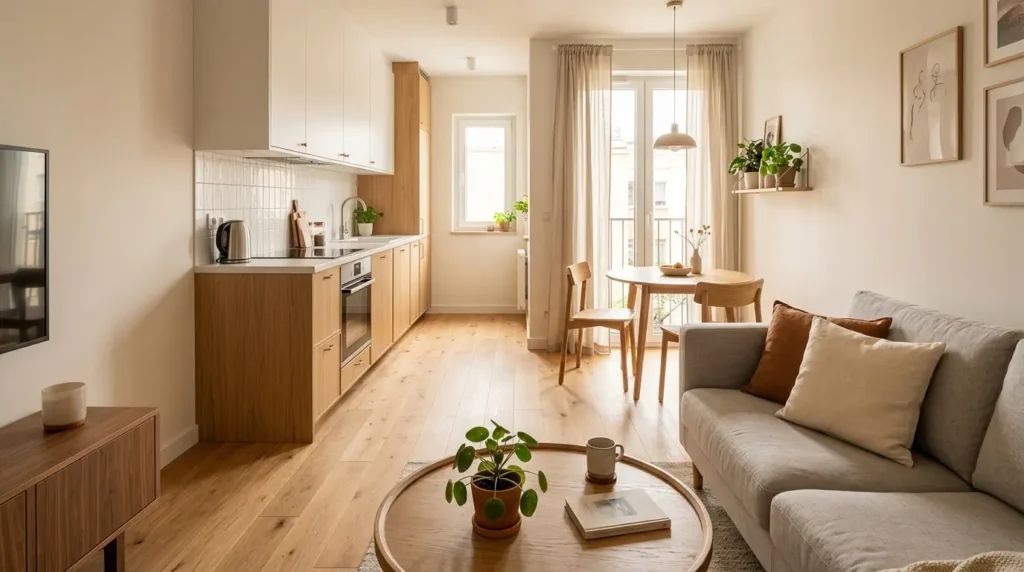
Color choice and flooring continuity have more effect on the perceived size of a small apartment than almost any furniture decision. Light colors on walls, ceilings, and floors reflect light around the space rather than absorbing it — the same apartment painted in warm white feels measurably larger than the same apartment painted in a medium gray or dark color under identical lighting. This is not a visual trick — it is a physical property of light-colored surfaces that delivers genuine spatial benefit.
Continuous flooring throughout a small apartment — the same material running from the entrance through the living area, kitchen, and bedroom without any transition strips or changes — removes the visual interruptions that divide a small floor plan into even smaller perceived zones. Each flooring transition is a visual boundary that tells the eye a new smaller space has begun. Removing those boundaries makes the total floor plan read as one continuous space rather than several small rooms.
For renters who cannot change the flooring: area rugs in consistent tones placed in each zone create a version of this continuity at the rug level — a warm pale rug in the living area and a matching pale rug in the bedroom create a visual thread that connects the two zones even if the underlying floor changes between them.
5. A Dining Area That Folds Away When the Meal Is Done
✦ Best for: small apartments where a permanent dining table occupies significant floor space that would be more useful as clear living area for most of the day
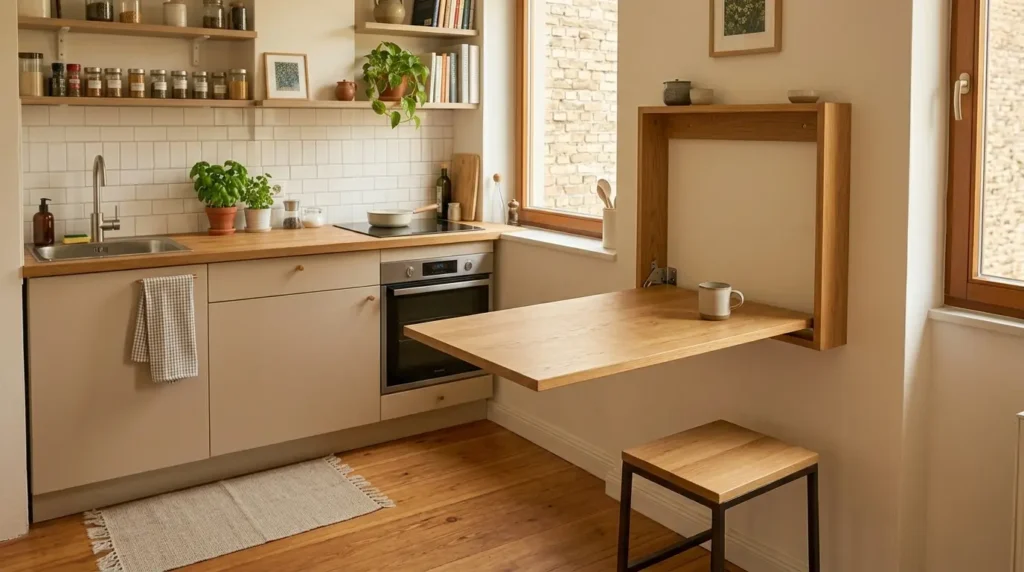
A standard four-person dining table occupies 15 to 20 square feet of floor space permanently — for a small apartment this is a significant commitment to a surface that is actively used for perhaps two hours per day at most. A fold-down wall-mounted dining table provides the same functional dining surface when needed and folds completely flat against the wall when not in use, returning 15 to 20 square feet of clear floor to the living area for the other 22 hours of the day.
The fold-down table works best in a small apartment when paired with stools that tuck completely beneath it when the table is in use — the stools disappear under the table rather than requiring their own floor space beside it. Bar-height fold-down tables with matching bar stools are the most space-efficient combination because the stool height allows the table to fold down to a narrower profile against the wall.
Alternatively a narrow console table against the wall that extends with a fold-out leaf when needed accommodates two to four diners in its extended form and functions as a desk or display surface in its compact form. The dual-function console and dining table combination suits small apartments that need both a work surface and an occasional dining surface without dedicating permanent floor space to either.
6. Curtains Hung From Ceiling Height to Make Every Window Look Bigger
✦ Best for: any small apartment where the windows feel small or the ceilings feel low and a simple textile change can address both
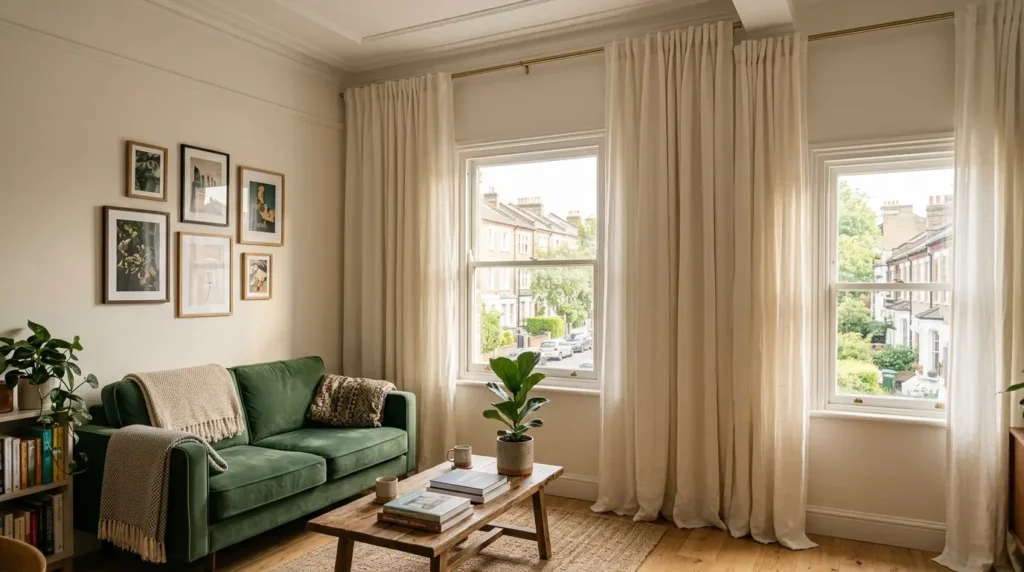
Hanging curtains from ceiling height rather than from just above the window frame is one of the most impactful and least expensive improvements available in any small apartment — it costs nothing beyond the cost of longer curtains and makes the ceiling feel taller, the window feel larger, and the room feel more generous simultaneously. The eye follows the curtain fabric from ceiling to floor and reads the entire height as window rather than registering where the actual window frame begins and ends.
The curtain rod should be mounted as close to the ceiling as possible — ideally within 4 to 6 inches. The curtains should fall to the floor or just barely skim it rather than ending at the window sill or below-sill height. This floor-to-ceiling treatment works with any window size — even a small window that extends only 3 feet reads as a generous architectural feature when framed by ceiling-height curtains on either side.
The curtain color that maximizes the effect in a small apartment: a tone close to the wall color rather than a contrasting color. Curtains that blend into the wall read as an extension of the wall and make the room feel wider. Curtains in a strongly contrasting color create a visual boundary that interrupts the wall surface and makes the room feel narrower than it is.
7. Layered Lighting That Makes a Small Apartment Feel Like a Luxury Home
✦ Best for: any small apartment where a single overhead light is the only source of illumination making the space feel flat and uninviting
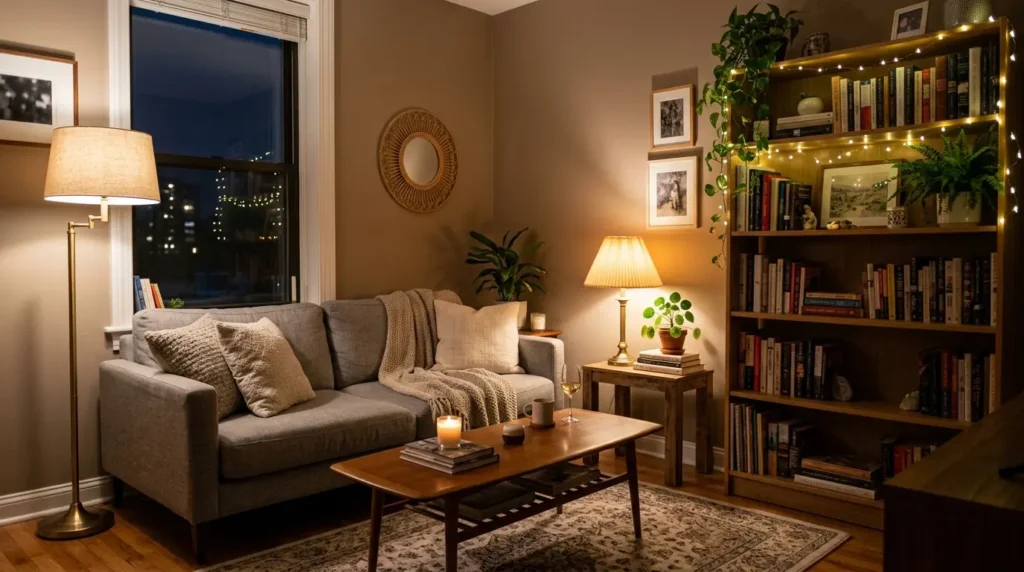
The single most impactful improvement available in any small apartment costs under $100 and takes one afternoon: adding a floor lamp and a table lamp so the apartment has three light sources rather than one. A single overhead ceiling light illuminates the room uniformly from above — it creates no shadows, no depth, no atmosphere, and no visual interest. Three light sources at different heights create the layered warm pools of light that make any space feel significantly more sophisticated and more spacious than flat overhead illumination.
The layered lighting approach for a small apartment living area: overhead light on a dimmer set to low or turned off entirely in the evening. A floor lamp in one corner providing directional warm light that creates depth and shadow in that corner. A table lamp on a side table or bookshelf providing a second warm pool at a lower level. Fairy lights or a small lamp on a shelf providing the lowest level of ambient warmth. All bulbs at 2700K warm white without exception.
The psychological effect of warm layered lighting in a small apartment is genuine and significant — the same apartment that feels cramped and uninviting under flat overhead fluorescent light feels warm, intimate, and genuinely comfortable under warm layered light at multiple levels. This is the change that costs the least, requires no permission from a landlord, and produces the most immediate transformation in how the apartment feels to be in.
📌 More home decor ideas: Studio Apartment Ideas That Look Surprisingly Luxurious
Frequently Asked Questions
How do I make a small apartment feel bigger?
The most effective ways to make a small apartment feel larger: use light or white wall colors throughout to maximize light reflection. Install floor-to-ceiling curtains hung close to the ceiling to make ceilings feel taller. Place a large mirror opposite a window to reflect light and create the impression of additional depth. Use furniture with visible legs rather than furniture that sits on the floor to reveal more floor surface. Keep the floor as clear as possible — visible floor reads as space. Switch all bulbs to 2700K warm white and add floor and table lamps to create layered lighting rather than relying on a single overhead source. According to research from University College London’s Bartlett School of Architecture, lighting quality and color temperature have the most significant effect on perceived room size of any non-structural intervention available in residential spaces.
What furniture works best in a small apartment?
The furniture choices that work best in a small apartment prioritize multiple functions over single functions: a storage ottoman that functions as coffee table, seating, and hidden storage simultaneously. A bed frame with built-in under-bed storage drawers that eliminates the need for a separate dresser. A fold-down wall-mounted dining table that returns its floor space to the room when not in use. A storage sofa or chaise with lift-up storage beneath. A floor-to-ceiling bookshelf unit that uses vertical space rather than floor space. Each of these pieces justifies its footprint by serving at least two functions rather than one.
What color makes a small apartment look bigger?
Warm white and very light off-white are the colors that most reliably make a small apartment feel larger because they reflect light throughout the space rather than absorbing it. The specific white tone matters — a warm white with slight yellow or cream undertones avoids the cold clinical quality of a stark cool white while maintaining maximum light reflectivity. Pale sage green and soft warm greige are the non-white alternatives that work best in small apartments — both are light enough to reflect adequate light while adding color warmth that makes the space feel more considered than plain white.
How do I add storage to a small apartment without it looking cluttered?
Storage in a small apartment looks considered rather than cluttered when it uses consistent containers and a consistent visual approach — baskets of the same material on shelves, boxes of the same color in a wardrobe, uniform storage containers on open shelves. The visual noise of storage comes from variety — different sized containers in different colors and materials all visible simultaneously. Replacing that variety with a consistent storage system makes even a heavily loaded shelf look organized. Concealed storage — drawers, cabinet doors, lift-up ottoman lids — eliminates the visual noise entirely by removing stored items from the sightline.
More Home Decor Ideas
→ Galley Kitchen Ideas That Maximize Every Inch
→ Master Bedroom Ideas That Make You Never Want to Leave
→ Boho Bedroom Ideas You’ll Want to Copy
Add the floor lamp first. It costs under fifty dollars, takes ten minutes to set up, and makes the apartment feel completely different by evening. Start there before changing anything else.

Sheikh Hassaan is a digital architect for small businesses and the founder of The Glow Up System. He writes about home decor, garden design, and outdoor living for real American homes – practical ideas that work in actual spaces without oversized budgets.