

A studio apartment presents a specific design challenge that most other living situations do not — every function of daily life has to coexist in a single room without any of them undermining the others. Studio apartment ideas that genuinely work solve this challenge not by making the space look bigger than it is but by making it function better than it appears it should, creating clear zones for sleeping, working, cooking, and relaxing within a single floor plan.
This guide covers studio apartment ideas organized by the specific problems every studio resident faces — from dividing the space without walls through furniture choices that serve multiple functions, storage solutions that work within tight limits, and the finishing details that make a studio apartment feel like a considered home rather than a single room with all your belongings in it.
Table of Contents
The One Principle That Makes Every Studio Apartment Work
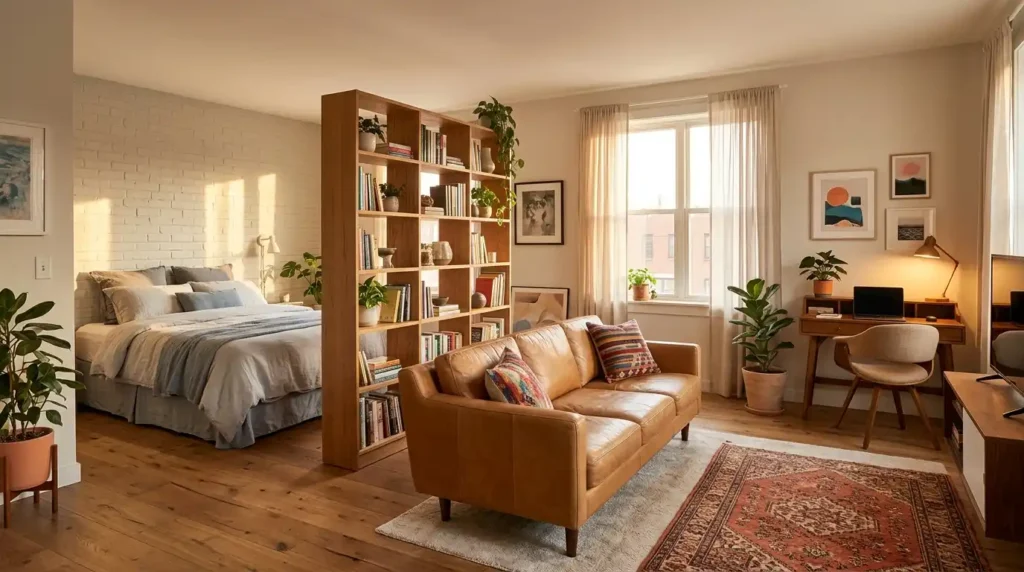
The principle that makes studio apartment living genuinely comfortable rather than merely manageable: zone the space deliberately so each area has a clear primary function and the brain associates each zone with that function. A studio where the bed is visible from every point in the room, the desk is pushed against a wall beside the kitchen, and the sofa faces the bed trains the brain to associate the entire space with sleep — which makes it harder to feel alert when working and harder to switch off when trying to sleep.
Creating zones in a studio does not require walls or room dividers — furniture orientation, rugs, and lighting do the same work. A sofa placed with its back to the sleeping area and facing toward a TV or window creates a living zone that feels separate from the bedroom zone even though both exist in the same room. A rug under the sofa and coffee table creates a floor boundary that reinforces the zone definition. A different light source in each zone — a floor lamp in the living area, a bedside lamp in the sleeping area — activates and deactivates each zone independently.
The furniture orientation rule that makes the biggest single difference in a studio apartment: the bed and the sofa should not face the same direction. When both face the same wall the room reads as a single space with furniture in it. When they face different directions they create two distinct zones that feel psychologically separate even without physical separation.
1. Using a Bookshelf as a Room Divider Between Sleeping and Living Zones
✦ Best for: studios with enough floor space to place a freestanding unit perpendicular to a wall without making the remaining zones too small
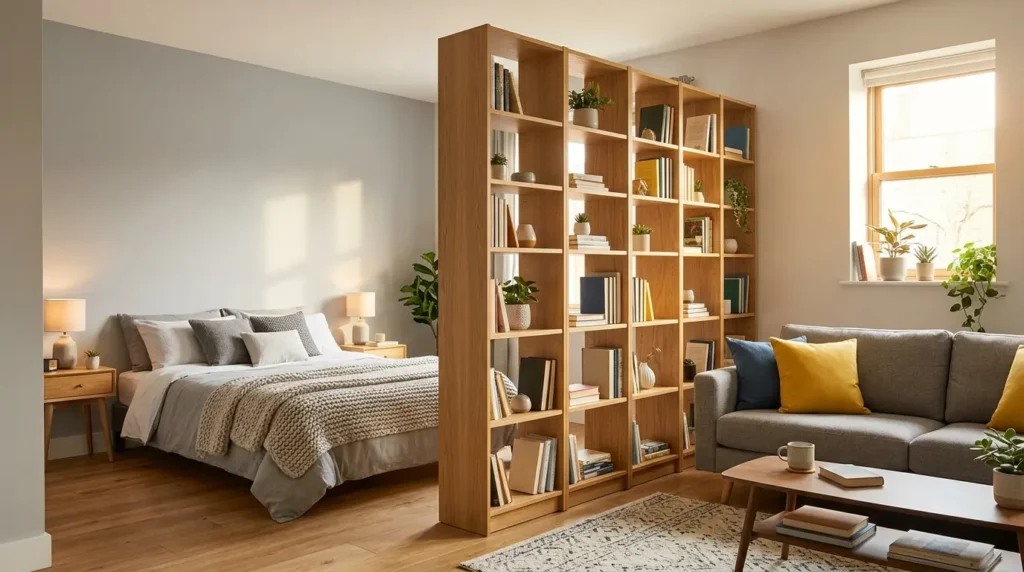
A freestanding open bookshelf placed perpendicular to the wall — jutting into the room rather than sitting against it — creates a partial room divider that separates the sleeping area from the living area without blocking light or making either zone feel enclosed. An open-back shelving unit allows light to pass through from both sides, which means the studio retains its openness while gaining the psychological benefit of defined separate zones.
The IKEA Kallax or Billy bookshelf range suit this application well because their open design and consistent proportions create a clean partition that reads as a considered design decision rather than an obstacle placed across the room. A unit of four cubes wide and two cubes tall — approximately 58 inches wide and 30 inches tall — provides enough visual separation to define two zones without cutting off the sightline completely or making either side of the partition feel boxed in.
Style the bookshelf from both sides — books and objects visible from the living area face outward toward the sofa, while the back of the unit faces the sleeping area and can be used as a headboard backdrop with a small lamp placed on top. The unit serves as storage, room divider, and headboard substitute simultaneously — the kind of multi-function furniture thinking that makes studio apartment living genuinely comfortable.
2. A Murphy Bed or Sofa Bed That Reclaims the Floor During the Day
✦ Best for: very small studios where the bed footprint dominates the room and daytime living quality suffers as a result
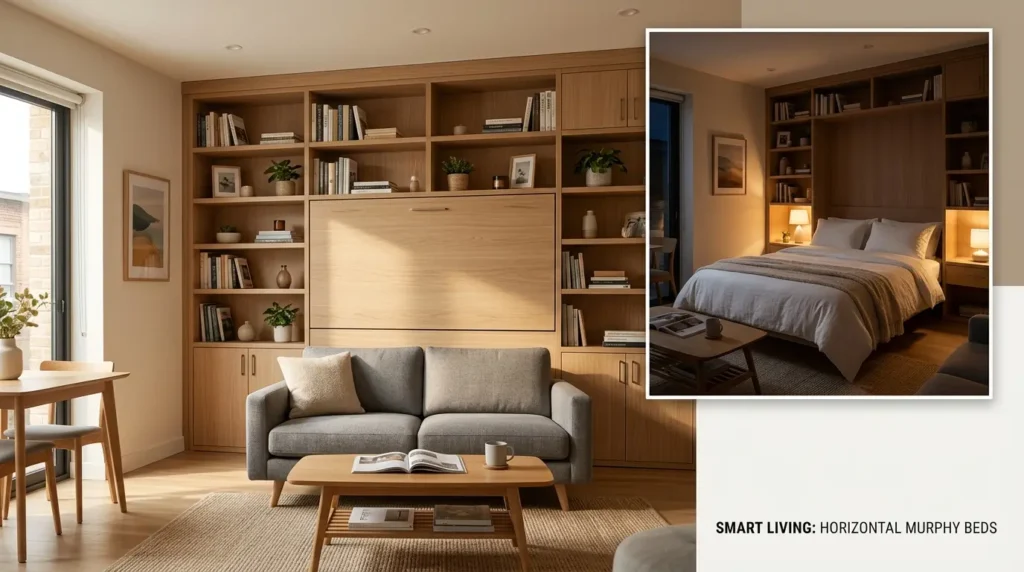
In a studio apartment under 300 square feet a double or queen bed occupies 35 to 45 percent of the total floor area. A murphy wall bed — a bed frame that folds vertically into a wall cabinet when not in use — converts that 35 to 45 percent of floor space back to usable living area during every waking hour. The difference in daytime quality of life between a studio with a permanent bed on the floor and one with a murphy bed is significant enough that it justifies the $800 to $2,000 installation cost for most people living in a very small studio long-term.
Modern murphy bed systems include integrated shelving and desk units on the surrounding panels — the wall cabinet looks like built-in storage or a home office unit when the bed is folded up, and converts to a bedroom in under 30 seconds when the bed is needed. Some systems include a sofa that rotates to face outward when the bed is stowed and becomes the foot-end of the bed when it folds down, eliminating the sofa storage problem that standard murphy beds create.
A quality sofa bed is a lower-cost alternative to a murphy bed that works reasonably well in studios where the priority is occasional flexibility rather than daily space transformation. The honest limitation of sofa beds: the sleeping comfort is generally lower than a dedicated mattress and the daily conversion between sofa and bed modes is more disruptive than a murphy bed’s fold-up action. For a studio resident who works from home and needs a genuinely functional living space every day a murphy bed is worth the additional investment.
3. Multi-Function Furniture That Does Two Jobs in the Space of One
✦ Best for: any studio apartment where every piece of furniture needs to justify its floor footprint by serving more than one function
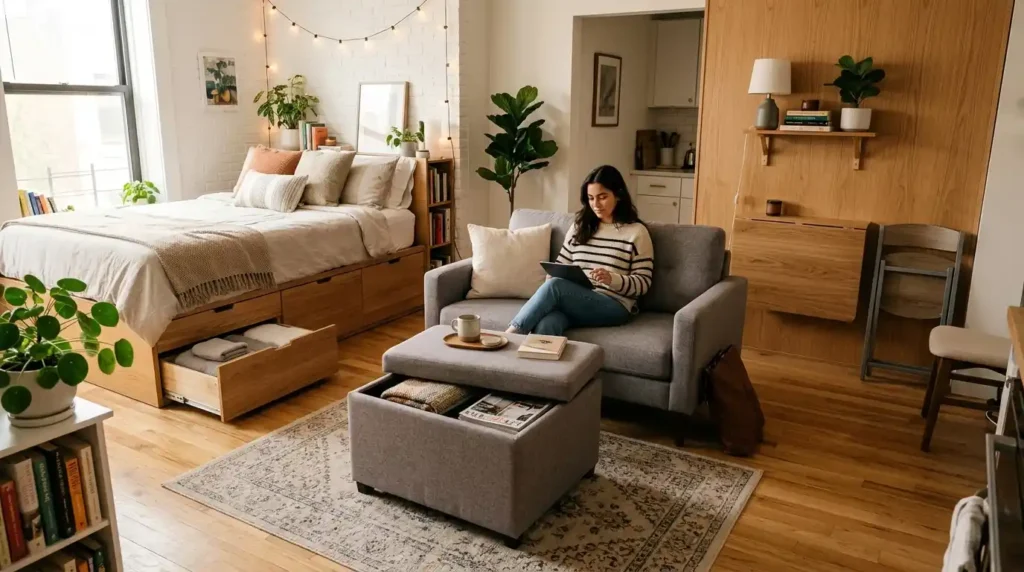
Every piece of furniture in a studio apartment should be evaluated against one question: does it do more than one job? A standard coffee table that only functions as a coffee table is a luxury a studio can rarely justify. The same footprint occupied by a storage ottoman — which functions as a coffee table, extra seating, and storage simultaneously — is justified three times over.
The multi-function pieces worth prioritizing:
A storage ottoman as the primary living area surface — provides seating, storage, and coffee table function. A bed frame with built-in drawers — eliminates the need for a separate dresser. A fold-down wall-mounted dining table — provides a dining or work surface when needed and disappears flat against the wall when not in use, reclaiming floor space in the kitchen or dining zone. A bench at the foot of the bed with hidden storage — provides seating for putting on shoes and stores extra bedding or seasonal clothing.
The multi-function furniture rule: the second function must be genuinely used regularly — not theoretically possible. A dining table that converts to a pool table is theoretically two functions but practically one if the pool table function is used twice a year. Multi-function furniture earns its place when both functions are part of the daily or weekly routine.
4. Vertical Storage That Uses the Walls Instead of the Floor
✦ Best for: studios where floor space is critically limited and wall height is the only storage dimension that has not been fully utilized
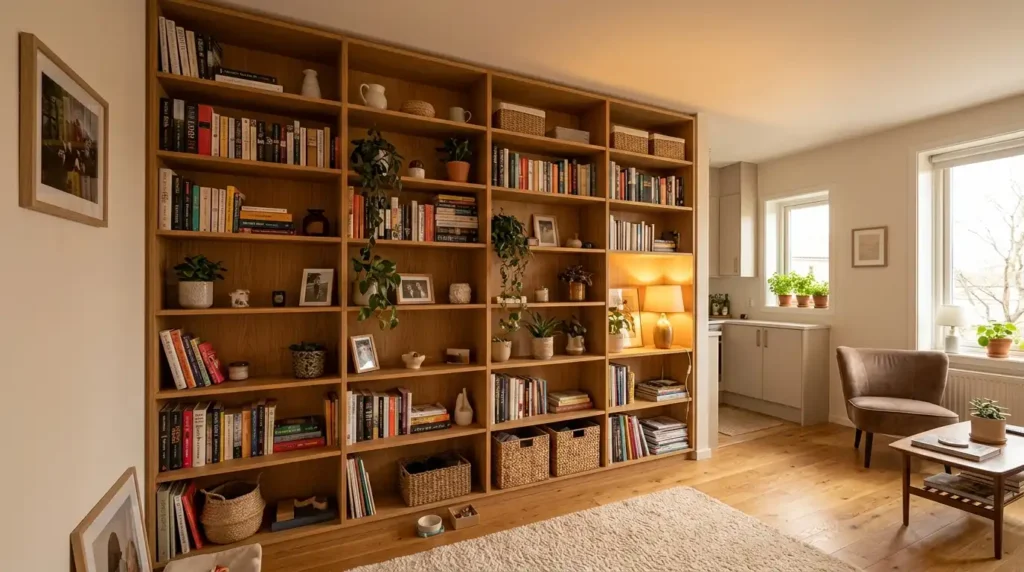
The most underused dimension in a studio apartment is height. Most studio furniture occupies 30 to 36 inches of vertical space — a standard dresser, a sofa, a bed — leaving everything above 36 inches to ceiling height completely empty. In a studio with 8-foot ceilings that is more than 4 feet of vertical storage potential per wall that most layouts leave entirely unused.
Floor-to-ceiling shelving on one full wall creates the single most abundant storage solution available in a studio apartment without occupying any additional floor space beyond the depth of the shelf brackets — typically 10 to 12 inches. A full wall of shelving at 8 feet tall and 10 feet wide provides roughly 80 square feet of storage surface in a footprint of less than 10 square feet — the best storage efficiency ratio available in any furniture format.
The styling principle for floor-to-ceiling shelving in a studio apartment: treat the lower shelves from floor level to 60 inches as functional storage — books, boxes, folded items, kitchen overflow. Treat the upper shelves from 60 inches to ceiling as display and visual interest — plants, artwork, decorative objects. The lower zone is organized for use. The upper zone is organized for appearance. This two-zone approach creates a shelving wall that looks designed rather than simply packed.
5. Creating a Bedroom Zone With Curtains Instead of Walls
✦ Best for: renters who cannot make permanent structural changes but want genuine visual separation between the sleeping and living areas
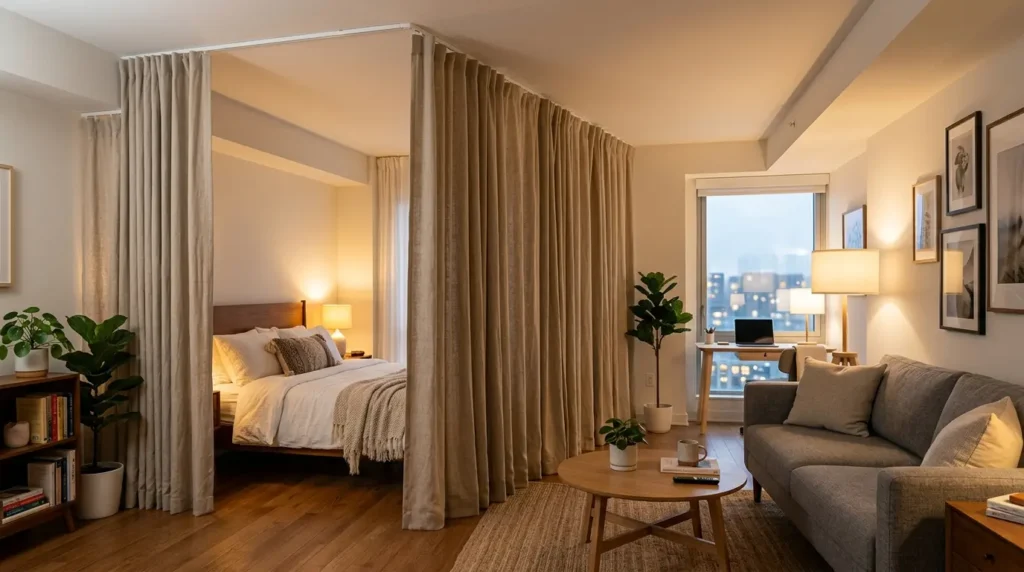
A ceiling-mounted curtain track running across the width of a studio apartment creates the most effective and most renter-friendly bedroom zone available — when the curtains are drawn the sleeping area becomes a genuinely separate enclosed space with its own light, its own atmosphere, and complete visual privacy from the rest of the studio. When the curtains are open the full studio floor plan is restored.
The curtain track should be ceiling-mounted rather than hung from a tension rod — a tension rod creates a barrier at rod height but not above it, which defeats the enclosure purpose. A ceiling-mounted track with floor-length curtains creates a complete visual partition from ceiling to floor that reads as a genuine room division rather than a decorative gesture. Most landlords permit ceiling-mounted curtain tracks because they require only small screw holes that are easily patched.
The curtain fabric for a studio apartment room divider should be heavy enough to block light when drawn — a sheer curtain that allows light to pass through creates ambiance but not genuine zone separation. A medium-weight linen or velvet curtain in a warm neutral tone provides both the light-blocking quality and the visual warmth that makes the enclosed sleeping zone feel like a genuine bedroom rather than a partitioned corner.
6. A Compact Home Office Zone That Does Not Eat the Whole Room
✦ Best for: studio residents who work from home and need a functional desk setup without sacrificing the room’s living quality
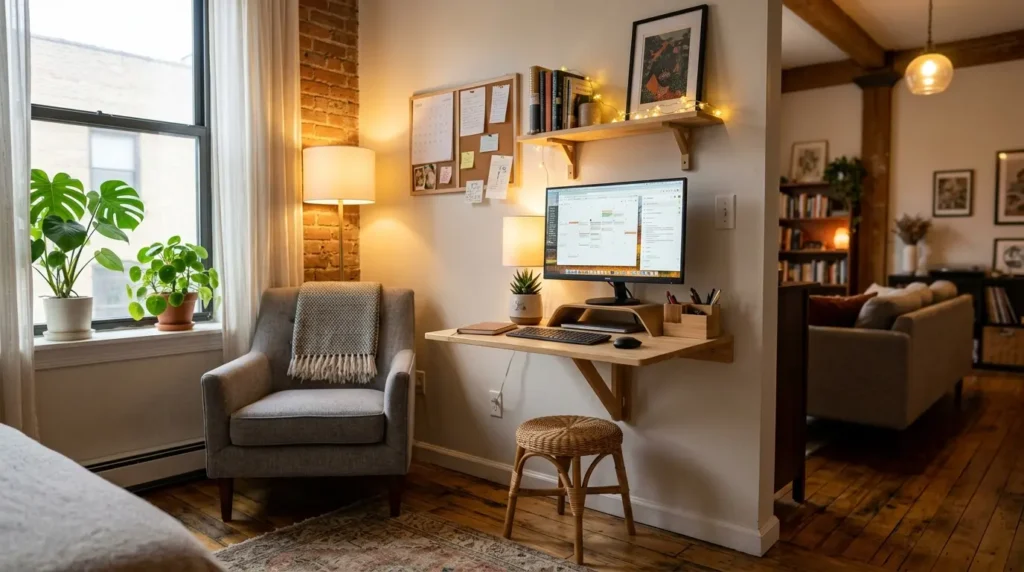
A home office in a studio apartment needs to be genuinely functional during working hours and visually recessive during non-working hours. A large freestanding desk in the center of a studio apartment dominates the room’s living quality permanently — it is always present and always reads as work space regardless of whether work is happening. A wall-mounted or fold-down desk solution provides equivalent functionality during work hours while disappearing from the visual field when the work day ends.
The best compact desk solutions for a studio apartment: a wall-mounted floating shelf at desk height — 28 to 30 inches from the floor — that is deep enough to accommodate a laptop (at least 20 inches) and provides a fixed work surface that takes zero floor space. A fold-down wall desk that opens to a usable work surface and folds flat against the wall when not needed. A narrow console table repurposed as a standing desk positioned against a wall rather than projecting into the room.
The work-from-home studio challenge that furniture alone cannot solve: the psychological transition between work mode and home mode is harder when both happen in the same room. Creating a physical ritual that marks the end of the work day — closing the laptop and putting it in a drawer, folding down the desk surface, covering the work area with a cloth — helps the brain register that work is over even when the physical space has not changed.
7. Making a Studio Apartment Feel Warm and Personal Rather Than Temporary
✦ Best for: any studio apartment where the functional layout is resolved but the space still feels like a temporary rental rather than a genuine home
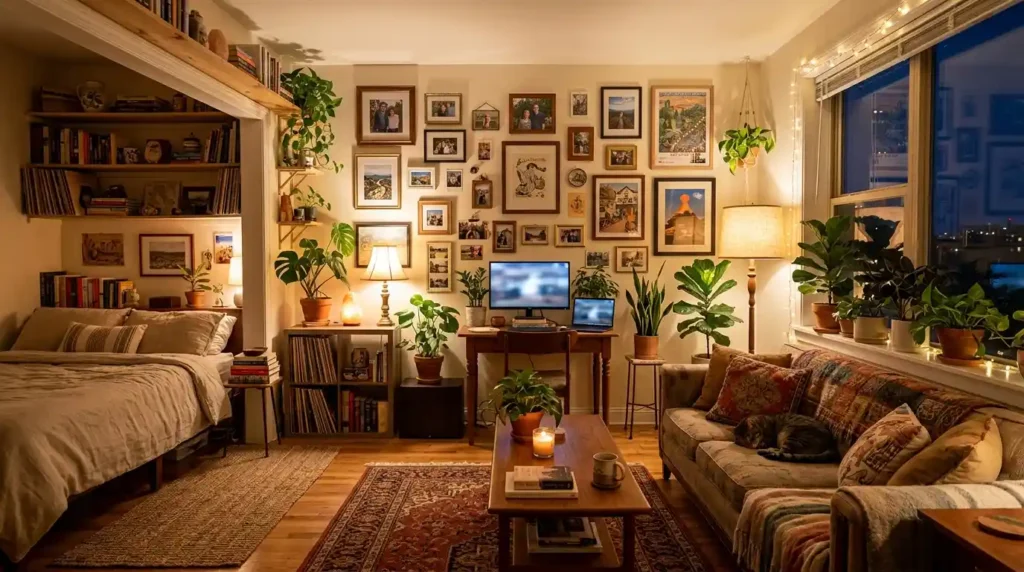
The difference between a studio apartment that feels like a home and one that feels like a furnished rental is not size or budget — it is the presence of personal objects that communicate that a specific person lives there. A studio apartment with art on the walls, plants that have been tended over time, books that have been read, and objects that arrived from meaningful places feels like a home regardless of its size. The same studio with bare walls, a generic rug, and furniture that came with the flat feels temporary regardless of how long the resident has lived there.
The finishing layer that most directly creates a home atmosphere in a studio apartment: warm layered lighting from multiple sources rather than a single overhead bulb. A floor lamp in the living zone, a bedside lamp in the sleeping zone, and fairy lights or candles on a surface create the pool-of-light quality that makes any space feel inhabited and cared for in the evening. All bulbs at 2700K warm white — the single most impactful setting change available in any apartment at zero cost.
Plants in a studio apartment add genuine life that no decorative object replicates — a trailing pothos on a shelf, a small monstera in a corner, or a collection of succulents on the windowsill introduces organic warmth and signals that the space is genuinely tended rather than merely occupied. A studio apartment with plants always feels more like a home than the same studio without them, regardless of every other design decision.
📌 More home decor ideas: Galley Kitchen Ideas That Maximize Every Inch
Frequently Asked Questions
How do you make a studio apartment feel bigger?
The changes that most effectively make a studio apartment feel larger: use light colors on walls, floors, and furniture to reflect light rather than absorb it. Keep the floor as clear as possible — visible floor reads as space. Use furniture with legs rather than furniture that sits directly on the floor, which creates the impression of more floor area. Install floor-to-ceiling curtains hung close to the ceiling rather than at window height — this makes the ceiling feel higher and the window feel larger. Use mirrors strategically — a large mirror on one wall creates the impression of an additional room beyond it. According to interior design research published by the Design Council, the single most effective spatial intervention in small apartments is lighting quality improvement — bright warm layered lighting consistently makes spaces feel larger and more welcoming than the same space under dim or flat overhead lighting.
How do you separate a bedroom from a living room in a studio apartment?
The most effective ways to create a bedroom zone in a studio apartment without permanent construction: a ceiling-mounted curtain track with floor-length curtains that can be drawn to enclose the sleeping area completely. A freestanding open bookshelf placed perpendicular to the wall as a partial room divider. Different rugs in each zone — a rug under the bed and a different rug under the sofa and coffee table creates floor-level zone definition that the brain registers as separate spaces. Facing the sofa away from the bed so the two pieces of furniture look in different directions rather than sharing the same sightline.
What furniture is essential in a studio apartment?
The essential furniture for a studio apartment that keeps floor space as clear as possible: a bed frame with built-in under-bed storage drawers — eliminates the need for a separate dresser. A storage ottoman as the living area surface — replaces a coffee table while adding storage. A floor-to-ceiling shelving unit on one wall — provides abundant storage without floor footprint. A fold-down or wall-mounted desk — provides a work surface without permanent floor space commitment. Every additional piece beyond these four should justify its floor footprint with a clear functional purpose.
How do you decorate a studio apartment on a budget?
Studio apartment decorating on a budget prioritizes the changes with the highest visual impact per dollar: switch all light bulbs to warm white 2700K — costs under $20 and immediately transforms the apartment’s evening atmosphere. Add one large rug under the sofa and coffee table — defines the living zone and adds warmth for $50 to $150. Hang curtains from ceiling height to floor rather than at window height — costs $30 to $80 and makes the ceiling feel higher. Add plants — a large pothos or snake plant costs $10 to $20 and immediately makes the space feel inhabited. Print and frame personal photos — 20 photos printed at a drugstore and displayed in simple frames from a discount store creates a personal gallery wall for under $50.
More Home Decor Ideas
→ Master Bedroom Ideas That Make You Never Want to Leave
→ Boho Bedroom Ideas You’ll Want to Copy Not Decorated
→ Bedroom Wall Decor Stickers That Make Small Rooms Feel Bigger
Orient the sofa away from the bed. That single furniture decision does more to make a studio feel like a home than any other change you can make today.

Sheikh Hassaan is a digital architect for small businesses and the founder of The Glow Up System. He writes about home decor, garden design, and outdoor living for real American homes – practical ideas that work in actual spaces without oversized budgets.