
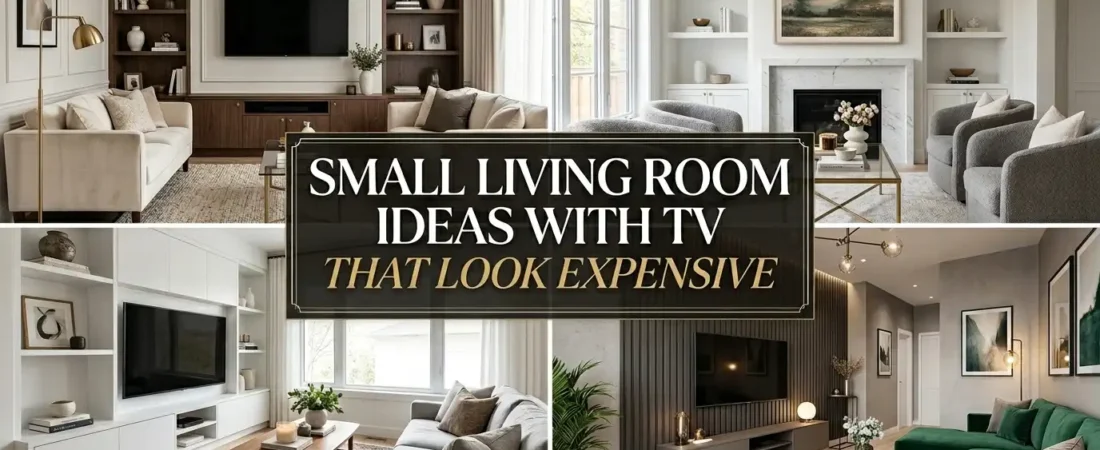
The television is the piece of furniture that most consistently causes problems in a small living room — not because of its size but because of how it gets positioned. Small living room ideas with TV that genuinely work treat the television as a design element to be incorporated into the room’s layout rather than a practical requirement to be accommodated wherever it fits, which almost always means the wrong wall, the wrong height, and a viewing distance that is either too close or too far.
This guide covers small living room ideas with TV organized by the specific layout and design challenges that the television creates — from the correct viewing distance and wall positioning through the furniture arrangements, storage solutions, and visual approaches that make a small living room with a TV feel genuinely designed rather than simply furnished around a screen.
Table of Contents
The TV Positioning Rule That Most Small Living Rooms Get Wrong
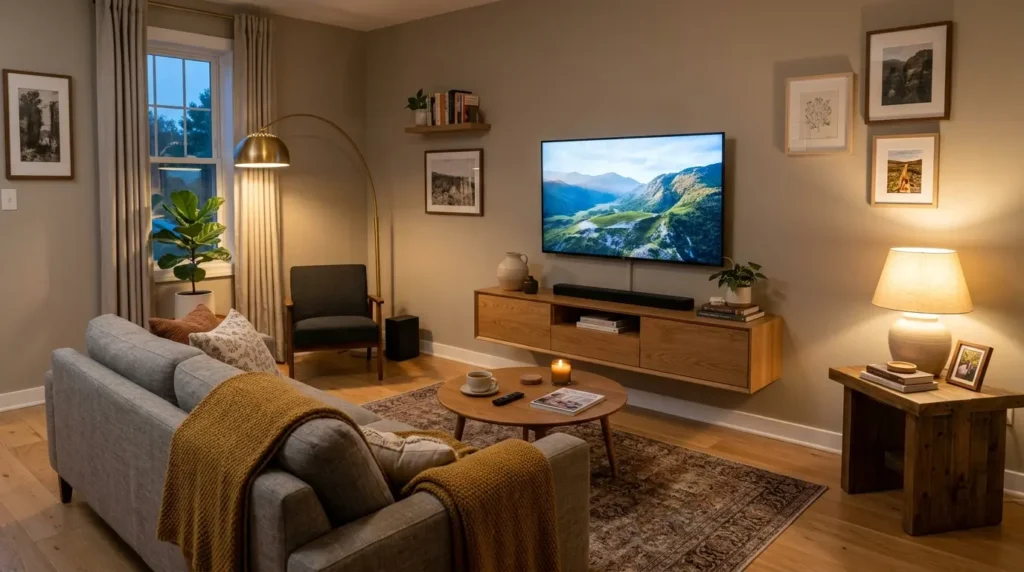
The most common small living room TV mistake is placing the television on whatever wall is available rather than the wall that creates the correct viewing distance and the most functional furniture layout. In a small living room this usually means the TV ends up on the wall opposite the door — which is often the wrong wall for the room’s proportions and creates a viewing distance that is either uncomfortably close or leaves the sofa pushed against the opposite wall with nothing between it and the screen.
The correct viewing distance for a television in a living room is determined by the screen size. The general formula: viewing distance in inches equals the screen size in inches multiplied by 1.5 to 2.5. A 43-inch TV works well at 65 to 108 inches — roughly 5.5 to 9 feet. A 55-inch TV works well at 82 to 137 inches — roughly 7 to 11.5 feet. In a small living room where the sofa-to-TV wall distance is fixed by the room dimensions choose a screen size that fits the available distance rather than placing a large screen too close.
TV height is the second positioning mistake most small living rooms make. The center of the screen should be at seated eye level — approximately 42 to 48 inches from the floor for most standard sofa seat heights. A TV mounted significantly above this — common when TVs are placed above fireplaces or high on a wall — causes neck strain during extended viewing and reads as visually uncomfortable even when the viewer cannot immediately identify why.
1. Wall Mount the TV to Reclaim the Floor Space a Stand Wastes
✦ Best for: any small living room where a freestanding TV stand or unit is taking up floor space that the room cannot afford to give up
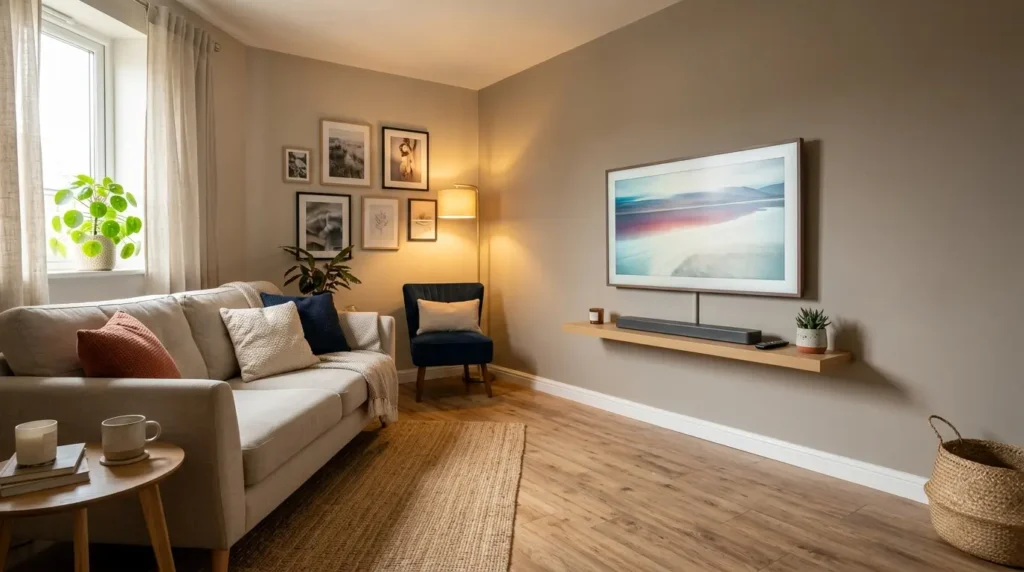
Wall mounting the television is the single most space-efficient TV solution available in a small living room. A wall-mounted TV with a slim floating media shelf beneath it occupies zero floor space — the floor beneath the TV is completely clear — compared to a freestanding TV unit which typically occupies 40 to 60 inches of wall width and 12 to 18 inches of floor depth permanently. In a small living room that floor depth reclaimed by wall mounting can be the difference between a room that feels workable and one that feels cramped.
A slim floating media shelf mounted directly below a wall-mounted TV — at a height of 24 to 30 inches from the floor — provides the surface for a soundbar, streaming devices, and remote controls without requiring a full media unit. The shelf should be no deeper than 10 to 12 inches to maintain the minimal footprint that makes wall mounting worthwhile. Cable management channels running down the wall behind the TV eliminate the cable clutter that makes wall-mounted TVs look messy despite the clean installation.
Renters who cannot drill into walls: a floor-standing TV mount post — a vertical pole that clamps between floor and ceiling and holds the TV on an adjustable arm — achieves the same floating TV appearance without any wall fixings. More expensive than a standard wall bracket but leaves no permanent marks and can be repositioned if the room layout changes.
2. Built-In Alcove Storage Around the TV That Hides the Clutter
✦ Best for: small living rooms with an existing chimney breast or alcoves where the TV and storage can be integrated into the architectural features
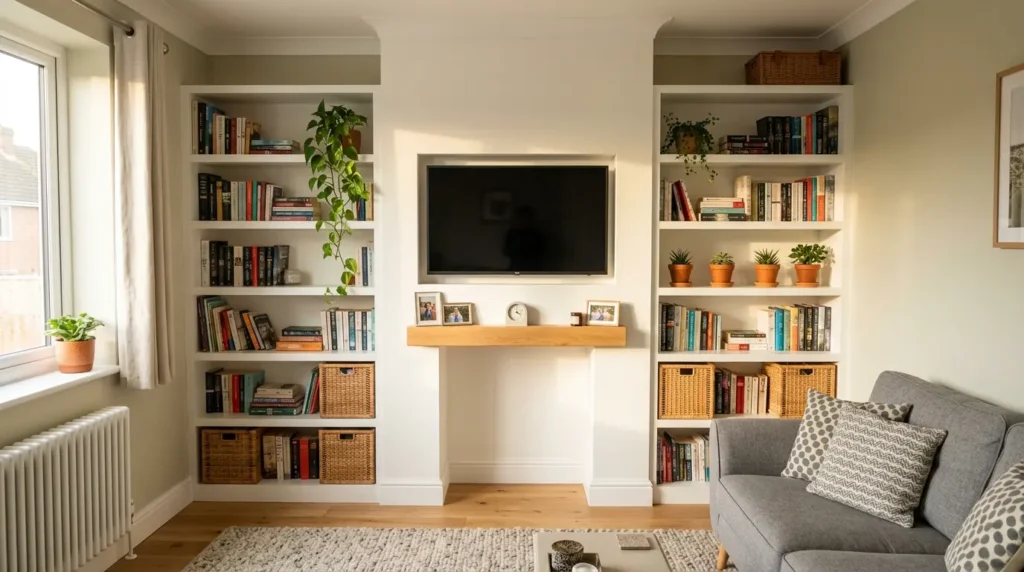
A chimney breast with alcoves on either side is one of the most common architectural features in UK terraced and semi-detached houses and one of the most underused in small living rooms. Mounting the TV on the chimney breast face at seated eye height and filling both alcoves with floor-to-ceiling built-in shelving creates a complete TV and storage wall that uses the room’s existing architectural structure rather than adding freestanding furniture in front of it.
The built-in alcove shelving approach creates significantly more storage than any freestanding media unit at the equivalent wall width because it uses the full floor-to-ceiling height rather than the typical 24 to 30 inches of a standard media unit. The lower section of each alcove unit can include cupboard doors to conceal gaming consoles, routers, cables, and media clutter — the upper shelves remain open for books and display. The result reads as a considered built-in installation rather than assembled furniture.
Painting the alcove shelving and the chimney breast the same color as the wall — or one shade darker — integrates the TV wall into the room rather than making it the focal point by contrast. A TV wall in a matching or tonal color reads as part of the room’s architecture. A TV wall in a contrasting color reads as a separate feature that draws the eye even when the television is switched off.
3. The Corner TV Position That Frees the Main Wall for Something Better
✦ Best for: small living rooms where positioning the TV on the corner wall rather than the main wall creates a more functional furniture layout
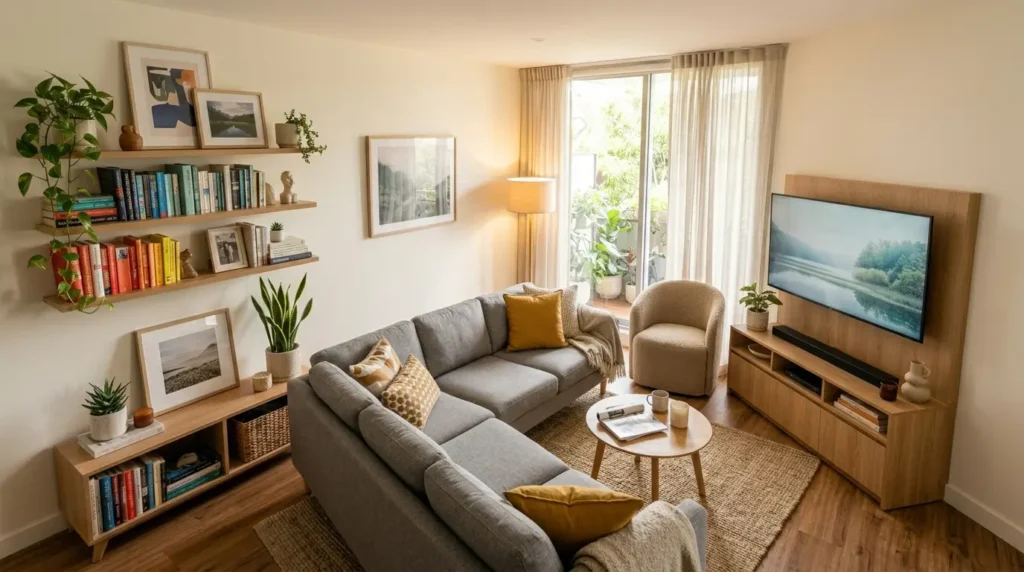
Positioning the TV in a corner rather than on the main wall is a counterintuitive solution that works particularly well in small square living rooms where placing the TV on any full wall creates a viewing arrangement that pushes the sofa too close to the screen. A corner-positioned TV creates a diagonal viewing axis that uses the room’s depth more efficiently and frees the main wall for floor-to-ceiling shelving, a large mirror, or art that improves the room when the TV is off.
A corner TV mount bracket — an angled bracket that holds the TV at 45 degrees to face into the room from a corner position — is the cleanest corner TV solution because it keeps the floor clear and positions the screen at the correct viewing height. A dedicated corner TV unit with angled front face provides more storage than a bracket alone and suits rooms where media storage alongside the TV is a priority.
The furniture arrangement that works best with a corner TV: the sofa positioned perpendicular to the room’s main axis facing the corner diagonally. A small coffee table between the sofa and the TV corner. One armchair on the other side of the coffee table completing the seating group. This diagonal arrangement creates a more dynamic and more spacious-feeling room layout than the parallel sofa-facing-TV-wall arrangement that most small living rooms default to.
4. A Media Wall With Closed Storage That Hides Everything Ugly
✦ Best for: small living rooms where the TV and media equipment creates visual clutter that undermines the room’s overall appearance
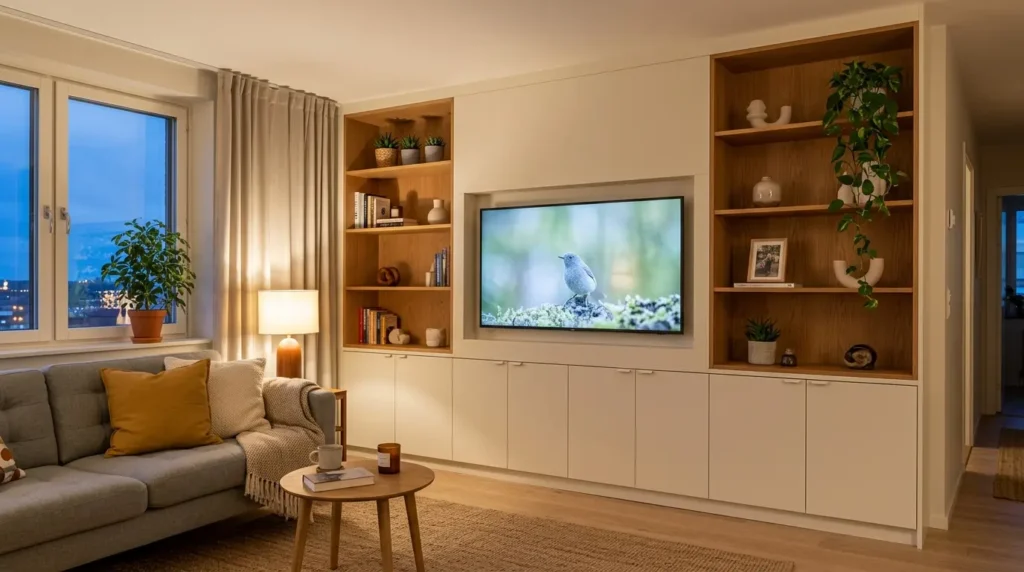
The visual chaos around a TV — cables, streaming sticks, game consoles, routers, DVD collections, remote controls — is responsible for most of the cluttered appearance of small living rooms. A media wall unit with closed cupboard doors in the lower section conceals all of this equipment while the TV sits cleanly above it. When the doors are closed the room reads as ordered and considered. Everything the living room needs to function is present — none of it is visible.
The most functional media wall layout for a small living room: TV mounted at the center of the unit at seated eye height. Open shelving on each side of the TV at the same level — for speakers, decorative objects, and items that look good on display. Closed cupboard doors in the lower section below the TV level — for all equipment, cables, and storage that should not be visible. The combination of open upper display and closed lower storage creates a media wall that reads as considered rather than purely functional.
Cable management is the finishing detail that separates a media wall that looks professional from one that looks DIY regardless of how good the unit itself is. All cables routed through cable channels or through the back of the unit rather than hanging visibly between the TV and the shelf below. A wireless charging pad integrated into the top surface of the lower unit eliminates the need for charging cables on any visible surface.
5. The Sofa Layout That Maximizes Both Seating and Viewing in a Small Room
✦ Best for: small living rooms where the sofa positioning relative to the TV creates a layout that feels either too cramped or too spread out
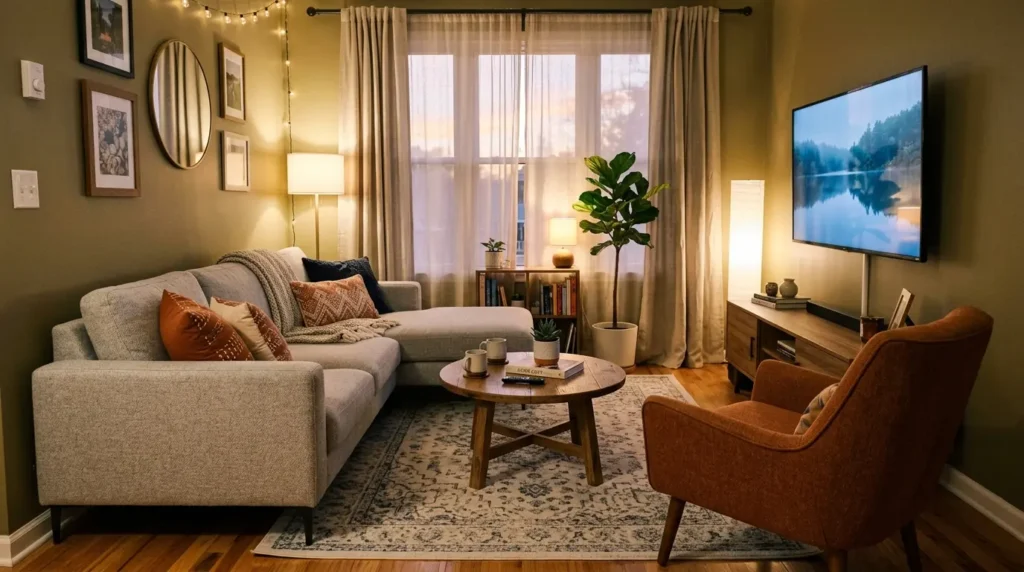
The sofa layout in a small living room with a TV needs to balance two requirements simultaneously: comfortable TV viewing from the primary seating position and comfortable conversation between people in the room when the TV is off. These two requirements pull in opposite directions — the ideal TV viewing position faces the screen directly, while the ideal conversation position faces other people. The furniture arrangement that resolves this tension most successfully in a small room is the L-shaped arrangement.
A two-seat sofa facing the TV with a single armchair on the side wall at a slight angle creates a viewing arrangement where both seats have a reasonable sightline to the screen and a conversation arrangement where the sofa and armchair occupants face each other across a small coffee table. This L-shaped seating group fits comfortably in a small living room of 10 by 12 feet — significantly more comfortably than a three-seat sofa and a separate sofa facing each other.
The coffee table size in a small living room should be in proportion to the sofa — a table of approximately two-thirds the sofa length at a height of 16 to 18 inches. A coffee table that is too large fills the seating group with a surface that impedes movement around the room. A coffee table that is too small reads as an afterthought. A round coffee table suits a small living room better than a rectangular one because it has no sharp corners and the curved edges feel less space-consuming at close range.
6. Gallery Wall Around the TV That Makes the Screen Part of the Decor
✦ Best for: small living rooms where the TV wall looks bare and the screen looks like an intrusion on an otherwise decorated room
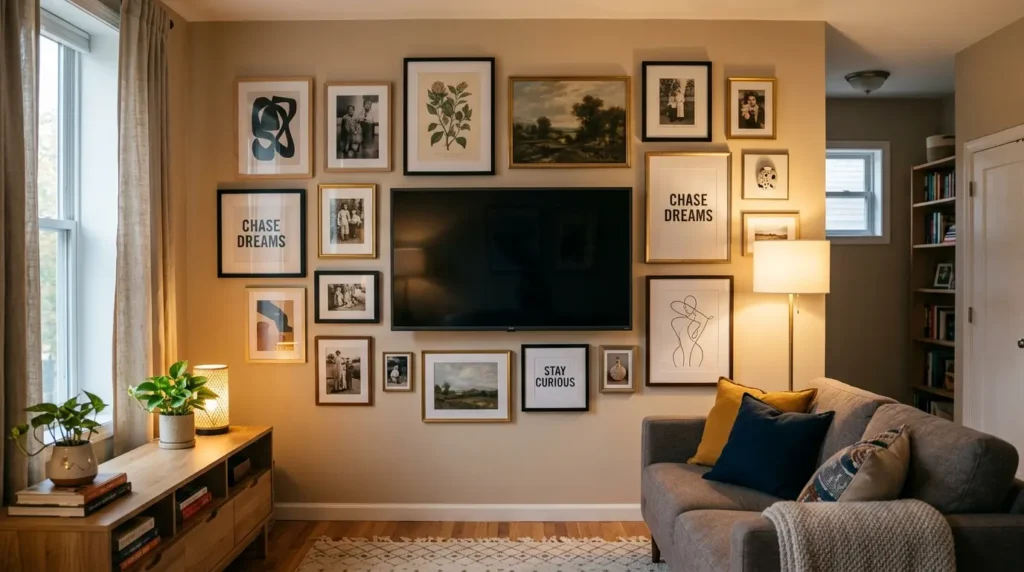
A gallery wall arranged around the TV integrates the screen into the room’s decoration rather than treating it as a functional intrusion on a decorated wall. When the TV is surrounded by framed art prints at the same visual level it becomes one element within a larger composition rather than the dominant focal point of the wall. When the TV is switched off the wall reads as an art installation. When the TV is on the surrounding art recedes and the screen reads naturally within the wall composition.
The gallery wall approach that works best around a TV: treat the TV as the largest frame in the arrangement — a 43-inch TV is roughly the same visual weight as a large piece of art at the same height. Position smaller frames on each side at the same hanging height as the center of the TV screen, then extend the arrangement upward and outward from the TV position. All frames in a consistent finish — all black, all natural timber, or all white — to maintain visual cohesion across the mixed arrangement.
The art content around a TV in a small living room should be in consistent tones rather than strongly colored — bright colors or highly contrasting art alongside a TV creates visual competition between the art and the screen. Botanical prints, black and white photography, and abstract art in warm neutrals all sit comfortably alongside a television without competing with it.
7. Lighting the TV Wall to Reduce Eye Strain and Improve the Room’s Atmosphere
✦ Best for: any small living room where the contrast between a bright screen and a dark surrounding wall causes eye strain during viewing
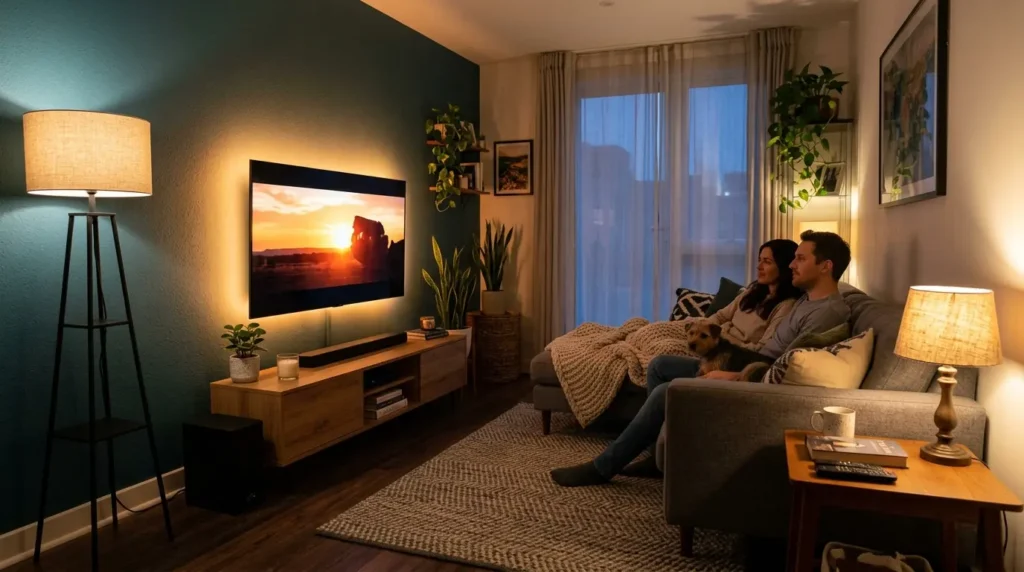
The contrast between a bright television screen and a completely dark wall behind it causes eye strain during extended viewing because the eyes are constantly adjusting between the bright screen and the dark surround. Bias lighting — a strip of LED lights attached to the back of the television that casts a soft glow on the wall behind the screen — reduces this contrast and makes extended viewing significantly more comfortable. The effect also makes the TV wall look more polished and more considered even when the TV is switched off.
A USB-powered LED light strip attached to the back of a wall-mounted TV costs $15 to $30 and takes five minutes to install. The strip should be set to warm white at 2700K to match the other warm light sources in the room — a cool white bias light behind a warm-lit room creates a mismatched quality that feels wrong even when the viewer cannot immediately identify why. Smart LED strips that sync to the TV’s color content create a more immersive viewing experience but are not necessary for the basic eye strain reduction benefit.
The complete small living room TV lighting approach that makes the room feel genuinely designed: bias lighting behind the TV on at all times during viewing. A floor lamp in one corner on during viewing. Overhead light dimmed to 20 percent or turned off entirely. This three-source approach creates the layered warm atmosphere that makes a small living room feel like a genuine home cinema environment rather than a room with a large screen on the wall.
📌 More living room and home decor ideas: Small Apartment Ideas That Make Every Square Foot Count
Frequently Asked Questions
Where should I put the TV in a small living room?
The TV should be positioned on the wall that creates the correct viewing distance from the primary seating position rather than simply on whatever wall has available space. Calculate the correct viewing distance for the screen size — multiply screen size in inches by 1.5 to find the minimum comfortable viewing distance in inches. Mount the TV so the center of the screen is at seated eye level — approximately 42 to 48 inches from the floor. In a small living room where space is limited choose a smaller screen that fits the available distance comfortably rather than mounting a large screen too close. According to the Society of Motion Picture and Television Engineers the ideal viewing angle for a television is no more than 30 degrees from the center of the screen to the sides of the seating area.
How do I hide TV cables in a small living room?
The most effective ways to hide TV cables in a small living room: a cable management channel mounted on the wall running vertically from the TV down to the media unit or power socket — available in white or paintable plastic that can be painted to match the wall color. An in-wall cable kit that routes cables through the wall itself between two wall plates — requires cutting into the wall and is only suitable for homeowners. For renters a slim cable raceway in the same color as the skirting board runs cables along the top of the skirting at floor level and is largely invisible from standing height.
What size TV is right for a small living room?
The correct TV size for a small living room is determined by the viewing distance rather than by personal preference or budget. Measure the distance from the sofa to the TV wall in inches and divide by 1.5 to get the maximum comfortable screen size. A room where the sofa sits 8 feet from the TV wall — 96 inches — suits a maximum screen size of 64 inches. A room where the sofa sits 6 feet from the TV wall — 72 inches — suits a maximum of 48 inches. Choosing a screen size within these parameters rather than the largest screen that fits the wall produces a more comfortable and more visually appropriate result.
How do I make a small living room with a TV look stylish?
A small living room with a TV looks stylish when the TV is integrated into the room’s design rather than positioned as an afterthought. Wall mount the TV to eliminate the floor footprint of a stand. Create a gallery wall around the TV so the screen becomes part of a larger art composition rather than a dominant isolated element. Add bias lighting behind the TV to reduce the contrast with the wall and create a more considered viewing environment. Use a media unit with closed lower storage to conceal all cables and equipment. Keep the TV wall in a consistent color or material that integrates it with the room rather than making it the focal point by contrast.
More Living Room and Home Decor Ideas
→ Studio Apartment Ideas That Look Surprisingly Luxurious
→ Family Photo Wall Ideas That Never Look Tacky
→ Maximalist Decor Ideas You’ll Wish You Tried Sooner
Mount it on the wall. Add bias lighting behind it. That combination alone changes how the room feels more than any other single TV-related decision.

Sheikh Hassaan is a digital architect for small businesses and the founder of The Glow Up System. He writes about home decor, garden design, and outdoor living for real American homes – practical ideas that work in actual spaces without oversized budgets.