

More is more — but only when the more is intentional. Maximalist decor is not the absence of editing, it is a different kind of editing that prioritizes abundance, personality, and visual richness over restraint, and gets it wrong when it mistakes accumulation for curation. The rooms that make maximalism look genuinely beautiful share a set of organizing principles that keep the abundance from tipping into chaos — and those principles are learnable regardless of how much stuff is already in the room.
This guide covers the maximalist decor principles and specific ideas that produce genuinely beautiful, richly layered rooms — from the color and pattern strategies that hold a busy room together through the specific arrangement and display techniques that make abundance look curated rather than chaotic.
Table of Contents
What Maximalism Actually Is and What It Is Not
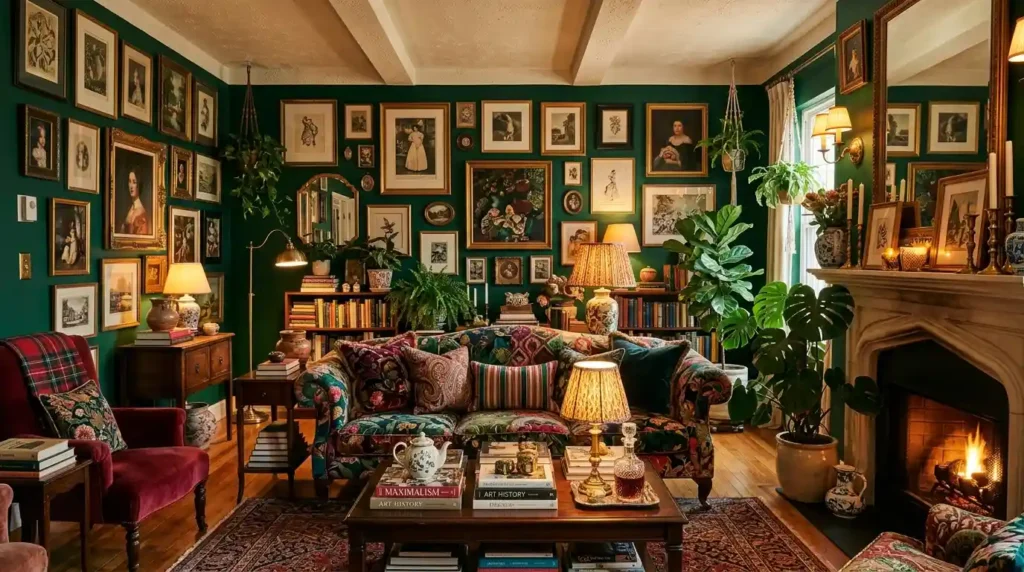
Maximalism is frequently misunderstood as simply the opposite of minimalism — that if minimalism means removing things, maximalism means keeping everything. This misunderstanding produces rooms that look cluttered and exhausting rather than richly layered and energizing. The actual distinction between maximalism and clutter is the same as the distinction between a museum and a storage unit — both contain many objects, but only one of them has been arranged with intention.
Genuine maximalist decor is characterized by deliberate abundance — every additional element added to the room serves the room’s visual story rather than simply occupying space. A maximalist room has more art on the walls than a minimalist room, but each piece was chosen for how it contributes to the room’s color palette, its emotional atmosphere, or its personal narrative. A cluttered room has more objects than a tidy room, but the additional objects contribute nothing beyond their own presence.
The three qualities that every well-executed maximalist room shares: a consistent underlying color story that creates visual coherence across the abundance of objects and patterns. A hierarchy of scale that prevents every element from competing for attention at the same visual weight. And a genuine personal narrative — the room tells a story about the people who live in it through their collected objects, travel acquisitions, and accumulated meaningful pieces rather than through purchased decor sets.
The Color Strategy That Holds a Maximalist Room Together
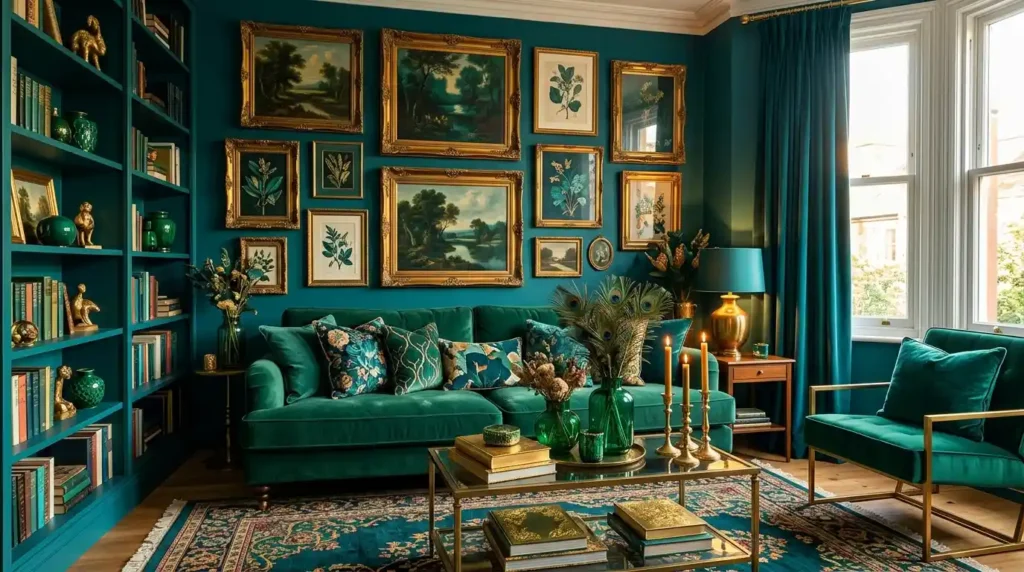
Color is the organizing principle that does the most work in a maximalist room — it is the thread running through all the disparate objects, patterns, and textures that allows the eye to read the room as a coherent whole rather than a collection of competing elements. A maximalist room without a consistent color story looks chaotic. The same room with a clear color strategy looks rich and intentional regardless of how many objects it contains.
The jewel tone approach:
Deep emerald, sapphire, amethyst, and ruby — the jewel tone palette is the color family most consistently associated with well-executed maximalism because these colors have the depth and saturation to hold their own against the visual abundance of a maximalist room without being overwhelmed by it. Choose two or three jewel tones as the room’s primary palette and allow them to appear in every category — walls, upholstery, cushions, art, and accessories — at different proportions throughout.
The warm earth tone approach:
Terracotta, burnt orange, deep ochre, warm burgundy, and rich chocolate brown create the bohemian maximalist version of the color strategy — warmer, more organic, and more directly connected to the global textile and craft traditions that this version of maximalism draws from. This palette suits a maximalist room filled with handmade objects, vintage textiles, and travel acquisitions better than jewel tones.
The dark and moody approach:
Charcoal, deep forest green, midnight navy, and black as the primary palette with gold and brass as the accent — the dark maximalist approach creates the most dramatic and most sophisticated version of the aesthetic, and the dark walls have a specific practical benefit in a maximalist room: they absorb rather than reflect the visual complexity of the room’s contents, paradoxically making the abundant room feel more composed than light walls that amplify everything.
How To Mix Patterns Without Making the Room Feel Unstable
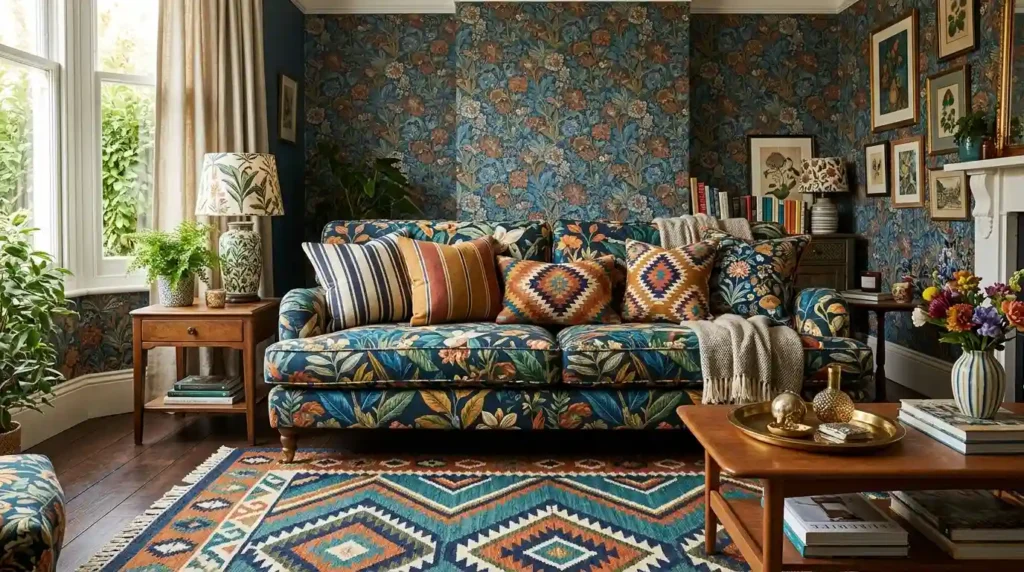
Pattern mixing is the element of maximalist decor that intimidates most people and looks the most impressive when done well. The rule that professional designers use consistently is not about which specific patterns can be mixed — it is about scale variation and color consistency. Any patterns can coexist in the same room if they vary significantly in scale from each other and share at least one color in common.
The three-pattern rule that works reliably: a large-scale pattern as the dominant, typically on the largest upholstered surface or the wallpaper. A medium-scale pattern as the secondary, typically on cushions or a rug. A small-scale pattern as the texture, typically on an accent textile or a secondary cushion. All three patterns should share at least one color that appears in each — the shared color is the visual thread that tells the eye they belong to the same composition rather than competing.
The pattern categories that mix most consistently well across all maximalist color palettes: a botanical or floral at large scale. A geometric or stripe at medium scale. A small repeat or texture at small scale. The combination of organic curved pattern at large scale with rigid geometric at medium scale and subtle texture at small creates the visual variety that makes pattern mixing interesting while the color consistency creates the coherence that makes it legible.
The Maximalist Gallery Wall Done at Full Commitment
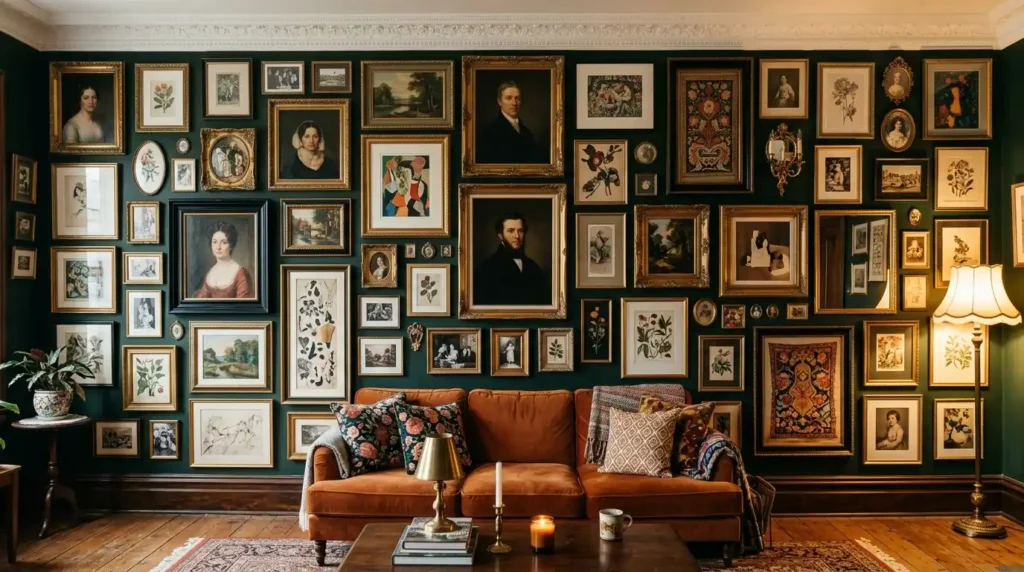
The maximalist gallery wall is not a standard gallery wall with more pieces — it is a salon-style floor-to-ceiling installation that treats the entire wall as a single composition rather than a collection of individual pieces with breathing room between them. The frames touch or nearly touch each other. The arrangement extends from close to the floor to close to the ceiling. The mix of frame sizes, art types, and subjects is wider than a standard gallery wall would tolerate.
What holds a maximalist salon gallery wall together when everything else about it is deliberately excessive: a consistent frame finish across all or most pieces — all black, all gold, or all natural wood — that creates a unifying visual element across the heterogeneous content. Or alternatively a consistent subject matter — all portraits, all landscapes, all botanical illustrations — with mixed frame finishes, where the content consistency replaces the frame consistency as the organizing principle.
The specific approach that produces the most genuinely maximalist result: begin with the largest piece at the visual center of the wall, then work outward in all directions filling gaps as you go rather than pre-planning the arrangement on the floor. The slight irregularity and the evidence of organic accumulation over time that this approach produces is precisely what a maximalist gallery wall should communicate — that these pieces were gathered rather than curated, even when in fact they were carefully chosen.
Layered Textiles as the Foundation of Maximalist Comfort
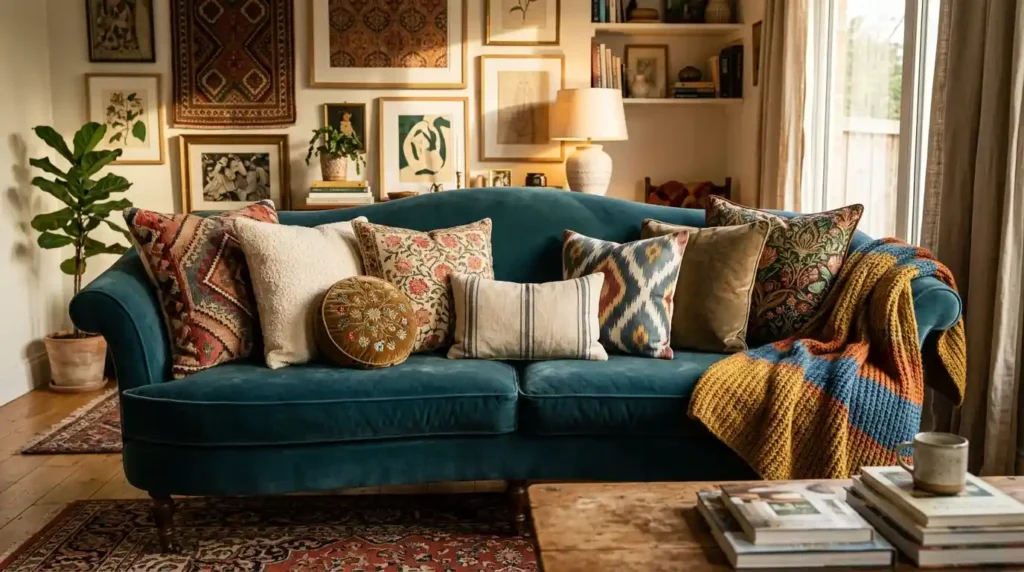
Layered textiles are the element of maximalist decor that most directly contributes to how the room feels as well as how it looks — the tactile richness of velvet against boucle against woven cotton against silk creates a sensory depth that purely visual elements cannot achieve. A maximalist room that looks abundant but contains only hard surfaces and flat textiles feels expensive in the visual sense but not in the lived-in sense. The textile layers are what make it feel genuinely rich.
The sofa in a maximalist room should have more cushions than feels immediately comfortable to a minimalist eye — typically five to nine cushions in a combination of sizes, varying from a large 24-inch square to a small 12-inch lumbar, in patterns and textures that follow the room’s color story. The cushions should be arranged not in a symmetrical row but in a slightly organic arrangement where some lean against others and the sizes are mixed rather than graduated uniformly.
Layer the floor as well as the furniture: a large area rug as the primary floor covering with a smaller vintage or patterned rug layered over it creates the floor-level textile depth that a maximalist room requires. The layered rug approach — a jute or sisal base rug under a smaller patterned vintage rug — is the specific technique that most clearly signals maximalist intent at the ground level and creates the layered quality even in rooms where the furniture and walls are less richly treated.
Plants and Collections as Living Maximalist Elements
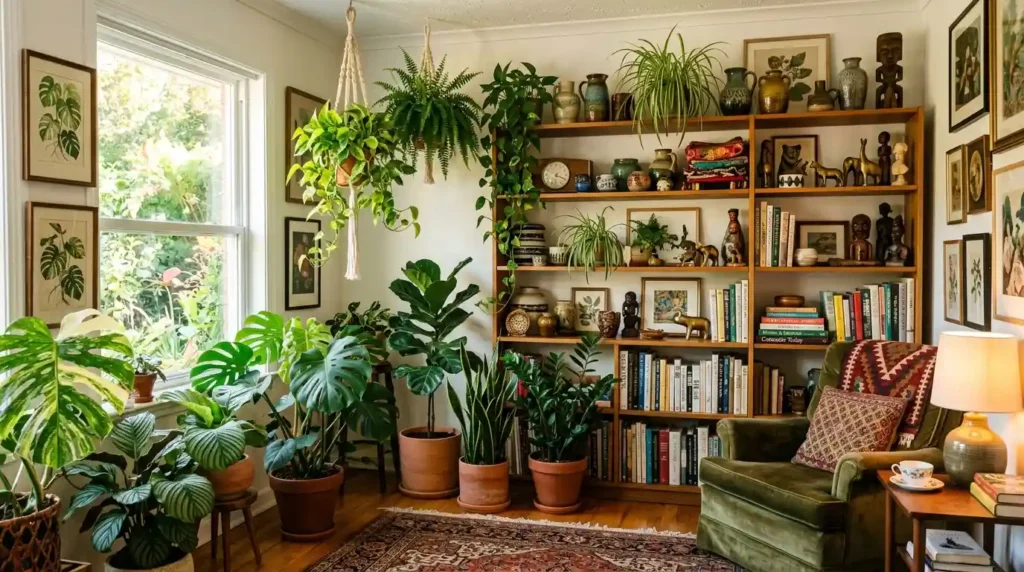
Plants in a maximalist room do not occupy a single corner — they occupy every height simultaneously. A floor-level large specimen in a statement pot. A medium trailing plant on a shelf or console. A hanging plant at ceiling height beside a window. The vertical stratification of plants through the full room height creates the lush inhabited quality that maximalist rooms are known for and that is genuinely difficult to achieve through any other means.
Collections are the element that most directly communicates the personal narrative quality that distinguishes genuine maximalism from simply busy decoration. A collection — of vintage ceramics, antique globes, paperweights, taxidermy, books organized by color, vintage perfume bottles, or any other category pursued with genuine interest — creates a section of the room that tells a story about the person who assembled it. This story-telling quality is absent from decorator-purchased collections and immediately present in genuinely accumulated ones.
Display collections at density rather than spread — a group of twenty similar objects arranged closely together on a single shelf reads as a collection and creates genuine visual impact. The same twenty objects spread individually across every surface in the room reads as accumulated clutter. The difference is the intentionality communicated by grouping — the grouped collection signals that someone made a decision to put all of these together, while the scattered objects signal that they simply landed wherever they fit.
Lighting a Maximalist Room Without Flattening Its Depth
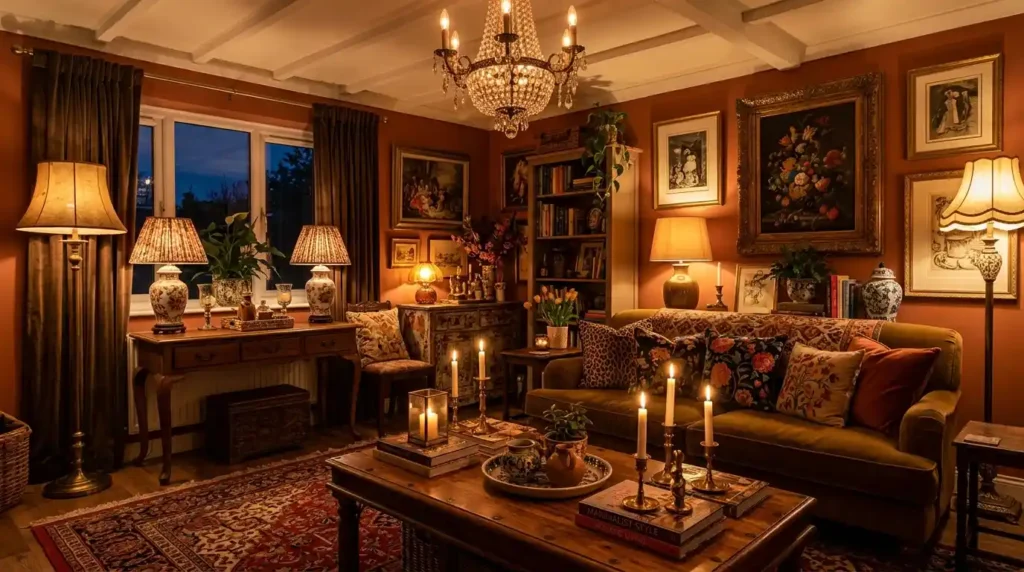
Flat overhead lighting is the single most effective way to make a maximalist room look chaotic rather than curated — it illuminates every element equally and removes all depth and shadow, creating a visual environment where the eye has nowhere to rest and nothing to prioritize. A maximalist room needs layered lighting with multiple sources at different heights, all at 2700K warm white, creating pools of light that guide the eye through the room rather than flattening everything simultaneously.
A maximalist room can support more light fixtures than a minimalist one without the fixtures themselves reading as excessive — a chandelier overhead, two floor lamps, table lamps on every available surface, and candlelight on the coffee table all together create the specific quality of warm, multi-source illumination that makes maximalist rooms feel genuinely luxurious in evening photographs and in person.
Statement light fixtures deserve particular attention in a maximalist room because the overhead fixture is the one object in the room that has no competition from other objects at the same level — it occupies the ceiling alone. A chandelier or pendant with genuine sculptural presence — crystal drops, beaded shades, aged brass arms, or a dramatic hand-blown glass form — contributes to the room’s visual richness from a position where no other element can compete with it.
📌 More home decor style ideas: Witchy Bedroom Decor Ideas That Create Instant Moonlit Vibes
What is maximalist decor?
Maximalist decor is an interior design aesthetic that embraces abundance, layering, pattern mixing, and personal collection as its organizing principles rather than the restraint and editing that define minimalism. A well-executed maximalist room contains more art, more textiles, more plants, and more objects than a minimal room, but every element has been chosen for how it contributes to the room’s color story, emotional atmosphere, or personal narrative. According to Architectural Digest, maximalism has experienced a significant revival as a direct cultural response to the dominance of minimalism in interior design over the previous decade, with designers and homeowners actively embracing personality and abundance as legitimate design values.
What is the difference between maximalist decor and clutter?
The difference between maximalist decor and clutter is intention and organization. A maximalist room contains many objects that have each been chosen for a specific reason — they contribute to the room’s color story, tell part of the room’s personal narrative, or serve a specific visual function. Clutter contains many objects that accumulated rather than being chosen. The practical distinction: a maximalist room can be described — it has a color palette, a dominant aesthetic, and a personal story. A cluttered room can only be summarized as containing many things.
What colors work best in a maximalist room?
The three color approaches that work best in maximalist decor: jewel tones — deep emerald, sapphire, amethyst, and ruby — for the most richly saturated and most formally maximalist result. Warm earth tones — terracotta, burnt orange, ochre, and burgundy — for the bohemian maximalist version. Dark and moody — charcoal, forest green, navy, and black with gold accents — for the most dramatic and most sophisticated version. In all three approaches the key is using the chosen palette consistently across every element in the room so the color story provides coherence across the visual abundance.
How do you start decorating in a maximalist style?
Start a maximalist room by establishing the color palette before adding any objects — choose two or three colors that will appear in every category from walls through textiles to accessories and commit to them as the room’s organizing principle. Then add elements in this sequence: wall color or wallpaper first as the largest surface. Largest upholstered piece next. Rug. Additional seating. Gallery wall or primary art. Cushions and throws. Lamps and light fixtures. Plants. Collections and accessories. This sequence builds the room from the largest elements inward and prevents the common maximalist mistake of filling the room with small objects before the large structural elements are resolved.
More Home Decor Style Ideas
→ Western Living Room Decor Ideas Designers Are Obsessed With
→ Family Photo Wall Ideas That Never Look Tacky
→ Bedroom Wall Decor Stickers That Make Small Rooms Feel Bigger
Choose the color palette first and commit to it completely. Every other maximalist decision becomes easier once the color story is established — it is the thread that holds everything else together.

Sheikh Hassaan is a digital architect for small businesses and the founder of The Glow Up System. He writes about home decor, garden design, and outdoor living for real American homes – practical ideas that work in actual spaces without oversized budgets.