

Aeration is the quiet hero behind every thriving koi pond. Without it, oxygen levels drop, beneficial bacteria struggle, and fish become stressed. A dedicated aeration system, particularly an air pump with diffusers, is essential for consistent oxygenation, especially as fish grow and water temperatures rise.
This guide compares the best koi pond aeration systems, from compact diffusers for small water gardens to powerful dual systems for large, deep ponds, helping you choose the right one for your setup.
Table of Contents
Why Koi Ponds Need Dedicated Aeration
Many pond owners rely on waterfalls or fountains for aeration, but these often only oxygenate the surface layer. A dedicated aerator, especially a subsurface air pump with an air stone, is vital for several reasons:
- Deep Water Oxygenation: It pushes oxygen to the bottom, preventing “dead zones” where organic matter decays without oxygen.
- Fish Health: Koi are large fish that consume significant oxygen. An aerator prevents stress, gasping, and disease.
- Filter Support: The beneficial bacteria that break down fish waste are aerobic and need oxygen to work efficiently.
- Summer Safety: Warmer water holds less oxygen, making aeration critical during heatwaves.
Most experts recommend using a subsurface aerator, ideally combined with surface agitation from a waterfall or fountain, for the best results.
5 Best Aeration Systems for Koi Ponds
1. Evolution Aqua AirPump Range: The Professional Standard
✦ Best for: Pond owners who want high output, professional-grade reliability, and a range of sizes
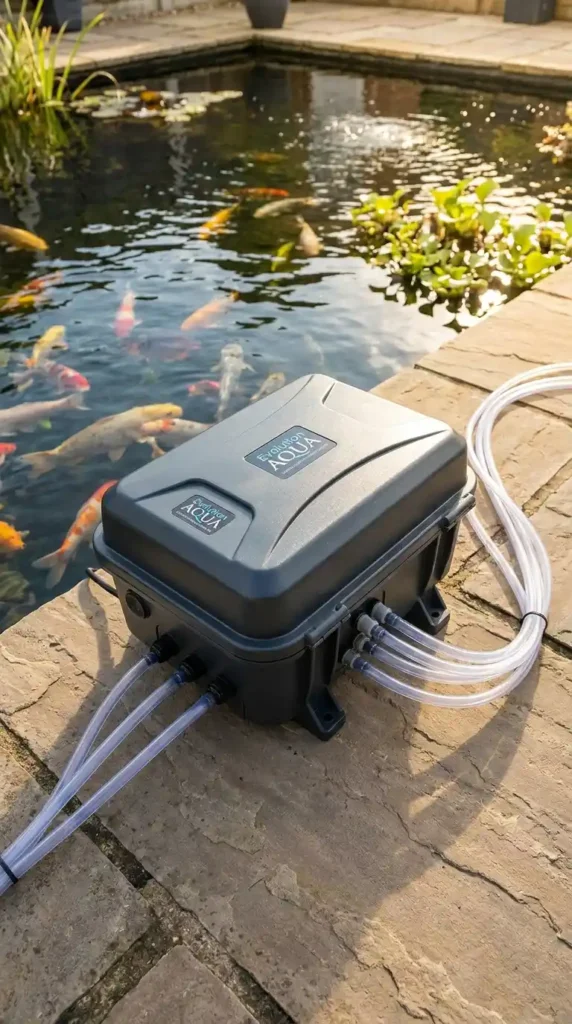
Evolution Aqua air pumps are a top choice for koi enthusiasts. They are known for high output at depth, tested and proven to provide exceptional aeration. Available in various sizes like the 75, 95, 130, and 150 models, output increases with size, with the 95-model producing 78 L/min at a 1-meter depth. These robust pumps are ideal for deeper ponds and heavy fish loads.
Key Features:
- High Output: Strong airflow even at depth
- Durable: Built for continuous outdoor use
- Multiple Sizes: Wide range from 70 to 150 L/min to suit various pond sizes
- Complete Kit Option: Some models come as a complete kit with air line and diffusers
2. KoiAir 2: The Dual-Diffuser System for Large Ponds
✦ Best for: Larger, deeper, or irregularly shaped ponds up to 16,000 gallons
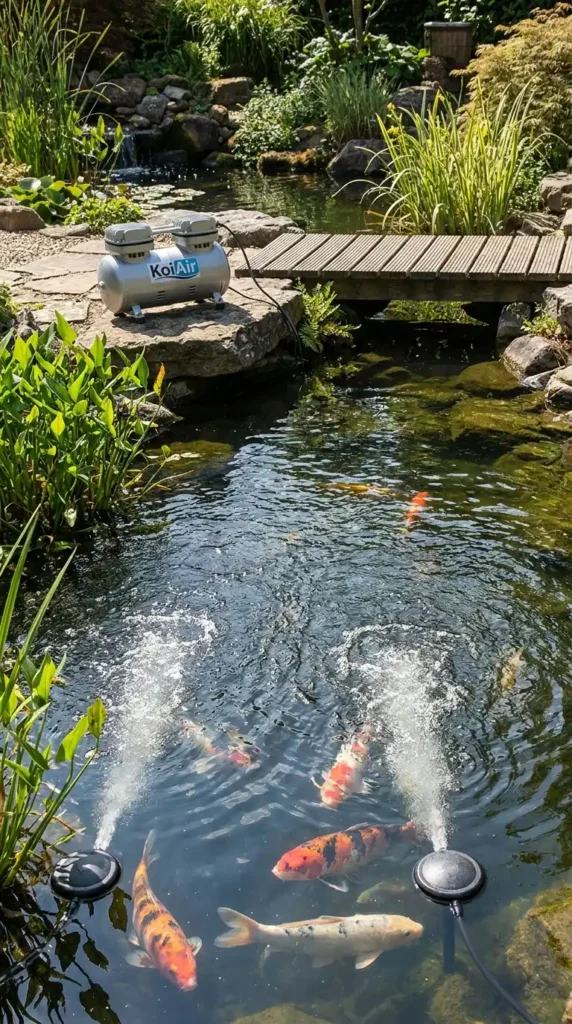
The KoiAir 2 system is designed for larger or irregularly shaped water gardens and koi ponds, aerating up to 8,000–16,000 gallons. It features two high-output diffuser assemblies that allow for better coverage across the pond and the flexibility to place diffusers in tricky corners or areas where debris tends to settle. This ensures uniform circulation and keeps the entire pond balanced and clear.
Key Features:
- Two Diffusers: Provides uniform aeration across large or irregularly shaped ponds
- High Airflow: More oxygenation for heavy fish loads
- Flexible Placement: Can reach dead spots and corners
- Designed for larger ponds: Up to 16,000 gallons
3. The Pond Guy Pond Aerator: The All-In-One Kit
✦ Best for: Small to medium ponds up to 6,000 gallons where a complete, easy-to-install kit is preferred
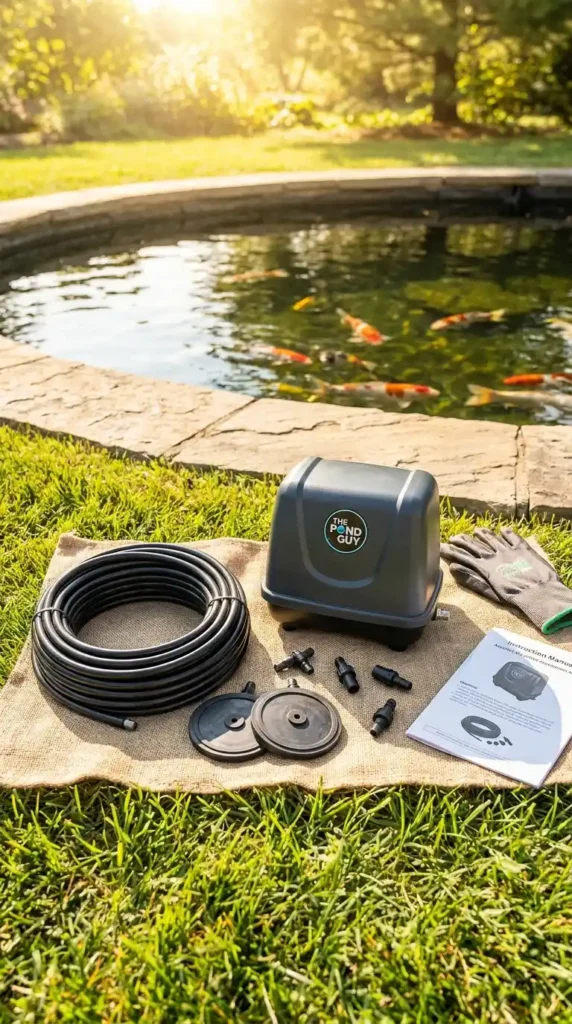
For a straightforward, all-in-one solution, The Pond Guy’s aerator kit is excellent. It’s designed for water gardens and koi ponds up to 6,000 gallons and less than 4 feet deep. The kit includes an energy-efficient diaphragm compressor, PTFE diffuser(s), and weighted airline tubing that stays securely on the bottom. Customers praise its quiet operation and ability to “keep a bigger area ice free and delivers more oxygen to the koi”.
Key Features:
- Complete Kit: Includes compressor, diffuser, and weighted airline
- Weighted Tubing: Keeps diffusers positioned on the pond floor
- Energy Efficient: Uses low wattage
- Winter Use: Helps keep a hole in the ice to vent toxic gases
4. CrystalClear PondAir Aeration Kit: The Small Pond Solution
✦ Best for: Decorative ponds, water gardens, and small koi ponds up to 2,000 gallons
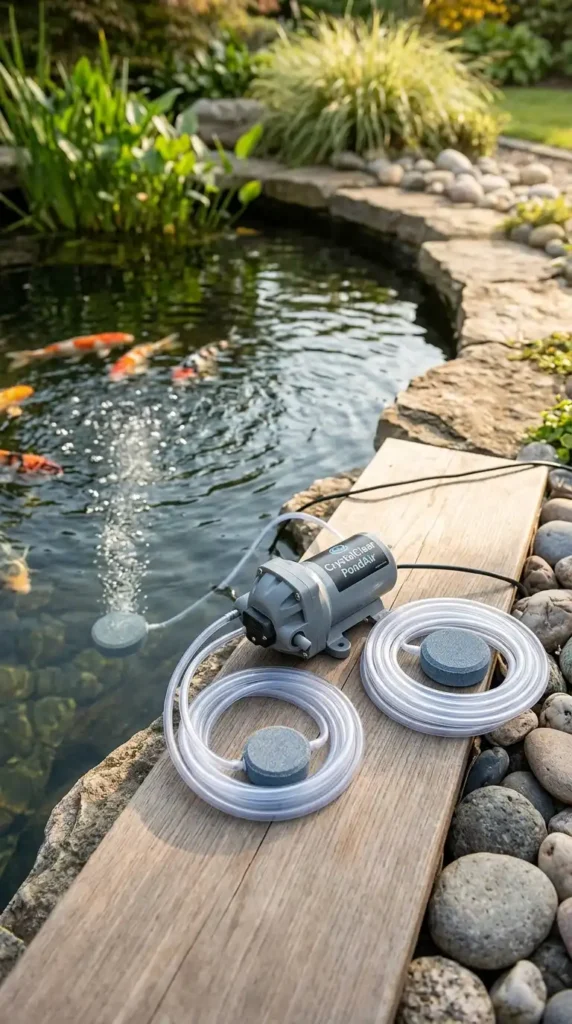
The CrystalClear PondAir Aeration Kit is a compact and affordable option for smaller setups. It’s ideal for ponds up to 2,000 gallons and a maximum depth of two feet, featuring an energy-efficient diaphragm compressor that operates quietly. Users report it “definitely keeps a bigger area ice free and delivers more oxygen to the koi”.
Key Features:
- Budget-Friendly: Affordable entry point for small ponds
- Quiet Operation: Uses a whisper-quiet diaphragm compressor
- Includes Airstones: Comes with two airstones and tubing
- Adjustable Airflow: Dial to adjust output
5. KoiAir 1: The Balanced Choice for Medium Ponds
✦ Best for: Average backyard koi ponds between 2,000 and 8,000 gallons
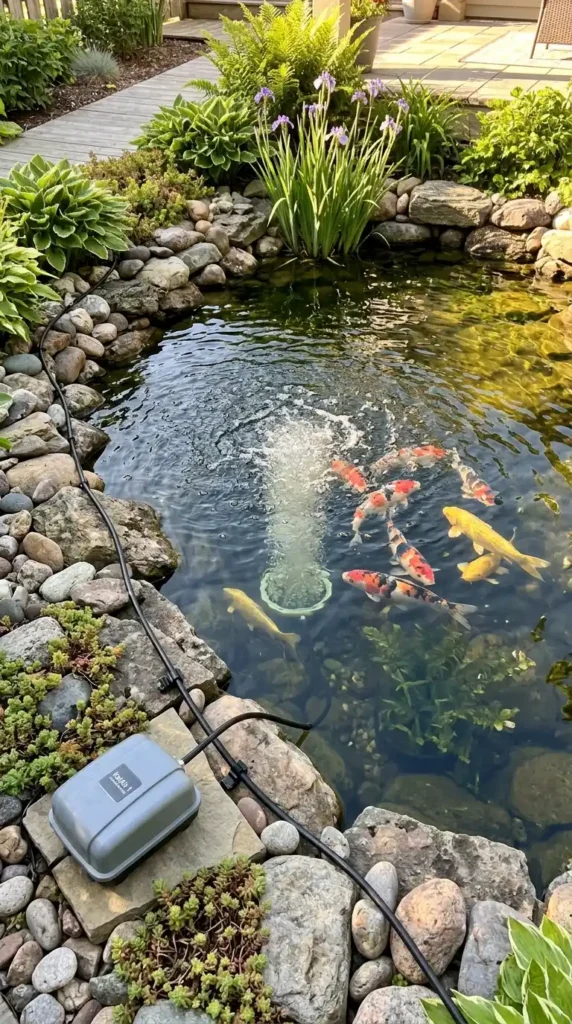
The KoiAir 1 is a great mid-range system that suits most average backyard ponds, aerating 2,000 to 8,000 gallons. It uses one high-output diffuser and a reliable, continuous-duty air pump to improve circulation, reduce bottom muck, and support plants and fish with a robust oxygen supply. It balances power and simplicity, making it a favorite for many homeowners.
Key Features:
- Reliable: Continuous-duty air pump for 24/7 operation
- Single Diffuser: Offers strong, targeted aeration
- Balanced Power: Ideal for most backyard ponds
- Improves Circulation: Helps reduce bottom muck
Aeration Calculator: How Much Oxygen Does Your Pond Need?
Choosing the correct air pump size is essential. The general rule is: 200 to 400 liters per hour (L/h) for every 1,000 liters of pond water for koi ponds. This translates to roughly 3 to 7 liters per minute (L/min) per 1,000 liters.
Use the lower end for cooler water, lighter feeding, or shallower ponds; use the higher end for warmer water, heavier feeding, or deeper ponds. As a safety buffer, add 10-20% more capacity to cover aging pumps, blocked diffusers, or hotter summers.
How to Use the Aeration Calculator
- Calculate your pond volume: Length (ft) x Width (ft) x Depth (ft) x 7.48 = Total Gallons.
- Convert to Liters: Multiply gallons by 3.785.
- Apply the formula: (Pond Volume in Liters / 1,000) x 200 L/h = Your base recommendation in Liters per Hour. Aim for the higher end for koi.
For example: A 3,000-gallon (13,500-liter) pond with a typical koi load would need roughly 40-80 L/min (2,400-4,800 L/h) of aeration.
Frequently Asked Questions About Koi Pond Aeration
1. Do koi ponds really need an aerator?
Yes. While a waterfall provides some aeration, a dedicated aerator is essential for maintaining adequate oxygen levels, especially in warm weather, for deep ponds, or with a heavy fish load.
2. What is the best way to aerate a koi pond?
A subsurface air pump with an air stone or diffuser is one of the most effective methods. It oxygenates the water from the bottom up, preventing stratification and dead zones.
3. How much aeration does a koi pond need?
A good baseline is 200–400 L/h of aeration for every 1,000 liters of pond water. The exact amount depends on water temperature, fish load, and pond depth.
4. How can I aerate my koi pond without electricity?
You can use wind-powered aeration systems, solar-powered aerators with battery backups, or even manual water spraying in emergencies. For continuous, reliable aeration, a dedicated air pump remains the best practice.
5. What is the difference between a pond aerator and a pond air pump?
The terms are often used interchangeably. An air pump sits outside the pond and pushes air through tubing to a diffuser inside the pond. This entire system is commonly called a pond aerator.
Related Articles
The Ultimate Koi Pond Guide: Design, Building, Filtration & Maintenance
21 Koi Pond Design Ideas for Small Gardens (Modern + Japanese Styles)
Best Koi Pond Filter Systems Compared (2026 Guide)
How to Build a Koi Pond: A Step-by-Step Guide for Beginners
Investing in a quality aeration system is one of the most important decisions you will make for the health of your koi and the clarity of your water. Choose the right system for your pond size and fish load, install it properly, and enjoy the serenity of a thriving, oxygen-rich ecosystem.

Sheikh Hassaan is a digital architect for small businesses and the founder of The Glow Up System. He writes about home decor, garden design, and outdoor living for real American homes – practical ideas that work in actual spaces without oversized budgets.