
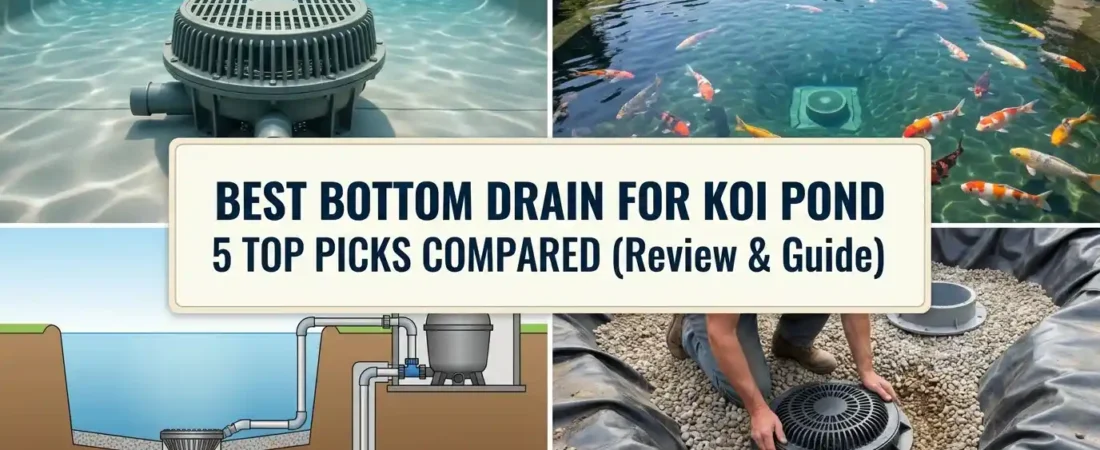
The single most important fitting in any serious koi pond sits at the very bottom, out of sight. A properly installed bottom drain pulls the heaviest, dirtiest water off the pond floor 24 hours a day, seven days a week, with zero effort from the pond keeper. Without one, it is like having a toilet that you cannot flush.
This guide compares the best bottom drain options on the market, from industry-standard Aquadyne models to budget-friendly EasyPro drains and premium aerated Koi Toilet systems. We evaluate key features like aeration, build quality, and installation requirements to help you make the right choice for your pond.
Table of Contents
Why Your Pond Needs a Bottom Drain
Most experienced koi keepers consider bottom drains non-negotiable for ponds over 1,000 gallons. Koi produces a significant amount of solid waste. Without a dedicated drain pulling that water out, organic sludge sits on the floor and breaks down, spiking ammonia, feeding parasites, and creating anaerobic dead zones.
The Key Benefits:
- Continuous waste removal: A bottom drain pulls debris from the pond floor 24/7
- Enables gravity-fed filtration: Widely regarded as the gold standard for koi ponds
- Reduces maintenance: Eliminates the need for weekly vacuuming
- Protects fish health: Removes decomposing waste before it releases toxins
5 Best Bottom Drains for Koi Ponds
1. Aquadyne Rhino II: The Industry Standard
✦ Best for: Most pond builds where you want a proven, reliable non-aerated drain
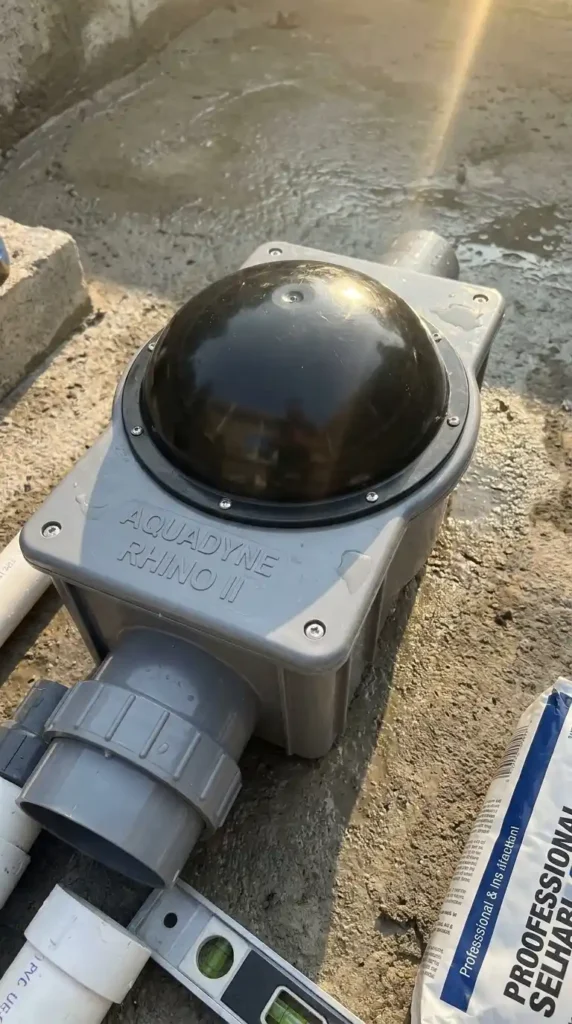
The Aquadyne Rhino II is the go-to choice for hobbyists building gravity-fed systems. It is a 4-inch ABS bottom drain with an anti-vortex dome that prevents the swirling vortex effect which can trap debris above the drain. Instead, water flows evenly from all directions into the drain opening, producing a gentle but consistent draw across the pond floor.
- Material: ABS plastic (chemical-resistant, UV-stable when submerged)
- Connection: 4-inch pipe, compatible with standard Schedule 40 fittings
- Dome: Anti-vortex design for even flow distribution
- Best for: Gravity-fed and pump-fed systems, new construction or retrofit
- Track Record: Decades of field use
Why it is the safest choice: The Rhino II works in both gravity-fed and pump-fed systems. The anti-vortex dome genuinely improves waste collection, and the decades of field use mean that installers know exactly how to plumb it.
2. Aquadyne Rhino Aerated: For Deep or Heavily Stocked Ponds
✦ Best for: Ponds deeper than 4 feet or those with heavy fish loads
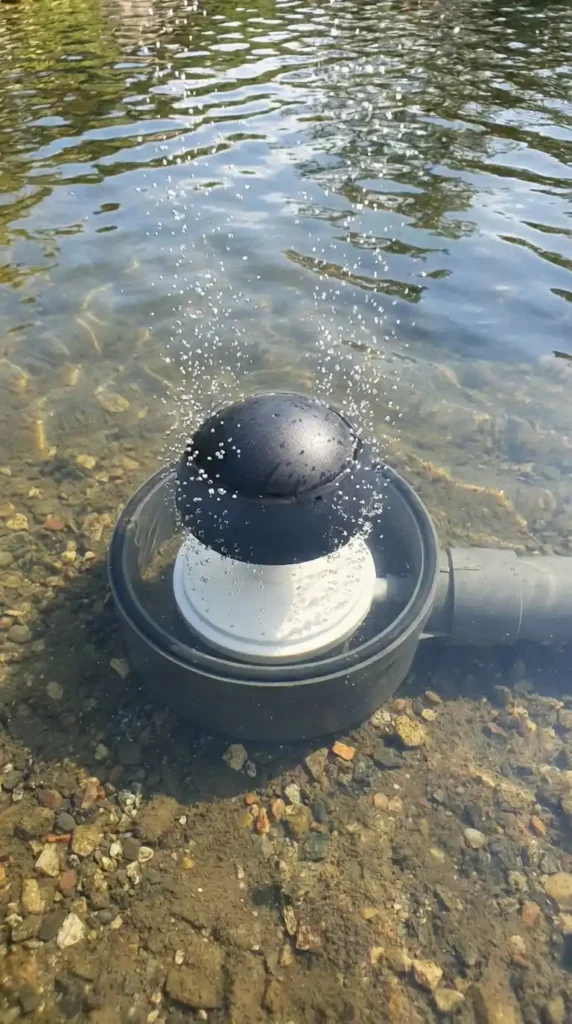
The Rhino Aerated adds an integrated air diffuser to the standard Rhino II design. An air line connects to the drain body, and fine bubbles rise from the base of the drain. This aeration serves two purposes: it adds dissolved oxygen at the pond’s deepest point, and the rising bubble column creates a gentle upward current that lifts lighter debris off the pond floor.
- Material: ABS plastic
- Connection: 4-inch pipe plus air line barb
- Diffuser: Built-in, no separate diffuser disc needed
- Best for: Deeper ponds (4+ feet), heavily stocked ponds, gravity-fed systems
When to choose this: For ponds 4 feet or deeper where thermal stratification becomes a factor, the aerated model adds meaningful value. It is a relatively small upgrade that pays dividends in water quality and fish health.
3. Koi Toilet I Aerated: Premium Performance
✦ Best for: Pond builders who want the best performance regardless of cost
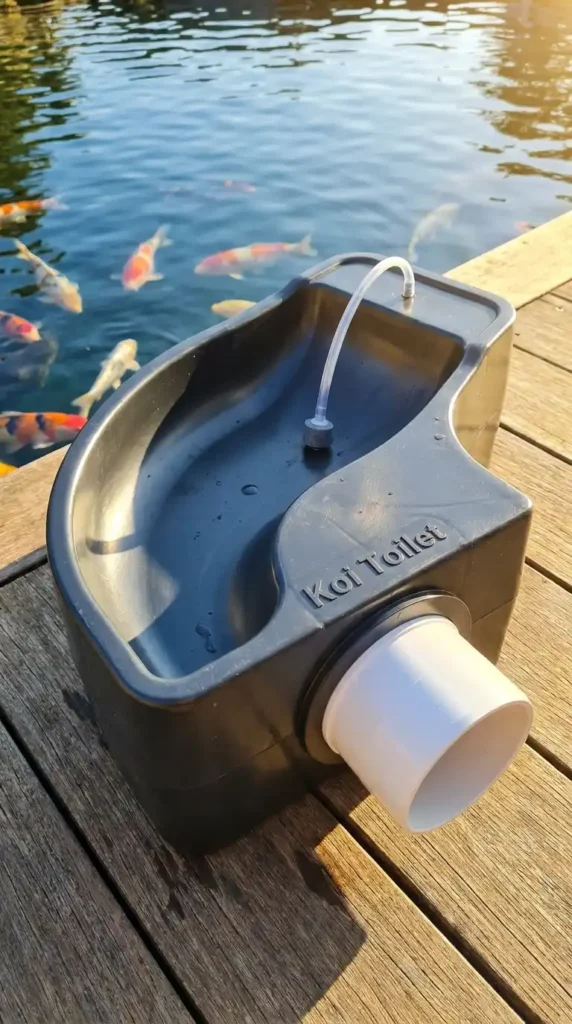
The Koi Toilet I is considered by many as the premium standard for bottom drain design. It features a standard 4-inch drainage connection with a sweeping and extremely smooth internal bottom that provides efficient debris movement with little chance of clogging. The aerated model comes with a large 1-inch air connection, reducing back pressure on stronger air compressors.
- Aeration: Yes (9-inch integrated diffuser)
- Outlet: 4-inch, with sweep bottom design
- Material: Ultra-durable molded ABS
- Special Feature: Triple check valve prevents solids from entering the air feed
Why it is worth the premium: The ultra-efficient design and large drainage and air connections mean you will have some of the best drainage possible for your koi pond.
4. EasyPro EBD4A: Best Budget Aerated Drain
✦ Best for: Budget-conscious builders who still want aeration at the drain
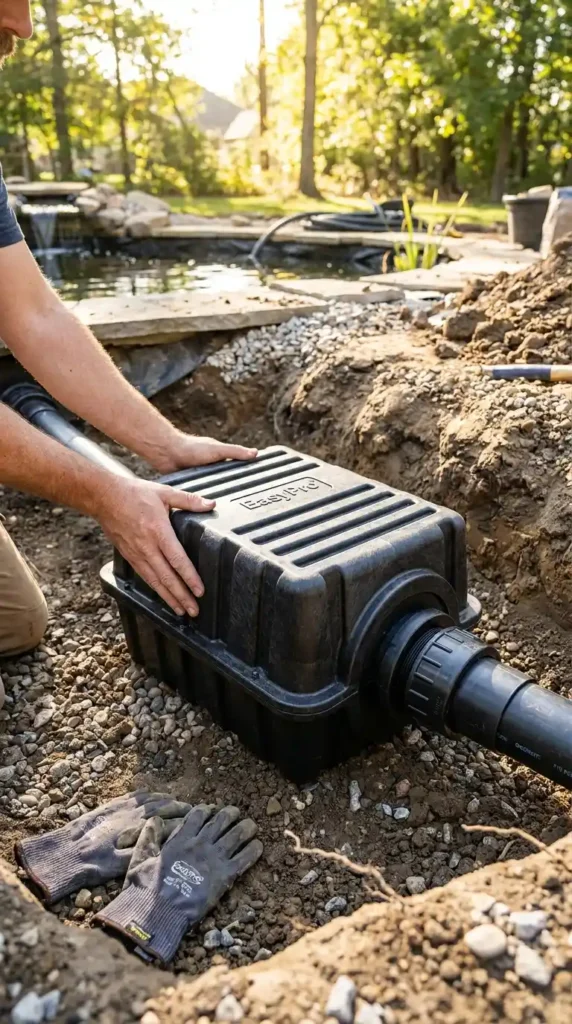
The EasyPro EBD4A offers heavy-duty roto-molded construction for enhanced strength at a reasonable price point. It includes a 4-inch out-take connection and a smaller 1/2-inch air connection on the base for the air compressor. The recommended air flow is 0.5-1.5 CFM, which is plenty for ponds up to 10,000 gallons.
- Aeration: Yes (diffuser plate included)
- Outlet: 4-inch
- Material: Roto-molded ABS
- Best for: Pond owners wanting aeration on a budget
Why it is a great value: Most aerated bottom drains are rather expensive, but the EasyPro model offers the best “bang for buck” in terms of cost vs quality.
5. DreamPond Koi Toilet II: Best Non-Aerated Budget Option
✦ Best for: Smaller ponds or light stocking where aeration is not needed
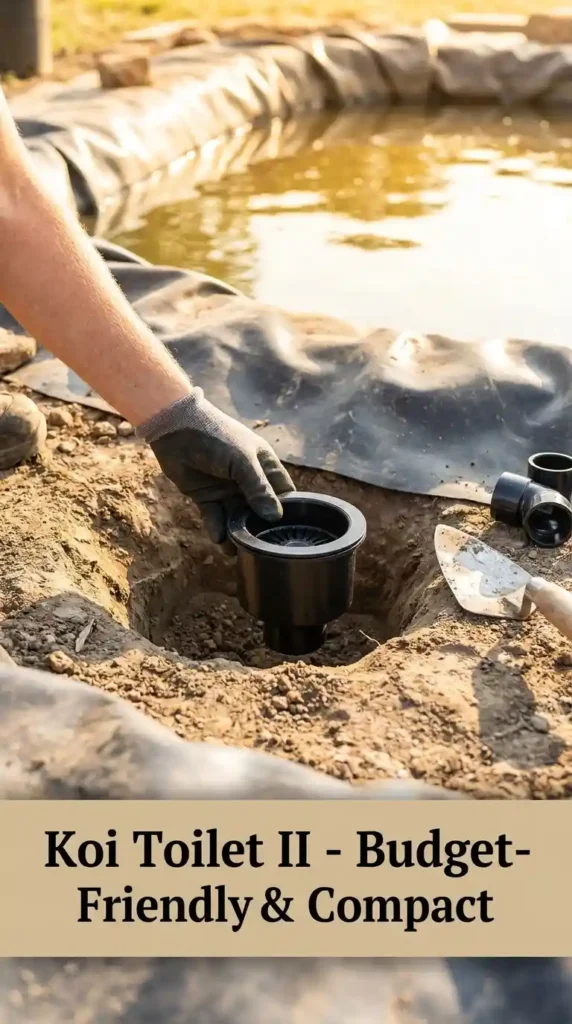
The Koi Toilet II is a non-aerated bottom drain constructed from extra durable molded ABS with a standard 4-inch out-take. It is fairly small, being only around 12 inches in length and weighing just 3 lbs, making it easier to handle compared to larger aerated models. It features a curved dome on top for smooth wave flow and a thick flange and liner ring for a better fit around the pond liner.
- Aeration: No
- Outlet: 4-inch
- Material: Molded ABS
- Weight: 3 lbs (1.3KG)
- Best for: Smaller ponds or lightly stocked ponds where space is more important than aeration potential
Aerated vs Non-Aerated: Which Do You Need?
When an Aerated Bottom Drain Makes Sense
Deep Ponds (4 Feet and Beyond): In ponds deeper than 4 feet, warmer, oxygen-rich water sits at the surface while cooler, oxygen-depleted water settles at the bottom. An aerated drain breaks this stratification.
Heavily Stocked Ponds: Higher fish density means more waste production and more biological oxygen demand. Placing aeration at the drain puts it where oxygen demand is highest.
Warm Climates: Water holds less dissolved oxygen as temperature rises. In regions where pond water regularly exceeds 75 degrees Fahrenheit, bottom aeration provides a meaningful safety margin.
When a Non-Aerated Bottom Drain Is Enough
Shallow Ponds (Under 3.5 Feet): Surface gas exchange and wind action typically provide adequate oxygenation throughout the water column.
Lightly Stocked Ponds: If the pond holds fewer than one inch of fish per 15 gallons, a non-aerated drain is usually sufficient.
Budget-Constrained Builds: A non-aerated drain costs less and eliminates the need for a dedicated air pump and airline.
Sizing Your Bottom Drain
How Many Drains Do You Need?
| Pond Volume | Recommended Bottom Drains | Notes |
|---|---|---|
| Under 2,500 gal | 1 | Single drain, centered at deepest point |
| 2,500 – 5,000 gal | 1–2 | Two recommended for L-shaped or irregular ponds |
| 5,000 – 8,000 gal | 2 | Spaced evenly, each with its own pipe run |
| 8,000 – 12,000 gal | 2–3 | Three if pond is long or has alcoves |
| 12,000+ gal | 3+ | One per ~3,000 gal; consult a builder |
Two drains are almost always better than one for ponds over 3,000 gallons. They create overlapping suction zones that leave fewer dead spots on the pond floor and provide redundancy.
What Size Pipe Should You Use?
Most koi pond bottom drains use 4-inch Schedule 40 PVC pipe. A 4-inch line can handle roughly 3,000-4,000 GPH of flow with acceptable friction loss. Never reduce the pipe size between the drain and the filter. Maintain full diameter throughout the run.
Installation Essentials
Bottom drain installation is best done during a new pond build, but retrofitting into an existing pond is also possible.
New Build Installation
- Form the sump at the lowest point of the pond floor
- Set the drain body and pass the pipe stub through the pond shell
- Connect 4-inch Schedule 40 PVC from the drain to the filter area
- Use minimal 90-degree elbows; long-sweep fittings reduce flow resistance
- Slope the floor toward each drain (1-2 inches per foot)
Retrofit Installation
Retrofitting a bottom drain into an existing pond requires draining the pond and cutting into the shell. It is one of the most impactful upgrades a pond keeper can make.
Professional Plumbing Tips
- Use rigid Schedule 40 PVC pipe: The inside wall is smooth for less friction, and the inside diameter matches the labeled size
- Use sweep fittings: Reduces friction loss in 90-degree turns
- Install unions: Essential for every equipment connection to allow easy pump and filter replacement
- Never use a “Y” connection: If using two drains, each should have its own independent pipe run to the filter area
Frequently Asked Questions About Bottom Drains for Koi Ponds
1. What is the best bottom drain for a koi pond?
For most pond builds, the Aquadyne Rhino II is the safest and most versatile choice. It works in both gravity-fed and pump-fed systems, the anti-vortex dome improves waste collection, and decades of field use mean installers know how to plumb it.
2. What is the difference between aerated and non-aerated bottom drains?
An aerated bottom drain has a built-in air diffuser that adds dissolved oxygen at the pond floor and creates vertical circulation, lifting debris toward the drain. A non-aerated drain relies on suction and floor slope alone. Aerated drains are recommended for deep ponds (4+ feet) or heavy fish loads.
3. How many bottom drains do I need?
The general guideline is one bottom drain per 2,500-3,000 gallons of pond volume. For ponds over 3,000 gallons, two drains are recommended to create overlapping suction zones and reduce dead spots.
4. What size pipe should a bottom drain use?
Most koi pond bottom drains use 4-inch Schedule 40 PVC pipe. A 4-inch line can handle roughly 3,000-4,000 GPH of flow with acceptable friction loss. Never reduce the pipe size between the drain and the filter.
5. Can fish get sucked into a bottom drain?
No, not with a properly installed anti-vortex dome cover. The dome breaks the suction pattern and prevents the swirling vortex that could trap a fish. Every quality bottom drain ship with an anti-vortex dome.
6. Can I add a bottom drain to an existing pond?
Yes, though it is a bigger project than installing one during a new build. The pond needs to be drained, and the shell must be cut or penetrated to route the pipe. It is one of the most impactful upgrades a pond keeper can make.
Related Articles
Best Koi Pond Filter Systems Compared (2026 Guide)
DIY Koi Pond: Cost + Step-by-Step Guide
How to Build a Koi Pond: A Step-by-Step Guide for Beginners
The Ultimate Koi Pond Guide: Design, Building, Filtration & Maintenance
Investing in a quality bottom drain is the most important decision you will make for the health of your koi. Choose the right model for your pond’s depth and stocking level, install it properly, and enjoy cleaner water and healthier fish for years to come.

Sheikh Hassaan is a digital architect for small businesses and the founder of The Glow Up System. He writes about home decor, garden design, and outdoor living for real American homes – practical ideas that work in actual spaces without oversized budgets.