
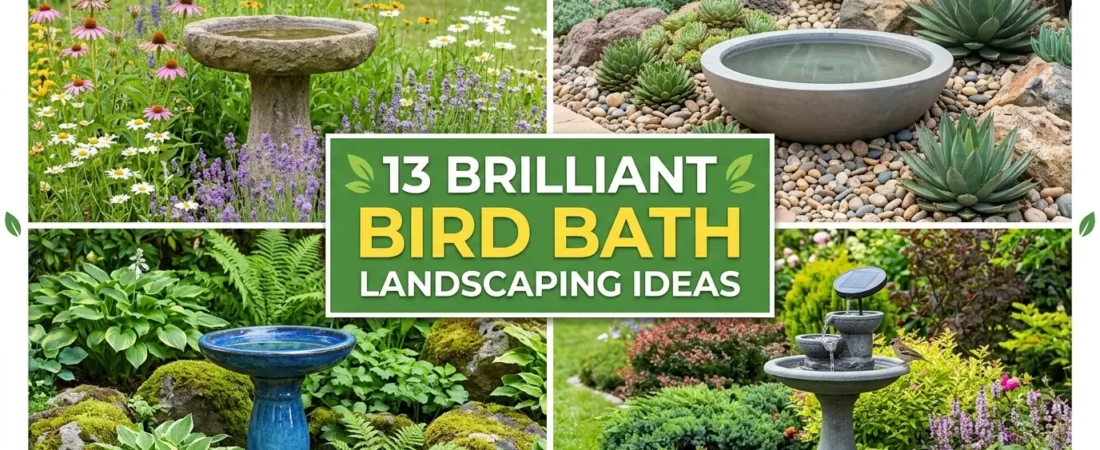
I spent two summers wondering why birds ignored my bird bath completely. The bath was clean, the water was fresh, and it sat in the middle of the lawn looking exactly like every bird bath in every garden center catalog. That was the problem.
Birds do not use bird baths that are positioned like decorative objects. They use water sources that feel like safe natural environments. The landscaping around the bath is what creates that feeling — and these 13 ideas cover every approach from wildflower settings to formal symmetrical layouts, with honest notes on which ones actually produce the most bird activity.
Table of Contents
1. A Cottage Garden Bird Bath Is Surrounded by the Plants Birds Already Know and Use
✦ Cottage Garden Bird Bath
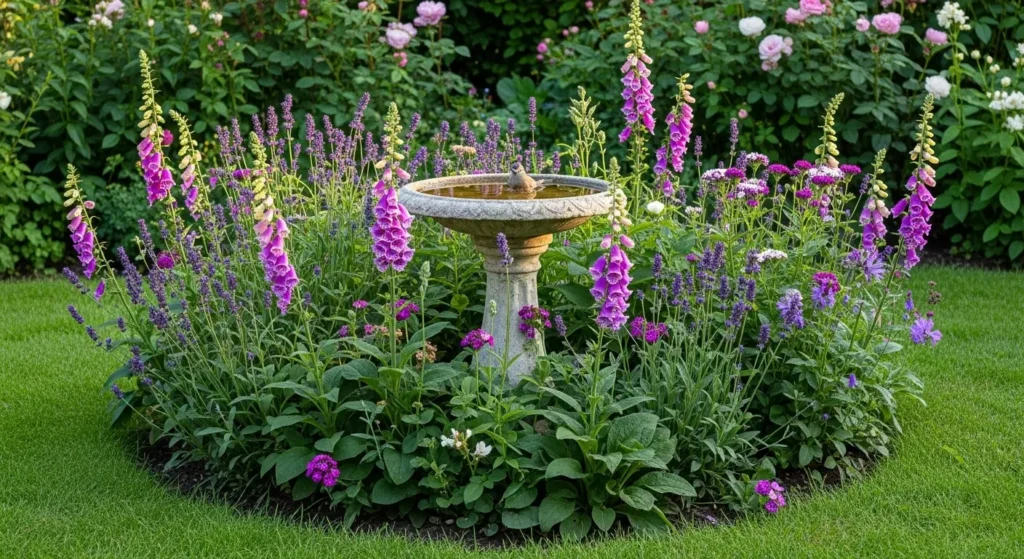
The cottage garden setting is where I would put my own bird bath if I had to choose one approach. The combination of insect-attracting plants, cover, and food sources creates more daily bird activity than any other garden style I have seen.
A cottage garden setting is the bird bath landscaping environment that produces the highest bird activity because cottage garden plants provide the resources birds need beyond water: insect food sources, seed heads for autumn and winter feeding, and dense planting that provides the cover that makes birds feel secure enough to approach an open water source.
The planting combination that creates the most active cottage garden bird bath setting: lavender at the rear of the bird bath for pollinating insects that attract insect-feeding birds. Foxgloves for bumblebee activity visible to visiting birds. Sunflowers allowed to go to seed for direct bird feeding in late summer. Sweet williams and pansies at the base for ground-level insect activity that ground-feeding birds exploit.
The DASTOLL Stained Glass Sun Catcher hung from a nearby rose arch or pergola post adds the light-refracting quality that creates the sparkling water effect visible to birds from above — birds navigate by light on water and a bird bath in dappled light with light refracting from nearby glass is significantly more visible to flying birds than the same bath in deep shadow. Find it linked on Amazon.
PRO TIP: Position a cottage garden bird bath so at least two sides have planting within 6 feet — close enough for birds to retreat quickly to cover if they feel threatened while bathing. Birds using open water are vulnerable to predation and rarely use bird baths positioned in the center of open lawn with no nearby cover. Surrounded by planting on multiple sides a bath gets used continuously throughout the day.
2. A Natural Stone Surround Creates the Most Convincing Wildlife Water Feature Setting
✦ Natural Stone Surround Design
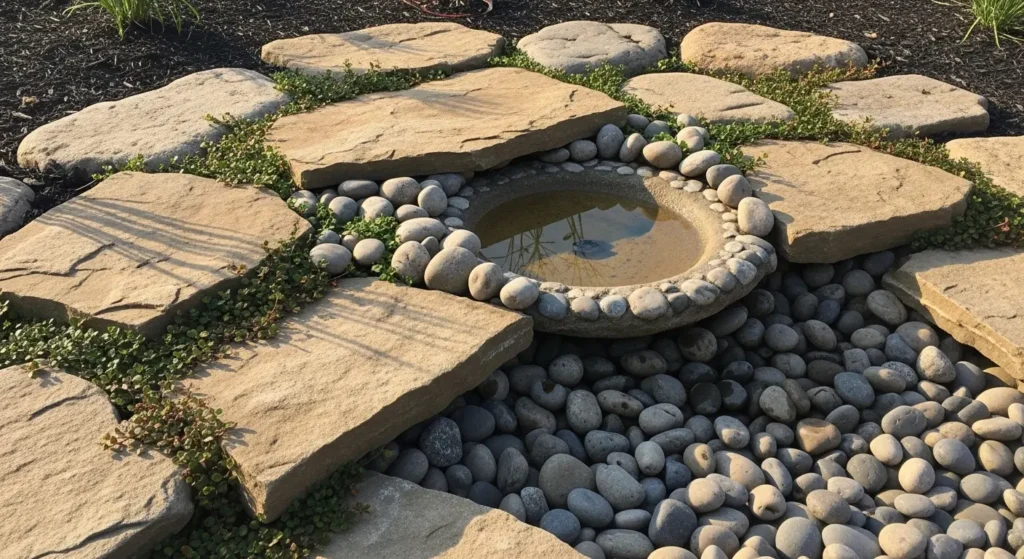
A natural stone surround transforms a standard pedestal bird bath into a landscape water feature — the stones create the visual context of a natural water source that the pedestal alone cannot provide. Birds that are uncertain about a pedestal bath in open space respond much more readily to a bath that is visually embedded in a stone setting that references a natural stream edge or rock pool.
The stone selection for a bird bath surround: mix three stone sizes. Large flat rocks (10 to 16 inches) positioned immediately beside the bath as landing and lookout stones where birds can assess the area before approaching the water. Medium rounded river stones filling the inner surround zone. Small gravel or grit as the ground surface between the stone elements. The gradient from large to small creates the natural stream-edge profile that is most recognizable to birds as a safe water source.
Allow low creeping plants to grow between the stone surround elements — thyme, chamomile, and Sagina subulata all grow flat between stones without obscuring them. The plants add green life to the stone setting and the flowers attract insects that feed at the water surface — providing additional food alongside the bathing water.
3. A Flower Ring Border Makes the Bird Bath the Visual Center of Its Own Garden Feature
✦ Colorful Flower Ring Border
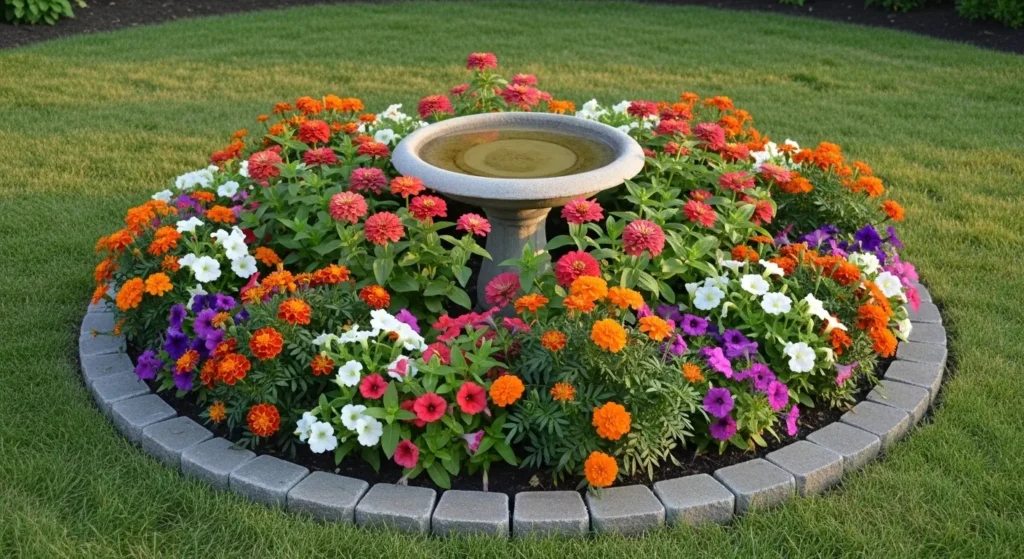
A circular flower ring border positions the bird bath as the literal and visual center of its own planting composition — the planting radiates outward from the bath creating a living frame that makes the bird bath unmissable as a garden feature.
The planting approach for a circular flower ring: choose one primary flowering variety planted as a complete ring at consistent spacing to create the circular frame. Marigolds for warm orange-yellow with strong insect attraction. Zinnias for vivid mixed color with butterfly appeal. Lavender for fragrance and bee activity with a silvery-blue tone. The single-variety ring approach creates more visual impact than a mixed variety ring because the circle reads as a deliberate design rather than a random border.
Circle diameter determines the visual proportion between bird bath and planting ring. A 24-inch diameter planting ring around a standard 18-inch bird bath looks like a collar rather than a feature border. A 48 to 60-inch diameter ring creates the balanced proportion that makes the bird bath feel landscape-integrated rather than simply surrounded by plants.
PRO TIP: Define the circular flower ring with a steel or aluminum ring edger bent to the correct radius before planting. A clean circular edge maintained throughout the season is what makes the flower ring read as a designed landscape feature rather than a circular bed that gradually loses its definition as plants spread and lawn encroaches.
4. A Wildflower Pollinator Setting Creates the Most Biodiverse Bird Bath Garden
✦ Wildflower Pollinator Haven
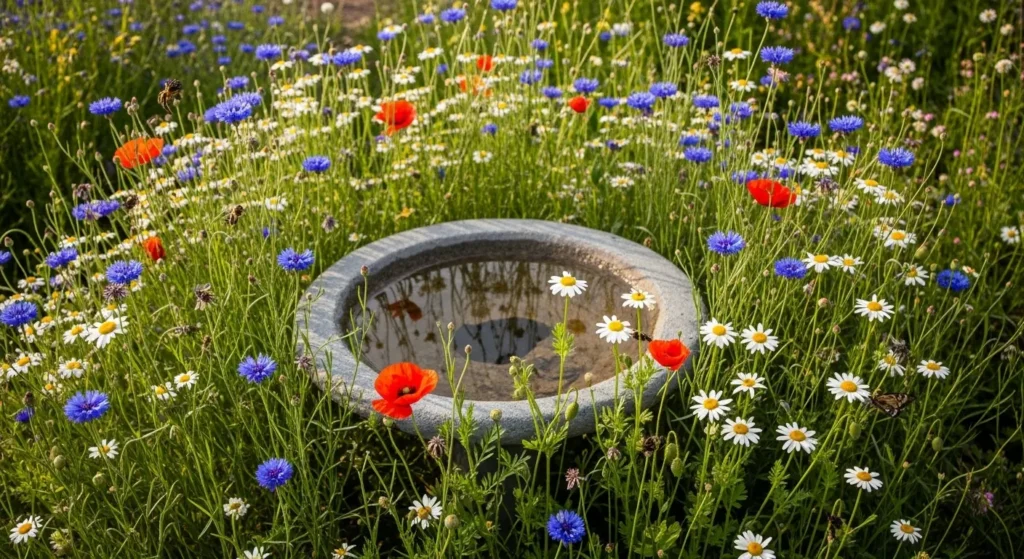
I think the wildflower setting is the most underrated bird bath landscaping idea on this list. Most people plant ornamental borders around their bath. A wildflower setting feeds the birds, attracts the insects that feed the birds, and looks genuinely beautiful doing it.
A wildflower setting is the bird bath landscaping approach with the highest ecological value. Where a flower ring border creates visual impact a wildflower setting creates a complete food web — the diverse insect population attracted by wildflowers provides abundant food for insectivorous birds who also need the water the bath provides. The bird activity in a wildflower setting far exceeds that in any ornamental planting because the food and water resources are co-located.
The annual wildflower mix that creates the most productive pollinator and bird feeding habitat around a bird bath: cornflowers for bumblebee and hoverfly attraction. Field poppies for seed feeding birds in late summer and autumn. Ox-eye daisies for long-season pollinator activity. Annual grasses for sparrow and finch seed foraging. Phacelia for the highest bee density of any annual — a single Phacelia plant in full flower attracts more pollinating insects per hour than any other common garden annual.
Allow spent wildflower heads to remain on the plants through autumn rather than deadheading. The seed heads of cornflowers, teasels, and grasses become the primary winter bird food resource in a wildflower setting — goldfinches on teasel and finches on grass seeds create bird activity at the bird bath through months when ornamental garden bird baths are deserted.
PRO TIP: Plant the wildflower setting around the bird bath in a kidney or irregular organic shape rather than a perfect circle or rectangle. Formal geometric shapes around a wildflower planting create a conflict between the informal naturalistic planting character and the formal geometric container. An irregular organic border edge suits the naturalistic planting and creates a more convincing meadow aesthetic.
5. A Raised Bed Frame Around a Bird Bath Creates a Complete Micro-Garden Feature
✦ Raised Garden Bed Feature
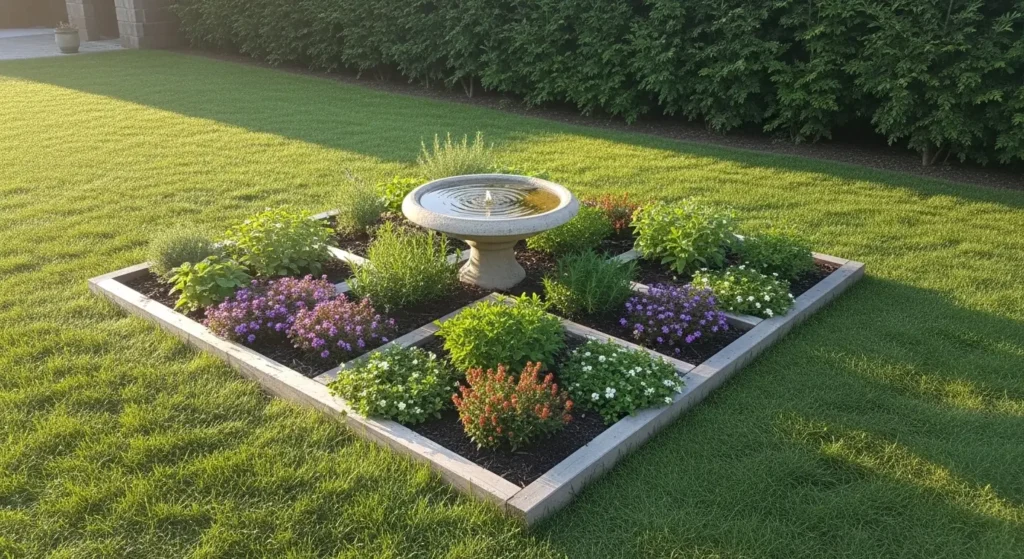
A low raised bed frame around a bird bath elevates the surrounding planting above lawn level, creates a defined growing space with improved drainage and soil quality, and gives the bird bath a permanent architectural setting that makes it read as a designed landscape feature rather than an object placed on the grass.
The raised bed height for a bird bath surround: 6 to 8 inches above ground level. High enough to create visual definition and improved growing conditions. Low enough to avoid visually competing with the bird bath itself, which should remain the tallest and most prominent element in the arrangement. A low raised surround reads as a setting. A tall raised surround reads as a container in which the bird bath is placed.
Planting within a raised bird bath surround bed: choose plants that fill the space without obscuring the bath base. Ground-level herbs — thyme, chamomile, and creeping oregano — suit the limited depth of a narrow surround bed and provide insect-attracting flowers at bath base level. The plants frame the pedestal visually and create the complete landscape micro-feature that a bare raised bed around a bird bath cannot achieve.
6. A Rustic Woodland Setting Creates the Bird Bath Environment With the Highest Bird Use
✦ Rustic Woodland Bird Bath
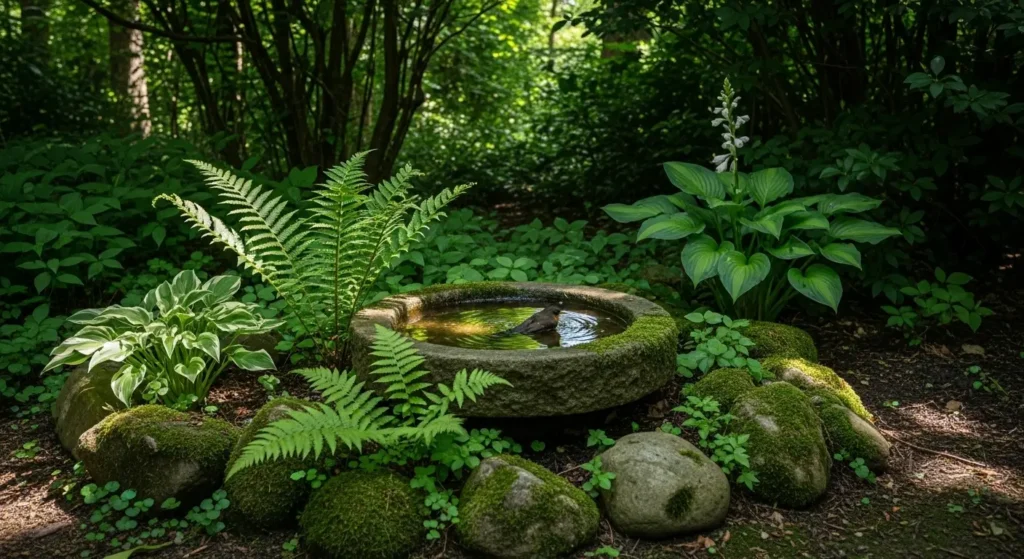
When I moved my bird bath from an open lawn position to a spot under a large shrub with ferns at the base, the daily bird visits went from occasional to constant within a week. The woodland setting is not just attractive — it is the environment most garden birds are actually wired to trust.
A woodland garden bird bath setting consistently produces higher bird activity than open sunny positions because woodland edge is the natural habitat of most common garden birds. Robins, blackbirds, thrushes, wrens, and dunnocks are all birds of woodland edge and undergrowth — they are instinctively more comfortable approaching water that is surrounded by the dappled light, dense ground cover, and overhead canopy that reference their natural habitat.
The planting composition for a woodland bird bath setting: ferns as the ground-level layer creating dense cover immediately beside the bath. Hostas as the mid-height shade-loving plants that fill the surrounding canopy zone. Mossy logs and stones at the base providing additional cover and the insect habitat that feeds ground-feeding birds. A single overhanging tree or large shrub providing the overhead canopy reference that makes woodland birds feel sheltered.
Moss management around a woodland bird bath: moss growing on the bird bath itself and on surrounding stones is a positive ecological sign indicating appropriate moisture levels and a healthy bacterial environment. Do not remove moss from bird bath surrounds. Scrub only the interior basin surface monthly to prevent algae build-up that creates slippery bathing conditions and waterborne bacteria.
PRO TIP: Place a mossy log within 3 feet of a woodland bird bath as a dedicated preening perch. After bathing birds require a safe elevated position to preen and dry their feathers — a bird that has bathed is temporarily less able to fly quickly and is correspondingly more vulnerable to predation. A log perch at close range allows birds to bathe and preen without moving far from the bath and significantly increases the daily use of the water feature.
7. A Gravel and Rock Garden Setting Creates a Low-Maintenance Bird Bath Landscape
✦ Gravel and Rock Garden Setting
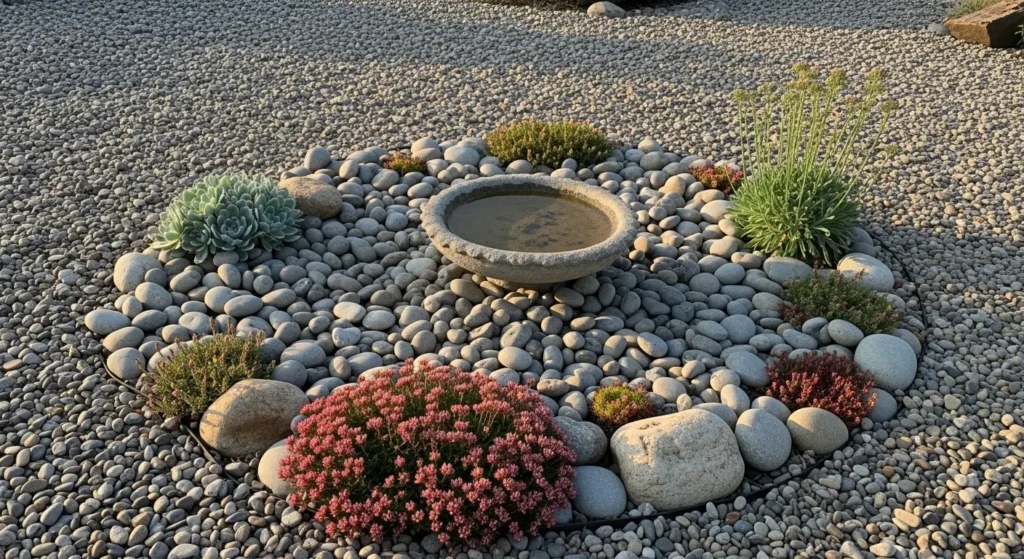
A gravel and rock garden setting creates the lowest maintenance bird bath landscape available while producing one of the most naturalistic and most aesthetically resolved settings. Gravel requires no mowing, no weeding beyond occasional attention, no seasonal replanting, and improves in appearance as stone weathers and low plants establish between the stones.
The gravel specification for a bird bath rock garden surround: 10mm pea gravel or natural flint provides the most naturalistic appearance. Angular chippings create a more formal effect. Smooth river pebbles of 25 to 50mm create the most convincing stream-bed aesthetic that reads as a natural water source setting. Use a single gravel type throughout rather than mixing — a consistent gravel surface reads as a designed landscape material rather than leftover building site material.
Plant selection for rock and gravel bird bath surrounds: drought-tolerant alpines and sedums establish between gravel stones without irrigation once established. Sempervivum, Sedum spurium, Thymus serpyllum, and Festuca glauca all colonize gravel surfaces beautifully and require no maintenance beyond occasional separation when clumps become too large. The established rock garden surround improves in visual quality every year as plants fill between the stones.
PRO TIP: Lay landscape fabric under the gravel surround of a bird bath rock garden before placing stones. The fabric prevents the gravel from mixing into the soil beneath over time while allowing water to drain freely. Without fabric a gravel surround gradually sinks into the soil and requires topping up every two to three years. With fabric the original gravel depth is maintained for a decade or more.
8. A Formal Symmetrical Bird Bath Layout Commands a Garden With Classical Presence
✦ Formal Symmetrical Layout
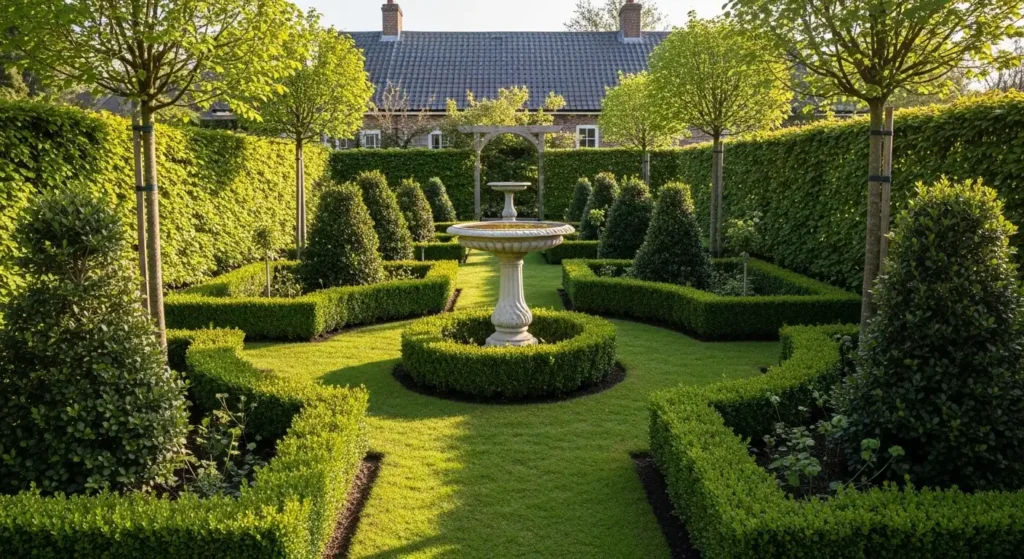
A formal symmetrical bird bath layout applies classical garden design principles to create a setting where the bird bath functions as the axis point of the entire garden composition. The formal approach suits stone and cast iron bird baths with classical architectural details — the formality of the setting reinforces the character of the bath rather than conflicting with it.
The symmetrical planting layout: two identical box-edged borders flanking the bird bath axis. Identical plantings on each side — either matching perennial planting in summer or matching seasonal bedding. Clipped topiary elements at each corner of the formal arrangement providing permanent structural definition. A gravel or stone path on the primary axis leading to the bird bath and continuing beyond it if the garden depth allows.
The maintenance implication of formal symmetrical bird bath layouts is significant: symmetry requires consistent maintenance on both sides simultaneously. An asymmetric planting on one side of a formally symmetrical layout immediately breaks the composition. Formal layouts suit gardeners who find the maintenance of symmetry satisfying rather than those who prefer the more forgiving character of informal planting styles.
9. Ground Cover Planting Around a Bird Bath Eliminates the Bare Soil That Makes Baths Look Unfinished
✦ Bird Bath With Ground Cover Plants
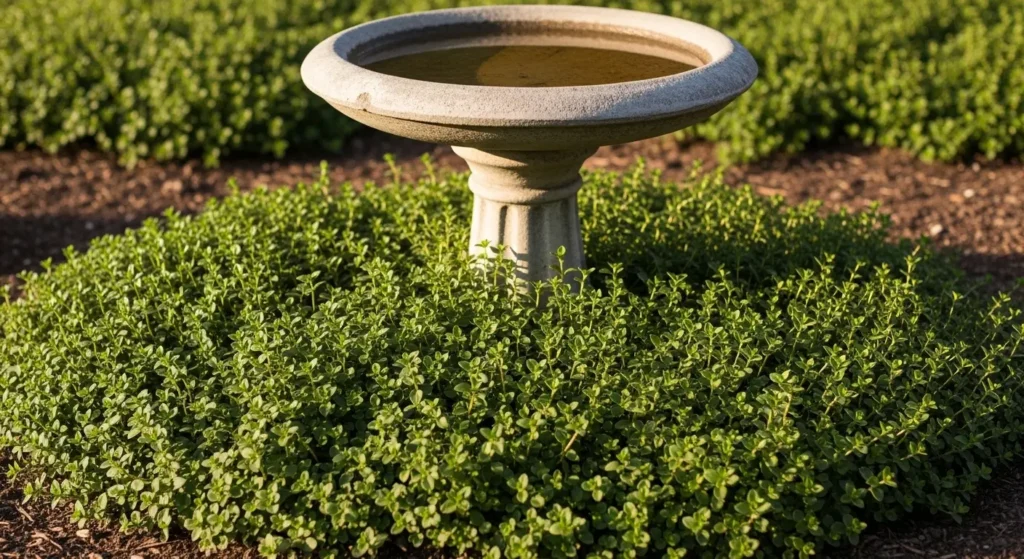
Ground cover planting around a bird bath pedestal is the landscaping detail that most immediately makes a bird bath look properly installed rather than placed. A pedestal rising from bare soil or short-cut lawn looks temporary regardless of the quality of the bath itself. A pedestal rising from a dense carpet of ground cover plants looks rooted in the landscape.
The ground cover varieties that work best immediately around bird bath pedestals: Ajuga reptans provides dense evergreen coverage with spring blue flower spikes that attract early insects. Creeping thyme covers ground densely with woody stems that handle the foot traffic of birds landing around the bath base. Vinca minor provides the darkest and most reliably dense evergreen coverage with periwinkle blue spring flowers. Lysimachia nummularia ‘Aurea’ (golden creeping Jenny) provides bright chartreuse foliage contrast that illuminates the bath base area.
The ground cover establishment period requires patience: most ground cover varieties take one full growing season to establish dense coverage from initial planting. Position plants at 6 to 8-inch spacing for coverage within one season. Wider spacing takes two seasons to fill. Mulch the bare soil between newly planted ground cover with bark chip to prevent weed competition during establishment.
PRO TIP: Avoid ground cover plants with strong horizontal root spread immediately beside a bird bath pedestal. Varieties like mint and comfrey establish aggressively and eventually undermine the stability of pedestals set in soil. Choose tap-rooted or fibrous-rooted ground covers — thyme, Ajuga, and Vinca — that grow laterally without disturbing the soil structure around the pedestal base.
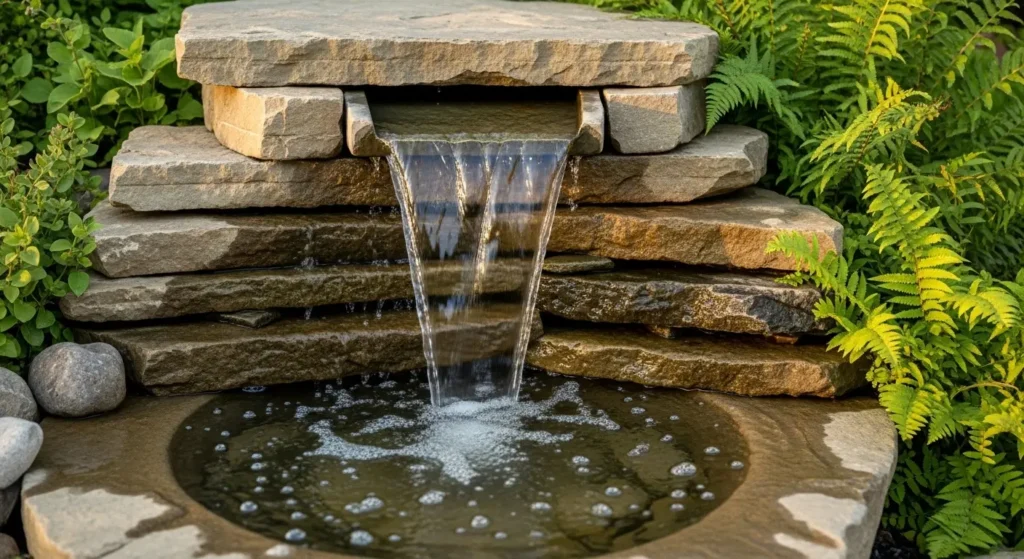
10. A Stacked Stone Waterfall Feature Transforms a Static Bird Bath Into a Moving Water Focal Point
✦ Waterfall Inspired Bird Bath Scene
This is the single upgrade I recommend most. I added a small solar pump to a standard pedestal bath and the difference in bird activity was immediate and dramatic. Moving water is audible and visible to birds from a distance that still water simply is not.
Moving water attracts birds significantly more effectively than static water. The sound and light shimmer of flowing water is audible and visible to birds from distances where a still bird bath is undetectable. A solar-powered submersible pump integrated into a bird bath creates the water movement effect with no electrical installation and at minimal cost.
The stacked stone waterfall bird bath builds a visual and functional upgrade around a standard bath. Position flat rocks in a stepped arrangement behind and above the bird bath basin level. Run a submersible solar pump from the basin up a concealed tube to the top rock tier. Water flows from the top tier across the rock steps and back into the basin in a continuous cycle. The solar pump runs automatically whenever sunlight is available — providing moving water through all daylight hours at zero running cost.
The sound of moving water in a garden has documented effects on human wellbeing beyond wildlife attraction — the VOOKRY Solar Watering Can Light creates a similar water-movement visual effect with its fairy light pouring illusion, positioned beside the bird bath setting as a complementary evening feature when the solar pump is not running. Find it linked on Amazon.
PRO TIP: Keep the water flow rate of a bird bath solar pump at the lowest effective setting rather than maximum. A gentle flow creates pleasant sound and light shimmer. A strong flow creates turbulence in the basin that makes bathing difficult and causes birds to avoid the feature rather than use it. Adjust the flow until it creates visible surface movement without creating whitecaps or excessive splash.
11. A Tropical Setting Bird Bath Creates the Most Dramatically Beautiful Water Feature Context
✦ Tropical Garden Accent
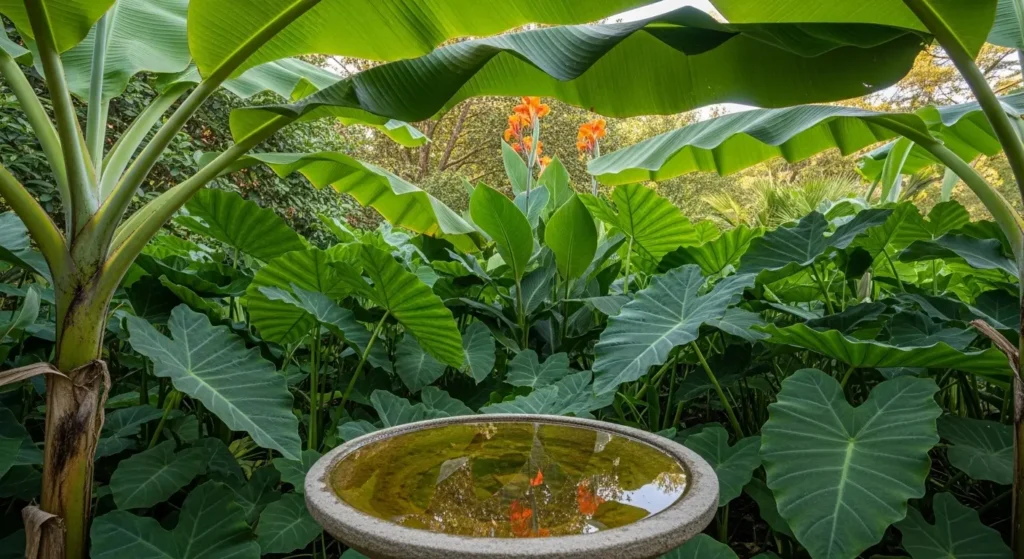
A tropical garden bird bath setting creates the most visually dramatic water feature context available in a temperate garden. Large-leaved tropical plants surrounding a bird bath create an enclosed green space where the water feature becomes the calm center of an enveloping canopy — a genuinely exotic and genuinely beautiful garden moment.
The tropical planting composition for a bird bath setting: one large anchor plant at the rear providing the canopy backdrop — banana, Canna lily, or large Colocasia. Two medium plants flanking the bath at mid-height providing enclosure without blocking light to the water surface — smaller Colocasia, large-leaved Hostas, or Gunnera in appropriate climates. Ground-level coverage of moisture-loving plants that suit the humid microclimate that a tropical water feature setting creates — Astilbe, Ligularia, and shade-tolerant ferns all perform well in the humid conditions beside a frequently filled bird bath.
The Quarut Barrel Planters provide the container volume for large tropical specimens positioned beside a bird bath setting — banana plants and large Canna lilies require 20-inch deep root volume for the scale of growth that creates genuine tropical canopy effect. Find them linked on Amazon.
12. A Butterfly-Friendly Bird Bath Planting Creates the Garden’s Most Active Wildlife Spectacle
✦ Butterfly-Friendly Planting Design
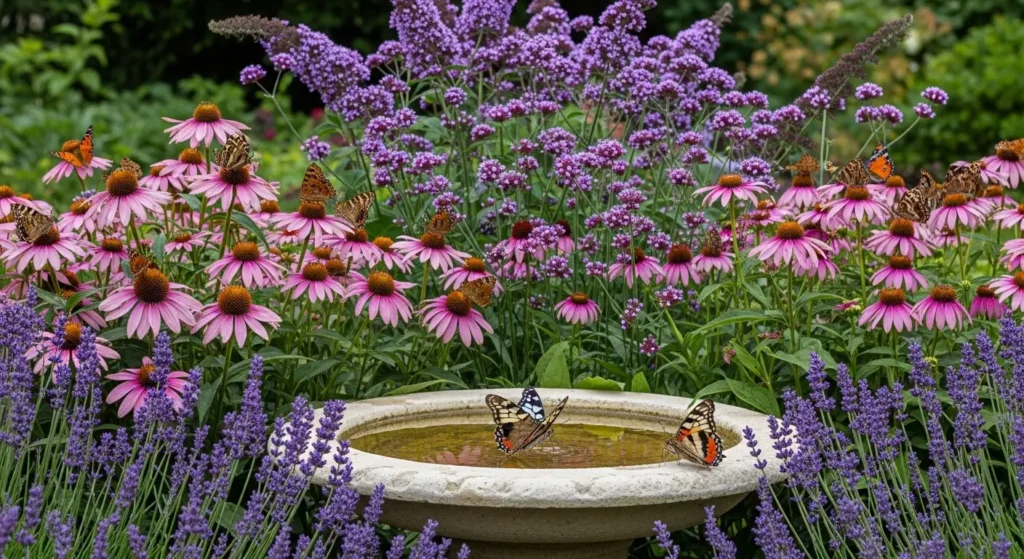
A butterfly-friendly bird bath planting creates a complete wildlife spectacle — butterflies feeding on surrounding flowers while birds bathe in the water and other butterflies use the damp rim of the bath for puddling behavior. Butterflies use shallow water sources for mineral absorption (a behavior called puddling) and a bird bath with a gently sloped interior edge and 1-inch water depth becomes both a bathing facility for birds and a puddling station for butterflies simultaneously.
The planting combination with the highest butterfly attraction value: Buddleja davidii (butterfly bush) as the anchor nectar plant providing the highest butterfly density of any British garden shrub. Echinacea purpurea for late summer butterfly feeding when many other nectar plants have finished. Verbena bonariensis for continuous tall flower spikes from July to October attracting painted ladies, red admirals, and comma butterflies. Lavender at the front edge providing early season butterfly and bee activity from June onward.
The water depth for a butterfly-puddling bird bath should be shallower than for bird bathing — place flat stones in the bird bath basin that protrude 1 inch above the water surface. Butterflies land on the stone surface and drink from the water edge. Birds use the deeper water between the stones. Both wildlife groups use the same feature simultaneously with no conflict between them.
PRO TIP: Add a small amount of sea salt or rock salt to bird bath water in a butterfly-friendly garden setting. Butterflies puddling at water sources are seeking dissolved minerals including sodium that are difficult to obtain from nectar alone. A pinch of sea salt in the bird bath water increases the mineral content that makes the puddling behavior more productive and makes the bath more attractive to butterflies relative to unprepared water sources.
13. A Shaded Retreat Bird Bath Creates the Coolest and Most Consistently Used Summer Water Feature
✦ Shaded Retreat Bird Bath
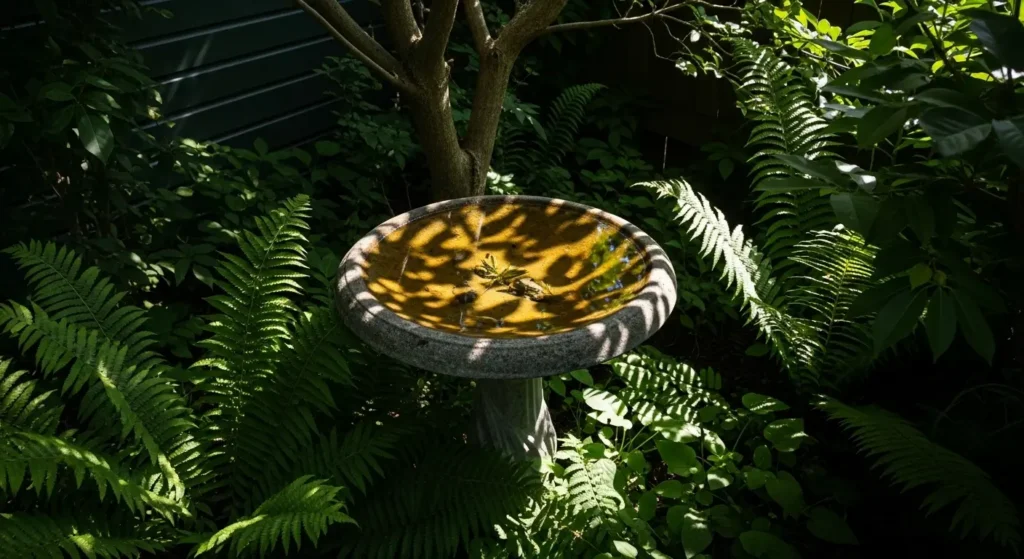
A shaded bird bath is the most practical bird bath landscape placement in a hot summer garden. Water in full sun evaporates rapidly, reaches temperatures that deter bird use, and develops algae bloom within days. Water in dappled shade stays cooler, evaporates more slowly, maintains freshness longer between changes, and attracts bird use throughout the hottest parts of summer days when open-position baths are too warm and too exposed for most birds to approach comfortably.
The planting for a shaded bird bath retreat: shade-tolerant plants that create the enclosed cool atmosphere that both birds and garden visitors appreciate as a retreat from summer heat. Hostas with their broad cooling foliage. Tree ferns where climate allows. Astilbe for feathery plume flowers in partial shade. Hellebores for year-round evergreen foliage and late winter flowers. Japanese anemone for late season white and pink flowers in deep shade positions.
The LANSOW solar spotlights positioned at ground level around a shaded bird bath setting create the evening lighting that extends the visual appeal of the feature beyond daylight hours. Uplighting the surrounding shade plants and the bird bath pedestal from ground level at dusk creates a garden scene that is genuinely beautiful after dark. Find them linked on Amazon.
PRO TIP: Change the water in a shaded bird bath every 3 to 4 days during summer rather than weekly. Shaded water stays cooler and fresher than sun-exposed water but the shelter from wind means leaf debris and bird droppings accumulate on the surface more slowly without the dispersal that wind provides in open positions. Regular water changes prevent the bacterial build-up that birds can smell and avoid even when the water appears visually clean.
Bird Bath Positioning: The Four Rules That Determine Whether Birds Actually Use It
Bird bath landscaping that looks beautiful but gets no bird use has failed at its primary purpose. These four positioning rules ensure bird bath use alongside landscape quality:
Cover within 6 feet:
Birds approaching a water source need nearby cover for rapid retreat. No bird bath in the center of open lawn without planting within 6 feet gets consistent use. Surrounded by planting on at least two sides a bath gets used throughout the day.
Cat-free zone:
A bird bath accessible to cats deters birds regardless of how beautifully it is landscaped. Position baths where cats cannot crouch unseen near the water. Prickly ground cover around the base — gorse, spiny low shrubs, or wire mesh — prevents cats from approaching unseen.
Visible from above:
Birds locate water sources by sight from above. Baths obscured from overhead view by dense overhanging canopy are rarely found by birds. Dappled overhead shade is ideal. Complete overhead canopy concealment significantly reduces bird discovery of a new bath.
Clean water:
Birds can smell bacterial water and avoid it. A bird bath cleaned and refilled every 3 to 4 days gets daily use. A bird bath left for two weeks gets none. The landscaping is irrelevant if the water is not maintained.
📌 More garden and wildlife ideas → 25 Simple But Stunning Garden Lighting Ideas
Frequently Asked Questions
Where is the best place to put a bird bath in the garden?
Dappled shade with dense planting within 6 feet on at least two sides. According to the RSPB this combination produces the highest daily bird visit rates of any garden bird bath position. Full sun and open lawn positions look better in photos but get used far less.
What plants should I put around a bird bath?
Combine cover plants that birds can retreat to quickly with food plants that attract insects and produce seeds. Lavender, buddleja, ornamental grasses left to seed, and berry-bearing shrubs like cotoneaster provide both resources alongside the water.
How often should I change bird bath water?
Every 3 to 4 days in summer, every 5 to 7 days in cooler months. Clean the basin with a stiff brush and plain water each time. Birds can smell bacterial water and will avoid a bath that looks clean but has not been changed recently.
A Bird Bath Landscaped Well Is a Wildlife Habitat That Also Happens to Look Beautiful
The bird bath landscaping ideas in this guide each serve two masters — the garden aesthetic and the wildlife ecology. The best of them are indistinguishable from natural water sources in their planting context while providing the consistent clean water that garden birds in built environments genuinely depend on through summer drought and winter freeze.
Choose the bird bath landscaping idea that suits your garden style and your growing conditions. Plant it with intention. Maintain the water consistently. The bird activity that follows will make the investment worthwhile every morning of the year.
All the products mentioned in this article are linked on Amazon. Every recommendation is something we genuinely believe in.
More Garden and Wildlife Ideas
→ 25 Simple But Stunning Garden Lighting Ideas
→ 12 Boho Garden Ideas You’ll Love
→ 12 Lovely Front Yard Garden Ideas
→ 20 Creative Garden Rock Art Ideas
The positioning rules at the end of this guide matter as much as the planting ideas themselves. I have seen beautifully landscaped bird baths that never get used because they are too exposed, too close to a fence where cats hide, or positioned under dense canopy that birds cannot see from above.
Get the position right first. Then choose the landscaping style that suits your garden. Then maintain the water consistently. Do those three things and a bird bath stops being a garden ornament and starts being the most active corner of your entire yard.

Sheikh Hassaan is a digital architect for small businesses and the founder of The Glow Up System. He writes about home decor, garden design, and outdoor living for real American homes – practical ideas that work in actual spaces without oversized budgets.