

The hallway is the room that most homes treat as a passthrough and most interior designers treat as a missed opportunity. A well-chosen entryway bench changes how the entire hallway functions, it gives everyone in the household a place to sit while putting on shoes, a surface to rest bags on while finding keys, and a storage solution for the shoes, umbrellas, and seasonal items that accumulate near the door of every home.
These entryway bench ideas cover every hallway size and style — from slim upholstered benches for narrow UK terraced house hallways through storage benches with built-in shoe organisation, mudroom-style benches for families, and DIY options that create a custom fitted look at a fraction of the cost of bespoke joinery.
Table of Contents
Why Every Hallway Needs an Entryway Bench
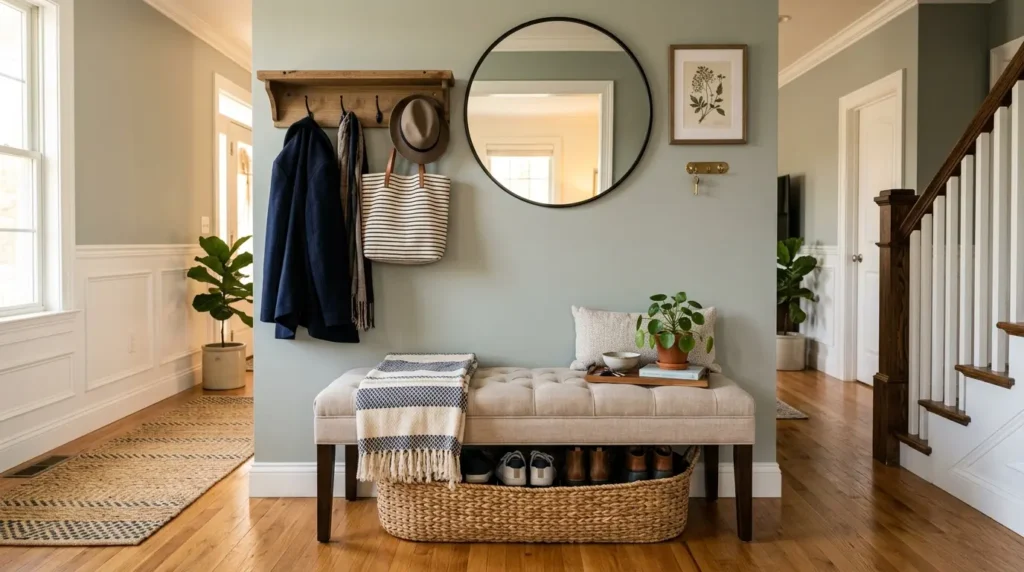
A hallway without a bench forces everyone who enters the house to either balance on one leg while putting on shoes, sit on the stairs which blocks the route through, or walk through to another room to sit down before coming back. None of these are good solutions to a problem that a bench solves completely for under $200 in most cases. The entryway bench is the most practical single piece of furniture available for a hallway and the one most frequently overlooked in favour of console tables, coat racks, and decorative elements that look good but do not help anyone get out of the door on time.
The entryway bench also anchors the hallway’s design in a way that other furniture cannot — it provides a horizontal surface at a height that the eye naturally settles on when entering a space, which creates an immediate impression of a considered interior rather than a functional corridor. A hallway with a bench, even a simple one, reads as designed. The same hallway without one reads as unfinished regardless of what is on the walls or floor.
The sizing rule that most people get wrong when choosing a hallway bench: the bench should be between 17 and 19 inches in seat height — this is the correct height for comfortable sitting when putting on shoes without bending too far forward or pushing up from a low position. A bench significantly below 17 inches requires an awkward squat to sit on. A bench above 19 inches leaves feet dangling uncomfortably. Standard dining chair height is 18 inches — any bench at this height will be comfortable for shoe-putting-on regardless of the user’s height.
1. Upholstered Entryway Bench for a Soft and Welcoming Hallway
✦ Best for: hallways in homes where the entryway sets a warm and considered first impression
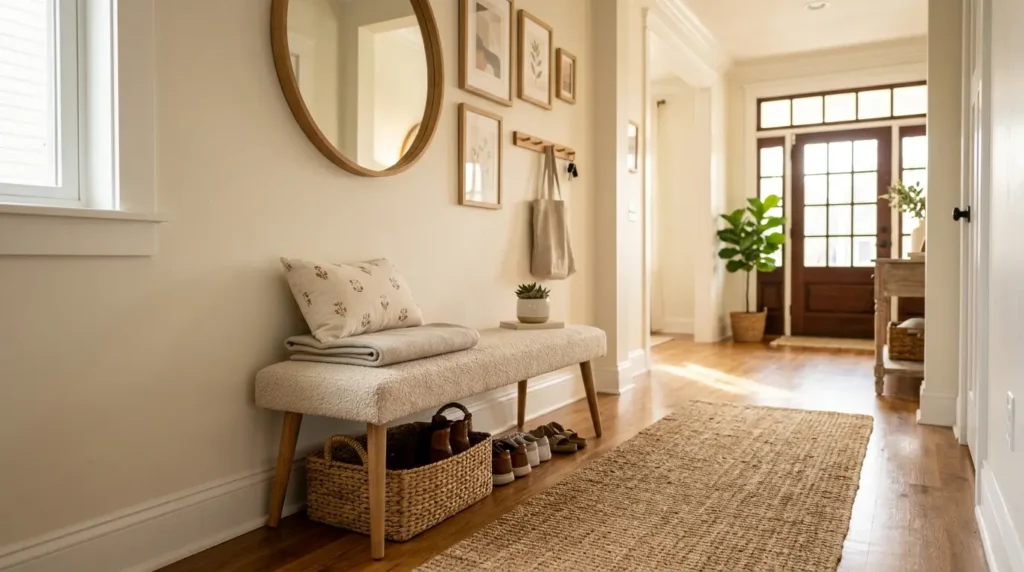
An upholstered entryway bench introduces the one quality that most hallways completely lack — softness. A hallway with hard flooring, hard walls, and hard coat hooks reads as functional. The same hallway with an upholstered bench reads as welcoming. The fabric surface creates a visual warmth that no timber or metal bench can match and communicates that the home values comfort from the moment anyone steps through the door.
The upholstery fabrics that work best on a hallway bench: boucle in warm white or cream for the most current and most tactile result. Linen in natural or stone for the most versatile and most durable finish — linen ages well in a high-traffic area and develops a lived-in quality that suits the hallway context. Velvet in a deep tone — navy, forest green, or charcoal — for the most dramatic and most design-led result in a hallway where a colour statement is wanted.
The leg style that determines how the upholstered bench reads in the hallway: tapered timber legs in a warm oak or walnut tone create a mid-century quality that suits contemporary and transitional hallways. Black metal hairpin legs create an industrial quality that suits more urban and contemporary spaces. Turned timber legs in a painted finish suit traditional and farmhouse hallways. The leg choice should respond to the hallway’s flooring and overall style rather than being chosen independently.
The practical addition that makes an upholstered entryway bench more functional: a woven basket or two underneath the bench for shoe storage. The space beneath a bench on legs is one of the most useful storage zones in a hallway — it is exactly the right height for shoes, the right depth for umbrellas stood upright, and the right width for a small basket of dog leads, gloves, or seasonal accessories. A bench without under-bench storage misses this opportunity entirely.
2. Entryway Bench With Storage for Hallways That Need to Work Hard
✦ Best for: family hallways where shoe storage, coat storage, and bag storage all need to be managed at the entrance to the home
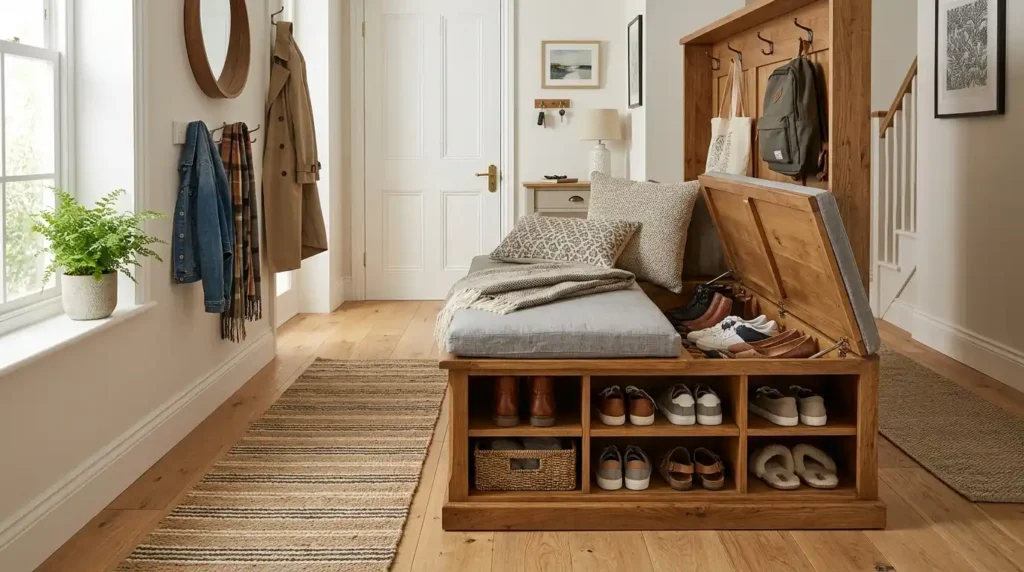
A storage bench — either a lift-lid bench with internal storage or a bench with open cubbies beneath the seat — solves the hallway’s most persistent problem: where do all the shoes go. The average UK or US household has between 15 and 30 pairs of shoes in regular rotation, and most hallways have no dedicated shoe storage beyond a boot rack beside the door. A storage entryway bench consolidates this problem into a single furniture piece that also provides seating.
The lift-lid bench with internal storage is best for storing items that do not need to be accessed daily — seasonal boots, spare umbrellas, dog accessories, sports gear. The storage capacity of a standard 42-inch lift-lid bench is significant — typically 30 to 40 litres of interior volume — but the access requires lifting the seat every time something is retrieved, which makes it less practical for everyday shoe rotation than open cubbies.
Open cubby benches — benches with individual square or rectangular openings beneath the seat, each sized to hold two or three pairs of shoes — are more practical for daily shoe storage because shoes slide in and out without any lifting or opening. A standard four-cubby bench holds eight to twelve pairs of shoes in a footprint of 42 to 48 inches wide and 15 inches deep. This footprint suits any hallway wide enough to allow 30 inches of clear passage alongside the bench.
The addition of a coat rack or hook rail directly above a storage entryway bench creates a complete hallway entry system — the bench handles shoes and lower storage while hooks above handle coats, bags, and hats. A hook rail mounted 60 to 66 inches from the floor above the bench creates the correct height for adult coat hanging without the coats sitting on the bench seat. This bench and hook rail combination is the most functional hallway entry arrangement available without built-in joinery.
3. Slim Entryway Bench for Narrow Hallways Under 36 Inches Wide
✦ Best for: narrow terraced house or flat hallways where standard bench depth makes the corridor impassable
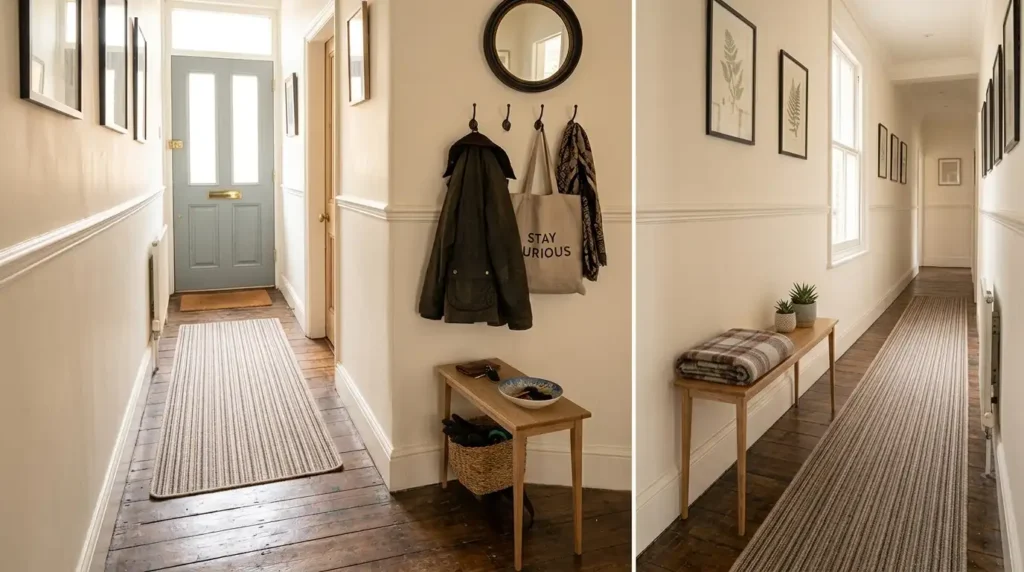
Most UK terraced houses have hallways between 30 and 40 inches wide — narrow enough that a standard 14 to 16 inch deep bench makes the corridor genuinely tight to pass through. A slim entryway bench at 10 to 12 inches deep solves this problem — it provides the seating function without projecting far enough into the hallway to impede movement. The seat depth of 10 to 12 inches is enough to sit on for shoe-putting-on purposes even though it is narrower than a standard bench.
A wall-mounted floating bench — a bench seat fixed directly to the wall studs rather than standing on legs — is the slimmest possible entryway bench option because it projects only the depth of the seat itself from the wall with nothing below it on the floor. A floating bench seat of 10 inches depth leaves 20 to 30 inches of clear floor passage in a 30 to 40 inch wide hallway. The floor beneath a floating bench is completely clear which reads as more spacious than the same bench on legs.
The styling approach that makes a slim entryway bench read as a design decision rather than a compromise: a single cushion in a fabric that contrasts the wall colour. A small woven basket on the floor beside rather than beneath the bench for one or two pairs of shoes. A mirror above the bench rather than a coat rack — a mirror makes a narrow hallway feel wider and serves the practical function of a last check before leaving the house. These three elements together create a complete narrow hallway entry that looks genuinely considered.
4. Mudroom Style Entryway Bench With Hooks and Cubbies for Families
✦ Best for: family homes where multiple people’s coats, bags, shoes, and everyday items need to be organized at the entrance
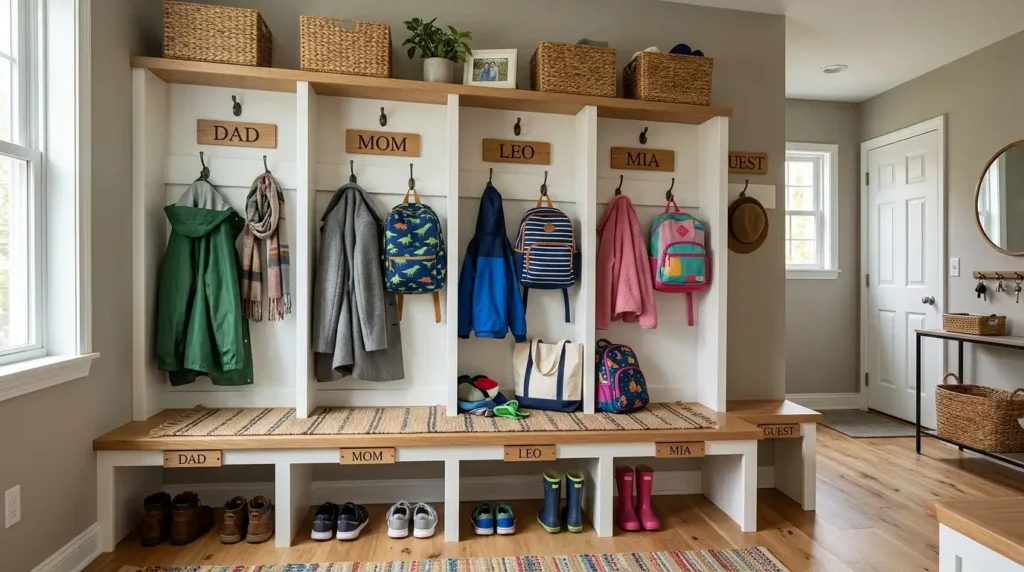
A mudroom-style entryway bench unit — a combined bench, hook, and cubby system that assigns a dedicated space to each family member — is the most organized and most functional hallway entry solution available for a household of three or more people. When each person has their own hook, their own shoe cubby, and their own section of bench the hallway stays organized as a system rather than requiring daily tidying to maintain.
The standard per-person allocation in a mudroom bench unit: one coat hook at adult height (60 to 66 inches from floor) or child height (48 to 52 inches) depending on the user. One shoe cubby below the bench seat sized to hold two to three pairs of shoes — approximately 12 inches wide, 12 inches deep, and 10 inches tall. One section of bench seat approximately 18 inches wide to sit on. This per-person allocation at 18 inches means a four-person household needs a unit of at least 72 inches — 6 feet — of width.
The IKEA Hemnes shoe cabinet bench or the IKEA Kallax with a bench top added are the most widely available off-the-shelf approximations of a mudroom bench unit at an accessible price point. Neither is a perfect solution but both provide the cubby and bench combination that creates the mudroom organization system at a fraction of the cost of custom-built joinery. Adding hook rails above either unit completes the mudroom look without any bespoke work.
5. Wooden Entryway Bench for Farmhouse and Traditional Hallways
✦ Best for: traditional, farmhouse, and country-style homes where natural timber creates the most authentic hallway character
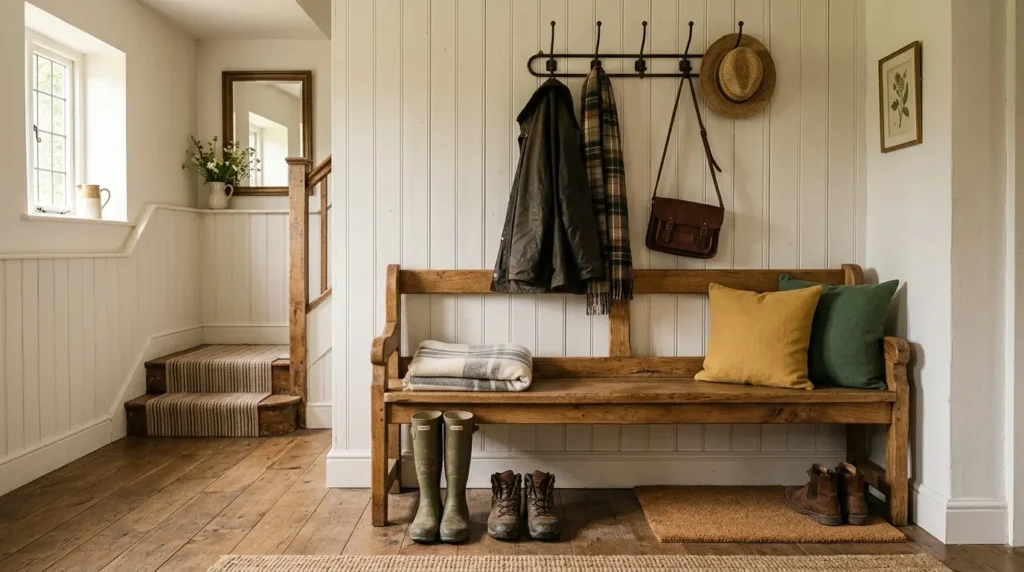
A solid timber entryway bench in oak, pine, or reclaimed wood suits the farmhouse and traditional hallway because timber is the material that most directly communicates the warmth and permanence that the hallway entry should feel. A well-made timber bench looks appropriate in a period property in a way that upholstered or metal alternatives often do not — the natural grain and material weight of solid timber reads as genuinely aged and genuinely quality rather than recently purchased.
The timber finishes that suit a farmhouse hallway bench: a natural oil finish that lets the grain show through and darkens slightly with age creates the most authentic and most beautiful result over time. A white or off-white painted finish suits a farmhouse hallway with panelled walls and creates a unified palette when the bench matches the wall panelling. A dark stained finish in walnut or ebony creates the most dramatic and most period-appropriate result for a traditional property with dark timber flooring.
Reclaimed timber is the material that creates the most authentic farmhouse bench character because the weathering, colour variation, and material history of reclaimed wood cannot be replicated by new timber stained to look old. A bench made from reclaimed scaffold boards, railway sleeper offcuts, or barn timber has a specific presence that suits a period property hallway in a way that a new pine bench, however well made, does not achieve.
6. DIY Entryway Bench Built for Under $100
✦ Best for: adding a hallway bench on a minimal budget using basic DIY skills and widely available materials
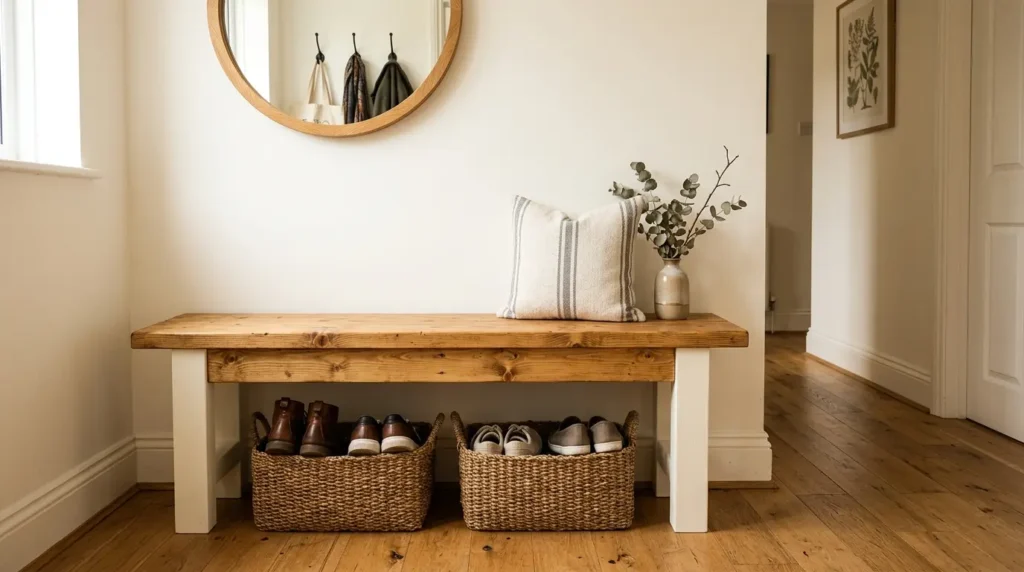
A DIY entryway bench is one of the most achievable first woodworking projects available — the construction requires only straight cuts, basic screws or pocket hole joinery, and sandpaper. The material cost for a pine plank bench of 42 inches wide at 18 inches seat height is typically $40 to $70 depending on timber prices locally, plus $15 to $30 for paint or stain. The total build time for a confident beginner is two to three hours including finishing.
Materials for a standard 42-inch DIY entryway bench:
One pine board at 42 inches by 12 inches for the seat. Four timber legs at 16.5 inches each — this gives a finished seat height of 18 inches including the seat board thickness. Two apron boards at 38 inches and 8 inches for the front and back. Two shorter apron boards at 8 inches and 8 inches for the sides. Wood screws or pocket hole screws. Sandpaper at 120 and 220 grit. Paint or wood oil for the finish.
The fastest route to a DIY entryway bench that looks professionally made: use hairpin legs rather than building timber legs from scratch. A set of four steel hairpin legs at 17.5 inches costs $25 to $40 online and screws directly into the underside of a pine seat board with no complex joinery. The seat board can be sanded and oiled in its natural pine finish or painted to match the hallway walls. The result is a genuinely beautiful bench that takes under one hour to assemble.
7. Entryway Bench With Mirror for a Hallway That Feels Larger
✦ Best for: small or dark hallways where the bench and mirror combination solves both the seating problem and the visual space problem simultaneously
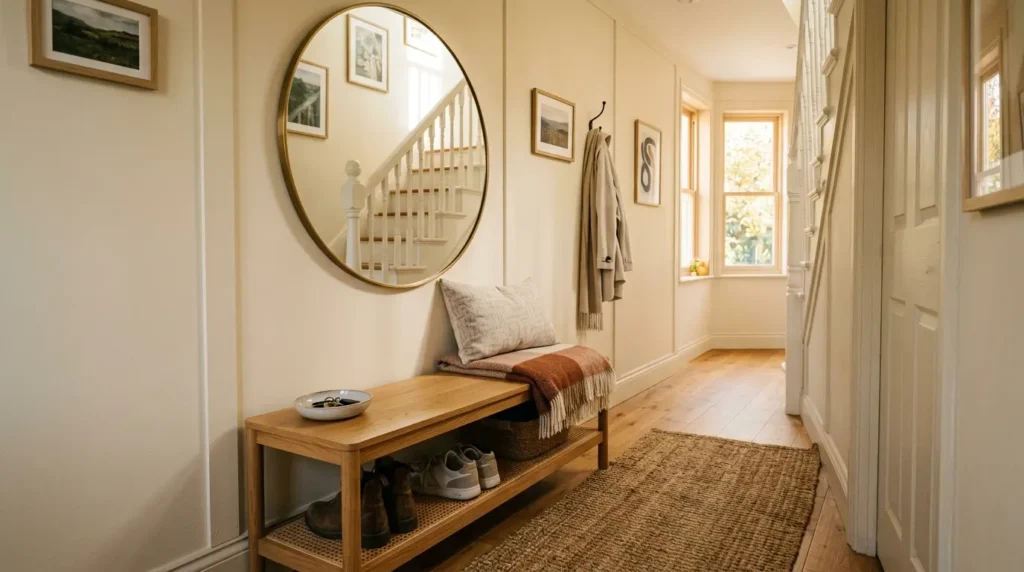
A bench and mirror pairing is the hallway combination that addresses the three most common hallway problems simultaneously — no seating for shoe-putting-on, no mirror for a last check before leaving the house, and a small or dark space that feels cramped. The mirror above the bench serves the practical function of a full-length or half-length reflection while creating the visual depth that makes a narrow hallway read as significantly wider and more generous than its actual dimensions.
The mirror shapes that work best above a hallway bench: a large round mirror — 24 to 30 inches in diameter — positioned centrally above the bench creates a soft organic focal point that suits most hallway styles. An arched or arch-top mirror in a slim frame creates an architectural quality that suits traditional and transitional hallways. A full rectangular mirror that matches the width of the bench below creates the most formal and most symmetrical result.
The mirror height above the bench matters for both practical use and visual balance: the bottom of the mirror should sit 6 to 8 inches above the bench seat — close enough to create a visual connection between the two pieces and high enough to clear anyone sitting on the bench below it. A mirror mounted too high above the bench reads as a disconnected wall decoration rather than a deliberate bench and mirror pairing.
📌 More hallway and home decor ideas: Mudroom Bench Ideas That Combine Storage and Style
Frequently Asked Questions
What size entryway bench do I need?
The correct entryway bench size depends on two measurements: the available wall width in the hallway and the hallway’s total width. The bench should be no longer than the available wall section minus 6 inches on each side — a wall section of 48 inches suits a bench of 36 inches maximum. The bench depth should leave at least 30 inches of clear passage alongside it — in a hallway 40 inches wide a bench of 10 inches depth leaves 30 inches clear. Seat height should be 17 to 19 inches for comfortable use. According to the National Kitchen and Bath Association standard residential design guidelines, a minimum clear passage width of 36 inches is recommended for hallways in residential properties, though 30 inches is functional for single-person use in compact homes.
What should I put under my entryway bench?
The most useful items to store under an entryway bench: woven baskets or fabric bins sized to hold two to four pairs of shoes each — one basket per household member keeps the shoe storage organised without requiring a dedicated shoe rack. A small tray for wet or muddy shoes that need to be kept separate from clean ones. An umbrella stand if the bench legs allow enough height. A small mat or rug runner beneath the bench that extends slightly beyond it to define the bench area and catch dirt from shoes being changed. Avoid storing items that are used infrequently under the bench — the under-bench space is prime real estate for daily-use items only.
How do I style an entryway bench?
The styling approach that makes an entryway bench look designed rather than simply placed: add one cushion or throw in a fabric that introduces texture or colour to the hallway palette — this is often the only soft furnishing in the hallway and it carries significant visual weight. Place one small plant or vase of flowers on the bench or on a shelf above it — a living element makes the hallway feel genuinely inhabited. Keep the bench surface clear of everyday clutter — bags, post, and keys should have specific homes off the bench surface so the bench always reads as a seating element rather than a dumping surface.
What is the best material for an entryway bench?
The best material for an entryway bench depends on the household’s specific needs. Solid timber — oak, pine, or reclaimed wood — is the most durable and most timeless material that suits any hallway style and improves with age. Upholstered benches in performance fabrics — linen, boucle, or velvet — add comfort and warmth but require more maintenance in high-traffic hallways where muddy hands or school bags make contact with the surface regularly. Metal frame benches with timber seats combine industrial durability with natural warmth and suit contemporary and urban hallways. For families with young children a wipeable upholstered bench in a performance fabric or a plain painted timber bench that can be repainted when marked is the most practical long-term choice.
More Hallway and Home Decor Ideas
→ Small Apartment Ideas That Make Every Square Foot Count
→ Family Photo Wall Ideas That Never Look Tacky
→ Master Bedroom Ideas That Make You Never Want to Leave
Measure the hallway width before buying anything. A bench that leaves less than 30 inches of clear passage is a bench that makes the hallway worse not better.

Sheikh Hassaan is a digital architect for small businesses and the founder of The Glow Up System. He writes about home decor, garden design, and outdoor living for real American homes – practical ideas that work in actual spaces without oversized budgets.