
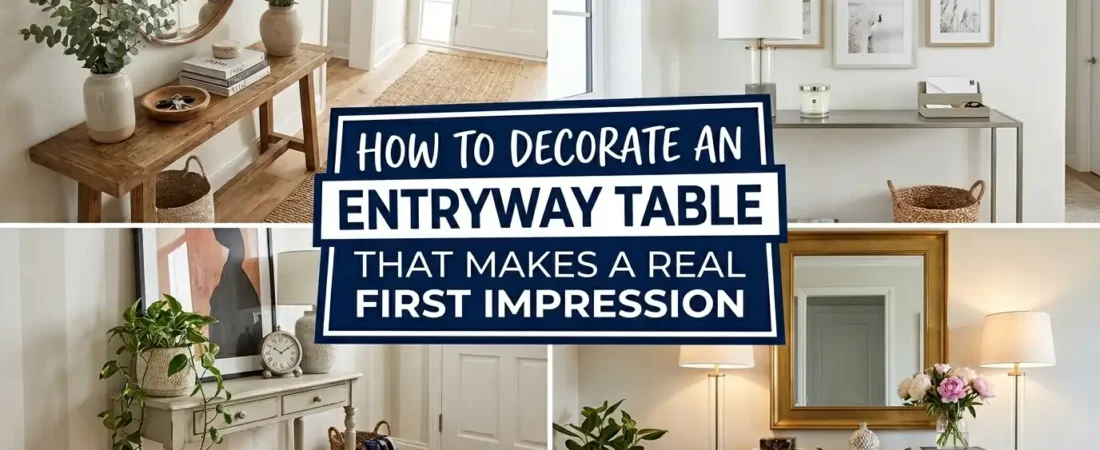
The entryway table is the first piece of furniture anyone sees when they walk into your home — and most entryway tables are either completely bare, a dumping ground for mail and keys, or styled with objects that look deliberately placed but feel disconnected from the rest of the home. Knowing how to decorate an entryway table means understanding the specific principles of scale, layering, and function that make the difference between a table that looks designed and one that simply has things on it.
This guide covers how to decorate an entryway table step by step — starting with the foundational rules of height, scale, and symmetry through the specific object categories that work best on a console table and the seasonal refresh approach that keeps the entryway feeling current without requiring a full redecoration.
Table of Contents
The Rules That Make Entryway Table Styling Actually Work
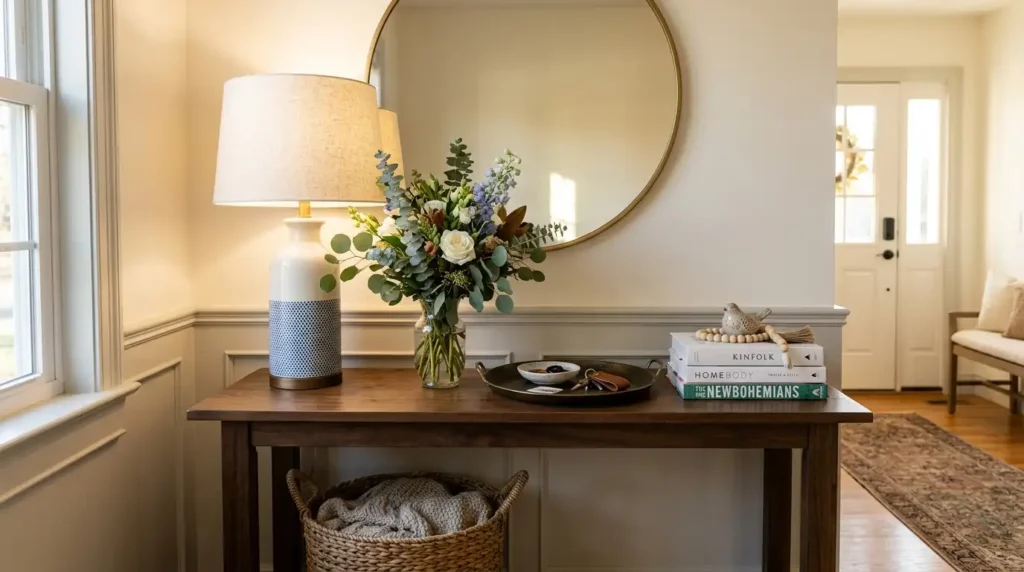
The reason most entryway tables look unstyled even when they have objects on them is that the objects were placed without reference to the three principles that professional stylists use on every console table: height variation, odd numbers, and the combination of functional and decorative objects. A table with three objects all at the same height reads as a shelf of things. The same three objects at three different heights reads as a considered arrangement.
Height variation is the single most important principle in entryway table styling. Every console table arrangement needs at least three distinct height levels — a tall element at 24 to 36 inches such as a lamp or tall vase, a medium element at 12 to 18 inches such as a plant or decorative object, and a low element at 2 to 6 inches such as a tray, a stack of books, or a small candle. The eye moves up and down through the arrangement rather than scanning horizontally across identical heights.
Odd numbers create more visually interesting arrangements than even numbers because odd groupings create asymmetry that the eye finds more engaging than perfectly matched pairs. Three objects, five objects, or seven objects arranged in a single console table vignette always reads as more designed than two objects or four objects placed symmetrically. The exception is when deliberate symmetry is the design intention — a lamp on each end of a console table with a single central mirror is a symmetrical arrangement that works because the symmetry itself is the design statement.
The combination of functional and decorative objects is what makes an entryway table arrangement feel genuinely lived-in rather than staged. A tray that actually holds keys. A bowl that actually contains mail or small items. A lamp that actually provides light. These functional objects anchored within a decorative arrangement create the quality of a home that is beautiful and genuinely used rather than a showroom that happens to have furniture in it.
1. Start With a Mirror Above the Table as the Vertical Anchor
✦ Best for: establishing the entryway table’s visual hierarchy before any other objects are placed
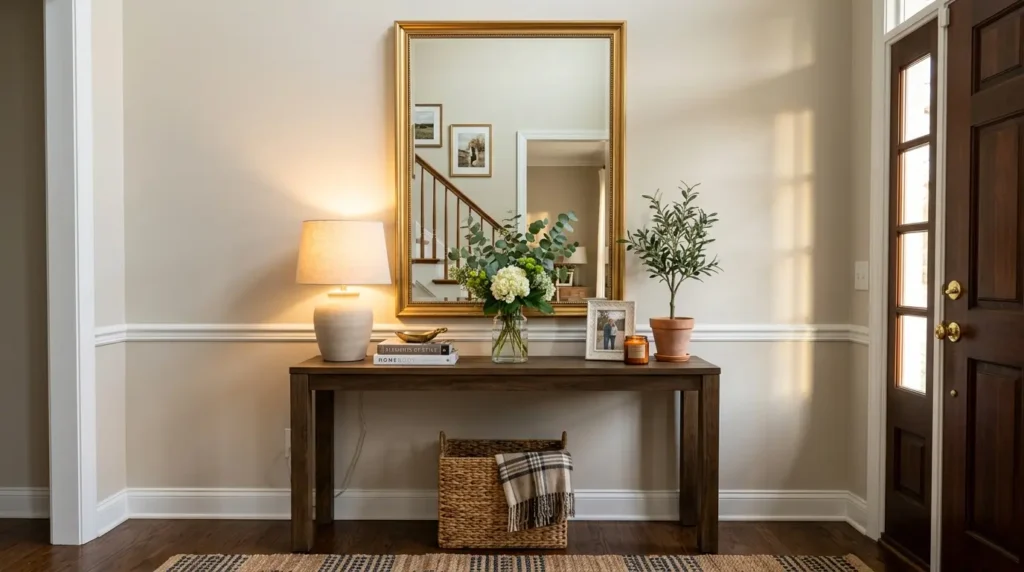
A mirror above an entryway table is the starting point for the arrangement because it establishes the vertical anchor that all the table-level objects respond to. Before placing a single object on the table surface, hang the mirror and let it determine the scale and proportions that the table styling needs to work within. A large mirror commands a larger arrangement beneath it. A smaller or more delicate mirror suits a lighter and simpler arrangement.
The mirror size that works best above a console table: the mirror width should be 70 to 80 percent of the table width below it. A table of 48 inches wide suits a mirror of 34 to 38 inches wide. A mirror significantly wider than the table above reads as top-heavy and visually unstable. A mirror significantly narrower reads as undersized for the wall and the table below it. The 70 to 80 percent proportion is the sweet spot that creates visual balance without making the mirror look paired by accident.
The mirror height above the table: the bottom of the mirror should sit 6 to 8 inches above the table surface. This gap is close enough to create a visual connection between the mirror and the table as a single unit rather than two separate elements, and high enough to clear any tall objects placed on the table below it. A mirror mounted directly above the table surface without clearance leaves no room for tall objects and makes the arrangement feel compressed.
2. Add a Lamp as the Tall Vertical Element on One End
✦ Best for: introducing the tallest element in the table arrangement and the primary light source for the entryway
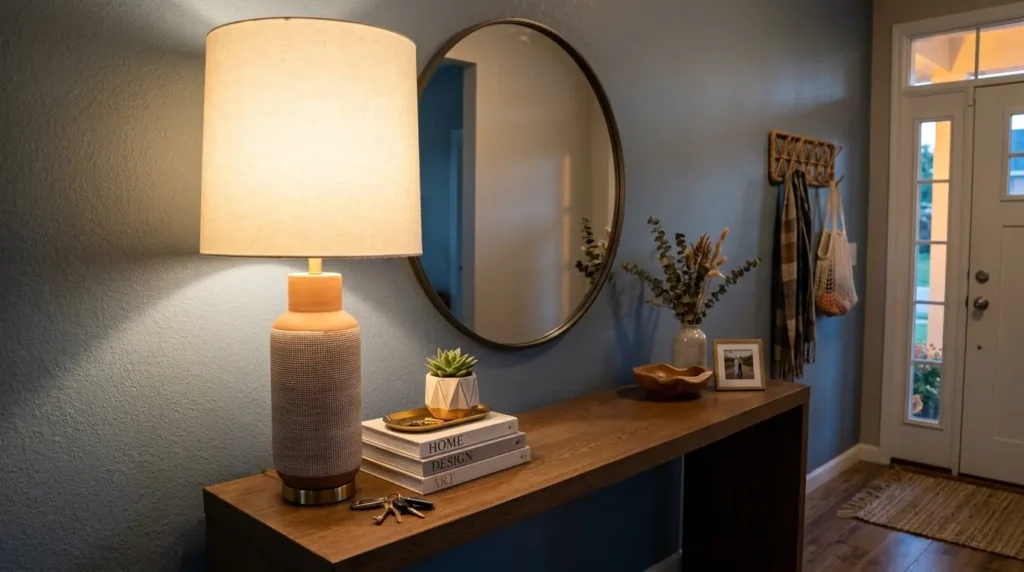
A table lamp on one end of the entryway table serves two functions simultaneously — it is the tallest element in the arrangement that creates the height variation the eye needs, and it is the practical light source that makes the entryway welcoming in the evening rather than dark and unwelcoming. A lamp that only decorates without lighting is an accessory. A lamp that does both is a design element that earns its place on the table.
The lamp height relative to the table and mirror: the top of the lamp shade should reach approximately two-thirds of the way up the mirror when viewed from straight ahead. A lamp that is too tall for the mirror above it overwhelms the arrangement. A lamp that is too short fails to create the height variation that makes the arrangement visually interesting. For a standard 30-inch tall console table a lamp of 28 to 32 inches total height including the shade is typically proportional.
The lamp base style that suits different entryway aesthetics: a ceramic lamp base in a simple geometric form suits contemporary and transitional entryways. A textured or hammered metal base suits farmhouse and industrial entryways. A clear glass or crystal base suits traditional and formal entryways. A rattan or woven base suits boho and coastal entryways. The lamp shade should be in a neutral — white, cream, or natural linen — regardless of base style so the shade reads as part of the arrangement rather than a competing design statement.
3. Place a Tray to Contain the Functional Items
✦ Best for: organizing the practical daily items that need to live on the entryway table without making the arrangement look like a junk drawer
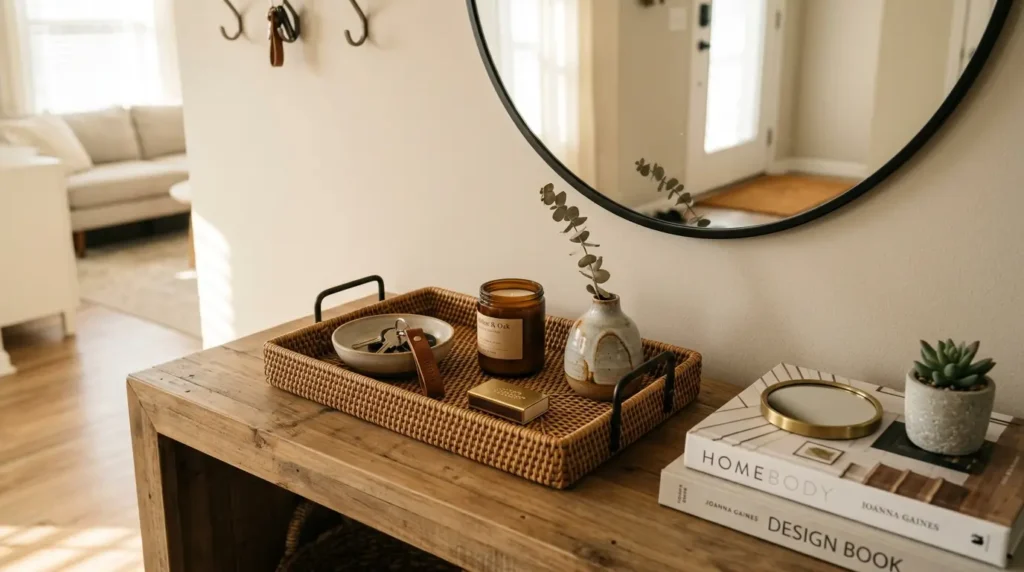
A tray on an entryway table does the most important organizational work of any object in the arrangement — it creates a defined zone where the practical daily items live, which prevents those items from spreading across the full table surface and reading as clutter. Keys, sunglasses, a small candle, and a pocket bowl inside a tray read as an intentional collection within a contained zone. The same items scattered across the table surface without a tray read as clutter regardless of how decorative each individual item is.
The tray materials that work best on an entryway table: a wooden or lacquer tray in a warm neutral tone — walnut, white, or natural oak — suits most entryway styles and creates a defined boundary without introducing a competing visual element. A marble or stone tray adds material luxury and suits contemporary and traditional entryways. A rattan or woven tray suits boho and coastal entryways. The tray should be rectangular rather than round for maximum organizational utility — round trays look beautiful but contain fewer items efficiently than rectangular ones.
The tray size relative to the table: a tray that occupies 25 to 35 percent of the table surface area reads as a design element within the arrangement. A tray that covers more than 50 percent of the table reads as the primary surface and reduces the available area for other arrangement objects. In a narrow console table of 10 to 14 inches depth a tray of 8 to 10 inches wide works. In a wider console of 14 to 18 inches depth a tray of 12 to 14 inches wide creates a more substantial presence.
4. Add Flowers or a Plant as the Living Organic Element
✦ Best for: introducing the one element that makes an entryway table feel genuinely inhabited rather than arranged for a photo
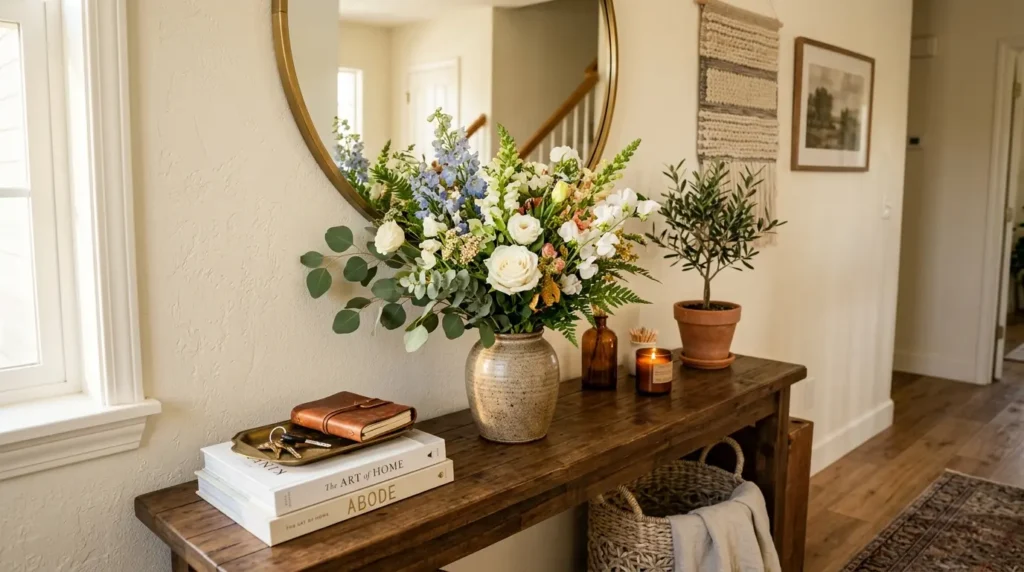
A vase of fresh flowers or a living plant is the element on an entryway table that no decorative object fully replaces — because it is genuinely alive, genuinely seasonal, and genuinely changing over time in a way that a ceramic vase or a decorative book does not. An entryway table with fresh flowers on it communicates that the home is tended and cared for. The same table with only permanent decorative objects, however beautiful, communicates a home that was styled once and has not been touched since.
Fresh flowers in a simple vase — a single stem or a small bunch of whatever is seasonal and available — suit the entryway table because the entry is the first room anyone enters and the last room anyone leaves, which means the flowers are seen and appreciated more frequently than flowers in any other room. A $10 bunch of flowers from the grocery store in a clear glass vase or a simple ceramic vase creates more immediate atmosphere than any decorative object at the same price.
When fresh flowers are not a consistent option, a potted plant is the most practical living alternative — a small trailing pothos in a simple pot, a snake plant that tolerates the variable light of a foyer, or a small succulent arrangement that requires minimal watering. The plant should be sized relative to the table — a plant that is too large for the table overwhelms the arrangement. A plant of 8 to 12 inches including the pot suits most console tables without competing with the other objects in the arrangement.
5. Use Books and Objects to Create the Lower Layer of the Arrangement
✦ Best for: adding the low-level objects that complete the arrangement’s height variation and express personal taste
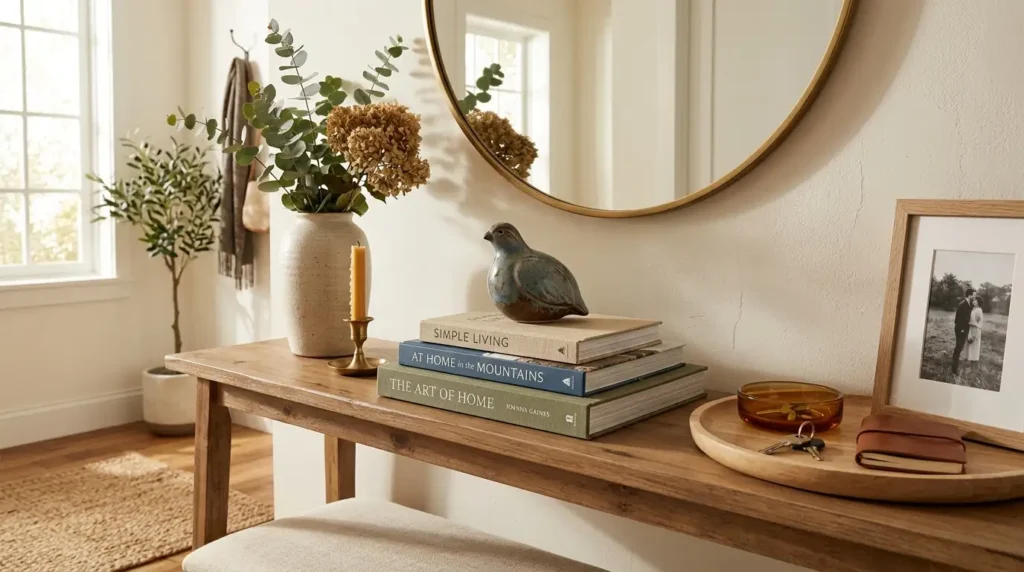
A stack of two or three coffee table books is the most versatile low-level object available for an entryway table arrangement — books at 8 to 12 inches tall as a stack provide the lowest height tier in the arrangement, add visual weight and personal taste, and serve as a pedestal for a small decorative object placed on top. The book spines or covers become part of the arrangement’s color palette, so choosing books with covers that complement the room’s color story is the detail that elevates a good arrangement to a great one.
Small decorative objects that work well on a stack of books or as standalone low elements: a small sculptural figure in ceramic or stone. A geode or natural crystal that introduces organic texture. A small ceramic bowl. A candle in a simple holder — a candle at the table level provides warm light from below the lamp light and the combination of the two light sources at different heights creates a genuinely atmospheric entryway in the evening.
The rule for the low layer of an entryway table arrangement: keep it simple and keep it still. The low layer should provide visual weight and completion at the table level without introducing movement or complexity that competes with the taller elements above it. One to three objects at this level is enough — more than three creates visual noise at the table surface that makes the arrangement look busy rather than considered.
6. How to Decorate a Small Entryway Table in a Tight Foyer
✦ Best for: narrow console tables in compact apartment entryways where the available surface area is limited
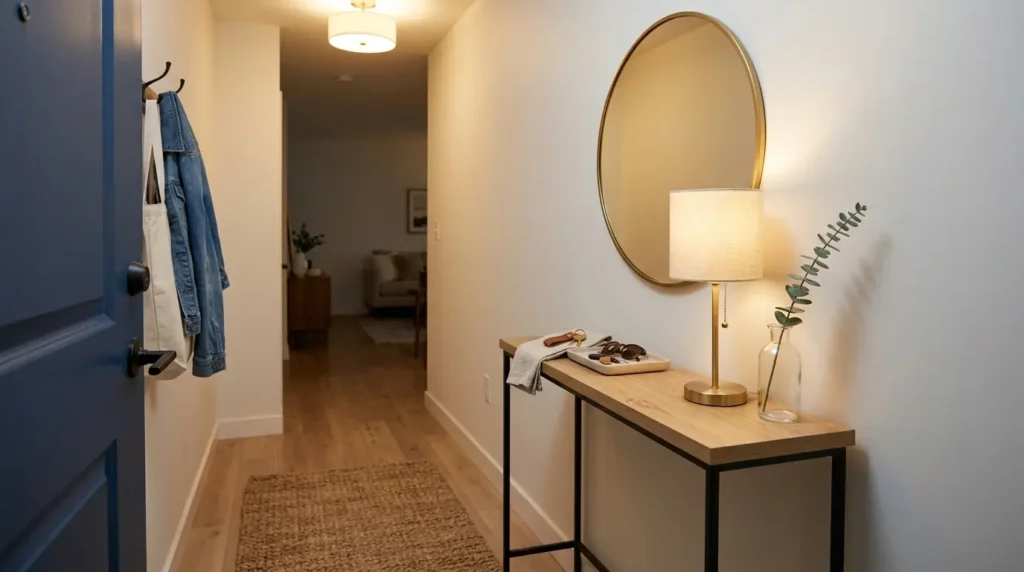
A small entryway table in a compact foyer requires a more edited arrangement than a full-size console — the limited surface area means every object must work harder and the usual guidance of three height levels must be achieved with fewer and smaller objects. The minimum complete arrangement for a small entryway table: one tall element, one mid-height element, and one low element — three objects total rather than five or seven — in the smallest sizes that still read as intentional rather than underwhelming.
For a very small console table of 24 to 30 inches wide: a small table lamp at one end provides the tall element without occupying too much width. A single bud vase with one or two flower stems provides the mid-height organic element at minimal surface cost. A small decorative dish or tray for keys provides the low functional element. This three-object arrangement completely styled reads as minimal and considered rather than sparse when the objects are well-chosen and properly sized.
The mirror above a small entryway table is more important in a compact foyer than in a large one because it makes the foyer read as larger — a mirror that reflects the light from a window opposite or from the lamp on the table creates the impression of additional depth beyond the mirror surface. In a small foyer the mirror does as much work as the table arrangement itself.
7. Seasonal Entryway Table Styling That Keeps the Arrangement Fresh
✦ Best for: maintaining an entryway table that looks current and intentional through every season without a complete restyling each time
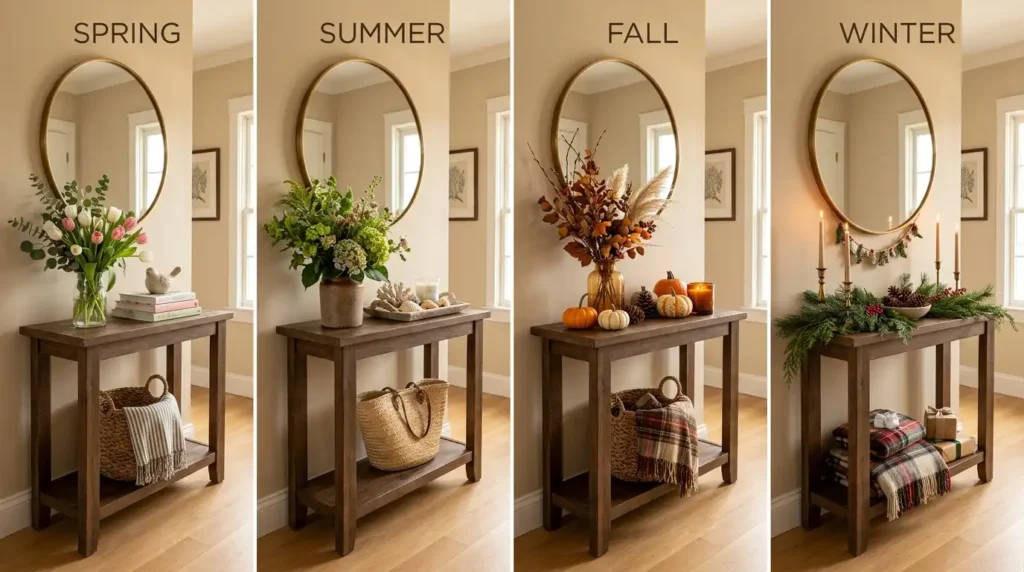
The most efficient approach to seasonal entryway table styling: keep the permanent elements — lamp, mirror, tray, books — in place year-round and change only the organic element and one or two seasonal accent objects. The lamp does not need to change. The tray does not need to change. The mirror does not need to change. The flowers, the plant, and one seasonal decorative object are the only elements that rotate with the season.
The seasonal rotation that keeps an entryway table looking current:
Spring — fresh tulips or daffodils in a simple glass vase. One small ceramic rabbit or Easter egg as the seasonal accent. Swap any heavy candle for a lighter scented variety in a fresh floral or green fragrance.
Summer — fresh garden flowers or a potted herb in a terra cotta pot. A small conch shell or piece of driftwood as a coastal nod. Lighter colored tray liner if applicable.
Fall — a small pumpkin or gourd in a warm orange or white tone. Dried stems of wheat or pampas grass in the vase. A candle in a warm spiced fragrance — cinnamon, amber, or sandalwood.
Winter — fresh pine or eucalyptus branches in the vase. A small cluster of pillar candles in white or cream. One subtle holiday accent — a pinecone, a small wreath leaned against the mirror, a sprig of holly — that communicates the season without turning the entryway into a holiday display.
📌 More entryway and home decor ideas: Entryway Cabinet Ideas That Add Style and Storage
Frequently Asked Questions
What do you put on an entryway table?
The objects that work best on an entryway table combine practical and decorative functions: a lamp for warm ambient light and the tallest height tier. A mirror above the table for practical reflection and visual depth. A decorative tray to contain keys, sunglasses, and small daily items. A vase of fresh flowers or a small plant for the living organic element. A stack of coffee table books or a sculptural object for the low tier. These five elements together create a complete entryway table arrangement that serves every function the space requires while reading as genuinely designed. According to the American Society of Interior Designers, entryway styling consistently ranks as one of the highest-return interior improvements available because the entryway is the first and last impression guests and residents have of the home.
How high should objects be on an entryway table?
A complete entryway table arrangement uses three distinct height levels. The tall tier at 24 to 36 inches above the table surface — typically a lamp or tall vase. The medium tier at 12 to 18 inches — typically a plant, a flower arrangement, or a mid-height sculptural object. The low tier at 2 to 6 inches — typically a tray, a stack of books, or a candle. The lamp or tallest object should reach approximately two-thirds of the way up the mirror above the table. No object on the table should be taller than the bottom of the mirror above it.
How do I keep my entryway table from looking cluttered?
The most effective ways to prevent entryway table clutter: use a tray to contain all functional daily items — keys, mail, and small objects inside the tray read as an intentional collection rather than clutter. Clear the table surface completely to its styled arrangement every evening — anything that arrived during the day that does not belong in the arrangement goes somewhere else. Have enough storage under the table or nearby for the items that consistently end up on the surface. The table will default to however much storage exists nearby — if there is no storage, the table will accumulate clutter regardless of how many times it is cleared.
What size mirror goes above an entryway table?
The mirror above an entryway table should be 70 to 80 percent of the table’s width. A 48-inch table suits a mirror of 34 to 38 inches wide. A 36-inch table suits a mirror of 25 to 29 inches wide. The mirror height above the table surface should position the bottom of the mirror 6 to 8 inches above the table top. The center of the mirror should be at approximately 57 to 60 inches from the floor — this is the standard art and mirror hanging height that aligns with the average eye level and ensures the reflection is useful for most adults standing at the table.
More Entryway and Home Decor Ideas
→ Entryway Bench Ideas That Instantly Upgrade Your Entryway
→ Family Photo Wall Ideas That Never Look Tacky
→ Small Apartment Ideas That Make Every Square Foot Count
Hang the mirror first. Every other object on the table responds to it. Get the mirror right and the rest of the arrangement falls into place.

Sheikh Hassaan is a digital architect for small businesses and the founder of The Glow Up System. He writes about home decor, garden design, and outdoor living for real American homes – practical ideas that work in actual spaces without oversized budgets.