
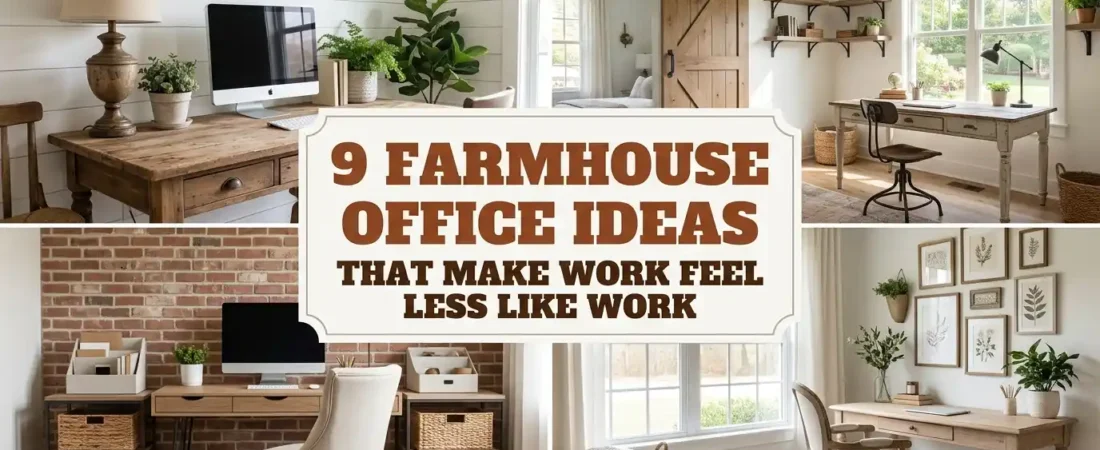
A farmhouse office is the one home office style that genuinely makes you want to sit down at your desk. Most home offices feel like a functional afterthought — a desk pushed into a corner, a chair that does not quite fit, overhead lighting that makes everything look flat and cold. A farmhouse office solves all of that with warm wood, natural textures, and the kind of layered lighting that makes working from home feel intentional rather than reluctant.
I think the reason farmhouse office design works so well in a home workspace is that it borrows from the same principles that make farmhouse kitchens and living rooms so liveable — natural materials, warm neutrals, practical storage that looks good, and enough personal character that the space feels genuinely yours rather than generic.
Table of Contents
What Defines a Farmhouse Office and What It Is Not
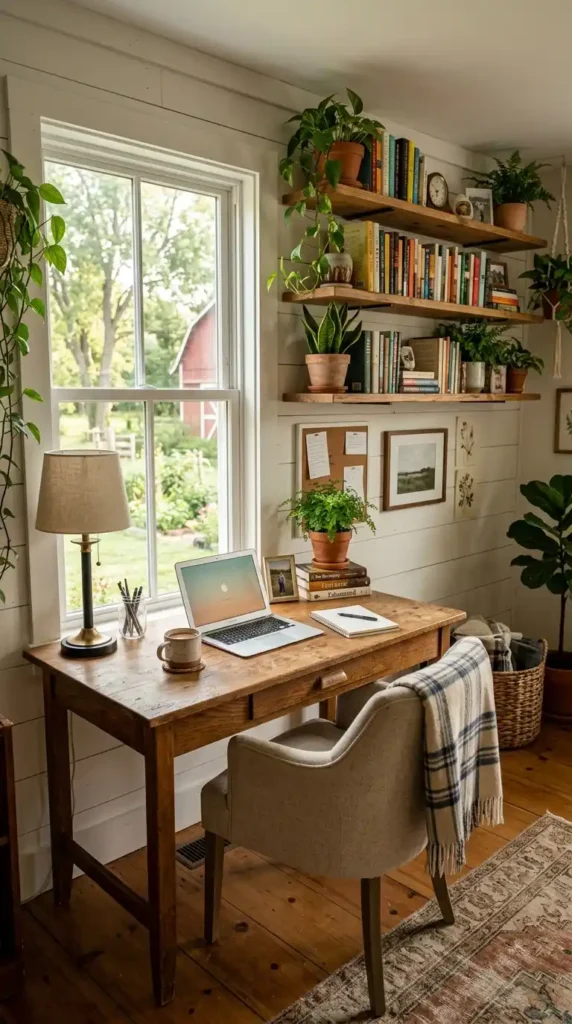
Farmhouse office style is not about shiplap on every wall and mason jars on every surface. I find that version of the aesthetic exhausting to look at and impractical to work in. The farmhouse office that actually improves a workspace is the one that brings in warm natural materials, a restrained neutral palette, and enough texture to make the room feel alive without cluttering the desk surface you need clear to work.
The core elements that define a genuinely functional farmhouse office: a solid wood desk with visible grain. Open shelving that stores things accessibly rather than concealing them behind closed doors. Warm lighting at desk level rather than overhead fluorescent light. A neutral palette of white, cream, warm gray, and natural wood tones.
The elements to avoid: anything that prioritizes looking like a farmhouse over functioning as an office. Decorative signs with motivational quotes. So many plants that the desk feels crowded. Wicker baskets that are too small to hold anything useful. The farmhouse office that works is one where the style serves the function rather than competing with it.
1. Solid Wood Farmhouse Desk as the Room’s Anchor
✦ Best for: establishing the warm natural material foundation that the entire farmhouse office aesthetic builds from
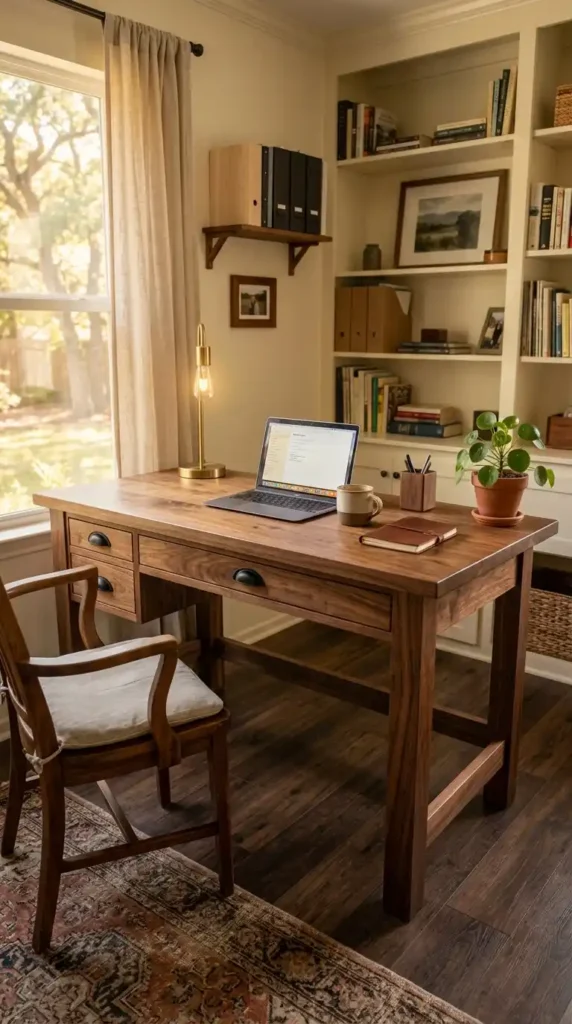
The desk is the one piece of furniture in a home office that determines the character of everything else in the room. I always say choose the desk first and build the farmhouse office around it rather than buying the room’s accessories and then trying to find a desk that fits.
A solid wood farmhouse desk in oak, pine, or walnut with simple hairpin legs or turned wood legs creates the foundational warmth that defines the aesthetic. The wood grain itself does significant design work without requiring any additional decoration on the desk surface. A clear desk with a beautiful wood grain reads as more designed than a cluttered desk with expensive accessories.
The desk width that works best in a typical spare bedroom converted to a home office: 48 to 60 inches wide gives adequate workspace for a monitor, keyboard, and a small amount of desk storage without overwhelming the room. A desk wider than 60 inches in a 10 by 10 foot office dominates the space. A desk narrower than 42 inches does not provide enough workspace for comfortable daily use.
2. Open Farmhouse Shelving for Practical Storage With Style
✦ Best for: organizing the books, files, and office supplies that accumulate in any working home office without making storage look purely utilitarian
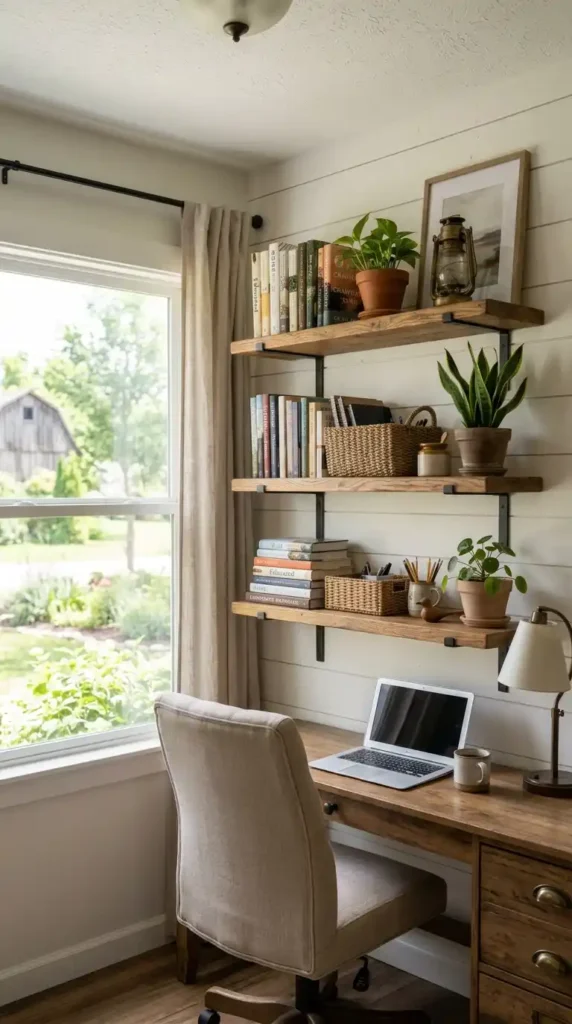
Open shelving is the farmhouse office storage solution I prefer over closed cabinets for one specific reason: it makes the office feel like a room you live in rather than a room you work in. Closed cabinet doors create a corporate feel that conflicts with the warmth farmhouse style is supposed to bring. Open shelves with books, plants, and a few considered objects feel personal and human.
Floating wood shelves in a warm walnut or oak tone mounted on black iron brackets are the most characteristic farmhouse office shelving option and the most widely photographed. The iron bracket detail is what most directly reads as farmhouse rather than generic contemporary shelving.
The shelving arrangement that works best in a farmhouse office: group books by height rather than by color or subject for a more natural and less staged appearance. Place one small plant on every other shelf. Use one or two small woven baskets for loose items that would otherwise create visual clutter. The arrangement should look like it developed organically over time rather than being styled for a photograph.
3. Warm Layered Lighting That Makes the Office Feel Inviting
✦ Best for: replacing the flat overhead lighting that makes most home offices feel clinical with a warm layered approach that improves both mood and productivity
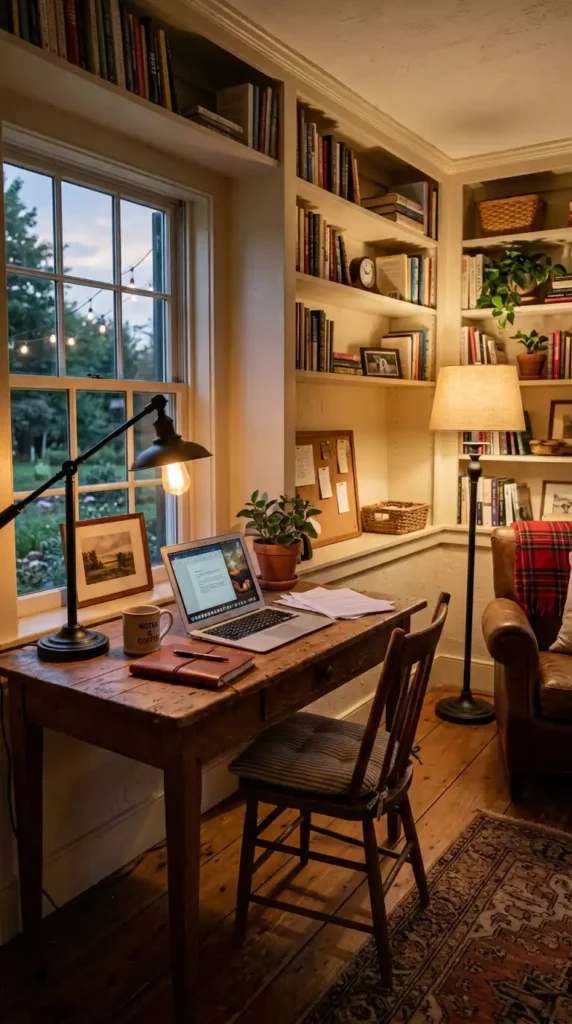
Lighting is the farmhouse office element I think about most when advising someone on the space because it is the one change that most immediately transforms how an office feels to work in. The same desk, the same chair, and the same shelving look completely different under warm layered lighting versus flat overhead fluorescent light.
The three-layer farmhouse office lighting approach: a desk lamp in brass or black iron at 2700K warm white for focused task lighting directly at the work surface. A floor lamp in the corner at the same color temperature for ambient room light that softens the shadows the desk lamp creates. A ceiling fixture on a dimmer as the primary room light that can be turned down during video calls.
All bulbs must be 2700K warm white without exception. A single cool white or daylight bulb in a farmhouse office immediately creates a visual discord that no amount of warm wood and iron hardware can overcome. 2700K bulbs make wood look rich and warm. Cool white bulbs make the same wood look flat and gray.
4. Shiplap or Board and Batten Accent Wall Behind the Desk
✦ Best for: adding the most characteristically farmhouse architectural detail to an otherwise plain office wall
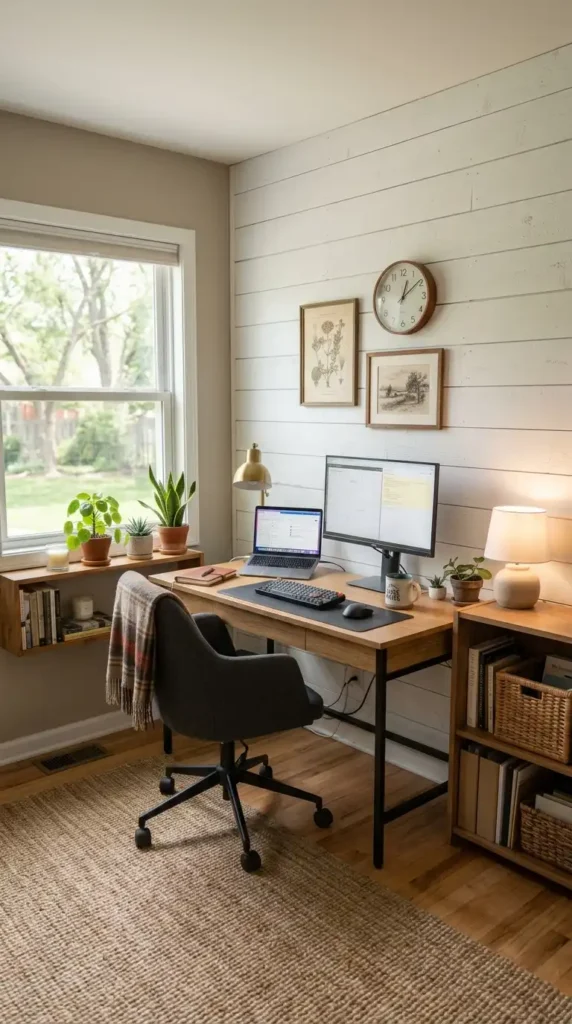
I recommend shiplap or board and batten on the desk wall specifically because it is the wall that appears behind you on every video call. A plain painted wall behind you on a video call communicates nothing about your workspace. A white shiplap wall communicates warmth, character, and intention in the 0.5 seconds it takes someone to form an impression of your background.
Board and batten is the more practical option for a DIY installation because it requires only vertical trim boards applied over existing drywall at regular spacing and painted. No new drywall. No demolition. The materials cost $100 to $200 for a standard wall and the installation takes one day. It creates a more formal and more architecturally refined result than horizontal shiplap.
Paint the shiplap or board and batten in white or warm off-white. Attempting a colored accent wall with shiplap creates a result that reads as trendy rather than timeless. White on white with the texture doing the visual work is the farmhouse office wall treatment that photographs well, ages well, and suits every other element in the room regardless of how the decor evolves.
5. Vintage or Antique Desk Chair That Adds Character
✦ Best for: adding the aged and characterful seating that makes a farmhouse office feel genuinely lived-in rather than recently decorated
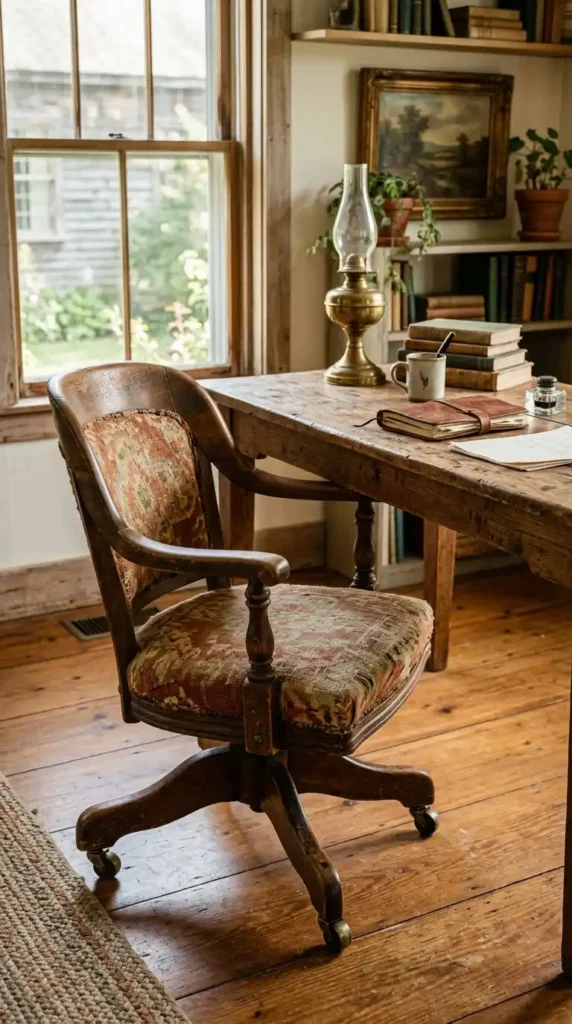
The desk chair is the farmhouse office element that most people get wrong in one specific direction — they buy a modern ergonomic office chair in black mesh because it is comfortable and practical, and it immediately kills the farmhouse aesthetic of everything around it. I completely understand the impulse because comfort matters in a chair you sit in for eight hours. But there are comfortable chairs that also look right.
A vintage wooden office chair with a padded fabric seat in cream, natural linen, or warm plaid suits a farmhouse office desk in a way that no contemporary office chair can match. Antique wooden rolling chairs from the early twentieth century are genuinely comfortable by modern standards and available affordably from antique stores and estate sales.
If ergonomic support is non-negotiable add a high-quality seat cushion to a vintage wood chair. The combination of a beautiful wooden chair with a thick natural linen cushion looks authentically farmhouse and provides the support a long workday requires. This is one of those practical compromises that costs almost nothing and solves both the aesthetic problem and the comfort problem simultaneously.
6. Woven Baskets and Iron Organizers for Desk Storage
✦ Best for: replacing plastic and synthetic desk organizers with natural material alternatives that contribute to the farmhouse aesthetic rather than conflicting with it
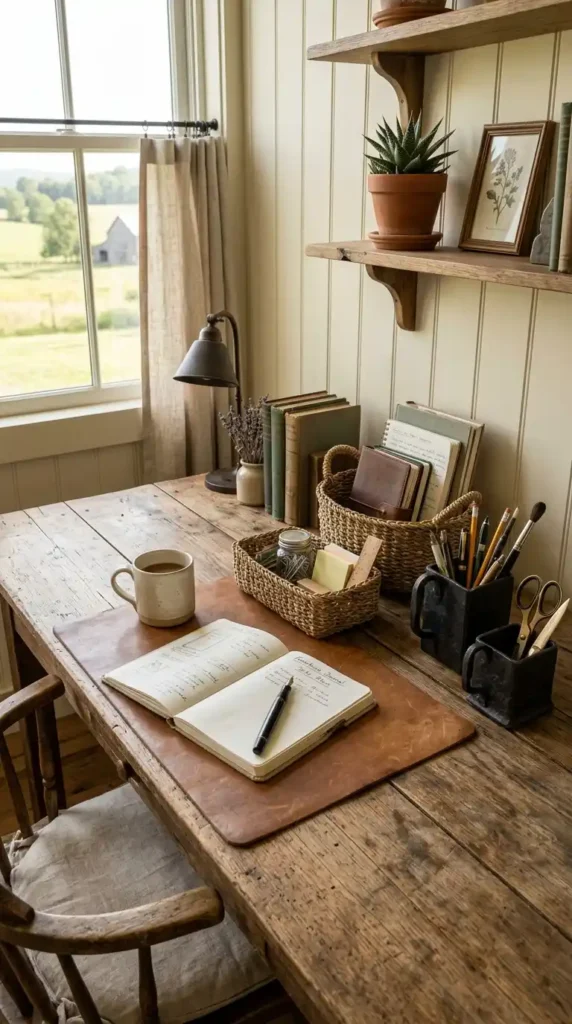
Desk organization in a farmhouse office needs to use materials that belong in the aesthetic. I find this is where most farmhouse office attempts fall apart at the detail level — the desk itself is beautiful and the shelving looks right but the pen holder is a plastic cup and the file organizer is a black wire rack from a big box office supply store.
Woven seagrass or rattan baskets in two or three sizes handle most desk storage needs beautifully. Small baskets for pens and pencils. Medium baskets for notebooks and loose papers. A deeper basket beside the desk for files. Black iron pen cups and letter trays provide the metal accent that farmhouse style uses alongside natural materials.
The desk surface rule that keeps a farmhouse office looking designed rather than cluttered: only objects in use or objects that earn their place aesthetically should be on the desk surface. Everything else goes in a basket or on a shelf. A clear desk with a beautiful wood grain surface and three considered objects reads as intentional. The same desk covered in ten objects reads as messy regardless of how carefully each individual item was chosen.
7. Plants That Bring the Farmhouse Garden Indoors
✦ Best for: adding the living organic element that makes a farmhouse office feel connected to the natural world rather than sealed away from it
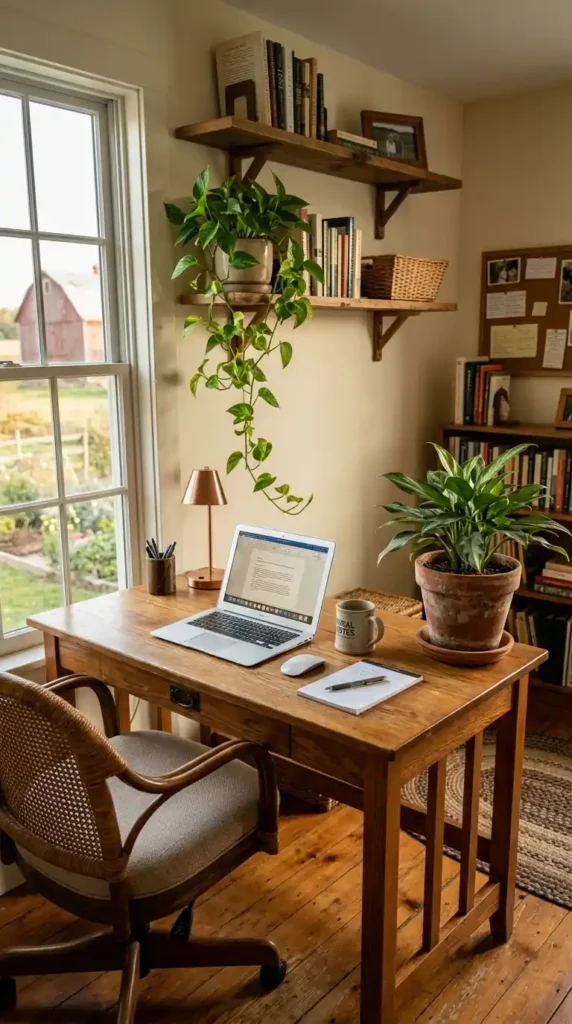
Plants in a farmhouse office do something that no other decorating element can fully replace. I have noticed that offices with living plants feel genuinely different to spend time in compared to identical offices without them. Something about the presence of something growing changes the atmosphere of a workspace in a way that is hard to quantify but immediately noticeable.
The plants that suit a farmhouse office best: a pothos trailing from a shelf creates the lush cascading green that farmhouse interiors are associated with and requires almost no care. A simple fern or peace lily on the desk corner in a terracotta pot adds the organic element without consuming the workspace. A snake plant in a corner provides structural architectural presence at floor level.
Terracotta pots are the container material that most naturally suits the farmhouse office. The warm clay tone pairs beautifully with wood grain and iron hardware. White ceramic pots work equally well for a slightly more refined farmhouse look. Avoid plastic pots and glossy ceramic in colors that compete with the neutral palette. For more plant options that thrive in indoor light conditions see our best plants for beginners guide.
8. Farmhouse Gallery Wall for Personal Character Behind the Desk
✦ Best for: making the desk wall feel genuinely personal and visually interesting without covering it in a single large piece of art that can feel impersonal
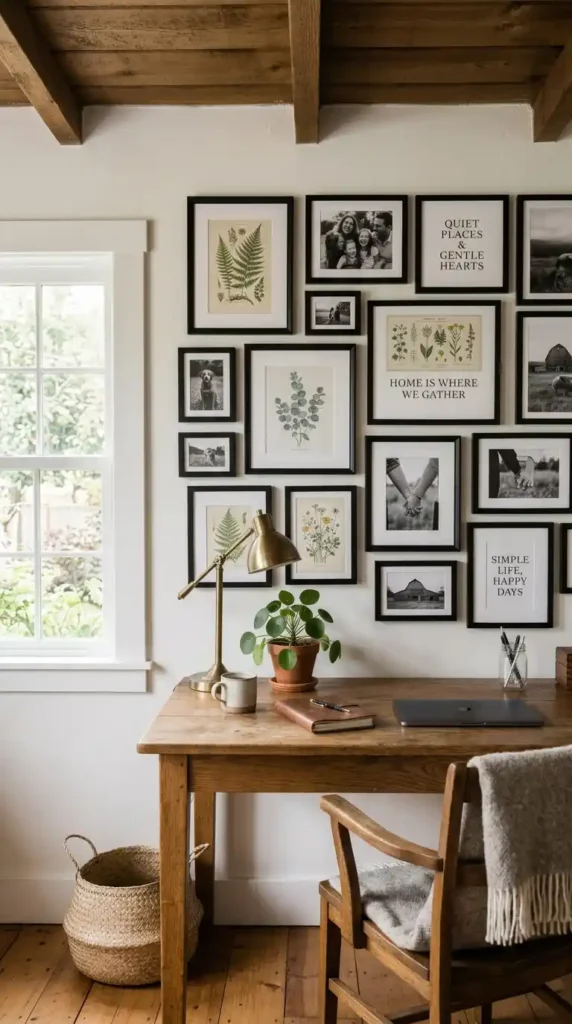
A gallery wall in a farmhouse office creates the most personally expressive wall treatment available and the one that most clearly signals that a real person works in the space. I find gallery walls behind desks particularly effective as video call backgrounds because the layered collection of frames reads as interesting and characterful without being distracting.
The farmhouse gallery wall formula that works consistently: black frames in two or three sizes throughout for visual cohesion. A mix of botanical prints, simple black and white photographs, and one or two short framed quotes. White or cream mats inside the frames to create visual breathing room between each piece. The botanical prints are the element most associated with farmhouse style and most immediately readable as the aesthetic.
Lay the gallery wall arrangement on the floor before hanging anything to confirm the composition reads well before making any holes in the wall. The arrangement that looks most considered uses a mix of landscape and portrait orientations with the largest frame as the visual anchor slightly off-center. Perfectly symmetrical gallery walls look staged. Slightly asymmetrical arrangements look collected.
9. Farmhouse Office in a Small Spare Bedroom or Closet
✦ Best for: creating a complete farmhouse office in the limited space of a spare bedroom corner or a converted closet
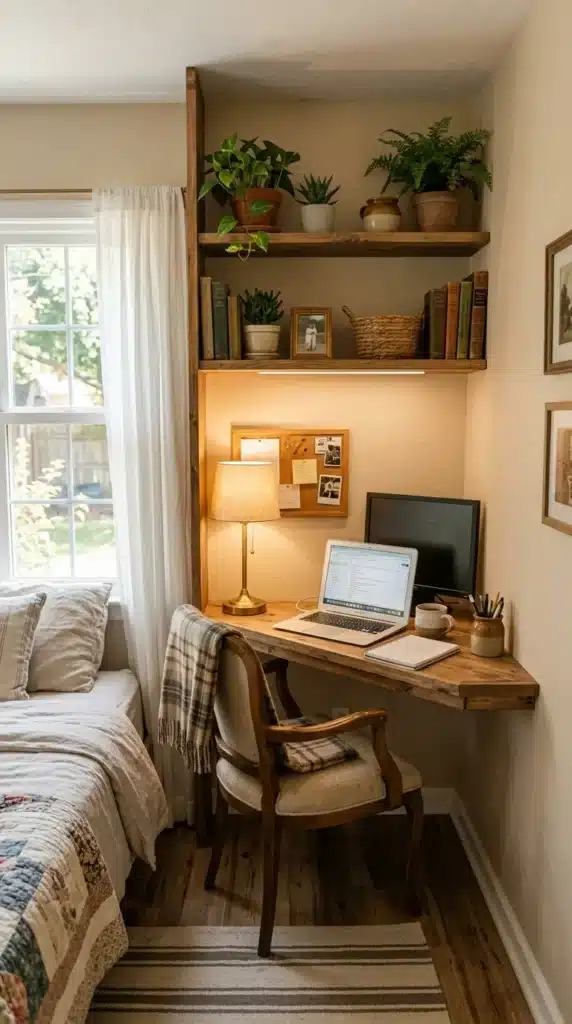
My favorite farmhouse office spaces are almost never the largest ones. A well-designed farmhouse office nook in a spare bedroom corner or a converted reach-in closet consistently looks more considered and more intentional than a large room where the furniture and decorating have room to spread out and lose their cohesion.
A converted closet office works particularly well with farmhouse style because the contained space creates natural wall surfaces on three sides that can be covered in open shelving, a board and batten treatment, and a gallery wall arrangement without any of them competing for visual dominance. Remove the closet doors, install floating shelves above a 24-inch-deep desk, add warm lighting, and the alcove immediately reads as a designed farmhouse workspace.
The one farmhouse office element that matters most in a small space: lighting. A small dark closet office with poor lighting feels claustrophobic regardless of how good the desk and shelving are. A small closet office with a well-placed desk lamp, warm wall sconces, and a 2700K overhead bulb feels cozy and purposeful. Light the small farmhouse office generously and it becomes the most pleasant room in the house to spend time in.
Frequently Asked Questions
What is a farmhouse office style?
A farmhouse office combines natural wood, iron hardware, warm neutral colors, and organic textures to create a home workspace that feels warm rather than corporate. It borrows from the same design principles as farmhouse kitchens and living rooms — practical materials that look beautiful and age well.
What colors work best in a farmhouse office?
White and warm cream for walls, warm wood tones for the desk and shelving, black or oil-rubbed bronze for hardware and lighting fixtures, and natural greens from plants. Avoid cool gray, navy, and stark white which conflict with the warmth that defines the farmhouse aesthetic.
How do I make a home office feel cozy?
Switch all bulbs to 2700K warm white and add a desk lamp as the primary light source rather than relying on overhead lighting. A warm wood desk, open shelving with books and plants, and one woven textile like a small rug or throw immediately shift the atmosphere from functional to genuinely comfortable.
What is the best desk for a farmhouse office?
A solid wood desk in oak, pine, or walnut with simple hairpin legs or turned wood legs in a warm finish. The wood grain does the decorative work without requiring additional ornamentation on the desk surface. Avoid glass, lacquered, and painted finishes which conflict with the natural material warmth that farmhouse style requires.
More Home Decor Ideas
→ Mexican Style Bathroom — 7 Ideas for a Vibrant, Culturally Rich Space
→ Master Bedroom Ideas That Make You Never Want to Leave
→ Small Apartment Ideas That Make Every Square Foot Count
→ Boho Bedroom Ideas You’ll Want to Copy
Start With the Desk and the Light
A farmhouse office comes together from two decisions more than anything else. The desk and the lighting. Get a solid wood desk with visible grain and replace the overhead bulbs with 2700K warm white. Those two changes alone shift the room significantly toward the farmhouse aesthetic before a single shelf or plant or frame is added.
Everything else on this list builds on those two foundations. The shelving, the gallery wall, the plants, the baskets — all of them look better in warm light on a beautiful wood surface than they would in cool overhead light against a plain white desk.
I have seen offices transformed by a $40 desk lamp swap more dramatically than by $2,000 worth of new furniture. The light is almost always what is missing. Fix the light first and everything else in the farmhouse office starts working.

Sheikh Hassaan is a digital architect for small businesses and the founder of The Glow Up System. He writes about home decor, garden design, and outdoor living for real American homes – practical ideas that work in actual spaces without oversized budgets.