
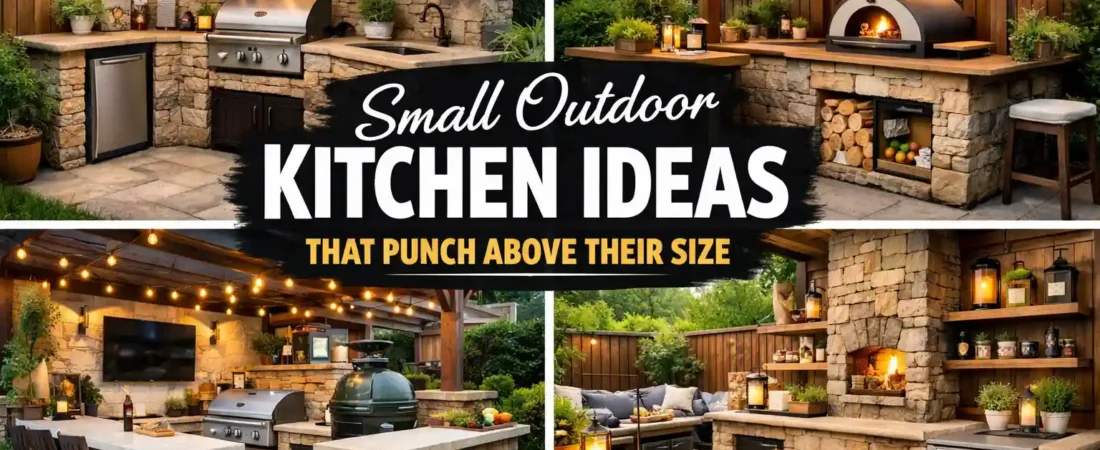
An outdoor kitchen does not require a large backyard or a large budget to function beautifully — it requires the right combination of equipment, counter space, and storage scaled specifically to the space available. Small outdoor kitchen ideas that genuinely work treat the compact footprint as a design constraint that produces a more focused and more functional cooking space rather than a compromised version of a larger one.
This guide covers small outdoor kitchen ideas organized by layout and build approach — from the simplest single-wall grilling station through L-shaped and corner configurations to the specific equipment and material choices that make a small outdoor kitchen look and function like a genuinely considered outdoor cooking space.
Table of Contents
What a Small Outdoor Kitchen Actually Needs to Work Well
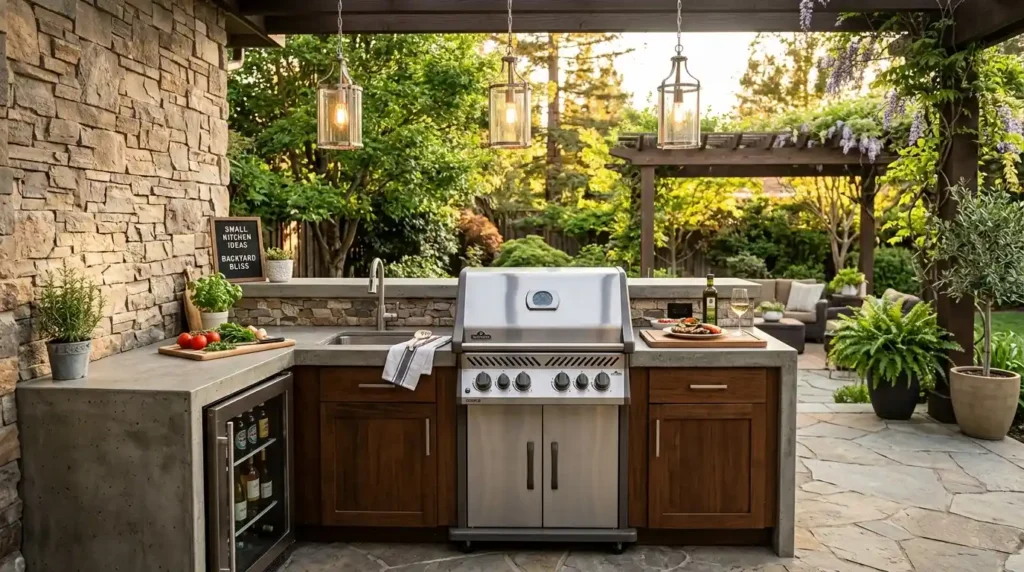
A small outdoor kitchen needs three things to function well regardless of how compact it is: adequate counter space on both sides of the primary cooking surface for food preparation and landing space for cooked items. At least one drawer or cabinet for tools and essentials that need to be at hand without requiring a trip inside. And a surface material and construction that genuinely withstands outdoor conditions without requiring constant maintenance.
The minimum functional footprint for a small outdoor kitchen that works as a genuine cooking space rather than a grilling station with nowhere to put anything: 8 linear feet of counter space total, with at least 18 inches of clear counter on each side of the grill. This fits in a space as small as 8 by 3 feet for a single-wall linear configuration — smaller than most people assume is necessary for an outdoor kitchen that functions properly.
The material choices that matter most in a small outdoor kitchen: the countertop must be genuinely weatherproof rather than weather-resistant — concrete, natural stone, porcelain tile, or stainless steel all withstand outdoor conditions permanently without sealing or seasonal treatment. The cabinet structure must be built from marine-grade materials — either stainless steel, concrete block, or treated masonry — rather than adapted interior cabinetry that will deteriorate within a few seasons.
1. The Single-Wall Linear Outdoor Kitchen for the Narrowest Spaces
✦ Best for: a narrow patio or deck edge where depth is limited but linear width is available
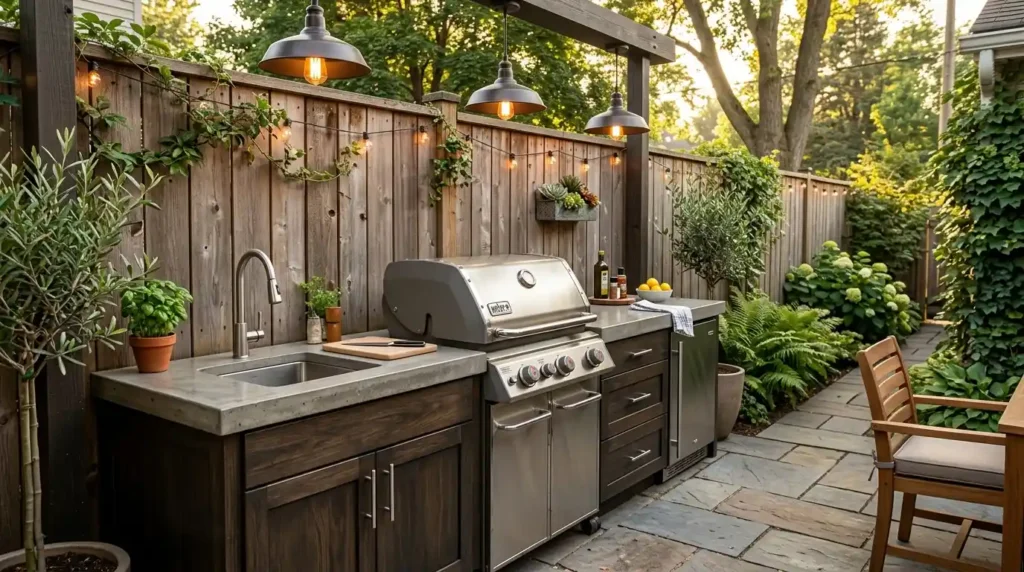
A single-wall linear outdoor kitchen — all components arranged in one straight line against a fence, wall, or the side of the house — is the most space-efficient outdoor kitchen configuration available because it requires only the depth of the counter unit itself, typically 24 to 30 inches, and can extend as long as the available linear wall space allows. An 8-foot single-wall kitchen fits in a patio as narrow as 6 feet while leaving adequate space in front for the cook to work.
The ideal equipment sequence for a single-wall small outdoor kitchen running left to right: a two-door storage cabinet on the left for propane tank access and tool storage. A 30-inch built-in grill centered in the run. 18 to 24 inches of clear counter on the right side of the grill for plating and serving. A small undercounter outdoor refrigerator at the right end for beverages and marinades. This eight-foot configuration handles everything required for outdoor cooking and entertaining without any unnecessary equipment.
Overhead structure above a single-wall outdoor kitchen — a pergola beam, a shade sail, or a simple timber frame with pendant lights — transforms it from an equipment installation into a genuine outdoor room. The overhead element defines the cooking zone, provides a mounting point for pendant lighting that makes evening cooking genuinely enjoyable, and creates the sense of an enclosed outdoor space that a freestanding grill against a fence cannot achieve.
2. The L-Shaped Corner Outdoor Kitchen That Maximizes a Small Patio
✦ Best for: a corner position in a small patio where two walls create a natural L-shaped enclosure for a compact kitchen
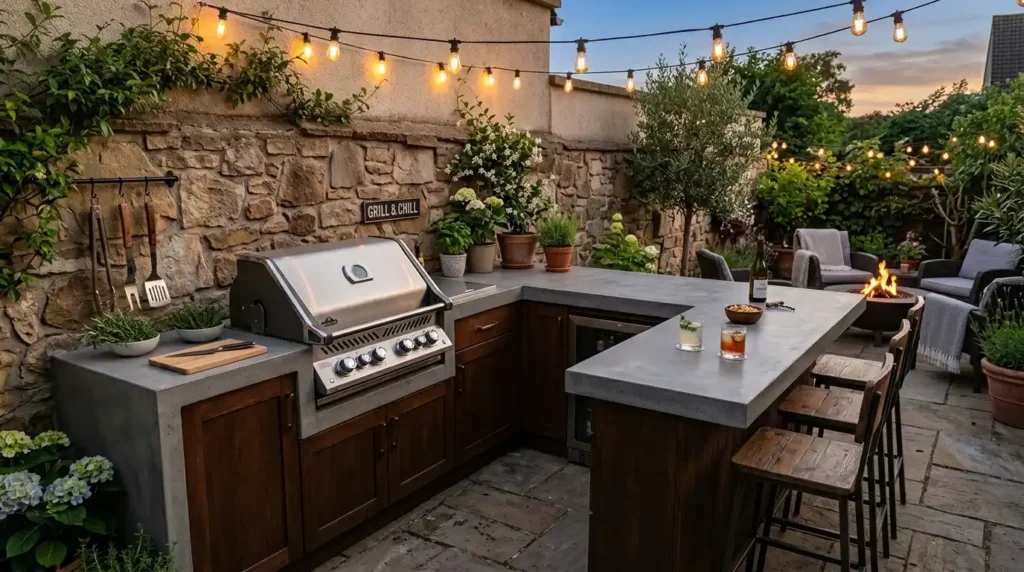
An L-shaped outdoor kitchen uses a corner position to create significantly more counter and storage space than a single-wall configuration of equivalent footprint — the two arms of the L together provide 12 to 16 linear feet of counter space while occupying a footprint of only 8 by 8 feet in the corner. This makes the L-shape the most functional small outdoor kitchen layout for entertaining because it creates a natural social zone on the open side of the L where guests can gather around the cooking area without blocking the cook’s movement.
The most effective equipment distribution for a small L-shaped outdoor kitchen: the grill on the longer arm, positioned close to the corner with counter space extending away from it on both sides. A sink or small refrigerator on the shorter arm. The corner section itself — the junction of the two arms — functions as a generous landing zone for dishes, platters, and cooking supplies that has no equivalent in a single-wall configuration.
Bar seating on the open face of the shorter arm — a counter overhang of 12 to 15 inches with bar stools on the outside — creates the outdoor bar and kitchen combination that makes a small outdoor kitchen genuinely social rather than purely functional. Guests sit at the bar, face the cook, and the kitchen becomes the center of outdoor entertaining rather than a separate preparation zone.
3. The Modular Outdoor Kitchen for Renters and Flexible Spaces
✦ Best for: renters and homeowners who want outdoor cooking capability without permanent installation
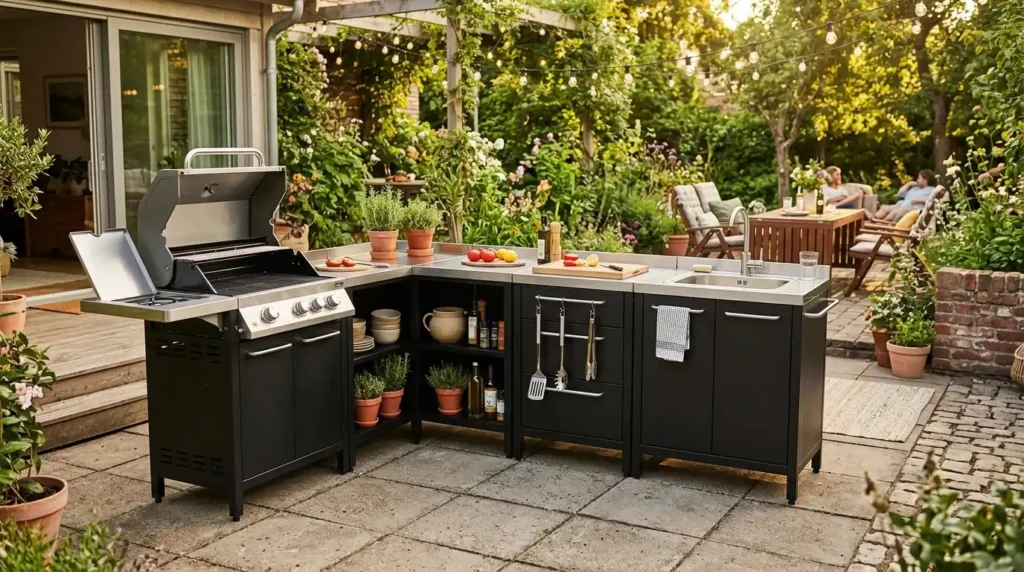
A modular outdoor kitchen — assembled from freestanding equipment modules rather than built into a permanent structure — creates a fully functional outdoor cooking space that can be configured, reconfigured, and relocated without any construction. For renters this is the only viable outdoor kitchen option. For homeowners who are not certain about the permanent layout, modular kitchen systems allow the configuration to be tested and adjusted before committing to a built installation.
The modular outdoor kitchen systems that produce the most genuinely designed appearance rather than a collection of freestanding equipment: stainless steel modular units from manufacturers like Summerset, Coyote, or Fire Magic that use consistent cabinet dimensions and profiles across grill modules, refrigerator modules, side burner modules, and storage modules. When all modules share the same height, depth, and finish they read as a cohesive kitchen rather than assembled equipment.
The practical advantage of a modular system beyond portability: each component can be upgraded independently rather than requiring the entire kitchen to be rebuilt when the grill needs replacement after ten years. The storage modules and counter surfaces remain while only the cooking equipment is swapped — a significantly lower lifetime cost than a built kitchen that requires demolition and reconstruction when any component fails.
4. The Concrete Block DIY Outdoor Kitchen Built for Under $2,000
✦ Best for: homeowners who want a permanent built-in outdoor kitchen at the lowest possible material cost and are comfortable with a DIY construction project
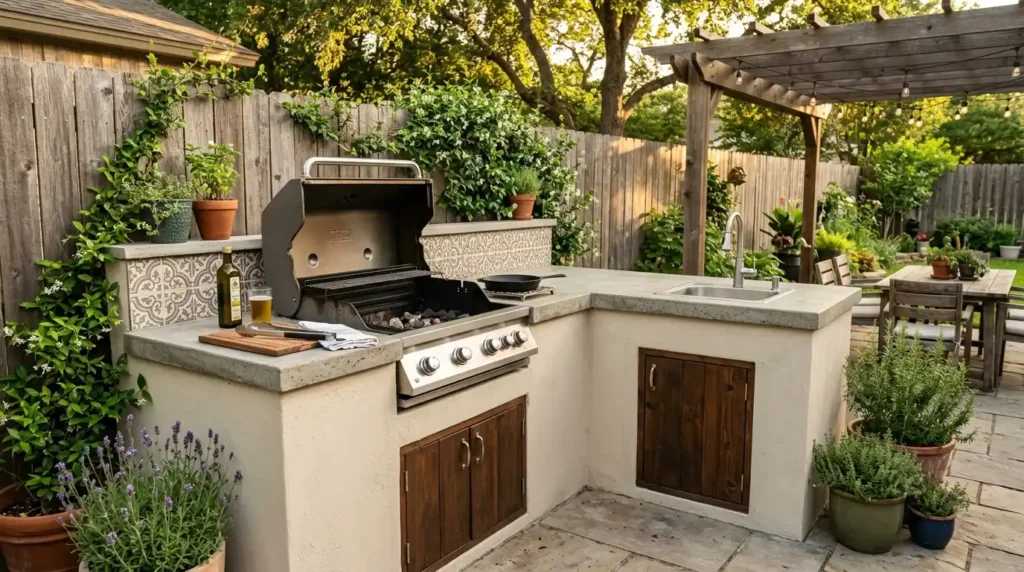
Concrete masonry unit construction — CMU blocks stacked and mortared to create the kitchen’s structural base — is the most affordable permanent outdoor kitchen construction method available, with material costs of $800 to $1,500 for a basic linear configuration before the grill, countertop, and finishing are added. CMU construction is within the skill range of a confident DIY builder, requires no specialized tools beyond standard masonry equipment, and produces a structure that is genuinely permanent and weatherproof.
The construction sequence for a small CMU outdoor kitchen: pour a concrete slab foundation or confirm the existing patio surface is adequate to support the weight. Lay the CMU block courses in the intended kitchen footprint, leaving openings for the grill insert and any undercounter equipment. Fill the blocks with concrete for structural rigidity. Apply a stucco or stone veneer finish to the exterior faces. Install the concrete, tile, or stone countertop. Drop the grill insert into the opening.
The countertop options that suit a DIY CMU outdoor kitchen: poured-in-place concrete is the most authentic and most DIY-compatible option — a 2-inch concrete pour over a form board creates a countertop that is permanently integrated with the structure, genuinely weatherproof, and costs under $200 in materials for a typical small outdoor kitchen. Large format outdoor porcelain tile set in weatherproof adhesive creates a cleaner and more refined finish. Natural stone slabs create the most beautiful result but require professional fabrication and installation.
5. The Covered Small Outdoor Kitchen That Works in All Weather
✦ Best for: outdoor kitchens in climates with variable weather where a covered structure extends the cooking season and protects the equipment year-round
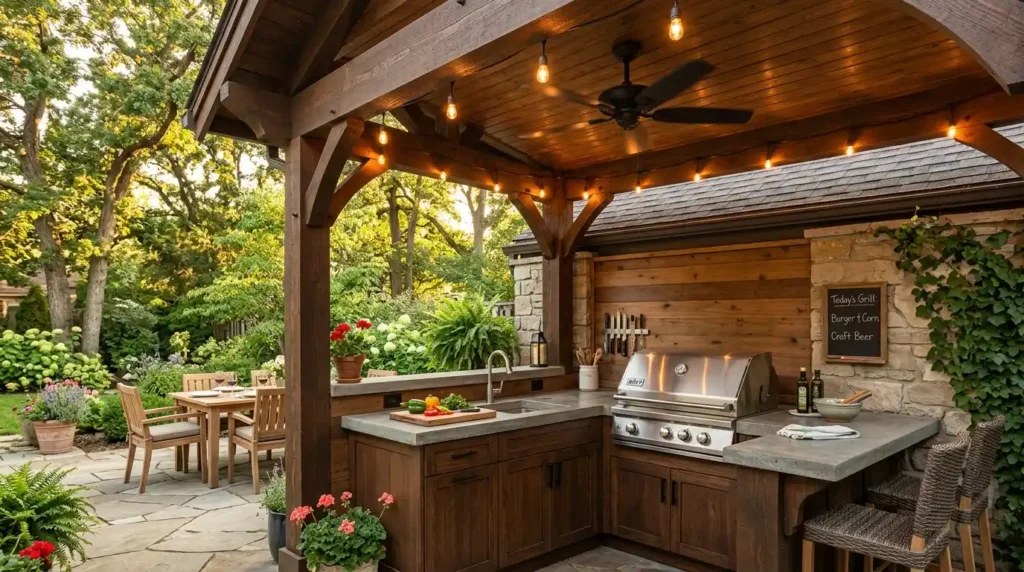
A covered outdoor kitchen under a pergola, patio roof, or solid overhead structure extends the cooking season in every climate and protects the equipment investment from weathering that uncovered outdoor kitchens experience. In warm climates a covered outdoor kitchen becomes a year-round cooking and entertaining space rather than a seasonal one. In variable climates it extends the season by several months in both directions and allows comfortable outdoor cooking on overcast or lightly rainy days that would make an uncovered kitchen impractical.
The overhead structure options for a small covered outdoor kitchen: a pergola with open rafters creates partial shade and a defined overhead structure for pendant lighting without the full weather protection of a solid roof. A solid patio cover or lean-to roof attached to the house provides complete rain protection. A sail shade or retractable awning offers flexible coverage that can be deployed or retracted based on conditions. Each provides the overhead definition that transforms an outdoor kitchen from equipment in a yard into a genuine outdoor room.
Ventilation is the critical design consideration for any covered outdoor kitchen with a gas grill — carbon monoxide and combustion gases from a gas grill under an enclosed or partially enclosed structure require adequate air movement to prevent accumulation. A covered outdoor kitchen should have at minimum two open sides for cross ventilation, and any fully enclosed covered outdoor kitchen with a gas appliance requires a proper ventilation hood rated for outdoor use. This is not an aesthetic consideration — it is a safety requirement.
6. The Small Outdoor Kitchen With Pizza Oven as the Hero Feature
✦ Best for: outdoor kitchens where one dramatic cooking feature creates the room’s identity and the entire layout supports it
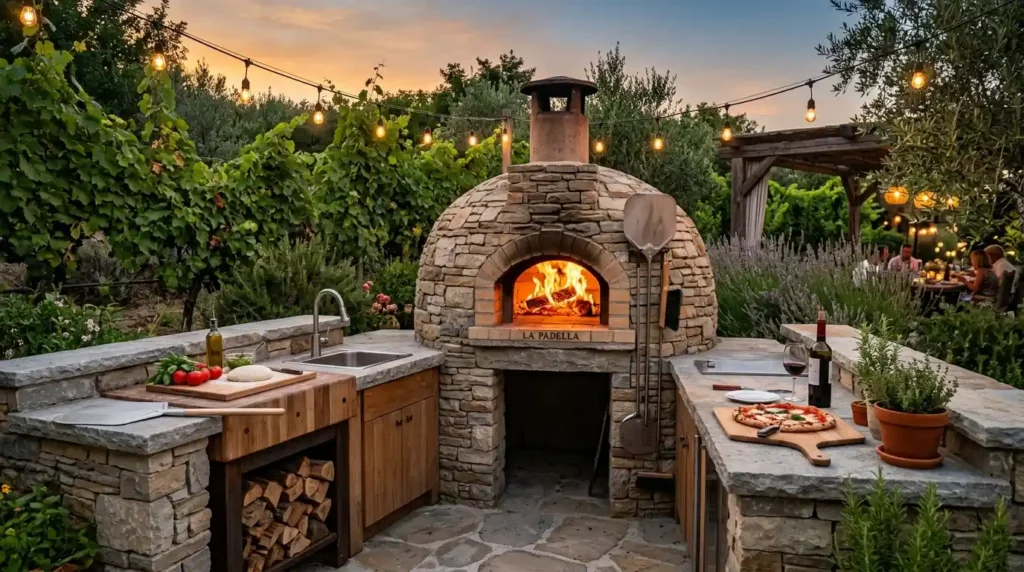
A pizza oven as the hero feature of a small outdoor kitchen creates the most visually dramatic and most socially engaging outdoor cooking environment available — the combination of the dome form, the visible fire, and the theatrical process of wood-fired cooking creates an outdoor space that people actively gather around rather than simply eating near. No other outdoor kitchen feature generates the same social energy or becomes such a central part of outdoor entertaining.
The layout that works best for a pizza oven-centered small outdoor kitchen: the oven mounted at counter height on a sturdy base — typically concrete block or stone — with 24 inches of clear counter on each side for pizza preparation and the tools needed for wood-fired cooking. The oven should be positioned so the opening faces the primary viewing and gathering area rather than a wall, since watching the fire and the cooking process is part of the appeal. A separate grill is often unnecessary in a pizza oven kitchen — the oven can roast, bake, and sear at the high temperatures it reaches.
Pre-fabricated portable pizza ovens — Ooni, Gozney, and similar brands — offer a significantly lower-cost and no-construction entry point to wood-fired outdoor cooking that suits a small outdoor kitchen perfectly. A pre-fabricated oven on a purpose-built stone or concrete base creates the architectural presence of a built-in pizza oven at a fraction of the cost, and the oven itself can be moved if needed.
7. The Budget Small Outdoor Kitchen Built From a Freestanding Grill
✦ Best for: creating a functional outdoor kitchen aesthetic on a minimal budget using an existing or affordable freestanding grill as the starting point
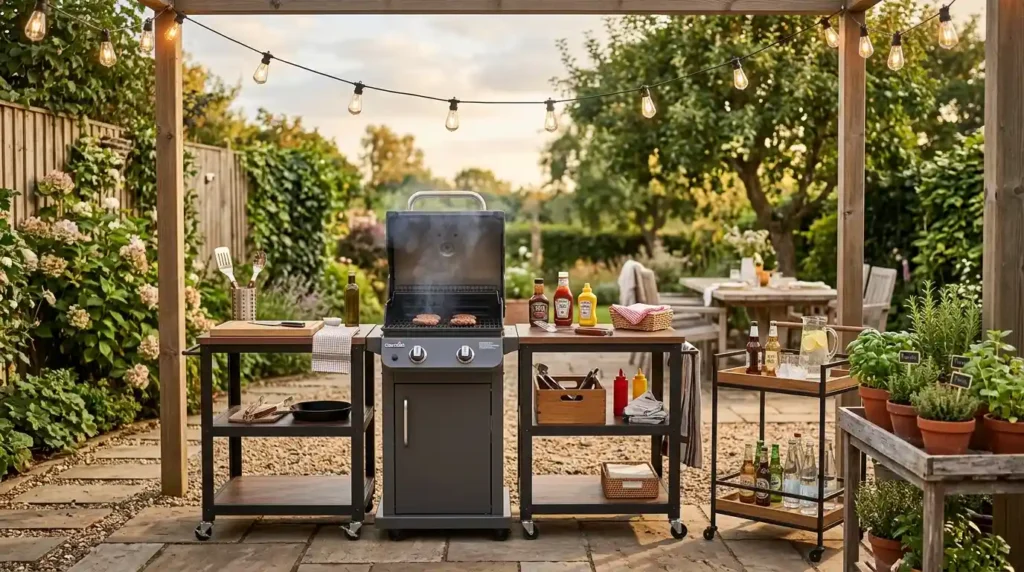
A freestanding grill flanked by purpose-built or repurposed outdoor prep surfaces creates a functional outdoor kitchen zone for under $500 in total investment — the closest approximation of a built outdoor kitchen available at budget level. The visual coherence of a budget outdoor kitchen setup comes from the deliberate arrangement of the components rather than the components themselves.
Two outdoor rolling prep carts or side tables positioned on each side of a freestanding grill create the counter space that a grilling station without sides lacks. Stainless steel outdoor prep tables from restaurant supply stores are the most durable and most cost-effective option at $80 to $150 each. Powder-coated steel or aluminum outdoor side tables create a more residential appearance at similar or slightly higher cost.
The finishing details that elevate a budget freestanding outdoor kitchen setup from equipment arrangement to genuine outdoor room: string lights overhead on a simple timber frame or suspended between two posts. A small potted herb garden on the prep surface — rosemary, thyme, and basil immediately beside the grill creates the most useful and most visually appealing counter accessory available. A small outdoor rug defining the cooking zone. These three additions together cost under $100 and create the outdoor kitchen atmosphere that the equipment alone cannot achieve.
📌 More outdoor and patio ideas: How To Build a Cozy Dad’s Retreat Patio Corner
Frequently Asked Questions
How small can an outdoor kitchen be?
The minimum functional outdoor kitchen footprint is approximately 8 linear feet of counter space with a depth of 24 to 30 inches — enough to accommodate a 30-inch built-in grill with 18 to 24 inches of counter on each side. This fits in a space as small as 8 feet wide by 3 feet deep for a single-wall configuration. According to the National Kitchen and Bath Association, the outdoor kitchen category has grown significantly in the past decade with compact designs under 100 square feet now representing the majority of new outdoor kitchen installations as homeowners prioritize outdoor cooking capability in existing patio spaces rather than expanding their outdoor footprint.
What is the cheapest way to build an outdoor kitchen?
The cheapest permanent outdoor kitchen construction method is concrete masonry unit construction — CMU blocks stacked and mortared to create the kitchen base — with a poured concrete countertop. Material costs for a basic 8-foot linear CMU outdoor kitchen structure run $800 to $1,500 before the grill insert, countertop finish, and any additional equipment. For a non-permanent option a freestanding grill with two stainless steel outdoor prep tables creates a functional outdoor cooking zone for $400 to $700 total without any construction.
What do I need in a small outdoor kitchen?
The essential components of a small outdoor kitchen that functions well: a primary cooking surface — either a built-in grill, pizza oven, or quality freestanding grill. At least 18 inches of clear counter on each side of the cooking surface for food preparation and landing space. One storage unit for tools and essentials — either a cabinet, a drawer module, or a storage cart. A power outlet for small appliances and lighting. Optional but significantly useful: a small outdoor refrigerator for beverages and marinades, a sink for handwashing and food prep, and overhead lighting for evening cooking.
What materials are best for a small outdoor kitchen?
The materials that withstand outdoor conditions permanently without seasonal treatment or regular maintenance: stainless steel for cabinet structures, drawer faces, and appliances — marine-grade 304 stainless resists corrosion in all but coastal salt air environments. Concrete, natural stone, and large format outdoor porcelain for countertops — all three are genuinely weatherproof and require no sealing or treatment. Concrete masonry units or stone for the kitchen base structure. The materials to avoid in an outdoor kitchen: standard interior cabinetry materials including MDF, particleboard, and standard plywood that will deteriorate within one to two seasons of outdoor exposure regardless of how they are finished.
More Outdoor and Patio Ideas
→ Deck Railing Ideas That Make Your Outdoor Space Look Expensive
→ How To Design the Ultimate Grilling Garden for Dad
→ Garden Border Ideas That Make Every Bed Look Designed
Get the counter space right on both sides of the grill first. Everything else in an outdoor kitchen is secondary to having somewhere to put things down while you cook.

Sheikh Hassaan is a digital architect for small businesses and the founder of The Glow Up System. He writes about home decor, garden design, and outdoor living for real American homes – practical ideas that work in actual spaces without oversized budgets.