
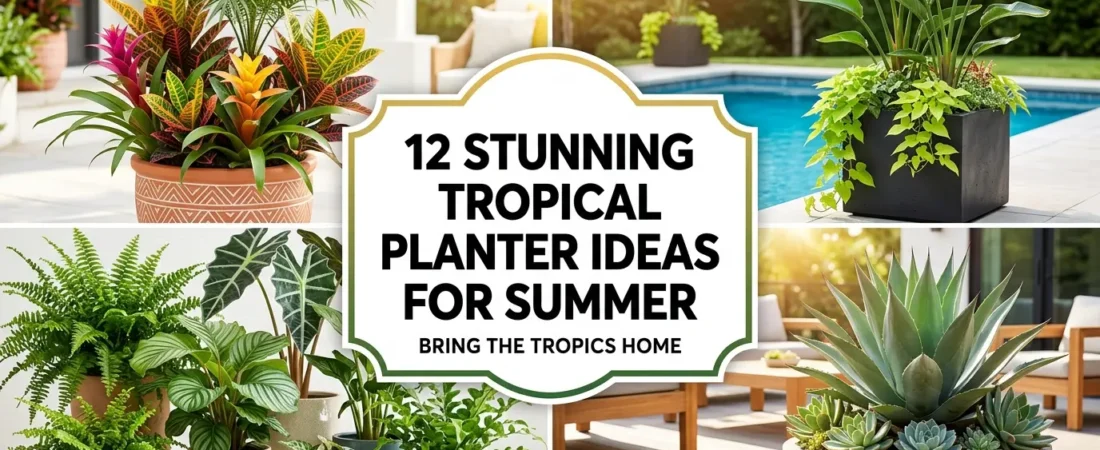
Tropical planter ideas for summer work because tropical plants do something temperate garden plants cannot: they transform the immediate atmosphere of a space. A single banana plant in a generous container changes the feeling of a patio from pleasant British garden to somewhere warmer, more exotic, and more worth lingering in. The scale of tropical leaves, the depth of tropical greens, and the saturated colors of tropical flowering plants create an outdoor drama that cannot be replicated with any amount of bedding plants or evergreen shrubs.
These 12 tropical planter ideas each identify the specific plant, container, position, and care approach that produces genuinely spectacular results through the summer season.
Table of Contents
1. Bird of Paradise: The Container Plant That Commands a Space From a Single Pot
✦ Bird of Paradise Statement Pot
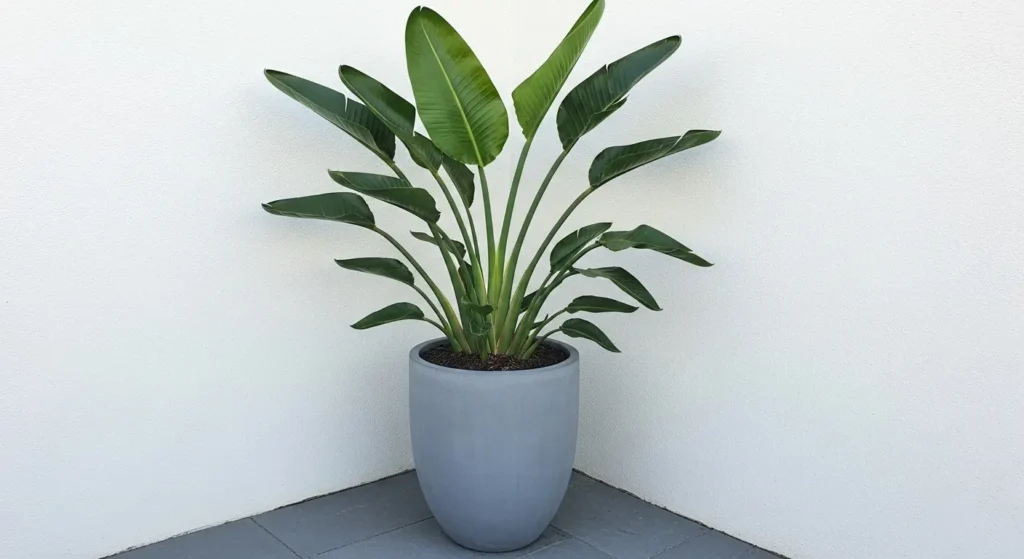
Bird of paradise (Strelitzia reginae or Strelitzia nicolai) is the container plant with the highest architectural authority available for summer patio display. Its paddle-shaped leaves reach 18 to 24 inches in length and fan outward from the crown creating a sculptural presence that reads from every angle and every viewing distance.
The container requirement is the critical variable. Bird of paradise has an extensive root system that becomes pot-bound quickly in undersized containers — pot-bound birds of paradise stop producing new leaves and the existing foliage yellows from stress rather than thriving in the confined root space. A minimum 18-inch diameter and 18-inch deep container is the starting point. The Quarut Large Planter Pots provide the correct scale and depth for establishing bird of paradise in a container environment. Find them linked on Amazon.
Summer care requirements: full sun (minimum 6 hours direct sun daily for Strelitzia reginae, 4 hours for Strelitzia nicolai). Water when the top 2 inches of compost dry out — approximately every 5 to 7 days in summer heat. Feed fortnightly with a balanced liquid fertilizer from June through August. In non-frost-free climates bring inside before temperatures drop below 10 degrees Celsius.
PRO TIP: Allow bird of paradise to become mildly root-bound before repotting — slightly stressed plants in slightly small containers produce more flowers than plants in generously sized containers with abundant root space. The mild root restriction triggers the plant’s reproductive instinct. Repot only when leaves begin yellowing from nutrient depletion rather than on a scheduled timeline.
2. Tropical Hibiscus in a Container: Maximum Summer Flower Color From a Single Plant
✦ Colorful Hibiscus Display
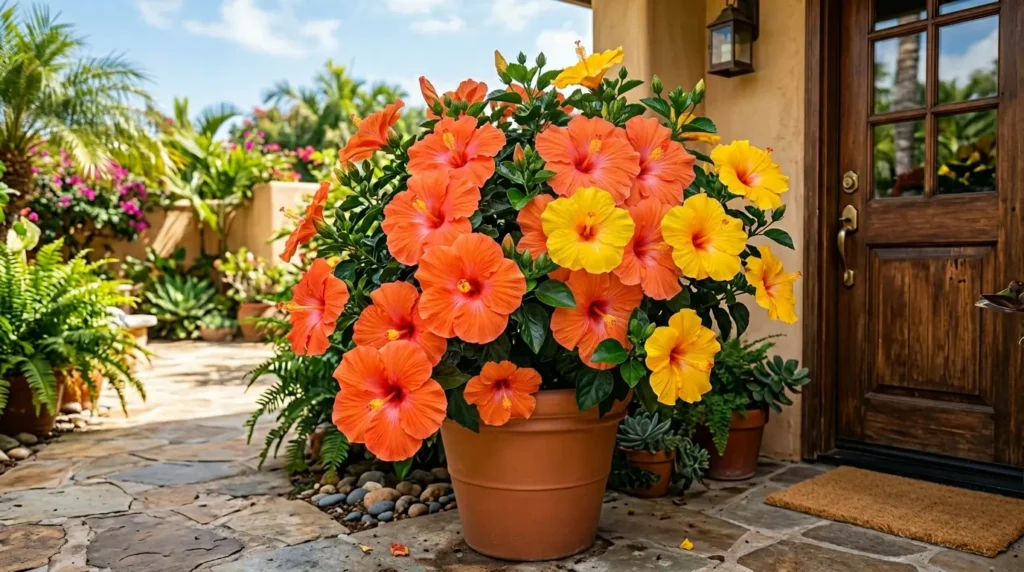
Tropical hibiscus (Hibiscus rosa-sinensis) produces flowers up to 12 inches in diameter in colors ranging from white through every shade of yellow, coral, orange, pink, and red to near-black burgundy. A single well-established container hibiscus in peak midsummer flowering produces 10 to 20 simultaneous blooms that create more vivid color impact than any bedding plant arrangement regardless of size.
Individual hibiscus flowers last only one day — the short lifespan is the primary management consideration for container display. A well-fed hibiscus replaces every spent flower within 24 to 48 hours through the summer season, maintaining a continuous display. The daily maintenance of removing spent flowers takes 2 minutes and prevents the developing seed pods from redirecting energy away from further flower production.
Container requirements: tropical hibiscus performs best in containers that are only slightly larger than the root ball — 2 to 4 inches larger in diameter. Oversized containers cause root problems before the hibiscus can establish. Use a well-draining compost mixed with 20% perlite. Feed weekly with a high-potassium fertilizer — the flowering demand is enormous and unfed container hibiscus drops flower buds rather than opening them when nutrient-stressed.
PRO TIP: Pinch out the growing tips of tropical hibiscus stems in late May before flowering begins to encourage branching. Each pinched tip produces two to three new shoots, each of which becomes a flowering stem. A pinched hibiscus produces three times more flowers than an unpinched one by midsummer. The 10 minutes spent pinching in late May determines the density of the summer display.
3. A Banana Plant in a Container Transforms a Patio Into a Tropical Garden in One Season
✦ Lush Banana Plant Planter
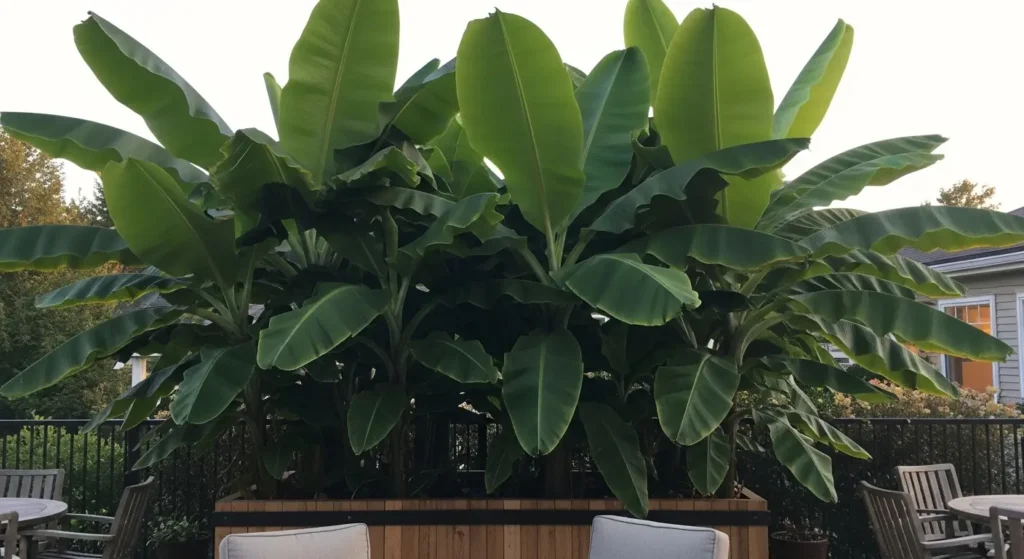
Banana plants in containers are the fastest way to achieve genuine tropical atmosphere in a temperate garden. From a 6-inch nursery plant in May a Musa or Ensete variety can produce leaves of 3 to 4 feet in length by midsummer — creating the tropical canopy effect above patio seating that makes outdoor spaces feel genuinely transformative.
The growth rate of container banana plants depends almost entirely on container volume and feeding frequency. A banana plant in a 10-inch pot grows slowly and produces modest leaves. The same plant moved to a 20-inch container with weekly high-nitrogen feeding grows at a rate that is genuinely astonishing — producing a new leaf every 7 to 10 days at peak summer temperature.
Variety selection matters significantly for non-tropical climates: Musa basjoo (Japanese banana) is the hardiest variety and can overwinter in the ground or in a cool frost-free space with the pseudostem cut down and mulched. Ensete ventricosum ‘Maurelii’ (Ethiopian red banana) produces the most dramatic burgundy-green foliage but requires frost-free overwintering. Both varieties achieve spectacular container display results in a single summer season.
PRO TIP: Feed container banana plants with a high-nitrogen fertilizer every 5 to 7 days rather than fortnightly during peak summer growth. Banana plants are exceptionally hungry — they produce leaf material faster than almost any other temperate-cultivated plant and consume available nutrients accordingly. A weekly feed rather than fortnightly feed produces leaves that are 30% larger and maintains the deep green leaf color that makes banana plants look healthy rather than stressed.
4. Croton Petra: The Container Plant That Looks Like It Is Already in Full Bloom
✦ Croton Color Explosion
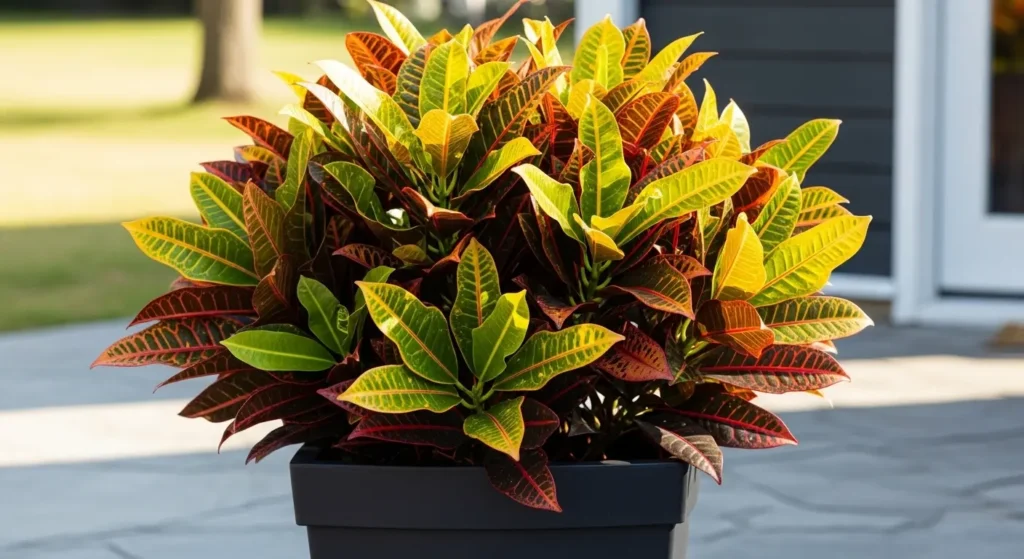
Croton Petra (Codiaeum variegatum ‘Petra’) provides the most saturated and most continuous leaf color of any summer container plant — the leaves are simultaneously deep green, bright yellow, vivid orange, scarlet red, and deep burgundy in the same plant at the same time. Unlike flowering annuals that peak and decline croton maintains this color display through the entire summer without deadheading, feeding for flower production, or seasonal replacement.
The specific care requirement that determines whether a croton thrives or sulks: consistent conditions. Crotons react to sudden changes in temperature, light, or watering routine by dropping leaves. A plant moved from a garden center to a patio must be transitioned gradually — keep it in a sheltered position for the first two weeks rather than placing immediately in full sun. Once established and stable croton is a resilient summer container plant.
Sun requirement is the variable that most affects color intensity. Croton in partial shade produces predominantly green leaves with reduced color saturation. The same croton in full sun produces the maximum orange-red coloration that makes Petra the most photographed croton variety. Position in minimum 4 to 6 hours direct sunlight for peak color performance.
5. Elephant Ears in Containers: The Leaves That Stop Visitors Mid-Conversation
✦ Elephant Ear Feature Planter
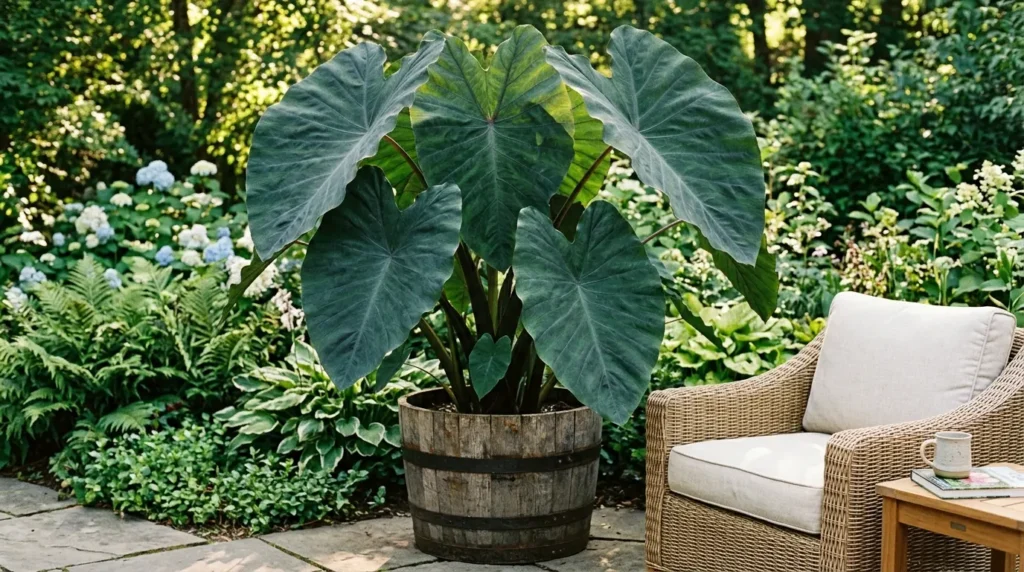
Elephant ear plants (Colocasia and Alocasia species) produce individual leaves of 24 to 36 inches width in a single summer season from a container — a scale that is simply impossible to achieve with any other plant in the same timeframe and creates an immediate conversation-stopping visual impact.
Colocasia esculenta (taro) is the most vigorous and most cold-tolerant elephant ear for container use. Given adequate water and heat it produces new leaves continuously through summer, each one larger than the last as the root system establishes. Unlike many tropical plants colocasia is not drought-tolerant — it requires consistently moist growing medium and benefits from being placed in a saucer of water in hot weather.
Alocasia macrorrhiza (giant taro) and Alocasia ‘Black Velvet’ provide different leaf textures and tones — the giant taro produces glossy arrowhead leaves with dramatic veining while Black Velvet offers the darkest near-black leaf with silver-white vein patterning. Both are slower-growing than colocasia but produce container specimens of exceptional ornamental quality by late summer.
PRO TIP: Position container elephant ear plants where they receive morning sun and afternoon shade in climates with hot dry summers. The large leaf surface area transpires significant moisture in full afternoon sun — a colocasia in full summer sun on a hot day can wilt visibly by mid-afternoon even when adequately watered, while the same plant in afternoon shade maintains its upright dramatic posture through the heat of the day.
6. A Mixed Jungle Container Combines Five Tropical Species Into One Lush Display
✦ Mixed Jungle Container
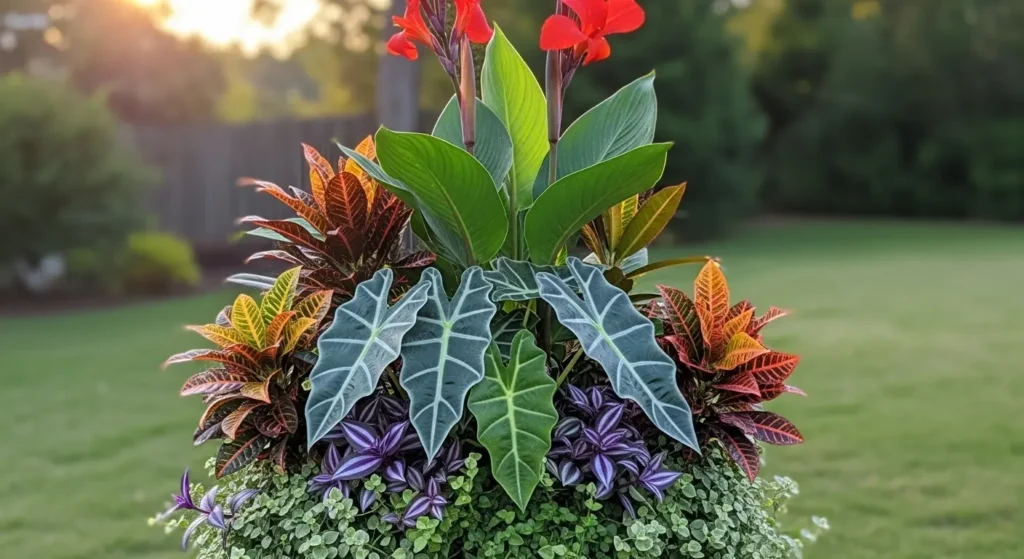
A mixed tropical jungle container applies the thriller-filler-spiller principle to tropical plant species to create a single container display that reads as a complete miniature tropical garden rather than a pot with plants in it.
The combination that produces the most consistently spectacular mixed tropical container: tall Canna lily at the back as the thriller — providing height, large leaves, and eventual flower color. Colocasia or smaller Alocasia as the mid-height filler — creating the dense green tropical mass at the container center. Trailing Tradescantia zebrina as the spiller — cascading over the container edge with purple-silver striped foliage that provides visual movement and ground-level interest.
Add Croton Petra as a fourth element for leaf color contrast within the predominantly green composition. The combination of Canna height, Colocasia mass, Tradescantia trail, and Croton color creates the four dimensions of a complete planting design — height, density, movement, and color — in one 20-inch container. The Quarut Barrel Planters provide the depth and volume this combination requires to perform at its best through a full summer season. Find them linked on Amazon.
PRO TIP: Feed a mixed tropical container every 5 days rather than weekly during peak summer growth. A mixed container contains multiple hungry plants with different nutrient demands all competing within the same growing medium. The increased feeding frequency maintains nutrient availability across the combined demand of all species simultaneously and prevents the deficiency symptoms — yellowing, reduced growth, bud drop — that standard fortnightly feeding allows in mixed tropical plantings.
7. A Container Palm Creates Year-Round Structure With a Summer Tropical Atmosphere
✦ Tropical Palm Arrangement
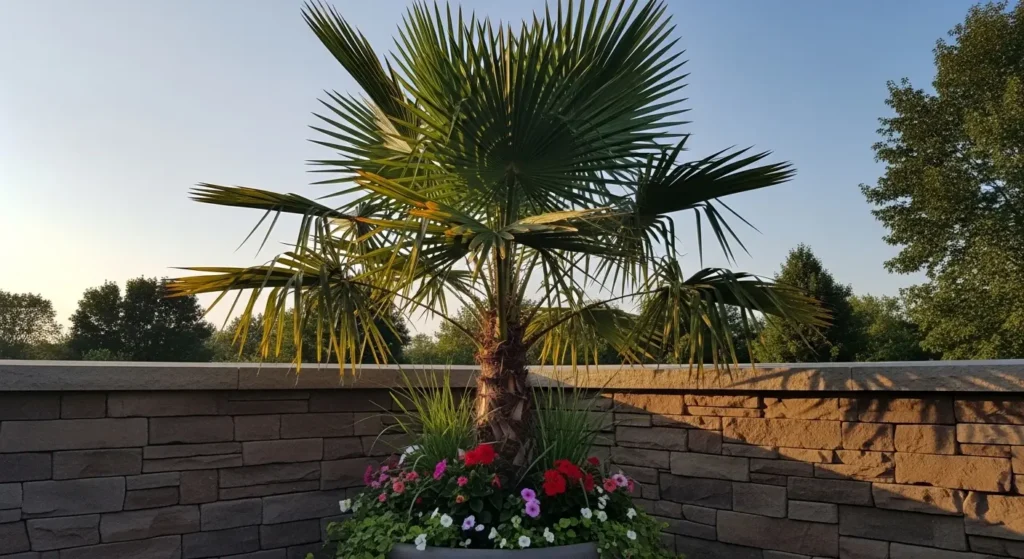
Container palms are the only tropical planter that provides year-round structural presence rather than seasonal display. While banana plants, hibiscus, and coleus all require winter protection or annual replacement a cold-hardy palm maintains its architectural presence in the outdoor space throughout the year, with the fan or feather fronds providing the tropical atmosphere even in winter months.
For temperate climates the two most reliable cold-hardy palms for container use: Trachycarpus fortunei (Chusan palm) which tolerates temperatures down to -15 degrees Celsius once established and produces its characteristic trunk within 5 to 8 years of container growing. Chamaerops humilis (Mediterranean fan palm) which is slightly less cold-hardy but produces a more compact multi-stemmed form suited to smaller containers.
Underpanting a container palm with summer tropical annuals completes the display without compromising the palm. Begonias, impatiens, and trailing sweet potato vine (Ipomoea) at the base of a palm container create a lush tropical underplanting that changes seasonally while the palm itself provides permanent structural presence above.
8. Coleus Combinations: The Shade-Tolerant Tropical Leaf Color That Transforms Dark Corners
✦ Bright Coleus Combination
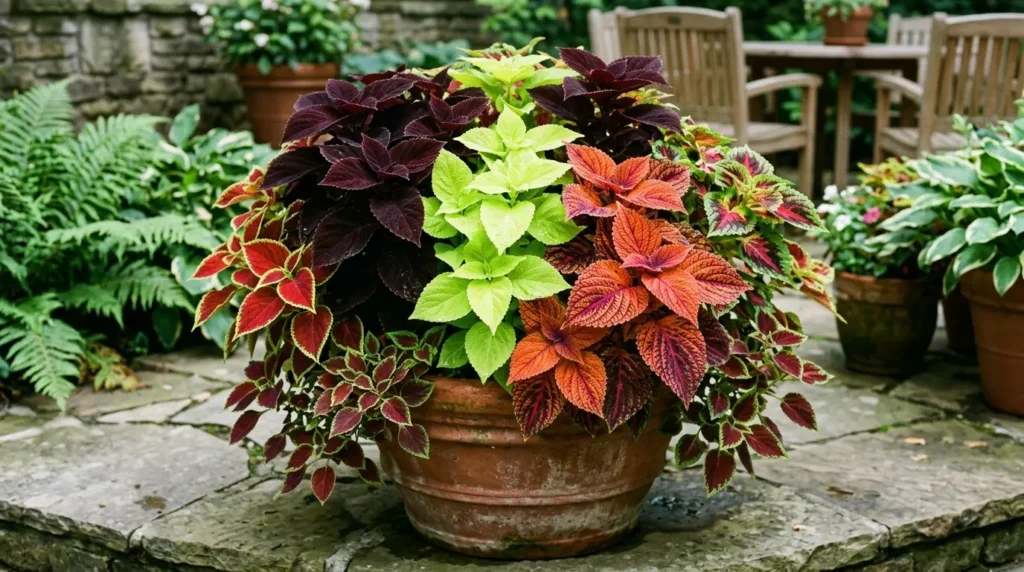
Coleus (Solenostemon/Plectranthus scutellarioides) is the tropical plant that solves the most frustrating summer container problem: how to achieve intense color in a shaded or partially shaded outdoor position. Coleus provides leaf color that rivals flowering annuals in intensity — scarlet, burgundy, chartreuse, copper, orange, and near-black — all produced from foliage rather than flowers, in positions that receive as little as 2 hours of direct sun.
The modern coleus cultivars have transformed the plant from a Victorian bedding fad into a genuinely sophisticated container plant material. ‘Black Magic’ produces near-black burgundy leaves with a metallic sheen. ‘Electric Lime’ produces chartreuse-yellow leaves with deep burgundy margins. ‘Fishnet Stockings’ produces bright lime leaves with burgundy veining that creates a literal fishnet pattern. Combined in a single large container these varieties create a leaf tapestry of remarkable complexity and vibrancy.
Coleus is also the easiest tropical to propagate — a 4-inch cutting placed in water roots within 10 to 14 days. One purchased plant produces five new plants within three weeks through water propagation, making coleus the most economical tropical container plant available when display scale is required on a limited budget.
PRO TIP: Pinch out the flowering spikes on coleus plants as soon as they appear — typically from midsummer onward. When coleus begins flowering it diverts energy from leaf production and the foliage quality declines rapidly. A coleus maintained in the vegetative stage through regular flower spike removal maintains its leaf size and color intensity through the entire summer season.
9. A Resort Entry Tropical Planter Makes the Front Door Feel Like an Arrival
✦ Resort Style Entry Planter
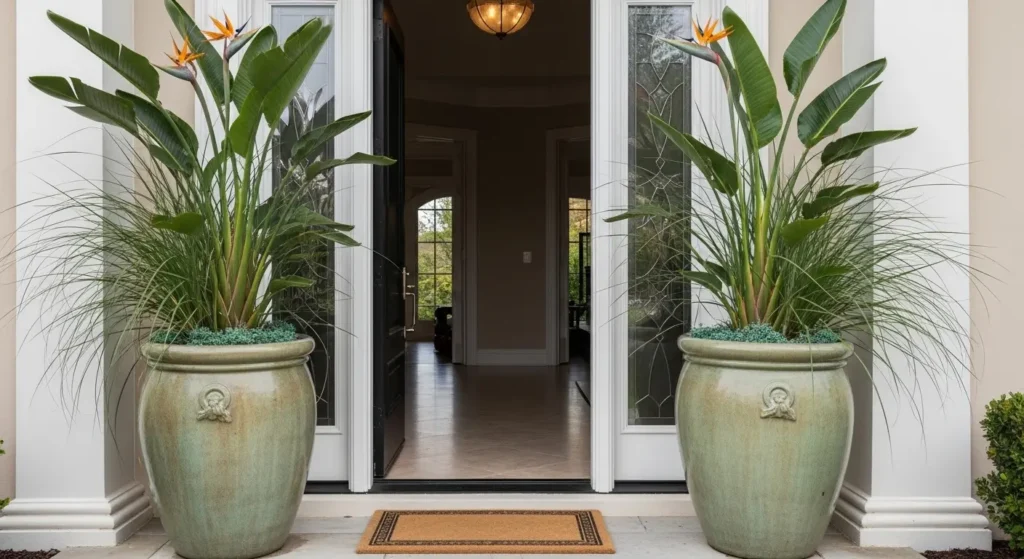
A resort entry tropical planter pair uses the same principle that hotel entrances apply: oversized containers with statement tropical plants on each side of the entrance create an arrival moment that communicates luxury and considered design from the approach. The scale does the work — resort entry planters are always larger than feels instinctively correct, which is precisely why they read as impressive rather than modest.
The plant selection for resort entry tropical planters must have strong architectural form visible from approach distance. Bird of paradise with its fan of paddle leaves. A large specimen Phormium with its dramatic sword foliage. A mature Cordyline with its arching leaf rosette. All three maintain their architectural presence in any weather, through any season, and from any viewing angle.
Container quality at entry scale matters more than anywhere else in the garden because entry containers are seen by every visitor and assessed at close range as they approach the door. The Quarut Large Planter Pots provide the scale and material quality for entry-level tropical planting. Find them linked on Amazon.
PRO TIP: Water resort entry tropical container plants in the early morning on days when guests are expected rather than in the evening or afternoon. Freshly watered plants with glistening leaves and upright posture in the morning look significantly more vital and more impressive than the same plants with slightly dusty leaves and mid-afternoon heat stress wilting. The morning watering timing is a hospitality detail.
10. Layered Tropical Foliage: Three Leaf Sizes, Three Textures, One Container
✦ Layered Foliage Look
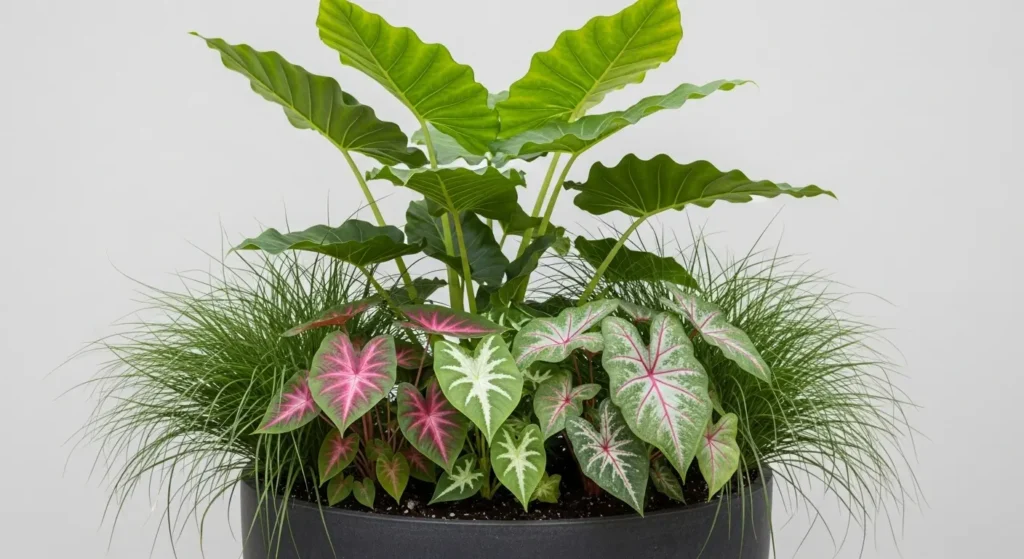
A layered tropical foliage container uses deliberate contrast between leaf sizes and textures to create visual complexity that single-species containers cannot achieve. The design principle borrows from interior design — layering different scales of pattern creates depth and interest that a single pattern at a single scale does not provide regardless of its quality.
The three-layer foliage formula: large leaves as the structural layer providing the primary visual mass. Medium leaves with pattern or color variation as the detail layer providing interest at mid-range viewing distance. Fine texture plants as the edge layer providing contrast against the large and medium leaves and visual movement at the container rim.
Applied to tropical plants: large Colocasia or Alocasia as the structural layer. Caladium (painted leaves in white, pink, and red patterns) as the detail layer. Fiber Optic grass or fine-leaved tropical Carex at the container edge as the texture layer. The three layers create a container composition that reads as designed from 20 feet away and rewards closer inspection with increasing detail as you approach.
11. A Tropical Porch Planter Cluster Creates the Holiday Feeling the Moment You Arrive Home
✦ Tropical Porch Display
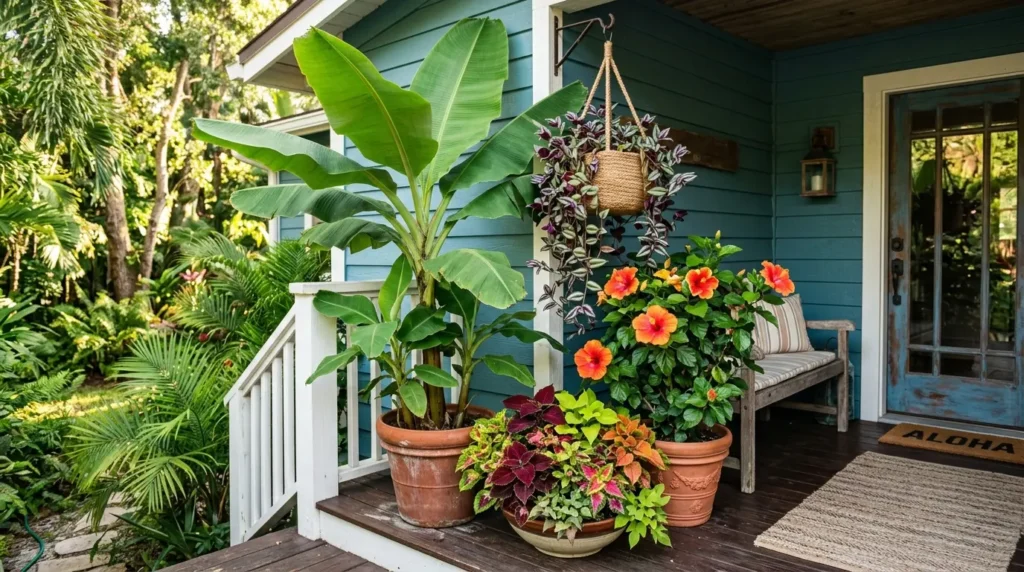
A tropical porch planter cluster groups multiple tropical containers together in one porch position to create a complete tropical garden vignette rather than scattered individual pots. The clustering principle applies here exactly as it does to any garden planting — five tropical plants grouped together create five times more visual impact than the same five plants distributed around the porch.
The porch cluster composition: one tall anchor plant at the back against the wall or in the corner — a banana, a bird of paradise, or a tall canna. Two to three medium plants at different heights surrounding the anchor — hibiscus, croton, and coleus all work at this scale. One trailing plant either in a hanging basket above or in a low pot at the front of the cluster that connects the arrangement to the ground level. The Brightown solar mushroom lights scattered at the base of the cluster create the magical evening focal lighting that completes the tropical porch experience after dark. Find them linked on Amazon.
PRO TIP: Group tropical porch cluster containers on a single large saucer or drainage tray rather than leaving each pot on the porch surface individually. The shared saucer creates a visual base that reads as a unified planted arrangement rather than a collection of individual pots. It also protects the porch surface from water staining and makes moving the whole cluster for cleaning a single-lift operation.
12. One Bold Tropical Accent Planter Changes the Whole Atmosphere of a Patio
✦ Bold Patio Accent Planter
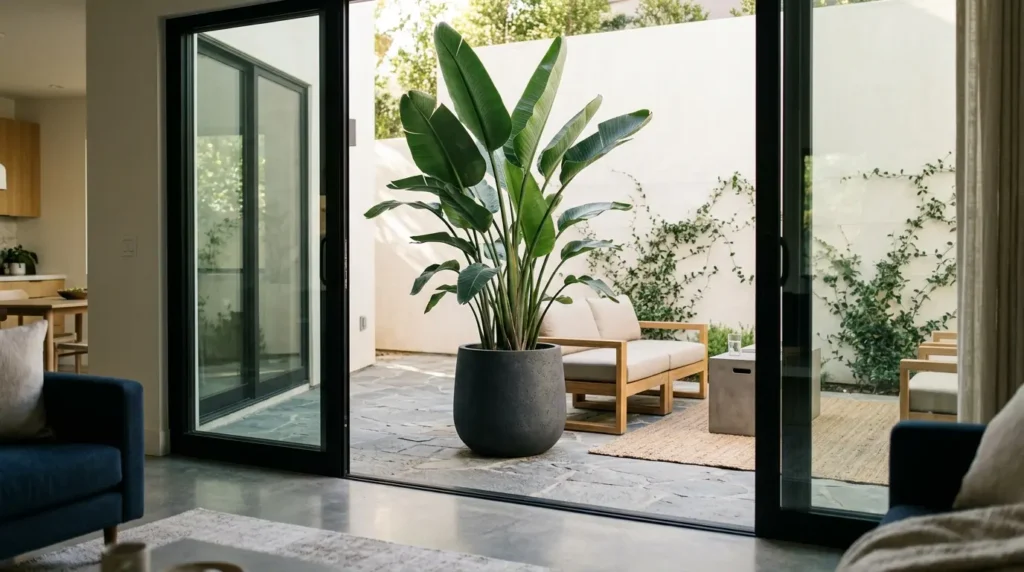
A single bold tropical accent planter applies the statement piece principle to outdoor planting: one exceptional plant in one quality container positioned at the dominant focal point changes the atmosphere of the entire patio without requiring any other additions or changes.
The statement tropical accent works because it creates a visual anchor that the eye returns to from every seating position and from every interior view of the patio through the back door or window. Everything else on the patio relates to it — either as supporting elements that complement the statement or as background that allows it to stand alone.
The plant and container selection for a bold tropical accent must prioritize presence over prettiness. A plant with genuine architectural confidence — bird of paradise, giant agave, tree fern, or large Strelitzia nicolai — in a container that is one size larger than feels comfortable. The combination of exceptional plant and oversized quality container creates the kind of outdoor statement that people notice on first arrival and continue to appreciate with every subsequent visit.
PRO TIP: Rotate a statement tropical accent container by a quarter turn every two weeks to prevent one-sided growth toward the primary light source. Tropical specimens in containers left in a fixed orientation for a full summer develop a pronounced lean toward the sun that undermines the balanced architectural presence that makes statement plants effective. Regular rotation maintains the symmetrical form that commands a space.
Overwintering Tropical Container Plants: The Decision Every Autumn
Most tropical plants in temperate climate containers require a decision in autumn: overwinter inside, cut back and mulch, or treat as annuals and replace. The right approach depends on the plant and the available overwintering space.
Bring inside to a frost-free bright space:
Hibiscus, Strelitzia, Colocasia, Alocasia, Croton, Coleus. These plants cannot handle any frost and must be brought inside before temperatures drop below 5 degrees Celsius. Reduce watering significantly and do not feed through winter.
Cut back and mulch in place or in a cool shed:
Musa basjoo (Japanese banana), Canna lily, and Ensete in milder climates. Cut the pseudostem to 6 inches, cover with deep straw or bark mulch, and leave in situ or move to a cool dry shed.
Leave in place year-round:
Trachycarpus fortunei, Chamaerops humilis, and established Phormium. These are genuinely cold-hardy to -15 degrees Celsius or colder once established and require no winter protection beyond being positioned in a sheltered spot away from frost pockets.
📌 More tropical and planter ideas → 14 Relaxing Tropical Patio Ideas For Summer
Frequently Asked Questions
What tropical plants grow well in containers?
The tropical plants that perform best in containers for summer display are those with vigorous growth responses to the improved drainage and warming that containers provide over ground planting. Canna lilies, Colocasia elephant ears, tropical hibiscus, Strelitzia bird of paradise, banana plants (Musa and Ensete), Croton Petra, and Coleus all produce spectacular container displays when given adequate container volume, consistent feeding, and full sun or partial sun positions. According to the RHS Musa basjoo is the most reliably spectacular tropical plant for container growing in temperate climates due to its extreme vigor and relative cold hardiness.
How big a container do tropical plants need?
Large-growing tropical plants produce their most spectacular container displays in the largest containers that are practical to position and manage. As a minimum guideline: banana plants and elephant ears need 18-inch diameter containers or larger. Bird of paradise, palms, and large hibiscus need 16 to 20-inch containers. Coleus, smaller croton, and mixed tropical combinations need 14 to 16-inch containers. Container size is the single variable that most limits or enables tropical plant performance — undersized containers produce undersized plants regardless of watering and feeding quality.
Can tropical plants survive outdoors in summer?
Most tropical plants thrive outdoors in temperate climates through the summer season when temperatures consistently exceed 15 degrees Celsius. Many tropical plants actually grow faster and more vigorously outdoors in summer than they do as houseplants year-round because outdoor conditions provide higher light intensity, natural air movement, and the temperature fluctuation between warm days and cooler nights that tropical plants experience in their native habitats. The transition from indoor to outdoor should be gradual — acclimatize over 7 to 10 days in a sheltered position before moving to full outdoor exposure.
Tropical Plants in Containers Bring Summer Indoors and Take the Garden Abroad
Every tropical planter idea in this guide creates an atmosphere shift that goes beyond visual decoration. The scale of tropical leaves, the saturated color of tropical flowers, and the lush abundance of a well-grown tropical container changes how a patio feels to everyone who spends time there. That is the difference between a garden you maintain and a garden you genuinely enjoy.
Choose one or two tropical planter ideas from this guide and invest in the container size and feeding frequency that the plants require. The results at midsummer will exceed every expectation set by the modest investment required in May.
All the products mentioned in this article are linked on Amazon. Every recommendation is something we genuinely believe in.
More Tropical and Outdoor Ideas
→ 16 Garden Planter Ideas That Transform Outdoor Spaces
→ 7 Outdoor Living Space Ideas For Summer
→ 12 Cozy Boho Patio Ideas To Copy
→ 12 Backyard Movie Night Setup Ideas
Choose one or two tropical planter ideas and invest in the container size and feeding frequency the plants require. The results at midsummer will exceed every expectation set by the modest investment required in May.

Sheikh Hassaan is a digital architect for small businesses and the founder of The Glow Up System. He writes about home decor, garden design, and outdoor living for real American homes – practical ideas that work in actual spaces without oversized budgets.