

Most men’s bedrooms end up looking the way they do not because of taste but because of accumulation — things get added over years without an organizing principle, and the room becomes a collection of individual objects that happen to share a space rather than a coherent environment. A minimalist mens bedroom solves this not by stripping everything out but by introducing a clear set of decisions about what belongs and what does not, and then holding to those decisions consistently.
This guide walks through how to style a modern bedroom for a dad who wants the room to function well, look clean, and require almost no maintenance to keep that way — because a bedroom that needs constant tidying to look presentable is not actually well designed, it is just temporarily straightened up.
Table of Contents
The No-Fuss Principle: Design Out the Maintenance
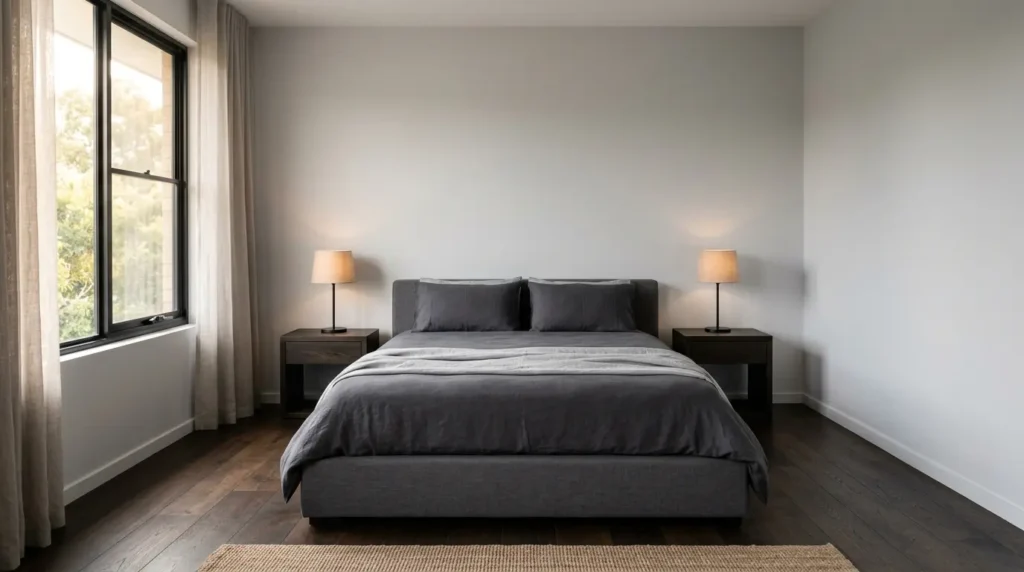
A bedroom that looks good only when it has just been tidied is not a well-designed room — it is a room that relies on ongoing effort to compensate for a layout that generates visual disorder naturally. A genuinely no-fuss minimalist bedroom is designed so that even with a day’s worth of normal use — clothes on the floor, a glass of water on the nightstand, a book left open — the room still looks largely coherent, because the underlying structure is strong enough to absorb a reasonable amount of disorder without falling apart visually.
Three principles that deliver this quality consistently: every surface in the room should have a default state of empty or nearly empty, so that anything placed on it is immediately visible and easy to put away. Every object in the room should have a designated home that requires no more than one motion to reach — clothes go on a hook or in a drawer that is easy to open, not on a chair that becomes a permanent fixture. The bed should be the dominant visual element in the room by a wide margin, and everything else should be subsidiary to it.
These are not aspirational principles for a showroom-quality bedroom — they are practical design decisions that make the room easier to live in daily, which is the actual goal of a no-fuss approach rather than the visual minimalism itself.
The Bed: Getting the Scale and Style Right
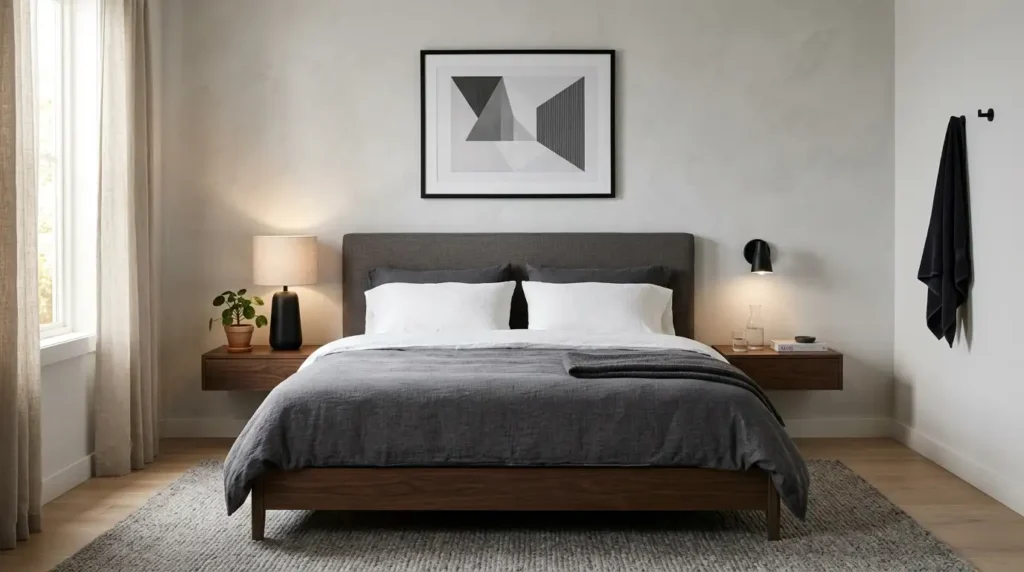
The bed frame in a minimalist masculine bedroom should be chosen for its silhouette before its material or color — the shape of the frame is what reads from across the room, and a clean geometric form in any neutral material will suit the aesthetic better than an ornate or heavily detailed frame in the most perfect color.
A platform bed with a low profile — typically 14 to 18 inches from floor to mattress top — suits a minimalist masculine bedroom better than a taller traditional frame because it keeps the room’s visual center of gravity low and close to the floor, which reads as calm and grounded rather than as the elevated look of a more traditional bed setup. A simple upholstered headboard in a charcoal, dark navy, or warm gray fabric provides enough softness at the wall without the ornate detail of a carved wood headboard.
Size matters in both directions: a bed that is too small for the room leaves awkward space around it that becomes difficult to fill without adding objects the room does not need. A bed that genuinely fills the room — a king in a room of adequate size, centered on the primary wall — leaves enough space on each side for a nightstand and walking clearance, which is the proportional relationship that makes a bedroom feel like it was designed rather than furnished.
Bedding That Looks Good Without Being Made Perfectly
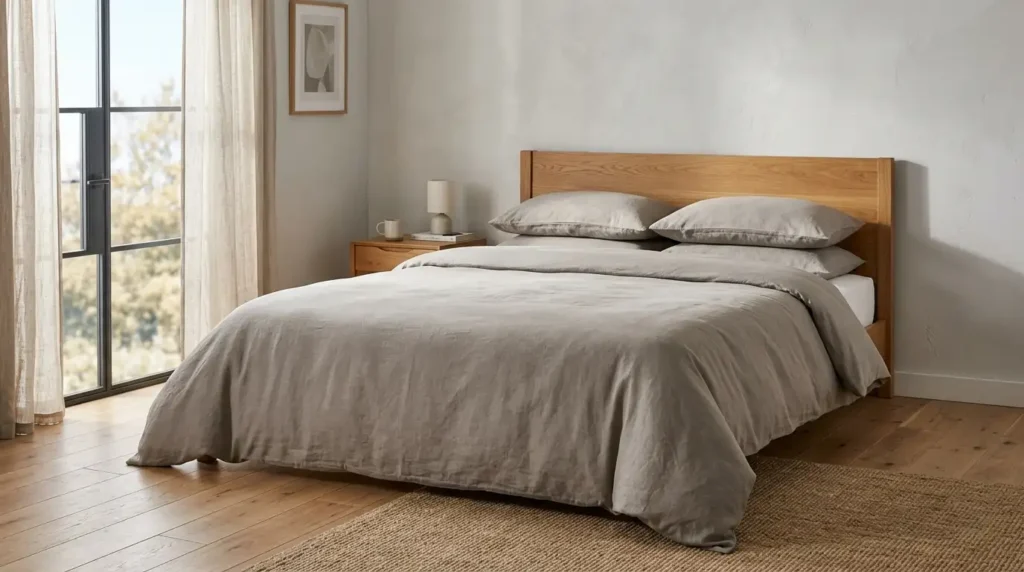
There is a specific category of bedding that looks genuinely expensive and considered when casually arranged and looks terrible when it has been slept in and pulled back — heavily structured hotel-style layering with multiple decorative pillows, a precisely folded accent throw, and a tight top sheet tucked in with military corners. This is not no-fuss bedding. It requires daily reconstruction to look as intended.
The genuinely no-fuss approach: a quality linen or high-thread-count cotton duvet in a warm white, stone, or slate gray, two sleeping pillows in matching cases, and nothing else on top of the bed. Washed linen in particular is the ideal bedding material for a minimalist masculine bedroom because it looks intentionally relaxed when casually arranged — wrinkles and slight unevenness read as texture and character rather than as a sign the bed has not been made.
The Blissy Silk Pillowcase in champagne or ivory introduces a premium sleeping surface alongside the linen duvet — silk against the face and neck at sleep temperature is genuinely different from cotton or linen at the same thread count, and it photographs as a considered luxury detail in a bedroom that is otherwise deliberately understated. Find it linked on Amazon.
Color Palette: Two Neutrals and One Anchor Tone
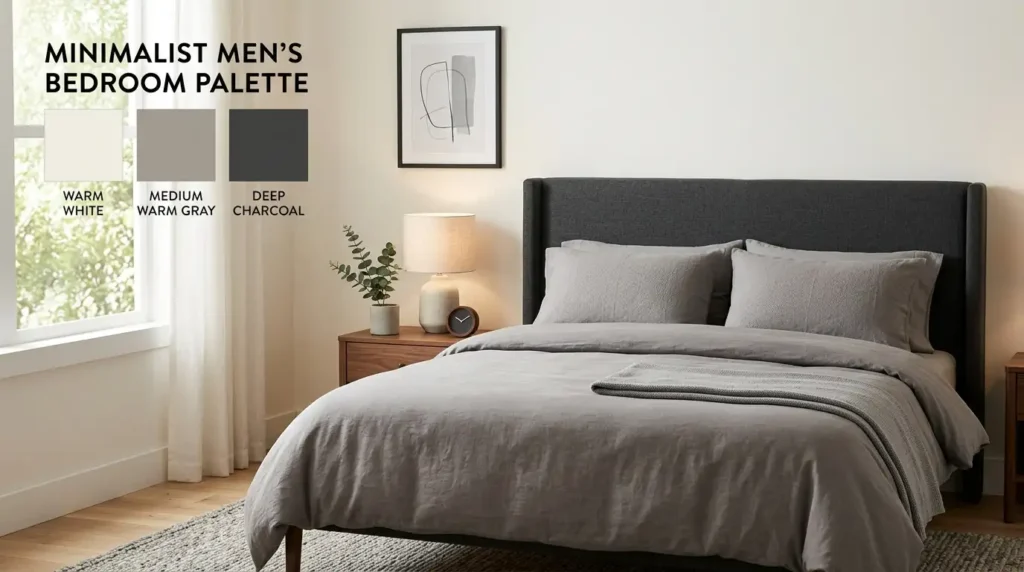
A minimalist bedroom palette works best with three tones rather than one or five: a warm white or off-white for the walls and ceiling, a mid-range warm neutral — stone, greige, or warm gray — for the bedding and upholstered surfaces, and one anchor tone that is substantially darker than the other two, present in the headboard, the flooring, or one accent element.
What makes this palette specifically masculine without relying on stereotypically masculine colors like navy or hunter green is the warmth temperature of all three tones. Warm white rather than cool white. Stone and greige rather than cool gray or lavender. Charcoal or dark walnut rather than bright black or chrome. Warm-toned neutrals read as sophisticated and grounded in a way that cool-toned minimalism sometimes does not.
The most common palette mistake in masculine minimalist bedrooms: adding a fourth color as an accent — a throw pillow in a different tone, a rug in a color that does not appear elsewhere in the room — which immediately disrupts the deliberate simplicity of a three-tone scheme. If a fourth element genuinely improves the room, it should replace one of the existing three rather than being added on top of them.
Using Strong Geometric Symmetry to Build a Calm Sleeping Space
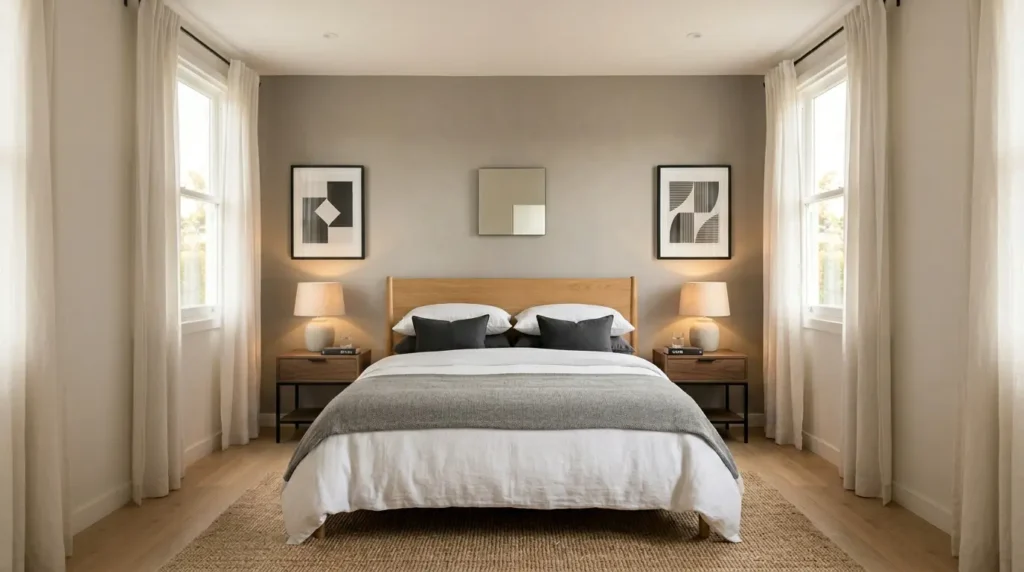
Symmetry in a bedroom is one of the simplest and most powerful tools available for creating a space that feels calm and deliberately designed rather than casually assembled. The human brain responds to bilateral symmetry with a sense of order and predictability that directly supports the mental state a bedroom is meant to create — the specific quality of an environment that signals rest rather than activity.
The foundational symmetry in a minimalist masculine bedroom is the bed centered precisely on the primary wall, with identical nightstands at equal distance on each side. Identical lamps on each nightstand at identical heights extend this symmetry upward from the bed surface to eye level when lying down, creating a framing effect around the sleeping position that is instinctively calming.
Two matching framed pieces — same frame, same size, same mounting height — above each nightstand complete the symmetrical composition from floor to wall and give the primary wall a fully resolved visual structure rather than an incomplete arrangement. The art or photography inside the frames matters far less than the consistent sizing and mounting of the frames themselves.
Intentional asymmetry can be introduced deliberately — one nightstand lamp slightly taller, one framed piece with a slightly different composition — but this requires genuine design confidence to execute correctly. For a no-fuss approach, consistent symmetry is more forgiving and more reliably produces a calm result than deliberate asymmetry, which tends to look like a mistake unless it is executed with real precision.
Concealed Storage as the Core of No-Fuss Living
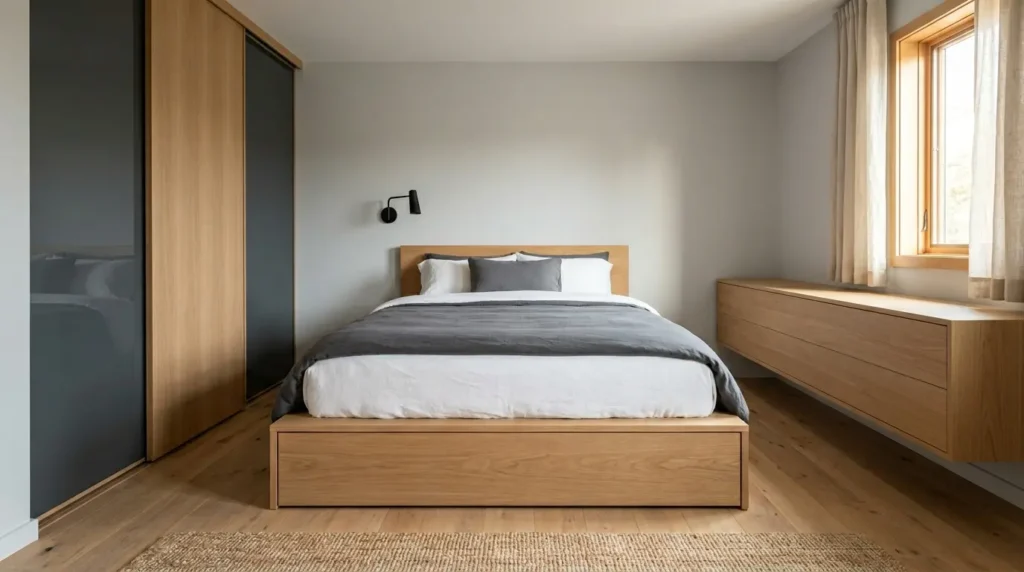
The quickest route to a no-fuss bedroom that maintains its appearance without daily effort is to substantially increase the available concealed storage so that nothing has to live on a visible surface because there is nowhere else for it to go. Most bedrooms have inadequate concealed storage, which is why clothes migrate to chairs, accessories accumulate on dressers, and the room always looks one step behind regardless of how often it is tidied.
Under-bed storage drawers:
A platform bed with integrated drawer storage beneath uses space that would otherwise be dead floor area under the bed. Two large drawers on each side of a king bed provide enough storage for seasonal clothing, extra bedding, or the assorted items that typically have no dedicated home in a bedroom.
Wall-mounted floating dresser:
A floating dresser mounted to the wall rather than standing on the floor contributes to the room’s visual lightness by revealing more floor surface beneath it, and eliminates the accumulation of dust and objects at floor level around a standing dresser’s legs. Push-to-open drawer mechanisms rather than visible handles maintain the clean surface aesthetic.
A hook rail on the back of the bedroom door or on one wall specifically designated for tomorrow’s outfit, a gym bag, or a jacket — a place that is specifically intended to hold temporarily placed items rather than being a surface that things land on by default — absorbs a significant portion of the daily visual disorder that most bedrooms accumulate.
Bedroom Lighting That Supports Sleep
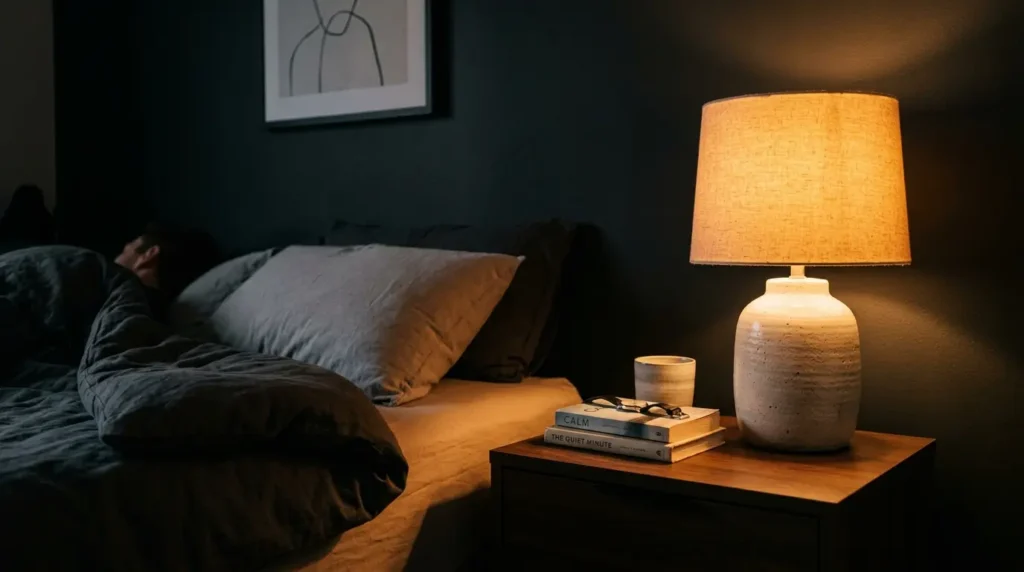
Bedroom lighting serves two distinct functions that require two distinct approaches: bright enough to see clearly for getting dressed and finding things in the morning, and dim and warm enough in the evening to support the biological wind-down process that precedes sleep. A single overhead light at fixed brightness does neither well — it is either too dim during the day or too bright in the evening.
The practical solution: an overhead light on a dimmer for general room illumination, and two matching bedside lamps in ceramic or timber bases for evening reading light. All bulbs at 2700K warm white. Dimmer on the overhead set to around 20 percent output in the evening produces a room brightness that is genuinely conducive to winding down rather than the bright overhead light that delays sleep by suppressing melatonin production.
Blackout blinds or curtains behind sheer day curtains give the room complete light control at night while maintaining a light, clean appearance during the day. A minimalist masculine bedroom that is otherwise perfectly designed but allows early morning light to disrupt sleep is not actually serving its primary function, and blackout window treatment is the practical fix that makes the room livable at all hours rather than just visually coherent during the day.
📌 More home decor ideas: 7 Home Office Decor Ideas That Make Dad Feel Like a King
Frequently Asked Questions
What makes a bedroom look masculine and modern?
A masculine modern bedroom is characterized by a limited warm-neutral palette, a low-profile platform bed as the dominant element, strong bilateral symmetry around the bed, concealed storage that keeps all surfaces clear, and warm-toned layered lighting rather than a single overhead source. According to the American Society of Interior Designers, the bedroom environments that most consistently score high for perceived quality and calm are those with the fewest visible objects and the strongest underlying organizational structure — both qualities that also define the masculine minimalist aesthetic.
What bedding colors work best in a minimalist men’s bedroom?
Warm white, stone, slate gray, and warm greige are the four bedding colors that most consistently suit a minimalist masculine bedroom because they are neutral enough to stay subordinate to the bed frame and room palette rather than competing with them, while still providing enough warmth to avoid the cold institutional feel of a purely white bed in an otherwise neutral room. Washed linen in any of these tones suits the no-fuss approach particularly well because it looks intentionally relaxed when casually arranged.
How do I keep a minimalist bedroom looking tidy every day?
A minimalist bedroom stays tidy consistently when it has adequate concealed storage so nothing has to live on visible surfaces by default, when every regularly used object has a designated home that requires minimal effort to reach, and when the bedding is chosen for its ability to look presentable when casually arranged rather than requiring precise making to look as intended. The goal is a room that maintains its appearance through design rather than through daily reconstruction.
What size bed should go in a minimalist masculine bedroom?
A king bed in a room with at least 12 feet of width and 10 feet of depth is the ideal specification for a minimalist masculine bedroom — the largest bed the room can accommodate while still allowing 24 to 30 inches of clearance on each side and at the foot. A bed that genuinely fills the primary wall, centered precisely on it, creates the proportional relationship between the bed and the room that makes the space feel designed rather than furnished. A bed that is too small for the room leaves dead space that is difficult to fill without adding objects the room does not need.
More Home Decor Ideas
→ Reading Nook Ideas Around Dad’s Favorite Chair
→ Home Espresso Bar Setup Ideas for Dad’s Kitchen
Center the bed on the wall. Get matching lamps. Clear every surface to its default empty state. The room tells you what it needs next from there.

Sheikh Hassaan is a digital architect for small businesses and the founder of The Glow Up System. He writes about home decor, garden design, and outdoor living for real American homes – practical ideas that work in actual spaces without oversized budgets.