
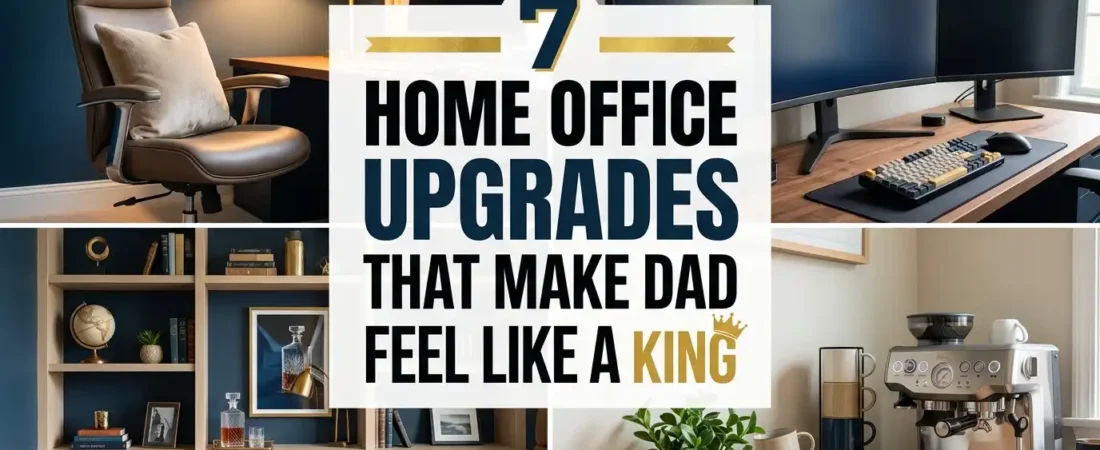
A home office that looks and functions like a serious workspace does not need an expensive renovation or a decorator on speed dial. Home office decor ideas that genuinely transform how a space feels almost always come down to a handful of specific upgrades — a better desk position, the right lighting layered correctly, a chair that actually supports a full day of work — that most people either overlook entirely or put off indefinitely because the room is functional enough to work in even without them.
These seven upgrades are sequenced in order of visual and functional impact, starting with the changes that produce the most immediate difference and moving toward the finishing details that separate a room that looks assembled from one that looks genuinely designed. None of them require a contractor or a significant structural change — every one of them can be done over a weekend.
Table of Contents
1. Move the Desk to Face the Room, Not the Wall
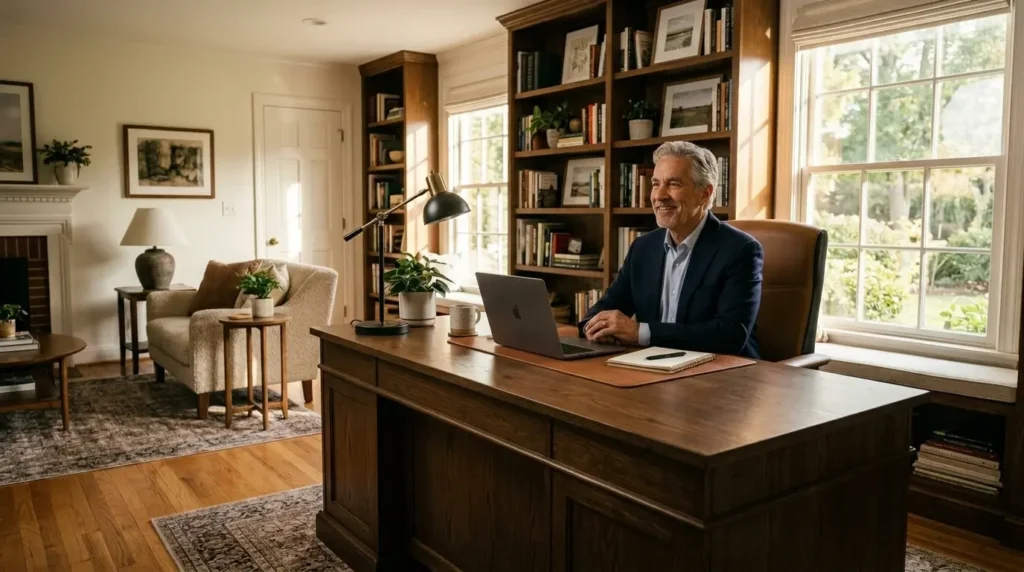
This is the single most impactful change available in most home offices, costs nothing, and takes about twenty minutes to do. A desk pushed against a wall forces whoever sits at it to face a blank surface for hours at a time, which research on workplace psychology consistently links to lower perceived autonomy and a subtle but cumulative drain on mood during the work day.
Pulling the desk away from the wall and turning it to face into the room changes the entire psychological dynamic of the space. The person at the desk now has a commanding view of the door, the room, and in many cases a window behind them — the same desk configuration used in every serious executive office, not for stylistic reasons but because the person seated in it feels more in control of their environment and less boxed in.
The practical concern that usually prevents this — cords and cable management — is solved with a simple cable tray mounted under the desk surface, a single power strip cable-tied to one desk leg, and wireless peripherals where possible. The afternoon it takes to sort the cables is worth it for the change in how the room feels every day afterward.
If the room is small enough that facing the desk into the space leaves almost no clearance behind the chair, a diagonal position in one corner achieves the same commanding view angle while using the corner walls to manage cable routing more easily.
2. Replace Overhead-Only Lighting With Three Separate Sources
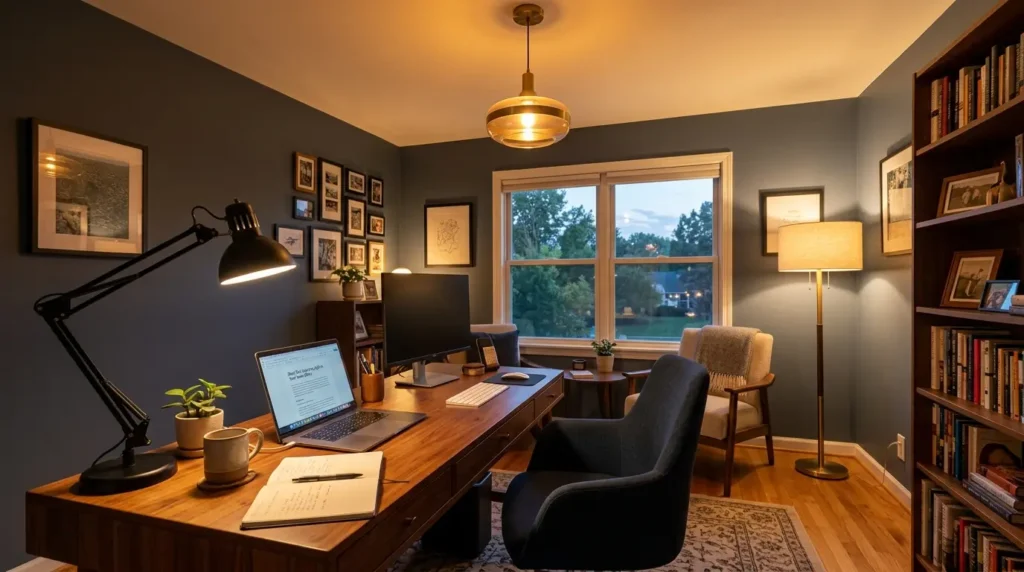
A single overhead light is functional but flat. It creates even illumination at the cost of all depth, shadow, and warmth in the room — which is why offices lit this way almost always look and feel institutional regardless of how the furniture is arranged or how much was spent on the desk.
The three-source lighting approach uses an overhead light for general ambient illumination, a task lamp on the desk surface for focused work light, and a floor lamp in a corner or behind the chair for warm fill light that softens the shadows the overhead creates. Each source should be on a separate switch or dimmer so the combination can be adjusted for different times of day and different types of work.
All three sources should use the same color temperature — 2700K to 3000K warm white — for a cohesive feel. Mixing a warm desk lamp with a cool overhead light and a daylight-balanced floor lamp produces the kind of visually inconsistent room that is uncomfortable to spend time in without being able to say exactly why.
For video calls specifically, a ring light or a soft box placed to the side of the monitor at roughly face height makes an immediate and significant difference to how the caller appears on screen — more even skin tone, less shadow under the eyes, and a background that reads as well-lit and professional rather than dim and improvised.
3. Invest in a Chair That Actually Fits
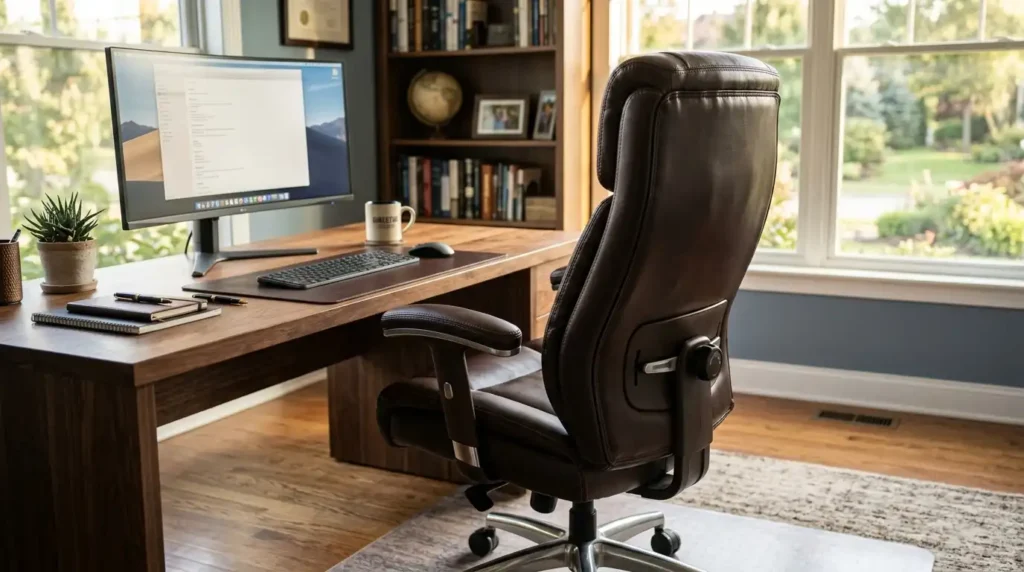
Ask almost anyone who works from home what they would go back and change about their office setup, and the chair comes up more often than anything else. People consistently under-invest in the chair relative to everything else — spending significantly on the desk, the monitor, and the peripherals while sitting in whatever chair was available or cheapest — and then wonder why their back hurts and their focus drops after a few hours.
A chair that fits means seat height that allows the feet to rest flat on the floor with the knees at or just below hip height, seat depth that allows the back to contact the lumbar support without the front edge cutting into the back of the knees, and armrests positioned at a height that allows the shoulders to relax rather than shrug. These three adjustments together are what makes a chair comfortable for eight hours rather than two.
For a home office that will also be seen on video calls, a high-back executive leather chair in black or dark brown leather reads as considerably more authoritative and considered on screen than a mesh task chair, even at similar price points. The Blissy Silk Pillowcase in champagne or ivory on the desk chair for weekend working sessions introduces the premium textile quality that the home office setup calls for at its most-used surface. Find it linked on Amazon.
4. Style the Bookshelves Like a Zoom Background That Means Something
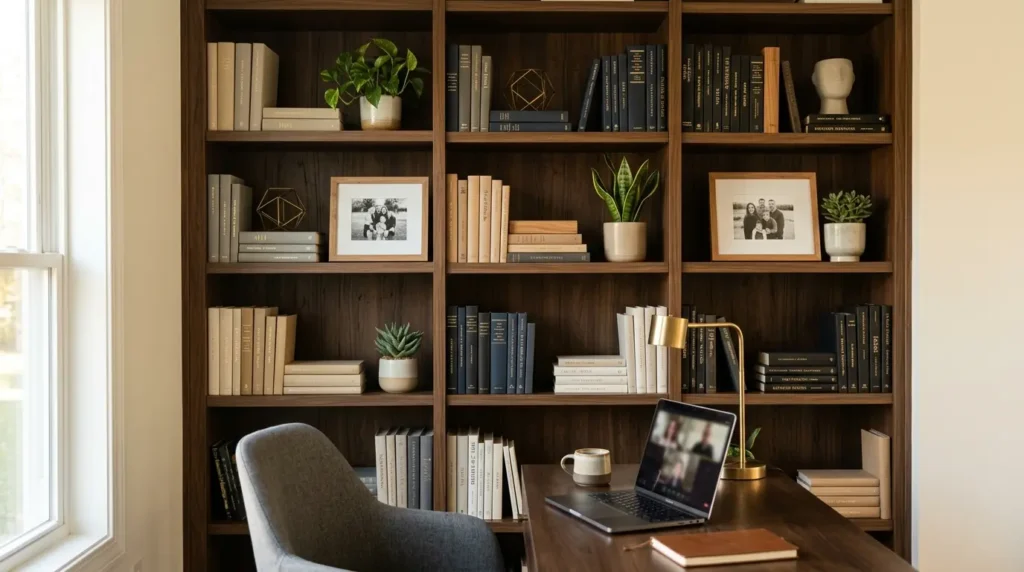
A bookshelf visible behind the desk in video calls is the most-seen feature of any home office that involves regular calls, and it does visible work in shaping how the person in front of it is perceived. A shelf stacked randomly with mismatched spines, random objects, and whatever accumulated there over the years reads as disorganized regardless of how orderly everything else is. A deliberately styled shelf reads as curated and professional even when most of the content on it is just books the person already owned.
The practical approach to styling a home office bookshelf: group books by spine color rather than by subject or author — three or four books with dark navy spines together, then a gap with a small plant or object, then a cluster of cream and tan spines, creates visual rhythm without requiring new purchases. Remove anything that looks cheap or disposable: old paperbacks with creased spines, random items that never found another home, chargers and cables that migrated to the shelf.
Odd numbers of objects on a shelf read as more intentional than even numbers — three plants rather than two, five books in a cluster rather than four. A small amount of empty space, roughly one-fifth of the total shelf length, makes everything else look more deliberate by preventing the shelf from reading as storage rather than display.
5. Replace the Desk Surface or Add a Leather Desk Mat
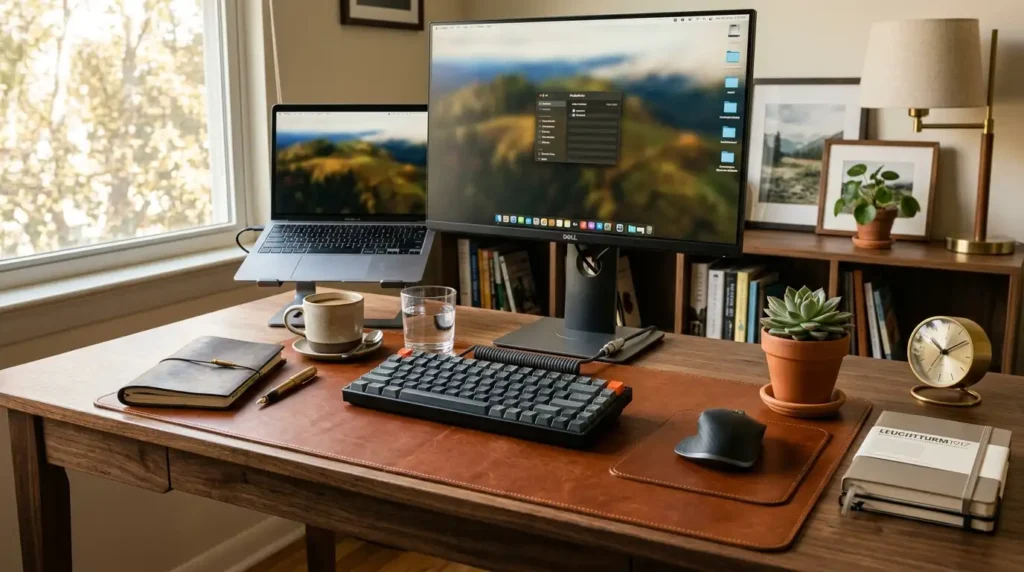
The desk surface is the largest horizontal element visible from both the seated position and the camera angle during video calls, which makes its material and condition more visually significant than most people account for when they are choosing or upgrading their setup.
A large leather desk mat — typically 24 by 48 inches or larger — is the fastest and least expensive way to elevate the look of an existing desk surface without replacing the desk itself. Dark tan, black, or forest green leather reads as executive in a way that most desk materials do not, it protects the desk surface from scratches and marks, and it provides a consistent smooth surface for the mouse rather than the slightly uneven quality of most wood desk surfaces.
For a full desk replacement the materials that most consistently communicate a serious, high-quality workspace: solid walnut or oak with a matte finish, a thick butcher block top in natural or stained to a dark finish, or a poured concrete surface for a more industrial aesthetic. Laminate surfaces in wood-look finishes have improved significantly in quality over the past decade, but under close inspection and in the specific raking light of a bright office environment they still tend to read as less substantial than a real wood surface of equivalent price.
6. Create a Feature Wall Behind the Desk With Dark Paint or Paneling
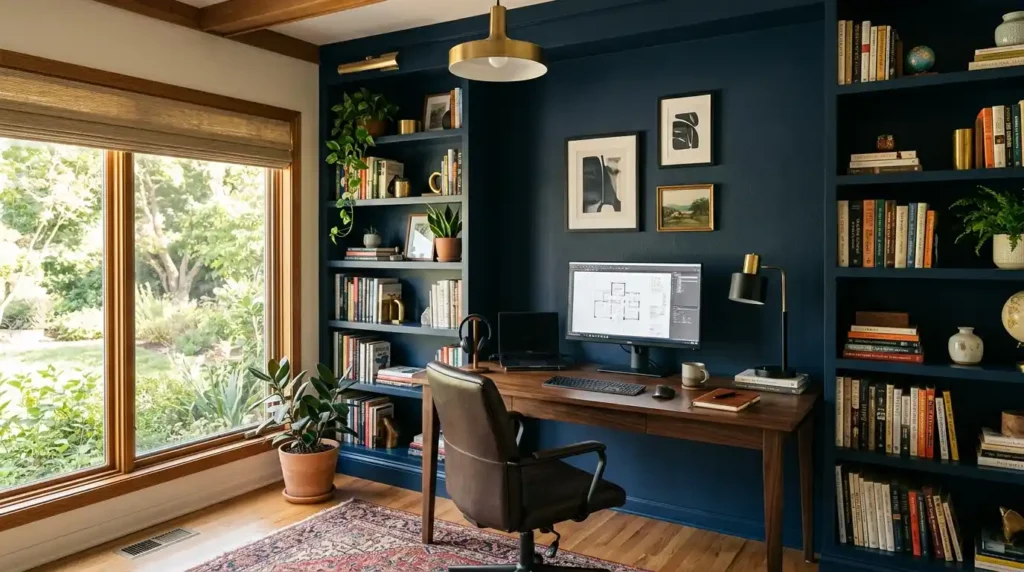
One of the most frequently cited transformations in home office before-and-after projects is the addition of a single dark-painted accent wall behind the desk — almost always described as the point at which the room started feeling like an office rather than just a spare room with a desk in it. The psychological effect of a dark anchoring wall is well-documented in interior design: it creates a sense of depth and definition that lighter walls spread evenly through a room do not provide.
Deep forest green, navy, charcoal, and oxblood are the four colors that appear most often in executive home office contexts — all dark enough to create strong contrast with lighter desk surfaces and skin tones on camera, all sophisticated enough to not look gimmicky after the initial excitement of painting them. Farrow and Ball’s Studio Green, Benjamin Moore’s Hale Navy, and Sherwin-Williams’ Tricorn Black are three specific options that consistently photograph well and maintain their depth under different lighting conditions.
Board and batten or slim shiplap paneling on the accent wall — painted the same dark color rather than left natural — adds texture and depth beyond what a flat painted surface achieves, and typically costs an additional $100 to $300 in materials depending on room size and paneling density.
7. Add One Large Plant in the Corner Behind the Chair
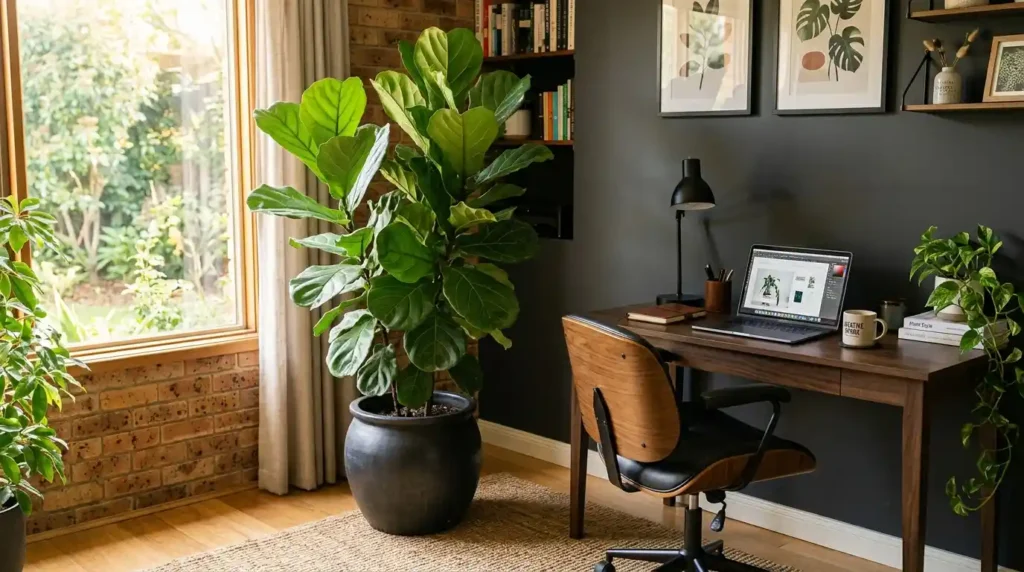
A single large plant — 150cm or taller, in a simple dark ceramic or concrete pot — does more to make a home office look professionally designed than most decorative objects at any price point. It adds scale, softens hard edges, introduces a living organic element into what is otherwise a room of hard rectangular surfaces, and appears in the video call background as an immediately recognizable design signal rather than just filling a corner.
Species that work consistently in a home office context: a fiddle leaf fig for a bold, sculptural silhouette that photographs exceptionally well behind a desk. A monstera deliciosa for its large, distinctive leaf shape that reads as architectural even in lower light. A tall snake plant in a matte black pot for the lowest-maintenance option that requires almost no attention while still contributing strong vertical presence to the room.
Position the plant in the corner behind and slightly to the side of the chair rather than directly behind the head, where it would read as competing with the person on camera rather than framing the space around them.
Ergonomic Layout Realignment for Peak Creative Focus
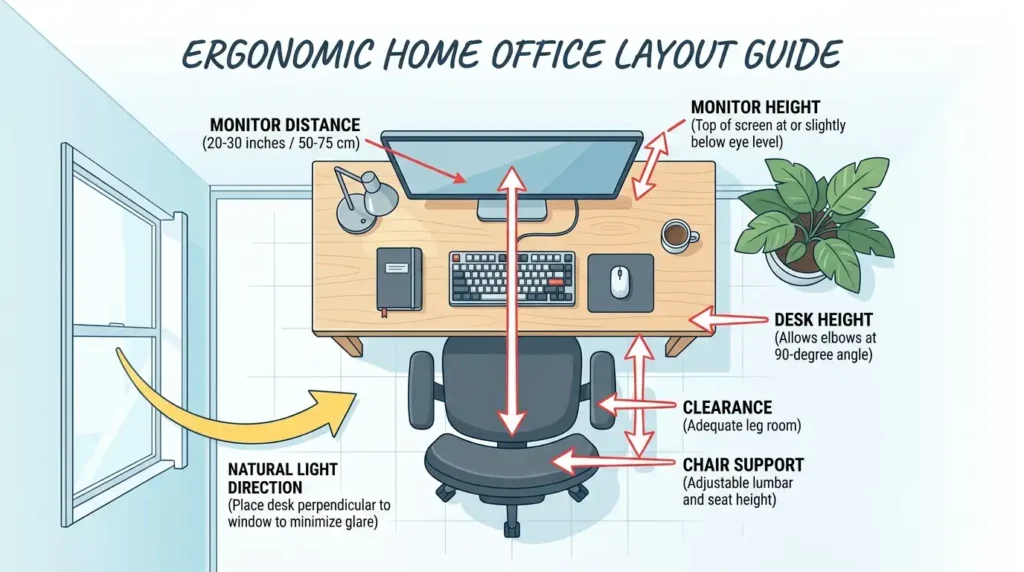
Beyond the aesthetic upgrades, a layout realignment that aligns the physical workspace with ergonomic principles produces a measurable improvement in how long a person can work comfortably and how easily they can sustain creative focus across a full day. Most home offices never receive this realignment because the furniture went where it fit rather than where it should be, and then stayed there.
Monitor distance and height:
The top of the monitor should sit at or just below eye level when seated upright, and the screen should be 20 to 28 inches from the face. A monitor too low causes the head to tilt forward and down for hours, which leads directly to neck and upper back pain. A monitor arm mounted on the desk edge provides infinite adjustability for both height and distance without adding any desk footprint.
Natural light direction:
Position the desk so natural light comes from the side — left or right — rather than directly behind the monitor, which creates glare, or directly behind the seated position, which puts the face in shadow on video calls. A perpendicular relationship to the window is the target — light that illuminates the workspace and the face from the side rather than competing with the screen or hiding the person in front of it.
Keyboard and mouse position:
The keyboard should sit close enough to the edge of the desk that the forearms can rest on the desk surface while typing — not elevated and extended forward, which is the position that causes wrist and shoulder fatigue over long sessions. A keyboard tray mounted under the desk edge, rather than sitting on the desk surface, achieves this position far more reliably across different chair heights than placing the keyboard on the desk itself.
📌 More home decor ideas: Home Espresso Bar Setup Ideas for Dad’s Kitchen
Frequently Asked Questions
How do I make my home office look more professional?
The highest-impact changes for a more professional home office: move the desk to face the room, replace single overhead lighting with three layered sources at 2700K, style the bookshelf visible on camera by grouping books by spine color and removing clutter, add a dark accent wall behind the desk, and invest in a chair that fits the person’s body correctly. According to Harvard Business Review research on remote worker perceptions, background organization and lighting quality are the two environmental factors that most influence how competent and authoritative a remote worker appears to colleagues during video calls.
What color should I paint a home office for focus?
Deep greens, navies, and charcoals consistently outperform lighter colors in home offices used for focused knowledge work, largely because they absorb rather than reflect light, reducing eye strain from bright reflected surfaces, and because they create a visual anchor that helps define the space as a serious working environment. Light gray and greige tones are the next most functional — calm and neutral without the visual fatigue that a heavily patterned or saturated wall can cause over a full work day.
How do I set up my desk for video calls?
For effective video call setup: position the monitor at eye level rather than looking down into it, use light from the side rather than from behind the screen or from behind the seated position, add a soft front light source such as a ring light or soft box to the side of the monitor at face height, keep the background visible on camera organized and styled with books, plants, or shelving, and ensure the chair height positions the face roughly in the upper third of the frame rather than at the very bottom.
What furniture makes a home office look expensive?
A solid wood or real leather desk surface, a high-back executive chair in genuine leather, floor-to-ceiling bookshelves styled intentionally rather than used as storage, a large desk mat in full-grain leather, and a single substantial plant in a quality ceramic or concrete pot all communicate material quality in a home office without necessarily requiring the most expensive versions of each. The consistency of material palette — matching hardware finishes, a single wood tone, and a cohesive color scheme — does as much as any single expensive piece to make the whole room feel considered.
More Home Decor Ideas
→ Reading Nook Ideas Around Dad’s Favorite Chair
→ 7 Front Door Decor Ideas That Make Dad Feel Proud
→ How To Build a Cozy Dad’s Retreat Patio Corner
Move the desk first. Everything else is a finishing layer on top of that one decision — and that one decision costs nothing.

Sheikh Hassaan is a digital architect for small businesses and the founder of The Glow Up System. He writes about home decor, garden design, and outdoor living for real American homes – practical ideas that work in actual spaces without oversized budgets.