
The galley kitchen is the layout that most home cooks underestimate and most professional chefs prefer, because a well-designed narrow kitchen with everything within arm’s reach on two parallel walls is genuinely more efficient to cook in than a sprawling open-plan kitchen where the refrigerator, hob, and sink are separated by significant distances. Galley kitchen ideas that work lean into this efficiency rather than fighting it, treating the narrow format as a design asset rather than a problem to be solved.
This guide covers galley kitchen ideas organized by the specific decisions that make the most difference in a narrow kitchen — from the layout and storage approaches that maximize a tight space through the visual tricks that make a galley kitchen feel wider and more generous than its dimensions suggest.
Table of Contents
Why Galley Kitchens Work Better Than Most People Expect
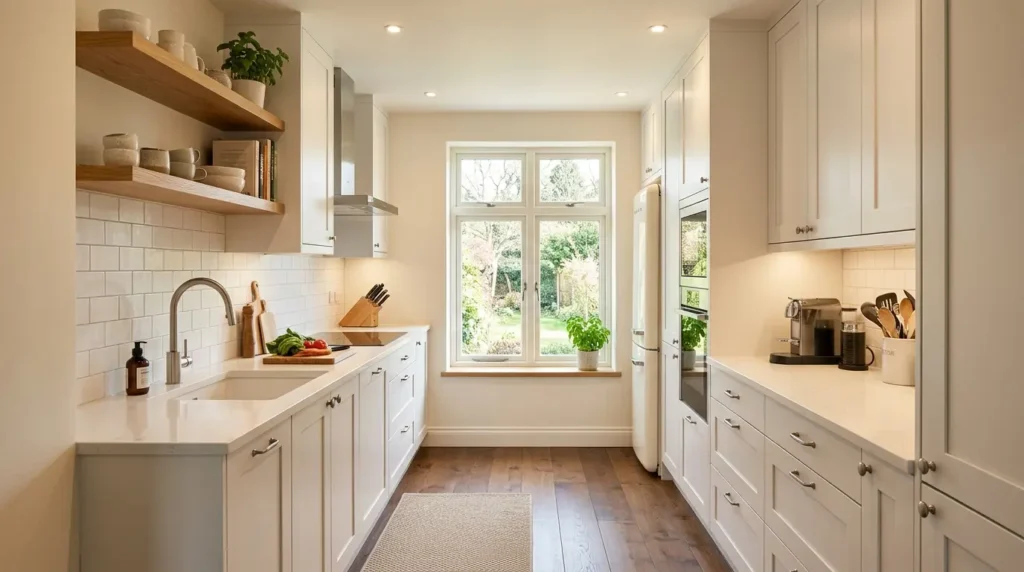
The galley kitchen format is named after the working kitchens of ships and trains — spaces where maximum cooking functionality was engineered into the smallest possible footprint with everything positioned for the most efficient possible workflow. A galley kitchen in a home operates on the same principle: the refrigerator, sink, and cooking surface are all within a few steps of each other, which means a cook spends less time walking between stations and more time actually cooking than in any other kitchen layout.
The minimum aisle width that makes a galley kitchen genuinely workable: 36 inches between the two counter faces for a single-cook household. 42 to 48 inches for a kitchen used by two people simultaneously — this allows one person to work at the counter while another passes behind without either having to stop or turn sideways. A galley kitchen narrower than 36 inches works for storage and basic food preparation but becomes uncomfortable for full cooking use.
The workflow rule that makes every galley kitchen more functional regardless of its specific dimensions: keep the three primary work stations — refrigerator, sink, and cooking surface — on opposite walls from each other rather than all on the same wall. Sink on one wall, hob on the opposite wall, refrigerator at one end creates the classic efficient galley work triangle that professional kitchen designers use as the benchmark for kitchen layout efficiency.
1. Open Shelving on One Wall to Break the Tunnel Effect
✦ Best for: galley kitchens where full upper cabinets on both walls create a closed-in feeling that makes the space feel smaller than it is
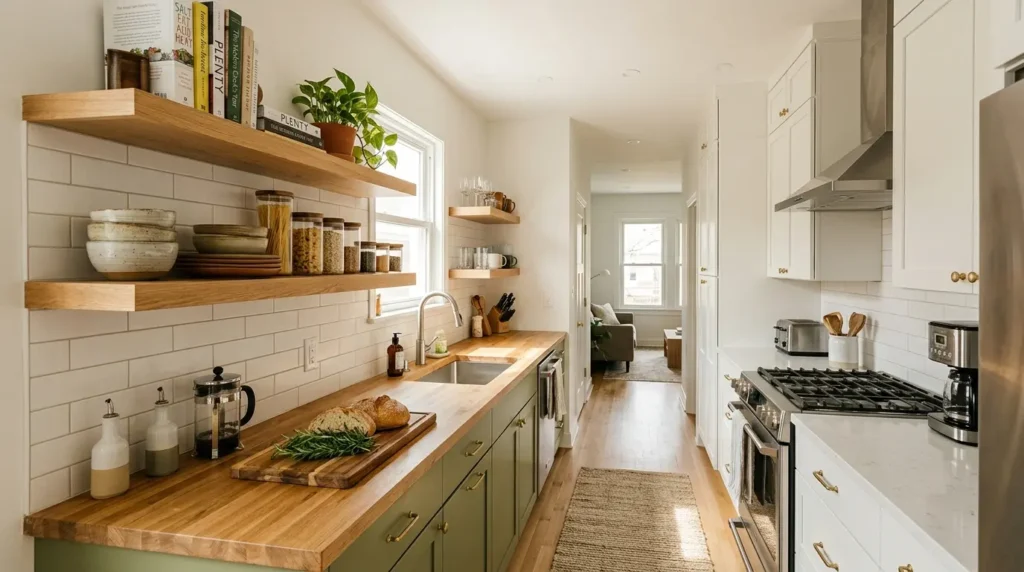
The single most impactful visual change available in a galley kitchen is replacing upper cabinets on one wall with open floating shelves. Full upper cabinets on both walls of a narrow kitchen create the tunnel effect — the walls feel like they are closing in because the cabinetry on both sides reaches from counter level to ceiling with no visual relief. Replacing one wall’s upper cabinets with two or three floating shelves immediately opens the visual field and makes the kitchen feel significantly wider without changing any physical dimension.
Natural timber floating shelves on the wall opposite the window create the warmest visual result — the timber introduces organic material contrast against white or painted walls and creates a display surface that makes a galley kitchen feel genuinely designed rather than merely functional. Style the shelves with restraint: a mix of ceramics in consistent tones, a few cookbooks stood upright, and one or two plants at the ends. Overcrowded open shelves create more visual noise than closed cabinets.
The practical consideration for open shelving in a kitchen: items on open shelves accumulate grease and dust from cooking faster than items in closed cabinets. Keep the most frequently used items — everyday glasses, plates, and bowls — on the open shelves so they are constantly being taken down and replaced rather than sitting unused and collecting residue. Store rarely used items in the remaining closed cabinets.
2. Light Color Cabinets and Reflective Surfaces to Expand the Space Visually
✦ Best for: galley kitchens with limited natural light where the color and surface choices directly determine how the space feels

Color choice in a galley kitchen has a more direct effect on the perceived spaciousness of the room than in any other kitchen layout because the narrow width means both walls are simultaneously in the primary sightline — every surface choice is immediately visible. Light colors on both walls reflect light between the surfaces and create the impression of a wider, brighter space. Dark cabinets on both walls of a narrow galley kitchen absorb the light that light cabinets would reflect, making an already narrow space feel enclosed.
The surface combinations that create the most spacious feeling in a galley kitchen: white or off-white cabinets throughout. A gloss or semi-gloss white subway tile backsplash that reflects light from the window back into the kitchen rather than absorbing it. Light quartz or stone countertops in white or pale gray. A pale or white floor — light floors make a narrow room feel significantly wider than dark floors at the same dimensions.
Handle and hardware choice matters more in a galley kitchen than in other layouts because handles are at eye level on both walls simultaneously. Integrated handleless cabinets — push-to-open or J-pull profile — remove all hardware from the visual field and create the cleanest, most seamless surface available in a narrow space. Where hardware is preferred, slim bar handles in brushed nickel or matte black add minimal visual weight while creating a clear visual rhythm along the cabinet faces.
3. Maximizing Storage in a Galley Kitchen Without Adding Clutter
✦ Best for: galley kitchens where the limited counter and cabinet space makes storage organization the most important functional challenge
A galley kitchen with inadequate storage becomes a countertop clutter problem almost immediately — items that have no cabinet home land on the counter, which is the only available surface, and the narrow kitchen that was already tight becomes genuinely uncomfortable to work in. Getting storage right in a galley kitchen is the functional priority that everything else depends on.
Drawer bases instead of lower cabinet doors:
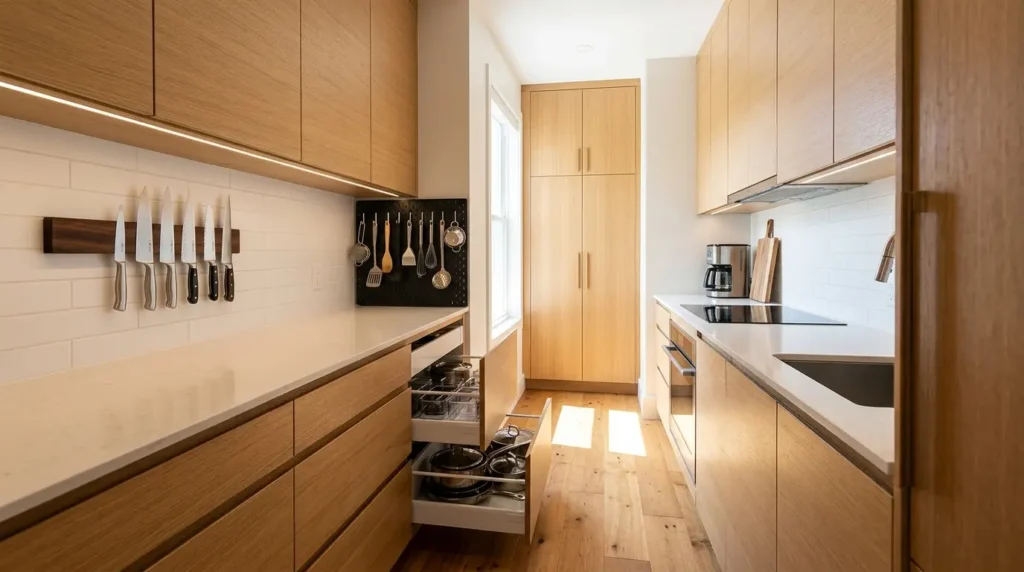
Replacing lower cabinet doors with full-extension drawer bases is the single most functional upgrade available in a galley kitchen — drawers allow everything at the back of a cabinet to be accessed without kneeling and searching, which in a narrow kitchen where bending down and opening a door simultaneously is difficult means dramatically better access to every item stored below the counter.
Full-height pantry column:
A full-height pantry cabinet — floor to ceiling in a single column at one end of the galley — provides more storage per square foot of floor space than any other cabinet configuration. A 24-inch wide by 84-inch tall pantry column with adjustable shelving holds the equivalent of four standard wall cabinets in a footprint that occupies only 2 square feet of floor.
A magnetic knife strip mounted on the wall between upper and lower cabinets keeps knives accessible without using counter or drawer space. A wall-mounted rail system with S-hooks holds frequently used utensils, small pans, and measuring cups on the wall above the counter rather than in a drawer or standing in a container on the counter. Both solutions use wall space that is typically wasted in a galley kitchen.
4. The One-Wall Galley Kitchen for Narrow Apartments and Studios
✦ Best for: studio apartments and narrow rooms where only one wall is available for kitchen installation
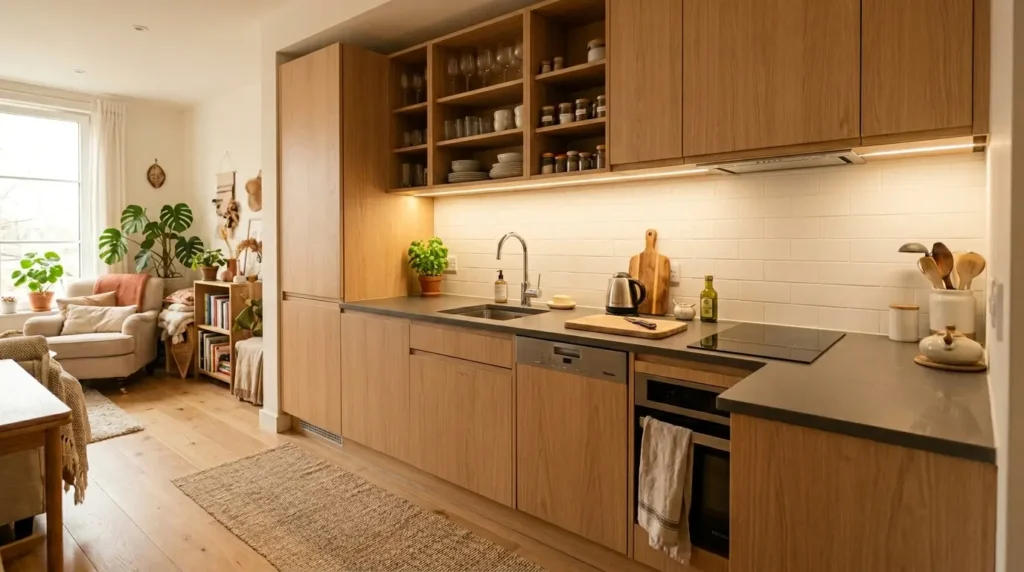
A single-wall kitchen — all cabinets, appliances, and counter space arranged on one wall rather than two — is technically a variation of the galley format and faces the same challenge of making limited linear space work as a complete kitchen. Studio apartments and compact flats frequently use this layout because it confines the entire kitchen to a single wall and keeps the remaining floor space available for living.
The appliance choices that make a single-wall kitchen genuinely functional in a small apartment: a slimline 45cm dishwasher rather than a standard 60cm dishwasher saves 15cm of linear space that can be allocated to counter. A two-burner induction hob rather than a four-burner gas hob reduces the cooking surface footprint while providing adequate cooking capacity for a one or two person household. An undercounter refrigerator rather than a freestanding full-height model keeps the upper cabinet run uninterrupted.
The counter extension that transforms a single-wall kitchen’s functionality without permanent installation: a butcher block kitchen cart or a fold-down wall-mounted table beside the kitchen run provides additional prep space when needed and folds away completely when the kitchen is not in use. In a studio apartment where every square foot is shared between functions the fold-down element is the most practical counter extension available.
5. Adding Character to a Galley Kitchen With a Bold Backsplash
✦ Best for: a functional galley kitchen that needs personality and visual interest without any structural changes
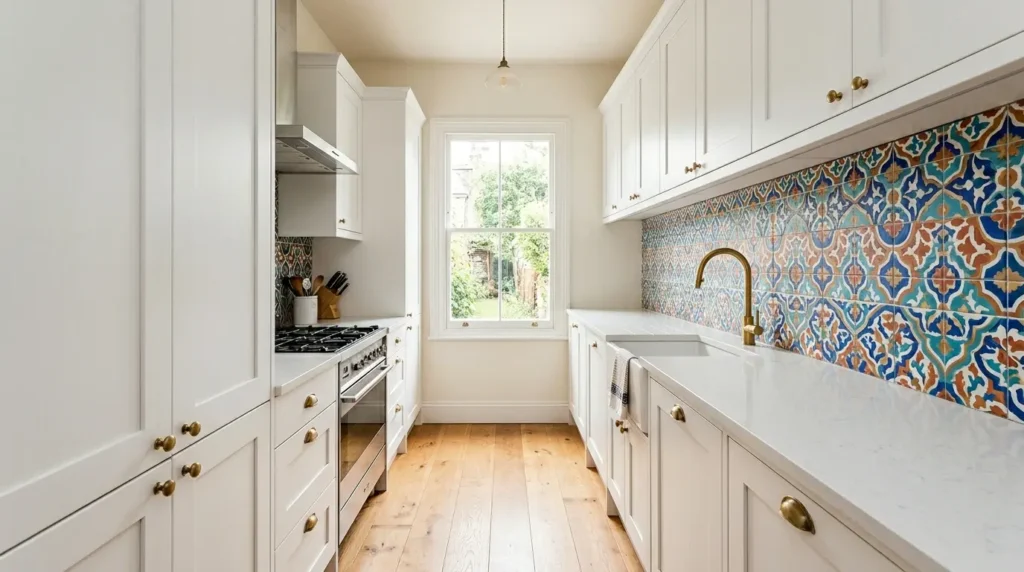
The backsplash in a galley kitchen occupies a prominent position on both walls simultaneously — it sits at eye level for anyone standing at the counter and is visible the full length of the kitchen from the doorway. This makes it the most visually impactful decorative surface in a narrow kitchen and the one place where bold pattern or color can be introduced without making the already narrow space feel smaller.
The backsplash approaches that add the most character to a plain galley kitchen: a Moroccan zellige or encaustic cement tile in a geometric pattern on one wall — the handmade quality of zellige creates a surface that is visually rich without being uniform, and its irregular color variation within the same tile creates depth that mass-produced tiles lack. A full-height slab of veined marble or marble-look porcelain from counter to upper cabinet on the main cooking wall creates a luxurious single-material statement.
The backsplash rule for a galley kitchen: bold pattern or color on one wall only — the cooking wall opposite the window. The window wall backsplash in a reflective neutral — white subway tile or light stone — maintains the light-reflective quality that the narrow kitchen depends on for its sense of space while the cooking wall carries the design personality.
6. Lighting a Galley Kitchen to Make It Feel Bigger and Work Better
✦ Best for: any galley kitchen where the current lighting creates shadows on the work surface or makes the narrow space feel dimmer and smaller than it needs to
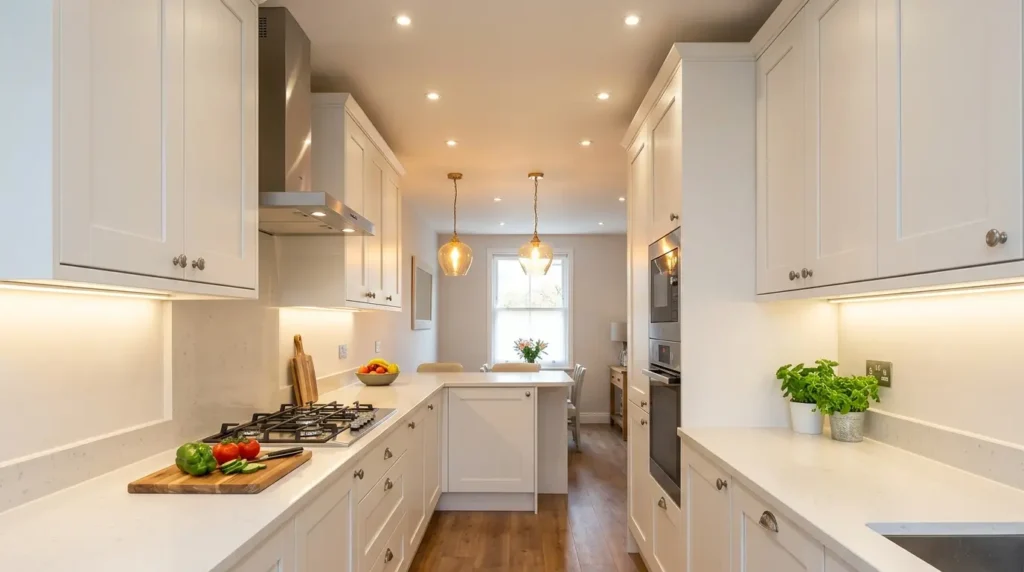
Lighting in a galley kitchen serves two distinct functions that require two distinct approaches: task lighting that illuminates the counter surface directly for safe and comfortable food preparation, and ambient lighting that fills the narrow space with enough general light to prevent the tunnel effect that poor lighting creates. A single ceiling fixture in the center of a galley kitchen rarely does either job well — it creates shadows on the counter surface from the cook’s own body and provides uneven ambient light along the length of the kitchen.
Under-cabinet LED strip lights are the single most functional lighting upgrade available in a galley kitchen — they illuminate the counter surface directly from above without any shadow from upper cabinets, providing the brightest and most even task lighting available in the format. Warm white LED strips at 2700K provide the best color rendering for food preparation. The strips are typically installed at the front underside of the upper cabinet and angled slightly toward the back of the counter.
Recessed ceiling lights at 24-inch spacing along the center line of the galley provide even ambient light along the full length of the kitchen without the shadow issues of a single central fitting. If the ceiling cannot be altered, a surface-mounted track light with adjustable heads achieves the same result without requiring ceiling work. All kitchen lighting at 3000K to 3500K — slightly cooler than bedroom lighting but warmer than daylight — provides the most accurate color rendering for cooking.
7. The Galley Kitchen Renovation That Transforms a Tired Space
✦ Best for: a galley kitchen with good bones but dated finishes that needs a complete visual refresh without changing the layout
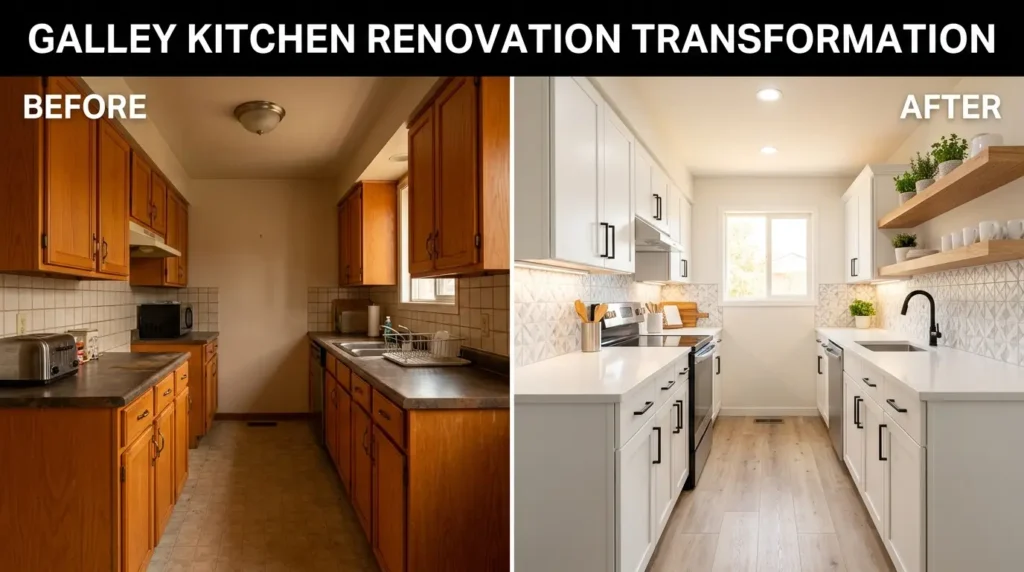
A galley kitchen with a good layout but dated finishes can be transformed completely without touching the plumbing, the electrics, or the cabinet boxes — the five changes that deliver the most visual impact for the least structural disruption are all surface-level and can be completed over a long weekend with basic DIY skills.
Paint the cabinets white or off-white ($100 to $300 DIY):
The most transformative single change available. Sand, prime, and paint the existing cabinet doors rather than replacing them — the result is virtually indistinguishable from new cabinets at a fraction of the cost.
Replace all hardware ($80 to $200):
New handles and drawer pulls in matte black or brushed brass immediately update the kitchen’s style without any other changes. The hardware choice should be made alongside the cabinet color — both elements together create the kitchen’s design language.
Retile the backsplash ($200 to $500 DIY):
New backsplash tiles over the existing ones using tile adhesive — no need to remove the existing tiles in most cases. A fresh subway tile or patterned tile backsplash with new grout creates an immediately refreshed appearance that no amount of cleaning the existing tiles achieves.
Add under-cabinet lighting and replace one run of upper cabinets with floating timber shelves and the transformation is complete — the entire galley kitchen reads as renovated for a total cost of $500 to $1,000 rather than $10,000 to $20,000.
📌 More home decor ideas: White Kitchen Ideas That Never Go Out of Style
Frequently Asked Questions
How do I make a galley kitchen look bigger?
The changes that most effectively make a galley kitchen feel larger: replace upper cabinets on one wall with floating open shelves to remove the tunnel effect. Use light or white cabinets throughout with a gloss or semi-gloss backsplash that reflects light between the two walls. Install under-cabinet LED lighting to eliminate counter shadows. Use a continuous pale floor that extends beyond the kitchen boundary to visually connect it to the adjacent space. Remove any freestanding items from the floor — a narrow kitchen with nothing on the floor reads as significantly wider than the same kitchen with a bin, a stand mixer, or a dog bowl occupying floor space. According to the National Association of Home Builders, kitchen lighting and cabinet color are the two renovation factors that most consistently affect the perceived spaciousness of small and narrow kitchens.
What is the ideal width for a galley kitchen?
The ideal galley kitchen aisle width — the clear space between the two counter faces — is 42 to 48 inches for a household where two people cook together. 36 inches is the functional minimum for a single-cook kitchen and feels comfortable for one person but requires one person to press against the counter to allow another to pass. Any width under 36 inches between counter faces is a working constraint rather than a design choice and should be addressed if renovation is possible by either narrowing one counter depth or removing upper cabinets to reduce the sense of enclosure.
Are galley kitchens practical?
Galley kitchens are not only practical — they are the most efficient kitchen layout for solo cooking because everything is within a few steps in both directions. The galley format is used in professional restaurant and commercial kitchens specifically because it minimizes the distance between work stations. The practical limitations are specifically for households that cook together regularly — two people working simultaneously in a galley kitchen narrower than 42 inches is genuinely uncomfortable. For a single cook or a cook with a helper who stays out of the way the galley is the most functional kitchen layout available.
What color makes a galley kitchen look bigger?
White and very light off-white are the colors that most reliably make a galley kitchen feel larger because they reflect light between the two walls rather than absorbing it. A warm white — Benjamin Moore Chantilly Lace or Sherwin-Williams Alabaster — avoids the clinical coldness of a stark cool white while maintaining maximum light reflectivity. Pale gray and soft sage green are the non-white alternatives that work best in a galley kitchen — both are light enough to maintain the reflective quality that makes the space feel more generous. Dark cabinet colors in a galley kitchen make the narrow space feel enclosed rather than intimate and are generally best avoided unless the kitchen is unusually wide.
More Home Decor Ideas
→ Family Photo Wall Ideas That Never Look Tacky
→ Master Bedroom Ideas That Make You Never Want to Leave
→ Maximalist Decor Ideas You’ll Wish You Tried Sooner
Replace the upper cabinets on one wall with shelves first. That single change does more for a galley kitchen than any other you can make without touching the plumbing.

Sheikh Hassaan is a digital architect for small businesses and the founder of The Glow Up System. He writes about home decor, garden design, and outdoor living for real American homes – practical ideas that work in actual spaces without oversized budgets.