
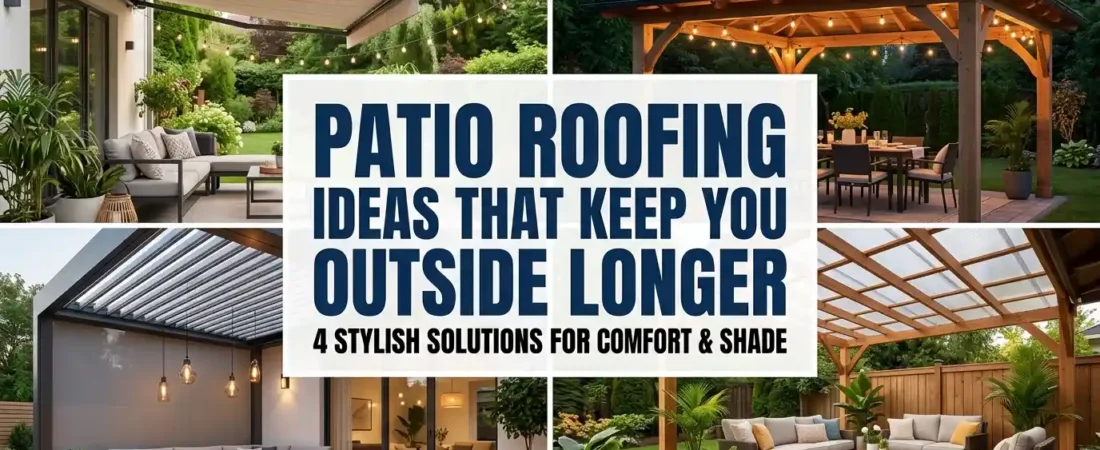
The difference between a patio you use three months a year and one you use eight months a year is almost always overhead cover. Rain, intense afternoon sun, and morning dew are the three things that keep most Americans off their patios more than cold weather does — and all three are solved by the right patio roof. Patio roofing ideas range from a $200 shade sail to a $15,000 attached pergola with a polycarbonate roof, and the right choice depends entirely on how much cover you need, how permanent you want the solution, and what your budget allows.
These patio roofing ideas cover every budget and every patio size — from simple no-permit shade solutions through semi-permanent pergola and polycarbonate options to the specific questions around attached versus freestanding structures that determine what requires a building permit in most US municipalities.
Table of Contents
What to Know Before Choosing a Patio Roof
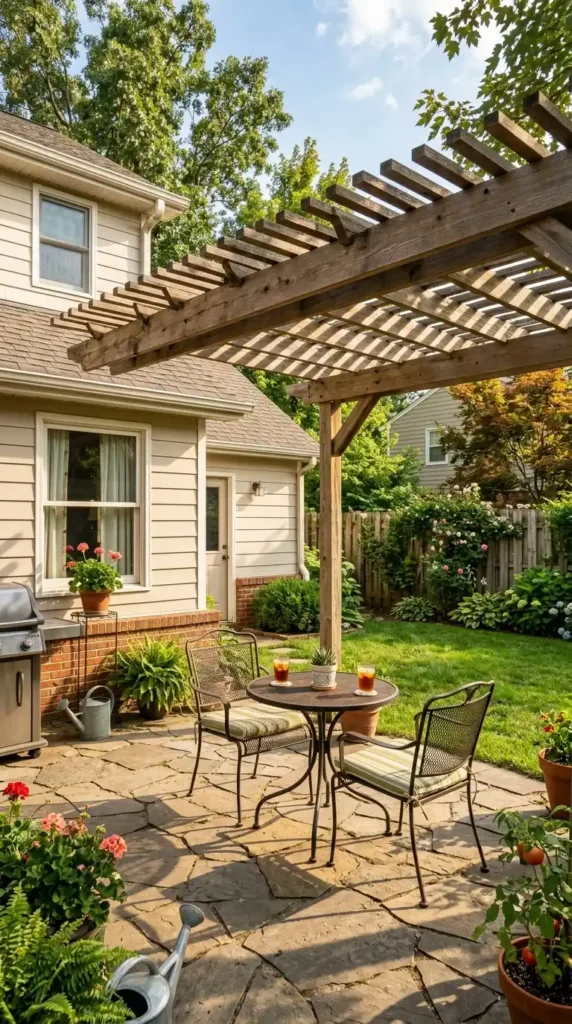
The first question to answer before choosing any patio roofing solution: do you need rain protection, sun protection, or both. A pergola with open slats reduces direct sun significantly but provides almost no rain protection — you are still getting wet in any meaningful rain. A solid polycarbonate or corrugated metal roof provides complete rain protection but may reduce natural light to the patio below. A retractable awning provides adjustable coverage for both sun and light rain but is not rated for heavy rainfall or strong winds. Identifying the primary problem to solve prevents purchasing a solution that handles the secondary problem while leaving the primary one unaddressed.
The permit question is the most commonly ignored consideration in patio roofing. In most US municipalities any structure attached to the house requires a building permit regardless of size. A freestanding pergola under 200 square feet typically does not require a permit in most areas but this varies significantly by city and county. Before purchasing any materials or hiring any contractor check with your local building department — an unpermitted attached patio structure can create problems when selling the home and may require removal at significant cost.
The budget ranges that correspond to different patio roofing solutions: under $500 covers shade sails, basic canopies, and simple retractable awnings for small patios. $500 to $2,000 covers quality retractable awnings, basic freestanding pergola kits, and corrugated polycarbonate roof panels on an existing pergola frame. $2,000 to $8,000 covers a properly built freestanding or attached pergola with a solid roof. $8,000 and above covers an attached covered patio or outdoor room with a proper roof that matches the house.
1. Shade Sail — The Simplest No-Permit Patio Roofing Solution
✦ Best for: renters and homeowners who want quick sun coverage without any permanent structure or permit
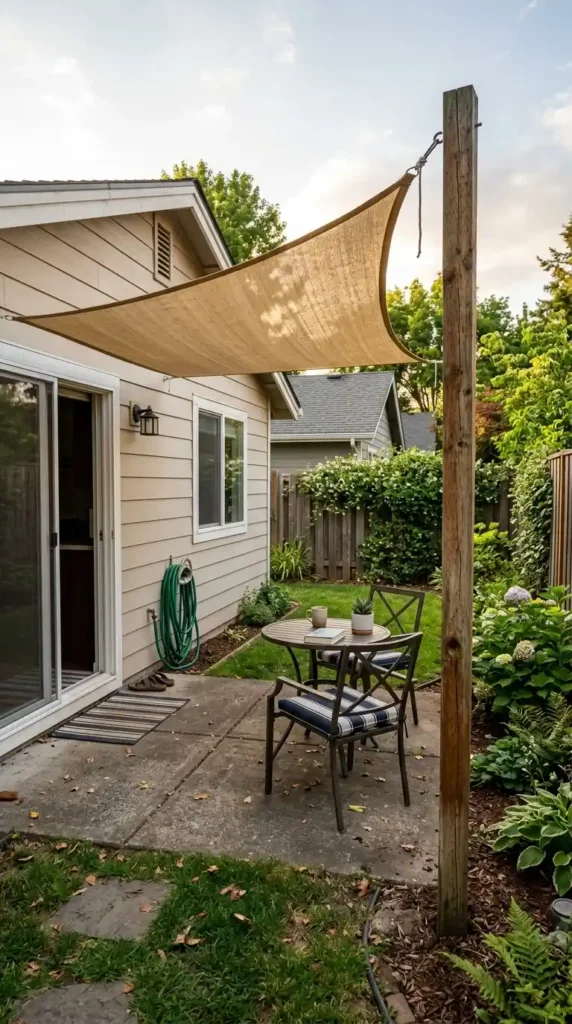
A shade sail is a tensioned fabric panel anchored between three or four attachment points — typically posts set in the ground or existing structures like a fence post, the house wall, or a tree. It requires no permit in most US municipalities, installs in an afternoon without professional help, costs $60 to $300 depending on size and quality, and provides meaningful sun protection at the cost of minimal rain protection. On a hot sunny afternoon a quality shade sail reduces the temperature beneath it by 10 to 15 degrees by blocking UV radiation.
The installation detail that most people get wrong with shade sails: the attachment points must create tension across the sail rather than allowing the sail to sag in the center. The center of a shade sail should sit lower than the attachment points so rainwater runs off toward the edges rather than pooling in the middle and eventually tearing the fabric. A slight diagonal slope created by mounting one corner higher than the others achieves this automatically.
Shade sail longevity depends almost entirely on the fabric quality. Cheap shade sails sold online for under $30 use lightweight polyethylene that fades and tears within one to two seasons. Quality shade sails use HDPE high density polyethylene at 185 to 220 GSM weight with UV-stabilized color that holds for five to ten years. The $120 to $200 price range is where quality shade sails begin — anything below that is a seasonal purchase rather than a lasting investment.
2. Retractable Awning for Adjustable Sun and Light Rain Coverage
✦ Best for: patios attached to the house where an adjustable overhead cover that extends and retracts is more useful than a fixed structure
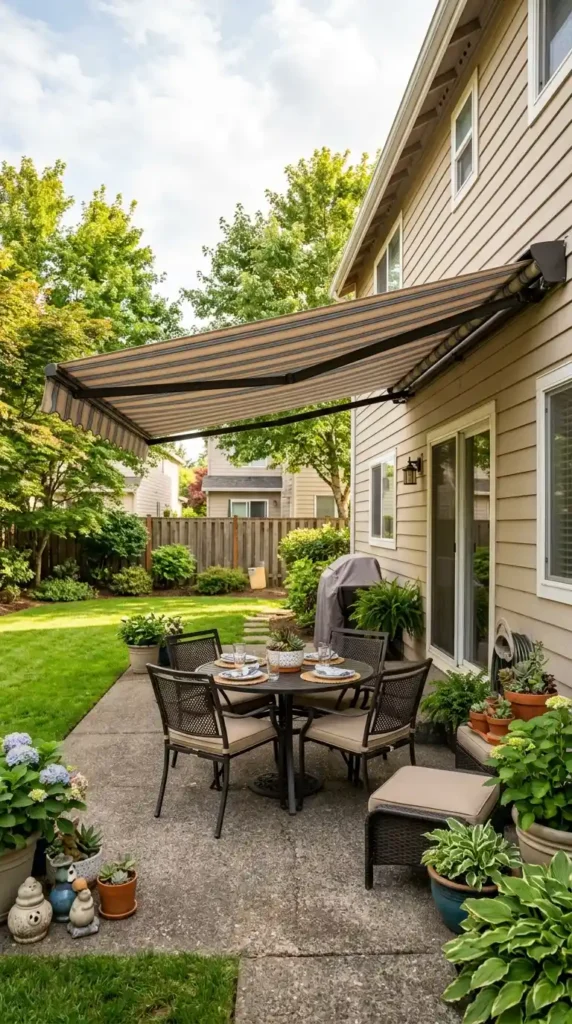
A retractable awning mounted to the back wall of the house extends over the patio on demand and retracts when not needed — it is the patio roofing solution that provides the most flexibility because it can be deployed in afternoon sun and retracted when shade is not needed, protecting the patio furniture from UV damage when extended and from wind damage when retracted. A manual retractable awning costs $300 to $800. A motorized version with a wind sensor that automatically retracts in high winds costs $800 to $2,500 depending on size.
Retractable awnings mount to the house fascia or exterior wall and require the wall to be structurally sound enough to support the awning’s weight and the wind load it creates when extended. Most wood-framed American homes support awning mounting without difficulty — the mounting hardware distributes the load across multiple wall studs. Brick or concrete block walls require masonry anchors rather than standard wood screws and may need a contractor for proper installation.
The fabric choice for a retractable awning affects both aesthetics and longevity significantly. Acrylic fabrics — Sunbrella is the most recognized brand — resist fading, mildew, and UV degradation better than polyester alternatives and carry warranties of five to ten years. The fabric color choice affects the light quality beneath the awning — a white or light-colored awning transmits diffused bright light. A darker colored awning creates deeper shade but reduces the natural light beneath it significantly.
3. Freestanding Pergola With Polycarbonate Roof Panels
✦ Best for: homeowners who want a solid rain-proof patio roof without attaching anything to the house
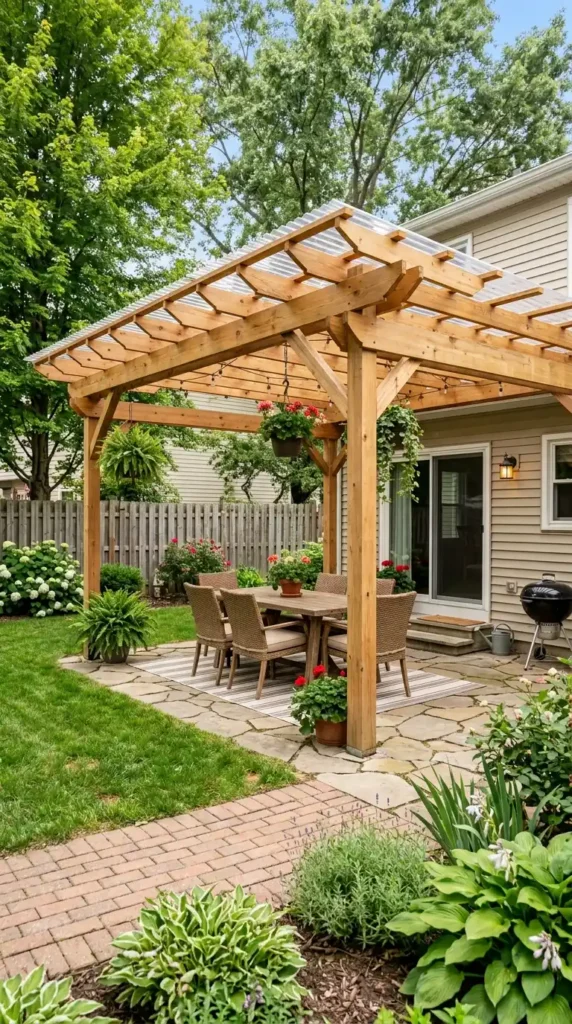
A freestanding pergola with polycarbonate roof panels installed between the rafters is the most practical all-weather patio roofing solution available in the mid-budget range — it provides complete rain protection while admitting significant natural light through the translucent panels, requires no attachment to the house wall which typically means no building permit in most jurisdictions, and costs $1,500 to $4,000 for a 10 by 12 foot structure including materials.
Polycarbonate panels come in three main options for patio roofing: clear panels that transmit the most light but also the most heat in direct sun. Tinted or bronze panels that reduce glare and heat transmission while still admitting diffused light. Opal or white panels that diffuse light most evenly and reduce heat significantly but give the patio a slightly overcast-day light quality even in full sun. For most US climates a tinted or bronze panel is the most comfortable choice — it reduces the greenhouse heat effect that clear panels create in summer.
The structural requirement that most DIY pergola-and-polycarbonate builds underestimate: polycarbonate panels require a minimum slope of 5 degrees — approximately 1 inch of drop per 12 inches of run — to shed rainwater effectively. A flat polycarbonate roof holds standing water which accelerates the growth of algae and mold on the panels and eventually leaks at the panel joints. Build the pergola rafters with this minimum slope built in from the start rather than trying to add it afterward.
4. Corrugated Metal Roof Over an Existing Patio Structure
✦ Best for: adding a solid waterproof roof to an existing pergola or patio structure at the lowest material cost per square foot
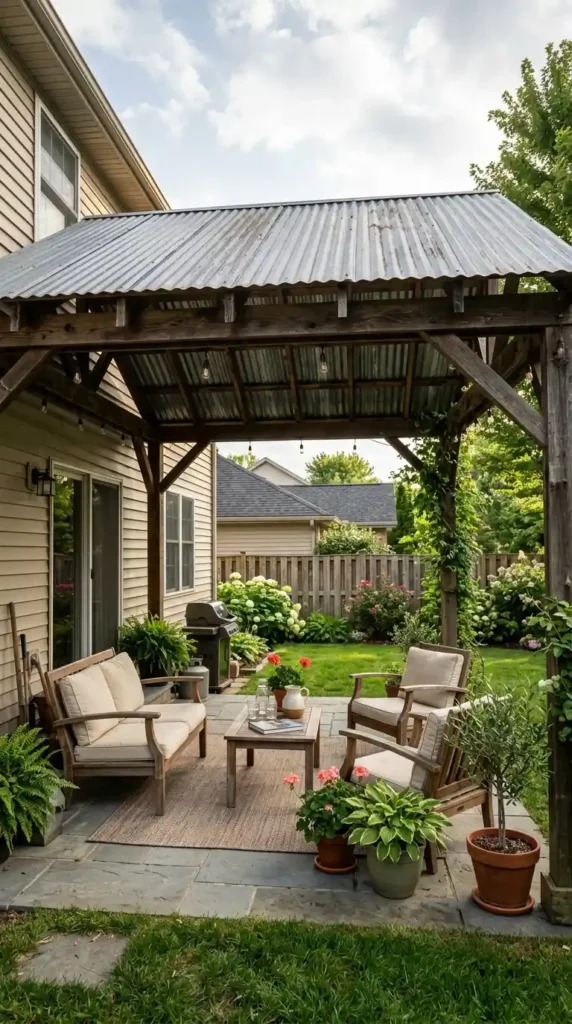
Corrugated metal roofing panels — the same galvanized steel or painted metal panels used on agricultural buildings and modern farmhouse roofs — are the most affordable solid roofing material available for a patio structure at $1.50 to $3.00 per square foot. Over a 10 by 12 foot pergola the material cost for a corrugated metal roof is $180 to $360 compared to $400 to $800 for equivalent polycarbonate coverage. The trade-off is that corrugated metal blocks all light — the patio beneath it receives no natural light from above.
The aesthetic that corrugated metal roofing creates on a patio suits farmhouse, industrial, and modern rustic home styles naturally. Against a traditional or cottage-style home it can look out of place. Painted corrugated metal in a color that matches or complements the house exterior — dark charcoal, barn red, or deep green — integrates better with the home’s existing palette than the standard bare galvanized silver finish.
Rain noise on corrugated metal is louder than on polycarbonate and significantly louder than on a solid wood or asphalt shingle roof. In a light drizzle the sound is pleasant and often cited as one of the appealing qualities of a metal patio roof. In heavy rain the noise can make conversation difficult. If the patio is primarily used for dining and entertaining in heavy rain conditions corrugated metal may not be the most practical choice despite its cost advantage.
5. Attached Covered Patio — The Most Permanent Patio Roofing Option
✦ Best for: homeowners planning to stay in the home long term who want a patio roof that matches the house and adds genuine property value
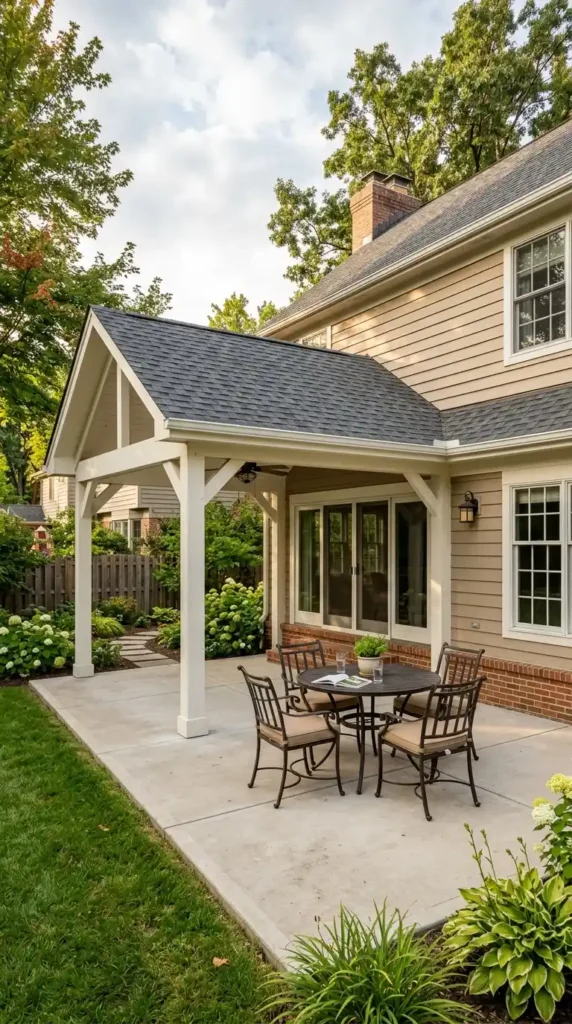
An attached covered patio — a roof structure attached to the back of the house with posts at the outer edge, matching the house roofline and using the same roofing material — is the most permanent and most property-value-adding patio roofing solution available. It requires a building permit in virtually every US municipality, typically needs engineered drawings in most jurisdictions for anything over 200 square feet, and costs $8,000 to $25,000 depending on size and finish level. It also adds directly to the appraised value of the home and effectively creates additional square footage of covered living space.
The structural connection between an attached patio roof and the house is the most critical and most regulated aspect of the project — the ledger board that attaches to the house must be properly flashed and sealed to prevent water infiltration into the house wall. This specific detail is the most common source of long-term problems in attached patio roofs and the reason most building departments require permit inspection at the ledger connection point before the roof is closed up.
An attached covered patio that matches the house roof pitch, uses the same roofing material, and is integrated into the house’s existing trim and fascia profile reads as a deliberate architectural addition rather than an afterthought. This integration quality is what separates an attached covered patio that adds genuine property value from one that simply covers the back patio without improving the home’s appearance.
6. Louvered Pergola for Adjustable Light and Rain Control
✦ Best for: homeowners who want precise control over light and rain coverage throughout the day without the permanence of a solid roof
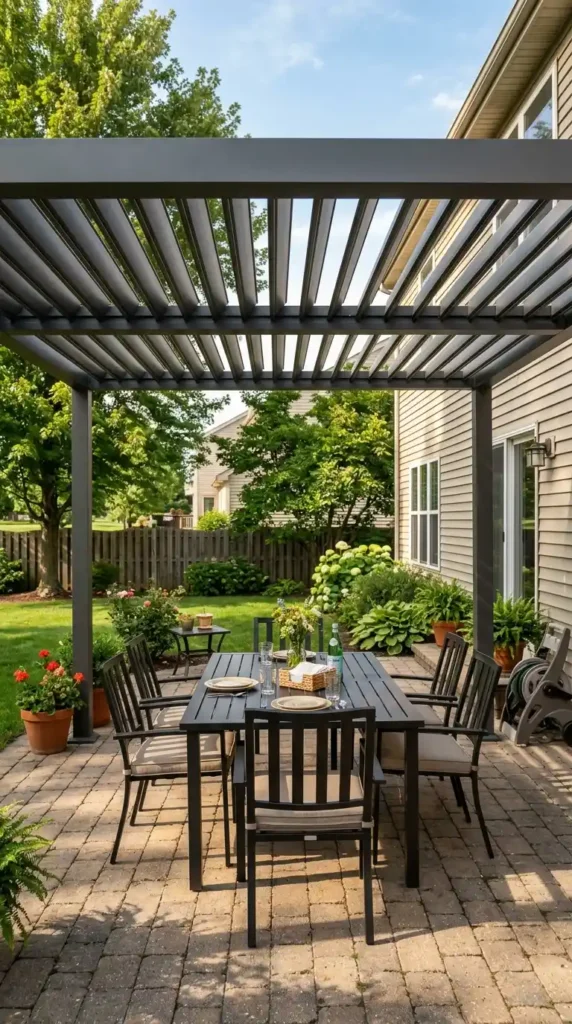
A louvered pergola has adjustable aluminum slats in the roof that rotate from fully open — allowing full sun and air through — to fully closed — creating a waterproof seal that keeps rain out. Between those two positions every angle of light and ventilation is available on demand. It is the most technically sophisticated patio roofing option and the most expensive freestanding option at $5,000 to $15,000 for a typical 10 by 14 foot structure, but it genuinely eliminates the compromise between sun and rain coverage that every other patio roofing solution requires.
Louvered pergola systems are available in manual crank operation or motorized with remote control or smartphone app control. The motorized versions often include rain sensors that automatically close the louvers when rain is detected — this automatic response means the patio furniture stays dry even when no one is home to manually close the system. For a patio that holds expensive outdoor furniture this automatic rain protection alone can justify the additional cost of the motorized system.
The brands available at different price points: TEMO and Equinox are the most widely distributed US brands in the $5,000 to $10,000 range for a standard 10 by 12 foot system installed. European brands including Renson and Brustor are available at higher price points with more refined engineering but require specialist installation. DIY louvered pergola kits are available from online retailers at $2,000 to $4,000 for the materials only — installation requires basic construction skills and a helper.
7. Gazebo or Canopy Kit — The Easiest Weekend Patio Roof
✦ Best for: renters and homeowners who want immediate patio coverage without any construction skills, tools, or permits
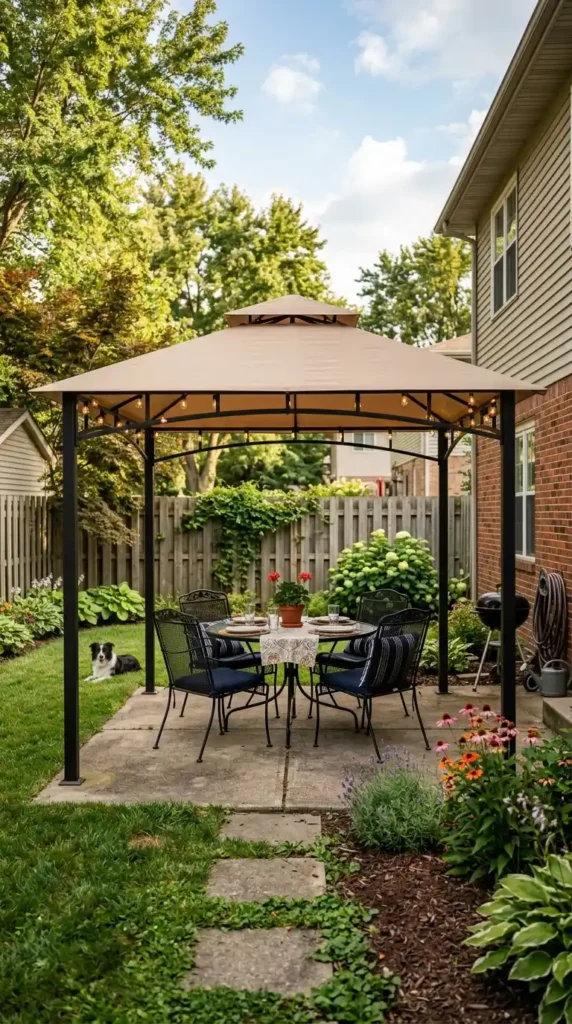
A freestanding canopy gazebo kit — a powder-coated steel frame with a fabric roof that assembles without tools in two to four hours — is the fastest and most accessible patio roofing solution available. It requires no permit, no construction skills, no anchoring to the ground in most cases, and no permanent modification to the property. Costs range from $150 for a basic 10 by 10 foot pop-up canopy to $800 to $1,500 for a hardtop gazebo with steel or polycarbonate roof panels and a more substantial steel frame.
The honest limitation of fabric canopy gazebos: wind is their enemy. A freestanding canopy that is not anchored to the ground becomes a sail in wind above 25 mph and will tip over or be damaged. Most canopy gazebo manufacturers provide ground anchor stakes and sandbag weights — use them every time the canopy is set up. A pop-up canopy not anchored is a liability in any weather that generates meaningful wind, which in most parts of the US means it needs anchoring every time it is deployed.
Hardtop gazebo kits with steel or aluminum frames and polycarbonate or metal roof panels are significantly more wind and weather resistant than fabric canopy versions and represent the best value in the category at $600 to $1,500. They assemble in a day with two people and basic hand tools, do not require a permit in most jurisdictions as freestanding temporary structures, and last five to ten years with minimal maintenance. For a homeowner who wants patio coverage without the commitment of a permanent structure a hardtop gazebo kit is the most practical choice.
Frequently Asked Questions
Do I need a permit for a patio roof?
Whether a patio roof requires a building permit depends on your specific municipality and the type of structure. In most US jurisdictions any structure attached to the house — including an attached pergola or covered patio — requires a building permit regardless of size. Freestanding structures under a certain size threshold — typically 200 square feet but this varies by municipality — often do not require a permit. Temporary structures like canopy gazebos that are not permanently anchored to the ground are usually exempt from permit requirements. The only reliable answer for your specific situation is to call your local building department before starting any work. According to the International Building Code which most US municipalities adopt, any permanent structure over 200 square feet or attached to the home requires a permit and must meet local wind load and snow load requirements.
What is the cheapest way to roof a patio?
The cheapest patio roofing options in order of cost: a shade sail at $60 to $200 provides sun coverage with minimal rain protection. A basic pop-up canopy at $100 to $200 provides both sun and rain coverage as a temporary structure. Corrugated polycarbonate or metal panels installed on an existing pergola frame cost $1.50 to $4.00 per square foot in materials. A DIY freestanding pergola built from lumber with polycarbonate panels added costs $500 to $1,500 in materials for a 10 by 10 foot structure. All of these options require the homeowner to provide the labor — hiring a contractor adds $1,000 to $3,000 to any of these projects depending on complexity.
What type of patio roof lasts the longest?
The patio roofing materials with the longest lifespans: a properly built attached covered patio with asphalt shingles matching the house roof lasts 20 to 30 years with normal maintenance. Standing seam metal roofing on a patio structure lasts 40 to 50 years. Aluminum louvered pergola systems carry 10 to 20 year warranties on the structure. Polycarbonate panels typically last 10 to 15 years before UV degradation makes them brittle or yellowed. Fabric awnings and canopy covers need replacement every 5 to 10 years depending on material quality and sun exposure. Shade sails at the budget end need replacement every 2 to 5 years.
Can I attach a pergola to my house without a permit?
An attached pergola — one where the ledger board is bolted to the house wall — almost always requires a building permit in US municipalities because the attachment to the house structure is a structural modification that must meet local building codes. A freestanding pergola positioned close to the house but not attached to it may not require a permit if it is under the local size threshold, typically 200 square feet. Building without a required permit creates liability when selling the home — title searches often reveal unpermitted structures and buyers or their lenders may require the structure to be permitted retroactively or removed before closing. The cost of obtaining a permit — typically $100 to $500 — is always less than the cost of dealing with an unpermitted structure during a home sale.
More Patio and Outdoor Ideas
→ 8 Easy Hanging Plant Ideas For Patios & Balconies
→ Deck Railing Ideas That Make Your Outdoor Space Look Expensive
→ Small Outdoor Kitchen Ideas That Punch Above Their Size
→ Cement Patio Ideas (Small Backyard Designs, Modern Finishes & Budget Makeovers)
Call the building department before you buy anything. One five-minute phone call tells you whether your planned structure needs a permit and saves potentially thousands in problems later.

Sheikh Hassaan is a digital architect for small businesses and the founder of The Glow Up System. He writes about home decor, garden design, and outdoor living for real American homes – practical ideas that work in actual spaces without oversized budgets.