
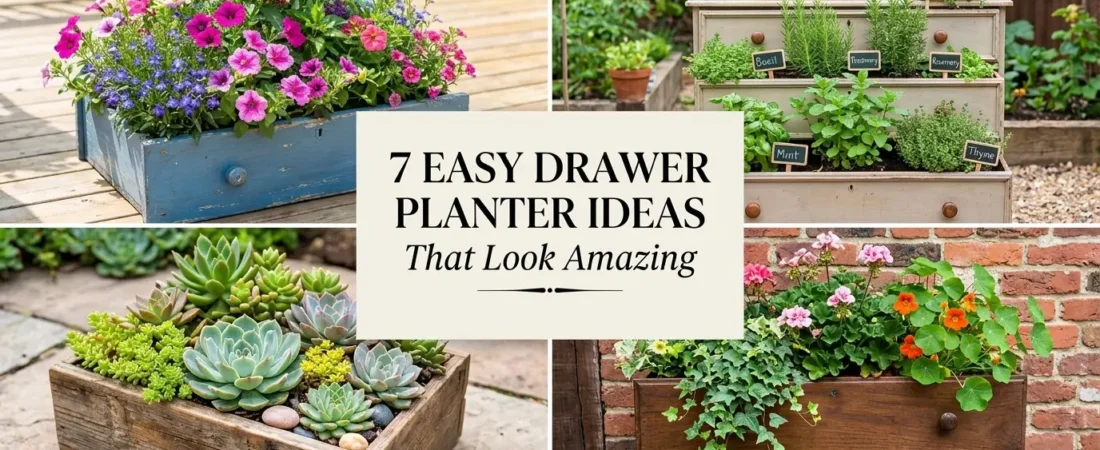
I found a broken chest of drawers beside a skip three years ago. Kept four drawers. The rest went for firewood. One drawer became a herb garden beside the back door. One became a wall-mounted succulent display. Two are stacked at angles in the corner of the patio with trailing Lobelia cascading down between them.
People who visit the garden ask about those drawers more than anything else. Not the expensive plants. Not the lighting. The drawers.
These 7 drawer planter ideas cover every approach — from a single mounted drawer on a fence to a complete dresser repurposed as a garden installation. Most cost nothing beyond the plants. All of them take an afternoon.
Table of Contents
1. Stack Multiple Drawers at Different Angles for a Rustic Feature
✦ Rustic Stacked Drawer Planter
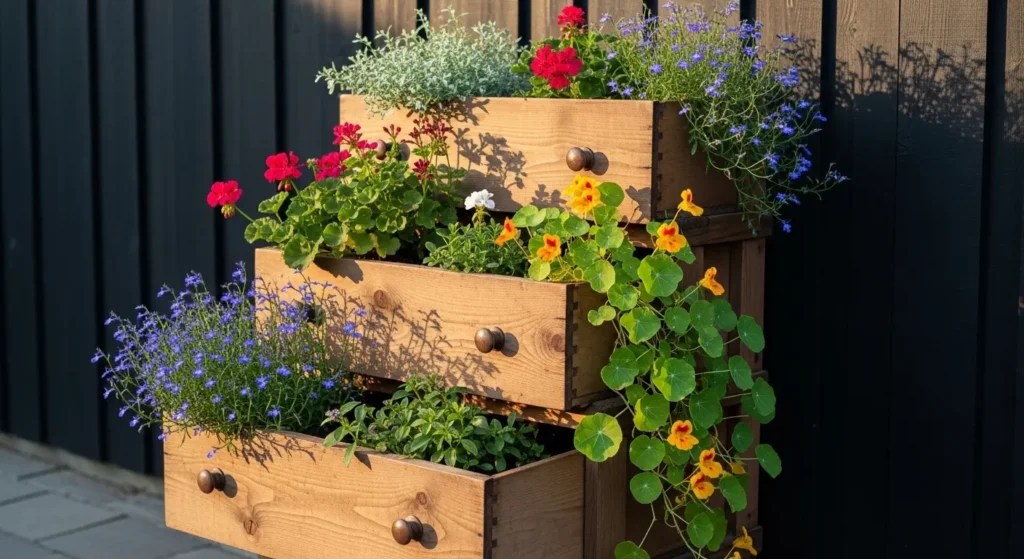
An unpainted drawer planter looks like a drawer in a garden. A painted drawer planter looks like it was designed to be there.
That is the entire case for painting drawer planters before planting them. The paint creates the relationship between the drawer and its surroundings — it stops reading as furniture and starts reading as a garden feature.
The stacked drawer arrangement at offset angles is the drawer planter idea I find most consistently impressive in photographs and in person. The deliberate asymmetry reads as designed rather than accidental and the cascading plants between levels create the visual connection that makes the whole structure read as a single composition.
For the specific herb varieties that perform best in shallow divided containers see our container garden plants for shade guide which covers compact food-growing varieties that suit limited root depth.
PRO TIP: Use drawers from the same piece of furniture rather than mixing drawer styles. Matching wood tones, hardware, and proportions across the stack create cohesion. Mismatched drawers from different furniture pieces look accidental rather than designed.
2. Paint a Drawer in a Bold Color for a Statement Floral Display
✦ Painted Floral Display Box
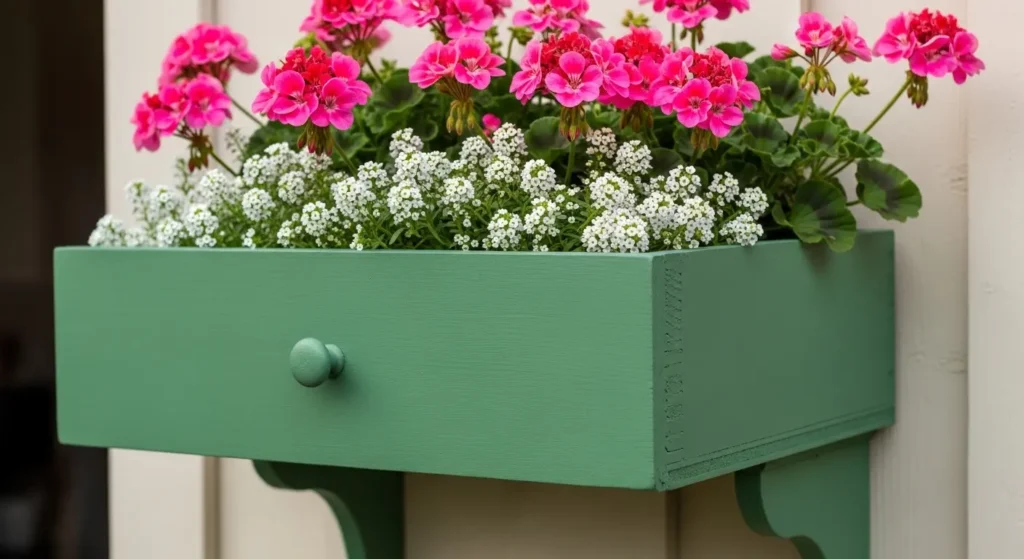
A plain old drawer becomes a designed garden statement when given the right paint treatment. The contrast between a boldly painted drawer and the flowers planted in it creates a visual impact that an unpainted wooden drawer can never achieve. Paint is the single most transformative step in any drawer planter project.
Choose exterior chalk paint or outdoor masonry paint in a color that works with your garden palette — sage green, deep navy, terracotta, or charcoal all create beautiful backdrops for flowering plants. Paint directly over any existing finish without sanding for the most authentic rustic texture. Two coats provide complete coverage. Plant with flowers in colors that contrast beautifully with the paint — bright pink and white flowers against dark green, orange and yellow against navy, cream and blush against charcoal.
3. Create a Herb Kitchen Drawer Garden for Fresh Cooking Herbs
✦ Herb Kitchen Drawer Garden
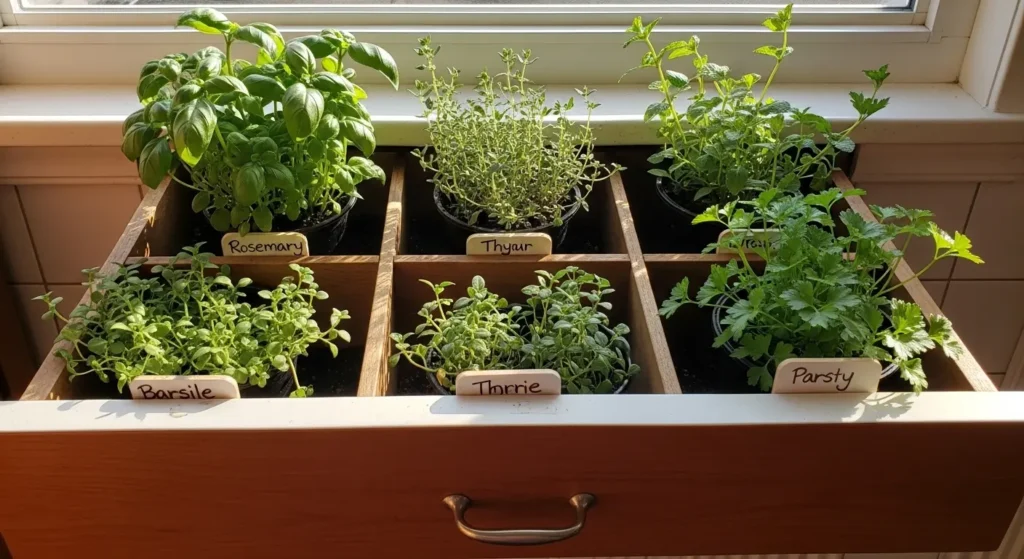
A kitchen drawer repurposed as a herb garden combines the charm of drawer planters with genuine daily utility. An old kitchen drawer positioned near the back door or on a kitchen windowsill with a selection of culinary herbs becomes both a beautiful display and a constantly useful cooking resource.
Divide a wider kitchen drawer into sections using small pieces of timber or bamboo glued across the drawer interior — each section becomes a separate herb compartment. Line each section with landscape fabric and fill with quality herb potting mix. Plant one herb variety per section and label each one with a small handwritten tag. The 5-Pack Heirloom Herb Seeds gives you a full culinary herb selection to plant directly from seed into your drawer herb garden. Find them linked on Amazon.
PRO TIP: Position your herb drawer garden at a 5-degree forward tilt rather than perfectly level. The slight forward angle improves drainage through any holes drilled in the base and presents the herbs slightly better visually — the front row is not obscured by the drawer sides.
4. Fill a Small Drawer With Succulents for a Low-Maintenance Display
✦ Succulent Mini Drawer Setup
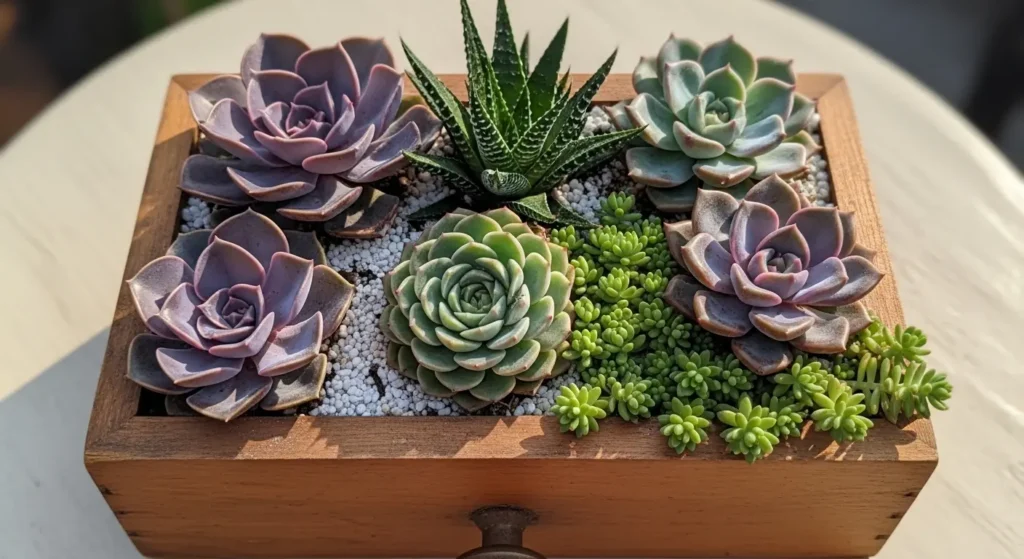
The wall-mounted drawer is the drawer planter idea that surprises people most in person. From across the garden it reads as wall art. Up close it is a planted drawer mounted at eye height with trailing plants cascading down from it.
The vertical mounting is what does it. The same drawer on the ground is a container. The same drawer on the fence is a feature.
For the specific succulent varieties that create the best drawer arrangements see our drought tolerant plants succulents guide which covers the rosette, upright, and trailing options that work best together.
5. Mount a Drawer on a Fence or Wall as Vertical Garden Art
✦ Wall Mounted Drawer Planter
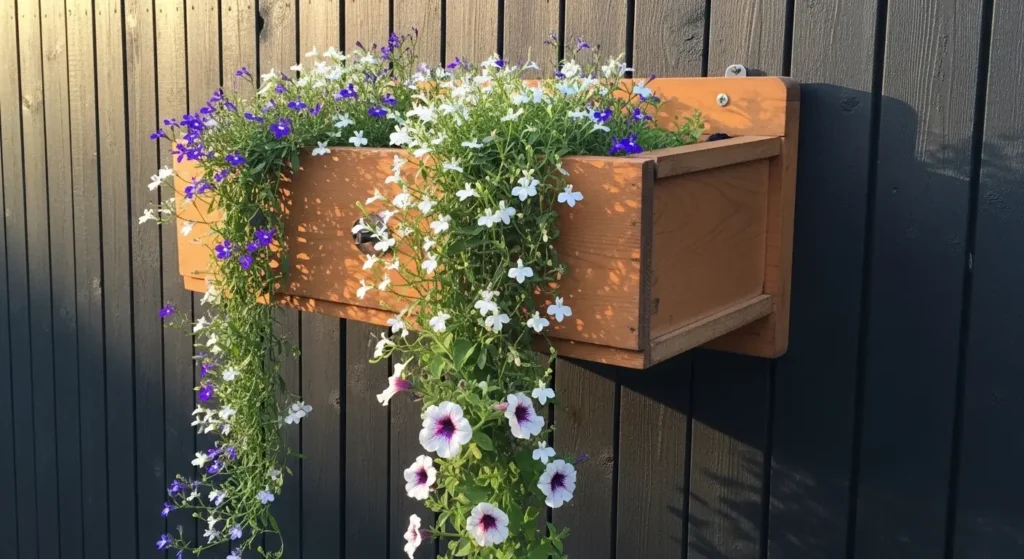
A drawer mounted on a fence or wall becomes garden art. The vertical mounting transforms the drawer from a container into a display — the plants growing from it cascade outward and downward creating a living picture that changes through the season. Wall-mounted drawer planters take zero floor space and create maximum visual impact.
Mount the drawer with the open face outward using two heavy-duty screws through the drawer back directly into the fence. Position at eye height for maximum visual impact. Line with coco liner to retain compost and add drainage holes through the drawer base. Plant with trailing varieties specifically — trailing Lobelia, Bacopa, Calibrachoa, and Petunia all cascade beautifully from a wall-mounted drawer. The cascading habit connects the mounted drawer to the garden below it and makes it look planted rather than installed.
PRO TIP: Mount multiple drawers of different sizes at different heights on the same fence section for a gallery wall effect. Three drawers of different sizes — large, medium, small — arranged asymmetrically at different heights creates a fence display that looks completely designed and becomes the most interesting feature of the whole garden.
6. Use a Full Dresser as a Statement Garden Planter Feature
✦ Vintage Wooden Drawer Bed
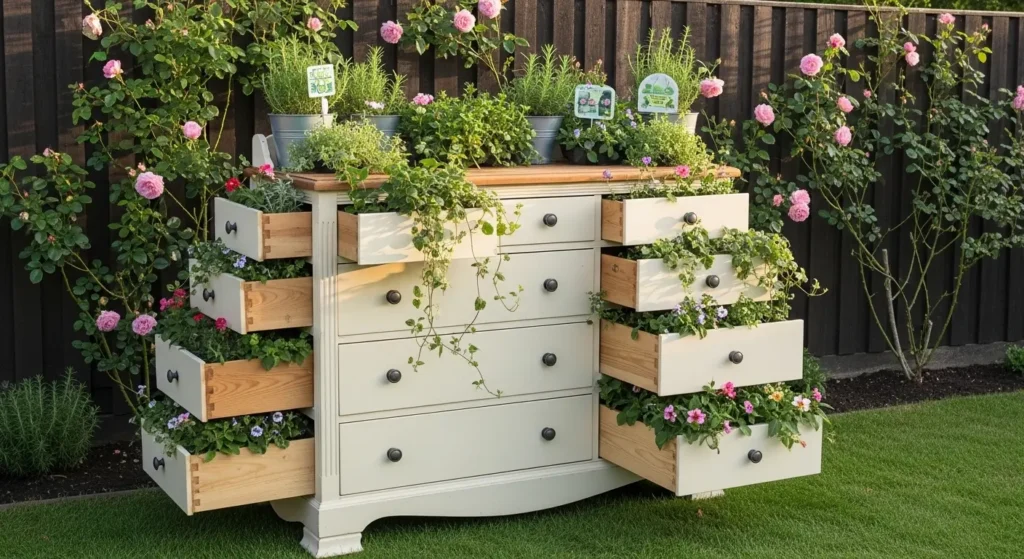
The full dresser drawer planter is the project I find creates the most consistent reaction from garden visitors. Not because it is the most beautiful thing technically. Because the recognition moment — that is a dresser — followed immediately by the realization that it is full of plants, creates a double-take that no purpose-built planter achieves.
Source imperfect examples. Chipped paint, worn edges, drawer handles missing on one side — these qualities make it look more like a garden feature and less like furniture that was placed outside.
For how the full dresser drawer planter works as part of a complete upcycled garden scheme see our upcycled garden decor ideas guide which covers the full range of furniture and found-object garden transformations.
7. Build a Tiered Drawer Stand as a Compact Garden Display Station
✦ Tiered Garden Drawer Stand
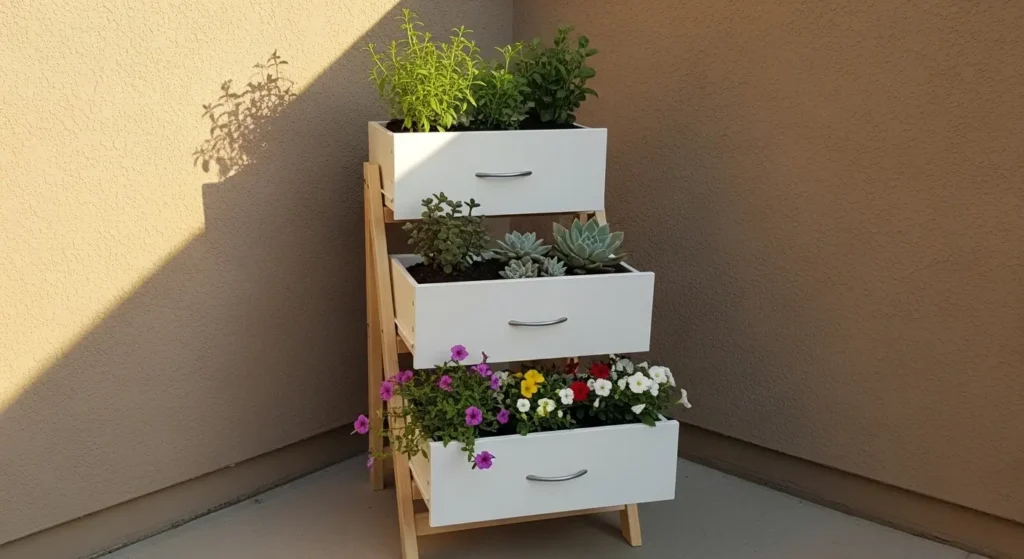
A tiered drawer stand combines three drawers on a simple wooden frame to create a compact multi-level garden display station. The structure occupies the floor space of a single large pot while providing three distinct planting tiers — each at a different height and each visible from the main garden viewpoint.
Build a simple timber frame from pressure-treated 2 by 2 inch lumber with three shelf positions at different heights. Secure one drawer at each level using screws through the drawer sides into the frame uprights. Seal the whole structure with exterior wood oil for weather resistance. Plant each level with different plants chosen for their height relationship — taller plants at the top, medium at the middle, trailing at the bottom. The LANSOW solar spotlights positioned at the base of the tiered drawer stand illuminate the whole display beautifully after dark. Find them linked on Amazon.
PRO TIP: Build your tiered drawer stand from drawers of the same width but different depths — the shallowest drawer at the top for succulents and alpines, a medium drawer in the middle for herbs and compact flowering plants, and the deepest drawer at the bottom for larger root systems. Matching the drawer depth to the plant’s root requirement significantly improves plant health across all three levels.
5 Drawer Planter Mistakes Worth Avoiding
These mistakes come up consistently in drawer planter projects:
Mistake 1 — No drainage holes
Drawer planters without drainage holes become waterlogged after the first rain and kill plant roots within days. Always drill drainage holes before planting regardless of how attractive the drawer base looks intact.
Mistake 2 — Using indoor paint outdoors
Interior paint peels from wooden drawer planters within one outdoor season. Always use exterior formulation paint or chalk paint specifically rated for outdoor use.
Mistake 3 — Planting in compost that is too deep
Drawers are typically shallow — 3 to 5 inches deep. Standard compost filled to the brim leaves very little depth for roots. Add a layer of gravel or perlite at the base first to improve drainage and use the remaining depth exclusively for root zone compost.
Mistake 4 — Mounting on a fence without checking weight
A drawer filled with wet compost and plants weighs significantly more than an empty drawer. Always use heavy-duty screws or brackets rated for the loaded weight when wall-mounting any drawer planter. A fallen drawer planter damages plants, breaks the drawer, and can be a safety hazard.
Mistake 5 — Overplanting
The shallow depth of a drawer limits root space significantly. Overplanting creates competition for limited root zone that results in all plants performing poorly rather than a few plants performing excellently. For a standard kitchen drawer plant no more than three to four plants of compact varieties.
📌 More creative garden ideas → How To Turn Old Junk Into Garden Decor
Frequently Asked Questions
What plants grow best in drawer planters?
The best plants for drawer planters are shallow-rooted compact varieties that suit the limited depth. For sunny positions — trailing Lobelia, Calibrachoa, Bacopa, compact Geraniums, succulents, and Mediterranean herbs like thyme and chives. For shadier positions — Violas, Begonias, and trailing Ivy. Avoid deep-rooted plants like tomatoes, large perennials, and any plant that needs more than 6 inches of root depth. According to the Royal Horticultural Society compact trailing annuals are the most reliable performers in shallow containers of any type.
How do I stop a drawer planter from rotting?
Seal all external surfaces with exterior wood preservative or exterior paint before planting and ensure adequate drainage holes so water never pools in the base. Raising the drawer slightly off the ground on small feet or bricks prevents moisture wicking from below and significantly extends outdoor life.
Where can I find old drawers for garden planters?
Charity shops, Facebook Marketplace, Freecycle, and estate sales all regularly list old dressers and chests of drawers very cheaply or free. Skips outside houses being renovated are one of the most reliable sources — discarded furniture drawers are among the most commonly skipped items.
How long do drawer planters last outdoors?
An unsealed softwood drawer typically lasts 1 to 2 outdoor seasons. A properly sealed and treated drawer lasts 3 to 5 seasons. Bringing drawer planters under cover during winter significantly extends their life regardless of wood type.
More Creative Garden Ideas
→ 8 Budget-Friendly Pallet Garden Ideas
→ 12 Boho Garden Ideas You’ll Love
→ 12 Lovely Front Yard Garden Ideas
→ 25 Stunning Back Porch Patio Ideas
Those four drawers from the skip beside the road — the herb garden, the succulent wall display, the stacked corner arrangement — cost nothing. The plants cost about $30 total.
That is the honest arithmetic of drawer planter ideas. The material is free if you are willing to ask or keep your eyes open. The preparation takes an hour. The result is the thing people photograph when they visit the garden.
Find one drawer this weekend. Drill the holes. Seal the wood. The rest of this list is waiting for the next one.

Sheikh Hassaan is a digital architect for small businesses and the founder of The Glow Up System. He writes about home decor, garden design, and outdoor living for real American homes – practical ideas that work in actual spaces without oversized budgets.