
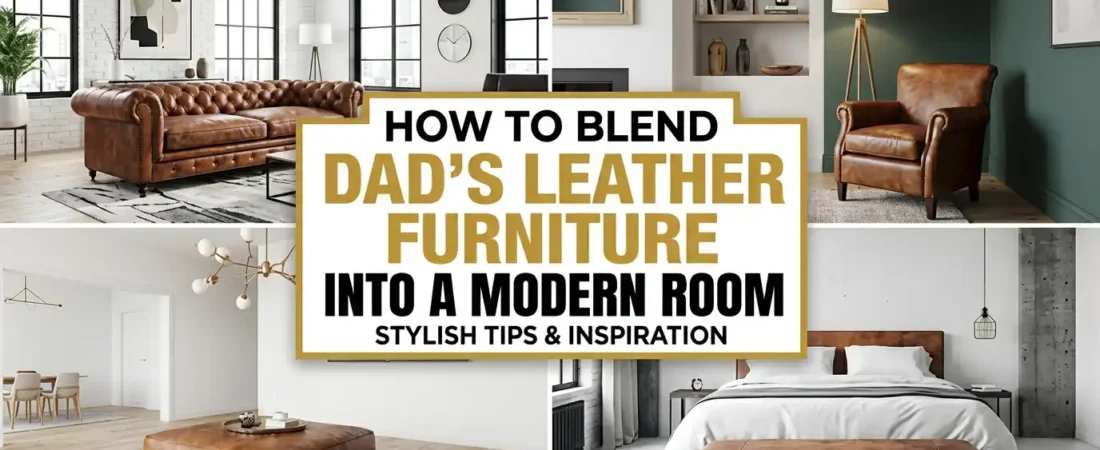
A worn leather sofa is one of those furniture pieces that a lot of dads refuse to get rid of — and genuinely should not have to. Leather furniture in a modern room is not a contradiction when it is handled correctly; the challenge is understanding what makes leather feel dated in a contemporary space and addressing those specific things rather than trying to make the piece invisible or replacing it entirely.
This guide covers the practical styling techniques that make leather furniture modern room-appropriate — the palette adjustments, texture pairings, rug choices, and accessory approaches that allow a substantial leather piece to sit comfortably in a contemporary interior without either dominating the room or looking apologetic in it.
Table of Contents
Why Leather Reads as Dated in Some Rooms and Not in Others
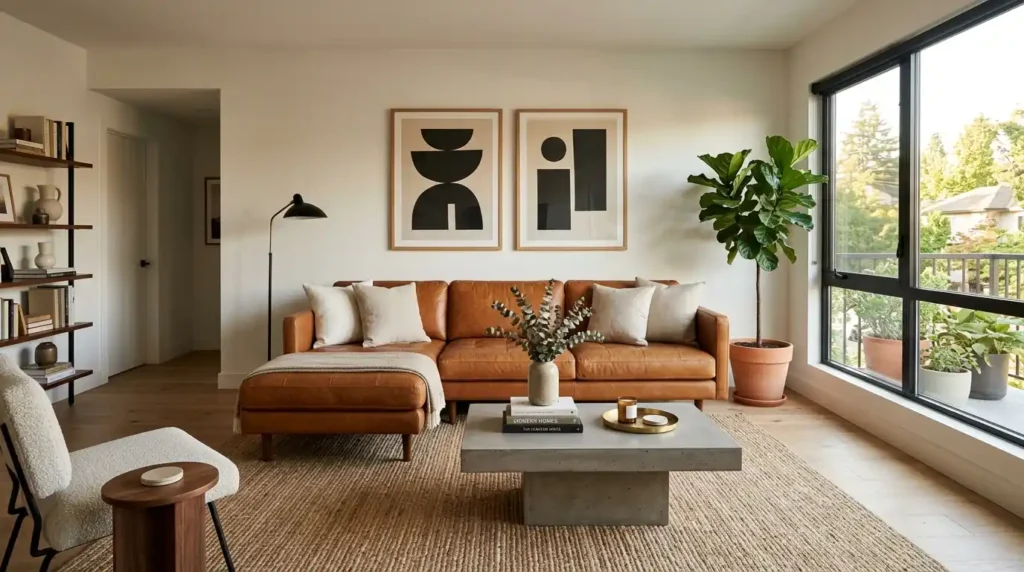
Leather furniture looks dated in some rooms not because of the leather itself but because of the company it keeps. A cognac leather sofa surrounded by dark wood furniture, heavy drapes, brass table lamps, and a Persian rug is being asked to participate in a traditional interior that reinforces its age rather than recontextualizing it. The same sofa against a white wall, on a natural fiber rug, with a concrete coffee table and linen cushions looks current — possibly even expensive — because the surrounding materials speak a contemporary language that the leather adapts to.
The test for whether a leather piece is working in a room is simple: remove it mentally and ask whether the room would read as more or less contemporary without it. If the answer is more contemporary, the leather is fighting its surroundings. If the answer is less interesting, the leather is contributing genuine material richness and warmth that the room needs rather than competing with it.
The specific things that make leather read as dated: surrounding it with matching leather or heavily patterned traditional textiles, positioning it against dark wood paneling or deeply colored walls, pairing it with heavy drapes and ornate accessories, and failing to introduce any lighter or more organic texture to balance the visual weight of the leather surface. Each of these is fixable without touching the leather piece itself.
The Wall Color That Makes Leather Look Modern
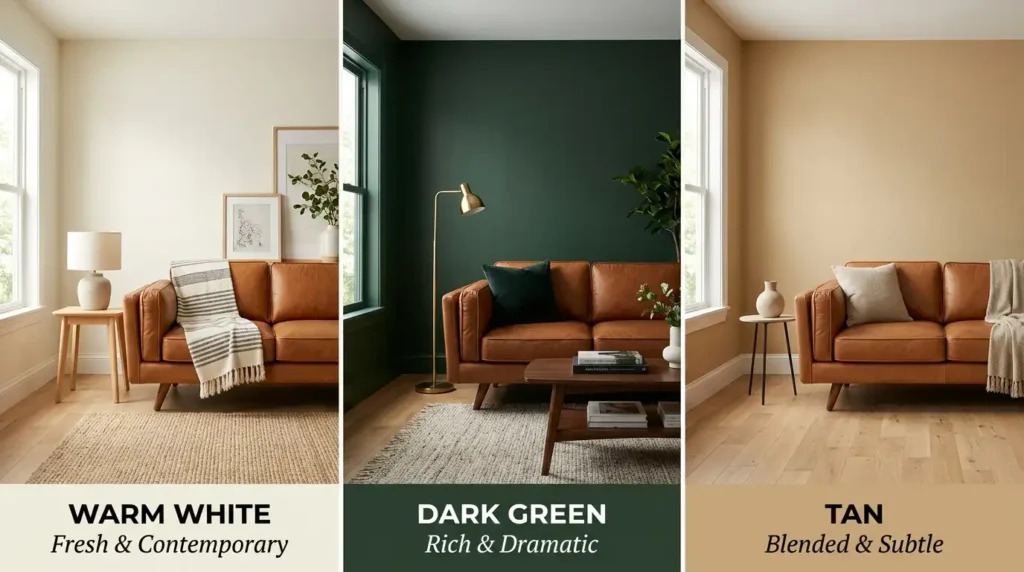
Wall color is the single most impactful change available for making leather furniture look more contemporary, because the contrast between the leather and the wall directly determines how the piece reads from across the room. Warm white or off-white walls create a clean modern backdrop that lets the leather’s own color and texture come forward without any visual competition.
The color combination to specifically avoid: a tan or medium-brown leather sofa against tan, beige, or warm cream painted walls. This combination reads as monotone and heavy — the leather disappears into the wall rather than reading as a deliberate design element, and the overall room palette collapses into a single undifferentiated warm brown that photographs poorly and feels smaller and dimmer than it actually is.
The most unexpectedly effective wall color for a leather piece: a deep forest green or muted dark teal. These colors create a richly contemporary contrast with warm leather tones — cognac against deep green in particular is one of those combinations that consistently reads as sophisticated and current rather than as traditional, possibly because it references the specific aesthetic of mid-century men’s club interiors, which have experienced a significant design revival over the past decade.
Softening Heavy Leather Silhouettes with Light Textures and Natural Fiber Rugs
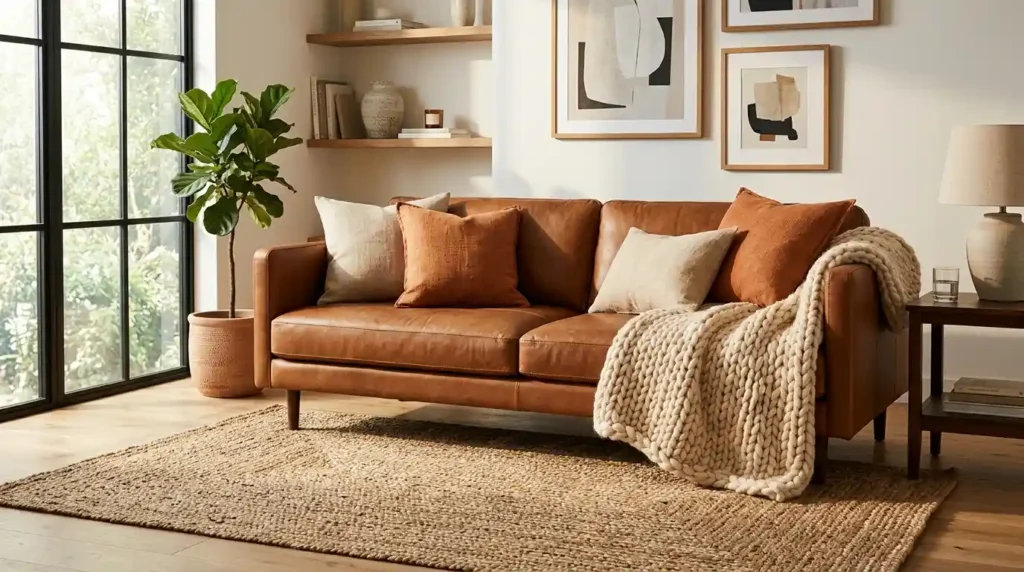
Leather is a visually heavy, smooth, and highly reflective material — all qualities that make it stand out strongly in a room but that also make it feel visually dominant if not balanced by counterweight textures that are lighter, softer, and more absorbent of light. Introducing natural fiber textures around and on a leather piece is the most effective technique for integrating it into a contemporary room because it creates the material contrast that makes each element more interesting by comparison.
Natural fiber rug under the leather sofa:
A large jute, sisal, or seagrass rug positioned under the leather sofa and coffee table creates a ground plane of rough, organic texture that directly contrasts with the leather surface above it. The natural fiber rug does three things simultaneously: it defines the seating zone, it introduces warmth and organic material, and it visually grounds the heavy leather piece so it reads as anchored rather than simply placed. The rug should be large enough that all front legs of the sofa sit on it rather than floating off the edge.
Linen cushions on the leather surface:
Two or three linen cushions in warm white, natural, or a warm gray placed on the leather sofa introduce soft fabric directly onto the leather surface and signal that this is a deliberately styled piece rather than a piece of furniture that has been left to stand alone. The key is restraint — two or three cushions that sit comfortably within the sofa scale rather than a large collection that obscures the leather entirely and defeats the purpose of having a leather sofa.
A single wool or chunky knit throw:
A chunky knit or wool throw draped loosely over one arm of the leather sofa introduces the third texture layer — rough, warm, and organic — and signals that the room is genuinely lived in rather than styled for a photograph. The throw should be in a neutral tone that complements rather than competes with the leather color: cream or oatmeal for cognac leather, charcoal for black leather, warm gray for a medium brown leather.
Choosing a Coffee Table That Makes Leather Look Modern
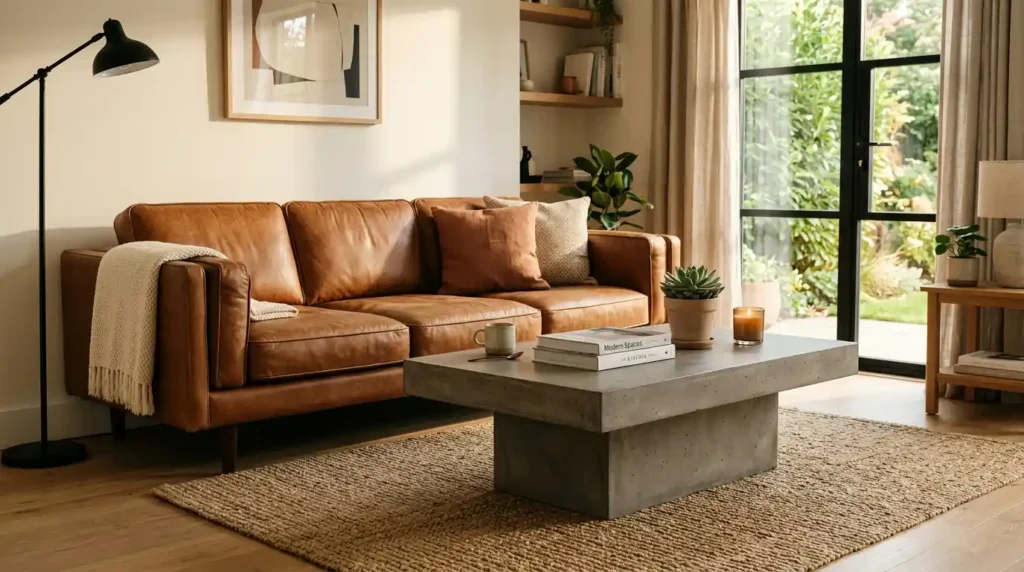
The coffee table positioned in front of a leather sofa has an outsized influence on how contemporary the entire seating group reads, because it sits at the visual center of the arrangement and its material reads directly against the leather behind it. A dark matching wood coffee table doubles the traditional quality of the setup. A concrete, pale stone, or glass table introduces the material contrast that makes the leather read as a deliberate design choice rather than a default.
Concrete coffee tables — either cast concrete slabs on simple timber or metal legs, or concrete-finish tops — work particularly well with warm leather because the cool gray of concrete and the warm amber-brown of leather are on opposite ends of the warm-cool temperature spectrum, creating exactly the kind of contrast that makes each material more interesting by comparison. This is the material pairing most frequently used in professionally designed contemporary rooms that incorporate leather furniture.
Pale bleached or whitewashed timber, glass on a metal base, and light-colored stone all achieve a similar modernizing effect for different reasons — all are lighter, cooler, or more minimal in visual weight than the leather itself, and all create the material conversation that a heavy leather sofa needs to feel designed rather than simply heavy. Avoid a matching dark leather or dark stained wood ottoman as the primary coffee table — it reinforces the traditional reading of the leather rather than recontextualizing it.
Lighting a Leather Piece to Look Its Best
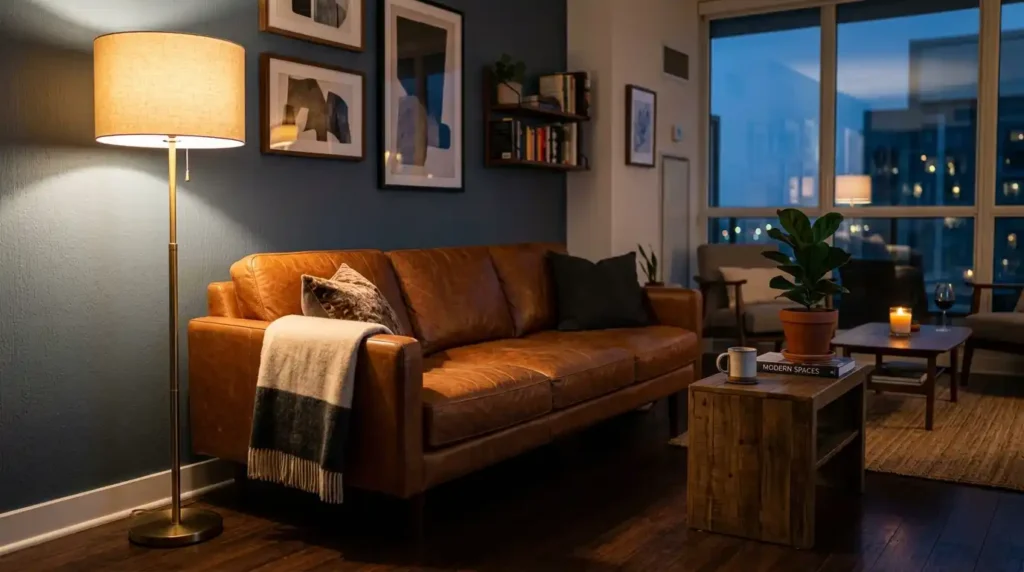
Leather interacts with light differently from fabric upholstery — it reflects directional light rather than absorbing it, which means that the type and angle of light in a room significantly affects how the leather reads. Warm directional light from a floor lamp positioned to the side of the leather sofa creates a rich, warm glow on the leather surface that shows the material’s depth and character. Flat overhead fluorescent light flattens leather completely and removes the specific richness that makes good leather worth having.
A floor lamp with a shade that directs warm light downward and outward, positioned at one end of the leather sofa rather than directly overhead, creates the specific lighting condition that makes warm leather look genuinely beautiful — the leather surface picks up the warm reflected light and glows amber in the same way a well-tended piece of wood does under similar conditions.
All lighting in a room with warm leather should be at 2700K warm white. Cool light temperature — daylight-balanced or blue-white — makes warm leather tones appear dull and slightly muddy, losing the rich amber-brown quality that is the entire appeal of the material. This applies to overhead lights, floor lamps, and table lamps alike.
Accessories and Plants That Complete the Modern Leather Room
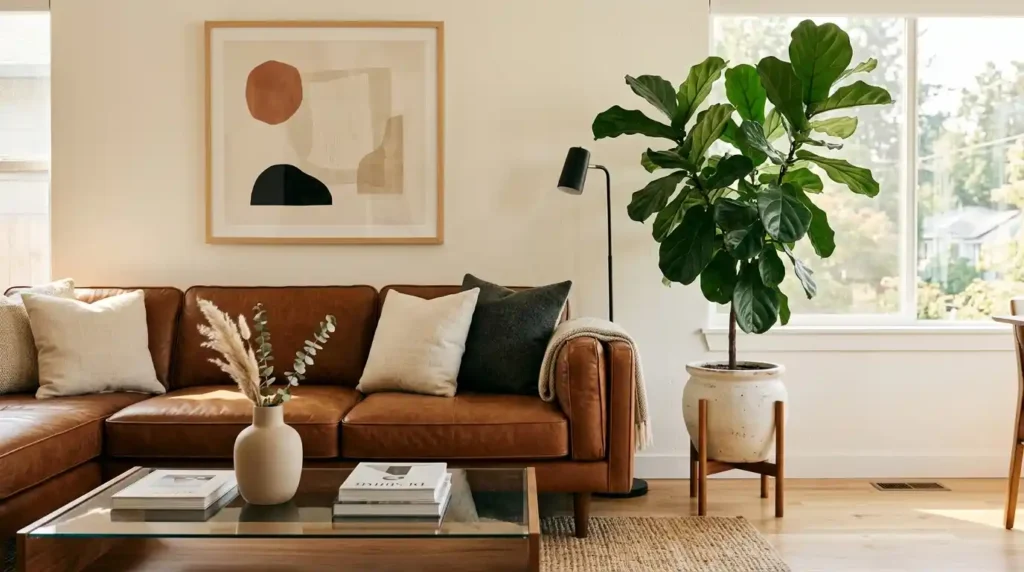
The accessories and art around a leather piece are the final layer of context that determine whether the room reads as contemporary or traditional. A large indoor plant — fiddle leaf fig, rubber plant, or monstera — positioned in a simple white or concrete pot beside the leather sofa introduces the living organic element that most traditional leather room setups completely lack, and it signals immediately that the room belongs to a different design era than the leather’s original context.
One piece of large abstract or photographic art above the sofa rather than a gallery wall or a traditional landscape painting reinforces the contemporary reading. The art should be sized at 70 to 80 percent of the sofa width — large enough to feel proportionally matched to the substantial visual weight of the leather below it, rather than a small piece floating disconnected above the sofa.
The Blissy Silk Pillowcase in champagne or ivory on one of the leather sofa cushions introduces the premium textile contrast that completes the material layering — silk against leather is a combination that reads as genuinely luxurious in a way that cotton cushions alongside leather do not quite achieve. Find it linked on Amazon.
Keeping Leather Looking Its Best in a Modern Room
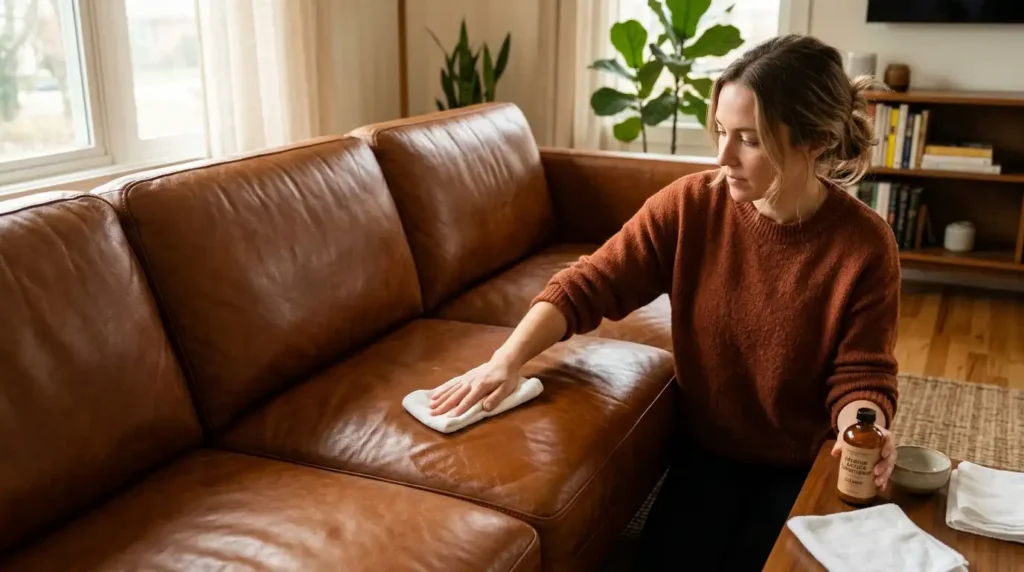
A well-maintained leather piece is an asset that improves with age. An unmaintained one develops a specific kind of dryness and fading at the contact points — the armrests, the seat cushion centers — that communicates neglect rather than the beautiful patina of well-used leather. The difference between the two outcomes is about 30 minutes twice a year.
Annual conditioning:
Apply a quality leather conditioner — Leather Honey, Lexol, or a comparable product — to the entire sofa surface once a year. The conditioner replenishes the natural oils that dry out of leather over time with exposure to air and sunlight, preventing the cracking and fading that makes older leather look worn rather than patinated. Apply with a clean cloth, allow to penetrate for 20 minutes, and buff off the excess.
Position away from direct sunlight:
Direct sunlight fades and dries leather faster than almost any other factor. A leather sofa positioned in front of or directly beside a south-facing window that receives direct afternoon sun will show fading at the sun-exposed surfaces within a few years regardless of conditioning. If repositioning is not possible, UV-filtering window film applied to the glass significantly slows the fading process.
A leather sofa in genuinely good condition — evenly colored, soft and supple rather than dry and cracked, with the specific deep sheen of well-maintained leather — looks more contemporary in any room than a neglected piece regardless of how well the rest of the room is styled around it. The styling tips in this guide work best when the leather itself is maintained to a standard that earns a prominent place in the room.
📌 More home decor ideas: Minimalist Men’s Bedroom Ideas for a No-Fuss Dad
Frequently Asked Questions
How do you make a leather sofa look modern?
Making a leather sofa look modern requires changing the material context around it rather than the sofa itself. Paint the walls warm white or a deep contemporary color like forest green or dark teal. Replace any matching leather or heavy traditional textiles with natural fiber rugs, linen cushions, and a lightweight throw. Switch the coffee table to concrete, pale stone, or bleached timber. Add a large indoor plant in a simple ceramic pot beside the sofa. According to Architectural Digest, the most successful contemporary rooms that incorporate leather furniture consistently use material contrast — pairing the leather with lighter, more organic, or cooler-toned materials — rather than surrounding the leather with materials of similar weight and warmth.
What colors go well with a brown leather sofa?
The wall and textile colors that work best with a brown leather sofa in a contemporary room: warm white or off-white walls, deep forest green or dark teal as a dramatic accent wall, natural fiber rug tones in undyed jute or sisal, and linen cushions in warm white, natural, or warm gray. Colors to avoid: matching tan, beige, or warm cream walls that cause the sofa to disappear into its background; very cool grays or blues that clash with the warm amber tones of most brown leather.
How do you style leather furniture with other furniture?
Leather furniture works best in a modern room when paired with furniture in contrasting rather than matching materials. A concrete or pale stone coffee table rather than a matching dark wood table. A rattan or natural timber accent chair rather than a second leather piece. Open shelving in pale timber or metal rather than dark wood cabinetry. The principle is material variety within a consistent palette — warm neutrals as the color thread connecting different materials, rather than using identical materials throughout.
How do you modernize an old leather couch?
Modernizing an old leather couch starts with conditioning it — a well-maintained leather surface is the foundation for any styling work. Then address the immediate surroundings: replace the wall color if it matches the leather tone, add a large natural fiber rug under the couch, replace any matching accessories with lighter contrasting materials, and add two or three linen cushions in warm white or natural. A large plant beside the couch and one piece of contemporary art above it complete the recontextualization. These changes together cost considerably less than a new sofa and often produce a more interesting result.
More Home Decor Ideas
→ 7 Home Office Decor Ideas That Make Dad Feel Like a King
→ Reading Nook Ideas Around Dad’s Favorite Chair
→ 7 Front Door Decor Ideas That Make Dad Feel Proud
Change what is around the leather before considering changing the leather. In most cases, the sofa was never the problem.

Sheikh Hassaan is a digital architect for small businesses and the founder of The Glow Up System. He writes about home decor, garden design, and outdoor living for real American homes – practical ideas that work in actual spaces without oversized budgets.