

Macrame plant hanger ideas are among the most saved categories on Pinterest for one reason that goes beyond aesthetics: a macrame hanger makes any plant look more intentionally placed. The same pothos that sits forgettably on a windowsill becomes a designed element when suspended in hand-knotted cotton cord at the right height. The hanger adds the vertical dimension, the texture, and the craft quality that transforms a plant from a purchase into a feature.
These 10 ideas range from a beginner-friendly single pot hanger that takes 45 minutes to make to a multi-tier statement installation that anchors an entire room. Each addresses a specific design goal and includes the cord weight, knot type, and pot size that makes the design work.
Table of Contents
1. The Classic Single Pot Hanger: The Design That Teaches You Every Knot You Need
✦ Classic Single Pot Hanger
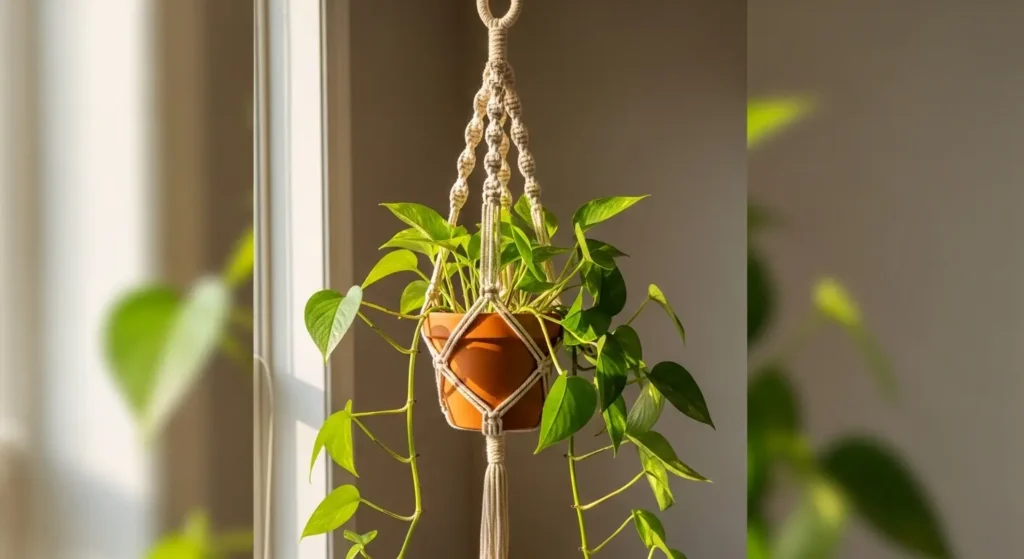
The classic single pot macrame hanger is the foundational design that all other macrame plant hanger ideas build from. It uses three knots — the gathering knot at the top, the square knot for the body, and the spiral half-hitch for the basket — and produces a functional, beautiful hanger in 45 minutes to an hour for a first-time maker.
The cord specification that produces the best result for a classic hanger: 3mm single-strand cotton macrame cord in natural undyed color. Single-strand cord has more flexibility than three-strand twisted rope and creates cleaner, tighter square knots with more definition. The natural undyed color suits every plant and every interior without competing with the planting.
Cord length calculation for a classic single pot hanger: cut eight cords each at 8 times the desired finished hanger length. For a 36-inch finished hanger cut eight cords at 288 inches (8 yards) each. This calculation accounts for the cord consumed by the knots — approximately 30% of the starting length disappears into the knot structure.
PRO TIP: Always dampen macrame cord slightly before tying the final gathering knots at the top of a plant hanger. Damp cord is more pliable and allows gathering knots to be pulled tighter and more evenly than dry cord. The tighter gathering knot holds the hanger structure more securely and looks significantly more professional.
2. Beaded Macrame Hangers: How Wooden Beads Change the Entire Character of the Design
✦ Boho Beaded Macrame Design
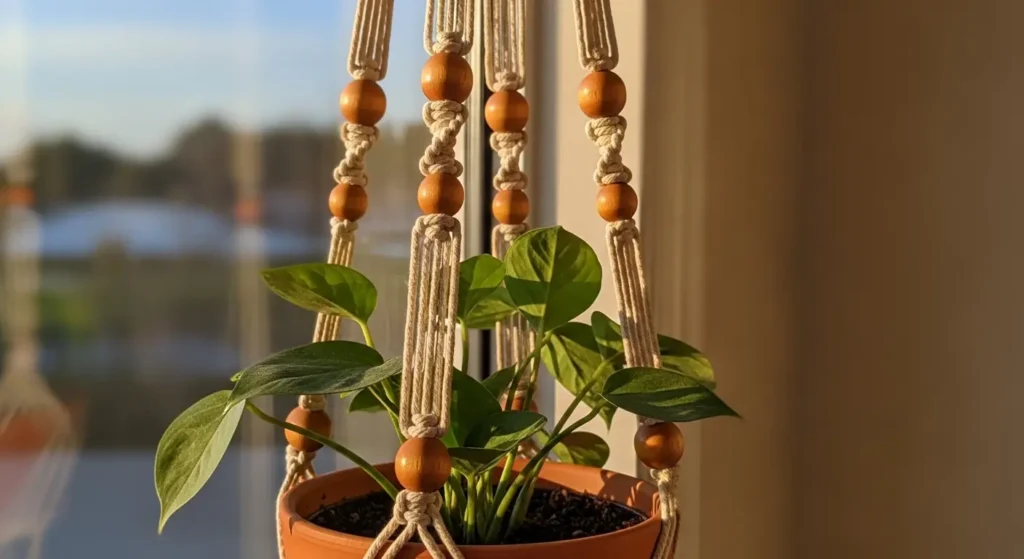
Wooden beads in macrame plant hangers serve a design function beyond decoration: they create visual rhythm by breaking the cord into defined sections and add weight at specific points that affects how the hanger hangs and moves. A beaded macrame hanger reads as more complex and more designed than an equivalent knotted-only design even when the knot count is lower.
The bead hole diameter is the critical specification. Macrame beads must have holes wide enough to thread the cord through — for 3mm cord use beads with a minimum 4mm hole diameter. For 5mm cord use beads with a minimum 6mm hole. Beads purchased without checking hole diameter are the most common and most frustrating macrame supply mistake.
Boho bead selection: natural wood beads in varied diameters create the most organic and most genuinely boho effect. Use three bead sizes — a large bead at the mid-point of the hanger as the focal element, medium beads at the transition between knot sections, and small beads as accent details within the knot body. The size graduation creates hierarchy rather than repetition.
3. A Multi-Tier Macrame Hanger Holds Three Plants From One Ceiling Hook
✦ Multi-Tier Plant Hanger
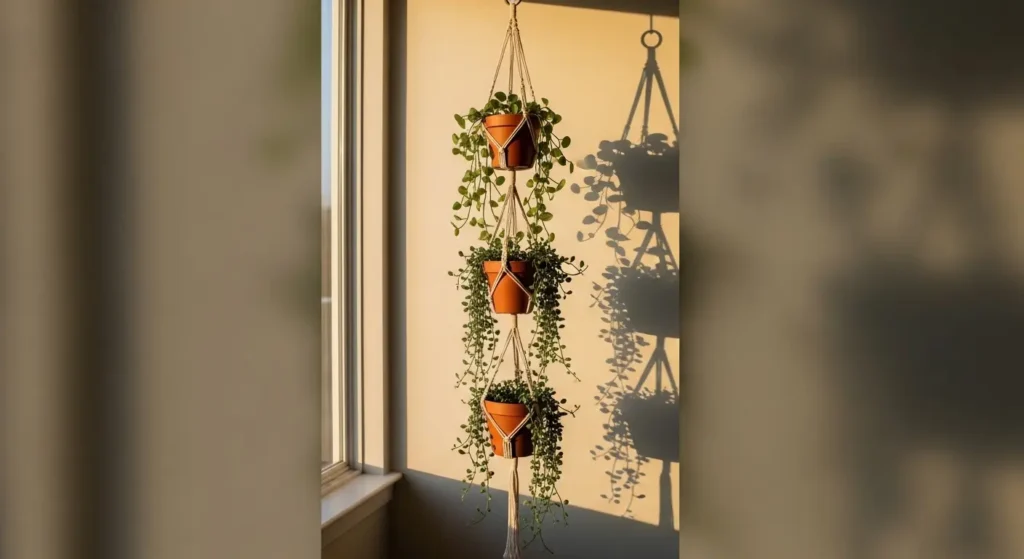
A multi-tier macrame hanger creates three hanging plant positions from a single ceiling hook — the most efficient use of overhead space available for indoor and covered outdoor planting. The visual effect of three plants at different heights suspended from one knotted cord structure is significantly more impactful than three individual hangers at similar heights.
The engineering of a multi-tier hanger differs from a single hanger in one critical way: load distribution. A single hanger carries one pot. A three-tier hanger carries three pots simultaneously and all the weight concentrates at the single ceiling fixing point. The ceiling hook must be rated for the combined weight of all three pots at full saturation — typically 15 to 25 pounds for three standard 6-inch pots. Use a structural ceiling hook screwed into a joist, not a plaster anchor.
The planting logic for a three-tier hanger positions the largest and heaviest pot at the lowest tier to keep the center of gravity low. The smallest lightest plant at the top tier reduces the top-heaviness that causes multi-tier hangers to twist and swing in air currents. Choose trailing plants for the middle and bottom tiers — their cascading growth connects the tiers visually and fills the space between pot levels.
PRO TIP: Make the cord sections between tiers in a multi-tier hanger at least 12 inches long rather than the 6 to 8 inches that feels visually balanced when the hanger is empty. Trailing plants grow downward from their pots and a 6-inch inter-tier gap fills completely with plant growth within weeks, visually merging the tiers. A 12-inch gap remains visible through the plant growth and maintains the tier separation that makes multi-tier hangers so distinctive.
4. A Wall-Mounted Macrame Display Hangs Plants Flat Against the Wall Without a Ceiling Hook
✦ Wall-Mounted Macrame Display
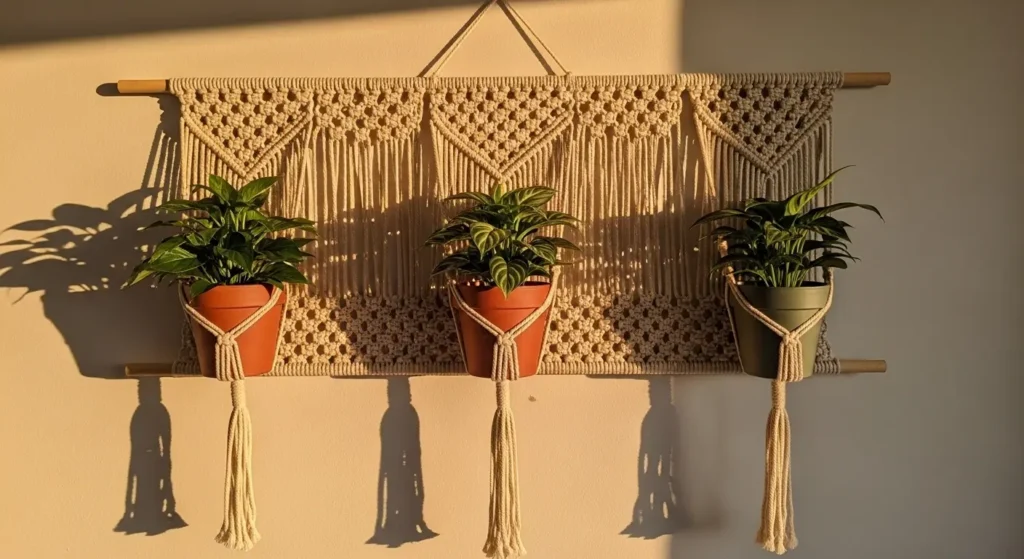
Wall-mounted macrame plant displays solve the ceiling hook problem entirely — the hanger mounts flat against the wall from a single wall fixing point and holds plants in knotted cradles positioned across its width and length. The result reads as wall art that happens to contain living plants rather than a functional hanging structure.
The construction differs from ceiling-hung hangers in its fundamental orientation. Where a ceiling hanger is vertical and gravity-loaded, a wall-mounted display is semi-horizontal and the pot cradles must be knotted at angles that hold pots level rather than allowing them to tip forward away from the wall.
The wall-mounting approach makes macrame plant displays accessible in spaces where ceiling hooks are not possible — rental apartments, rooms with plasterboard ceilings without accessible joists, and outdoor covered areas without overhead structure. One wall hook rated for 15 to 20 pounds handles most wall-mounted macrame display weights even when fully planted.
5. A Wooden Ring Macrame Hanger Uses the Ring as Both Structure and Aesthetic Statement
✦ Wooden Ring Macrame Hanger
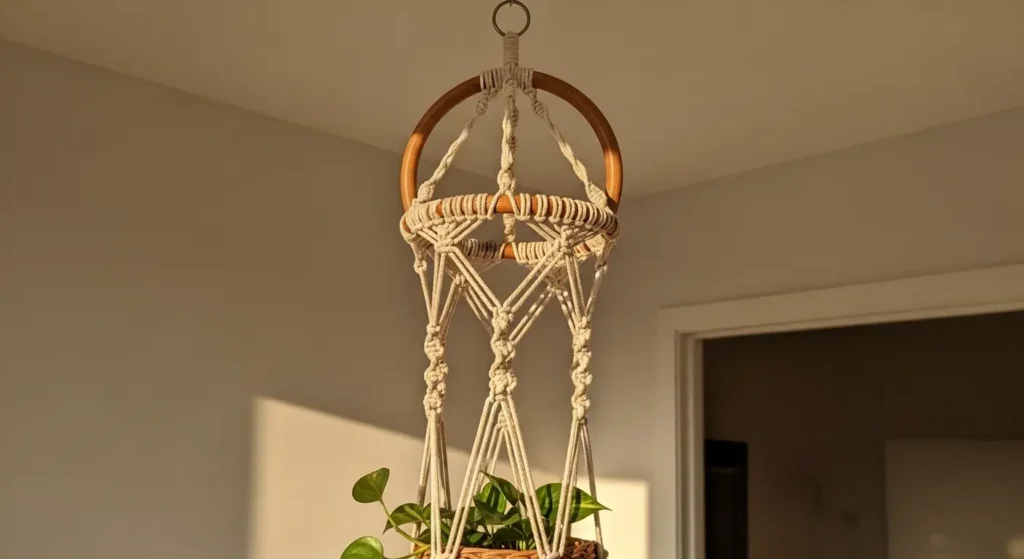
A wooden ring macrame hanger uses the ring as a visible structural and aesthetic element rather than hiding the suspension mechanism. The cords attach through and around the ring, creating a geometric crown at the top of the hanger that reads as a deliberate design detail rather than a functional fixing point.
Ring diameter determines the visual scale of the crown and the number of cords that can be attached around the circumference. A 6-inch ring suits 8 to 12 cords and creates a compact crown that reads well for small and medium pots. A 10 to 12-inch ring suits 16 to 24 cords and creates a more dramatic crown with denser knotting that makes a stronger visual statement from ceiling height.
Materials for macrame rings: natural wood rings have the warmest tone and suit boho and natural aesthetics. Brass rings create a warm metallic contrast with natural cotton cord and suit maximalist and eclectic interiors. Black powder-coated metal rings suit minimal and Scandinavian aesthetics where the ring creates a clean geometric accent rather than an organic natural element.
PRO TIP: Wrap the wooden ring with a layer of cotton cord before attaching hanger cords to it. The wrapped ring creates a softer more cohesive visual connection between ring and cord — an unwrapped wood ring with raw cord attached creates a visible material discontinuity that the cord wrapping eliminates. The wrapping technique takes five minutes and significantly improves the finished quality of the ring connection.
6. Color-Dipped Macrame: The Detail That Makes a Classic Design Look Contemporary
✦ Color-Dipped Modern Design
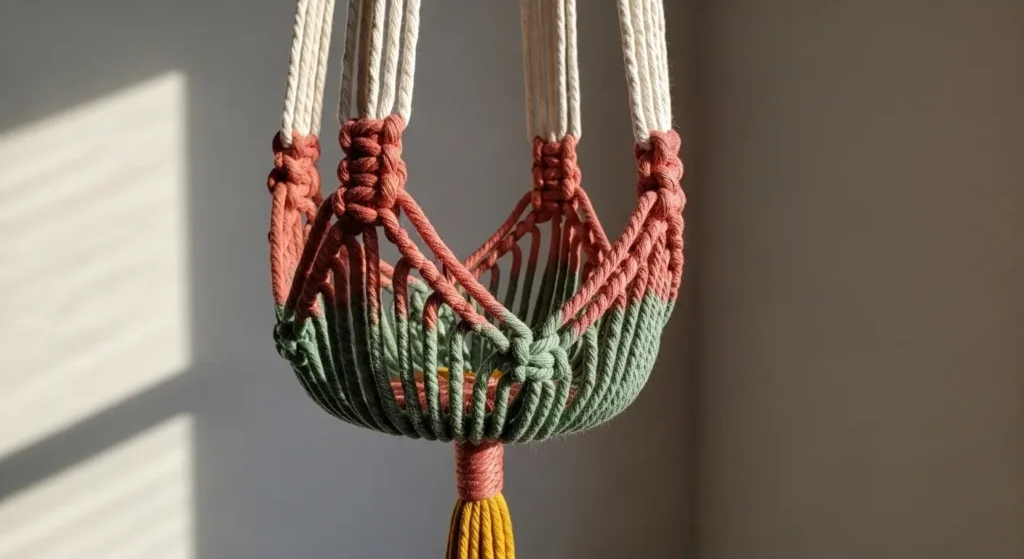
Color-dipping the fringe ends of a macrame plant hanger is the single modification that most effectively updates a classic natural design to a contemporary aesthetic. The color block created by dipped fringe ends transforms a neutral natural object into a deliberate color statement — connecting the hanger to the color palette of the room it inhabits.
The color-dipping process: lay the completed macrame hanger flat with the fringe ends submerged in a shallow tray of fabric paint diluted to a thin consistency with water. Leave for 30 to 60 minutes. Remove and hang to dry completely before use. The diluted paint creates a soft gradient fade from natural cord to full color rather than a sharp line — the gradient reads as more artistic and more intentional than a hard paint edge.
Color selection for dipped macrame: terracotta and rust work with the natural beige tone of cotton cord and suit boho and earthy interiors. Sage and olive green connect the hanger to its plant contents. Mustard and ochre create the highest contrast against natural cord while staying within a warm palette. Avoid cool blues and greys against natural cotton — the cool-warm contrast reads as mismatched rather than deliberately contemporary.
PRO TIP: Seal color-dipped macrame cord ends with a 1:1 mixture of white craft glue and water after the paint has dried completely. The diluted glue stiffens the painted section slightly and prevents the paint from cracking or flaking with repeated handling. Apply with a brush, work it through the cord fibers, and allow to dry. The sealed finish lasts significantly longer than unsealed painted cord.
7. An Extra-Long Macrame Hanger Creates a Floor-to-Ceiling Plant Feature
✦ Extra-Long Statement Hanger
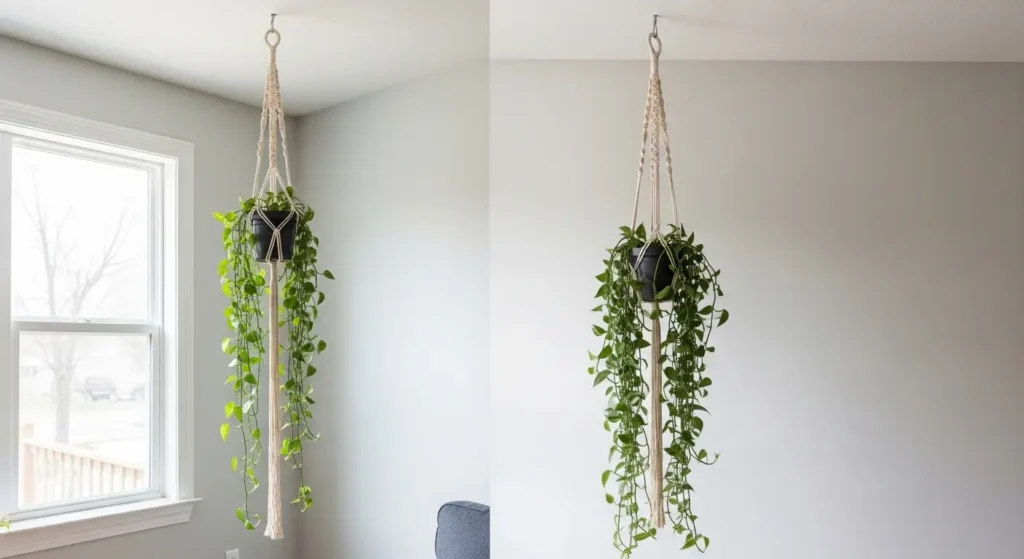
An extra-long macrame hanger — 5 to 7 feet in total length — creates a floor-to-ceiling vertical feature that commands a room without requiring any furniture or large objects. The length creates visual impact through proportion rather than complexity — a simple knotted design at 7 feet reads as a statement that the same design at 3 feet does not.
The practical consideration for extra-long hangers is pot weight relative to cord length. A heavy pot at the end of 7 feet of cord creates significant pendulum movement in any air current — a gentle breeze or a person walking past creates visible swinging that, while not damaging, can become irritating. Use lightweight plastic nursery pots rather than ceramic or terracotta for extra-long hangers. The weight saving at the end of a long cord lever arm has an outsized effect on movement.
Plant selection for extra-long hangers: trailing and cascading varieties produce the most dramatic visual complement to the long cord. String of Pearls cascading from a pot suspended at 5 feet creates a vertical green waterfall. Pothos with long trailing stems echoes the cord length. Devil’s Ivy allowed to trail from an extra-long hanger creates a combined cord-and-plant installation that fills vertical space in a way no standard-length hanger achieves.
8. Minimal Scandinavian Macrame: Fewer Knots, More Negative Space, Better Result
✦ Minimal Scandinavian Style
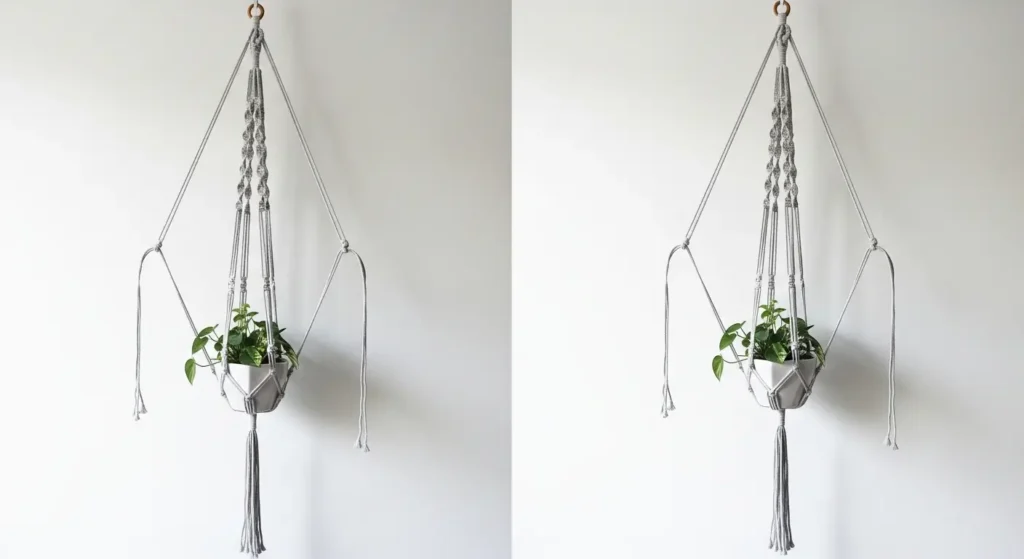
Minimal Scandinavian macrame design operates on the opposite principle from classic boho macrame. Where boho maximizes knot density, bead decoration, and fringe abundance Scandinavian minimal design maximizes negative space — the sections of straight cord between sparse knot clusters that create the clean geometric quality associated with Nordic design aesthetics.
The cord choice for minimal Scandinavian hangers: bleached white or light grey single-strand cord rather than natural beige. The cooler whiter tone suits the minimal aesthetic and reads as deliberate and contemporary. Three-strand twisted rope creates too much visual texture for the minimal Scandinavian style — single-strand cord with its smooth surface and clean profile is the correct specification.
The knot grammar of minimal Scandinavian design uses the square knot sparingly and relies on gathered bundles held by single wrapping knots to create structure. Where a classic hanger might use 40 to 60 square knots in the body a minimal Scandinavian equivalent uses 8 to 12 gathering wraps with large sections of hanging parallel cord between them. The reduction in knot density requires more precise execution of each knot — minimal design does not hide imprecision the way dense knotting does.
PRO TIP: For minimal Scandinavian macrame use a comb to brush out the fringe ends of the finished hanger into a perfectly uniform soft fringe. Combed fringe in white or light grey cord creates the clean tassel quality that defines the Scandinavian aesthetic. Unworked fringe on minimal hangers looks undone rather than relaxed — the precision of the combed finish is part of the design.
9. A Macrame Shelf Hanger Adds a Surface for Objects as Well as a Plant
✦ Shelf and Macrame Combo
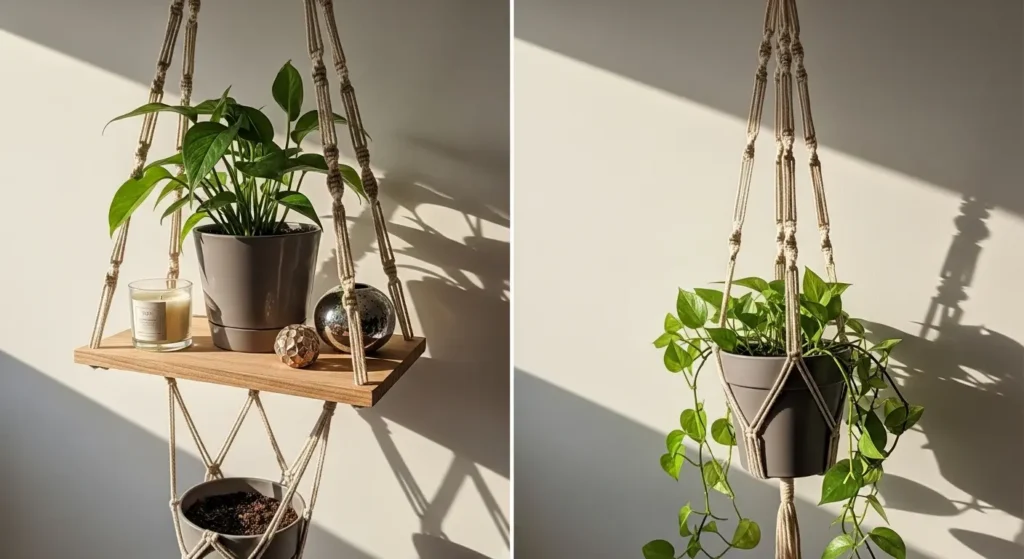
A macrame shelf hanger combines a suspended wooden shelf with integrated plant hanging below — creating a complete hanging display vignette rather than a single pot hanger. The shelf surface adds a horizontal display level for candles, small objects, and decorative items alongside the plant, making the installation feel like a designed interior moment rather than a functional hanging element.
The shelf construction uses a piece of natural wood — a slice of driftwood, a length of scaffold board, or a piece of reclaimed timber — drilled at two points at equal distances from each end. Cord passes through the holes and knots beneath the shelf to hold it level. The cord continues below the shelf to a standard pot cradle.
The weight distribution of a shelf hanger requires balance between the shelf contents and the hanging pot below. If the pot below is significantly heavier than the shelf contents the shelf tilts forward. Counter-balance by weighting the shelf surface with a heavier object toward the back edge, or by positioning the shelf cord holes slightly behind the center line of the shelf depth so the shelf naturally tilts slightly backward when loaded.
10. A Driftwood Bar Macrame Display Creates the Most Distinctive Hanging Plant Installation Available
✦ Rustic Boho Plant Display
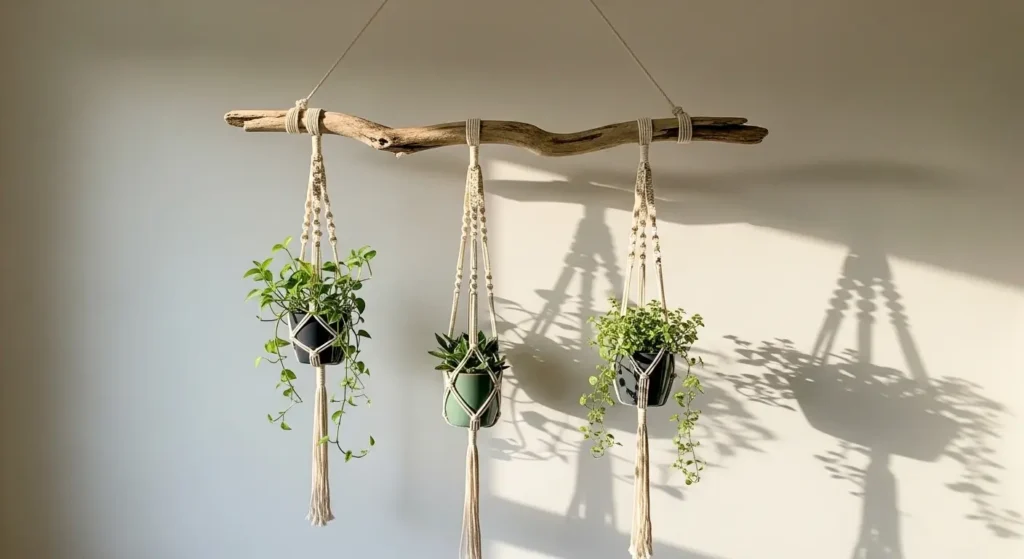
A driftwood bar macrame display uses a horizontal driftwood branch or beach-found timber as the hanging bar from which multiple individual hangers are suspended at different heights and positions. The driftwood itself adds an organic sculptural quality that a standard wooden dowel or metal bar cannot replicate — each piece of driftwood is unique and the knots and curves of natural driftwood make the display read as found and assembled rather than purchased.
The installation hangs from two ceiling hooks positioned at the width of the driftwood piece. Twisted wire or jute rope wrapped around each end of the driftwood creates the hanging loop at each end. The driftwood must be level — adjust the end loops to equal length before adding the plant hangers.
Individual hangers suspended from the driftwood bar should vary in three ways simultaneously: cord length, knot pattern complexity, and pot size. Long simple hanger beside a short complex hanger beside a medium-length beaded hanger creates the collected quality that makes driftwood bar displays look assembled over time. Three identical hangers on a driftwood bar looks retail. Three varied hangers looks personal and genuinely curated.
PRO TIP: Dry driftwood completely before using it as a macrame display bar — damp driftwood contains residual salt and moisture that promotes mold growth on the cord attached to it. Leave collected driftwood in a warm dry indoor position for two to three weeks before use. Bone-dry driftwood is significantly lighter than fresh-collected pieces and reduces the ceiling hook load requirement.
The Macrame Cord Guide: Which Rope for Which Hanger
Cord choice determines the final appearance of a macrame plant hanger more than any other variable including knot pattern. These are the main options and when to use each:
3mm single-strand cotton cord:
The most versatile choice. Clean knot definition, soft fringe, works for all styles from minimal to complex. Best for hangers up to 5 pounds load.
5mm three-strand twisted rope:
Creates the richest texture and most substantial feel. Best for boho and rustic designs. More difficult to achieve tight square knots. Suits heavier pots and outdoor use.
1.5mm fine cord:
Creates the most delicate and most intricate-looking hangers. Best for small pots and indoor-only use. Not suitable for outdoor conditions or heavy pots.
Jute twine:
The most rustic and most affordable option. Natural brown color creates the most organic look. Not as soft to work with as cotton. Degrades faster in outdoor conditions than cotton or synthetic cord.
📌 More plant and home decor ideas → 8 Easy Hanging Plant Ideas For Patios & Balconies
Frequently Asked Questions
What cord is best for macrame plant hangers?
3mm single-strand cotton macrame cord is the most recommended starting point for macrame plant hangers because it creates clean knot definition, produces a soft fringe, handles pots up to 5 pounds, and works for every hanger style from minimal Scandinavian to complex boho. For heavier pots or outdoor use 5mm three-strand twisted rope provides more load capacity and weather resistance. According to Interweave, the leading craft publication for fiber arts, cotton macrame cord is the preferred material for beginner and intermediate plant hangers due to its workability and forgiving knot structure.
How long should macrame plant hanger cord be?
For a standard single pot macrame hanger finishing at 36 inches long cut eight cords each at 8 times the finished length — 288 inches or 8 yards each. The 8x multiplier accounts for the cord consumed by knot structure (approximately 30% of starting length) and fringe. For extra-long hangers finishing at 60 inches cut cords at 10x the finished length to allow additional cord for the extended knot body. For multi-tier hangers add 24 to 36 inches of starting length per additional tier.
Can macrame plant hangers be used outdoors?
Cotton macrame plant hangers can be used in covered outdoor positions — a porch, a covered balcony, or a pergola — where they receive no direct rain. Cotton absorbs moisture and takes several days to dry fully when wetted, during which time the cord is vulnerable to mold growth and weakening. For positions with direct weather exposure use polyester or nylon macrame cord which handles moisture without absorbing it. Jute and natural fiber cords deteriorate fastest in outdoor conditions and are best kept to indoor or fully covered positions only.
A Macrame Hanger Changes What a Plant Communicates
The same plant in a nursery plastic pot on a shelf communicates nothing. The same plant suspended in hand-knotted cord at the right height communicates care, intention, and the kind of domestic attention to detail that makes a home feel genuinely considered. The hanger is not the point — but it changes the point completely.
Choose the macrame plant hanger idea from this guide that suits the plant you want to display and the space it inhabits. Make it or source it. Hang it at the right height. The transformation from plant to feature takes less than an hour.
All the products mentioned in this article are linked on Amazon. Every recommendation is something we genuinely believe in.
More Plant and Boho Decor Ideas
→ 12 Cozy Boho Patio Ideas To Copy
→ 12 Boho Garden Ideas You’ll Love
→ 16 Garden Planter Ideas That Transform Outdoor Spaces
→ 7 Fabulous Front Door Planter Ideas
The transformation from plant to feature takes less than an hour. Choose the design, make it or source it, hang it at the right height.

Sheikh Hassaan is a digital architect for small businesses and the founder of The Glow Up System. He writes about home decor, garden design, and outdoor living for real American homes – practical ideas that work in actual spaces without oversized budgets.