
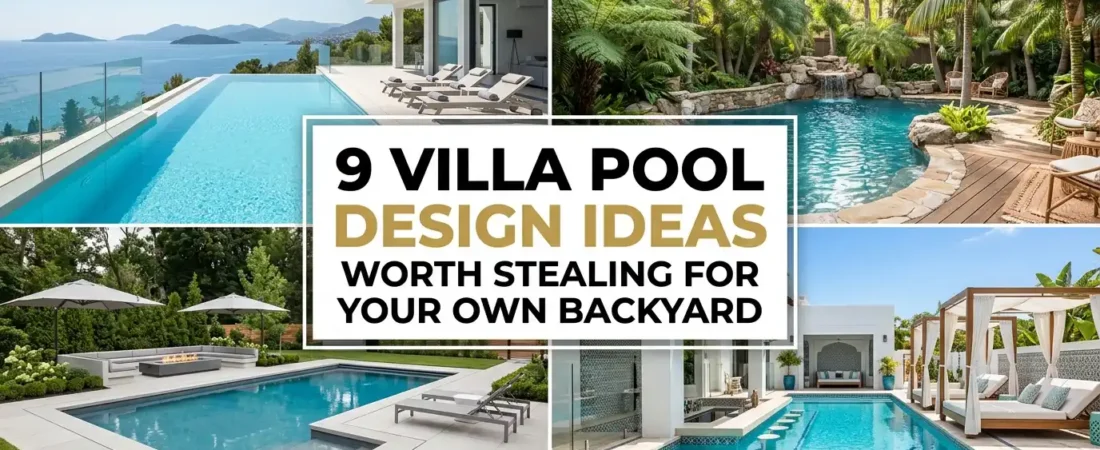
Villa pool design is the category most homeowners save on Pinterest and assume is completely out of reach. The infinity edge. The seamless stone surround. The way the water and the landscape read as one continuous element. I used to think the same thing until I started looking at what actually creates that effect and realized most of it is not about budget — it is about decision-making.
The specific elements that make a pool look like a villa pool rather than a suburban backyard pool are simpler than most people expect. Coping material. Water color. The relationship between the pool edge and the surrounding surface. These decisions cost the same whether the pool is 40 feet or 14 feet. The ideas below cover all of them.
Table of Contents
What Makes a Villa Pool Design Look Different From a Standard Pool
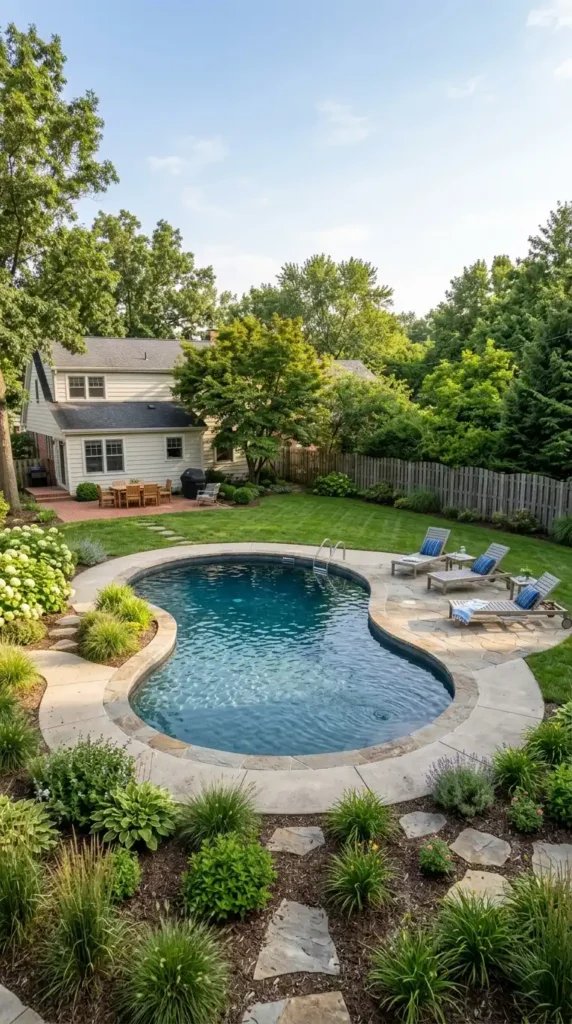
I think the difference comes down to three things that have nothing to do with size or cost. First, the pool interior color — dark plaster in charcoal, black, or deep blue creates the jewel-like water color that villa pools are known for. Standard pools use white or light blue plaster which produces a bright turquoise that reads as suburban regardless of how beautiful everything else is.
Second, the coping — the material that caps the pool edge. Natural stone coping in travertine, bluestone, or limestone creates an immediate visual upgrade over standard concrete or brick coping. The coping is what the eye settles on when looking at a pool from ground level and it determines more of the overall impression than the pool interior.
Third, the surround material continuing beyond the coping. Villa pools blur the boundary between pool and landscape — the same stone or paver that caps the pool edge continues across the surrounding deck creating a unified surface. Standard pools have a clear visual break between the pool and the patio that reads as two separate elements rather than one cohesive design.
1. Dark Plaster Interior for Deep Jewel-Toned Water Color
✦ Best for: any pool renovation where the single highest-impact change is needed for the lowest relative cost
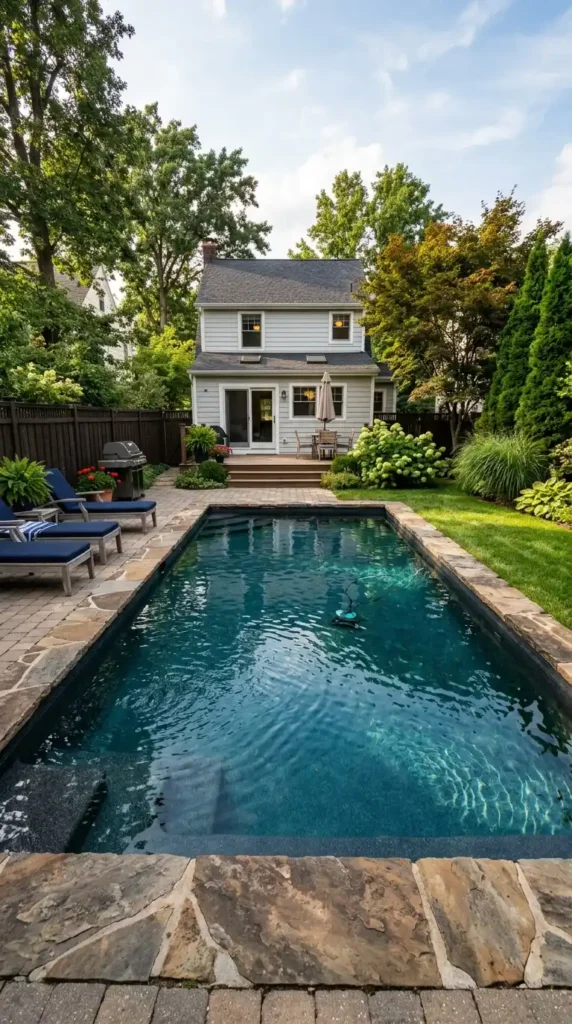
Dark plaster is the villa pool design decision I recommend above everything else because it is the one change that most completely transforms how a pool reads. The water color produced by charcoal or black plaster — a deep teal or sapphire blue that changes with the light through the day — is genuinely beautiful in a way that bright turquoise standard pool water is not.
The plaster colors that produce the best villa pool water effect: charcoal gray plaster produces deep teal water that reads as sophisticated and resort-like. Black plaster produces the darkest and most dramatic water color — almost mirror-like on still mornings. Deep blue plaster produces a cobalt water color that is the most immediately recognizable villa pool effect.
Replastering a pool costs $5,000 to $15,000 depending on size and finish. That is significant but it is also the lowest cost change available for the highest visual impact on an existing pool. A pool that looks ordinary with white plaster can look genuinely stunning with dark plaster with no other changes to the design.
2. Natural Stone Coping That Unifies Pool and Landscape
✦ Best for: replacing standard concrete or brick coping with a material that immediately elevates the villa pool aesthetic
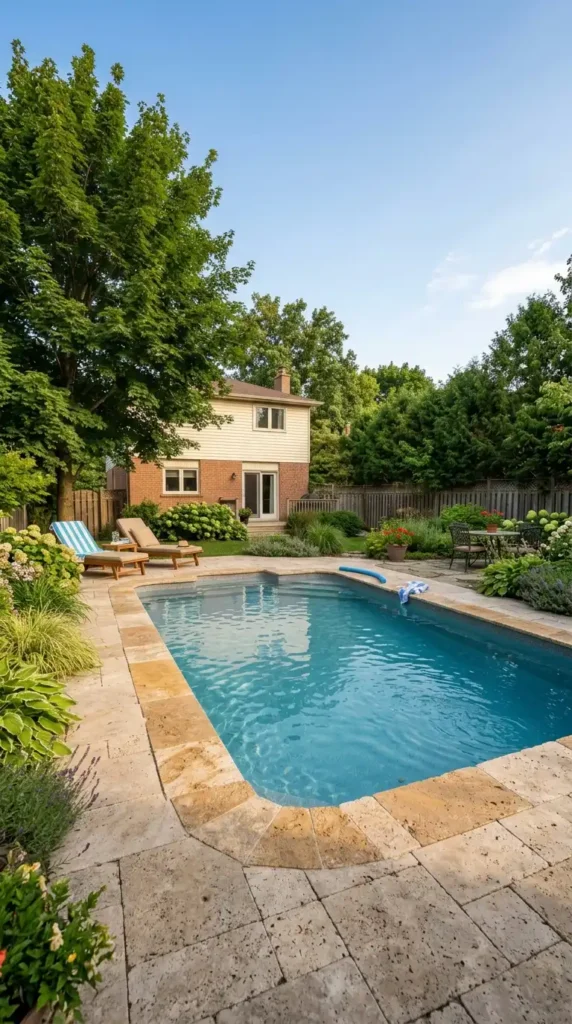
Natural stone coping is the element I find most consistently makes the difference between a pool that looks designed and one that looks installed. The coping is the frame around the pool — it is what defines the pool’s edge visually and sets the material tone for everything around it.
Travertine coping is the most widely used villa pool coping material in warm US climates — its cream and warm beige tones stay cool underfoot in direct sun, pair beautifully with dark plaster water color, and age gracefully over decades. Bluestone is the choice for cooler US climates where travertine’s porosity creates freeze-thaw problems. Limestone suits the most formal and most architecturally refined villa pool designs.
The coping detail that most creates the villa pool look: a cantilevered edge where the coping overhangs the pool wall by 1.5 to 2 inches casting a shadow line on the pool tile below. That shadow line is visible in almost every high-end villa pool photograph and is one of the details that reads as expensive even though it costs nothing extra beyond specifying the overhang correctly.
3. Infinity Edge Design for Maximum Visual Drama
✦ Best for: sloped properties where one edge of the pool can be built as a vanishing edge overlooking the landscape below
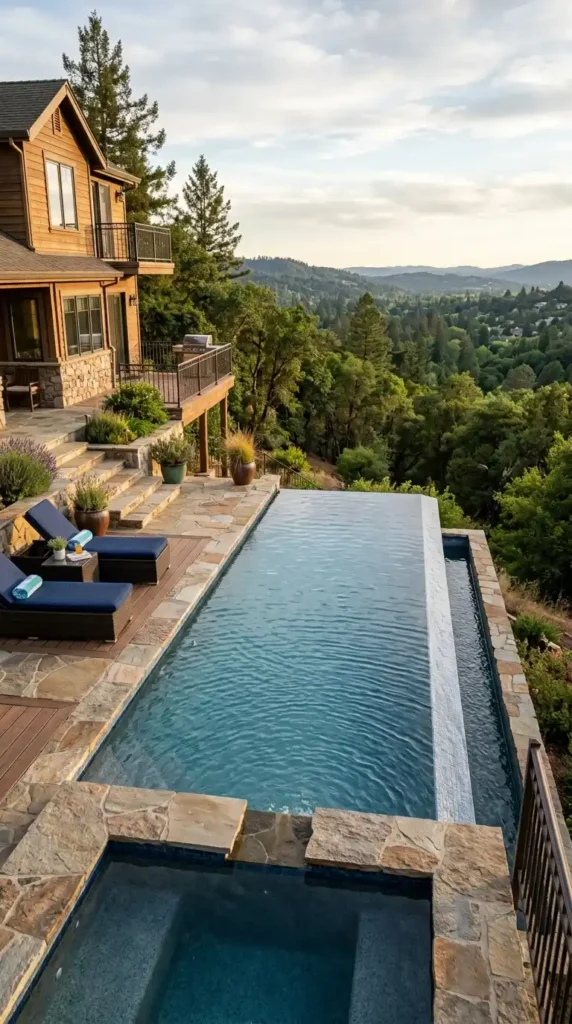
The infinity edge — also called a vanishing edge or negative edge — is the most visually dramatic villa pool design element available. Water flows over one edge of the pool into a concealed catch basin below creating the visual effect that the pool water extends to the horizon. I find it genuinely spectacular in person in a way that photographs only partially capture.
An infinity edge requires a sloped property where the overflow edge can drop to a lower level where the catch basin sits. It adds $15,000 to $30,000 to pool construction cost and requires ongoing pump maintenance for the recirculating system. It is not appropriate for flat lots regardless of how much the homeowner wants it — the visual effect only works when there is genuine depth beyond the edge.
The less expensive alternative that creates a similar visual effect on a flat lot: a perimeter overflow pool where water flows over all four edges into a surrounding catch trough. The effect is different from a true infinity edge but shares the quality of water that appears to have no visible edge — deeply beautiful and genuinely villa-like at a lower engineering complexity.
4. Integrated Spa for the Complete Villa Pool Experience
✦ Best for: homeowners building a new pool who want to incorporate spa functionality within the same unified design
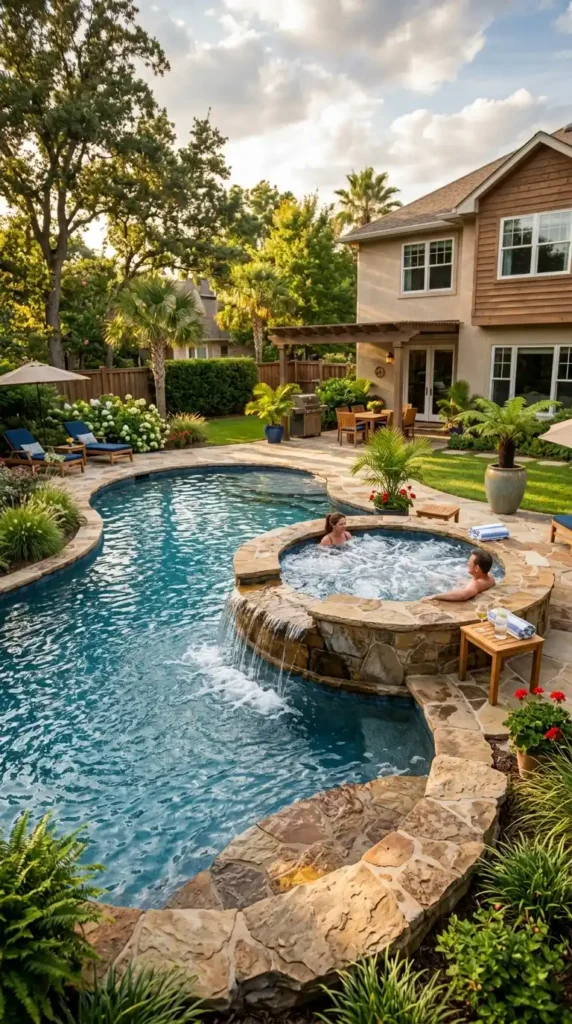
An integrated spa elevated above the main pool with a spillover waterfall between them is one of the most characteristic villa pool design features. The elevated spa creates the waterfall sound that transforms pool time from quiet to genuinely atmospheric. I think the sound element is as important as the visual — a pool with moving water sounds completely different from a still pool.
The spa should be positioned at the far end of the pool from the house so it becomes a destination within the backyard rather than something immediately beside the house entry. Elevating it 18 to 24 inches above the main pool water level creates a waterfall drop that is visible from seating areas and provides continuous gentle water sound when the system is running.
Sharing equipment between the pool and spa — the same heater, pump, and filtration system — significantly reduces the cost of an integrated spa compared to two separate systems. A shared equipment integrated pool and spa typically adds $15,000 to $25,000 to pool construction rather than the $30,000 to $50,000 that two separate systems would cost.
5. Seamless Pool Deck That Reads as One Continuous Surface
✦ Best for: creating the unified ground plane that makes a villa pool look integrated into its landscape rather than placed within it
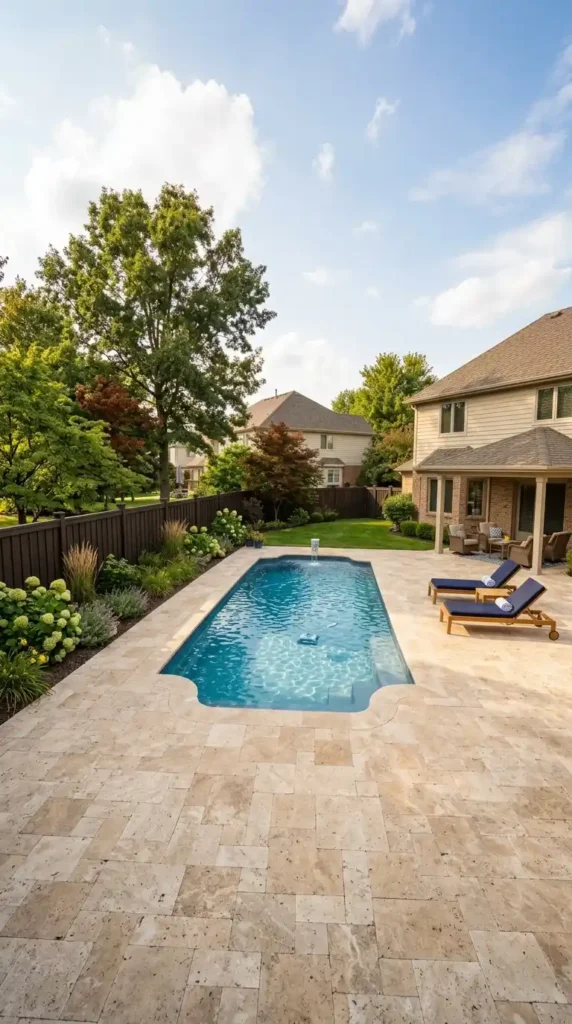
The seamless pool deck is the villa pool design detail that I find most often missing from American backyard pools that are otherwise beautifully designed. The pool has beautiful coping. The patio beside it has different pavers. The visual break between the two materials immediately reads as two separate projects rather than one unified design.
Using the same material for both the pool coping and the surrounding deck eliminates that break. The eye reads from the pool edge across the deck to the landscape beyond as one continuous element. Travertine coping with travertine deck. Bluestone coping with bluestone deck. The continuity is what creates the villa quality.
The grout color between pavers matters enormously for this seamless effect. A grout color matched to the stone tone makes the joints recede and the surface read as a continuous plane. A contrasting grout emphasizes every joint and breaks the seamless quality. Match the grout to the stone and the deck reads as genuinely luxurious.For more on patio slab materials and grout selection our patio slab ideas guide covers every option with cost comparisons.
6. Landscape Planting That Frames the Pool Without Crowding It
✦ Best for: creating the lush but controlled landscape framing that makes villa pools look embedded in their setting
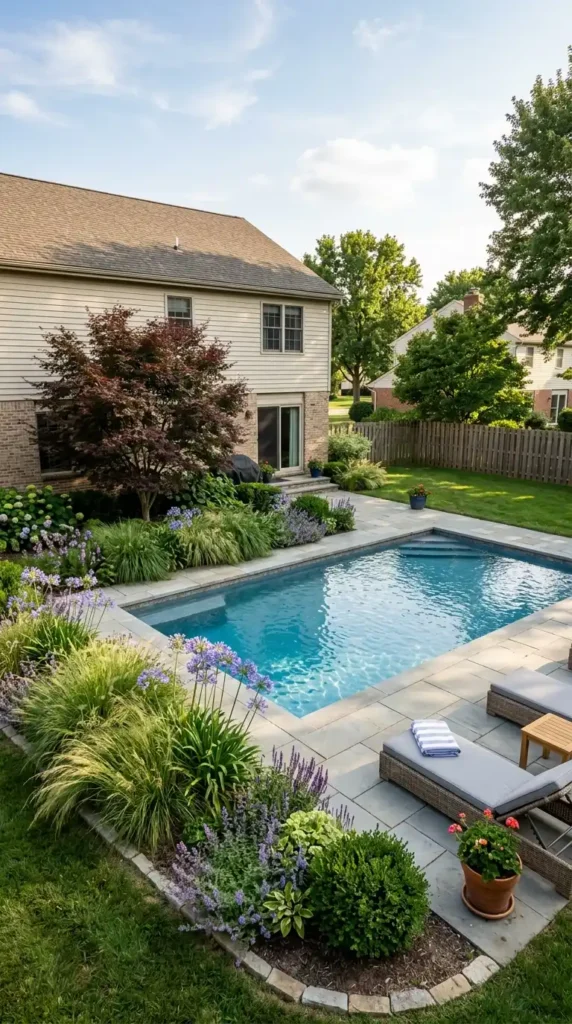
Villa pool landscape planting follows a principle that I find completely opposite to typical American garden planting: restraint. Where most American gardens fill every border with variety and volume, villa pool landscapes use fewer plants chosen for architectural quality and repeat them with discipline.
The plants that create the most convincing villa pool landscape framing: agapanthus for its architectural strap leaves and blue or white flower globes that look genuinely Mediterranean. Ornamental grasses for movement and softness at the pool edges. One or two specimen trees — olive, Italian cypress, or queen palm depending on climate — that provide height and architectural presence without dropping significant leaf debris into the pool.
The planting rule that most improves villa pool landscape: keep planting 3 to 4 feet back from the pool coping edge. Plants immediately at the pool edge drop leaves and debris into the water continuously. A clear stone margin between the planting bed and the pool edge looks cleaner, requires less maintenance, and photographs significantly better than plants overhanging the water.
7. Pool Lighting for Evening Drama and Night Swimming
✦ Best for: transforming a pool that looks beautiful during the day into one that is genuinely spectacular after dark
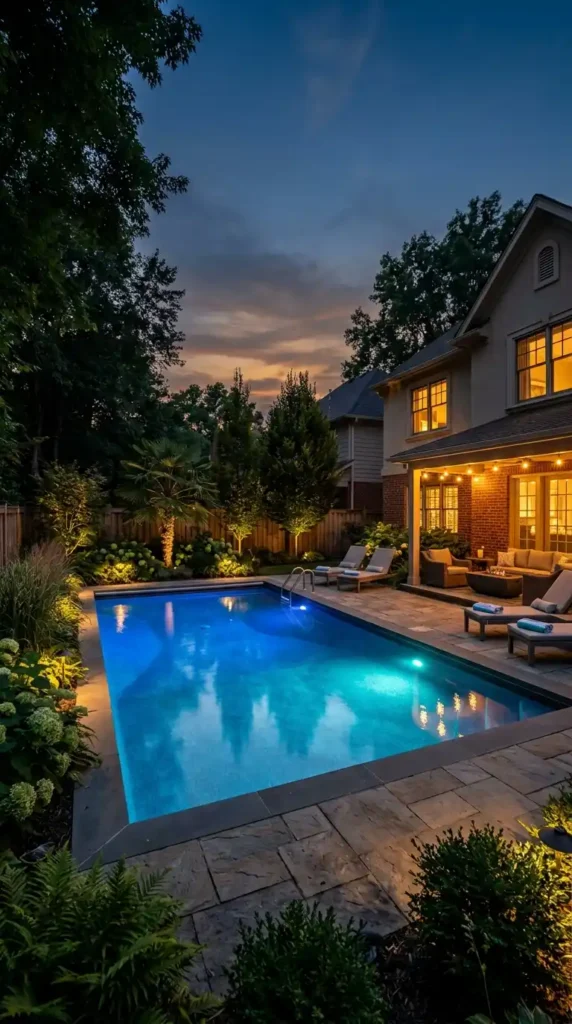
Pool lighting at night is where villa pool design separates most completely from standard pool design. I find the difference between a lit and an unlit pool at dusk is more dramatic than almost any daytime design decision. A dark pool at night is invisible. A lit pool at night is the most beautiful thing in the backyard.
The lighting approach that creates the most villa-like evening pool: underwater LED lights in warm white rather than color-changing RGB. Color-changing LED lights are a common pool addition that immediately reads as suburban rather than villa. Warm white underwater lighting with dark plaster creates a deep glowing jewel effect that is genuinely spectacular.
Landscape lighting around the pool completes the villa evening effect — uplighting two or three specimen plants beside the pool creates depth and drama that the pool lights alone cannot achieve. The combination of illuminated water and lit landscape creates the complete resort pool evening atmosphere. For outdoor lighting ideas that complement the pool surroundings see our garden lighting ideas guide.
8. Outdoor Shower and Changing Area as Part of the Pool Design
✦ Best for: adding the functional villa pool elements that make poolside living genuinely comfortable rather than purely aesthetic
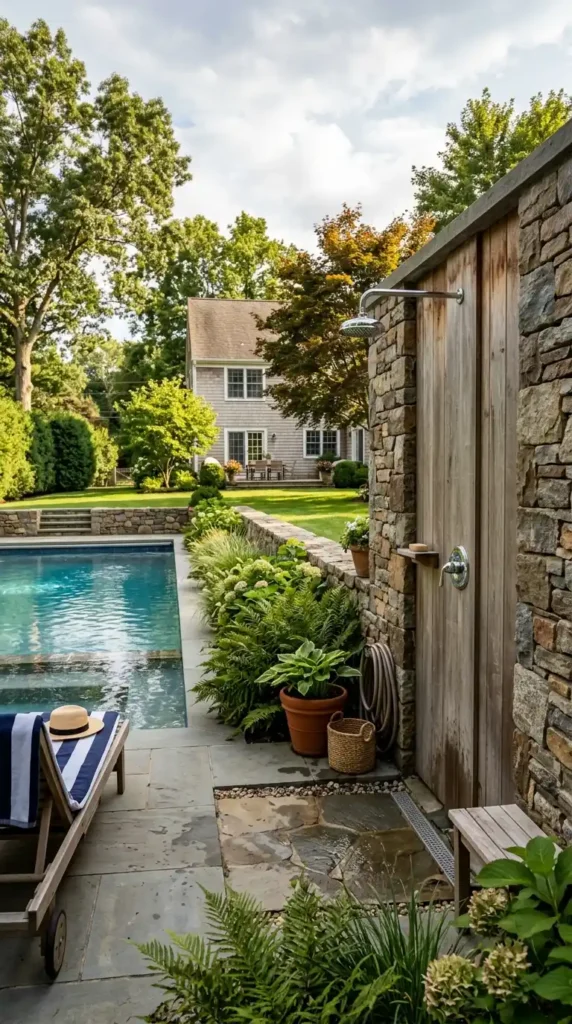
An outdoor shower beside a pool is the functional villa pool element I think about most practically. Every pool visit involves a before-swim rinse and an after-swim rinse. Without an outdoor shower those rinses happen inside the house which means wet feet through the house every time someone goes in or out of the pool.
A simple outdoor shower mounted on a stone or rendered wall beside the pool keeps pool activity outside where it belongs. The most minimal version — a single cold-water shower head on a stone wall — costs $500 to $1,500 installed. A hot and cold outdoor shower with a teak deck beneath it costs $2,000 to $5,000 and creates a genuinely spa-like pool experience.
The outdoor shower placement that works best: at the entrance to the pool area so it is encountered naturally on the way to and from the pool rather than requiring a deliberate detour. A shower that is inconveniently located gets used inconsistently. A shower positioned on the natural path between house and pool becomes part of the automatic pool ritual.
9. Poolside Cabana or Shade Structure for Complete Villa Living
✦ Best for: creating the shaded poolside seating that makes a pool genuinely usable through the hottest summer hours
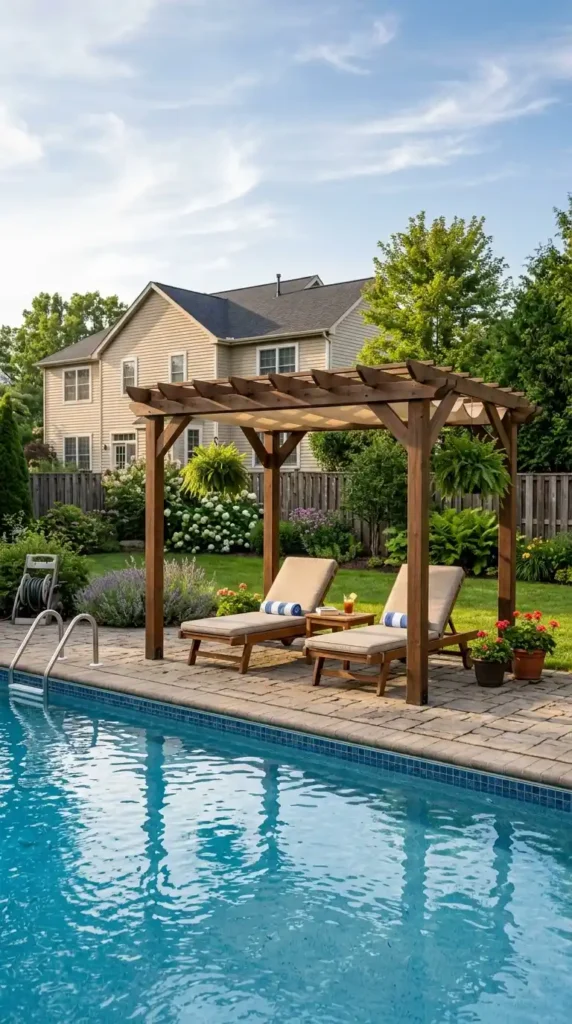
Every villa pool photograph shows the same element beside the water — somewhere shaded to sit. The pool itself is the feature but a pool with no shade beside it is only usable for swimming. The shaded poolside seating area is what makes villa pool living genuinely different from suburban pool ownership.
A simple freestanding pergola at the end of the pool deck opposite the house creates the poolside destination that makes you want to be beside the pool even when you are not swimming. Two sun loungers beneath a pergola with outdoor curtains that can be drawn for afternoon shade creates the complete villa pool experience at a cost of $1,500 to $4,000 for a DIY pergola build.
The pergola material that suits villa pool design best: natural timber in cedar or pressure-treated pine for a warm organic quality that ages beautifully beside water. Black powder-coated aluminum for a more contemporary villa pool aesthetic. Both work with the natural stone and dark water palette of a well-designed villa pool. For a complete guide to poolside shade options see our patio roofing ideas guide which covers every structure type with costs.
Frequently Asked Questions
What makes a villa pool design different from a standard pool?
Dark plaster interior color, natural stone coping, and a seamless deck surface that continues the same material from pool edge across the surrounding area are the three elements that most create the villa pool aesthetic. According to the Association of Pool and Spa Professionals, dark interior finishes and natural stone coping are the fastest-growing specification choices in residential pool construction as homeowners seek the resort pool look.
What color plaster makes pool water look the best?
Charcoal gray and black plaster produce the deepest and most jewel-like water colors — deep teal and sapphire blue that change beautifully through the day. Dark blue plaster produces a cobalt water color that is the most recognizable villa pool effect. White and light blue plaster produce bright turquoise water that reads as standard suburban pool regardless of surrounding design quality.
How much does villa pool design cost?
A new pool with villa design elements including dark plaster, natural stone coping, integrated spa, and landscape lighting typically costs $80,000 to $200,000 depending on size, complexity, and local labor rates. Applying villa pool design elements to an existing pool through replastering and coping replacement costs $15,000 to $35,000 and achieves the majority of the visual transformation.
What is the best pool coping material?
Travertine is the most popular villa pool coping choice in warm US climates for its warmth, durability, and cool-underfoot quality in direct sun. Bluestone is the better choice in freeze-thaw climates where travertine’s porosity creates cracking problems. Limestone suits the most formally designed villa pool aesthetics.
The Villa Pool Effect Starts With Two Decisions
Everything on this list matters but if I had to identify the two decisions that create 80 percent of the villa pool effect they are the plaster color and the coping material. Get those two right and a modest pool in a modest backyard looks genuinely resort-like.
Dark plaster costs the same as white plaster to install. Natural stone coping costs more than concrete but less than most homeowners assume — the difference between travertine coping and standard concrete coping on a typical pool is $3,000 to $6,000. That is the price of the villa pool effect on an existing pool.
The infinity edge and the integrated spa are spectacular additions if the budget and the site allow. But the homeowners I know who are happiest with their pools did not necessarily build the most elaborate version. They made the right decisions on the fundamentals and the result looks beautiful every single day.
More Outdoor and Garden Ideas
→ 7 Patio Slab Ideas That Transform a Plain Backyard
→ Patio Roofing Ideas That Keep You Outside Longer
→ Rectangle Patio Layout Ideas That Make the Most of Your Space
→ 7 Privacy Plants That Block Neighbors and Look Beautiful Doing It
Everything on this list matters but if I had to identify the two decisions that create 80 percent of the villa pool effect they are the plaster color and the coping material. Get those two right and a modest pool in a modest backyard looks genuinely resort-like.
Dark plaster costs the same as white plaster to install. Natural stone coping costs more than concrete but less than most homeowners assume — the difference between travertine coping and standard concrete coping on a typical pool is $3,000 to $6,000. That is the price of the villa pool effect on an existing pool.
The homeowners I know who are happiest with their pools did not necessarily build the most elaborate version. They made the right decisions on the fundamentals and the result looks beautiful every single day.

Sheikh Hassaan is a digital architect for small businesses and the founder of The Glow Up System. He writes about home decor, garden design, and outdoor living for real American homes – practical ideas that work in actual spaces without oversized budgets.